




















How to Hire 1,000 Software
Engineers
…and Does the Market
Actually Hate You
The Plan
HOUSEKEEPING
You are in Listen-Only Mode.
You can hear us, but we can’t hear you.
ASK QUESTIONS
Don’t be shy!
Use the Questions Panel in your side bar to
speak to Brian.
SHARE
We’re LIVE.
Use the #rdaily hashtag to share on social
WE’RE RECORDING
You will receive a copy of this slide deck &
recording after the webinar.
Keep an eye on your inbox.
Hi – I’m Brian Fink,
your host
for today’s webinar
Brian Fink
Senior Talent Sourcer, RentPath
 Understanding Your Needs
 Writing a “Job Description”
 Building Talent Pipelines
 Conducting Interviews
 Managing Candidate Relationships
 Measuring and Optimizing Your Success
 Providing a Positive Candidate Experience
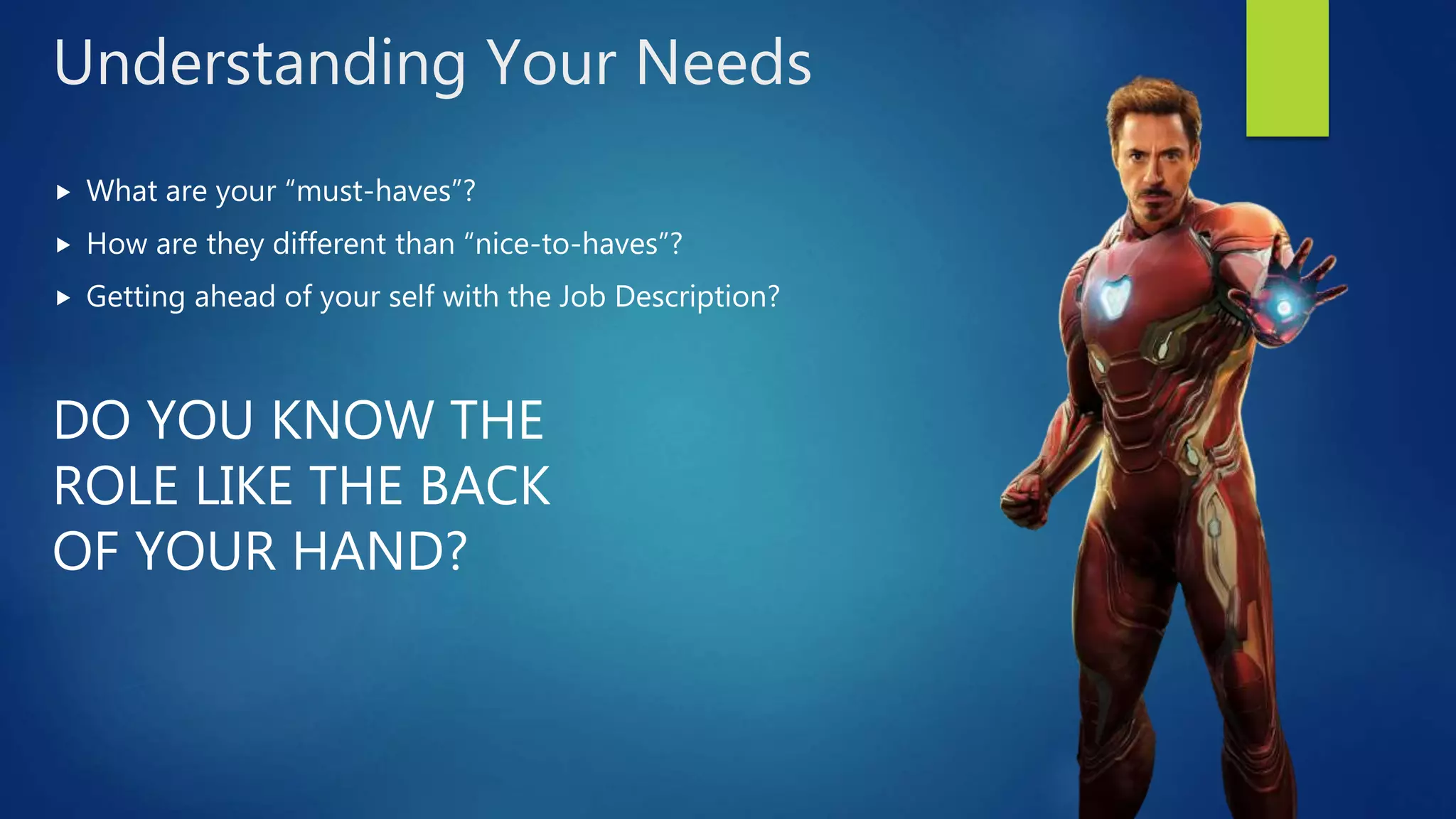
Understanding Your Needs
 What are your “must-haves”?
 How are they different than “nice-to-haves”?
 Getting ahead of your self with the Job Description?
DO YOU KNOW THE
ROLE LIKE THE BACK
OF YOUR HAND?
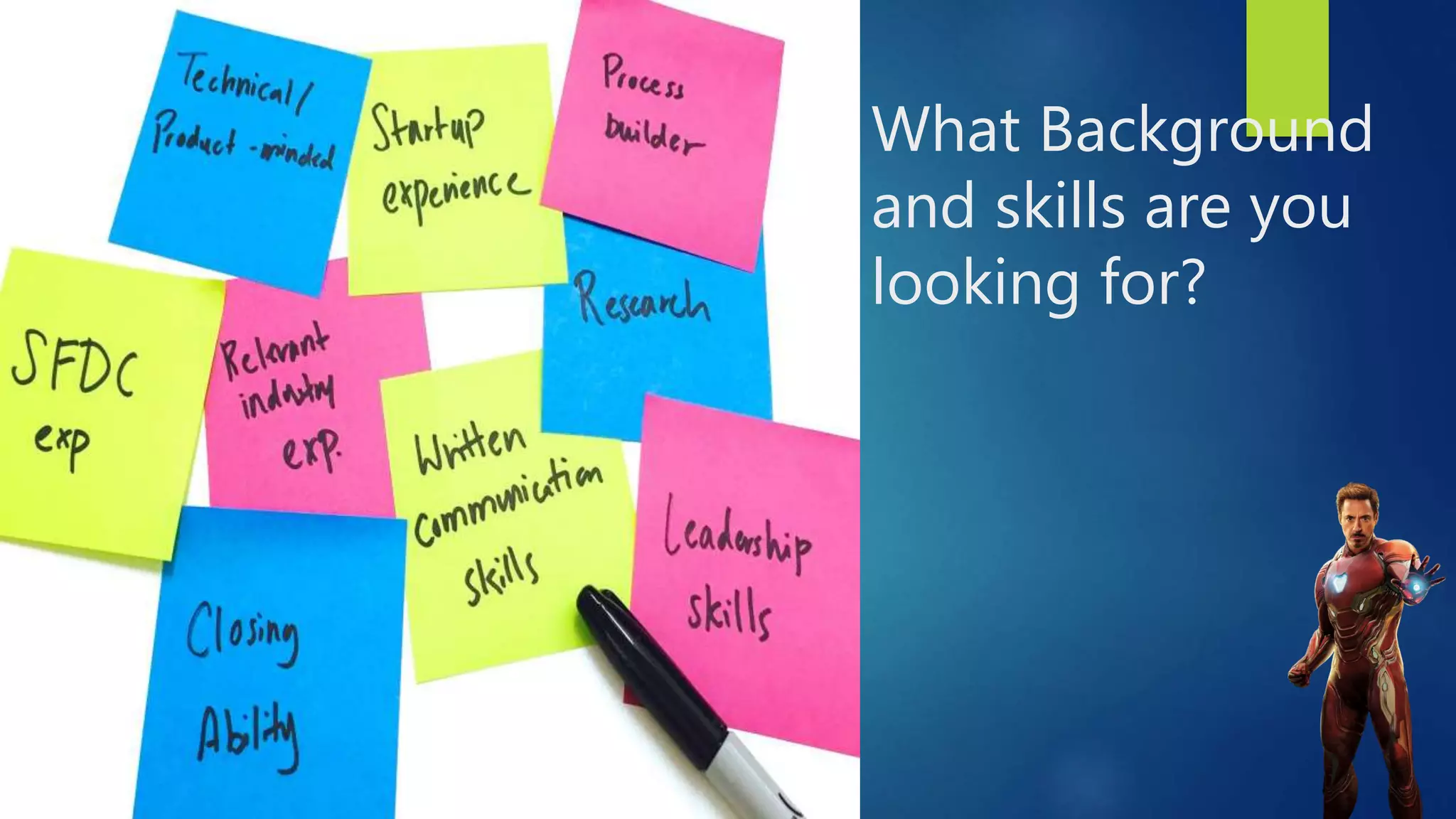
What Background
and skills are you
looking for?
What
personal
Attributes
should this
person
Have?
What differentiates our
Company?
Our Team?
Our Managers?
Our Offer?
Our Culture?
bit.ly/MgrMeetingRD
Writing
A Job Description
Shift your overall thought process
Get your hiring manager on board
Showcase Motivators
Understand the role and
ideal candidate
Draft your bullets and timeline
Did You Know?
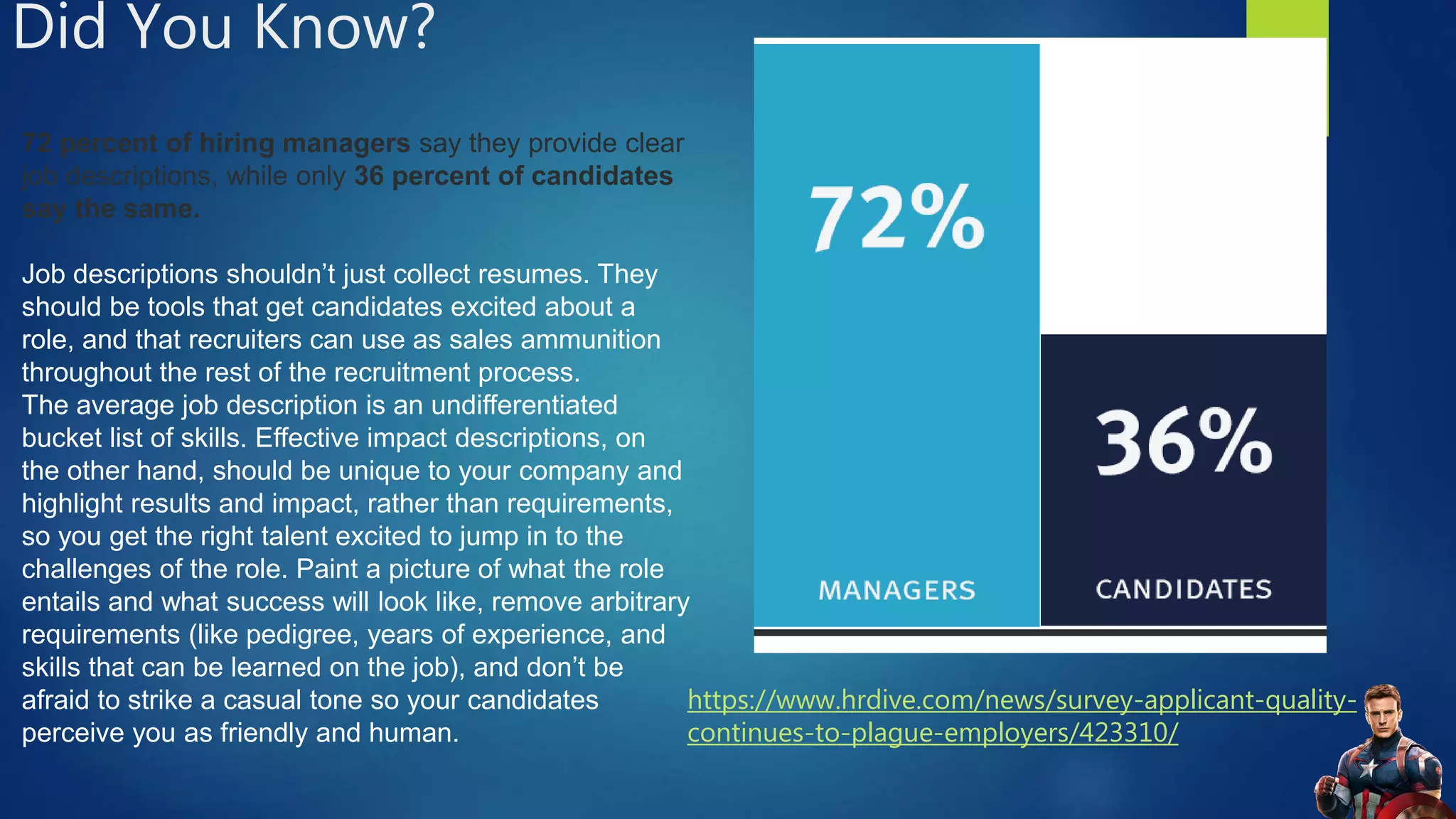
72 percent of hiring managers say they provide clear
job descriptions, while only 36 percent of candidates
say the same.
Job descriptions shouldn’t just collect resumes. They
should be tools that get candidates excited about a
role, and that recruiters can use as sales ammunition
throughout the rest of the recruitment process.
The average job description is an undifferentiated
bucket list of skills. Effective impact descriptions, on
the other hand, should be unique to your company and
highlight results and impact, rather than requirements,
so you get the right talent excited to jump in to the
challenges of the role. Paint a picture of what the role
entails and what success will look like, remove arbitrary
requirements (like pedigree, years of experience, and
skills that can be learned on the job), and don’t be
afraid to strike a casual tone so your candidates
perceive you as friendly and human.
https://www.hrdive.com/news/survey-applicant-quality-
continues-to-plague-employers/423310/
Perhaps We Should Focus
Beyond the Job Description?
http://bit.ly/ScoreCardRD
Building
Talent
Pipelines
https://www.lever.co/recruiting-resources/little-grey-book-of-recruiting-benchmarks-2018?hsLang=en-us
Careers page
Is your careers page dressed to impress?
Every interaction with a candidate – even the ones
before a recruiter is in touch – is a chance to
convince them that your company is the place they
want to work.
Here are a few ways to make your careers page work as a tool to attract top talent:
• Make it mobile optimized. 9 in 10 job seekers report that they are likely to search for jobs via mobile.
• Make it easy to apply. Does your applicant tracking system make candidates jump through a million
hoops before hitting submit? Candidates, especially the best ones, might lose patience and abandon
your process.
• Showcase your culture. Candidates want to know what it would be like to work at your company.
Help them see with photos, videos, information about your mission and values, fun employee facts,
etc
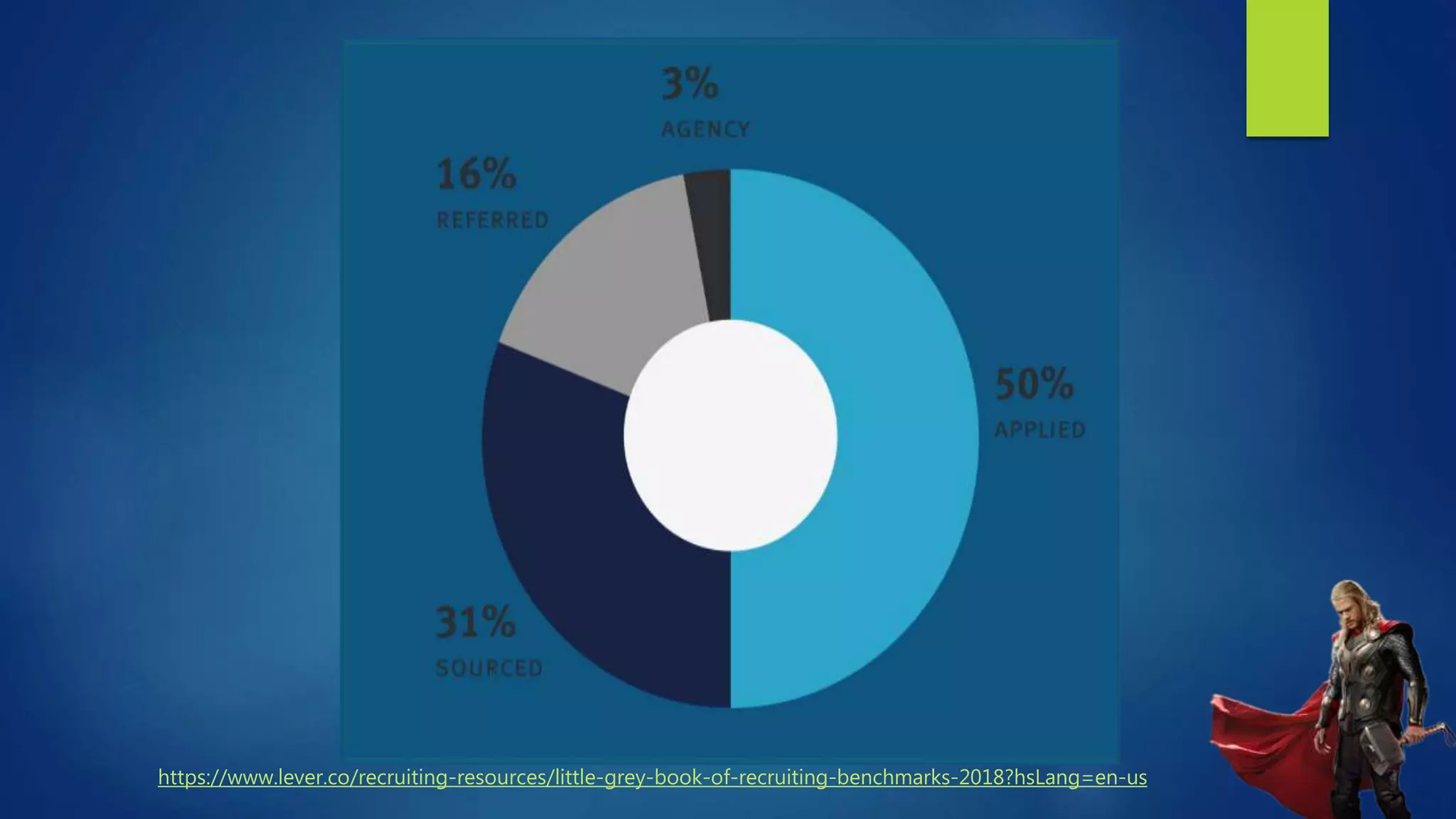
recruiting benchmarks research highlights the
relative efficiency of employee referrals. With 1 in 16
referred candidates being hired, that makes them
almost ten times as efficient as applicants.
Job boards
Companies use job boards to post their openings and
increase visibility to candidates. Two of the most well
known are Monster and Indeed, but there are dozens
more, including specialized ones, like Dice for tech talent
or eFinancialCareers for jobs in finance, banking,
accounting, and insurance.
Employee referral program
Employee referrals are widely recognized as the top
source of hire, for their faster time to hire, lower cost per
hire, and higher retention compared to other sources. If
you invest in building a strong employee referral program,
it’s reasonable to expect your offer and offer acceptance
rate to go up, and your attrition rate go down.
Candidate sourcing
Candidate sourcing means proactively finding and
reaching out to qualified people for a role. Today’s top
talent is less commonly “actively” on the job market and
applying to jobs, but quite likely to be open to a
conversation if approached – which makes sourcing an
essential component of any successful recruiting strategy.
If you’re not sourcing candidates, you’re missing out on
huge swaths of potential employees. While only 36
percent of the workforce identifies as “active,” an entire 90
percent of global professionals are interested in hearing
about new job opportunities.
Nurturing Passive candidates
Learn candidate motivations
Remember, this isn’t an interview, so your initial conversations
with a passive candidate should be exploratory and center on
their career motivations. What do they like about their current
role? What would they change about it? What are their longer-
term career goals?
If you think the candidate would be successful on your team,
explain to them why. Even if you don’t have a role for them in the
immediate future, you want them to want to work at your
company so you can hire them when the time is right.
NURTURING PASSIVE CANDIDATES
Follow up consistently
Follow up with candidates on a regular basis to keep them engaged with your
company. Stay up to date on changes in their career. Keep them in the loop
about company news and job openings. Reinforce why your company is a good
fit for them by circling back on their motivations.
Gone are the days of approaching recruiting as an administrative function
designed to cope with volume and move candidates through a pipeline.
Top talent is in such high demand that it’s essential to be more strategic and
build long-term relationships.
Candidates who may not be interested in making a move now may feel
differently in six months. Or, even if they’re not interested, they may refer
someone who is – so it can’t hurt to check in with them regularly.
NURTURING PASSIVE CANDIDATES
Personalize your outreach
When you reach out to candidates, continue building a relationship with them by
personalizing your communications.
Track each of your previous conversations so you can reference them in future
communications, and coordinate outreach with the rest of your team to ensure that
they’re not overwhelmed with multiple messages at a time. You’ll never have to ask,
“Who was the last person to talk to this candidate?” again.
For instance, if a candidate says they aren’t interested in your position right now
because they’re looking forward to a new product launch with their current company,
follow up after the expected launch date to ask how it went. This gives you the
opportunity to learn a little bit more about the candidate and potentially reach them at a
time when they’d be ready to consider making a move. It’s all about the personal touch
CONDUCTING
INTERVIEWS
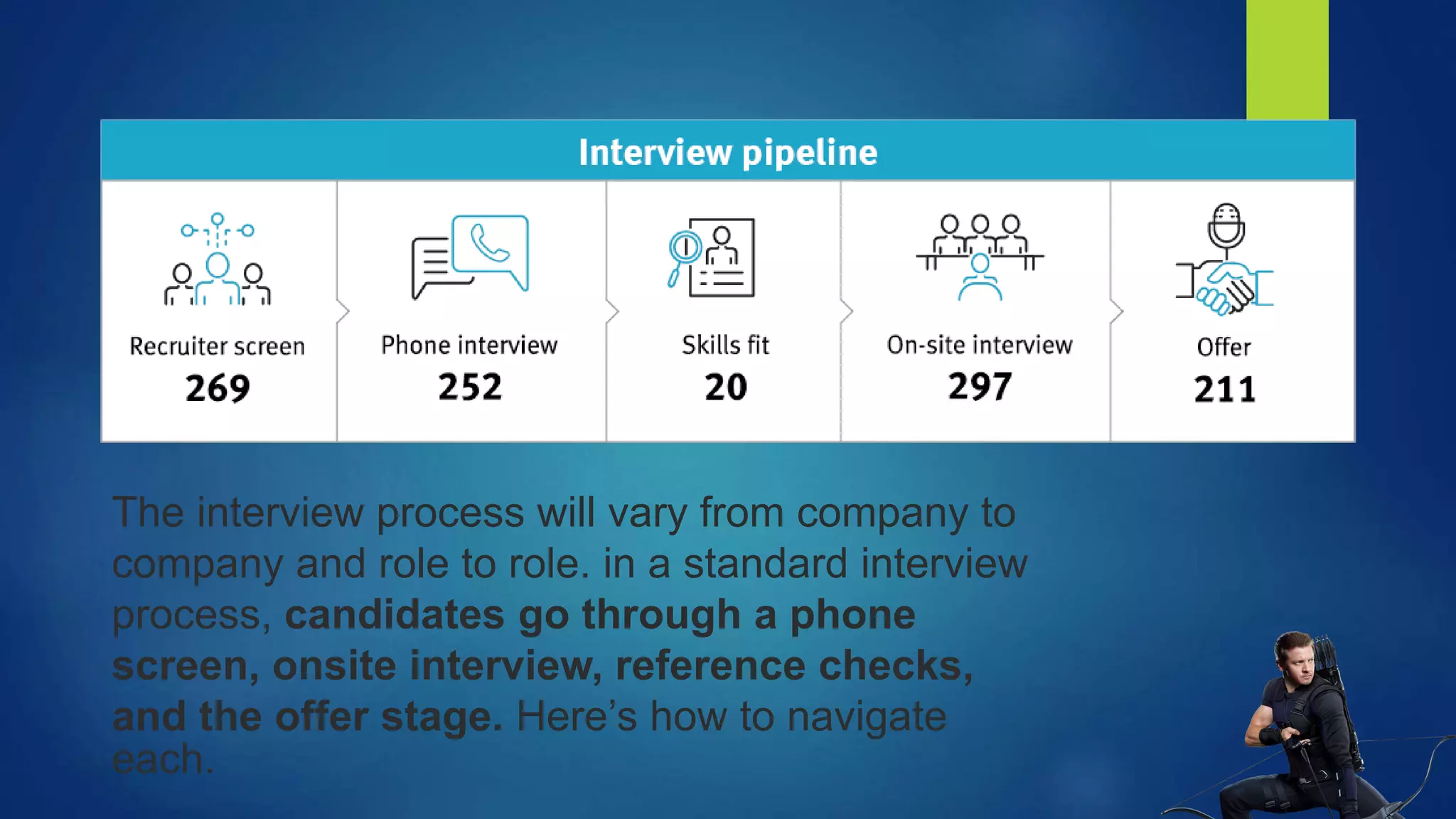
The interview process will vary from company to
company and role to role. in a standard interview
process, candidates go through a phone
screen, onsite interview, reference checks,
and the offer stage. Here’s how to navigate
each.
Phone interview
The initial phone interview is typically conducted by the
recruiter for the role. For high priority candidates,
however, it can help to have the hiring manager take the
call. The purpose of a phone interview is to make sure that
you advance appropriate and qualified people to the next
stage.
Are there any glaring red flags?
Do they have the right motivations fit?
Do they meet the baseline “must haves” that you and your
hiring manager decided upon at the beginning of the
process?
Are compensation expectations in the ballpark?
Always leave time for questions, but keep in mind that the
way you conduct a phone interview should vary
depending on the candidate. Sourced candidates, for
example, will need to be sold more heavily than those who
applied.
Onsite interview
The onsite interview is perhaps the most make-or-break moment of the entire recruitment process. This is when
you get the information you need to say goodbye to a candidate or extend them an offer to become part of your
team. It’s critical, therefore, to structure your interview process. Here are some pointers:
Establish what you are looking for in a candidate before they come in.
The benefit: If you are deciding between two candidates, you can reduce the effects of unconscious bias with an
objective framework for evaluation.
Ask interviewers to evaluate for different areas (culture fit, behavioral fit,
skills fit, etc.).
The benefit: You’ll get the information you need in order to make an informed decision, and give the candidate a
positive, professional experience.
Interview feedback and decision
It’s important to collect interview feedback quickly. Right after an interview is when information is freshest in
everybody’s mind, and the ability to make a quick decision and get an offer out is a competitive advantage. Ask
interviewers to take notes during their interviews and submit feedback via your chosen tool.
Keep in mind it’s not only about selling
the candidate, but making sure they
are happy with the actual role. You
want to find a good mutual fit.
A modern recruiting process has to be
agile and flexible enough to adapt to
non-linear events.
For example, you may source a
candidate who won’t be ready to think
about new opportunities for another
year, or turn a candidate down but find
a new role they’re a better fit for a few
months down the line. How are you
keeping tabs on those candidates?
GOOGLE ALERTS
DRIPEO.com
SNAIL MAIL
FOLLOW UP FRIDAY
AMAZON LISTS
Top talent isn’t knocking on
doors, so recruiters today have
to be smart and strategic, taking
advantage of, and nurturing, the
relationships they already have.
Here are a few tips for building
strong relationships with
candidates who need the long
sell:
Measuring You
Success
Source of hire
When you know which sources lead to quality candidates,
you can double down your efforts in the right places. If you
can see that one source accounts for a small portion of
your total pipeline, for example, but a large portion of total
hires and offers, it makes sense to invest more of your
efforts in that source.
Candidate to hire ratio
By understanding past data, you’ll get a sense for how
many candidates you need in your pipeline to fill the
position at hand.
Conversion funnel
Understanding conversion rates at each stage of the
process helps you ask the right questions to spot
opportunities for improvement.
For example, why aren’t candidates accepting your
and how can you improve? Alternately, if there’s no
dropoff between two stages, are you asking the
appropriate questions to effectively screen candidates?
Time to hire
What matters most in recruiting is ultimately how quickly
you can make a hire (without lowering your hiring bar).
Track your time to hire – from the time a candidate is
engaged to the time they sign an offer letter – to
the overall efficiency of your recruitment process.
Positive Candidate
Experience
In fact, 83 percent of talent say a negative
interview experience can change their mind
about a role or company they once liked, while
87 percent of talent say a positive interview
experience can change their mind about a role
or company they once doubted.
Source: LinkedIn 2015 Talent Trends Report
Candidate experience starts before candidates are even candidates. The “pre-candidate
experience” includes anything that can shape and inform their opinion of you as a
company – like mentions in the press, Glassdoor reviews, your careers page, word of
mouth, and application process (do you make them jump through dozens of hoops just
to apply?).
Once a candidate is in your system, how long does it take you to get in touch?
Does the candidate feel welcome when they come onsite?
Are your interviews professional and organized?
Top candidates are evaluating you as much as you’re evaluating them, so it’s important
to make candidate experience a priority.
To ensure that you’re continually improving your process, consider asking candidates
informally, or more formally via a survey, for their feedback.
6 Ways to
Insure Great
CX
ACT IN THEIR
VOICE
Shift
Response
Goals
LET YOUR
BRAND GUIDE
YOU
Train Your
Interview
teams
Creative
Hello’s
48hr feedback
229.854.4781
HTTPS://WWW.Linkedin.com/brianfink
https://www.facebook.com/thebrianfink
Q&A

How to hire 1,000 Software Engineers & Does the Market Actually Hate You

  • 1.
    How to Hire1,000 Software Engineers …and Does the Market Actually Hate You
  • 2.
    The Plan HOUSEKEEPING You arein Listen-Only Mode. You can hear us, but we can’t hear you. ASK QUESTIONS Don’t be shy! Use the Questions Panel in your side bar to speak to Brian. SHARE We’re LIVE. Use the #rdaily hashtag to share on social WE’RE RECORDING You will receive a copy of this slide deck & recording after the webinar. Keep an eye on your inbox.
  • 3.
    Hi – I’mBrian Fink, your host for today’s webinar Brian Fink Senior Talent Sourcer, RentPath
  • 4.
     Understanding YourNeeds  Writing a “Job Description”  Building Talent Pipelines  Conducting Interviews  Managing Candidate Relationships  Measuring and Optimizing Your Success  Providing a Positive Candidate Experience
  • 5.
    Understanding Your Needs What are your “must-haves”?  How are they different than “nice-to-haves”?  Getting ahead of your self with the Job Description? DO YOU KNOW THE ROLE LIKE THE BACK OF YOUR HAND?
  • 6.
    What Background and skillsare you looking for?
  • 7.
  • 8.
    What differentiates our Company? OurTeam? Our Managers? Our Offer? Our Culture? bit.ly/MgrMeetingRD
  • 9.
  • 10.
    Shift your overallthought process Get your hiring manager on board Showcase Motivators Understand the role and ideal candidate Draft your bullets and timeline
  • 11.
    Did You Know? 72percent of hiring managers say they provide clear job descriptions, while only 36 percent of candidates say the same. Job descriptions shouldn’t just collect resumes. They should be tools that get candidates excited about a role, and that recruiters can use as sales ammunition throughout the rest of the recruitment process. The average job description is an undifferentiated bucket list of skills. Effective impact descriptions, on the other hand, should be unique to your company and highlight results and impact, rather than requirements, so you get the right talent excited to jump in to the challenges of the role. Paint a picture of what the role entails and what success will look like, remove arbitrary requirements (like pedigree, years of experience, and skills that can be learned on the job), and don’t be afraid to strike a casual tone so your candidates perceive you as friendly and human. https://www.hrdive.com/news/survey-applicant-quality- continues-to-plague-employers/423310/
  • 12.
    Perhaps We ShouldFocus Beyond the Job Description? http://bit.ly/ScoreCardRD
  • 13.
  • 14.
  • 15.
    Careers page Is yourcareers page dressed to impress? Every interaction with a candidate – even the ones before a recruiter is in touch – is a chance to convince them that your company is the place they want to work. Here are a few ways to make your careers page work as a tool to attract top talent: • Make it mobile optimized. 9 in 10 job seekers report that they are likely to search for jobs via mobile. • Make it easy to apply. Does your applicant tracking system make candidates jump through a million hoops before hitting submit? Candidates, especially the best ones, might lose patience and abandon your process. • Showcase your culture. Candidates want to know what it would be like to work at your company. Help them see with photos, videos, information about your mission and values, fun employee facts, etc
  • 16.
    recruiting benchmarks researchhighlights the relative efficiency of employee referrals. With 1 in 16 referred candidates being hired, that makes them almost ten times as efficient as applicants. Job boards Companies use job boards to post their openings and increase visibility to candidates. Two of the most well known are Monster and Indeed, but there are dozens more, including specialized ones, like Dice for tech talent or eFinancialCareers for jobs in finance, banking, accounting, and insurance. Employee referral program Employee referrals are widely recognized as the top source of hire, for their faster time to hire, lower cost per hire, and higher retention compared to other sources. If you invest in building a strong employee referral program, it’s reasonable to expect your offer and offer acceptance rate to go up, and your attrition rate go down.
  • 17.
    Candidate sourcing Candidate sourcingmeans proactively finding and reaching out to qualified people for a role. Today’s top talent is less commonly “actively” on the job market and applying to jobs, but quite likely to be open to a conversation if approached – which makes sourcing an essential component of any successful recruiting strategy. If you’re not sourcing candidates, you’re missing out on huge swaths of potential employees. While only 36 percent of the workforce identifies as “active,” an entire 90 percent of global professionals are interested in hearing about new job opportunities.
  • 18.
    Nurturing Passive candidates Learncandidate motivations Remember, this isn’t an interview, so your initial conversations with a passive candidate should be exploratory and center on their career motivations. What do they like about their current role? What would they change about it? What are their longer- term career goals? If you think the candidate would be successful on your team, explain to them why. Even if you don’t have a role for them in the immediate future, you want them to want to work at your company so you can hire them when the time is right.
  • 19.
    NURTURING PASSIVE CANDIDATES Followup consistently Follow up with candidates on a regular basis to keep them engaged with your company. Stay up to date on changes in their career. Keep them in the loop about company news and job openings. Reinforce why your company is a good fit for them by circling back on their motivations. Gone are the days of approaching recruiting as an administrative function designed to cope with volume and move candidates through a pipeline. Top talent is in such high demand that it’s essential to be more strategic and build long-term relationships. Candidates who may not be interested in making a move now may feel differently in six months. Or, even if they’re not interested, they may refer someone who is – so it can’t hurt to check in with them regularly.
  • 20.
    NURTURING PASSIVE CANDIDATES Personalizeyour outreach When you reach out to candidates, continue building a relationship with them by personalizing your communications. Track each of your previous conversations so you can reference them in future communications, and coordinate outreach with the rest of your team to ensure that they’re not overwhelmed with multiple messages at a time. You’ll never have to ask, “Who was the last person to talk to this candidate?” again. For instance, if a candidate says they aren’t interested in your position right now because they’re looking forward to a new product launch with their current company, follow up after the expected launch date to ask how it went. This gives you the opportunity to learn a little bit more about the candidate and potentially reach them at a time when they’d be ready to consider making a move. It’s all about the personal touch
  • 21.
  • 22.
    The interview processwill vary from company to company and role to role. in a standard interview process, candidates go through a phone screen, onsite interview, reference checks, and the offer stage. Here’s how to navigate each.
  • 23.
    Phone interview The initialphone interview is typically conducted by the recruiter for the role. For high priority candidates, however, it can help to have the hiring manager take the call. The purpose of a phone interview is to make sure that you advance appropriate and qualified people to the next stage. Are there any glaring red flags? Do they have the right motivations fit? Do they meet the baseline “must haves” that you and your hiring manager decided upon at the beginning of the process? Are compensation expectations in the ballpark? Always leave time for questions, but keep in mind that the way you conduct a phone interview should vary depending on the candidate. Sourced candidates, for example, will need to be sold more heavily than those who applied.
  • 24.
    Onsite interview The onsiteinterview is perhaps the most make-or-break moment of the entire recruitment process. This is when you get the information you need to say goodbye to a candidate or extend them an offer to become part of your team. It’s critical, therefore, to structure your interview process. Here are some pointers: Establish what you are looking for in a candidate before they come in. The benefit: If you are deciding between two candidates, you can reduce the effects of unconscious bias with an objective framework for evaluation. Ask interviewers to evaluate for different areas (culture fit, behavioral fit, skills fit, etc.). The benefit: You’ll get the information you need in order to make an informed decision, and give the candidate a positive, professional experience. Interview feedback and decision It’s important to collect interview feedback quickly. Right after an interview is when information is freshest in everybody’s mind, and the ability to make a quick decision and get an offer out is a competitive advantage. Ask interviewers to take notes during their interviews and submit feedback via your chosen tool.
  • 25.
    Keep in mindit’s not only about selling the candidate, but making sure they are happy with the actual role. You want to find a good mutual fit.
  • 27.
    A modern recruitingprocess has to be agile and flexible enough to adapt to non-linear events. For example, you may source a candidate who won’t be ready to think about new opportunities for another year, or turn a candidate down but find a new role they’re a better fit for a few months down the line. How are you keeping tabs on those candidates?
  • 28.
    GOOGLE ALERTS DRIPEO.com SNAIL MAIL FOLLOWUP FRIDAY AMAZON LISTS Top talent isn’t knocking on doors, so recruiters today have to be smart and strategic, taking advantage of, and nurturing, the relationships they already have. Here are a few tips for building strong relationships with candidates who need the long sell:
  • 29.
  • 30.
    Source of hire Whenyou know which sources lead to quality candidates, you can double down your efforts in the right places. If you can see that one source accounts for a small portion of your total pipeline, for example, but a large portion of total hires and offers, it makes sense to invest more of your efforts in that source.
  • 31.
    Candidate to hireratio By understanding past data, you’ll get a sense for how many candidates you need in your pipeline to fill the position at hand.
  • 32.
    Conversion funnel Understanding conversionrates at each stage of the process helps you ask the right questions to spot opportunities for improvement. For example, why aren’t candidates accepting your and how can you improve? Alternately, if there’s no dropoff between two stages, are you asking the appropriate questions to effectively screen candidates?
  • 33.
    Time to hire Whatmatters most in recruiting is ultimately how quickly you can make a hire (without lowering your hiring bar). Track your time to hire – from the time a candidate is engaged to the time they sign an offer letter – to the overall efficiency of your recruitment process.
  • 34.
  • 35.
    In fact, 83percent of talent say a negative interview experience can change their mind about a role or company they once liked, while 87 percent of talent say a positive interview experience can change their mind about a role or company they once doubted. Source: LinkedIn 2015 Talent Trends Report
  • 36.
    Candidate experience startsbefore candidates are even candidates. The “pre-candidate experience” includes anything that can shape and inform their opinion of you as a company – like mentions in the press, Glassdoor reviews, your careers page, word of mouth, and application process (do you make them jump through dozens of hoops just to apply?). Once a candidate is in your system, how long does it take you to get in touch? Does the candidate feel welcome when they come onsite? Are your interviews professional and organized? Top candidates are evaluating you as much as you’re evaluating them, so it’s important to make candidate experience a priority. To ensure that you’re continually improving your process, consider asking candidates informally, or more formally via a survey, for their feedback.
  • 37.
  • 38.
  • 39.
  • 40.
  • 41.
  • 42.
  • 43.
  • 44.