

Welcome Onboard
Steps for Supporting New Hires Do Real Work Day 1
Presented by Dr Sarah Burke
OPRA Consulting Group
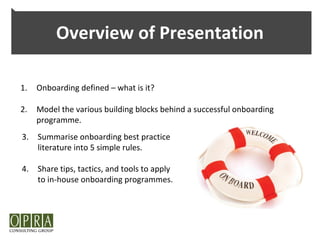
1. Onboarding defined – what is it?
2. Model the various building blocks behind a successful onboarding
programme.
3. Summarise onboarding best practice
literature into 5 simple rules.
4. Share tips, tactics, and tools to apply
to in-house onboarding programmes.
Overview of Presentation
Onboarding is the process by which a
new hire acquires job-specific content,
role, group, and cultural
knowledge to transition from an
organisational outsider to insider. It is a
process that relies on insiders to
provide a suitably customised
experience that commences pre-
selection and unfolds over
time.
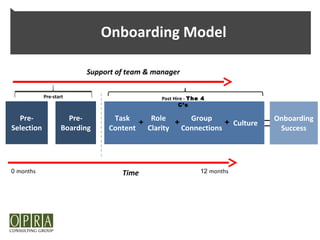
Onboarding
Success
Task
Content
Role
Clarity
Group
Connections
Culture+ + +
Post Hire - The 4
C’s
Pre-
Selection
Pre-
Boarding
Pre-start
Onboarding Model
0 months 12 monthsTime
Support of team & manager
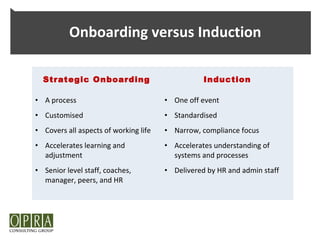
Onboarding versus Induction
Strategic Onboarding Induction
• A process
• Customised
• Covers all aspects of working life
• Accelerates learning and
adjustment
• Senior level staff, coaches,
manager, peers, and HR
• One off event
• Standardised
• Narrow, compliance focus
• Accelerates understanding of
systems and processes
• Delivered by HR and admin staff
Rule 1:
Don’t leave learning & adjustment to chance
The breakeven point is the point at which a new
hire has contributed as much value to their new
organisation as they have consumed from it.
Value
consumed
Value
contributed
Breakeven Point
Net contribution = 0
Number of Months after Entry
Contribution
1 2 3 4 5 6 7
Content Areas a Newcomer needs to
Learn
Adapted from the Society for Human Resource Management:
Survey Findings Onboarding Practices 2011
Very
Difficult
Somewhat
Difficult
Somewhat
Easy
Very
Easy
The formal workplace rules and procedures 7% 25% 40% 28%
What the organisation offers to employees (including pay, benefits and
opportunities )
9% 23% 42% 26%
The organisation’s history, traditions, and origins 8% 27% 42% 24%
The formal structure, including the physical layout and where authority is
assigned.
6% 27% 45% 22%
Information about others necessary to develop a social network 4% 26% 55% 16%
The organisation’s culture, including values, customs and myths 7% 32% 45% 16%
The organisation’s competitive position, mission, goals and strategies 12% 38% 36% 13%
The informal rules, norms and procedures of the workplace 7% 37% 46% 10%
The knowledge, skills and abilities to successfully perform job tasks 13% 48% 32% 8%
The informal power structure 15% 46% 33% 6%
Information about others necessary to establish effective working
relationships (including learning colleagues’ expectations, working styles)
12% 53% 29% 5%
The unique technical language, acronyms, slang and jargon used at work 17% 50% 28% 4%
How can we instill this
learning?
How can we instill this
learning?
Structured learning = less stress and anxiety
New learning must be structured to
include:
oA clear onboarding plan for Day 1, Week 1 that outlines key
firsts/key events, target dates, and deliverables
oKey insiders to help navigate areas of learning difficulty and
to provide critical information
oHelp get some quick wins – instill confidence and stimulate
greater success
“New hires are more likely to ask questions, seek
feedback, socialise, and build relationships when
their onboarding is structured. When
organisation’s adopt a sink or swim mentality,
new hires are less likely to do these things”.
(Gruman, Saks, & Zweig, 2006)
Rule 2:
Onboarding starts pre-selection
We do this by…We do this by…
Assist potential hires pre-
selection by:
oBy providing accurate information about the job
oRemember candidates can get connected to staff inside
your organisation
oGive your onboarding programme a brand/logo/ tagline
that communicates the experience
Video Pre-ScreenVideo Pre-Screen
Candidate is sent an email with
embedded link
Website can be totally branded as
your own
Include welcome from the hiring
manager + additional
organisational and job information
Immerse candidate in
organisational culture from the
outset
o Get the workspace organised (computer, phone,
business cards)
o Send an online welcome pack with important
information & welcome letter
o Share background organisational information (history,
newsletters, webinars)
o Share team bio’s, blogs, photos…..
o Schedule key meetings in advance
o Take advantage of technology
Pre-boarding is when a new hire has accepted a new
position but is still sitting inside their current workplace
Anything to get them connected into the organisational chatter
is valuable!
Rule 3:
Engage the wider team and leaders
The Boss
(expectations, performance
standards, evaluation)
Direct Report
(social support, an additional set of
eyes/ears)
Peer
(social support, group
and technical
information)
Buddy
(Someone at the same
level; to ask trivial
questions without
fear)
A relatively small set of connections of
breadth and depth is far better than a
lot of superficial acquaintances with peripheral
players.
Post- seven weeks of entry, the best predictor of
whether a new hire was still going to be around in 1½
years was the quality of the boss
relationship (Burke, unpublished doctorate, 2009).
The messages people hear within the first 2 months are the
most memorable, so don’t let networks develop by chance.
o Get involved in cross functional projects
o Give time to socialise (coffee breaks, out-of-work
functions)
o Help them find a buddy at work
o A ‘newcomer’s club’ that has executive support
o Feed existing employees with information about
their new colleague. They are impacted on the
transition of a new hire too!
No longer see a job for life
Interested in what we can offer and
plan for them in the first year and beyond
Organisations will lose out if they can’t
demonstrate a robust
onboarding programme
Desire scope for stimulating work,
growth and change
Often assume seniors will work things
out faster & get connected
sooner
Narrow experience can lead to someone being
set in their ways, while considerable
prior experience can produce ‘false
confidence’ and inhibit feedback seeking
Little time for learning on the job, so
we should kick start learning before Day 1
Rule 5:
Onboarding is a process not a single event
We do this by…We do this by…
o Front-loading the programme as much as possible
o Ensuring that all mentoring, support, and learning is
consistent and continuous
o Use milestones to check on employee progress;
what is the learning, challenges,
and gaps?
o Identify 2-3 quick wins to build credibility and
confidence within 1-2 months
90% of employees will decide to stay in an organisation
within the first 6 months (Aberdeen Group, 2006)
90% of employees will decide to stay in an organisation
within the first 6 months (Aberdeen Group, 2006)
Timeframe in which an Employee Decides to StayTimeframe in which an Employee Decides to Stay
Individual Group Organisation
• Lower stress & anxiety
• Increased job satisfaction
• Greater creativity/innovation
• Greater intentions to stay
• Task mastery
• Increased confidence & self-
belief
• Increased performance
• Stronger team cohesion
• More stable team
membership
• Social acceptance
• Stronger culture
• Higher morale
• Reduced intentions to quit
• Lower absenteeism &
turnover
• More positive employer
brand
Onboarding = Positive OutcomesOnboarding = Positive Outcomes

Onboarding

  • 1.
    Welcome Onboard Steps forSupporting New Hires Do Real Work Day 1 Presented by Dr Sarah Burke OPRA Consulting Group
  • 2.
    1. Onboarding defined– what is it? 2. Model the various building blocks behind a successful onboarding programme. 3. Summarise onboarding best practice literature into 5 simple rules. 4. Share tips, tactics, and tools to apply to in-house onboarding programmes. Overview of Presentation
  • 3.
    Onboarding is theprocess by which a new hire acquires job-specific content, role, group, and cultural knowledge to transition from an organisational outsider to insider. It is a process that relies on insiders to provide a suitably customised experience that commences pre- selection and unfolds over time.
  • 4.
    Onboarding Success Task Content Role Clarity Group Connections Culture+ + + PostHire - The 4 C’s Pre- Selection Pre- Boarding Pre-start Onboarding Model 0 months 12 monthsTime Support of team & manager
  • 5.
    Onboarding versus Induction StrategicOnboarding Induction • A process • Customised • Covers all aspects of working life • Accelerates learning and adjustment • Senior level staff, coaches, manager, peers, and HR • One off event • Standardised • Narrow, compliance focus • Accelerates understanding of systems and processes • Delivered by HR and admin staff
  • 6.
    Rule 1: Don’t leavelearning & adjustment to chance
  • 7.
    The breakeven pointis the point at which a new hire has contributed as much value to their new organisation as they have consumed from it.
  • 8.
    Value consumed Value contributed Breakeven Point Net contribution= 0 Number of Months after Entry Contribution 1 2 3 4 5 6 7
  • 9.
    Content Areas aNewcomer needs to Learn Adapted from the Society for Human Resource Management: Survey Findings Onboarding Practices 2011 Very Difficult Somewhat Difficult Somewhat Easy Very Easy The formal workplace rules and procedures 7% 25% 40% 28% What the organisation offers to employees (including pay, benefits and opportunities ) 9% 23% 42% 26% The organisation’s history, traditions, and origins 8% 27% 42% 24% The formal structure, including the physical layout and where authority is assigned. 6% 27% 45% 22% Information about others necessary to develop a social network 4% 26% 55% 16% The organisation’s culture, including values, customs and myths 7% 32% 45% 16% The organisation’s competitive position, mission, goals and strategies 12% 38% 36% 13% The informal rules, norms and procedures of the workplace 7% 37% 46% 10% The knowledge, skills and abilities to successfully perform job tasks 13% 48% 32% 8% The informal power structure 15% 46% 33% 6% Information about others necessary to establish effective working relationships (including learning colleagues’ expectations, working styles) 12% 53% 29% 5% The unique technical language, acronyms, slang and jargon used at work 17% 50% 28% 4%
  • 10.
    How can weinstill this learning? How can we instill this learning? Structured learning = less stress and anxiety New learning must be structured to include: oA clear onboarding plan for Day 1, Week 1 that outlines key firsts/key events, target dates, and deliverables oKey insiders to help navigate areas of learning difficulty and to provide critical information oHelp get some quick wins – instill confidence and stimulate greater success
  • 11.
    “New hires aremore likely to ask questions, seek feedback, socialise, and build relationships when their onboarding is structured. When organisation’s adopt a sink or swim mentality, new hires are less likely to do these things”. (Gruman, Saks, & Zweig, 2006)
  • 12.
  • 13.
    We do thisby…We do this by… Assist potential hires pre- selection by: oBy providing accurate information about the job oRemember candidates can get connected to staff inside your organisation oGive your onboarding programme a brand/logo/ tagline that communicates the experience
  • 14.
    Video Pre-ScreenVideo Pre-Screen Candidateis sent an email with embedded link Website can be totally branded as your own Include welcome from the hiring manager + additional organisational and job information Immerse candidate in organisational culture from the outset
  • 15.
    o Get theworkspace organised (computer, phone, business cards) o Send an online welcome pack with important information & welcome letter o Share background organisational information (history, newsletters, webinars) o Share team bio’s, blogs, photos….. o Schedule key meetings in advance o Take advantage of technology Pre-boarding is when a new hire has accepted a new position but is still sitting inside their current workplace Anything to get them connected into the organisational chatter is valuable!
  • 16.
    Rule 3: Engage thewider team and leaders
  • 17.
    The Boss (expectations, performance standards,evaluation) Direct Report (social support, an additional set of eyes/ears) Peer (social support, group and technical information) Buddy (Someone at the same level; to ask trivial questions without fear)
  • 18.
    A relatively smallset of connections of breadth and depth is far better than a lot of superficial acquaintances with peripheral players. Post- seven weeks of entry, the best predictor of whether a new hire was still going to be around in 1½ years was the quality of the boss relationship (Burke, unpublished doctorate, 2009).
  • 19.
    The messages peoplehear within the first 2 months are the most memorable, so don’t let networks develop by chance. o Get involved in cross functional projects o Give time to socialise (coffee breaks, out-of-work functions) o Help them find a buddy at work o A ‘newcomer’s club’ that has executive support o Feed existing employees with information about their new colleague. They are impacted on the transition of a new hire too!
  • 21.
    No longer seea job for life Interested in what we can offer and plan for them in the first year and beyond Organisations will lose out if they can’t demonstrate a robust onboarding programme Desire scope for stimulating work, growth and change Often assume seniors will work things out faster & get connected sooner Narrow experience can lead to someone being set in their ways, while considerable prior experience can produce ‘false confidence’ and inhibit feedback seeking Little time for learning on the job, so we should kick start learning before Day 1
  • 22.
    Rule 5: Onboarding isa process not a single event
  • 23.
    We do thisby…We do this by… o Front-loading the programme as much as possible o Ensuring that all mentoring, support, and learning is consistent and continuous o Use milestones to check on employee progress; what is the learning, challenges, and gaps? o Identify 2-3 quick wins to build credibility and confidence within 1-2 months
  • 24.
    90% of employeeswill decide to stay in an organisation within the first 6 months (Aberdeen Group, 2006) 90% of employees will decide to stay in an organisation within the first 6 months (Aberdeen Group, 2006) Timeframe in which an Employee Decides to StayTimeframe in which an Employee Decides to Stay
  • 25.
    Individual Group Organisation •Lower stress & anxiety • Increased job satisfaction • Greater creativity/innovation • Greater intentions to stay • Task mastery • Increased confidence & self- belief • Increased performance • Stronger team cohesion • More stable team membership • Social acceptance • Stronger culture • Higher morale • Reduced intentions to quit • Lower absenteeism & turnover • More positive employer brand Onboarding = Positive OutcomesOnboarding = Positive Outcomes