Improving the Accuracy of
K-means Algorithm
using
Genetic Algorithm
W. T. R. Fernando*
K. R. Wijeweera
D. M. N. K. Dasanayaka
K-means Algorithm Example 1
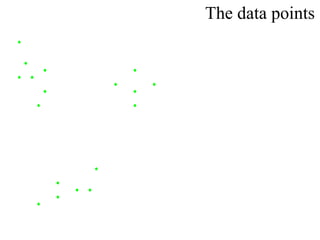
The data points
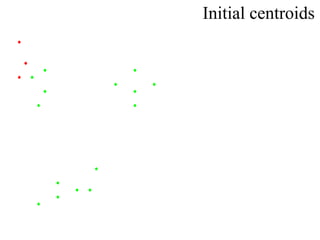
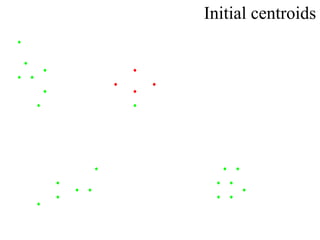
Initial centroids
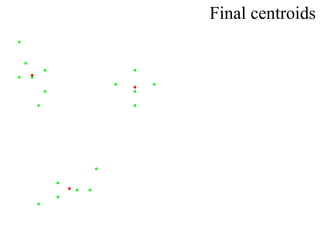
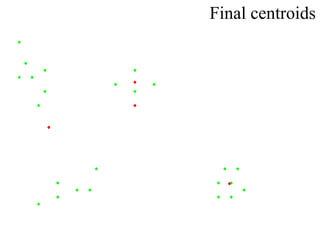
Final centroids
K-means Algorithm Example 2
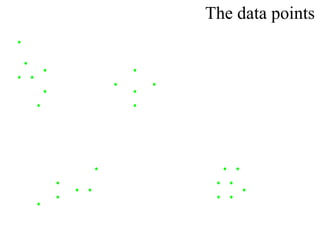
The data points
Initial centroids
Final centroids
Problem
• The accuracy of convergence depends on the level of
approximation of the initial centroids.
• A method is proposed to overcome this problem by
approximating the initial centroids using genetic algorithm.
Creating the Initial Population
• Suppose there are n number of points with k number of
clusters.
• A gene consists of coordinates of a point randomly picked
from the set of points.
• A chain of k number of such genes forms a chromosome.
• A collection of N number of such chromosomes forms the
initial population.
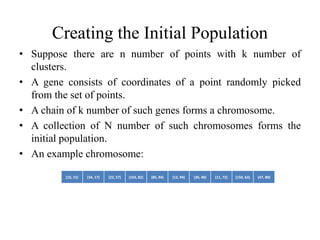
• An example chromosome:
(10, 15) (34, 17) (22, 57) (103, 82) (85, 94) (12, 94) (30, 48) (11, 72) (150, 63) (47, 88)
The Process of Evolution
• Selection
• Recombination
• Mutation
Selection
• The fitness of each chromosome is evaluated using a fitness
function.
• Let G be the average J(C) value of chromosomes.
• Then the fitness of a given chromosome is calculated by:
F = G/J(C);
• The chromosomes with higher fitness values should be
replicated.
• The chromosomes with lower fitness values should be
removed.
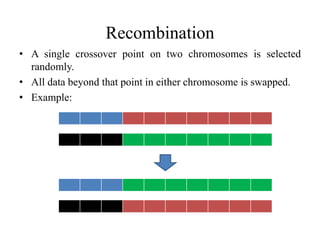
Recombination
• A single crossover point on two chromosomes is selected
randomly.
• All data beyond that point in either chromosome is swapped.
• Example:
Mutation
• Randomly select a gene in the chromosome.
• Replace the coordinates in that gene by a random point in the
set of points.
Results
• A random chromosome is picked from the final population and
used it for the initial centroids of k-means algorithm.
• The recombination between 45% - 65%, mutation between
10% - 14% and number of iterations (or populations created)
among 20-30 yields more accurate and globally optimized
results.
Any Questions?
Thank You!

Improving the accuracy of k-means algorithm using genetic algorithm

  • 1.
    Improving the Accuracyof K-means Algorithm using Genetic Algorithm W. T. R. Fernando* K. R. Wijeweera D. M. N. K. Dasanayaka
  • 2.
  • 3.
  • 4.
  • 5.
  • 6.
  • 7.
  • 8.
  • 9.
  • 10.
    Problem • The accuracyof convergence depends on the level of approximation of the initial centroids. • A method is proposed to overcome this problem by approximating the initial centroids using genetic algorithm.
  • 11.
    Creating the InitialPopulation • Suppose there are n number of points with k number of clusters. • A gene consists of coordinates of a point randomly picked from the set of points. • A chain of k number of such genes forms a chromosome. • A collection of N number of such chromosomes forms the initial population. • An example chromosome: (10, 15) (34, 17) (22, 57) (103, 82) (85, 94) (12, 94) (30, 48) (11, 72) (150, 63) (47, 88)
  • 12.
    The Process ofEvolution • Selection • Recombination • Mutation
  • 13.
    Selection • The fitnessof each chromosome is evaluated using a fitness function. • Let G be the average J(C) value of chromosomes. • Then the fitness of a given chromosome is calculated by: F = G/J(C); • The chromosomes with higher fitness values should be replicated. • The chromosomes with lower fitness values should be removed.
  • 14.
    Recombination • A singlecrossover point on two chromosomes is selected randomly. • All data beyond that point in either chromosome is swapped. • Example:
  • 15.
    Mutation • Randomly selecta gene in the chromosome. • Replace the coordinates in that gene by a random point in the set of points.
  • 16.
    Results • A randomchromosome is picked from the final population and used it for the initial centroids of k-means algorithm. • The recombination between 45% - 65%, mutation between 10% - 14% and number of iterations (or populations created) among 20-30 yields more accurate and globally optimized results.
  • 17.
  • 18.