EDUCATION PLANNING
Foundation Level
2019
Education Learning and
Development Module
EDUCATION PLANNING FOUNDATION LEVEL
2
CONTENTS
Acronyms.................................................................................................................................... 3
1 Introduction...................................................................................................................... 4
2 The government planning cycle........................................................................................ 4
3 Involvement of non-government actors in planning...................................................... 12
4 Test your knowledge....................................................................................................... 17
References and links................................................................................................................. 25
EDUCATION PLANNING FOUNDATION LEVEL
3
ACRONYMS
BRAC Building Resources Across Communities
GPE The Global Partnership for Education
INGO international non-government organisation
LTSP Long Term Sector Plans
MTEF Medium Term Expenditure Framework
MTSP Medium Term Sector Plans
NGO non-government organisation
SWAps sector-wide approaches
TVET technical and vocational education and training
UNICEF United Nations Children’s Fund
UNGEI United Nations Girls’ Education Initiative
EDUCATION PLANNING FOUNDATION LEVEL
4
1 INTRODUCTION
Education planning is a very broad and complex process. This module focusses on the
national education sector plan and considers its relationship with other key national and
regional documents. Education sector planning is important for development partners, as
the education sector plan typically underpins the formulation of partnership approaches and
the selection of programming options.
This module provides a foundation to engage in this topic and apply advice from staff with
operational or expert levels of knowledge in education. On successful completion, you will
be an informed participant in forums related to education planning.
2 THE GOVERNMENT PLANNING CYCLE
What is the relationship between the Constitution, legislation,
national budgets and education planning?
Planning is part of a hierarchy which ultimately determines how an education system
functions. Typically, a country's Constitution prevails over any other legislation, regulations
and directives. Following the Constitution, education ministries are then required to
comply with other legislation such as regulations over financial management and
disbursement; as well as directives and agreements issued under legislation. A typical
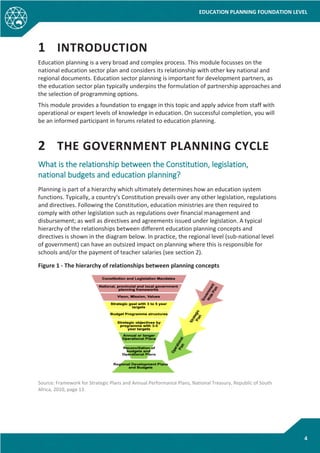
hierarchy of the relationships between different education planning concepts and
directives is shown in the diagram below. In practice, the regional level (sub-national level
of government) can have an outsized impact on planning where this is responsible for
schools and/or the payment of teacher salaries (see section 2).
Figure 1 - The hierarchy of relationships between planning concepts
Source: Framework for Strategic Plans and Annual Performance Plans, National Treasury, Republic of South
Africa, 2010, page 13.
EDUCATION PLANNING FOUNDATION LEVEL
5
Types of education plans
Governments use many different types of documents to plan. There are program and project
plan documents, short and long term budget documents, strategic and policy analysis
documents and many other types of information which may all be considered education
planning documents. The following are the most common high level national planning
documents which typically guide the development of an education system.
1. Expenditure Frameworks
2. Strategic Education (Sector) Plans
3. Operational Plans
4. Annual Performance Plans.
Note: It is important to note that there are no hard and fast rules as to the types of plans
governments will employ and how they are used and structured. Often the hierarchy of plans is
unclear, particularly for governments which have experienced recent crises.
Expenditure Frameworks
Governments typically lay out their broad financial allocations to each sector and often sub-
sectors, in national 'Expenditure Frameworks'. The Expenditure Framework informs and
guides the allocations of the national and sub-national budgets to each area of government.
Thus, the government expenditure projections for the education sector are presented in this
document.
Typically governments plan in three to five year financing windows and so expenditure
frameworks are often referred to as Medium-Term Expenditure Frameworks (MTEF).
What is the appeal of an MTEF?
The appeal of MTEFs lie in their potential to link the often competing short-term budget
constraints with medium and longer term demands on budget resources. When carefully
prepared and adhered to, MTEFs contribute to improved policy making and planning, and
more efficient and effective service delivery.
Can governments have multiple Expenditure Frameworks?
Some governments may have multiple Expenditure Frameworks. For example, there may be
a national framework covering all sectors and then a separate expenditure framework for
each sector. These would then typically be distinguished as a 'National Expenditure
Framework' and an 'Education Expenditure Framework'.
Who prepares the MTEF?
The MTEF is usually prepared by the Ministry of Finance or its equivalent. Therefore, there
needs to be strong dialogue between the Ministry of Finance and the relevant education
authorities. This dialogue is usually led by the Ministry or Department of Education.
Successful implementation of MTEF is affected by various factors including:
EDUCATION PLANNING FOUNDATION LEVEL
6
• the extent to which MTEF covers the whole of government
• integration of the various phases of the budget cycle (including the MTEF) with
other key policy and planning processes
• forecasts must be current and credible
• realism in setting the aggregate resource constraint is a key factor for achieving
predictability
• early engagement with the political decision making process.
Strategic (Sector) Plans
An Education Strategic Sector Plan is a tool to effectively describe the inputs, processes
and resulting outputs, outcomes and impacts for the education system as a whole. Sector
Plans assist Ministries of Education and involved stakeholders to prioritise and plan the
progressive implementation of legislative mandates, policies and programs in the sector.
Strategic Plans are important for effective management, including planning, budgeting,
implementation, reporting, monitoring and evaluation. Plans should indicate the likely
sequencing of implementation in the period ahead. This is important for guiding
implementation and assessing progress.
A Strategic Plan should include the activities of development partners and non-
government providers, to provide a whole of sector 'story'. Ideally, the Strategic Plan
should not simply represent the forward work plan of the Ministry of Education but
account for the roles of other actors in the sector.
What are the common types of strategic plans in
education?
There are two common types of strategic plans in education as
follows:
• Long Term Sector Plans (LTSP)
• Medium Term Sector Plans (MTSP).
Long-term plans may span 10 or more years and can be thought of as a roadmap for
overall policies and broader goals. An MTSP tends to cover a period of three to five
years, and includes detailed programming information, which in turn reflects policy
priorities. Outputs and outcomes are identified in both, and an MTSP typically includes
detailed budget projections (e.g. through the inclusion of a MTEF).
Medium vs Long Term Sector Plans
Medium and Long Term Education Sector Plans can operate simultaneously. Long Term
Education Sector Plans provide a valuable long term vision of how the sector should
operate. However, detailed planning is far more reliable in the short to medium term.
Therefore, governments are increasingly concerned with Medium Term Education Sector
EDUCATION PLANNING FOUNDATION LEVEL
7
Plans since the likely levels of financial resources can be estimated with a higher degree of
probability for the associated timeframe.
In many instances, particularly in fragile states, a Long Term Education Sector Plan may not
be available or feasible. In instances where the political environment may be unstable, it
may be more realistic to generate a Medium Term Sector Plan which can provide some
guidance to the annual budget setting processes.
In countries where the education sector is administered through multiple ministries, there
may be multiple education-related Medium Term Sector Plans. This can cause significant
coordination problems, which is particularly pronounced in the early childhood, technical
and vocational education and training (TVET) and higher education sub-sectors. A problem
that can also present itself within long-term planning where this is driven by sectoral
agencies.
Case study: Indonesia
Indonesia sets its high level economic and social development
objectives through a 20 year, long term development plan, and
five-yearly National Medium Term Development Plans (Rencana
Pembangunan Jangka Menengah Nasional - RPJMN) that run
parallel with the taking office of a new national government. Development of the RPJMN
is led by the Ministry for Development Planning (Bappenas) with a key input being a
review of the current/existing plan to assess achievement against targets, review the
policy context, and set out proposed focus for the next RPJMN.
While the RPJMN covers all sectors, key education related components include:
1. the human development chapter of RPJMN (developed by the Ministry for National
Development Planning - Bappenas)
2. the Ministry of Education and Culture’s Education and Culture Strategic Plan
3. the Ministry of Religious Affairs’ Islamic Education Strategic Plan.
Taken together, these documents provide (i) the interlinkages and interdependencies
between these plans, (ii) their relationship to the election and early inception period of
the national government, and (iii) indicative timeframes for their development and
completion.
The ministry-led five-year sectoral strategic plans (Rencana Strategis – Renstra)
articulate the strategic objectives for the five-year planning period, strategies to achieve
them, and supporting policies, programs, and financing. The strategic planning process
for the line ministry Renstra is interrelated with the RPJMN development process, and
the two documents are intended to be part of a cascading approach through which the
strategic vision for Indonesia’s education sector is articulated in the RPJMN to the
Renstra, and then through the annual planning process of technical units within
ministries.
EDUCATION PLANNING FOUNDATION LEVEL
8
Medium Term Sector Plans
A MTSP is usually led by the main ministry concerned with education and will typically
encompass the entire education sector including early childhood, primary, secondary,
higher education and vocational training and skills based education. The MTSP is a national
level document. Where a country has sub-national levels of government with responsibility
for education provision (e.g. schools or pre-schools) the integrity of the MTSP can be
considerably affected by (i) accuracy of data, and (ii) policy agreement across levels of
government. Both of these can be enhanced through the active and willing participation of
sub-national levels of government in the development and endorsement of the MTSP.
At its best, a MTSP is a structured, coherent and integrated (institutionalised) process of
policy making, planning and budgeting. Ideally, it involves a wide range of sector
stakeholders in an iterative decision making process that:
• Ensures that national goals and targets (set in national policies and plans) are
reached through appropriate medium-term programs.
• Reconciles the resource levels (in particular financial resources) required to reach
the medium-term targets with the resources likely to be available (set by annual
budget ceilings negotiated with the Ministry of Finance).
A MTSP is situated within the broader government budget framework.
• To be implemented, the medium-term education plan needs financing, which is
provided through annual budgets (which are legally binding financial commitments
of the central Government).
• In most instances, a medium-term education plan will cover the entire sector,
encompassing both public and non-public provision of education and training. The
MTSP should identify the resource requirements for both public and non-public
education; i.e. human resources, teaching-learning materials, physical facilities,
financial resources.
Source: International Monetary Fund 1999, Guidelines for Public Expenditure Management.
The relationship between the MTEF and education planning
The relationship between the MTEF and the education sector planning should be very close,
both being developed in an iterative process. The iterative process continues once
implementation commences. During implementation a plan will be monitored and
periodically evaluated. The findings of each evaluation will feed back into the remaining
implementation of the plan.
EDUCATION PLANNING FOUNDATION LEVEL
9
Operational Plans
An Operational Plan 'operationalises' a strategic plan. It is
typically over a shorter period of time than a MTSP or LTSP.
Operational Plans should establish the activities and budgets for
each part of the organisation for the next one to three years.
They link the strategic plan with the activities that the department or organisation will
deliver and the resources required to deliver them. It usually describes milestones,
conditions for success and explains how, or what portion of, a strategic plan will be put
into operation during a given operational period, such as a fiscal year.
In other words, an Operational Plan is a more practical version of the strategic plan. It
usually covers a shorter timeframe and has a more detailed specification of the budget.
Annual Performance Plans
Many countries also encourage Annual Performance Plans. Annual Performance Plans
typically identify the performance indicators and targets that a part of the education
system or department will seek to achieve in the upcoming budget year. It is important
that these performance indicators and targets are aligned across an institution's annual
plans, budgets, in-year and annual reports. In addition, the process for the production
of the Annual Performance Plan should be aligned to the budget process.
Rolling on of medium term expenditure frameworks and plans
In some countries the MTEF period is only three years, but the medium-term sector plan
may cover a five-year period. In such cases it is common to roll on the MTEF at the end of
each year by another year, so that the MTEF will always cover a three-year period. This is
often known as a rolling plan. However, there can be some tricky issues of timing and
coordination when it comes to updating the underlying data and projections:
• Since disbursements are supposed to be results and performance related, results
information has to be captured at the end of each year, in time for the preparation
of the budget of the following year, and for updating the rolling MTEF. This, in turn,
requires timely and reliable data collection and analysis.
• The problem will be compounded under conditions of a decentralised MTEF, since
provincial MTEFs depend on the national MTEF to be available first, before the
provinces can finalise their MTEF.
EDUCATION PLANNING FOUNDATION LEVEL
10
Why roll on the MTEF?
Owing to the challenges described above, it is common for the
MTEF to be out of synchronisation with the MTSP. This will not
create significant problems provided the MTEF is updated every
two to three years. The latest MTEF can be used to inform the
new MTSP and the existing MTSP can be used to inform the MTEF. However, in
developing countries and particularly in post-conflict environments, the capacity of
Ministry staff is often low, making this regular and detailed planning a challenge.
There is often a lack of cohesion between plans, and also between plans and budgets.
Australian aid program staff can help by providing technical advice to governments to
strengthen plans and budgets and ensure that they are properly inter-related. This is
discussed further in the Education Sector Planning module, Practitioner level.
Other issues impacting planning
There are several types of decentralisation which will influence the development of
Education Plans. These include political, administrative, fiscal and economic decentralisation.
The extent of decentralisation will heavily influence the planning process.
Centralised education planning
In a strictly centralised bureaucracy in which all decisions are made nationally, a single
centralised Education Sector Plan will give little autonomy to regions or lower levels of
government to decide their own planning and expenditure frameworks. An example of this is
in Myanmar where the Ministry of Education has established a comprehensive National
Education Sector Plan.
Decentralised education planning
The extent of decentralisation of a bureaucracy will influence the type of education plan
suitable to the country context. In a highly decentralised bureaucracy, local government
entities are likely to have or require their own sub-national education planning process
which may be independent from the broader national level.
Where high levels of decentralisation are evident, national education plans may be
restricted to national policy and funding initiatives, leaving local governments to formulate
their own strategic plans. In practice, the extent of decentralisation often varies between
sub-sectors and between different departments. There will be some aspects of planning that
are suitable for national plans and some which are suitable for sub-national plans. Examples
of decentralised education systems include Nigeria, Pakistan, India, Philippines and
Indonesia.
Decentralised planning generally helps ensure that the specific needs of schools and
communities are better identified and met. However if decentralised planning is allowed to
EDUCATION PLANNING FOUNDATION LEVEL
11
flourish without proper central control and support, there is a risk that disadvantaged areas
will remain underfunded and inequalities will be exacerbated.
Gender equality
The Education for All initiative has demonstrated that progress towards gender parity in
primary schools has varied greatly and while enrolments have increased substantially since
the Millennium Development Goals specified universal primary education as a target for
2015, enrolments have not been equal between boys and girls. With fewer girls completing
education, some countries experience large gender imbalances in labour markets.
Education planning to address gender equity is affected by the low proportion of women in
leadership positions in most countries. The two major problems affecting women's
advancement in ministries of education are:
• The supply of sufficiently qualified women at each level of authority in order to
ensure gender equality at the most senior levels.
• Institution, societal and cultural obstacles to women's career advancement.
Good education planning has the ability to change negative trends in enrolment and
completion of girls. The Global Partnership for Education (GPE) and United Nations Girls’
Education Initiative (UNGEI), with support from United Nations Children’s Fund (UNICEF),
established the Guidance for Developing Gender-Responsive Education Sector Plans in 2017.
This tool is designed to support developing countries to establish gender-sensitive policies,
plans and learning environments, with a view to transforming the way education systems
function. Applying a gender lens to education policies and strategies ensures that they
address the specific needs of girls or boys and the challenges they face.
Source: GPE, UNGEI & UNICEF 2017.
Shifts in policies and legislation
In many countries there have been significant shifts in terms of
policies and legislation to address gender balance but
governments may lack the financial resources and the political
will to implement them. Policies are often developed without
the engagement of the women they affect.
Planning also needs to take account of enabling factors known to support women, such
as access to mentors and supervision, tailored training, flexible working hours,
facilitating a good work/life balance, having support networks, good policy and
legislative contexts.
EDUCATION PLANNING FOUNDATION LEVEL
12
3 INVOLVEMENT OF NON-GOVERNMENT
ACTORS IN PLANNING
Main stakeholders in education planning
Education planning should involve a broad range of stakeholders active in the education
sector. Some of the main stakeholders who should be involved in planning include:
• development partners such as the Australian aid program
• non-government providers of education
• non-government organisations (NGOs).
The role of development partners in education planning
Development partners in education can have a significant impact, particularly for
disadvantaged groups.
Often innovation and reform activities depend on donor funding, since 85 to 95 per cent of
the domestic public education budget is directed to recurrent expenditure (e.g. teacher
salaries), leaving little for reform programs. Donor financed activities should be included in
the budget framework of education plans, to ensure that they are consistent with goals
and targets in national sector plans, and to promote transparency and accountability of
funding allocations. With a small proportion of budgets allocated to development (non-
recurrent) programs, the impact of donor funding can be significant for addressing gender
inequity and the needs of marginalised and disadvantaged groups in education.
Source: UNESCO 2015, Trends in government expenditure for public education, 2011-13.
This impact is also influenced by the implementing partner, who may be an NGO or
multilateral agency (e.g. UNICEF). For example, in Bangladesh, Australia is partnering with
the UK and Building Resources Across Communities (BRAC), the world’s largest NGO, on a
multi-sectoral program (including education) that is delivering results at scale to 110
million people. This includes providing education to 1.9 million disadvantaged children in
2017/18. Every year the program supports 55,000 students (over 50 per cent girls) in
ethnic primary schools. It also uses local languages and tailored curricula to annually
educate 11,000 mainly tribal children in the remote Chittagong Hill Tracts.
In developing and post-conflict environments the capacity of Ministry staff to undertake
education planning and budget preparation is often low. See the Education in Conflict
Affected/and or Fragile States modules for further information.
By supporting and engaging in the planning for education, donors are better able to
support the sector so it can perform its functions. This includes the adaptation and
extension/replication of successful and significant donor funded interventions (as in BRAC
described above).
The extent to which development partners can engage with the planning process is
affected by the institutional and political environment. Building strong relationships with
EDUCATION PLANNING FOUNDATION LEVEL
13
counterparts in the Ministries of Education and Finance is helpful to engaging with the
planning and budget processes.
Development partner approaches and funding
mechanisms should align with government planning
Education planning has significant implications for donors
because it determines the priorities of the Government and
therefore influences where donors can provide support.
Government planning documents and budgets are instruments for public sector
management reform (such as Public Expenditure Reviews) and they support the
development of program approaches and funding mechanisms (such as sector budget
support and sector-wide approaches (SWAps). Good practice is for donors to align their
support to the greatest extent possible with national policies, systems and processes.
These processes require integrated policy, planning and budgeting, led by strong and
effective education plans. Good education plans support and encourage the
strengthening of systems.
The role of the non-government providers in education planning
Who are non-government providers of education?
Non-government providers of education include:
• religious schools (e.g. run by churches or religious groups)
• community owned schools run by local communities
• non-profit schools run by NGOs
• for-profit schools run by commercial entities.
It is possible for well-planned and regulated non-government involvement in schooling to
help improve overall school performance (e.g through competition, accountability and
autonomy) as well as providing expanded access. These positive impacts are most likely to
be attained (and negative developments avoided) through strong systems of accountable,
non-government education providers coupled with capable government oversight and
regulatory systems.
Education planning may include incentives and mechanisms to better engage non-
government providers in the education sector. Education planning should aim to maintain
proper regulatory mechanisms for the monitoring and quality assurance of non-
government providers and ensure that government and non-government schools attain
the required standards in education. The participation of non-government providers in
planning and regulation of the education sector helps to secure their understanding and
commitment to shared goals and targets.
EDUCATION PLANNING FOUNDATION LEVEL
14
What is the significance of the non-government providers for developing
education plans?
The public sector in several parts of the world is developing innovative partnerships with
non-government providers. Non-government providers can expand equitable access and
improve learning outcomes. The significance of their engagement in the planning process
is partly driven by their share of enrolments.
The proportion of non-government schools varies greatly between countries. For example,
in Tonga, approximately 70 per cent of primary and secondary schools are run privately, by
church-based organisations. As a result, the church influence in education planning is
significant and therefore, they are a major stakeholder in the sector.
In Samoa, on the other hand, privately run schools account for approximately 10 per cent
of all schools. The dominant provider of education is the Ministry of Education. However,
early childhood centres are almost entirely privately operated. In the early childhood sub-
sector, private operators are the key stakeholder for government.
What is important about non-government providers to be captured in
education planning?
Non-government education funding, fees, institutes, enrolments, teachers and facilities
should be included in education plans. Inclusion of non-government providers in sector
planning can help ensure that:
• Changes to the number or coverage of non-government providers can be factored
into future models. This supports better projections of government school coverage
and hence funding requirements.
• Policies to ensure regulation of non-government providers are appropriate and
adequately resourced.
• Policies enable student access to good quality public and non-government schools
(e.g. scholarships and stipends).
• The inputs, outputs, outcomes, revenues and costs associated with public and non-
government education provision, and the allocation of costs, are transparent and
can be used to inform government policy-making.
The role of NGOs in education planning
NGOs should be included in the education planning process. Education planning should
ensure that NGOs are encouraged to undertake their work within the overall planning
process and under the regulatory mechanisms of the national and sub-national
governments. Development partners can play a significant role in both supporting NGOs
and encouraging dialogue and communication between NGOs and government.
What is the role of NGOs in education?
NGOs may oversee a subset of non-government providers, typically aimed at improving access to
education for all children, or they may run supplementary programs addressing particular
aspects of the curriculum or needs of disadvantaged children. NGOs may be important
EDUCATION PLANNING FOUNDATION LEVEL
15
advocates for change in education priority-setting (e.g. pro-poor investment; inclusion of ethnic
minorities; changes to language of instruction policy; teacher training standards).
What are the strengths of NGOs in education planning?
A particular strength of NGOs is their ability to combine work at the community level with
policy advocacy. As advocates, NGOs can present grounded evidence from their work at
the community level to feed into education planning and priority-setting, with a focus on
good quality education for all children. NGOs often fill an 'evidence gap' at the community
level for the area in which they operate.
How can NGOs contribute towards education planning?
International NGOs (INGOs) have played a significant role in adopting a rights-based
approach and in supporting civil society groups to demand good quality education. They
contribute toward policy development and support initiatives within communities. NGOs,
through their work, have helped in linking education with child rights, gender equity and
national development. NGOs support in providing the vital link between grass-roots level
work with advocacy has been helpful in encouraging people to demand education as a
right for their children.
Examples of NGOs involved in planning
NGOs can play a positive role in education planning, particularly in supporting national
programs at the sub-national level.
Some examples of NGOs involved in education planning in India are:
• Bodh Shiksha Samiti (India). This NGO is heavily involved in provincial education
program implementation in urban slums and rural habitations. They have been
actively engaged in research and piloting of programs and policies in disadvantaged
areas. Using evidence from their work on the ground, they have helped to evolve
and refine the learning processes for teachers and enhanced community
involvement in school management.
• MV Foundation (India). This NGO began its work in three villages in 1991 and
gradually, it expanded its operations to cover 6000 villages in 158 mandals
(administrative divisions of some countries of South Asia) of Andhra Pradesh.
Cumulatively, over a period of 18 years, about 500,000 children have been
withdrawn from work and sent to schools in 13 districts of Andhra Pradesh. The MV
Foundation works closely with government to help inform policies to encourage
children into formal education.
EDUCATION PLANNING FOUNDATION LEVEL
16
Summary
Sound education planning is critical to ensuring education targets
and goals are identified, programs and projects are defined and
coordinated and proper allocation of resources is made to ensure
goals can be reached. Where possible, development partners
should work alongside government and be engaged in the education planning and
budgeting processes.
Once a plan is developed, development partners should be engaged in the monitoring
and evaluation process and challenge governments to reflect on and be critical of their
own plans. Building respectful relationships within government can facilitate
development partners' involvement in planning processes. Supporting strategic and
technical advice can enable improvements to the planning process and strengthen the
relevance and practicality of education strategic plans.
EDUCATION PLANNING FOUNDATION LEVEL
17
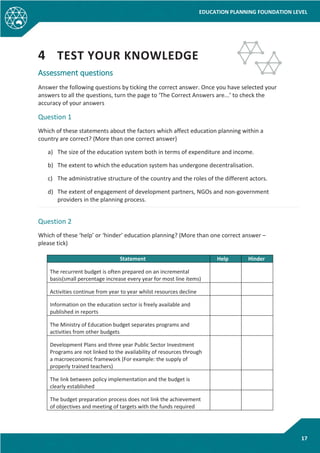
4 TEST YOUR KNOWLEDGE
Assessment questions
Answer the following questions by ticking the correct answer. Once you have selected your
answers to all the questions, turn the page to ‘The Correct Answers are...’ to check the
accuracy of your answers
Question 1
Which of these statements about the factors which affect education planning within a
country are correct? (More than one correct answer)
a) The size of the education system both in terms of expenditure and income.
b) The extent to which the education system has undergone decentralisation.
c) The administrative structure of the country and the roles of the different actors.
d) The extent of engagement of development partners, NGOs and non-government
providers in the planning process.
Question 2
Which of these ‘help’ or ‘hinder’ education planning? (More than one correct answer –
please tick)
Statement Help Hinder
The recurrent budget is often prepared on an incremental
basis(small percentage increase every year for most line items)
Activities continue from year to year whilst resources decline
Information on the education sector is freely available and
published in reports
The Ministry of Education budget separates programs and
activities from other budgets
Development Plans and three year Public Sector Investment
Programs are not linked to the availability of resources through
a macroeconomic framework (For example: the supply of
properly trained teachers)
The link between policy implementation and the budget is
clearly established
The budget preparation process does not link the achievement
of objectives and meeting of targets with the funds required
EDUCATION PLANNING FOUNDATION LEVEL
18
Question 3
Which of these statements are correct explanations of why annual operational plans are
developed? (More than one correct answer)
a) Because ministries cannot decide how to allocate their funds over the longer term.
b) Because funding cannot be guaranteed over the lifespan of longer term plans such
as education strategic plans.
c) Operational plans provide a short term link between budget frameworks and
strategic plans.
d) Because they help ministries to plan education for long periods such as five and ten
years.
e) To 'operationalise' strategic plans.
Question 4
Which of these statements are correct? (More than one correct answer)
A strategic plan should:
a) Involve a diverse group of key stakeholders.
b) Develop a common vision and set of values/principles.
c) Be exclusively focused on primary education.
d) Address gender differences.
e) Analyse needs and assets over the medium term.
f) Create both a long-term plan and shorter-term priorities for implementation.
g) Establish benchmarks and track progress toward outcomes.
Question 5
Which of these statements are correct descriptions of a Medium Term Sector Plan (MTSP)?
(More than one correct answer)
a) An MTSP should include implementation and performance monitoring.
b) An MTSP should ideally cover the entire education sector.
c) An MTSP may cover a selected number of subsectors of the education sector.
EDUCATION PLANNING FOUNDATION LEVEL
19
d) An MTSP should include all expenditures: those funded from domestic revenues
and those funded by donors.
e) An MTSP should refer to longer term plans, visions and missions and be responsive
to the Constitution and legislation.
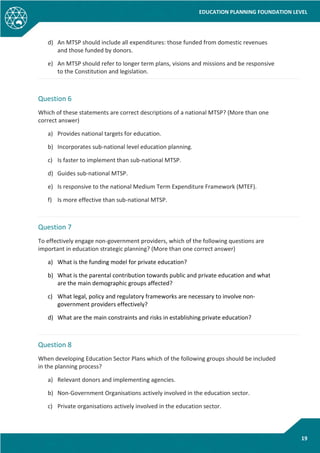
Question 6
Which of these statements are correct descriptions of a national MTSP? (More than one
correct answer)
a) Provides national targets for education.
b) Incorporates sub-national level education planning.
c) Is faster to implement than sub-national MTSP.
d) Guides sub-national MTSP.
e) Is responsive to the national Medium Term Expenditure Framework (MTEF).
f) Is more effective than sub-national MTSP.
Question 7
To effectively engage non-government providers, which of the following questions are
important in education strategic planning? (More than one correct answer)
a) What is the funding model for private education?
b) What is the parental contribution towards public and private education and what
are the main demographic groups affected?
c) What legal, policy and regulatory frameworks are necessary to involve non-
government providers effectively?
d) What are the main constraints and risks in establishing private education?
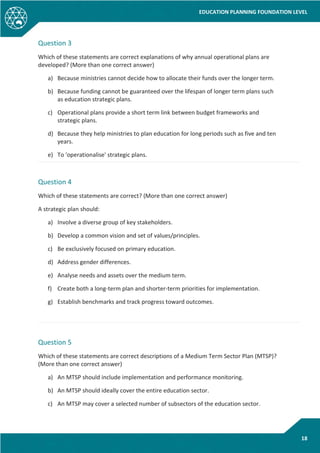
Question 8
When developing Education Sector Plans which of the following groups should be included
in the planning process?
a) Relevant donors and implementing agencies.
b) Non-Government Organisations actively involved in the education sector.
c) Private organisations actively involved in the education sector.
EDUCATION PLANNING FOUNDATION LEVEL
20
d) The Ministry or Department of Finance.
e) Representatives from each Ministry of Education Department or sub-division.
f) Community-based organisations.
EDUCATION PLANNING FOUNDATION LEVEL
21
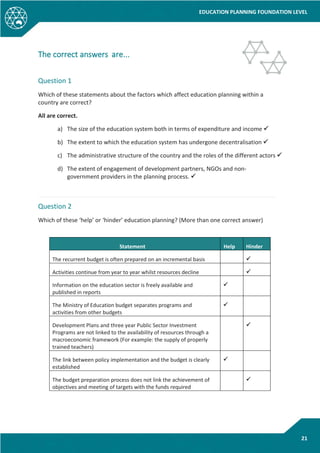
The correct answers are...
Question 1
Which of these statements about the factors which affect education planning within a
country are correct?
All are correct.
a) The size of the education system both in terms of expenditure and income 
b) The extent to which the education system has undergone decentralisation 
c) The administrative structure of the country and the roles of the different actors 
d) The extent of engagement of development partners, NGOs and non-
government providers in the planning process. 
Question 2
Which of these ‘help’ or ‘hinder’ education planning? (More than one correct answer)
Statement Help Hinder
The recurrent budget is often prepared on an incremental basis 
Activities continue from year to year whilst resources decline 
Information on the education sector is freely available and
published in reports

The Ministry of Education budget separates programs and
activities from other budgets

Development Plans and three year Public Sector Investment
Programs are not linked to the availability of resources through a
macroeconomic framework (For example: the supply of properly
trained teachers)

The link between policy implementation and the budget is clearly
established

The budget preparation process does not link the achievement of
objectives and meeting of targets with the funds required

EDUCATION PLANNING FOUNDATION LEVEL
22
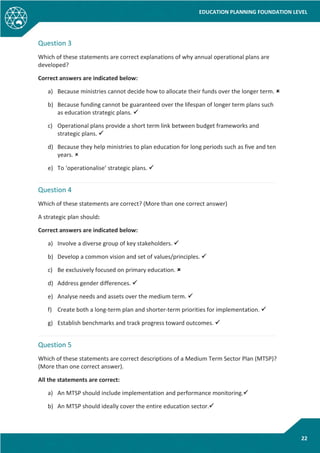
Question 3
Which of these statements are correct explanations of why annual operational plans are
developed?
Correct answers are indicated below:
a) Because ministries cannot decide how to allocate their funds over the longer term. 
b) Because funding cannot be guaranteed over the lifespan of longer term plans such
as education strategic plans. 
c) Operational plans provide a short term link between budget frameworks and
strategic plans. 
d) Because they help ministries to plan education for long periods such as five and ten
years. 
e) To ‘operationalise’ strategic plans. 
Question 4
Which of these statements are correct? (More than one correct answer)
A strategic plan should:
Correct answers are indicated below:
a) Involve a diverse group of key stakeholders. 
b) Develop a common vision and set of values/principles. 
c) Be exclusively focused on primary education. 
d) Address gender differences. 
e) Analyse needs and assets over the medium term. 
f) Create both a long-term plan and shorter-term priorities for implementation. 
g) Establish benchmarks and track progress toward outcomes. 
Question 5
Which of these statements are correct descriptions of a Medium Term Sector Plan (MTSP)?
(More than one correct answer).
All the statements are correct:
a) An MTSP should include implementation and performance monitoring.
b) An MTSP should ideally cover the entire education sector.
EDUCATION PLANNING FOUNDATION LEVEL
23
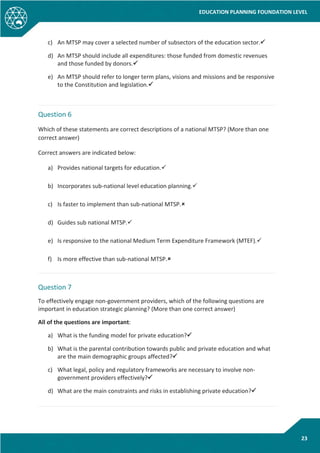
c) An MTSP may cover a selected number of subsectors of the education sector.
d) An MTSP should include all expenditures: those funded from domestic revenues
and those funded by donors.
e) An MTSP should refer to longer term plans, visions and missions and be responsive
to the Constitution and legislation.
Question 6
Which of these statements are correct descriptions of a national MTSP? (More than one
correct answer)
Correct answers are indicated below:
a) Provides national targets for education.
b) Incorporates sub-national level education planning.
c) Is faster to implement than sub-national MTSP.
d) Guides sub national MTSP.
e) Is responsive to the national Medium Term Expenditure Framework (MTEF).
f) Is more effective than sub-national MTSP.
Question 7
To effectively engage non-government providers, which of the following questions are
important in education strategic planning? (More than one correct answer)
All of the questions are important:
a) What is the funding model for private education?
b) What is the parental contribution towards public and private education and what
are the main demographic groups affected?
c) What legal, policy and regulatory frameworks are necessary to involve non-
government providers effectively?
d) What are the main constraints and risks in establishing private education?
EDUCATION PLANNING FOUNDATION LEVEL
24
Question 8
When developing Education Sector Plans which of the following groups should be included
in the planning process?
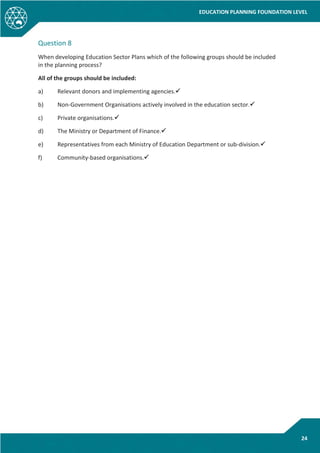
All of the groups should be included:
a) Relevant donors and implementing agencies.
b) Non-Government Organisations actively involved in the education sector.
c) Private organisations.
d) The Ministry or Department of Finance.
e) Representatives from each Ministry of Education Department or sub-division.
f) Community-based organisations.
EDUCATION PLANNING FOUNDATION LEVEL
25
REFERENCES AND LINKS
All links retrieved August 2019
GPE, UNGEI and UNICEF 2017, Guidance for developing gender-responsive education
sector plans. http://www.globalpartnership.org/content/guidance-developing-gender-
responsive-education-sector-plans
International Monetary Fund 1999, Guidelines for Public Expenditure Management,
https://www.imf.org/external/pubs/ft/expend/guide3.htm
Republic of South Africa National Treasury 2010, Framework for Strategic Plans and Annual
Performance Plans. https://cer.org.za/wp-content/uploads/2016/08/NT-Framework.pdf
UNESCO 2015, Trends in government expenditure for public education,
http://unesdoc.unesco.org/images/0023/002324/232476e.pdf
Learn more about…
Case studies that highlight the advantages and disadvantages of the Medium Term
Expenditure Framework (MTEF) can be found at:
http://www.odi.org.uk/sites/odi.org.uk/files/odi-assets/publications-opinion-
files/2019.pdf
The role of non-government actors in education, found at: Non-government providers in
education, found at: https://www.brookings.edu/wp-content/uploads/2016/06/102215-
Non-State-Actors-in-Education-Framing-paper-Final.pdf
The role of private providers of education, found at:
http://unesdoc.unesco.org/images/0024/002438/243823e.pdf
Decentralised education planning, found at:
http://unesdoc.unesco.org/images/0014/001409/140949e.pdf
The concept and rationale of strategic planning, found at:
http://unesdoc.unesco.org/images/0018/001897/189757e.pdf
The organisational arrangements of strategic planning, found at:
http://unesdoc.unesco.org/images/0018/001897/189758e.pdf
Gender equality in educational planning and management, found at:
http://unesdoc.unesco.org/images/0023/002326/232636E.pdf

education-planning-practitioner.pdf

  • 1.
  • 2.
    EDUCATION PLANNING FOUNDATIONLEVEL 2 CONTENTS Acronyms.................................................................................................................................... 3 1 Introduction...................................................................................................................... 4 2 The government planning cycle........................................................................................ 4 3 Involvement of non-government actors in planning...................................................... 12 4 Test your knowledge....................................................................................................... 17 References and links................................................................................................................. 25
  • 3.
    EDUCATION PLANNING FOUNDATIONLEVEL 3 ACRONYMS BRAC Building Resources Across Communities GPE The Global Partnership for Education INGO international non-government organisation LTSP Long Term Sector Plans MTEF Medium Term Expenditure Framework MTSP Medium Term Sector Plans NGO non-government organisation SWAps sector-wide approaches TVET technical and vocational education and training UNICEF United Nations Children’s Fund UNGEI United Nations Girls’ Education Initiative
  • 4.
    EDUCATION PLANNING FOUNDATIONLEVEL 4 1 INTRODUCTION Education planning is a very broad and complex process. This module focusses on the national education sector plan and considers its relationship with other key national and regional documents. Education sector planning is important for development partners, as the education sector plan typically underpins the formulation of partnership approaches and the selection of programming options. This module provides a foundation to engage in this topic and apply advice from staff with operational or expert levels of knowledge in education. On successful completion, you will be an informed participant in forums related to education planning. 2 THE GOVERNMENT PLANNING CYCLE What is the relationship between the Constitution, legislation, national budgets and education planning? Planning is part of a hierarchy which ultimately determines how an education system functions. Typically, a country's Constitution prevails over any other legislation, regulations and directives. Following the Constitution, education ministries are then required to comply with other legislation such as regulations over financial management and disbursement; as well as directives and agreements issued under legislation. A typical hierarchy of the relationships between different education planning concepts and directives is shown in the diagram below. In practice, the regional level (sub-national level of government) can have an outsized impact on planning where this is responsible for schools and/or the payment of teacher salaries (see section 2). Figure 1 - The hierarchy of relationships between planning concepts Source: Framework for Strategic Plans and Annual Performance Plans, National Treasury, Republic of South Africa, 2010, page 13.
  • 5.
    EDUCATION PLANNING FOUNDATIONLEVEL 5 Types of education plans Governments use many different types of documents to plan. There are program and project plan documents, short and long term budget documents, strategic and policy analysis documents and many other types of information which may all be considered education planning documents. The following are the most common high level national planning documents which typically guide the development of an education system. 1. Expenditure Frameworks 2. Strategic Education (Sector) Plans 3. Operational Plans 4. Annual Performance Plans. Note: It is important to note that there are no hard and fast rules as to the types of plans governments will employ and how they are used and structured. Often the hierarchy of plans is unclear, particularly for governments which have experienced recent crises. Expenditure Frameworks Governments typically lay out their broad financial allocations to each sector and often sub- sectors, in national 'Expenditure Frameworks'. The Expenditure Framework informs and guides the allocations of the national and sub-national budgets to each area of government. Thus, the government expenditure projections for the education sector are presented in this document. Typically governments plan in three to five year financing windows and so expenditure frameworks are often referred to as Medium-Term Expenditure Frameworks (MTEF). What is the appeal of an MTEF? The appeal of MTEFs lie in their potential to link the often competing short-term budget constraints with medium and longer term demands on budget resources. When carefully prepared and adhered to, MTEFs contribute to improved policy making and planning, and more efficient and effective service delivery. Can governments have multiple Expenditure Frameworks? Some governments may have multiple Expenditure Frameworks. For example, there may be a national framework covering all sectors and then a separate expenditure framework for each sector. These would then typically be distinguished as a 'National Expenditure Framework' and an 'Education Expenditure Framework'. Who prepares the MTEF? The MTEF is usually prepared by the Ministry of Finance or its equivalent. Therefore, there needs to be strong dialogue between the Ministry of Finance and the relevant education authorities. This dialogue is usually led by the Ministry or Department of Education. Successful implementation of MTEF is affected by various factors including:
  • 6.
    EDUCATION PLANNING FOUNDATIONLEVEL 6 • the extent to which MTEF covers the whole of government • integration of the various phases of the budget cycle (including the MTEF) with other key policy and planning processes • forecasts must be current and credible • realism in setting the aggregate resource constraint is a key factor for achieving predictability • early engagement with the political decision making process. Strategic (Sector) Plans An Education Strategic Sector Plan is a tool to effectively describe the inputs, processes and resulting outputs, outcomes and impacts for the education system as a whole. Sector Plans assist Ministries of Education and involved stakeholders to prioritise and plan the progressive implementation of legislative mandates, policies and programs in the sector. Strategic Plans are important for effective management, including planning, budgeting, implementation, reporting, monitoring and evaluation. Plans should indicate the likely sequencing of implementation in the period ahead. This is important for guiding implementation and assessing progress. A Strategic Plan should include the activities of development partners and non- government providers, to provide a whole of sector 'story'. Ideally, the Strategic Plan should not simply represent the forward work plan of the Ministry of Education but account for the roles of other actors in the sector. What are the common types of strategic plans in education? There are two common types of strategic plans in education as follows: • Long Term Sector Plans (LTSP) • Medium Term Sector Plans (MTSP). Long-term plans may span 10 or more years and can be thought of as a roadmap for overall policies and broader goals. An MTSP tends to cover a period of three to five years, and includes detailed programming information, which in turn reflects policy priorities. Outputs and outcomes are identified in both, and an MTSP typically includes detailed budget projections (e.g. through the inclusion of a MTEF). Medium vs Long Term Sector Plans Medium and Long Term Education Sector Plans can operate simultaneously. Long Term Education Sector Plans provide a valuable long term vision of how the sector should operate. However, detailed planning is far more reliable in the short to medium term. Therefore, governments are increasingly concerned with Medium Term Education Sector
  • 7.
    EDUCATION PLANNING FOUNDATIONLEVEL 7 Plans since the likely levels of financial resources can be estimated with a higher degree of probability for the associated timeframe. In many instances, particularly in fragile states, a Long Term Education Sector Plan may not be available or feasible. In instances where the political environment may be unstable, it may be more realistic to generate a Medium Term Sector Plan which can provide some guidance to the annual budget setting processes. In countries where the education sector is administered through multiple ministries, there may be multiple education-related Medium Term Sector Plans. This can cause significant coordination problems, which is particularly pronounced in the early childhood, technical and vocational education and training (TVET) and higher education sub-sectors. A problem that can also present itself within long-term planning where this is driven by sectoral agencies. Case study: Indonesia Indonesia sets its high level economic and social development objectives through a 20 year, long term development plan, and five-yearly National Medium Term Development Plans (Rencana Pembangunan Jangka Menengah Nasional - RPJMN) that run parallel with the taking office of a new national government. Development of the RPJMN is led by the Ministry for Development Planning (Bappenas) with a key input being a review of the current/existing plan to assess achievement against targets, review the policy context, and set out proposed focus for the next RPJMN. While the RPJMN covers all sectors, key education related components include: 1. the human development chapter of RPJMN (developed by the Ministry for National Development Planning - Bappenas) 2. the Ministry of Education and Culture’s Education and Culture Strategic Plan 3. the Ministry of Religious Affairs’ Islamic Education Strategic Plan. Taken together, these documents provide (i) the interlinkages and interdependencies between these plans, (ii) their relationship to the election and early inception period of the national government, and (iii) indicative timeframes for their development and completion. The ministry-led five-year sectoral strategic plans (Rencana Strategis – Renstra) articulate the strategic objectives for the five-year planning period, strategies to achieve them, and supporting policies, programs, and financing. The strategic planning process for the line ministry Renstra is interrelated with the RPJMN development process, and the two documents are intended to be part of a cascading approach through which the strategic vision for Indonesia’s education sector is articulated in the RPJMN to the Renstra, and then through the annual planning process of technical units within ministries.
  • 8.
    EDUCATION PLANNING FOUNDATIONLEVEL 8 Medium Term Sector Plans A MTSP is usually led by the main ministry concerned with education and will typically encompass the entire education sector including early childhood, primary, secondary, higher education and vocational training and skills based education. The MTSP is a national level document. Where a country has sub-national levels of government with responsibility for education provision (e.g. schools or pre-schools) the integrity of the MTSP can be considerably affected by (i) accuracy of data, and (ii) policy agreement across levels of government. Both of these can be enhanced through the active and willing participation of sub-national levels of government in the development and endorsement of the MTSP. At its best, a MTSP is a structured, coherent and integrated (institutionalised) process of policy making, planning and budgeting. Ideally, it involves a wide range of sector stakeholders in an iterative decision making process that: • Ensures that national goals and targets (set in national policies and plans) are reached through appropriate medium-term programs. • Reconciles the resource levels (in particular financial resources) required to reach the medium-term targets with the resources likely to be available (set by annual budget ceilings negotiated with the Ministry of Finance). A MTSP is situated within the broader government budget framework. • To be implemented, the medium-term education plan needs financing, which is provided through annual budgets (which are legally binding financial commitments of the central Government). • In most instances, a medium-term education plan will cover the entire sector, encompassing both public and non-public provision of education and training. The MTSP should identify the resource requirements for both public and non-public education; i.e. human resources, teaching-learning materials, physical facilities, financial resources. Source: International Monetary Fund 1999, Guidelines for Public Expenditure Management. The relationship between the MTEF and education planning The relationship between the MTEF and the education sector planning should be very close, both being developed in an iterative process. The iterative process continues once implementation commences. During implementation a plan will be monitored and periodically evaluated. The findings of each evaluation will feed back into the remaining implementation of the plan.
  • 9.
    EDUCATION PLANNING FOUNDATIONLEVEL 9 Operational Plans An Operational Plan 'operationalises' a strategic plan. It is typically over a shorter period of time than a MTSP or LTSP. Operational Plans should establish the activities and budgets for each part of the organisation for the next one to three years. They link the strategic plan with the activities that the department or organisation will deliver and the resources required to deliver them. It usually describes milestones, conditions for success and explains how, or what portion of, a strategic plan will be put into operation during a given operational period, such as a fiscal year. In other words, an Operational Plan is a more practical version of the strategic plan. It usually covers a shorter timeframe and has a more detailed specification of the budget. Annual Performance Plans Many countries also encourage Annual Performance Plans. Annual Performance Plans typically identify the performance indicators and targets that a part of the education system or department will seek to achieve in the upcoming budget year. It is important that these performance indicators and targets are aligned across an institution's annual plans, budgets, in-year and annual reports. In addition, the process for the production of the Annual Performance Plan should be aligned to the budget process. Rolling on of medium term expenditure frameworks and plans In some countries the MTEF period is only three years, but the medium-term sector plan may cover a five-year period. In such cases it is common to roll on the MTEF at the end of each year by another year, so that the MTEF will always cover a three-year period. This is often known as a rolling plan. However, there can be some tricky issues of timing and coordination when it comes to updating the underlying data and projections: • Since disbursements are supposed to be results and performance related, results information has to be captured at the end of each year, in time for the preparation of the budget of the following year, and for updating the rolling MTEF. This, in turn, requires timely and reliable data collection and analysis. • The problem will be compounded under conditions of a decentralised MTEF, since provincial MTEFs depend on the national MTEF to be available first, before the provinces can finalise their MTEF.
  • 10.
    EDUCATION PLANNING FOUNDATIONLEVEL 10 Why roll on the MTEF? Owing to the challenges described above, it is common for the MTEF to be out of synchronisation with the MTSP. This will not create significant problems provided the MTEF is updated every two to three years. The latest MTEF can be used to inform the new MTSP and the existing MTSP can be used to inform the MTEF. However, in developing countries and particularly in post-conflict environments, the capacity of Ministry staff is often low, making this regular and detailed planning a challenge. There is often a lack of cohesion between plans, and also between plans and budgets. Australian aid program staff can help by providing technical advice to governments to strengthen plans and budgets and ensure that they are properly inter-related. This is discussed further in the Education Sector Planning module, Practitioner level. Other issues impacting planning There are several types of decentralisation which will influence the development of Education Plans. These include political, administrative, fiscal and economic decentralisation. The extent of decentralisation will heavily influence the planning process. Centralised education planning In a strictly centralised bureaucracy in which all decisions are made nationally, a single centralised Education Sector Plan will give little autonomy to regions or lower levels of government to decide their own planning and expenditure frameworks. An example of this is in Myanmar where the Ministry of Education has established a comprehensive National Education Sector Plan. Decentralised education planning The extent of decentralisation of a bureaucracy will influence the type of education plan suitable to the country context. In a highly decentralised bureaucracy, local government entities are likely to have or require their own sub-national education planning process which may be independent from the broader national level. Where high levels of decentralisation are evident, national education plans may be restricted to national policy and funding initiatives, leaving local governments to formulate their own strategic plans. In practice, the extent of decentralisation often varies between sub-sectors and between different departments. There will be some aspects of planning that are suitable for national plans and some which are suitable for sub-national plans. Examples of decentralised education systems include Nigeria, Pakistan, India, Philippines and Indonesia. Decentralised planning generally helps ensure that the specific needs of schools and communities are better identified and met. However if decentralised planning is allowed to
  • 11.
    EDUCATION PLANNING FOUNDATIONLEVEL 11 flourish without proper central control and support, there is a risk that disadvantaged areas will remain underfunded and inequalities will be exacerbated. Gender equality The Education for All initiative has demonstrated that progress towards gender parity in primary schools has varied greatly and while enrolments have increased substantially since the Millennium Development Goals specified universal primary education as a target for 2015, enrolments have not been equal between boys and girls. With fewer girls completing education, some countries experience large gender imbalances in labour markets. Education planning to address gender equity is affected by the low proportion of women in leadership positions in most countries. The two major problems affecting women's advancement in ministries of education are: • The supply of sufficiently qualified women at each level of authority in order to ensure gender equality at the most senior levels. • Institution, societal and cultural obstacles to women's career advancement. Good education planning has the ability to change negative trends in enrolment and completion of girls. The Global Partnership for Education (GPE) and United Nations Girls’ Education Initiative (UNGEI), with support from United Nations Children’s Fund (UNICEF), established the Guidance for Developing Gender-Responsive Education Sector Plans in 2017. This tool is designed to support developing countries to establish gender-sensitive policies, plans and learning environments, with a view to transforming the way education systems function. Applying a gender lens to education policies and strategies ensures that they address the specific needs of girls or boys and the challenges they face. Source: GPE, UNGEI & UNICEF 2017. Shifts in policies and legislation In many countries there have been significant shifts in terms of policies and legislation to address gender balance but governments may lack the financial resources and the political will to implement them. Policies are often developed without the engagement of the women they affect. Planning also needs to take account of enabling factors known to support women, such as access to mentors and supervision, tailored training, flexible working hours, facilitating a good work/life balance, having support networks, good policy and legislative contexts.
  • 12.
    EDUCATION PLANNING FOUNDATIONLEVEL 12 3 INVOLVEMENT OF NON-GOVERNMENT ACTORS IN PLANNING Main stakeholders in education planning Education planning should involve a broad range of stakeholders active in the education sector. Some of the main stakeholders who should be involved in planning include: • development partners such as the Australian aid program • non-government providers of education • non-government organisations (NGOs). The role of development partners in education planning Development partners in education can have a significant impact, particularly for disadvantaged groups. Often innovation and reform activities depend on donor funding, since 85 to 95 per cent of the domestic public education budget is directed to recurrent expenditure (e.g. teacher salaries), leaving little for reform programs. Donor financed activities should be included in the budget framework of education plans, to ensure that they are consistent with goals and targets in national sector plans, and to promote transparency and accountability of funding allocations. With a small proportion of budgets allocated to development (non- recurrent) programs, the impact of donor funding can be significant for addressing gender inequity and the needs of marginalised and disadvantaged groups in education. Source: UNESCO 2015, Trends in government expenditure for public education, 2011-13. This impact is also influenced by the implementing partner, who may be an NGO or multilateral agency (e.g. UNICEF). For example, in Bangladesh, Australia is partnering with the UK and Building Resources Across Communities (BRAC), the world’s largest NGO, on a multi-sectoral program (including education) that is delivering results at scale to 110 million people. This includes providing education to 1.9 million disadvantaged children in 2017/18. Every year the program supports 55,000 students (over 50 per cent girls) in ethnic primary schools. It also uses local languages and tailored curricula to annually educate 11,000 mainly tribal children in the remote Chittagong Hill Tracts. In developing and post-conflict environments the capacity of Ministry staff to undertake education planning and budget preparation is often low. See the Education in Conflict Affected/and or Fragile States modules for further information. By supporting and engaging in the planning for education, donors are better able to support the sector so it can perform its functions. This includes the adaptation and extension/replication of successful and significant donor funded interventions (as in BRAC described above). The extent to which development partners can engage with the planning process is affected by the institutional and political environment. Building strong relationships with
  • 13.
    EDUCATION PLANNING FOUNDATIONLEVEL 13 counterparts in the Ministries of Education and Finance is helpful to engaging with the planning and budget processes. Development partner approaches and funding mechanisms should align with government planning Education planning has significant implications for donors because it determines the priorities of the Government and therefore influences where donors can provide support. Government planning documents and budgets are instruments for public sector management reform (such as Public Expenditure Reviews) and they support the development of program approaches and funding mechanisms (such as sector budget support and sector-wide approaches (SWAps). Good practice is for donors to align their support to the greatest extent possible with national policies, systems and processes. These processes require integrated policy, planning and budgeting, led by strong and effective education plans. Good education plans support and encourage the strengthening of systems. The role of the non-government providers in education planning Who are non-government providers of education? Non-government providers of education include: • religious schools (e.g. run by churches or religious groups) • community owned schools run by local communities • non-profit schools run by NGOs • for-profit schools run by commercial entities. It is possible for well-planned and regulated non-government involvement in schooling to help improve overall school performance (e.g through competition, accountability and autonomy) as well as providing expanded access. These positive impacts are most likely to be attained (and negative developments avoided) through strong systems of accountable, non-government education providers coupled with capable government oversight and regulatory systems. Education planning may include incentives and mechanisms to better engage non- government providers in the education sector. Education planning should aim to maintain proper regulatory mechanisms for the monitoring and quality assurance of non- government providers and ensure that government and non-government schools attain the required standards in education. The participation of non-government providers in planning and regulation of the education sector helps to secure their understanding and commitment to shared goals and targets.
  • 14.
    EDUCATION PLANNING FOUNDATIONLEVEL 14 What is the significance of the non-government providers for developing education plans? The public sector in several parts of the world is developing innovative partnerships with non-government providers. Non-government providers can expand equitable access and improve learning outcomes. The significance of their engagement in the planning process is partly driven by their share of enrolments. The proportion of non-government schools varies greatly between countries. For example, in Tonga, approximately 70 per cent of primary and secondary schools are run privately, by church-based organisations. As a result, the church influence in education planning is significant and therefore, they are a major stakeholder in the sector. In Samoa, on the other hand, privately run schools account for approximately 10 per cent of all schools. The dominant provider of education is the Ministry of Education. However, early childhood centres are almost entirely privately operated. In the early childhood sub- sector, private operators are the key stakeholder for government. What is important about non-government providers to be captured in education planning? Non-government education funding, fees, institutes, enrolments, teachers and facilities should be included in education plans. Inclusion of non-government providers in sector planning can help ensure that: • Changes to the number or coverage of non-government providers can be factored into future models. This supports better projections of government school coverage and hence funding requirements. • Policies to ensure regulation of non-government providers are appropriate and adequately resourced. • Policies enable student access to good quality public and non-government schools (e.g. scholarships and stipends). • The inputs, outputs, outcomes, revenues and costs associated with public and non- government education provision, and the allocation of costs, are transparent and can be used to inform government policy-making. The role of NGOs in education planning NGOs should be included in the education planning process. Education planning should ensure that NGOs are encouraged to undertake their work within the overall planning process and under the regulatory mechanisms of the national and sub-national governments. Development partners can play a significant role in both supporting NGOs and encouraging dialogue and communication between NGOs and government. What is the role of NGOs in education? NGOs may oversee a subset of non-government providers, typically aimed at improving access to education for all children, or they may run supplementary programs addressing particular aspects of the curriculum or needs of disadvantaged children. NGOs may be important
  • 15.
    EDUCATION PLANNING FOUNDATIONLEVEL 15 advocates for change in education priority-setting (e.g. pro-poor investment; inclusion of ethnic minorities; changes to language of instruction policy; teacher training standards). What are the strengths of NGOs in education planning? A particular strength of NGOs is their ability to combine work at the community level with policy advocacy. As advocates, NGOs can present grounded evidence from their work at the community level to feed into education planning and priority-setting, with a focus on good quality education for all children. NGOs often fill an 'evidence gap' at the community level for the area in which they operate. How can NGOs contribute towards education planning? International NGOs (INGOs) have played a significant role in adopting a rights-based approach and in supporting civil society groups to demand good quality education. They contribute toward policy development and support initiatives within communities. NGOs, through their work, have helped in linking education with child rights, gender equity and national development. NGOs support in providing the vital link between grass-roots level work with advocacy has been helpful in encouraging people to demand education as a right for their children. Examples of NGOs involved in planning NGOs can play a positive role in education planning, particularly in supporting national programs at the sub-national level. Some examples of NGOs involved in education planning in India are: • Bodh Shiksha Samiti (India). This NGO is heavily involved in provincial education program implementation in urban slums and rural habitations. They have been actively engaged in research and piloting of programs and policies in disadvantaged areas. Using evidence from their work on the ground, they have helped to evolve and refine the learning processes for teachers and enhanced community involvement in school management. • MV Foundation (India). This NGO began its work in three villages in 1991 and gradually, it expanded its operations to cover 6000 villages in 158 mandals (administrative divisions of some countries of South Asia) of Andhra Pradesh. Cumulatively, over a period of 18 years, about 500,000 children have been withdrawn from work and sent to schools in 13 districts of Andhra Pradesh. The MV Foundation works closely with government to help inform policies to encourage children into formal education.
  • 16.
    EDUCATION PLANNING FOUNDATIONLEVEL 16 Summary Sound education planning is critical to ensuring education targets and goals are identified, programs and projects are defined and coordinated and proper allocation of resources is made to ensure goals can be reached. Where possible, development partners should work alongside government and be engaged in the education planning and budgeting processes. Once a plan is developed, development partners should be engaged in the monitoring and evaluation process and challenge governments to reflect on and be critical of their own plans. Building respectful relationships within government can facilitate development partners' involvement in planning processes. Supporting strategic and technical advice can enable improvements to the planning process and strengthen the relevance and practicality of education strategic plans.
  • 17.
    EDUCATION PLANNING FOUNDATIONLEVEL 17 4 TEST YOUR KNOWLEDGE Assessment questions Answer the following questions by ticking the correct answer. Once you have selected your answers to all the questions, turn the page to ‘The Correct Answers are...’ to check the accuracy of your answers Question 1 Which of these statements about the factors which affect education planning within a country are correct? (More than one correct answer) a) The size of the education system both in terms of expenditure and income. b) The extent to which the education system has undergone decentralisation. c) The administrative structure of the country and the roles of the different actors. d) The extent of engagement of development partners, NGOs and non-government providers in the planning process. Question 2 Which of these ‘help’ or ‘hinder’ education planning? (More than one correct answer – please tick) Statement Help Hinder The recurrent budget is often prepared on an incremental basis(small percentage increase every year for most line items) Activities continue from year to year whilst resources decline Information on the education sector is freely available and published in reports The Ministry of Education budget separates programs and activities from other budgets Development Plans and three year Public Sector Investment Programs are not linked to the availability of resources through a macroeconomic framework (For example: the supply of properly trained teachers) The link between policy implementation and the budget is clearly established The budget preparation process does not link the achievement of objectives and meeting of targets with the funds required
  • 18.
    EDUCATION PLANNING FOUNDATIONLEVEL 18 Question 3 Which of these statements are correct explanations of why annual operational plans are developed? (More than one correct answer) a) Because ministries cannot decide how to allocate their funds over the longer term. b) Because funding cannot be guaranteed over the lifespan of longer term plans such as education strategic plans. c) Operational plans provide a short term link between budget frameworks and strategic plans. d) Because they help ministries to plan education for long periods such as five and ten years. e) To 'operationalise' strategic plans. Question 4 Which of these statements are correct? (More than one correct answer) A strategic plan should: a) Involve a diverse group of key stakeholders. b) Develop a common vision and set of values/principles. c) Be exclusively focused on primary education. d) Address gender differences. e) Analyse needs and assets over the medium term. f) Create both a long-term plan and shorter-term priorities for implementation. g) Establish benchmarks and track progress toward outcomes. Question 5 Which of these statements are correct descriptions of a Medium Term Sector Plan (MTSP)? (More than one correct answer) a) An MTSP should include implementation and performance monitoring. b) An MTSP should ideally cover the entire education sector. c) An MTSP may cover a selected number of subsectors of the education sector.
  • 19.
    EDUCATION PLANNING FOUNDATIONLEVEL 19 d) An MTSP should include all expenditures: those funded from domestic revenues and those funded by donors. e) An MTSP should refer to longer term plans, visions and missions and be responsive to the Constitution and legislation. Question 6 Which of these statements are correct descriptions of a national MTSP? (More than one correct answer) a) Provides national targets for education. b) Incorporates sub-national level education planning. c) Is faster to implement than sub-national MTSP. d) Guides sub-national MTSP. e) Is responsive to the national Medium Term Expenditure Framework (MTEF). f) Is more effective than sub-national MTSP. Question 7 To effectively engage non-government providers, which of the following questions are important in education strategic planning? (More than one correct answer) a) What is the funding model for private education? b) What is the parental contribution towards public and private education and what are the main demographic groups affected? c) What legal, policy and regulatory frameworks are necessary to involve non- government providers effectively? d) What are the main constraints and risks in establishing private education? Question 8 When developing Education Sector Plans which of the following groups should be included in the planning process? a) Relevant donors and implementing agencies. b) Non-Government Organisations actively involved in the education sector. c) Private organisations actively involved in the education sector.
  • 20.
    EDUCATION PLANNING FOUNDATIONLEVEL 20 d) The Ministry or Department of Finance. e) Representatives from each Ministry of Education Department or sub-division. f) Community-based organisations.
  • 21.
    EDUCATION PLANNING FOUNDATIONLEVEL 21 The correct answers are... Question 1 Which of these statements about the factors which affect education planning within a country are correct? All are correct. a) The size of the education system both in terms of expenditure and income  b) The extent to which the education system has undergone decentralisation  c) The administrative structure of the country and the roles of the different actors  d) The extent of engagement of development partners, NGOs and non- government providers in the planning process.  Question 2 Which of these ‘help’ or ‘hinder’ education planning? (More than one correct answer) Statement Help Hinder The recurrent budget is often prepared on an incremental basis  Activities continue from year to year whilst resources decline  Information on the education sector is freely available and published in reports  The Ministry of Education budget separates programs and activities from other budgets  Development Plans and three year Public Sector Investment Programs are not linked to the availability of resources through a macroeconomic framework (For example: the supply of properly trained teachers)  The link between policy implementation and the budget is clearly established  The budget preparation process does not link the achievement of objectives and meeting of targets with the funds required 
  • 22.
    EDUCATION PLANNING FOUNDATIONLEVEL 22 Question 3 Which of these statements are correct explanations of why annual operational plans are developed? Correct answers are indicated below: a) Because ministries cannot decide how to allocate their funds over the longer term.  b) Because funding cannot be guaranteed over the lifespan of longer term plans such as education strategic plans.  c) Operational plans provide a short term link between budget frameworks and strategic plans.  d) Because they help ministries to plan education for long periods such as five and ten years.  e) To ‘operationalise’ strategic plans.  Question 4 Which of these statements are correct? (More than one correct answer) A strategic plan should: Correct answers are indicated below: a) Involve a diverse group of key stakeholders.  b) Develop a common vision and set of values/principles.  c) Be exclusively focused on primary education.  d) Address gender differences.  e) Analyse needs and assets over the medium term.  f) Create both a long-term plan and shorter-term priorities for implementation.  g) Establish benchmarks and track progress toward outcomes.  Question 5 Which of these statements are correct descriptions of a Medium Term Sector Plan (MTSP)? (More than one correct answer). All the statements are correct: a) An MTSP should include implementation and performance monitoring. b) An MTSP should ideally cover the entire education sector.
  • 23.
    EDUCATION PLANNING FOUNDATIONLEVEL 23 c) An MTSP may cover a selected number of subsectors of the education sector. d) An MTSP should include all expenditures: those funded from domestic revenues and those funded by donors. e) An MTSP should refer to longer term plans, visions and missions and be responsive to the Constitution and legislation. Question 6 Which of these statements are correct descriptions of a national MTSP? (More than one correct answer) Correct answers are indicated below: a) Provides national targets for education. b) Incorporates sub-national level education planning. c) Is faster to implement than sub-national MTSP. d) Guides sub national MTSP. e) Is responsive to the national Medium Term Expenditure Framework (MTEF). f) Is more effective than sub-national MTSP. Question 7 To effectively engage non-government providers, which of the following questions are important in education strategic planning? (More than one correct answer) All of the questions are important: a) What is the funding model for private education? b) What is the parental contribution towards public and private education and what are the main demographic groups affected? c) What legal, policy and regulatory frameworks are necessary to involve non- government providers effectively? d) What are the main constraints and risks in establishing private education?
  • 24.
    EDUCATION PLANNING FOUNDATIONLEVEL 24 Question 8 When developing Education Sector Plans which of the following groups should be included in the planning process? All of the groups should be included: a) Relevant donors and implementing agencies. b) Non-Government Organisations actively involved in the education sector. c) Private organisations. d) The Ministry or Department of Finance. e) Representatives from each Ministry of Education Department or sub-division. f) Community-based organisations.
  • 25.
    EDUCATION PLANNING FOUNDATIONLEVEL 25 REFERENCES AND LINKS All links retrieved August 2019 GPE, UNGEI and UNICEF 2017, Guidance for developing gender-responsive education sector plans. http://www.globalpartnership.org/content/guidance-developing-gender- responsive-education-sector-plans International Monetary Fund 1999, Guidelines for Public Expenditure Management, https://www.imf.org/external/pubs/ft/expend/guide3.htm Republic of South Africa National Treasury 2010, Framework for Strategic Plans and Annual Performance Plans. https://cer.org.za/wp-content/uploads/2016/08/NT-Framework.pdf UNESCO 2015, Trends in government expenditure for public education, http://unesdoc.unesco.org/images/0023/002324/232476e.pdf Learn more about… Case studies that highlight the advantages and disadvantages of the Medium Term Expenditure Framework (MTEF) can be found at: http://www.odi.org.uk/sites/odi.org.uk/files/odi-assets/publications-opinion- files/2019.pdf The role of non-government actors in education, found at: Non-government providers in education, found at: https://www.brookings.edu/wp-content/uploads/2016/06/102215- Non-State-Actors-in-Education-Framing-paper-Final.pdf The role of private providers of education, found at: http://unesdoc.unesco.org/images/0024/002438/243823e.pdf Decentralised education planning, found at: http://unesdoc.unesco.org/images/0014/001409/140949e.pdf The concept and rationale of strategic planning, found at: http://unesdoc.unesco.org/images/0018/001897/189757e.pdf The organisational arrangements of strategic planning, found at: http://unesdoc.unesco.org/images/0018/001897/189758e.pdf Gender equality in educational planning and management, found at: http://unesdoc.unesco.org/images/0023/002326/232636E.pdf