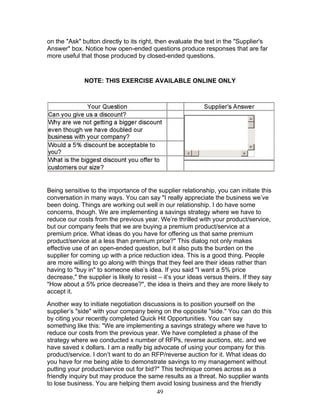
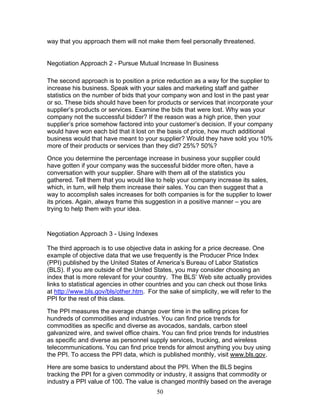
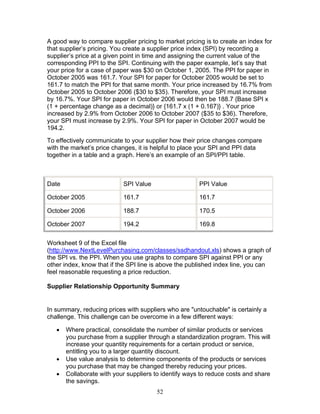
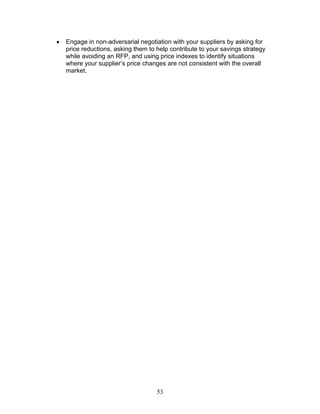
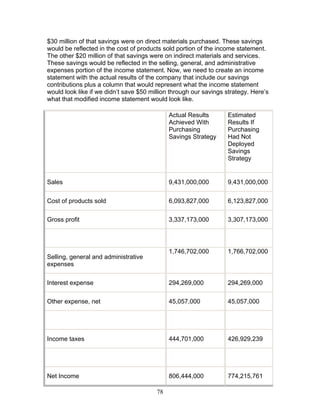
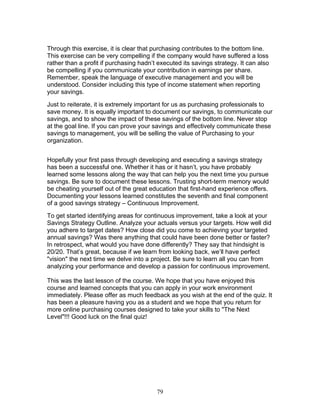
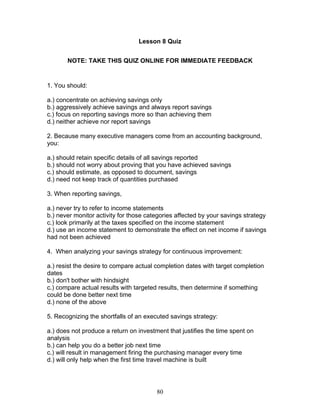
Savings Strategy Development

A Printer-Friendly Version Of The Online Class Material From

Please note the following recommendations:
Use this document only for future reference when finished with the class. It is recommended
that you use the online version of this material during the time that you have access to the
class. When accessing the class online, you can:
Engage in the interactive exercises
Send questions to an instructor
Take quizzes with immediate feedback

Earn your Certificate of Completion by correctly answering at least 28 of the 40
quiz questions

This material is protected under copyright law and may not be distributed
to any person other than the individual to whom it was delivered by Next
Level Purchasing, Inc.
TABLE OF CONTENTS

Lesson
Lesson 1 - Executive View of Purchasing Savings & Savings Definitions
Lesson 2 - Avoidance Definitions & Outlining A Savings Strategy
Lesson 3 - Spend Categorization & Analysis
Lesson 4 - Quick Hit Opportunities
Lesson 5 - Supplier Relationship Opportunities
Lesson 6 - The 10 Phase Approach To World Class Sourcing (Part I)
Lesson 7 - The 10 Phase Approach To World Class Sourcing (Part II)
Lesson 8 - Reporting Savings & Continuous Improvement

Page
1
14
22
34
44
55
68
77
Lesson 1 - Executive View of Purchasing Savings & Savings Definitions
Saving money for our organizations is arguably the #1 reason that the
purchasing profession exists. Sure, we purchasing professionals do an
impeccable job of supporting our operations, ensuring that all business
transactions are ethical, protecting our organizations from undue risk, and so
forth. But it is our contribution to the bottom line through savings that justifies our
paycheck. An organization may not be able to measure a return on its investment
in human resources for many of its functions. The return on investment in the
purchasing function can be measured very easily – we can show that for the
money invested in our salaries and benefits, we save (hopefully, a larger amount
of) money that goes to our organizations’ profits. Because this type of visibility
can result in senior management’s expectations of strong performance, it is
critical to develop and execute a strategy that maximizes savings.
This course will take you step-by-step through the process of developing and
executing a savings strategy. This process is written so that you can apply it to
your company, irrespective of the industry. We will begin by discussing an
executive view of purchasing savings and will define savings in this lesson. In
the next several lessons, we will outline a savings strategy and explain each
component of that strategy.
Let’s begin by talking about savings from an executive perspective. For
executives like CEO’s and CFO’s, the most important result of their businesses’
operations is profit. Simplified, profit is the amount by which revenues (monetary
value coming into the company) exceed expenses and taxes (monetary value
leaving the company). CEO’s and CFO’s spend their energies trying to maximize
profit. Most CEO’s and CFO’s set an annual goal of earning more profit than the
organization earned in the previous year. There are two ways of increasing profit:
increasing revenues and/or decreasing expenses. As a fellow purchasing
professional, you know that we are relied upon primarily to decrease expenses.
In other words, we save money.
Many purchasing professionals think that because we save money, thus
supporting the goal of our executive management to increase profits, that we will
be recognized as valuable to the organization. This is not necessarily true. There
is an important job of communicating our value to executive management that
needs to follow our savings efforts. This communication must be done in a way
that is probably different than most of us are used to. CEO’s and CFO’s often
come from an accounting background. To communicate effectively to CEO’s and
CFO’s, you must speak their language – the language of accounting.
We’ll teach you a little portion of the accounting language. Allow us to introduce
you to an accounting document called an income statement. Income statements,
also called statements of operations, profit and loss statements, P&L’s, etc.,
essentially show you a monetary value for revenue or sales, monetary values for
different categories of expenses and taxes, and the difference between the two.
If this difference is a positive value, it is referred to as net income, or profit. If this
difference is a negative value, it is referred to as a net loss, or loss.
1
Income Statement Examples
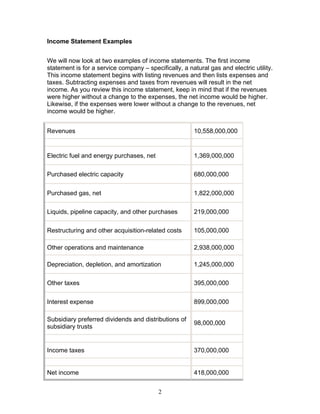
We will now look at two examples of income statements. The first income
statement is for a service company – specifically, a natural gas and electric utility.
This income statement begins with listing revenues and then lists expenses and
taxes. Subtracting expenses and taxes from revenues will result in the net
income. As you review this income statement, keep in mind that if the revenues
were higher without a change to the expenses, the net income would be higher.
Likewise, if the expenses were lower without a change to the revenues, net
income would be higher.
Revenues

10,558,000,000

Electric fuel and energy purchases, net

1,369,000,000

Purchased electric capacity

680,000,000

Purchased gas, net

1,822,000,000

Liquids, pipeline capacity, and other purchases

219,000,000

Restructuring and other acquisition-related costs

105,000,000

Other operations and maintenance

2,938,000,000

Depreciation, depletion, and amortization

1,245,000,000

Other taxes

395,000,000

Interest expense

899,000,000

Subsidiary preferred dividends and distributions of
subsidiary trusts

98,000,000

Income taxes

370,000,000

Net income

418,000,000
2
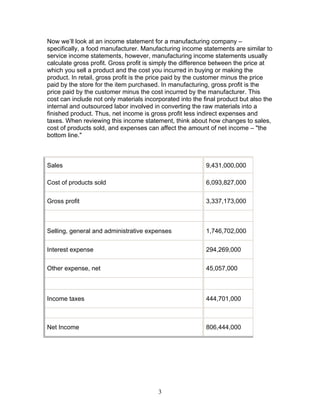
Now we’ll look at an income statement for a manufacturing company –
specifically, a food manufacturer. Manufacturing income statements are similar to
service income statements, however, manufacturing income statements usually
calculate gross profit. Gross profit is simply the difference between the price at
which you sell a product and the cost you incurred in buying or making the
product. In retail, gross profit is the price paid by the customer minus the price
paid by the store for the item purchased. In manufacturing, gross profit is the
price paid by the customer minus the cost incurred by the manufacturer. This
cost can include not only materials incorporated into the final product but also the
internal and outsourced labor involved in converting the raw materials into a
finished product. Thus, net income is gross profit less indirect expenses and
taxes. When reviewing this income statement, think about how changes to sales,
cost of products sold, and expenses can affect the amount of net income – "the
bottom line."

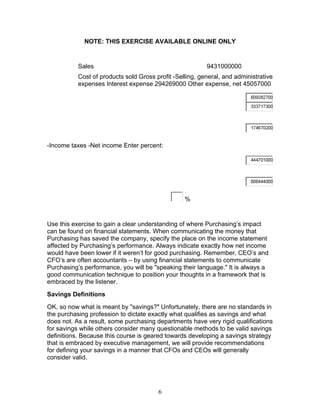
Sales

9,431,000,000

Cost of products sold

6,093,827,000

Gross profit

3,337,173,000

Selling, general and administrative expenses

1,746,702,000

Interest expense

294,269,000

Other expense, net

45,057,000

Income taxes

444,701,000

Net Income

806,444,000

3
Income Statement Line Item Explanation
If you have begun asking yourself "what does all of this bean counting have to do
with purchasing?” wonder no more. As we have mentioned earlier, the
purchasing function reduces expenses through the savings that we generate.
Because financial statements are so near and dear to the hearts of our executive
management, it is important to know what part of the income statement is
affected by our savings. We will refer to the manufacturer’s income statement to
illustrate where purchasing impact is felt. Specifically, we will look at each of
these line items: sales; cost of products sold; selling, general, and administrative
expenses; interest expense; other expense, net; and income taxes.
Sales: While purchasing can help sales figures by ensuring that supplier
performance gives our company products or services that meet the
marketplace’s cost, delivery, quality, and service demands, it is difficult to
quantify the real impact that purchasing has on sales. Therefore, for the
purposes of this discussion, we will say that purchasing does not affect this line
item on the income statement.
Cost of products sold: Because this line item includes the costs of materials and
outsourced services involved in producing a finished product, purchasing
definitely impacts this line item. However, because this line item includes costs
associated with internal labor, purchasing may not be able to have 100% control
over the amount of the cost of products.
Selling, general, and administrative expenses: This line item includes expenses
not considered to be directly allocated to producing the products to be sold. It
includes a variety of types of expenses: from office supplies to utilities; from
salaries to facility lease payments; and from employee benefits to advertising.
Therefore, it is easy to see that purchasing can impact a portion of this expense,
but not all of it.
Interest expense: This line item covers all expenses related to interest incurred
by a company. A company may be financing its purchases of facilities or vehicles
or may have taken out loans for operating capital. Interest incurred on those
financing activities is captured in this line item. Purchasing generally does not get
involved in financing transactions, so we will consider this expense outside of the
scope of the purchasing function.
Other expense, net: This line item captures all expenses that Generally Accepted
Accounting Principles deem unallocable into the foregoing categories. Because
the expenses captured in this category are commonly unusual expenses and
relatively small compared to the expenses in the aforementioned categories, we
will consider them to be outside of Purchasing’s control.
Income taxes: Unless someone can show me an example of how purchasing
negotiated favorable treatment from the government, this category will be
outside of Purchasing’s control also.
4
Purchasing Impact Exercise
Now that we have examined those areas where Purchasing’s impact can be felt,
it is time to engage in an exercise to demonstrate how our impact affects an
income statement. We’ll see how much better purchasing performance improves
profits. And, remember, improving profits is commonly the #1 goal of CEO’s and
CFO’s.
Before beginning this exercise, we must clearly state our assumptions. Here they
are:
•
•

•

•
•

Sales will remain constant
We’ll consider Purchasing to have the capability of impacting 50% of cost
of products sold. The other half will be considered to be comprised of
costs associated with internal labor.
We’ll consider Purchasing to have the capability of impacting 50% of
selling, general, and administrative expenses. The other half will be
considered to be comprised of costs associated with salaries, benefits,
and the like.
We’ll consider Purchasing to have no impact on interest expense or other
expense
The income tax rate (approximately 35.5%) will stay the same. Thus, if net
income before taxes increases as a result of decreased expenses, the
amount of taxes paid will increase.

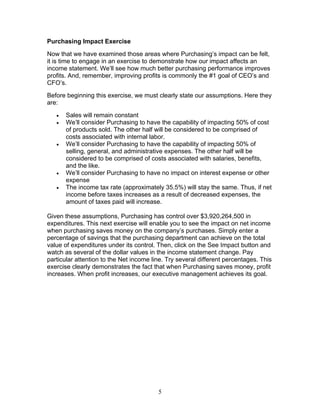
Given these assumptions, Purchasing has control over $3,920,264,500 in
expenditures. This next exercise will enable you to see the impact on net income
when purchasing saves money on the company’s purchases. Simply enter a
percentage of savings that the purchasing department can achieve on the total
value of expenditures under its control. Then, click on the See Impact button and
watch as several of the dollar values in the income statement change. Pay
particular attention to the Net income line. Try several different percentages. This
exercise clearly demonstrates the fact that when Purchasing saves money, profit
increases. When profit increases, our executive management achieves its goal.

5
NOTE: THIS EXERCISE AVAILABLE ONLINE ONLY

Sales

9431000000

Cost of products sold Gross profit -Selling, general, and administrative
expenses Interest expense 294269000 Other expense, net 45057000

-Income taxes -Net income Enter percent:

%

Use this exercise to gain a clear understanding of where Purchasing’s impact
can be found on financial statements. When communicating the money that
Purchasing has saved the company, specify the place on the income statement
affected by Purchasing’s performance. Always indicate exactly how net income
would have been lower if it weren’t for good purchasing. Remember, CEO’s and
CFO’s are often accountants – by using financial statements to communicate
Purchasing’s performance, you will be "speaking their language." It is always a
good communication technique to position your thoughts in a framework that is
embraced by the listener.
Savings Definitions
OK, so now what is meant by "savings?" Unfortunately, there are no standards in
the purchasing profession to dictate exactly what qualifies as savings and what
does not. As a result, some purchasing departments have very rigid qualifications
for savings while others consider many questionable methods to be valid savings
definitions. Because this course is geared towards developing a savings strategy
that is embraced by executive management, we will provide recommendations
for defining your savings in a manner that CFOs and CEOs will generally
consider valid.

6
In this section of the lesson, we will cover different savings types. Information
about each savings type will be broken down into four sections:
1.
2.
3.
4.

A definition of the savings type
The formula for calculating savings
An example scenario to which the savings type would apply
A calculation of the savings in the example scenario

All formulas are algebraic in nature. They calculate a result by performing
mathematical operations on variables. Variables are simply values in the formula
that change depending on the situation. For example, a formula may be cost =
price x quantity. Price and quantity are variables – they will change depending on
the situation. All formulas in this section use acronyms as the variables. Each
formula will then be followed by the word "Where" and a description of what each
variable represents. Therefore, you determine what the proper value of the
variable is and then plug that value into the formula.
For some savings types, the fourth section will be replaced by an exercise. In the
exercise, you will be asked to enter values for some of the variables. When you
click on the "Calculate" button, the total savings will be calculated and the correct
answer will appear on the screen directly below the values you entered. This will
allow you to check your understanding of how the savings types are calculated.
Alright. Let’s discuss some savings types…
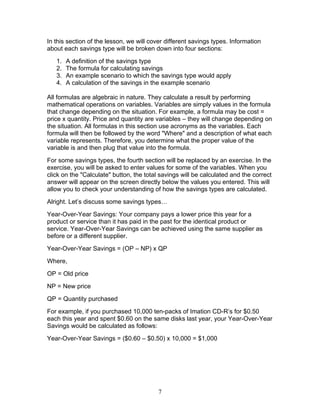
Year-Over-Year Savings: Your company pays a lower price this year for a
product or service than it has paid in the past for the identical product or
service. Year-Over-Year Savings can be achieved using the same supplier as
before or a different supplier.
Year-Over-Year Savings = (OP – NP) x QP
Where,
OP = Old price
NP = New price
QP = Quantity purchased
For example, if you purchased 10,000 ten-packs of Imation CD-R’s for $0.50
each this year and spent $0.60 on the same disks last year, your Year-Over-Year
Savings would be calculated as follows:
Year-Over-Year Savings = ($0.60 – $0.50) x 10,000 = $1,000

7
Payment Term Savings: Your company receives more favorable payment terms
for products or services purchased this year than it has received in the past for
the identical products or services or from the same supplier. Note that when your
company must pay earlier to receive a discount, your company's cost of money
must be factored into the calculation.
Payment Term Savings = {(ND – OD) – [(ON – NN) x (CM/365)]} x SP
Where, ND = New discount where percentages are written as numbers
with two decimal places (e.g., 2% = 0.02)
OD = Old discount where percentages are written as numbers with
two decimal places (e.g., 2% = 0.02)
ON = Old number of days in which payment is due
NN = New number of days in which payment is due
CM = Annual cost of money (i.e., the interest or other return earned
by your company through investing idle cash). This value can be
best estimated by your Finance department.
SP = Spend on the products and/or services to which the new
discount applies
For example, if you spend $10,000 with a supplier who has changed your
payment terms from Net 30 to 2%/10, Net 30 and your annual cost of money is
6%, your Payment Term Savings would be calculated as follows:
Payment Term Savings = {(0.02 – 0.00) – [(30 – 10) x (0.06/365)]} x $10,000 =
$167.12
Substitution Savings: Your company pays a lower price this year for a new
product or service than it has paid in the past for an old product or service that
served the same purpose. Note: If there is a degradation or improvement in
quality as a result of the substitution, you must adjust the savings such that it
reflects any costs or avoided costs as a result of the change in quality.
Substitution Savings = (OP – NP) x QP
Where,
OP = Price for old product or service
NP = Price for new product or service
QP = Quantity of new product or service purchased
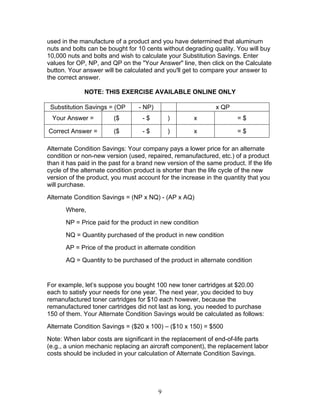
Now, you can calculate Substitution Savings through an exercise. In this
scenario, you used to buy for 20 cents each stainless steel nuts and bolts to be
8
used in the manufacture of a product and you have determined that aluminum
nuts and bolts can be bought for 10 cents without degrading quality. You will buy
10,000 nuts and bolts and wish to calculate your Substitution Savings. Enter
values for OP, NP, and QP on the "Your Answer" line, then click on the Calculate
button. Your answer will be calculated and you'll get to compare your answer to
the correct answer.
NOTE: THIS EXERCISE AVAILABLE ONLINE ONLY
Substitution Savings = (OP

- NP)

x QP

Your Answer =

($

-$

)

x

=$

Correct Answer =

($

-$

)

x

=$

Alternate Condition Savings: Your company pays a lower price for an alternate
condition or non-new version (used, repaired, remanufactured, etc.) of a product
than it has paid in the past for a brand new version of the same product. If the life
cycle of the alternate condition product is shorter than the life cycle of the new
version of the product, you must account for the increase in the quantity that you
will purchase.
Alternate Condition Savings = (NP x NQ) - (AP x AQ)
Where,
NP = Price paid for the product in new condition
NQ = Quantity purchased of the product in new condition
AP = Price of the product in alternate condition
AQ = Quantity to be purchased of the product in alternate condition

For example, let’s suppose you bought 100 new toner cartridges at $20.00
each to satisfy your needs for one year. The next year, you decided to buy
remanufactured toner cartridges for $10 each however, because the
remanufactured toner cartridges did not last as long, you needed to purchase
150 of them. Your Alternate Condition Savings would be calculated as follows:
Alternate Condition Savings = ($20 x 100) – ($10 x 150) = $500
Note: When labor costs are significant in the replacement of end-of-life parts
(e.g., a union mechanic replacing an aircraft component), the replacement labor
costs should be included in your calculation of Alternate Condition Savings.

9
Fee Waiver Savings: Your company is not charged certain incidental fees that
were paid in the past. Commonly waived fees include shipping, set up, and other
charges that are in addition to the direct cost of the product or service.
Fee Waiver Savings = AF x NT
Where,
AF = Amount of fee
NT = Number of times fee is waived

For example, you have previously paid an average of $5 in shipping charges per
shipment from a supplier who ships 1,000 boxes per year to you. If the supplier
waives shipping charges, your Fee Waiver Savings will be calculated as follows:
Fee Waiver Savings = $5 x 1,000 = $5,000

Specification Change Savings: Your company has changed its specification for a
product or service such that you will pay a lower price than you have in the past
for the product or service. Note: If the idea of modifying the specifications
originated in another department and that other department is responsible for
reporting cost savings, the purchasing department should not attempt to take
credit for the savings.
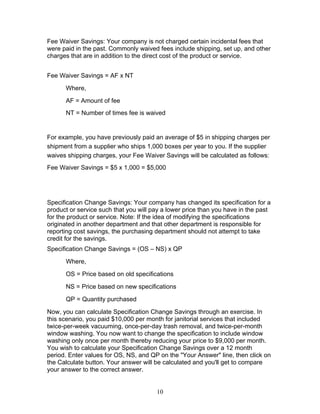
Specification Change Savings = (OS – NS) x QP
Where,
OS = Price based on old specifications
NS = Price based on new specifications
QP = Quantity purchased
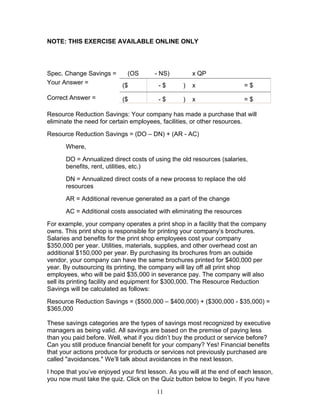
Now, you can calculate Specification Change Savings through an exercise. In
this scenario, you paid $10,000 per month for janitorial services that included
twice-per-week vacuuming, once-per-day trash removal, and twice-per-month
window washing. You now want to change the specification to include window
washing only once per month thereby reducing your price to $9,000 per month.
You wish to calculate your Specification Change Savings over a 12 month
period. Enter values for OS, NS, and QP on the "Your Answer" line, then click on
the Calculate button. Your answer will be calculated and you'll get to compare
your answer to the correct answer.

10
NOTE: THIS EXERCISE AVAILABLE ONLINE ONLY

Spec. Change Savings =
(OS
Your Answer =
($
Correct Answer =

($

- NS)

x QP

-$

)

x

=$

-$

)

x

=$

Resource Reduction Savings: Your company has made a purchase that will
eliminate the need for certain employees, facilities, or other resources.
Resource Reduction Savings = (DO – DN) + (AR - AC)
Where,
DO = Annualized direct costs of using the old resources (salaries,
benefits, rent, utilities, etc.)
DN = Annualized direct costs of a new process to replace the old
resources
AR = Additional revenue generated as a part of the change
AC = Additional costs associated with eliminating the resources
For example, your company operates a print shop in a facility that the company
owns. This print shop is responsible for printing your company’s brochures.
Salaries and benefits for the print shop employees cost your company
$350,000 per year. Utilities, materials, supplies, and other overhead cost an
additional $150,000 per year. By purchasing its brochures from an outside
vendor, your company can have the same brochures printed for $400,000 per
year. By outsourcing its printing, the company will lay off all print shop
employees, who will be paid $35,000 in severance pay. The company will also
sell its printing facility and equipment for $300,000. The Resource Reduction
Savings will be calculated as follows:
Resource Reduction Savings = ($500,000 – $400,000) + ($300,000 - $35,000) =
$365,000
These savings categories are the types of savings most recognized by executive
managers as being valid. All savings are based on the premise of paying less
than you paid before. Well, what if you didn’t buy the product or service before?
Can you still produce financial benefit for your company? Yes! Financial benefits
that your actions produce for products or services not previously purchased are
called "avoidances." We’ll talk about avoidances in the next lesson.
I hope that you’ve enjoyed your first lesson. As you will at the end of each lesson,
you now must take the quiz. Click on the Quiz button below to begin. If you have
11
any questions, please click on the Ask Charles! button below to ask a question
and get a response from your instructor by email within 24 hours.

12
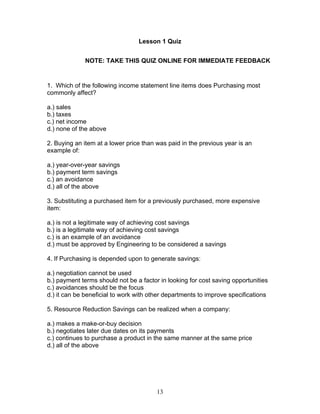
Lesson 1 Quiz
NOTE: TAKE THIS QUIZ ONLINE FOR IMMEDIATE FEEDBACK

1. Which of the following income statement line items does Purchasing most
commonly affect?
a.) sales
b.) taxes
c.) net income
d.) none of the above
2. Buying an item at a lower price than was paid in the previous year is an
example of:
a.) year-over-year savings
b.) payment term savings
c.) an avoidance
d.) all of the above
3. Substituting a purchased item for a previously purchased, more expensive
item:
a.) is not a legitimate way of achieving cost savings
b.) is a legitimate way of achieving cost savings
c.) is an example of an avoidance
d.) must be approved by Engineering to be considered a savings
4. If Purchasing is depended upon to generate savings:
a.) negotiation cannot be used
b.) payment terms should not be a factor in looking for cost saving opportunities
c.) avoidances should be the focus
d.) it can be beneficial to work with other departments to improve specifications
5. Resource Reduction Savings can be realized when a company:
a.) makes a make-or-buy decision
b.) negotiates later due dates on its payments
c.) continues to purchase a product in the same manner at the same price
d.) all of the above

13
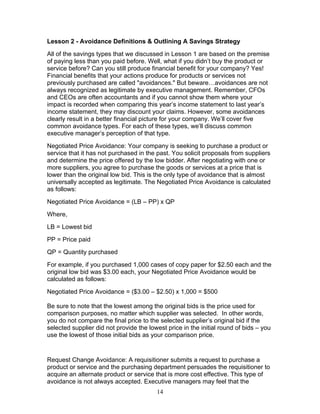
Lesson 2 - Avoidance Definitions & Outlining A Savings Strategy
All of the savings types that we discussed in Lesson 1 are based on the premise
of paying less than you paid before. Well, what if you didn’t buy the product or
service before? Can you still produce financial benefit for your company? Yes!
Financial benefits that your actions produce for products or services not
previously purchased are called "avoidances." But beware…avoidances are not
always recognized as legitimate by executive management. Remember, CFOs
and CEOs are often accountants and if you cannot show them where your
impact is recorded when comparing this year’s income statement to last year’s
income statement, they may discount your claims. However, some avoidances
clearly result in a better financial picture for your company. We’ll cover five
common avoidance types. For each of these types, we’ll discuss common
executive manager’s perception of that type.
Negotiated Price Avoidance: Your company is seeking to purchase a product or
service that it has not purchased in the past. You solicit proposals from suppliers
and determine the price offered by the low bidder. After negotiating with one or
more suppliers, you agree to purchase the goods or services at a price that is
lower than the original low bid. This is the only type of avoidance that is almost
universally accepted as legitimate. The Negotiated Price Avoidance is calculated
as follows:
Negotiated Price Avoidance = (LB – PP) x QP
Where,
LB = Lowest bid
PP = Price paid
QP = Quantity purchased
For example, if you purchased 1,000 cases of copy paper for $2.50 each and the
original low bid was $3.00 each, your Negotiated Price Avoidance would be
calculated as follows:
Negotiated Price Avoidance = ($3.00 – $2.50) x 1,000 = $500
Be sure to note that the lowest among the original bids is the price used for
comparison purposes, no matter which supplier was selected. In other words,
you do not compare the final price to the selected supplier’s original bid if the
selected supplier did not provide the lowest price in the initial round of bids – you
use the lowest of those initial bids as your comparison price.

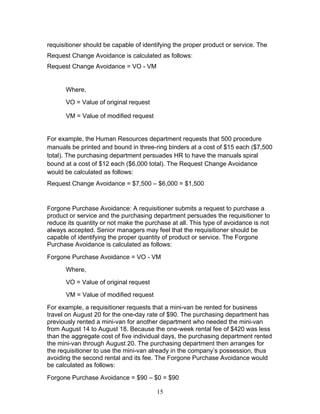
Request Change Avoidance: A requisitioner submits a request to purchase a
product or service and the purchasing department persuades the requisitioner to
acquire an alternate product or service that is more cost effective. This type of
avoidance is not always accepted. Executive managers may feel that the
14
requisitioner should be capable of identifying the proper product or service. The
Request Change Avoidance is calculated as follows:
Request Change Avoidance = VO - VM

Where,
VO = Value of original request
VM = Value of modified request

For example, the Human Resources department requests that 500 procedure
manuals be printed and bound in three-ring binders at a cost of $15 each ($7,500
total). The purchasing department persuades HR to have the manuals spiral
bound at a cost of $12 each ($6,000 total). The Request Change Avoidance
would be calculated as follows:
Request Change Avoidance = $7,500 – $6,000 = $1,500

Forgone Purchase Avoidance: A requisitioner submits a request to purchase a
product or service and the purchasing department persuades the requisitioner to
reduce its quantity or not make the purchase at all. This type of avoidance is not
always accepted. Senior managers may feel that the requisitioner should be
capable of identifying the proper quantity of product or service. The Forgone
Purchase Avoidance is calculated as follows:
Forgone Purchase Avoidance = VO - VM
Where,
VO = Value of original request
VM = Value of modified request
For example, a requisitioner requests that a mini-van be rented for business
travel on August 20 for the one-day rate of $90. The purchasing department has
previously rented a mini-van for another department who needed the mini-van
from August 14 to August 18. Because the one-week rental fee of $420 was less
than the aggregate cost of five individual days, the purchasing department rented
the mini-van through August 20. The purchasing department then arranges for
the requisitioner to use the mini-van already in the company’s possession, thus
avoiding the second rental and its fee. The Forgone Purchase Avoidance would
be calculated as follows:
Forgone Purchase Avoidance = $90 – $0 = $90
15
Inventory Reduction Avoidance: You determine that inventory levels are too high
and decide to reduce the quantity of certain items that are kept in stock without
substantially increasing the number of times that you order the items. There are
many costs associated with inventory: the cost of money that could have been
invested rather than spent on inventory, the costs associated with storage,
insurance costs, and so forth. These costs are collectively called "carrying costs."
Many companies estimate their annual carrying costs to be 20% to 30% of the
value of items in inventory. Your Finance department may have an estimate of
the carrying cost percentage that your company uses. This type of avoidance is
not always accepted. Senior managers may feel that a small reduction of its total
inventory does not necessarily eliminate many of the costs that comprise the
carrying costs – they cannot lay off any employees, divest any facilities, etc. It is
difficult to prove exactly where a small Inventory Reduction Avoidance would
impact the income statement. The Inventory Reduction Avoidance, which is
expressed as an annualized value, is calculated as follows:
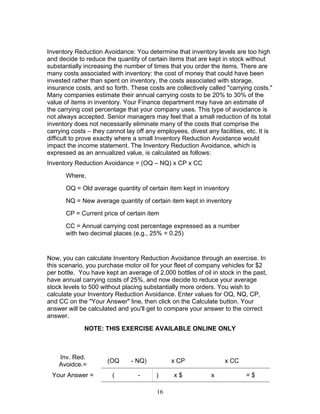
Inventory Reduction Avoidance = (OQ – NQ) x CP x CC
Where,
OQ = Old average quantity of certain item kept in inventory
NQ = New average quantity of certain item kept in inventory
CP = Current price of certain item
CC = Annual carrying cost percentage expressed as a number
with two decimal places (e.g., 25% = 0.25)

Now, you can calculate Inventory Reduction Avoidance through an exercise. In
this scenario, you purchase motor oil for your fleet of company vehicles for $2
per bottle. You have kept an average of 2,000 bottles of oil in stock in the past,
have annual carrying costs of 25%, and now decide to reduce your average
stock levels to 500 without placing substantially more orders. You wish to
calculate your Inventory Reduction Avoidance. Enter values for OQ, NQ, CP,
and CC on the "Your Answer" line, then click on the Calculate button. Your
answer will be calculated and you'll get to compare your answer to the correct
answer.
NOTE: THIS EXERCISE AVAILABLE ONLINE ONLY

Inv. Red.
Avoidce.=

(OQ

- NQ)

Your Answer =

(

-

x CP
)
16

x$

x CC
x

=$
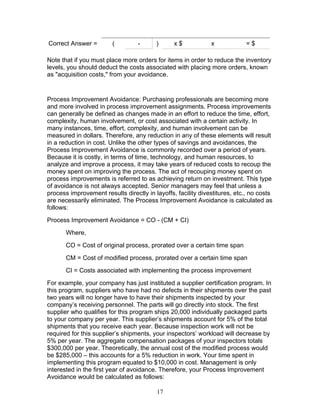
Correct Answer =

(

-

)

x$

x

=$

Note that if you must place more orders for items in order to reduce the inventory
levels, you should deduct the costs associated with placing more orders, known
as "acquisition costs," from your avoidance.

Process Improvement Avoidance: Purchasing professionals are becoming more
and more involved in process improvement assignments. Process improvements
can generally be defined as changes made in an effort to reduce the time, effort,
complexity, human involvement, or cost associated with a certain activity. In
many instances, time, effort, complexity, and human involvement can be
measured in dollars. Therefore, any reduction in any of these elements will result
in a reduction in cost. Unlike the other types of savings and avoidances, the
Process Improvement Avoidance is commonly recorded over a period of years.
Because it is costly, in terms of time, technology, and human resources, to
analyze and improve a process, it may take years of reduced costs to recoup the
money spent on improving the process. The act of recouping money spent on
process improvements is referred to as achieving return on investment. This type
of avoidance is not always accepted. Senior managers may feel that unless a
process improvement results directly in layoffs, facility divestitures, etc., no costs
are necessarily eliminated. The Process Improvement Avoidance is calculated as
follows:
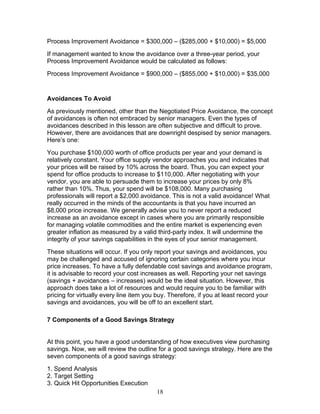
Process Improvement Avoidance = CO - (CM + CI)
Where,
CO = Cost of original process, prorated over a certain time span
CM = Cost of modified process, prorated over a certain time span
CI = Costs associated with implementing the process improvement
For example, your company has just instituted a supplier certification program. In
this program, suppliers who have had no defects in their shipments over the past
two years will no longer have to have their shipments inspected by your
company’s receiving personnel. The parts will go directly into stock. The first
supplier who qualifies for this program ships 20,000 individually packaged parts
to your company per year. This supplier’s shipments account for 5% of the total
shipments that you receive each year. Because inspection work will not be
required for this supplier’s shipments, your inspectors’ workload will decrease by
5% per year. The aggregate compensation packages of your inspectors totals
$300,000 per year. Theoretically, the annual cost of the modified process would
be $285,000 – this accounts for a 5% reduction in work. Your time spent in
implementing this program equated to $10,000 in cost. Management is only
interested in the first year of avoidance. Therefore, your Process Improvement
Avoidance would be calculated as follows:
17
Process Improvement Avoidance = $300,000 – ($285,000 + $10,000) = $5,000
If management wanted to know the avoidance over a three-year period, your
Process Improvement Avoidance would be calculated as follows:
Process Improvement Avoidance = $900,000 – ($855,000 + $10,000) = $35,000

Avoidances To Avoid
As previously mentioned, other than the Negotiated Price Avoidance, the concept
of avoidances is often not embraced by senior managers. Even the types of
avoidances described in this lesson are often subjective and difficult to prove.
However, there are avoidances that are downright despised by senior managers.
Here’s one:
You purchase $100,000 worth of office products per year and your demand is
relatively constant. Your office supply vendor approaches you and indicates that
your prices will be raised by 10% across the board. Thus, you can expect your
spend for office products to increase to $110,000. After negotiating with your
vendor, you are able to persuade them to increase your prices by only 8%
rather than 10%. Thus, your spend will be $108,000. Many purchasing
professionals will report a $2,000 avoidance. This is not a valid avoidance! What
really occurred in the minds of the accountants is that you have incurred an
$8,000 price increase. We generally advise you to never report a reduced
increase as an avoidance except in cases where you are primarily responsible
for managing volatile commodities and the entire market is experiencing even
greater inflation as measured by a valid third-party index. It will undermine the
integrity of your savings capabilities in the eyes of your senior management.
These situations will occur. If you only report your savings and avoidances, you
may be challenged and accused of ignoring certain categories where you incur
price increases. To have a fully defendable cost savings and avoidance program,
it is advisable to record your cost increases as well. Reporting your net savings
(savings + avoidances – increases) would be the ideal situation. However, this
approach does take a lot of resources and would require you to be familiar with
pricing for virtually every line item you buy. Therefore, if you at least record your
savings and avoidances, you will be off to an excellent start.
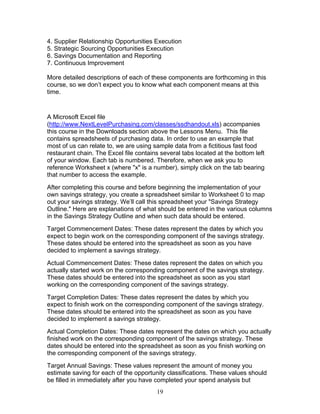
7 Components of a Good Savings Strategy

At this point, you have a good understanding of how executives view purchasing
savings. Now, we will review the outline for a good savings strategy. Here are the
seven components of a good savings strategy:
1. Spend Analysis
2. Target Setting
3. Quick Hit Opportunities Execution
18
4. Supplier Relationship Opportunities Execution
5. Strategic Sourcing Opportunities Execution
6. Savings Documentation and Reporting
7. Continuous Improvement
More detailed descriptions of each of these components are forthcoming in this
course, so we don’t expect you to know what each component means at this
time.

A Microsoft Excel file
(http://www.NextLevelPurchasing.com/classes/ssdhandout.xls) accompanies
this course in the Downloads section above the Lessons Menu. This file
contains spreadsheets of purchasing data. In order to use an example that
most of us can relate to, we are using sample data from a fictitious fast food
restaurant chain. The Excel file contains several tabs located at the bottom left
of your window. Each tab is numbered. Therefore, when we ask you to
reference Worksheet x (where "x" is a number), simply click on the tab bearing
that number to access the example.
After completing this course and before beginning the implementation of your
own savings strategy, you create a spreadsheet similar to Worksheet 0 to map
out your savings strategy. We’ll call this spreadsheet your "Savings Strategy
Outline." Here are explanations of what should be entered in the various columns
in the Savings Strategy Outline and when such data should be entered.
Target Commencement Dates: These dates represent the dates by which you
expect to begin work on the corresponding component of the savings strategy.
These dates should be entered into the spreadsheet as soon as you have
decided to implement a savings strategy.
Actual Commencement Dates: These dates represent the dates on which you
actually started work on the corresponding component of the savings strategy.
These dates should be entered into the spreadsheet as soon as you start
working on the corresponding component of the savings strategy.
Target Completion Dates: These dates represent the dates by which you
expect to finish work on the corresponding component of the savings strategy.
These dates should be entered into the spreadsheet as soon as you have
decided to implement a savings strategy.
Actual Completion Dates: These dates represent the dates on which you actually
finished work on the corresponding component of the savings strategy. These
dates should be entered into the spreadsheet as soon as you finish working on
the corresponding component of the savings strategy.
Target Annual Savings: These values represent the amount of money you
estimate saving for each of the opportunity classifications. These values should
be filled in immediately after you have completed your spend analysis but
19
before acting on any of the opportunities.
Actual Annual Savings: These values represent the amount of money you expect
to save or have saved after executing the corresponding opportunity
classification. These values should be filled in immediately after signing any
contracts for goods and/or services in the corresponding opportunity
classification. These values should be updated frequently and finalized at the end
of the accounting year to document actual savings.
In the next lesson, we will begin going over each of the seven components of a
good savings strategy.

20
Lesson 2 Quiz
NOTE: TAKE THIS QUIZ ONLINE FOR IMMEDIATE FEEDBACK

1. Which of the following is true?
a.) An avoidance is realized when you have achieved a cost reduction on a
product or service that you did not purchase in the past
b.) Avoidances are generally not as easily accepted as savings by executive
management
c.) A lesser than originally proposed price increase should not be mistaken for an
avoidance
d.) All of the above
2. A reduction in inventory:
a.) is obviously a savings, not an avoidance
b.) is not associated with a reduction in carrying costs
c.) can result in the avoidance of carrying costs expressed as a percentage of the
value of the inventory
d.) all of the above
3. Process Improvement Avoidances have a higher probability of being
recognized as legitimate if:
a.) layoffs are avoided
b.) staffing is reduced and facilities are divested
c.) facilities are added
d.) carrying costs are calculated
4. If a supplier proposes a 12% price increase but, after negotiation, concedes to
a 5% increase, you should consider this scenario:
a.) a savings
b.) an avoidance
c.) a price increase
d.) breaking even
5. What should you do immediately before implementing a savings strategy?
a.) develop a Savings Strategy Outline
b.) set target completion dates for each component of the strategy
c.) set target dollar values for savings
d.) all of the above

21
Lesson 3 - Spend Categorization & Analysis
During this lesson, you will be given instructions on how to manipulate
spreadsheets containing your company’s purchasing data. However, we
recommend trying these exercises using the sample spreadsheets first so that
you can compare the results of the exercises that you complete with our versions
of the same exercises before you manipulate your own data.
While many students taking this class have already taken Microsoft Excel For
Purchasing Professionals and, therefore, will know how to apply the Excel
techniques used in this class, we have made instructions available for certain
Excel techniques that will be required to manipulate the spreadsheets. Where we
give instructions on what to do in Excel, we will follow those instructions with the
underlined word "(How?)". To open a pop-up box with specific instructions,
simply click on "(How?)". This pop-up box will provide the commands that you will
need to execute on the sample spreadsheets to complete the exercise.
Before beginning work on the spreadsheet, we recommend that you save the
Excel file under a second file name. This will enable you to always have the
original copy just in case you make changes and wish to save your changes
while also preserving the original data.

What Do You Buy?
The first component of a good savings strategy is spend analysis - assessing
exactly what you buy. You probably have some type of computerized records of
either purchases or payments for purchases. Perhaps these records exist in your
purchasing system or your accounts payable system. You need to extract these
records of your purchases into a format that will enable you to analyze them.
Unless your organization has invested in one of the feature-rich spend analysis
tools on the market, Microsoft Excel is perhaps the most user-friendly tool
available when it comes to analyzing data.
For the purpose of this class, we’ll assume that Excel will be your software of
choice for spend analysis.
Unless you already have access to a data warehouse, you must request that
your IT department extract your purchasing records from your purchasing or A/P
system into Excel. This extraction is simply called a "data dump." It would be
optimal if your data dump contained at least one year of purchasing transactions.
We recommend that this year be the financial reporting year of your company.
The most compelling way to illustrate Purchasing’s value to CFOs and CEOs
(who are often accountants), is to examine two year’s financial statements and
show exactly how Purchasing made improvements from one year to the next.
However, some versions of Excel limit the number of records in a spreadsheet to
approximately 65,000. Therefore, it may be necessary for you to accept less than
a year’s worth of data. If you must accept less than a year’s worth of data, select
22
the month or months that would represent the most typical months from a
purchasing pattern perspective. If your business is cyclical (consistently less or
more busy at certain times of the year), you should select months that are neither
at the peak nor at the trough of your business cycle.
Here are guidelines that you can provide to your IT department when requesting
your data dump:
One year’s worth of purchasing transactions exported into a Microsoft Excel
spreadsheet. The fields that should be included are:
•
•
•
•
•
•
•
•
•

Date of transaction
Part number (if used)
Description of product or service purchased
Unit of measure
Supplier
Category or Commodity (if available)
Quantity purchased
Unit price
Extended price (quantity x price)

Other fields are acceptable. You may use this spreadsheet for other analyses, so
having things like PO number, receiving information, and other data will not hurt.
Open up the Excel file that accompanies this class
(http://www.NextLevelPurchasing.com/classes/ssdhandout.xls). Click on
Worksheet 1. This is an example of a data dump for our fictitious fast food
restaurant.
When we have advised certain individuals to consult their IT department for
purchasing data, we have met resistance: "We can’t ask I.T. to do THAT!"
Believe it or not, extracting information from your system’s database into an
Excel spreadsheet is not that difficult. You will not be asking IT to do any
customization of your system, create new reports, or anything complex and time
consuming. All you need is the data in a spreadsheet where you will do the
analysis. Most of the techniques taught in this course are dependent upon having
this information, so you cannot develop your savings strategy unless you follow
this step. Don’t be shy!

23
Categorizing Purchases
Some purchasing systems require that a commodity or category code be
assigned to each purchase order or line item. If your data does not have a
commodity or category code (we’ll call either of these "categories") associated
with each transaction, this section will teach you strategies for categorizing the
transactions in your data dump. If your data does have categories associated
with each transaction, you will avoid having to do a lot of work. However, this
section will still have value to you because you may want to restructure your
categories so that they optimally support the development of your savings
strategy.
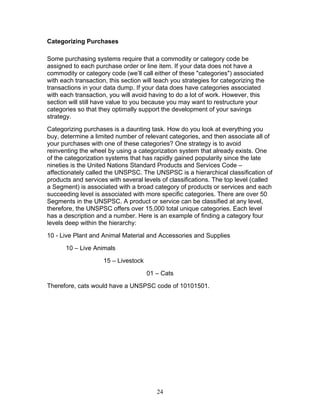
Categorizing purchases is a daunting task. How do you look at everything you
buy, determine a limited number of relevant categories, and then associate all of
your purchases with one of these categories? One strategy is to avoid
reinventing the wheel by using a categorization system that already exists. One
of the categorization systems that has rapidly gained popularity since the late
nineties is the United Nations Standard Products and Services Code –
affectionately called the UNSPSC. The UNSPSC is a hierarchical classification of
products and services with several levels of classifications. The top level (called
a Segment) is associated with a broad category of products or services and each
succeeding level is associated with more specific categories. There are over 50
Segments in the UNSPSC. A product or service can be classified at any level,
therefore, the UNSPSC offers over 15,000 total unique categories. Each level
has a description and a number. Here is an example of finding a category four
levels deep within the hierarchy:
10 - Live Plant and Animal Material and Accessories and Supplies
10 – Live Animals
15 – Livestock
01 – Cats
Therefore, cats would have a UNSPSC code of 10101501.

24
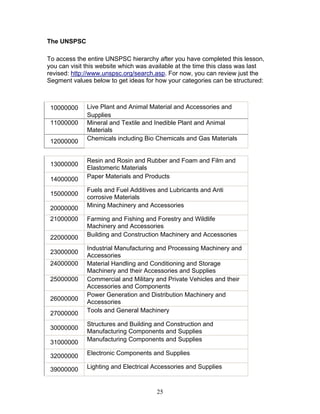
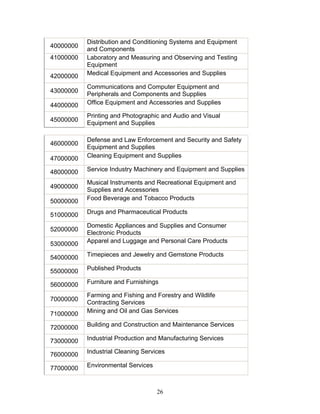
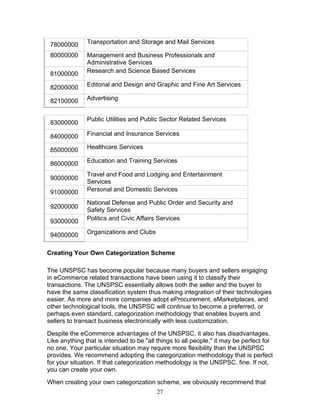
The UNSPSC
To access the entire UNSPSC hierarchy after you have completed this lesson,
you can visit this website which was available at the time this class was last
revised: http://www.unspsc.org/search.asp. For now, you can review just the
Segment values below to get ideas for how your categories can be structured:

10000000
11000000
12000000

13000000
14000000
15000000
20000000
21000000
22000000
23000000
24000000
25000000
26000000
27000000

Live Plant and Animal Material and Accessories and
Supplies
Mineral and Textile and Inedible Plant and Animal
Materials
Chemicals including Bio Chemicals and Gas Materials

Resin and Rosin and Rubber and Foam and Film and
Elastomeric Materials
Paper Materials and Products
Fuels and Fuel Additives and Lubricants and Anti
corrosive Materials
Mining Machinery and Accessories
Farming and Fishing and Forestry and Wildlife
Machinery and Accessories
Building and Construction Machinery and Accessories
Industrial Manufacturing and Processing Machinery and
Accessories
Material Handling and Conditioning and Storage
Machinery and their Accessories and Supplies
Commercial and Military and Private Vehicles and their
Accessories and Components
Power Generation and Distribution Machinery and
Accessories
Tools and General Machinery

31000000

Structures and Building and Construction and
Manufacturing Components and Supplies

32000000

Electronic Components and Supplies

39000000

Lighting and Electrical Accessories and Supplies

30000000

25
40000000
41000000
42000000
43000000
44000000
45000000

Distribution and Conditioning Systems and Equipment
and Components
Laboratory and Measuring and Observing and Testing
Equipment
Medical Equipment and Accessories and Supplies
Communications and Computer Equipment and
Peripherals and Components and Supplies
Office Equipment and Accessories and Supplies
Printing and Photographic and Audio and Visual
Equipment and Supplies

47000000

Defense and Law Enforcement and Security and Safety
Equipment and Supplies
Cleaning Equipment and Supplies

48000000

Service Industry Machinery and Equipment and Supplies

46000000

50000000

Musical Instruments and Recreational Equipment and
Supplies and Accessories
Food Beverage and Tobacco Products

51000000

Drugs and Pharmaceutical Products

49000000

53000000

Domestic Appliances and Supplies and Consumer
Electronic Products
Apparel and Luggage and Personal Care Products

54000000

Timepieces and Jewelry and Gemstone Products

55000000

Published Products

56000000

Furniture and Furnishings

52000000

71000000

Farming and Fishing and Forestry and Wildlife
Contracting Services
Mining and Oil and Gas Services

72000000

Building and Construction and Maintenance Services

73000000

Industrial Production and Manufacturing Services

76000000

Industrial Cleaning Services

77000000

Environmental Services

70000000

26
78000000

Transportation and Storage and Mail Services

80000000
81000000

Management and Business Professionals and
Administrative Services
Research and Science Based Services

82000000

Editorial and Design and Graphic and Fine Art Services

82100000

Advertising

83000000

Public Utilities and Public Sector Related Services

84000000

Financial and Insurance Services

85000000

Healthcare Services

86000000

Education and Training Services

90000000
91000000

Travel and Food and Lodging and Entertainment
Services
Personal and Domestic Services

93000000

National Defense and Public Order and Security and
Safety Services
Politics and Civic Affairs Services

94000000

Organizations and Clubs

92000000

Creating Your Own Categorization Scheme
The UNSPSC has become popular because many buyers and sellers engaging
in eCommerce related transactions have been using it to classify their
transactions. The UNSPSC essentially allows both the seller and the buyer to
have the same classification system thus making integration of their technologies
easier. As more and more companies adopt eProcurement, eMarketplaces, and
other technological tools, the UNSPSC will continue to become a preferred, or
perhaps even standard, categorization methodology that enables buyers and
sellers to transact business electronically with less customization.
Despite the eCommerce advantages of the UNSPSC, it also has disadvantages.
Like anything that is intended to be "all things to all people," it may be perfect for
no one. Your particular situation may require more flexibility than the UNSPSC
provides. We recommend adopting the categorization methodology that is perfect
for your situation. If that categorization methodology is the UNSPSC, fine. If not,
you can create your own.
When creating your own categorization scheme, we obviously recommend that
27
you gear it to your needs from a purchasing perspective. Create your categories
such that suppliers that offer similar products or services are in the same
category. We call this "Think RFP Categorization." In other words, think of all
items that could be grouped into a single Request For Proposal and be awarded
to a single supplier. When developing your categories based on Think RFP
Categorization, you do have to find the right balance between being too specific
and not being specific enough.
For example, if your company buys computers and computer components, you
may think that you need a category for hard drives and a separate category for
CD-RW drives. You may be thinking that you could group all of your
requirements for various hard drives into a single RFP and award the contract to
a single bidder. You may think the same about your requirements for CD-RW
drives and prepare a second RFP. However, you may find that most computer
peripheral distributors sell both hard drives and CD-RW drives. As such, you
could do an RFP that included both hard drives and CD-RW drives and award
the contract to a single bidder. Therefore, it would make more sense to have a
more general category such as "Computer Components" that included hard
drives, CD-RW drives, modems, and other componentry that is available from the
same group of suppliers.
The opposite situation can also be true – your categories may be too general. A
great example is office supplies. Look around your desk right now. Almost
anything you see could be considered by someone to be an "office supply." But it
does not always make sense to buy all of these things from a single source. For
example, copier paper can often be purchased up to 20% less expensively from
a paper distributor compared to an office supply vendor. Therefore, it may make
sense to have a category for copier paper that is separate from the office
supplies category because you would want to do separate RFPs and/or have
separate contracts.
If you are having difficulty determining which categories to select, a short
analysis exercise can help. After you have received your data dump with noncategorized transactions, create a PivotTable so that your supplier names are
in each row with the total amount that you spent with each supplier appears to
the right of each supplier name. (How?) Next, sort the PivotTable so that it is in
descending order with the supplier with the most spend on top and the supplier
with the least spend on the bottom. (How?) You can practice creating this
PivotTable by using Worksheet 1 in the Sample Excel File
(http://www.NextLevelPurchasing.com/classes/ssdhandout.xls). Worksheet 2
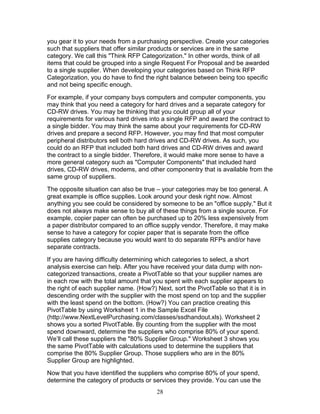
shows you a sorted PivotTable. By counting from the supplier with the most
spend downward, determine the suppliers who comprise 80% of your spend.
We’ll call these suppliers the "80% Supplier Group." Worksheet 3 shows you
the same PivotTable with calculations used to determine the suppliers that
comprise the 80% Supplier Group. Those suppliers who are in the 80%
Supplier Group are highlighted.
Now that you have identified the suppliers who comprise 80% of your spend,
determine the category of products or services they provide. You can use the
28
UNSPSC or you can make up categories on your own.
Go back to your data dump. Sort your spreadsheet by supplier name so that all
transactions for a given supplier are grouped together. (How?) Create a new
column in your spreadsheet and label it "Category." One-by-one, find each of the
suppliers in the 80% Supplier Group and enter the category that you identified for
that supplier. Some suppliers may provide more than one category, so pay
attention to the descriptions and assign categories that apply to the descriptions.
Assigning categories by description should take precedence over assigning
categories by supplier. Even though you most likely have most of your categories
identified by this point, you probably have not categorized the majority of your
transactions. Go through your remaining transactions and assign a category. Is
this tedious work? Yes. Will it be worth it? Yes! Only when your purchases are
categorized will you be able to effectively identify savings targets.
Once you have all of your transactions categorized, create a new PivotTable so
that your categories are in each row with the total amount that you spent in each
category in the period covered by the spreadsheet appears to the right of each
category. Next, sort the PivotTable so that it is in descending order with the
category with the most spend on top and the category with the least spend on the
bottom. This sorted PivotTable is called your "Spend Profile." Worksheet 4
contains the Spend Profile for our fictitious fast food restaurant. If you have
obtained less than a year’s worth of data in your data dump, prorate the data you
have so that your Spend Profile approximates one year of purchases.
Forecasting
Now just because you purchased a certain volume of products and services in
those categories you have identified in the past year does not mean that you will
purchase the same volume in the next year. You may never purchase those
products or services again. You may purchase twice as many products or
services. So while a Spend Profile is an excellent foundation for your savings
strategy, it must be complemented with a forecast. To fail to complement your
Spend Profile when developing a savings strategy would be like driving while
looking in the rear view mirror thinking that the road ahead of you will be exactly
like the road behind you. Translated to a purchasing situation, if an electronic
pager manufacturer expects to enter the cell phone business in the coming
year, they will purchase more miniature microphones than they had the previous
year. The purchasing manager who used only the Spend Profile as a source for
planning information, would be ill prepared to save money on microphone
purchases.
There are a variety of ways that companies do their forecasting. Some
purchasing departments are intimately involved in the forecast. Other purchasing
departments don’t even know that other departments are working together on a
forecast. To properly develop your savings strategy, you must have access to
forecasting information. How you access forecasting information will depend on
your particular company. Find out who in your company has possession of a
29
forecast of activity. This could be Finance, who carefully plans cash flow. It could
be Production, who has to arrange for an appropriate amount of capacity. It could
be Marketing, who is in touch with your company’s client and prospect bases in
an effort to estimate sales. Someone in your organization probably has some
type of forecast that will enable you to compare projected performance with past
performance. This forecast will ensure that any estimated deviations from the
Spend Profile are properly prepared for as you implement your savings strategy.
If you cannot determine where a formal forecast can be found, at least sit down
with your company’s key end users to see how their demand for products and
services may differ in the coming year.
With a Spend Profile and forecast complete, you now know what you will buy
in the coming year. You can now develop a strategy for saving money on
those products and services you will buy.
You have already seen that the information in your data dump is powerful. With
your knowledge of Excel, you can conduct high impact analysis using your data
dump. Using PivotTables, we found out how much we spend with certain
suppliers and on certain categories of products and services. The next section
will allow you to get more powerful information from your data dump.

Baselining
The simplest explanation of savings is that we pay a lower price in the present
than we paid in the past. Therefore, it is mandatory that we know the price that
we paid in the past. You cannot calculate savings without first having a "baseline"
– a measurement of performance prior to implementing an improvement. While
there is no standardization in the purchasing profession for properly determining
a baseline, we recommend using the average price for a product or service in the
previous accounting year. Again, because we want to demonstrate our value to
CFOs and CEOs who are often accountants, it is important that we report our
savings in a structure that they will embrace.
Using our data dump, we can determine average prices in three steps in Excel:
sorting, filtering, and subtotaling.
First, sort your data dump by category then description or part number (part
number is preferable). (How?) Worksheet 5 shows our data dump sorted by
category then description. Next, we will filter our data so that we will see
only those products or services in a particular category.
Right now, your screen will show all of your transactions. We are going to isolate
those transactions in a particular category. Make sure that one cell containing
data in your spreadsheet is selected.
If using Excel 2003 or earlier:
Click on Data to open the Data Menu. Click on Filter to display the Filter
submenu. Click on AutoFilter. Notice that the cells containing your column
30
headers now have drop down arrows on their right sides. Click on the drop
down arrow in the Category column header. A list containing, among other
things, each value in that column appears. By clicking on one of the
values, your spreadsheet will show only those records whose category
matches the value you selected. This is called filtering. Worksheet 6
shows our data dump filtered such that only records in the Paper Cups
Category are shown.
End of Excel 2003-specific material
If using Excel 2007:
Click on the Sort & Filter button in the Editing group within the Home tab to
display a menu. Select Filter from the menu. Notice that the cells
containing your column headers now have drop down arrows on their right
sides. Click on the drop down arrow in the Category column header. A list
containing, among other things, each value in that column appears. By unchecking the box next to (Select All) and checking the box for one of the
values, your spreadsheet will show only those records whose category
matches the value you selected. This is called filtering. Worksheet 6
shows our data dump filtered such that only records in the Paper Cups
Category are shown.
End of Excel 2007-specific material
Now that you have isolated a category of products or services, you can get
average prices for each product or service in that category. Simply set your
spreadsheet to subtotal your records such that for each change in description or
part number the average function is used to add a subtotal to the unit price.
(How?)Your spreadsheet will then show you the average price for each product
or service that you purchased in the selected category. These average prices will
be your baselines. Worksheet 7 is an example of our baselines.
Here’s where you have to be careful, though. Notice that you bought the same
quantity of 16 ounce cups with each purchase. But that is not true for the 12 and
20 ounce cups.
Could this affect your average price baseline? Yes, it could because a “true”
average price is calculated by dividing total cost by total quantity. Let’s see how.
The following formula will give a true average price paid for every single cup
bought by dividing total cost by total quantity. Type it into Cell I40 of Worksheet
7:
=((F37*G37)+(F38*G38)+(F39*G39))/(F37+F38+F39)
You see a different average price, huh? It’s a good lesson to always carefully
scrutinize your data – you could have presented a higher baseline (making it
31
easier to show savings) which, if challenged by management, could have
embarrassed you.
Figure out the appropriate formula to apply to the 20 ounce cups as well and
enter it into Cell I48 to see the true average price.
When you have executed your savings strategy and lowered your prices, you will
compare your new prices against these old prices then multiply by the quantity
purchased in the new year to calculate your savings.
After completing all of this analysis, it is now time to prioritize your savings
opportunities. We will break our opportunities into three categories: Quick Hit
Opportunities, Supplier Relationship Opportunities, and Strategic Sourcing
Opportunities. We’ll talk about each briefly now and in more detail in the next few
lessons.
Quick Hit Opportunities, also called "Easy Wins" and "Low Hanging Fruit" by
consultants, are categories of purchases where savings can be achieved easily
and rapidly. Supplier Relationship Opportunities are categories of purchases
where changing suppliers is not a viable option for realizing savings. Strategic
Sourcing Opportunities are categories of purchases that are critical and
challenging. Selecting and/or changing suppliers for these opportunities must be
done carefully through a diligent process.
Setting Targets
The second component of a good savings strategy is setting targets or goals.
Working towards a goal is simply smart business. How will you know if you are
doing a good job unless you have a goal against which to compare your
performance? Targets and goals are motivators as well as indicators. You will
set goals immediately after analyzing your spend (but not until after this class
because you have much to learn).

To set goals, you will identify which categories you will address as Quick Hit
Opportunities, which categories you will address as Supplier Relationship
Opportunities, and which categories you will address as Strategic Sourcing
Opportunities. Then, you will estimate a percentage of spend that you expect to
save through each of the three opportunity classifications. Multiplying this
percentage by the aggregate spend in each opportunity classification will give
you your target savings that you will enter on your Savings Strategy Outline. At
this point, you are unfamiliar with each of the opportunity classifications, so you
will not enter any targets until you are familiar with these. The important part is
that you set targets before taking action and executing any of the opportunity
classifications.

32
Lesson 3 Quiz
NOTE: TAKE THIS QUIZ ONLINE FOR IMMEDIATE FEEDBACK

1. Which of the following is the best way to access purchasing transaction data if
your organization has not invested in a spend analysis software package?
a.) use your system's standard reports
b.) dump purchasing data into an Excel spreadsheet
c.) ask each of your suppliers to provide reports
d.) begin searching for data warehousing services
2. "Think RFP" categorization:
a.) is more universal than the UNSPSC
b.) does not help to group similar suppliers into a single category
c.) is not flexible towards your organization's needs
d.) can facilitate a savings strategy better than a standard classification scheme
3. A spend profile:
a.) shows you how much you spend in each category of goods and services
b.) shows you how much you spend on each purchase
c.) shows you how much you spend over budget
d.) all of the above
4. A baseline:
a.) is a measurement of performance prior to improvements
b.) should not be used to judge improvements
c.) is applicable to America's favorite pastime, but not the purchasing profession
d.) is a snapshot of performance after improvements have been made
5. Targets:
a.) are vastly different than goals
b.) motivate high achievement
c.) A & B
d.) none of the above

33
Lesson 4 - Quick Hit Opportunities
The third component of a good savings strategy is Quick Hit Opportunity
Execution. Quick Hit Opportunities should always be addressed first - before
Supplier Relationship Opportunities and Strategic Sourcing Opportunities.
Achieving savings through Quick Hit Opportunities delivers rapid results for
management and inspires confidence in your savings strategy right at the
beginning of your sourcing initiative. Management, purchasing staff, and
stakeholders will see that your strategy really works and will be supportive of it.
Support is critical because the other two categories of savings opportunities are
more challenging and require more collaboration and buy-in throughout the
organization.
After completing your Quick Hit Opportunities, there is no rule on whether to
address Strategic Sourcing Opportunities or Supplier Relationship Opportunities
next. You should assess your organization’s situation, culture, available
resources, etc. to determine which of these two categories you will address
next.
So, let’s find our Quick Hit Opportunities. Take a look at your Spend Profile. You
will have several categories of purchases sorted in descending order from most
spend to least spend. To identify your Quick Hit Opportunities, you must consider
both the impact and the effort for each category.
Impact
First, let’s talk about impact. When evaluating a category, you must consider the
impact of reducing prices for goods and services in each category. High impact
categories are those categories for which the most potential savings exist. Low
impact categories are those categories for which the least potential savings exist.
We want to concentrate on those categories that are high impact. Here are some
ways of determining whether a category is high impact:

•

The spending in the category is high. A rule of thumb is that any category
whose total spend is 50% or more than the spend in the highest spend
category in your Spend Profile is a high impact category.

•

Prices in the category have not been historically challenged. For various
reasons, some categories of our purchases have not gotten very much
attention paid to them. You can be sure that suppliers providing these
categories have not gone out of their way to give us the best deal. There
are probably ample opportunities for savings in these categories.

•

Profit margins are high in the market. There are various ways of
34
determining the margins for the products and services that you buy.
Business publications, the Internet, and suppliers’ annual reports are all
sources of information about margins in certain categories. If you find that
a particular category has large margins, chances are that you will be able
to wrestle a price decrease – there is plenty of room for the supplier to
move.

Effort
Let’s now talk about the second criterion in identifying Quick Hit Opportunities:
effort. When evaluating a category, you must consider the level of effort involved
to reduce prices for goods and services in each category. High effort categories
are those categories where changes to suppliers, purchasing methods, etc.
would involve a great deal of preparation time and/or involvement of others. Low
effort categories are those categories where changes to suppliers, purchasing
methods, etc. would involve little preparation time and/or involvement of others.
We want to concentrate on those categories that are low effort. Here are some
ways of determining whether a category is low effort:
•
•
•

There is little differentiation in the marketplace. Most suppliers provide
similar delivery, service, and quality.
Customized or detailed specifications are not required. A simple
specification, description, or part number is all you need to ensure that
suppliers understand your product or service needs.
There are few line items involved.

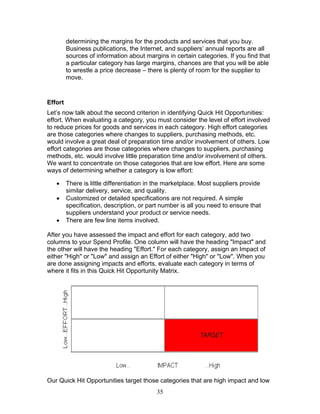
After you have assessed the impact and effort for each category, add two
columns to your Spend Profile. One column will have the heading "Impact" and
the other will have the heading "Effort." For each category, assign an Impact of
either "High" or "Low" and assign an Effort of either "High" or "Low". When you
are done assigning impacts and efforts, evaluate each category in terms of
where it fits in this Quick Hit Opportunity Matrix.

Our Quick Hit Opportunities target those categories that are high impact and low
35
effort. In other words, Quick Hit Opportunities are those categories for which we
can achieve significant savings relatively quickly and easily. Before finalizing your
list of categories that qualify as Quick Hit Opportunities, review your forecast.
Find any categories that were purchased during the period for which the Spend
Profile was created but will not be purchased in the immediate future. Eliminate
these categories from your Quick Hit Opportunities. Worksheet 8 shows our
Spend Profile modified to make use of the quick hit criteria. Those categories that
meet these criteria are highlighted.
Quick Hit Groundwork
At this point, you have your Quick Hit Opportunities identified. You are ready to
take action and begin realizing savings for your organization. Here is a little
groundwork that you should do internally to communicate your targets and nail
down your requirements:
Advise management of your targets. Sometimes management can be secretive
about its plans for the organization. Be sure not to attempt to achieve savings
on something that will be phased out as a result of a forthcoming strategic
decision by management. Advising management of your targets will give them
the opportunity to inform you of any conflicts with their plans.
Collaborate with stakeholders. Ensure that any stakeholders, particularly end
users, are involved as early as possible and as often as they would like to be.
Create an atmosphere that screams "we are going to deliver benefit to our
organization together." Make them feel as if they will get credit for something
good. A well involved stakeholder can help you succeed. An ignored stakeholder
would celebrate if you failed and may even try to facilitate your failure. Even
though you will be creating a spirit of collaboration, clearly establish, preferably in
writing, the goals of the savings strategy and the roles of each stakeholder.
Consider standardization. Standardization is a concept all to itself and will be
discussed later in this course. For quick hits, identify any variations of a certain
product or service that could be consolidated into one single specification. This
type of consolidation could increase your requirements for a certain product or
service, thus giving you more buying power, which usually results in lower prices.
Acquire current specifications. Make sure that the products or services that
you are buying meet the current, as well as future, needs of the organization.
Determine quantity, delivery, service, and quality needs. In your collaboration
with stakeholders, determine the amount of products or services in the quick hit
categories that you will buy over the next one to three years. Determine a
schedule or desired lead time for the products or services. Document any service
requirements you would have from suppliers of quick hit products or services.
Formalize any requirements you may have for passing incoming inspection,
warranty, and other quality issues. When you have all of this information, you will
be able to determine the suppliers who are capable of meeting your needs, not
just offering lower prices.
36
Develop baselines. As previously described, determine your current average
price for the quick hit products and/or services. Once you do this, you will be able
to determine the amount that you’ve saved by seeking cost reductions for these
products and/or services.
Now it’s time to take action that results in savings. The tried and true way to
achieve savings is to utilize competitive bidding, also referred to as sourcing.
Simplified, competitive bidding involves asking several suppliers for their best
price and terms with the intention of awarding a contract to the qualified supplier
who offers the best overall deal. Suppliers naturally want to offer better pricing
than their competitors in an effort to earn the business, so the buying
organization can often achieve significant savings. Because most of us are
familiar with competitive bidding and sourcing is covered in detail later in this
course, we will focus this section on how to make competitive bidding effective
and efficient (i.e., fast) when acting upon Quick Hit Opportunities.

Key To Effective & Efficient Sourcing
The key to effective and efficient sourcing is to identify and avoid bottlenecks
while maximizing competitive leverage. We’ll take a look at three bottlenecks that
can be avoided with proper strategy.
One bottleneck that we have seen organizations run into over and over is
qualifying the low bidder. This bottleneck arises when organizations blindly
send out requests for proposal to suppliers who reply with bids. The low bidder
ends up being a supplier who is unfamiliar to the buying organization. The
buying organization then scrambles to determine whether the low bidder is
qualified: visiting the supplier’s site, checking references, reviewing financial
statements, etc. It becomes difficult to determine if the low bidder is qualified
and it is also difficult rejecting the low bid. This process can take an
unbelievable amount of time.
To avoid this bottleneck, supplier pre-qualification is necessary. You should
determine which criteria a supplier needs to meet in order to be considered
"qualified" to do business with you. Supplier pre-qualification should be done
before a request for proposal is sent to bidders. Only qualified bidders should be
given the opportunity to bid on your requirements. This process will force the
sellers to sell in order to be considered for the opportunity to bid. It is their job to
communicate the advantages of doing business with them. The buyer should
not have to work so hard to figure out those advantages.
A couple of additional notes on supplier pre-qualification…
This is another great opportunity to involve your stakeholders. Determining your
supplier selection criteria up front can make the selection process smoother once
proposals are received. Waiting until proposals are received to determine
selection criteria can result in heated debates among stakeholders, which of
course can slow down a quick hit.
37
You may find that when you start working on pre-qualification criteria, common
elements are found. Pre-qualification criteria such as positive references, solid
financial statements, and good historical performance may be found in prequalification rituals for a variety of categories. When you find these common
elements, it can be easy to document a standard pre-qualification procedure that
is embraced by present and future stakeholders.
Another bottleneck that we have seen is late contract introduction. This
bottleneck arises when an organization puts a requirement out to bid. After
proposals are received and discussions have taken place with one or more of the
preferred suppliers, either the supplier or the buyer gives the other party a
contract to review. Several weeks usually pass before the attorney for the
receiving party completes his or her review. When the review is complete, the
attorney recommends changes that the other party’s attorney must review, then
that attorney recommends additional changes, and the revisions go back and
forth for months. This process is unacceptable for Quick Hit Opportunities.
To avoid this problem, develop a contract template with the assistance of your
legal department. A contract template will have all of your company’s standard
terms and conditions in it and will leave room for variables such as price, lead
time, warranty, and specifications. When preparing an RFP, simply enter all of
the variables that apply to your purchase and include the contract template in
your RFP. Make sure that the instructions in your RFP communicate that bids
must be made based on the requirements outlined in your RFP including all
contract terms and conditions. The bidders should treat your contract as they
treat your specifications – your terms and conditions are requirements not to be
deviated from. This practice commonly results in fewer exceptions to your
language and a lot less time spent involving attorneys.
Internet Reverse Auctions
A final bottleneck is price negotiation. Price negotiation is another process that
can add months to competitive bidding. After receiving initial proposals,
purchasing professionals are often not convinced that they have suppliers’ best
offers on the table. So we persuade bidders to lower their prices. Now, there is
nothing necessarily wrong with this approach. Negotiation is a core competency
of purchasing professionals and those who are good at negotiation save their
companies millions of dollars. But remember the concept of Quick Hit
Opportunities – we want to achieve significant savings relatively quickly and
easily.
For achieving savings in a short amount of time, Internet reverse auctions can be
extremely effective. Most of us are familiar with a "traditional" auction - where
one individual, group, or selling organization has a product or service to sell and
a host of buyers compete with each other to buy that product or service. The
competitive forces at work ensure that the seller gets the highest price in the
market for the offered product or service. A reverse auction is where one buying
organization has a requirement to buy a product or service and a host of sellers
compete for the opportunity to sell that product or service to the buying
38
organization. The competitive forces at work ensure that the buyer gets the
lowest price in the market for the required product or service. An Internet reverse
auction is a reverse auction that is conducted live, in real time, over the Internet,
thereby permitting sellers in different locations to simultaneously attempt to
outbid each other. Internet reverse auctions have generated billions of dollars in
savings and have become embraced by modern purchasing professionals across
many industries.
When submitting a sealed bid, suppliers usually don’t offer their best price
possible. They usually don’t feel the pressure to do so. Why should they
minimize their profit margin when the probability exists that they can make more
money? Then, when their pricing is challenged by purchasing professionals, they
employ a variety of techniques to delay or prevent them from giving the best
price possible. So not only is traditional negotiation slow, it may not get to the
true lowest price.
In an Internet reverse auction, the suppliers see the pricing submitted by their
competitors, even though the identity of competitors is kept secret. Suppliers can
resubmit bids continually throughout the auction until the time that the auction
ends. This process puts maximum pressure on the suppliers to get to their true
lowest price quickly. When used in conjunction with pre-qualifying suppliers and
positioning your contract template as a requirement, you can generate great
savings and conclude the competitive bidding process quickly. Internet reverse
auctions overcome the obstacles found in traditional competitive bidding and
negotiation – buyers typically can save 5 to 12% more and can award a contract
on the same day that proposals are due. These results and speed support the
fundamental premises of Quick Hit Opportunities.
On the next screen, you will get to participate in a mock Internet reverse auction.
On the right side of the screen will be a table displaying a series of bids. You will
submit a bid by entering a price in the space to the left of the table, then clicking
on the Next button. When you click on the Next button, your bid will be recorded
and you will see it in the table with the other bids. The objective is to provide a
price that is lower than those that had been previously submitted. Just remember
when entering your price to use a format with no dollar signs, no commas, and a
decimal point with at least one digit to its left and exactly two digits to its right. An
example price would be:
10078.99
And, oh, some students like to bid 0.00, which takes the fun away from the
process. So please resist that temptation. If the bids do get that low, please let
us know so we can reset the auction. OK. Ready to go? Have fun!!!

39
NOTE: THIS EXERCISE AVAILABLE ONLINE ONLY

This Page Was Loaded Onto Your Screen On 09-10-2008 At 4 : 11 : 54 PM EST
This auction is for one million widgets. This auction ends at 12:00:00 PM on
February 30, 2012.
Bidder ID: customer
Enter Your Find your bid...

Price
$8.35
$8.50
$8.90
$8.93
$8.94
$8.96
$8.99
$9.01
$9.02
$9.03
$9.05
$9.94
$9.96

Bidder ID

Time Of Receipt
08/4/2008 3 : 56 : 40 PM
linda.moisey
EST
07/1/2008 10 : 48 : 51 AM
jackie.maldonado
EST
07/1/2008 8 : 56 : 21 AM
rskonier
EST
05/30/2008 7 : 33 : 11 PM
jnunez
EST
05/24/2008 3 : 15 : 25 PM
john.rine
EST
05/22/2003 5 : 41 : 46 PM
john.rine
EST 05/17/2003 10 : 54 :
41 AM
02/26/2008 1 : 10 : 1 PM
j_ml john.rine
EST
EST
03/11/2008 9 : 22 : 33 AM
cdominick
EST
02/26/2008 1 : 7 : 49 PM
j_ml
EST
02/25/2008 2 : 7 : 57 PM
erojas
EST
02/22/2003 5 : 6 : 2 PM
EST 10/27/2002 9 : 5 : 9
erojas rfisher
AM EST
40
Price

Bidder ID

Time Of Receipt
09/10/2008 4 : 12 : 58 PM
$8.34
customer
EST
08/4/2008 3 : 56 : 40 PM
$8.35
linda.moisey
EST
07/1/2008 10 : 48 : 51 AM
$8.50
jackie.maldonado
EST
07/1/2008 8 : 56 : 21 AM
$8.90
rskonier
EST
05/30/2008 7 : 33 : 11 PM
$8.93
jnunez
EST
05/24/2008 3 : 15 : 25 PM
$8.94
john.rine
EST
05/22/2008 5 : 41 : 46 PM
$8.96
john.rine
EST
05/17/2008 10 : 54 : 41
$8.99
john.rine
AM EST
02/26/2008 1 : 10 : 1 PM
$9.01
j_ml
EST
03/11/2008 9 : 22 : 33 AM
$9.02
cdominick
EST
02/26/2008 1 : 7 : 49 PM
$9.03
j_ml
EST
02/25/2008 2 : 7 : 57 PM
$9.05
erojas
EST
02/22/2008 5 : 6 : 2 PM
$9.94
erojas
EST
10/27/2007 9 : 5 : 9 AM
$9.96
rfisher
EST
10/11/2007 1 : 41 : 53 PM
$9.97
michael.smith
EST
10/3/2007 7 : 48 : 7 AM
$9.98
rskonier
EST
10/2/2007 9 : 15 : 30 AM
$9.99
rskonier
EST
08/29/2008 3 : 42 : 1 PM
$10000.00 student101
EST
08/29/2008 8 : 43 : 5 PM
$10001.00 student101
EST
08/30/2007 11 : 50 : 36
$10077.00 student102
AM EST
09/10/2007 11 : 17 : 34
$10077.07 customer
AM EST
05/8/2008 11 : 59 : 58 AM
$10077.08 customer
EST
08/30/2007 11 : 37 : 28
$10078.99 student101
AM EST
41
To summarize the process for achieving quick hits:
•
•
•
•
•
•

Find categories that are high impact and low effort
Communicate your targets and nail down your requirements
Prepare for competitive bidding
Pre-qualify suppliers
Position your contract template as a requirement of bidding
Conduct reverse auctions

42
Lesson 4 Quiz
NOTE: TAKE THIS QUIZ ONLINE FOR IMMEDIATE FEEDBACK

1. It is important to address Quick Hit Opportunities first because:
a.) you can gain momentum and confidence by succeeding quickly
b.) management will be supportive of your later, more challenging efforts if you
show rapid results
c.) you can prove your success to stakeholders whose support you will need later
d.) all of the above
2. Which attributes characterize Quick Hit Opportunities?
a.) high effort and low impact
b.) high impact and low effort
c.) high impact and low interest
d.) low effort and high tension
3. When laying the groundwork for Quick Hit Opportunities, what should you not
do?
a.) concentrate on keeping your current suppliers
b.) advise management of your targets
c.) consider standardization
d.) collaborate with stakeholders
4. What is likely to happen if you wait too long to introduce a contract?
a.) your supplier will sign the contract without review
b.) your competitive leverage will be diminished and your supplier's attorney will
suggest changes to the contract language
c.) the supplier will decline the opportunity to do business with you
d.) your attorney will permit the use of the supplier's contract without review
5. Which of the following is a benefit of reverse auctions?
a.) they apply a great deal of competitive pressure on suppliers, resulting in a
lower price for the buyer
b.) they speed the negotiation process
c.) they intimidate old fashioned purchasing managers
d.) A & B

43
Lesson 5 - Supplier Relationship Opportunities

The fourth component of a good savings strategy is Supplier Relationship
Opportunity Execution. Unlike Quick Hit Opportunities and Strategic Sourcing
Opportunities, Supplier Relationship Opportunities are those categories for which
you cannot or do not want to switch suppliers. You do not need to switch
suppliers, or even threaten to switch suppliers, to achieve savings. However, it is
probable that you will not achieve as high a percentage savings as you would
with Quick Hit Opportunities and Strategic Sourcing Opportunities.
To determine which categories are Supplier Relationship Opportunities, evaluate
each of the categories that you did not select as your Quick Hit Opportunities by
asking these questions:
•
•

•

Does my organization already have a long-term contract in place with a
supplier for this category?
Is the supplier for this category the only supplier with the capability of
producing this product or providing this service to my organization’s
requirements?
Has using the incumbent supplier in this category eliminated the problems
my organization has had with most of its competitors without creating new
problems?

If you have answered "yes" to any of these questions, then the category would
be appropriately deemed Supplier Relationship Opportunities. As we have stated
earlier, you will probably realize the least savings in Supplier Relationship
Opportunities, so be sure not to haphazardly consider a category a Supplier
Relationship Opportunity rather than a Strategic Sourcing Opportunity. Beware of
lame excuses for not switching suppliers. Let’s do an excuse check…be sure that
these are not your reasons for not switching suppliers:
"We’ve always used that supplier."
"We get a good price now."
"I don’t have time to think about switching suppliers."
All of these are invalid excuses and should not preclude you from considering
switching suppliers. You must treat the evaluation of excuses as if the excuse
was on trial. The burden of proof for not switching suppliers is on the individuals
who object to switching.
To be a valid justification for not switching suppliers, your stakeholders need to
present evidence. Instead of "we’ve always used Supplier A," a valid justification
would state "we have had no late deliveries from Supplier A in the last 3 years. I
have a letter from the purchasing director from the company next door that has
stated that Supplier A’s only other competitor has only been able to deliver 80%
of orders on time." Instead of "we get a good price now," a valid justification
would be "I have checked our prices against the publicly released prices that our
44
state and local governments get for the same products, in similar quantities, with
similar service and delivery requirements. Our price is already 5% lower. The
cost of competitive bidding would not justify the small or non-existent savings
we would achieve." Do you see how using evidence is much more compelling?
Accept justifications with evidence only – not excuses!
There are many techniques for achieving savings by working with existing
suppliers. These include:
•
•
•
•

Standardization
Value Analysis
Savings Sharing
Negotiation

We’ll talk about each of these one by one.
Standardization
Standardization is the process of consolidating the purchases of several similar
products or services into the purchase of a single product or service. For
example, a hospital may purchase 10,000 16cm tongue depressors per year and
5,000 19cm tongue depressors per year. The purchasing department may learn
that no medical justification exists for two sizes and may be able to standardize
on a single size. By standardizing, the hospital increases its buying power for the
single size and can attain greater volume discounts.
Analyze your own spending. Take each Supplier Relationship Opportunity
category and create a PivotTable within that category. Find similar goods or
services that may be ripe for consolidation. Then, forecast your quantity
requirements if you were to consolidate the many varieties into a single variety
or, at most, a few varieties.
Now, you need to approach the existing supplier (who you have identified as a
supplier you cannot replace) seeking cost reductions. However, be careful not to
create an atmosphere in which it seems like you are beating the supplier over the
head for a discount (even though you are in no uncertain terms seeking lower
prices). Make it seem like you have both companies’ interests in mind.
Tell the supplier that you have an idea that will help them reduce their inventory
and streamline their process of fulfilling your orders. Ask the supplier to
collaborate with you on a standardization program that will reduce both
companies’ costs. Present your specific ideas and let the supplier know that
you would like to increase your volume discount in return for purchasing more
of a certain item. In every way possible, try to quantify the financial benefit the
supplier will realize as result of collaborating with you on a standardization
program. If the supplier is convinced that it will realize savings through
standardization, the supplier will be more likely to concede discounts.

45
Value Analysis
Value analysis is the process of evaluating the design of a product or service
(including all components thereof) and identifying changes to such design that
will result in a reduction of the cost to produce the product or provide the service
without a substantial loss of functionality. Let’s consider an example of a
weightlifting equipment manufacturer. This manufacturer essentially designs its
equipment, purchases all components for its equipment, assembles portions of
the equipment, then packages and markets the equipment which will have its
assembly completed by the consumer. This manufacturer has historically
purchased metal plates for use as its barbell weights at an average cost of $1 per
pound. By examining each part that went into its equipment, the manufacturer
notices that it can purchase sand-filled plastic weights for an average cost of 50
cents per pound from the same supplier. Because the manufacturer’s research
has shown that its customers generally have no preference for metal or plastic
weights, the manufacturer can keep its selling price the same while reducing its
cost which, of course, increases profit. Let’s dissect this example by comparing it
against the definition of value analysis.

Portion of Definition

Action Taken

evaluating the design of a product or
service (including all components
thereof) and

The manufacturer looked at all
components that went into its
weightlifting equipment

identifying changes to such design

The manufacturer opts to use plastic
rather than metal weights

that will result in a reduction of the cost
to produce the product or provide the
service

The cost for weights is decreased by
50%

without a substantial loss of
functionality

The consumer still lifts the same
amount of weight when using the
barbells

The use of value analysis is not limited to manufacturers. Service industries are
filled with value analysis opportunities. Consider something as simple as a
purchase requisition. One company had a purchase requisition that made four
copies: one that the originator kept when submitting the requisition, one that the
approver kept after signing, one that the purchasing department kept, and one
that the purchasing department sent back to the originator to confirm placement
of the order. After examining the purpose of each copy, it was found that the
approver rarely kept a copy – the originator’s confirmation copy was usually
enough of a paper trail for a department. Therefore, the number of copies was
reduced to 3 and the cost of the requisitions decreased by nearly 20%. Of
46
course, this company could take the idea farther by implementing an
eProcurement system and eliminating paper entirely, but you get the point.
When conducting value analysis, always try to determine the financial benefit of
each component of the product or service and then compare that benefit against
the cost of that component. For example, because most people keep their
computers at a low volume, a computer manufacturer may not be able to charge
more for a computer with 200-watt speakers, but you can bet that it would cost
more to produce the louder speakers.
When possible, use value analysis to compare component prices between
product lines. A manufacturer of three different lines of tractors found that it was
paying similar prices for the horn installed on two of its tractor lines. However, it
was paying 6 times as much for the horn installed on the third tractor line. It
became obvious that the horn didn’t have 6 times the value – a horn is a horn, it
beeps. Therefore, the tractor manufacturer was able to find a horn that was more
appropriately priced.

Savings Sharing
Savings sharing is another way to reduce costs without changing suppliers. In
its most basic form, savings sharing works like this: you agree with a supplier to
analyze characteristics of the way you do business with them. Each party
comes up with suggestions on how to reduce the costs of doing business. For
those suggestions upon which both parties agree, the cost savings is calculated
and shared equally, usually in the form of lower prices for the buyer.
For example, let’s say that an automobile manufacturer has had a contract with a
supplier of windshield wipers for many years. Because windshield wipers are
somewhat delicate, the contract includes strict requirements for packaging the
wipers for shipment. It costs $5 to package a case ($100 worth) of wipers and the
packaging cost is absorbed by the wiper supplier. Thus, packaging represents
5% of the price paid by the automobile manufacturer. The wiper supplier
suggests that the automobile manufacturer allow the packaging to be comprised
of less expensive recycled materials and the two parties will split the savings. By
using recycled material, the packaging costs for a case worth of wipers
decreases to $3 – a savings of $2. When the savings is shared, each party is
entitled to $1 of the $2 worth of savings. Therefore, the wiper supplier reduces
the price for a case of wipers to $99.
There are countless ways to evaluate shared savings opportunities. The best
part is that it is often easy to get suppliers to collaborate with you on shared
savings projects. Because the suppliers can improve their bottom line by working
with you, they are eager to listen to and identify ideas for savings.
Negotiation
47
The final technique for saving money through Supplier Relationship Opportunities
that we’ll discuss is negotiation. What can be said about negotiation that hasn’t
already been written in the countless books, articles, and other resources that
address negotiation not to mention our online class “Powerful Negotiation For
Successful Buying?” Not much. But we will show you three approaches to
negotiating with a supplier that you can use in a situation where you want to
reduce your costs but cannot switch suppliers.
Before we begin discussing these approaches, we must first remind you of a law
that you should obey when negotiating with an important supplier who you
cannot replace – DO NOT THREATEN THE SUPPLIER. You have obviously not
considered the applicable category of goods or services as a Quick Hit
Opportunity or a Strategic Sourcing Opportunity for a reason – you do not plan
on replacing the supplier. You must ensure that your good relationship with your
supplier is maintained, so do not get into an adversarial situation. Each approach
that we will discuss can be framed in a manner that is not adversarial. As we
discuss these approaches, we will go from the least formal to the most formal.

Negotiation Approach 1 - Initiating The Discussion
The first approach to negotiating with this type of supplier is to simply initiate
discussions on price reductions. If you never asked for a price reduction before,
you probably never got one. Before you begin the discussion of price reductions,
you must understand the difference between closed-ended and open-ended
questions. A closed-ended question is a question that can be answered by a
simple "yes" or "no" response. These are easy to answer and do not require
elaboration. An open-ended question is a question that cannot be answered by a
"yes" or "no" response. These are more difficult to answer. When negotiating,
always ask open-ended questions. This will put the supplier on the spot and force
the supplier to justify why they cannot offer a price reduction. If there is no
justification (which there often isn’t), your probability of receiving a price reduction
will be higher.
To illustrate these points, let’s take a look at examples of these two types of
questions. If you ask a supplier "Can you reduce your prices?", the supplier will
simply say "No" and the conversation ends. You have gotten no information that
may lead to evidence that a price reduction is possible. If you ask a supplier
"How do you feel about offering us a price reduction?", the supplier will be forced
to give you information about why or why not a price reduction is possible. You
can either use this information to further persuade the supplier to reduce prices
or you can challenge the information if it does not seem valid. Either way, you’ve
got your conversation started. If you talk about price reductions, the probability of
receiving them is much higher than if you never initiated the discussion.
Here's an exercise to further illustrate how open-ended questions can stimulate
discussion and intelligence gathering while closed-ended questions often go
nowhere. In this exercise, read the question in the "Your Question" column, click
48
on the "Ask" button directly to its right, then evaluate the text in the "Supplier's
Answer" box. Notice how open-ended questions produce responses that are far
more useful that those produced by closed-ended questions.

NOTE: THIS EXERCISE AVAILABLE ONLINE ONLY

Being sensitive to the importance of the supplier relationship, you can initiate this
conversation in many ways. You can say "I really appreciate the business we’ve
been doing. Things are working out well in our relationship. I do have some
concerns, though. We are implementing a savings strategy where we have to
reduce our costs from the previous year. We’re thrilled with your product/service,
but our company feels that we are buying a premium product/service at a
premium price. What ideas do you have for offering us that same premium
product/service at a less than premium price?" This dialog not only makes
effective use of an open-ended question, but it also puts the burden on the
supplier for coming up with a price reduction idea. This is a good thing. People
are more willing to go along with things that they feel are their ideas rather than
having to "buy in" to someone else’s idea. If you said "I want a 5% price
decrease," the supplier is likely to resist – it’s your ideas versus theirs. If they say
"How about a 5% price decrease?", the idea is theirs and they are more likely to
accept it.
Another way to initiate negotiation discussions is to position yourself on the
supplier’s "side" with your company being on the opposite "side." You can do this
by citing your recently completed Quick Hit Opportunities. You can say
something like this: "We are implementing a savings strategy where we have to
reduce our costs from the previous year. We have completed a phase of the
strategy where we conducted x number of RFPs, reverse auctions, etc. and we
have saved x dollars. I am a really big advocate of using your company for this
product/service. I don’t want to do an RFP/reverse auction for it. What ideas do
you have for me being able to demonstrate savings to my management without
putting your product/service out for bid?" This technique comes across as a
friendly inquiry but may produce the same results as a threat. No supplier wants
to lose business. You are helping them avoid losing business and the friendly
49
way that you approach them will not make them feel personally threatened.

Negotiation Approach 2 - Pursue Mutual Increase In Business
The second approach is to position a price reduction as a way for the supplier to
increase his business. Speak with your sales and marketing staff and gather
statistics on the number of bids that your company won and lost in the past year
or so. These bids should have been for products or services that incorporate your
supplier’s products or services. Examine the bids that were lost. Why was your
company not the successful bidder? If the reason was a high price, then your
supplier’s price somehow factored into your customer’s decision. If your company
would have won each bid that it lost on the basis of price, how much additional
business would that have meant to your supplier? Would they have sold you 10%
more of their products or services than they did? 25%? 50%?
Once you determine the percentage increase in business your supplier could
have gotten if your company was the successful bidder more often, have a
conversation with your supplier. Share with them all of the statistics you
gathered. Tell them that you would like to help your company increase its sales,
which, in turn, will help them increase their sales. You can then suggest that a
way to accomplish sales increases for both companies is for the supplier to lower
its prices. Again, always frame this suggestion in a positive manner – you are
trying to help them with your idea.

Negotiation Approach 3 - Using Indexes
The third approach is to use objective data in asking for a price decrease. One
example of objective data that we use frequently is the Producer Price Index
(PPI) published by the United States of America’s Bureau of Labor Statistics
(BLS). If you are outside of the United States, you may consider choosing an
index that is more relevant for your country. The BLS’ Web site actually provides
links to statistical agencies in other countries and you can check out those links
at http://www.bls.gov/bls/other.htm. For the sake of simplicity, we will refer to the
PPI for the rest of this class.
The PPI measures the average change over time in the selling prices for
hundreds of commodities and industries. You can find price trends for
commodities as specific and diverse as avocados, sandals, carbon steel
galvanized wire, and swivel office chairs. You can find price trends for industries
as specific and diverse as personnel supply services, trucking, and wireless
telecommunications. You can find price trends for almost anything you buy using
the PPI. To access the PPI data, which is published monthly, visit www.bls.gov.
Here are some basics to understand about the PPI. When the BLS begins
tracking the PPI for a given commodity or industry, it assigns that commodity or
industry a PPI value of 100. The value is changed monthly based on the average
50
change in the prices in that commodity or industry. For example, if the BLS starts
tracking prices for online purchasing classes in July 2010, it will assign a value of
100 to the PPI for the online purchasing class industry for July 2010. If prices
increase by 10% from July 2010 to August 2010, the PPI will increase by 10% as
well. Thus, the new PPI for August 2010 would be 100 x 1.10 = 110. If the prices
increased by 20% from August 2010 to September 2010, the new PPI for
September 2010 would be 110 x 1.20 = 132. Then, you could calculate the
percent change between July 2010 and September 2010 by using this formula:
PC = [(LV/PV) – 1] x 100
Where,
PC = Percentage change in prices
LV = Latest value of PPI
PV = Previous value of PPI
If PC is a positive number, prices have increased. If PC is a negative number,
prices have decreased.
Therefore, the percentage change in prices between July 2010 and September
2010 would be calculated as follows:
PC = [(132/100) – 1] x 100
PC = 32%
Prices for online purchasing classes have increased by 32%.
So how can use this data in negotiations? Here’s how. First, find the PPI for a
commodity or industry. Then, find the percentage change over a period of time
for that PPI. Next, calculate the percentage change of your supplier’s prices over
the same period of time. Finally, compare the percentage change of the PPI
against the percentage change of your supplier’s prices. If the PPI increased by a
certain percentage and your supplier’s prices increased by a greater percentage,
you have ammunition for negotiations. If the PPI decreased by a certain
percentage and your supplier’s prices did not decrease by as high a percentage,
you have ammunition for negotiations.
Let’s look at an example of paper purchases over a one year period: October
2006 to October 2007. Let’s say that your price for a carton of paper was $35 on
October 1, 2006 and $36 on October 1, 2007. Also assume that your quantity
requirements did not change. Let’s take a look at the PPI for Paper (Series ID
WPU0913). In October 2006, the PPI value was 170.5. In October 2007, the PPI
value was 169.8. Thus, even though the national average prices for paper
decreased by 0.4%, your price increased by 2.9%. You can share this data with
your supplier and suggest that this objective data makes it reasonable for you to
request a price decrease.
51
A good way to compare supplier pricing to market pricing is to create an index for
that supplier’s pricing. You create a supplier price index (SPI) by recording a
supplier’s price at a given point in time and assigning the current value of the
corresponding PPI to the SPI. Continuing with the paper example, let’s say that
your price for a case of paper was $30 on October 1, 2005. The PPI for paper in
October 2005 was 161.7. Your SPI for paper for October 2005 would be set to
161.7 to match the PPI for that same month. Your price increased by 16.7% from
October 2005 to October 2006 ($30 to $35). Therefore, your SPI must increase
by 16.7%. Your SPI for paper in October 2006 would then be 188.7 {Base SPI x
(1 + percentage change as a decimal)} or {161.7 x (1 + 0.167)} . Your price
increased by 2.9% from October 2006 to October 2007 ($35 to $36). Therefore,
your SPI must increase by 2.9%. Your SPI for paper in October 2007 would be
194.2.
To effectively communicate to your supplier how their price changes compare
with the market’s price changes, it is helpful to place your SPI and PPI data
together in a table and a graph. Here’s an example of an SPI/PPI table.

Date

SPI Value

PPI Value

October 2005

161.7

161.7

October 2006

188.7

170.5

October 2007

194.2

169.8

Worksheet 9 of the Excel file
(http://www.NextLevelPurchasing.com/classes/ssdhandout.xls) shows a graph of
the SPI vs. the PPI. When you use graphs to compare SPI against PPI or any
other index, know that if the SPI line is above the published index line, you can
feel reasonable requesting a price reduction.
Supplier Relationship Opportunity Summary

In summary, reducing prices with suppliers who are "untouchable" is certainly a
challenge. This challenge can be overcome in a few different ways:
•

•
•

Where practical, consolidate the number of similar products or services
you purchase from a supplier through a standardization program. This will
increase your quantity requirements for a certain product or service,
entitling you to a larger quantity discount.
Use value analysis to determine components of the products or services
you purchase that may be changed thereby reducing your prices.
Collaborate with your suppliers to identify ways to reduce costs and share
the savings.
52
•

Engage in non-adversarial negotiation with your suppliers by asking for
price reductions, asking them to help contribute to your savings strategy
while avoiding an RFP, and using price indexes to identify situations
where your supplier’s price changes are not consistent with the overall
market.

53
Lesson 5 Quiz
NOTE: TAKE THIS QUIZ ONLINE FOR IMMEDIATE FEEDBACK

1. Which of the following is not a valid reason for classifying a category as a
Supplier Relationship Opportunity?
a.) a long-term contract is already in place with a supplier in that category
b.) an end user's favorite supplier has always been used for that category
c.) there is only one supplier capable of supporting the requirements of your
organization
d.) a recent switch to the current supplier has eliminated all problems previously
experienced in that category
2. If you purchase 29 different sizes of ball point pens and pay list price for each
of them, which cost reduction technique may you be able to employ easily?
a.) standardization
b.) value analysis
c.) savings sharing
d.) negotiation
3. Which of the following is an example of value analysis?
a.) reducing the number of different types of ball point pens you buy to 1 from 29
b.) examining your spend profile
c.) telling your supplier to lower his price "or else"
d.) having your purchasing manuals printed on white paper instead of hot pink
4. Which of the following is an example of an open-ended question?
a.) What percentage discount is available to customers who spend over a million
dollars per year with you?
b.) May I have the pleasure of a discount?
c.) Can you tell me the percentage discount you give to your biggest customer?
d.) Are we getting the best deal?
5. You can feel reasonable requesting a price reduction if:
a.) the percentage increase in the PPI is greater than the percentage increase in
your Supplier Price Index
b.) you never compare the change in your supplier's prices against the market
c.) you threaten your supplier
d.) the percentage increase in the PPI is less than the percentage increase in
your Supplier Price Index
54
Lesson 6 - The 10 Phase Approach To World Class Sourcing (Part I)

The next set of savings opportunities is the Strategic Sourcing Opportunities. The
Strategic Sourcing Opportunities are perhaps the most challenging set of savings
opportunities you will experience. The Quick Hit Opportunities required relatively
little effort to execute. The Supplier Relationship Opportunities were
characterized by continuing to deal with suppliers with whom you have been
dealing for some time. In contrast, Strategic Sourcing Opportunities are those
opportunities that require significant effort and may involve the change of
suppliers.
To cope with any big challenge, it is always helpful to have a process that has
worked in similar situations in the past or for others. To satisfy this need, Next
Level Purchasing, Inc. has created "The 10 Phase Approach To World Class
Sourcing." We have condensed the key points of the 10 Phase Approach to a
single page with bullet points summarizing the key points. The next page will
contain this one page summary of the 10 Phase Approach. Print it out and keep it
handy. It is helpful to always visualize the future of your project and to track your
project along the way.
Also, the 10 Phase Approach can be a standalone process. While we
recommend that it be used as a part of a comprehensive plan that you develop
after completing this class, it can certainly be used by itself.
The 10 Phase Approach To World Class Sourcing
NOTE: Throughout the process, it is key to measure and obtain feedback on plan
effectiveness. Any unforeseen roadblocks should be addressed by the sourcing
team and a problem recovery/barrier mitigation plan should be implemented.

Phase I: Objective Definition
•
•
•
•

Communicate purpose of sourcing initiative
Specify ultimate goals
Determine milestones
Involve entire affected staff in the process, assign responsibility, and
emphasize individual accountability

Phase II: Current Business Analysis
•
•
•

Record current purchases, spend, supply base
Identify opportunities for impact
Identify threats to success and develop threat avoidance plan

55
Phase III: Requirement Determination
•
•
•
•
•

Create, revise, or validate specifications applying value analysis,
standardization consideration, and/or substitution evaluation where
appropriate
Forecast demand, involving end users and stakeholders where
appropriate
Determine supplier qualification and selection criteria, involving end users
and stakeholders where appropriate
Define target commercial/legal terms
Define supplier performance metrics and initiate development of
performance reporting system

Phase IV: Market Survey
•
•
•
•
•
•
•

Identify current suppliers
Find new sources
Identify opportunities for special categories of suppliers (disadvantaged,
local, etc.)
Identify key supply partners
Conduct Porter’s Five Forces analysis
Note "red flag" suppliers
Prequalify suppliers

Phase V: Bid Preparation
•
•
•
•

Determine methodology and strategy and variations thereon
Develop contract for inclusion in request for proposal
Optimize tools: standardize where possible, customize where necessary
Develop supplier scorecards, involving end users and stakeholders where
practical

Phase VI: Proposal Request
•
•

Minimize variables
Ensure standardized response format and acknowledgement of key terms

Phase VII: Proposal Analysis
•
•
•
•
•

Analyze supplier scorecards and identify/rectify any breakdowns in
evaluation method
Involve end users and stakeholders where applicable
Determine ability to select special categories of suppliers
Select desired source or short list
Conduct final acceptance tests/supplier visits/reference checking/vendor
qualification, etc.
56
Phase VIII: Contracting
•
•
•
•

Engage in time-bound negotiation
Focus on minimizing further analysis burden
Secure any required approvals for changes to contract language
Execute contract

Phase IX: Determine Success of Sourcing Process
• Compare results with goals
• Celebrate and broadcast achievement
• Document key success factors and lessons learned
Phase X: Performance Measurement/Supplier Management
•
•
•
•

Record key performance metrics
Initiate corrective action where necessary
Recognize outstanding supplier performance
Identify process improvements and value analysis opportunities

After reading through the summary of the 10 Phase Approach, you probably
have noticed that many of the concepts we have already introduced are
incorporated into the 10 Phases. This is no accident – if the concept benefited
you in Quick Hit or Supplier Relationship Opportunities, it only makes sense to
use it in Strategic Sourcing Opportunities.
You will also notice a statement at the top of the previous page: "NOTE:
Throughout the process, it is key to measure and obtain feedback on plan
effectiveness. Any unforeseen roadblocks should be addressed by the sourcing
team and a problem recovery/barrier mitigation plan should be implemented."
This is important. Just because there is a proven approach to dealing with
strategic sourcing doesn’t mean you can just go on auto-pilot. You need to
continually focus on how well the process is going. If you run into difficulties, you
must figure out ways to get through those difficulties. Because some companies
have different and unique cultures, you need to take note of anywhere the
process breaks down. Then, you can revise the 10 Phase Approach so that it
works best in your company’s culture.
We will go through each Phase in detail, beginning with Phase I – Objective
Definition.

Phase I – Objective Definition
The purpose of Phase I is to formalize the process of addressing your Strategic
Sourcing Opportunities. Formalizing the process should be done up front. You
should never begin any project without having a vision of your final result and the
path that you will take to get to that final result.
57
•

Communicate purpose of sourcing initiative

You need to begin by communicating the purpose of your sourcing initiative. This
should be done in writing. Writing a purpose for anything naturally forces you to
think through exactly what it is you are trying to accomplish. This goes so far
towards clarifying the mission of a project, a department, or even a company.
It is shocking that so few purchasing departments actually document their
purpose for their department or an initiative. Almost every purchasing leader will
feel that they have a strong sense of mission, but very few have missions or
purposes written. So why don’t they? Documenting a purpose is harder than it
sounds. It forces one to use very critical thinking. Does your department have a
written statement of its purpose? Whether or not you do, definitely write down the
purpose of your strategic sourcing initiative and communicate it to all involved. It
can be simple: "To reduce costs," "To improve operational efficiencies," or "To
enter a new market" are all examples of legitimate purposes.
•

Specify ultimate goals

You must determine and document the goals of your sourcing initiative. If the
purpose of your sourcing initiative is to save money, how much do you want to
save? Specifying your goals in a quantitative manner accomplishes several
things. First, it motivates a team towards a desired end state. Second, it makes
you critically assess your action plan. It is easy to say "we will save money," but
no one wants to commit to saving $50 million unless they first assess if it is
realistic to expect that amount of savings. Therefore, setting goals is a great
way of flushing out potential threats to success early in the project.
•

Determine milestones

Milestones are significant dates during a project by which certain portions of that
project are completed. Break down your sourcing initiative into these 10 phases
and determine the dates by which you expect to complete each phase.
Determining milestones also can support realistic expectations of project
progress. For example, 2 months may not sound unrealistic to complete a
sourcing project, but when broken into phases, you may realize that it will take 3
weeks just to create specifications in Phase III. Knowing this, you can more
accurately determine the length of the entire process.
•

Involve entire affected staff in the process, assign responsibility, and
emphasize individual accountability

Strategic Sourcing Opportunities are very important and affect many people
throughout the organization. Many of these people have a strong vested interest
in the success of the acquisition of the goods or services you are addressing.
Therefore, the leader of the sourcing initiative should develop a team. This team
should include all significant stakeholders from various functional areas. In a
manufacturing environment, this team could include a leader from the purchasing
department and representatives from Engineering, Quality Assurance,
58
Production, etc. In a service environment, this team could include the most active
end users of the product or service.
You should hold a kickoff meeting for the team. You should invite the highest
level of management that supports the initiative so that the importance of the
sourcing initiative is infinitely clear to the team members. During this meeting, the
purpose, goals, and milestones are presented for discussion. You should clarify
the role of each person and, if ready, begin assigning action items to each
person. Emphasize that the success of the project is dependent upon the diligent
work of each team member. Communicate how and by whom the project will be
tracked. It is helpful to present a schedule of periodic progress meetings to
further emphasize the accountability of each member of the team.
Phase II: Current Business Analysis
Now that you have your goals determined, your schedule formalized, and your
team built, it is time to get the momentum of your sourcing initiative going. In
Phase II, you will be evaluating the way you do business.
•

Record current purchases, spend, supply base

At this point, you should examine your spending patterns in each category you
have selected as a Strategic Sourcing Opportunity. Determine how much you
spend in that category and with whom. Get down to line item detail.
•

Identify opportunities for impact

In looking at line item detail, consider the ways in which you can achieve your
goals. A thorough analysis will highlight those areas where you are using too
many suppliers, buying too many variations of the same item, keeping too large
of an inventory, and so forth. If practical, plan on isolating those high-impact
areas and focus your sourcing initiative on addressing each inefficiency at
once.
•

Identify threats to success and develop threat avoidance plan

As you look at the way you currently do business, consider all of the things that
could happen to derail your efforts to bring about improvements. Brainstorm.
Think freely. If Murphy’s Law (“Whatever can go wrong, will”) was to apply, what
could go wrong and pose a threat to your success? Then, come up with a plan
to avoid or overcome those threats. For example, you may envision that the
engineer you are depending on to write specifications may leave the company.
What is your backup plan? Who will write the specifications in his absence? The
more hypothetical situations you come up with, the more prepared you will be
when things go wrong, and the more probable it will be that your sourcing
initiative will be a success.

59
Phase III: Requirement Determination
Phase III is all about figuring out "what you want." What product or service do
you want? What quantities of that product or service do you want? What do you
want in a supplier? What rules do you want to govern your relationship with a
new supplier? What performance do you want from a supplier? What mechanism
do you want to use to track supplier performance?

•

Create, revise, or validate specifications applying value analysis,
standardization consideration, and/or substitution evaluation where
appropriate

If you do not already have a specification for the goods or services you wish to
source, you will need to create one now. If you do have a specification, you need
to critically evaluate it. It may end up being perfect, but you need to validate this
through careful and critical evaluation. If the specification is not perfect, you can
revise it. When revising a specification, you can apply many of the concepts we
have discussed earlier in this course. You can identify components of that
specification that can be modified to reduce costs without sacrificing quality
(value analysis). You can identify opportunities for purchasing a single version of
a product or service rather than several variations (standardization). You can
determine whether a less expensive product or service, or portion thereof, can
replace the current product or service, or portion thereof (substitution evaluation).
•

Forecast demand, involving end users and stakeholders where
appropriate

We’ll illustrate the importance of accurate forecasting with an example. To
produce customized widgets, a supplier must purchase and set up its tooling.
The tooling costs money and setting up the tooling requires a certain level of
human effort and, therefore, labor costs. The costs for tooling and setup are the
same irrespective of whether the supplier is manufacturing one widget or one
million widgets. Therefore, they have to pass these costs along to their
customers. If the tooling and setup charges are $10,000 and the customer is
going to buy 10,000 widgets, the supplier must add $1 to its price to cover tooling
and setup. If the customer is going to buy only 1,000 widgets, then the supplier
must allocate $10 of its price towards tooling and setup.
A common problem that suppliers face is that they often do not know the
quantities that customers will buy. So what do they do? They pad their price to
protect their profits in the face of uncertainty. If the supplier doesn’t know whether
the buyer will buy 1,000 or 10,000 widgets, it will probably prepare for the worst
and incorporate the higher dollar value for tooling and setup into its price.
Here is an exercise to further emphasize this point. In this scenario, a supplier is
asked to manufacture promotional calendars for a customer. The supplier is
60
expected to provide various setup services that include taking 12 photos of its
customer’s various employees and facilities, creating a logo for its customer, and
incorporating the photos and logo into the calendar. It will cost the supplier
$5,000 to meet these expectations. Irrespective of quantity ordered, the materials
for each calendar will cost $1 and printing will cost $2 per calendar. The supplier
wishes to markup its costs by 20% to cover its overhead and profit. Type in a
quantity and click on the "Calculate Unit Price" button to see the unit price based
on the quantity ordered. Repeat the process of entering quantities and clicking on
the button to see how changes in quantity can affect the unit price.
NOTE: THIS EXERCISE AVAILABLE ONLINE ONLY

The moral of the story is that, by providing suppliers with more accurate forecasts
of demand, purchasing professionals can avoid "price padding" and help produce
lower prices. The message is that you should do whatever it takes, particularly
working with stakeholders and end users, to determine your quantity
requirements for the foreseeable future in Phase III.
•

Determine supplier qualification and selection criteria, involving end
users and stakeholders where appropriate

As we discussed earlier, the time to determine what criteria makes a supplier
qualified to do business with you is not after you have received bids. You should
work with your stakeholders in Phase III to determine the factors that make a
supplier qualified to bid on your requirements. Is past history important? Is most
recent financial performance important? Is industry reputation important? These
are but a few questions that you should ask among your team. Then, you will
have a structured approach to determine which suppliers have the opportunity
to bid.
61
It is also in Phase III that you should determine your criteria for selecting a
supplier after bids are received. What makes one supplier better than another?
Price? Quality? Estimated Total Cost of Ownership? Some combination of
factors? Begin determining the factors that you will use to compare suppliers
when making your final decision. Know at the very beginning what your
selection criteria will be. If several criteria exist, agree upon a weighting of the
various criteria so that it is easy to determine the most important factor when
selecting a supplier, the second most important factor, and so on. Identify any
"no go" factors, or characteristics of a supplier’s proposal that would make it
undesirable or impossible to do business with them.
Waiting until all suppliers’ bids are received could result in heated debates when
individuals on the evaluation team have differing opinions on what supplier
selection factors are important. Deciding at a late point what the supplier
selection criteria are usually results in accusations of "playing favorites" with
suppliers. Obtaining early agreement among the sourcing team with regard to
supplier selection criteria will make supplier selection relatively easy with minimal
disagreements.
•

Define target commercial/legal terms

In Phase III, you need to determine the "rules" that will govern your relationship
with the successful supplier. You need to think of all of the typical commercial
attributes of doing business like how much lead time the supplier can have for
delivery, how you will pay the supplier, what conditions will constitute a
warranty claim, how much response time is allowed, and so forth.
You will also need to determine the legal elements of your relationship. You
should work closely with your legal counsel at this point to obtain guidance on the
legal provisions that would be beneficial to your company in an agreement with
the successful bidder. Can your company be sued over any aspect of doing
business that directly or indirectly involves the supplier? If so, you will need to
work with legal counsel to craft the appropriate contract language such as
indemnity, insurance, and limit of liability provisions. As we’ve described in the
Quick Hit Opportunity lesson, contract language can be a bottleneck. Don’t wait
until the last minute to determine what your optimal contract language is.
•

Define supplier performance metrics and initiate development of
performance reporting system

Because you have developed your target commercial terms, you need to have a
way of measuring your supplier’s compliance with those terms. If your supplier is
required to deliver within three days of receipt of your order, how many times is
the supplier late? When the supplier is late, how late? How many times are the
supplier’s items rejected at incoming inspection? Most performance issues can
be quantified into statistics or metrics such as percentage of on-time deliveries,
percentage of product failures, average response time, and so forth. You need to
determine what those metrics are and begin developing a way to capture and
62
report on those metrics. The way companies capture performance data varies
wildly among companies. Some companies have sophisticated systems that
collect this data. Some companies have ways of documenting end user
observations. Other companies require their suppliers to provide performance
information. In any event, you definitely need to determine how you will monitor
the supplier’s performance. Taking this action in Phase III will enable you to
implement performance reporting as soon as the contract is implemented.

Phase IV: Market Survey
Phase IV deals with evaluating the supply base. Specifically, you are identifying
who you want to bid on your requirements through a process that incorporates
multiple considerations.
•

Identify current suppliers

The obvious first step in figuring out who can bid on your requirements is
determining who you do business with today. This may be easy in a centralized
purchasing environment where the category of goods or services is narrow. This
may be difficult in a decentralized purchasing environment where the category
of goods or services is broad. In either case, simply manipulate your data dump
to determine which suppliers you are currently using.
•

Find new sources

Finding new suppliers, in other words suppliers that you do not currently use, can
be challenging. There are many sources available for finding potential new
suppliers. You can search the Internet, speak with other purchasing
professionals at different companies, review literature sent to you by interested
suppliers, search supplier directories, etc. In almost every category, there is
usually some level of competition that will allow you to find at least one supplier
with whom you have never done business. Don’t forget to consider international
suppliers at this point. For certain categories, the cost difference between
domestic and international products or services is large. For example, IT services
have been reported to be from slightly under three times to as much as 14 times
less expensive in India than in the United States.
•

Identify opportunities for special categories of suppliers
(disadvantaged, local, etc.)

Many large companies have a program in which doing business with diversity
suppliers (also called disadvantaged business enterprises) is encouraged.
Diversity suppliers is a loosely used term to describe businesses that are
primarily owned by minorities, women, or veterans as well as businesses
located in certain economically distressed locations such as those designated
by the government as Historically Underutilized Business Zones (HUB Zones).
Some companies actively promote doing business with small businesses and
local businesses. If your company deems it important to consider special
63
categories of suppliers in its sourcing activities, be sure to expend a reasonable
amount of effort to identify potential suppliers in any of these categories.
Consider whether a dual award or subcontracting opportunity for these special
categories of suppliers is available through your sourcing initiative.
•

Identify key supply partners

After you have listed all of the suppliers who you will consider pre-qualifying,
identify any of them that you would consider "key supply partners." Key supply
partners are those companies who, throughout the years, have given your needs
the highest priority and have performed flawlessly in challenging situations. If you
have key supply partners, you need to decide in Phase IV whether their history of
excellent performance will earn them a higher rating in your evaluation than an
unknown supplier. Except in some government procurements, it is OK to have
historical performance as a factor in selecting a supplier. It is best, however, to
determine before bidding exactly how much emphasis you will place on historical
performance relative to price, delivery, and the other criteria.
You may have key supply partners, but perhaps they do not supply the category
of goods or services that are being considered in your Strategic Sourcing
Opportunity. It may be beneficial to evaluate whether those key supply partners
have the capability and interest in expanding their business to the category
considered. For example, you may be purchasing medical supplies from two
excellent distributors and your Strategic Sourcing Opportunity is concentrating on
research-related chemicals. Because the supplies and the chemicals are used
together and are in related industries, perhaps you could arrange for your
medical supply distributors to bid to distribute the chemicals.
•

Conduct Porter’s Five Forces analysis

In planning your sourcing initiative for a particular category of goods or services,
you must evaluate the state of the industry for that category. The most revered
method for analyzing an industry is known as "Porter’s Five Forces" developed
by Michael Porter, a professor at the Harvard Business School. Porter’s Five
Forces asserts that the following characteristics of a market determine the pricing
structure in that market:
1. Rivalry among existing competitors
2. Threat of new entrants
3. Threat of substitute products or services
4. Bargaining power of suppliers
5. Bargaining power of buyers
By analyzing these characteristics of a market, you will be able to get a feel for
your ability to drive down prices. While basic Porter’s Five Forces analysis can
be conducted very informally, it is a good idea to incorporate it into every
sourcing process. Doing so will enable you to set realistic targets for savings
and to determine the best approach for forthcoming negotiations.
•

Note "red flag" suppliers
64
"Red flag" suppliers are those suppliers who have exhibited poor performance in
the past and have created the expectation of poor performance in the future. If
selected as the successful bidder in your sourcing initiative, a red flag supplier’s
poor performance could lead to disruption of operations and a higher total cost of
doing business. Identify these suppliers early on. If practical, do not even give
red flag suppliers the opportunity to bid. If you must give red flag suppliers the
opportunity to bid, be sure to communicate and document your concerns and
have those concerns available when your team is ready to make a decision.
•

Pre-qualify suppliers

The worst time to find out that a supplier is not capable of supporting your
requirements is after you have signed a long-term, high effort, high visibility
contract with that supplier. Particularly with Strategic Sourcing Opportunities, you
must be careful with supplier selection. Ferret out incapable suppliers early – it
only gets more difficult later. As mentioned earlier in this course, analyzing
financial statements, checking references, conducting site visits, and seeing
samples of suppliers’ work are a few ways to determine whether or not a supplier
is capable of supporting your needs.
When working on your market survey, it is helpful to document your findings in a
standard format. Click here for an example.
Phase V: Bid Preparation
Phase V involves organizing all of the documents and other tools for requesting
and receiving bids from your suppliers.

•

Determine methodology and strategy and variations thereon

Now you need to decide how to structure the bid and evaluation process. You
need to decide how you will receive bids – options include traditional sealed bids
as well as reverse auctions. You need to determine if you will have a pre-bid
meeting and, if so, the points that you want to drive home to the suppliers to
inspire them to present their best deal. Also, you need to finalize and
communicate to your internal team how the evaluation and supplier selection
process will work. Again, getting agreement early on will keep everyone on the
same page when it comes to determining the best supplier choice.
•

Develop contract for inclusion in request for proposal

Just like we did in our Quick Hit Opportunities, we will include a contract in our
request for proposal. Bidders will be instructed to treat it like a specification.
Make it clear to the bidders that any exceptions to the language will be evaluated
as less competitive than other bids. For the sake of speed, you may be tempted
to worry about the contract later, especially if you have to involve legal counsel.
Resist this temptation! We have seen it time and time again – a purchasing
65
department tries to save a week or two by releasing its request for proposal
without a contract only to have negotiations with the top bidder drag on for
months. Do yourself a favor – get that contract in the RFP when the suppliers
feel the most competitive pressure to agree to your terms.
•

Optimize tools: standardize where possible, customize where
necessary

When it is possible to do so, using a standard RFP and standard analysis tools
speeds the sourcing process. If you don’t have these standard tools in place
and need to develop them for a sourcing initiative, create the tools as if you
were creating standard tools. Then, you will have something in place for your
next sourcing initiative and won’t have to "reinvent the wheel." Of course, many
sourcing processes are unique from any others that you have done or will do in
the future. In these cases, customize your RFP and analysis tools to meet the
specific needs of the process at hand.
•

Develop supplier scorecards, involving end users and stakeholders
where practical

Before ever requesting a proposal, you should have your supplier scorecards in
place. These scorecards will be used to evaluate and compare proposals. Design
your scorecard around those criteria that your sourcing team agreed upon in
Phase III. Don’t forget to include a way of applying different weights to multiple
criteria and a way of making it clear when the supplier’s proposal contains a "no
go" characteristic. Finally, work with the people who are going to be using the
scorecards when you develop them. If your scorecard format is difficult to
understand, it could harm your evaluation process and even lead to an accidental
selection of the wrong supplier.
We’ll continue with Phases VI through X in the next lesson.

66
Lesson 6 Quiz
NOTE: TAKE THIS QUIZ ONLINE FOR IMMEDIATE FEEDBACK

1. Which of the following is not a task completed in Phase I of a sourcing
initiative?
a.) determine milestones
b.) involve entire affected staff in the process
c.) create specifications
d.) communicate purpose of sourcing initiative
2. When assessing your approach to your sourcing initiative, you should:
a.) proceed rapidly to meet management demands
b.) identify threats to your success and develop a plan for avoiding them
c.) proceed without stakeholder involvement
d.) all of the above
3. Which of the following should be determined before releasing your request for
proposal?
a.) supplier performance metrics
b.) supplier selection criteria
c.) target legal terms
d.) all of the above
4. Which of the following is a common characteristic of a highly competitive
market or industry?
a.) low barriers to entry
b.) suppliers in the Thomas Register
c.) low bargaining power on the part of buyers
d.) none of the above
5. Including contracts in requests for proposals:
a.) weakens the buyer's bargaining power
b.) tends to lengthen the start-to-finish sourcing cycle
c.) increases the seller's bargaining power
d.) often results in fewer exceptions to the buyer's standard language

67
Lesson 7 - The 10 Phase Approach To World Class Sourcing (Part II)

Phase VI: Proposal Request
Phase VI covers key tips in finalizing the format of your request for proposal
documents. When preparing your documents, visualize a link between the
information you request and the manner in which you will evaluate that
information. First, determine specifically how you will analyze and compare
proposals: will you use a spreadsheet, will you create a checklist, etc.? Then,
craft your request for proposal so that all bidders submit their proposals in a
format that makes it easy for you to use your analysis and comparison tools.

•

Minimize variables

One of the common practices that bogs down the bid analysis process and often
keeps bidders from offering their best overall deal is the practice of having
suppliers respond to too many variables. An example scenario has the buyer
requesting from seven bidders a price, payment terms, warranty, lead time,
rebate, and terms for an overstock buy back program. Each bidder responds and
all of them have different variables. The bidder with the lowest price has the
worst warranty and average payment terms. The bidder with the best lead time
and warranty has the highest price and a "middle of the road" rebate. The buyer
then struggles to determine what the best deal is. This process is unnecessary.
An educated buyer with expertise in the commodity being sourced will have a
feel for the most competitive warranty available, reasonable lead time, and so
forth. The buyer should ask all suppliers to bid on the same competitive
requirements. By having more variables than necessary, analysis is more difficult
because you are not comparing the proverbial "apples-to-apples" (i.e., not
comparing equitable proposals). When analysis is any more difficult than it has
to be, decision making confidence is lower thereby raising the probability of a bad
decision. In addition, sellers can get a feel for how successful they will be at
having a higher price accepted by offering "cheap" concessions on lesser terms.
Conversely, sellers can get a feel for how successful they will be by having other
low-value-added aspects of their proposal overlooked because of a lowball price.
In any event, if you are a true specialist in your commodity, you will tell the
suppliers the requirements upon which to bid.
•

Ensure standardized response format and acknowledgement of key
terms

You have waited weeks for your suppliers to respond to your request for
proposal. Today, the deadline arrives and so do your suppliers’ proposals in the
mail. Just as you begin opening the first package, your boss walks by your office
and asks "Are you done looking at those proposals yet?" while stressing the
urgency of bringing the project to completion. As the boss walks away, you begin
68
feeling pressured as you open each proposal. Each is in a 4" thick binder filled
with literature explaining how the suppliers have been in business since 1907
and other irrelevant stuff. You search and search for minutes on end, desperately
trying to find the price in each binder. When you do, you find all kind of footnotes
and small print explaining why the price you see is not the price you will pay and
a more detailed explanation is on page 1047. Some bidders omit information,
others seem to not understand it and offer responses that don’t seem to make
sense. You frantically try to summarize all of the proposals in an Excel
spreadsheet when, 6 hours after his last visit, the boss stops by and asks "Are
you done looking at those proposals yet?"
A little dramatic? Perhaps. Unrealistic? Not at all. Collecting and combining
proposal information can be very time consuming and labor intensive. That’s why
you should include a standard response format in which all bidders will submit
their proposals. This way, you can simply take the bidders’ responses, all of
which look the same, get the information you need, and summarize it as
necessary. This approach easily flushes out anomalies and exceptions, directing
you instantly to the bidders who can unconditionally meet your requirements.
When there are critical and/or unusual nuances to your requirements, it is also a
good idea to have your suppliers acknowledge key terms. For instance, if you
want your first shipment of a custom product within one day of placing your first
order, you may want to have a line in your standard proposal response form
where each bidder can check off or initial a term describing your critical and
unusual delivery requirement. This will ensure that each bidder pays attention to
the details of your request for proposal and it avoids any unpleasant and stressful
surprises later.
Phase VII: Proposal Analysis
Phase VII describes the process of analyzing and comparing proposals against
each other as well as against the previously developed selection criteria.
Collect all of the proposal data and summarize it using the analysis and
comparison tools developed in Phase VI.

•

Analyze supplier scorecards and identify/rectify any breakdowns in
evaluation method

Now that you have received your suppliers’ proposals, you know for a fact what
terms are available in the marketplace. When developing your supplier
scorecards, you made several assumptions about how the proposals would look
and what they would include. Before going deep into your analysis, determine if
any of your assumptions were not in line with the suppliers’ offerings. Is your
scorecard structured properly? Are there any key attributes among the proposals
that were not included in your scorecard?
69
For example, maybe 3 of 7 bidders offered a vendor managed inventory (VMI)
program as part of their proposal. Your documents did not specify a VMI
requirement and, therefore, your scorecard did not include a line item for VMI.
But certainly such a program has value and may warrant inclusion in your
scorecard to help you determine the best deal available. Then, you should work
with your stakeholders to modify the scorecard to weigh the impact of VMI on
your decision.
Always look for these little unanticipated elements of proposals. Then, adjust
your selection criteria if your team deems it prudent to do so.
•

Involve end users and stakeholders where applicable

Early on, you worked with your stakeholders to determine the supplier selection
criteria and develop a scorecard that would make it an almost scientific process
to select a supplier. In some organizations, the Purchasing Department is free to
review the bids and select a supplier without further input from stakeholders. In
other organizations, the culture demands that stakeholders be intimately involved
in the evaluation and selection process. Our advice is to do whatever fits into the
culture of your company.
We do recommend at least summarizing your evaluation to the stakeholders and
facilitating discussion on the advantages and disadvantages of each supplier.
Stakeholders generally like to feel that they are involved in a decision. It is up to
you to determine the degree of involvement. Just remember, two things happen
when a team rather than an individual makes a decision. First, the support for the
decision is usually greater. Second, when something goes wrong, each member
of the team feels responsible and works together for a solution as opposed to
engaging in finger pointing.
•

Determine ability to select special categories of suppliers

As you prepare to select your supplier, determine if any of the opportunities for
special categories of suppliers (diversity suppliers, local suppliers, etc.) can be
realized. A partial award, subcontracting requirement, or other approach can
help direct more dollars towards your goals for doing business with special
categories of suppliers, if you have such goals.
•

Select desired source or short list

After making your requirements crystal clear, determining your supplier selection
criteria, obtaining apples-to-apples proposals, and involving your stakeholders in
the proposal evaluation process, you should be able to home in on one supplier
or a select few suppliers that can meet your needs. At this time, you can
internally formalize the identification of suppliers who meet your needs, then
prepare to work out final details with the preferred supplier(s).
•

Conduct final acceptance tests/supplier visits/reference
checking/vendor qualification, etc.
70
It is never a bad idea to validate your supplier selection before signing on the
dotted line. This validation process can take several forms such as acceptance
tests, supplier visits, reference checking, and so forth. You probably have already
done your share of due diligence during Phase IV, but if you have learned
anything new or different when evaluating the proposals, be sure to spare no
effort in confirming that you are making the right decision.
Phase VIII: Contracting
In Phase VIII, you will be working with the supplier to formalize your new
relationship.
•

Engage in time-bound negotiation

Before awarding your business to a supplier, there may be details that you need
to work out. These details could range from seeking a 10% reduction in the price
to hammering out changes to your standard contract language. When negotiating
these details, be sure to do two things: set a deadline and have an alternative.
Always communicate to your supplier a deadline by which you expect
agreement. You want to keep the pressure on the supplier to agree to your
contract terms or variations of those terms that favor your interests. Some
suppliers will let negotiations drag on forever, particularly those suppliers that
know you are in a hurry to acquire a product or service and those suppliers who
already have your business. A deadline will keep all parties focused on closing
the deal.
A deadline by itself is not necessarily a good idea. A deadline where you know
you will have an almost equivalent alternative is perfect. To use (or, more
appropriately, abuse) a cliché, don’t "throw all of your eggs in one basket" until a
contract is signed, sealed, and delivered. Know your second choice and be
prepared to choose your second choice. You can keep discussions open with
your second choice of supplier, just keep dialog with all suppliers honest. If you
are speaking with multiple suppliers, don’t allow them to believe that they "won"
and you are just finalizing details. Not only does this prevent false expectations,
but it allows suppliers to know that you have an alternative, thereby putting
pressure on them to agree to your terms by your deadline.
•

Focus on minimizing further analysis burden

Negotiations can get creative. Many negotiation experts encourage this. Creative
negotiation can be rewarding to all parties involved. But, if you choose to get
creative, also remember to keep it simple. Don’t introduce complexities into your
supplier selection process at the last minute. Coming up with escalation
formulas, alternate payment terms, financing, and so forth can alter the total cost
of ownership of a proposal. An altered total cost of ownership can result in a
requirement for more analysis, which can be time consuming. Stick to the original
proposal as much as practical, focusing only on the small issues. And, if you set
up your supplier selection criteria correctly, there should only be small issues left
71
to negotiate.
•

Secure any required approvals for changes to contract language

Any changes to what your company considers "standard" should be approved
before a contract is signed.
Make sure to have your legal counsel, management, or other decision maker
readily available throughout the contracting process. If possible, have them
present during the negotiations. This will help speed decisions along while
making sure that you are not making concessions that you have to retract
later.
•

Execute contract

After negotiating the details, you have reached the moment everyone has been
waiting for – signing the contract. Before putting pen to paper, confirm that all of
the changes that you have negotiated are included in the contract. Then, make
sure that both parties sign the contract and keep a copy handy. You never
know when a dispute will arise and you’ll need the contract to remember what
you have agreed to.
Phase IX: Determine Success of Sourcing Process
While signing the contract may inspire spirited reactions ranging from an
exchange of high-fives among the sourcing team to a sigh of relief from the
leader of that sourcing team, the work is not done. There are still two phases to
work through. Phase IX covers the process of evaluating the effectiveness of the
sourcing initiative.
•

Compare results with goals

Way back in Phase I, you set specific goals for the sourcing initiative. Now it is
time to compare the results you actually achieved with those documented goals.
If the goal was to save 10% on your purchases of goods or services in a
particular category, do the prices you achieved through sourcing enable you to
reach that goal? How much did you save? Look at every goal that you set and
determine the degree to which you met (or hopefully exceeded) those goals.
•

Celebrate and broadcast achievement

When you have done something that has resulted in an improvement to your
company’s performance, broadcast it appropriately. Be sure that executive
management knows what you have achieved. Let your stakeholders know that
their involvement paid off. And be sure to recognize the efforts of the sourcing
team. They poured their blood, sweat, and tears into the sourcing initiative, so
be sure to let them know that they have reason to celebrate.
•

Document key success factors and lessons learned
72
You will probably engage in another sourcing initiative at some point. Take an
objective look at your sourcing process and ask two questions. What went well
and why? What could have been done better? Keep these questions and their
answers documented so that you, or another sourcing team leader, can refer to
them in the future.

Phase X: Performance Measurement/Supplier Management
You made your supplier selection based upon what the supplier said it could do
and what you thought that the supplier could do. Phase X, which could be
indefinite in duration, evaluates the degree to which the supplier is doing what it
is supposed to be doing. It also involves managing the relationship with the
supplier and seeking improvements.

•

Record key performance metrics

As a futuristic thinker in Phase III, you determined how you were going to
measure supplier performance. You developed metrics that would be indicators
of how well your supplier performs. In Phase X, you will be recording statistics of
your supplier’s performance and comparing them against your targets. This
should be done continuously throughout the life of the contract.
•

Initiate corrective action where necessary

When your supplier’s performance does not meet or exceed your target
metrics, you need to initiate corrective action.
The following exercise employs a simple tool to determine whether corrective
actions are needed. For each metric, enter a number in the "Actual Performance"
column. Then, click on the "Evaluate Performance" button. A comment will
appear for each metric in the "Assessment" column.

73
NOTE: THIS EXERCISE AVAILABLE ONLINE ONLY

When supplier performance requires corrective action, meet with your supplier’s
management and discuss the shortfalls in performance. Ask the supplier to
submit a specific plan where the root causes of the problems are identified and a
plan of action, addressing resources and timelines, is outlined. Asking for such a
corrective action plan will force the supplier to think through how the problem will
be solved and will avoid you having to accept the "lip service" that suppliers often
give when problems arise: "Yeah, we’ll get the problem fixed." Be sure to consult
your contract for any remedies that are available to you.

•

Recognize outstanding supplier performance

On the flip side of correcting problems with supplier performance, it is good
purchasing practice to recognize those suppliers that perform well. After all,
these companies support your operations and help you succeed. A supplier
awards program is beneficial. Such a program motivates suppliers to
perform and shows your appreciation for outstanding efforts.
•

Identify process improvements and value analysis opportunities
74
Always look for opportunities to make good things better. If you have done a
good job at selecting the right supplier, you will have a relationship that will
prosper for years. Because this relationship will be strong, your company and the
supplier can collaborate for mutual gain. Your Strategic Sourcing Opportunity of
yesterday has now become your Supplier Relationship Opportunity of tomorrow.
Look for opportunities to apply standardization, value analysis, and savings
sharing.

75
Lesson 7 Quiz
NOTE: TAKE THIS QUIZ ONLINE FOR IMMEDIATE FEEDBACK

1. To streamline the analysis process, a request for proposal should:
a.) allow the suppliers to introduce as many variables as they would like
b.) not address warranty or delivery
c.) always include VMI so a scorecard will not need to be revised
d.) specify firm requirements rather than allow for weak offers for several
variables
2. When analyzing proposals, you should:
a.) do any additional supplier qualification that may be required
b.) consider opportunities to work with diversity suppliers when your company
supports such an initiative
c.) A & B
d.) none of the above
3. When in final negotiations, you should determine:
a.) a deadline and scorecard criteria
b.) a deadline and an alternative
c.) an alternative and stakeholders
d.) your short list of qualified suppliers
4. After signing a contract:
a.) compare results with goals and document what you did well
b.) plan for renegotiation
c.) ask for legal approval of modified terms
d.) communicate the purpose of your sourcing initiative
5. Which of the following is the best approach to managing supplier
performance?
a.) Periodically review the contract for performance requirements
b.) Record performance metrics and take corrective action when necessary
c.) Record performance metrics, reward good suppliers, and take corrective
action with poor suppliers
d.) None of the above

76
Lesson 8 - Reporting Savings & Continuous Improvement

At this point, you have marched down the football field of cost savings. You have
led your team to the goal line by amassing hopefully a fortune in cost reductions
by implementing your savings strategy. Is your job finished? No! You have to
take the ball across the goal line and give your coach a reason to celebrate.
Even though you have come so far, it is the last few inches that count the most.
Those last few inches are the sixth component of a good savings strategy –
documenting and reporting savings.
Even though this late-in-the-game step seems logical, purchasing professionals
often overlook this step. As a result, executive management at your company
may overlook the purchasing department’s contribution to the organization. Not
good. Therefore, you must not be modest. You must show your impact on the
organization. You must SELL PURCHASING!
When compiling the value of your savings, do everything practical to prove your
savings. You have done a lot of work in achieving those savings, so build an iron
clad case for what you have accomplished. Closely monitor the actual quantities
of goods or services that you have purchased at a lower price. If possible, keep a
spreadsheet like the one in Worksheet 10 that shows your actual quantities, the
baseline price, the price paid, and the savings for every item on which you have
realized savings. This will make for a fully defendable system of cost savings. No
one can legitimately dispute that you have indeed saved money for your
company.
It is not enough to simply record your savings, you must REPORT your savings.
Do anything possible to get the amount of your real savings into the president’s
hands. Even though you may only be presenting a summary of your savings to
executive management, have the backup data available if you ever need to drill
down into the details.
Using Income Statements For Savings Reporting
We began this course with a discussion of income statements and we will again
discuss income statements now in this last lesson. As a reminder, the income
statement is the #1 indicator of your company’s performance. When a purchasing
department performs well, the company performs well. What’s beautiful is that
the good performance of purchasing can be seen on the income statement. We
will now show you a way of communicating to executive management the effect
Purchasing has had on the bottom line in a given year.
Now that you have implemented your savings strategy and have documented
all of your savings, it is time to show its effect on the income statement. Let’s
take the income statement of the food manufacturer that we discussed in
Lesson 1. Let’s imagine that over the course of the year, that we, as the food
manufacturer’s purchasing department, saved $50,000,000. Let’s imagine that
77
$30 million of that savings were on direct materials purchased. These savings
would be reflected in the cost of products sold portion of the income statement.
The other $20 million of that savings were on indirect materials and services.
These savings would be reflected in the selling, general, and administrative
expenses portion of the income statement. Now, we need to create an income
statement with the actual results of the company that include our savings
contributions plus a column that would represent what the income statement
would look like if we didn’t save $50 million through our savings strategy. Here’s
what that modified income statement would look like.
Actual Results
Achieved With
Purchasing
Savings Strategy

Estimated
Results If
Purchasing
Had Not
Deployed
Savings
Strategy

Sales

9,431,000,000

9,431,000,000

Cost of products sold

6,093,827,000

6,123,827,000

Gross profit

3,337,173,000

3,307,173,000

1,746,702,000

1,766,702,000

Interest expense

294,269,000

294,269,000

Other expense, net

45,057,000

45,057,000

Income taxes

444,701,000

426,929,239

Net Income

806,444,000

774,215,761

Selling, general and administrative
expenses

78
Through this exercise, it is clear that purchasing contributes to the bottom line.
This exercise can be very compelling if the company would have suffered a loss
rather than a profit if purchasing hadn’t executed its savings strategy. It can also
be compelling if you communicate your contribution in earnings per share.
Remember, speak the language of executive management and you will be
understood. Consider including this type of income statement when reporting
your savings.
Just to reiterate, it is extremely important for us as purchasing professionals to
save money. It is equally important to document our savings, to communicate our
savings, and to show the impact of these savings of the bottom line. Never stop
at the goal line. If you can prove your savings and effectively communicate these
savings to management, you will be selling the value of Purchasing to your
organization.
Hopefully your first pass through developing and executing a savings strategy
has been a successful one. Whether it has or it hasn’t, you have probably
learned some lessons along the way that can help you the next time you pursue
savings. Be sure to document these lessons. Trusting short-term memory would
be cheating yourself out of the great education that first-hand experience offers.
Documenting your lessons learned constitutes the seventh and final component
of a good savings strategy – Continuous Improvement.
To get started identifying areas for continuous improvement, take a look at your
Savings Strategy Outline. Analyze your actuals versus your targets. How well did
you adhere to target dates? How close did you come to achieving your targeted
annual savings? Was there anything that could have been done better or faster?
In retrospect, what would you have done differently? They say that hindsight is
20/20. That’s great, because if we learn from looking back, we’ll have perfect
"vision" the next time we delve into a project. Be sure to learn all you can from
analyzing your performance and develop a passion for continuous improvement.
This was the last lesson of the course. We hope that you have enjoyed this
course and learned concepts that you can apply in your work environment
immediately. Please offer as much feedback as you wish at the end of the quiz. It
has been a pleasure having you as a student and we hope that you return for
more online purchasing courses designed to take your skills to "The Next
Level"!!! Good luck on the final quiz!

79
Lesson 8 Quiz
NOTE: TAKE THIS QUIZ ONLINE FOR IMMEDIATE FEEDBACK

1. You should:
a.) concentrate on achieving savings only
b.) aggressively achieve savings and always report savings
c.) focus on reporting savings more so than achieving them
d.) neither achieve nor report savings
2. Because many executive managers come from an accounting background,
you:
a.) should retain specific details of all savings reported
b.) should not worry about proving that you have achieved savings
c.) should estimate, as opposed to document, savings
d.) need not keep track of quantities purchased
3. When reporting savings,
a.) never try to refer to income statements
b.) never monitor activity for those categories affected by your savings strategy
c.) look primarily at the taxes specified on the income statement
d.) use an income statement to demonstrate the effect on net income if savings
had not been achieved
4. When analyzing your savings strategy for continuous improvement:
a.) resist the desire to compare actual completion dates with target completion
dates
b.) don't bother with hindsight
c.) compare actual results with targeted results, then determine if something
could be done better next time
d.) none of the above
5. Recognizing the shortfalls of an executed savings strategy:
a.) does not produce a return on investment that justifies the time spent on
analysis
b.) can help you do a better job next time
c.) will result in management firing the purchasing manager every time
d.) will only help when the first time travel machine is built

80

Ssd

  • 1.
    Savings Strategy Development APrinter-Friendly Version Of The Online Class Material From Please note the following recommendations: Use this document only for future reference when finished with the class. It is recommended that you use the online version of this material during the time that you have access to the class. When accessing the class online, you can: Engage in the interactive exercises Send questions to an instructor Take quizzes with immediate feedback Earn your Certificate of Completion by correctly answering at least 28 of the 40 quiz questions This material is protected under copyright law and may not be distributed to any person other than the individual to whom it was delivered by Next Level Purchasing, Inc.
  • 2.
    TABLE OF CONTENTS Lesson Lesson1 - Executive View of Purchasing Savings & Savings Definitions Lesson 2 - Avoidance Definitions & Outlining A Savings Strategy Lesson 3 - Spend Categorization & Analysis Lesson 4 - Quick Hit Opportunities Lesson 5 - Supplier Relationship Opportunities Lesson 6 - The 10 Phase Approach To World Class Sourcing (Part I) Lesson 7 - The 10 Phase Approach To World Class Sourcing (Part II) Lesson 8 - Reporting Savings & Continuous Improvement Page 1 14 22 34 44 55 68 77
  • 3.
    Lesson 1 -Executive View of Purchasing Savings & Savings Definitions Saving money for our organizations is arguably the #1 reason that the purchasing profession exists. Sure, we purchasing professionals do an impeccable job of supporting our operations, ensuring that all business transactions are ethical, protecting our organizations from undue risk, and so forth. But it is our contribution to the bottom line through savings that justifies our paycheck. An organization may not be able to measure a return on its investment in human resources for many of its functions. The return on investment in the purchasing function can be measured very easily – we can show that for the money invested in our salaries and benefits, we save (hopefully, a larger amount of) money that goes to our organizations’ profits. Because this type of visibility can result in senior management’s expectations of strong performance, it is critical to develop and execute a strategy that maximizes savings. This course will take you step-by-step through the process of developing and executing a savings strategy. This process is written so that you can apply it to your company, irrespective of the industry. We will begin by discussing an executive view of purchasing savings and will define savings in this lesson. In the next several lessons, we will outline a savings strategy and explain each component of that strategy. Let’s begin by talking about savings from an executive perspective. For executives like CEO’s and CFO’s, the most important result of their businesses’ operations is profit. Simplified, profit is the amount by which revenues (monetary value coming into the company) exceed expenses and taxes (monetary value leaving the company). CEO’s and CFO’s spend their energies trying to maximize profit. Most CEO’s and CFO’s set an annual goal of earning more profit than the organization earned in the previous year. There are two ways of increasing profit: increasing revenues and/or decreasing expenses. As a fellow purchasing professional, you know that we are relied upon primarily to decrease expenses. In other words, we save money. Many purchasing professionals think that because we save money, thus supporting the goal of our executive management to increase profits, that we will be recognized as valuable to the organization. This is not necessarily true. There is an important job of communicating our value to executive management that needs to follow our savings efforts. This communication must be done in a way that is probably different than most of us are used to. CEO’s and CFO’s often come from an accounting background. To communicate effectively to CEO’s and CFO’s, you must speak their language – the language of accounting. We’ll teach you a little portion of the accounting language. Allow us to introduce you to an accounting document called an income statement. Income statements, also called statements of operations, profit and loss statements, P&L’s, etc., essentially show you a monetary value for revenue or sales, monetary values for different categories of expenses and taxes, and the difference between the two. If this difference is a positive value, it is referred to as net income, or profit. If this difference is a negative value, it is referred to as a net loss, or loss. 1
  • 4.
    Income Statement Examples Wewill now look at two examples of income statements. The first income statement is for a service company – specifically, a natural gas and electric utility. This income statement begins with listing revenues and then lists expenses and taxes. Subtracting expenses and taxes from revenues will result in the net income. As you review this income statement, keep in mind that if the revenues were higher without a change to the expenses, the net income would be higher. Likewise, if the expenses were lower without a change to the revenues, net income would be higher. Revenues 10,558,000,000 Electric fuel and energy purchases, net 1,369,000,000 Purchased electric capacity 680,000,000 Purchased gas, net 1,822,000,000 Liquids, pipeline capacity, and other purchases 219,000,000 Restructuring and other acquisition-related costs 105,000,000 Other operations and maintenance 2,938,000,000 Depreciation, depletion, and amortization 1,245,000,000 Other taxes 395,000,000 Interest expense 899,000,000 Subsidiary preferred dividends and distributions of subsidiary trusts 98,000,000 Income taxes 370,000,000 Net income 418,000,000 2
  • 5.
    Now we’ll lookat an income statement for a manufacturing company – specifically, a food manufacturer. Manufacturing income statements are similar to service income statements, however, manufacturing income statements usually calculate gross profit. Gross profit is simply the difference between the price at which you sell a product and the cost you incurred in buying or making the product. In retail, gross profit is the price paid by the customer minus the price paid by the store for the item purchased. In manufacturing, gross profit is the price paid by the customer minus the cost incurred by the manufacturer. This cost can include not only materials incorporated into the final product but also the internal and outsourced labor involved in converting the raw materials into a finished product. Thus, net income is gross profit less indirect expenses and taxes. When reviewing this income statement, think about how changes to sales, cost of products sold, and expenses can affect the amount of net income – "the bottom line." Sales 9,431,000,000 Cost of products sold 6,093,827,000 Gross profit 3,337,173,000 Selling, general and administrative expenses 1,746,702,000 Interest expense 294,269,000 Other expense, net 45,057,000 Income taxes 444,701,000 Net Income 806,444,000 3
  • 6.
    Income Statement LineItem Explanation If you have begun asking yourself "what does all of this bean counting have to do with purchasing?” wonder no more. As we have mentioned earlier, the purchasing function reduces expenses through the savings that we generate. Because financial statements are so near and dear to the hearts of our executive management, it is important to know what part of the income statement is affected by our savings. We will refer to the manufacturer’s income statement to illustrate where purchasing impact is felt. Specifically, we will look at each of these line items: sales; cost of products sold; selling, general, and administrative expenses; interest expense; other expense, net; and income taxes. Sales: While purchasing can help sales figures by ensuring that supplier performance gives our company products or services that meet the marketplace’s cost, delivery, quality, and service demands, it is difficult to quantify the real impact that purchasing has on sales. Therefore, for the purposes of this discussion, we will say that purchasing does not affect this line item on the income statement. Cost of products sold: Because this line item includes the costs of materials and outsourced services involved in producing a finished product, purchasing definitely impacts this line item. However, because this line item includes costs associated with internal labor, purchasing may not be able to have 100% control over the amount of the cost of products. Selling, general, and administrative expenses: This line item includes expenses not considered to be directly allocated to producing the products to be sold. It includes a variety of types of expenses: from office supplies to utilities; from salaries to facility lease payments; and from employee benefits to advertising. Therefore, it is easy to see that purchasing can impact a portion of this expense, but not all of it. Interest expense: This line item covers all expenses related to interest incurred by a company. A company may be financing its purchases of facilities or vehicles or may have taken out loans for operating capital. Interest incurred on those financing activities is captured in this line item. Purchasing generally does not get involved in financing transactions, so we will consider this expense outside of the scope of the purchasing function. Other expense, net: This line item captures all expenses that Generally Accepted Accounting Principles deem unallocable into the foregoing categories. Because the expenses captured in this category are commonly unusual expenses and relatively small compared to the expenses in the aforementioned categories, we will consider them to be outside of Purchasing’s control. Income taxes: Unless someone can show me an example of how purchasing negotiated favorable treatment from the government, this category will be outside of Purchasing’s control also. 4
  • 7.
    Purchasing Impact Exercise Nowthat we have examined those areas where Purchasing’s impact can be felt, it is time to engage in an exercise to demonstrate how our impact affects an income statement. We’ll see how much better purchasing performance improves profits. And, remember, improving profits is commonly the #1 goal of CEO’s and CFO’s. Before beginning this exercise, we must clearly state our assumptions. Here they are: • • • • • Sales will remain constant We’ll consider Purchasing to have the capability of impacting 50% of cost of products sold. The other half will be considered to be comprised of costs associated with internal labor. We’ll consider Purchasing to have the capability of impacting 50% of selling, general, and administrative expenses. The other half will be considered to be comprised of costs associated with salaries, benefits, and the like. We’ll consider Purchasing to have no impact on interest expense or other expense The income tax rate (approximately 35.5%) will stay the same. Thus, if net income before taxes increases as a result of decreased expenses, the amount of taxes paid will increase. Given these assumptions, Purchasing has control over $3,920,264,500 in expenditures. This next exercise will enable you to see the impact on net income when purchasing saves money on the company’s purchases. Simply enter a percentage of savings that the purchasing department can achieve on the total value of expenditures under its control. Then, click on the See Impact button and watch as several of the dollar values in the income statement change. Pay particular attention to the Net income line. Try several different percentages. This exercise clearly demonstrates the fact that when Purchasing saves money, profit increases. When profit increases, our executive management achieves its goal. 5
  • 8.
    NOTE: THIS EXERCISEAVAILABLE ONLINE ONLY Sales 9431000000 Cost of products sold Gross profit -Selling, general, and administrative expenses Interest expense 294269000 Other expense, net 45057000 -Income taxes -Net income Enter percent: % Use this exercise to gain a clear understanding of where Purchasing’s impact can be found on financial statements. When communicating the money that Purchasing has saved the company, specify the place on the income statement affected by Purchasing’s performance. Always indicate exactly how net income would have been lower if it weren’t for good purchasing. Remember, CEO’s and CFO’s are often accountants – by using financial statements to communicate Purchasing’s performance, you will be "speaking their language." It is always a good communication technique to position your thoughts in a framework that is embraced by the listener. Savings Definitions OK, so now what is meant by "savings?" Unfortunately, there are no standards in the purchasing profession to dictate exactly what qualifies as savings and what does not. As a result, some purchasing departments have very rigid qualifications for savings while others consider many questionable methods to be valid savings definitions. Because this course is geared towards developing a savings strategy that is embraced by executive management, we will provide recommendations for defining your savings in a manner that CFOs and CEOs will generally consider valid. 6
  • 9.
    In this sectionof the lesson, we will cover different savings types. Information about each savings type will be broken down into four sections: 1. 2. 3. 4. A definition of the savings type The formula for calculating savings An example scenario to which the savings type would apply A calculation of the savings in the example scenario All formulas are algebraic in nature. They calculate a result by performing mathematical operations on variables. Variables are simply values in the formula that change depending on the situation. For example, a formula may be cost = price x quantity. Price and quantity are variables – they will change depending on the situation. All formulas in this section use acronyms as the variables. Each formula will then be followed by the word "Where" and a description of what each variable represents. Therefore, you determine what the proper value of the variable is and then plug that value into the formula. For some savings types, the fourth section will be replaced by an exercise. In the exercise, you will be asked to enter values for some of the variables. When you click on the "Calculate" button, the total savings will be calculated and the correct answer will appear on the screen directly below the values you entered. This will allow you to check your understanding of how the savings types are calculated. Alright. Let’s discuss some savings types… Year-Over-Year Savings: Your company pays a lower price this year for a product or service than it has paid in the past for the identical product or service. Year-Over-Year Savings can be achieved using the same supplier as before or a different supplier. Year-Over-Year Savings = (OP – NP) x QP Where, OP = Old price NP = New price QP = Quantity purchased For example, if you purchased 10,000 ten-packs of Imation CD-R’s for $0.50 each this year and spent $0.60 on the same disks last year, your Year-Over-Year Savings would be calculated as follows: Year-Over-Year Savings = ($0.60 – $0.50) x 10,000 = $1,000 7
  • 10.
    Payment Term Savings:Your company receives more favorable payment terms for products or services purchased this year than it has received in the past for the identical products or services or from the same supplier. Note that when your company must pay earlier to receive a discount, your company's cost of money must be factored into the calculation. Payment Term Savings = {(ND – OD) – [(ON – NN) x (CM/365)]} x SP Where, ND = New discount where percentages are written as numbers with two decimal places (e.g., 2% = 0.02) OD = Old discount where percentages are written as numbers with two decimal places (e.g., 2% = 0.02) ON = Old number of days in which payment is due NN = New number of days in which payment is due CM = Annual cost of money (i.e., the interest or other return earned by your company through investing idle cash). This value can be best estimated by your Finance department. SP = Spend on the products and/or services to which the new discount applies For example, if you spend $10,000 with a supplier who has changed your payment terms from Net 30 to 2%/10, Net 30 and your annual cost of money is 6%, your Payment Term Savings would be calculated as follows: Payment Term Savings = {(0.02 – 0.00) – [(30 – 10) x (0.06/365)]} x $10,000 = $167.12 Substitution Savings: Your company pays a lower price this year for a new product or service than it has paid in the past for an old product or service that served the same purpose. Note: If there is a degradation or improvement in quality as a result of the substitution, you must adjust the savings such that it reflects any costs or avoided costs as a result of the change in quality. Substitution Savings = (OP – NP) x QP Where, OP = Price for old product or service NP = Price for new product or service QP = Quantity of new product or service purchased Now, you can calculate Substitution Savings through an exercise. In this scenario, you used to buy for 20 cents each stainless steel nuts and bolts to be 8
  • 11.
    used in themanufacture of a product and you have determined that aluminum nuts and bolts can be bought for 10 cents without degrading quality. You will buy 10,000 nuts and bolts and wish to calculate your Substitution Savings. Enter values for OP, NP, and QP on the "Your Answer" line, then click on the Calculate button. Your answer will be calculated and you'll get to compare your answer to the correct answer. NOTE: THIS EXERCISE AVAILABLE ONLINE ONLY Substitution Savings = (OP - NP) x QP Your Answer = ($ -$ ) x =$ Correct Answer = ($ -$ ) x =$ Alternate Condition Savings: Your company pays a lower price for an alternate condition or non-new version (used, repaired, remanufactured, etc.) of a product than it has paid in the past for a brand new version of the same product. If the life cycle of the alternate condition product is shorter than the life cycle of the new version of the product, you must account for the increase in the quantity that you will purchase. Alternate Condition Savings = (NP x NQ) - (AP x AQ) Where, NP = Price paid for the product in new condition NQ = Quantity purchased of the product in new condition AP = Price of the product in alternate condition AQ = Quantity to be purchased of the product in alternate condition For example, let’s suppose you bought 100 new toner cartridges at $20.00 each to satisfy your needs for one year. The next year, you decided to buy remanufactured toner cartridges for $10 each however, because the remanufactured toner cartridges did not last as long, you needed to purchase 150 of them. Your Alternate Condition Savings would be calculated as follows: Alternate Condition Savings = ($20 x 100) – ($10 x 150) = $500 Note: When labor costs are significant in the replacement of end-of-life parts (e.g., a union mechanic replacing an aircraft component), the replacement labor costs should be included in your calculation of Alternate Condition Savings. 9
  • 12.
    Fee Waiver Savings:Your company is not charged certain incidental fees that were paid in the past. Commonly waived fees include shipping, set up, and other charges that are in addition to the direct cost of the product or service. Fee Waiver Savings = AF x NT Where, AF = Amount of fee NT = Number of times fee is waived For example, you have previously paid an average of $5 in shipping charges per shipment from a supplier who ships 1,000 boxes per year to you. If the supplier waives shipping charges, your Fee Waiver Savings will be calculated as follows: Fee Waiver Savings = $5 x 1,000 = $5,000 Specification Change Savings: Your company has changed its specification for a product or service such that you will pay a lower price than you have in the past for the product or service. Note: If the idea of modifying the specifications originated in another department and that other department is responsible for reporting cost savings, the purchasing department should not attempt to take credit for the savings. Specification Change Savings = (OS – NS) x QP Where, OS = Price based on old specifications NS = Price based on new specifications QP = Quantity purchased Now, you can calculate Specification Change Savings through an exercise. In this scenario, you paid $10,000 per month for janitorial services that included twice-per-week vacuuming, once-per-day trash removal, and twice-per-month window washing. You now want to change the specification to include window washing only once per month thereby reducing your price to $9,000 per month. You wish to calculate your Specification Change Savings over a 12 month period. Enter values for OS, NS, and QP on the "Your Answer" line, then click on the Calculate button. Your answer will be calculated and you'll get to compare your answer to the correct answer. 10
  • 13.
    NOTE: THIS EXERCISEAVAILABLE ONLINE ONLY Spec. Change Savings = (OS Your Answer = ($ Correct Answer = ($ - NS) x QP -$ ) x =$ -$ ) x =$ Resource Reduction Savings: Your company has made a purchase that will eliminate the need for certain employees, facilities, or other resources. Resource Reduction Savings = (DO – DN) + (AR - AC) Where, DO = Annualized direct costs of using the old resources (salaries, benefits, rent, utilities, etc.) DN = Annualized direct costs of a new process to replace the old resources AR = Additional revenue generated as a part of the change AC = Additional costs associated with eliminating the resources For example, your company operates a print shop in a facility that the company owns. This print shop is responsible for printing your company’s brochures. Salaries and benefits for the print shop employees cost your company $350,000 per year. Utilities, materials, supplies, and other overhead cost an additional $150,000 per year. By purchasing its brochures from an outside vendor, your company can have the same brochures printed for $400,000 per year. By outsourcing its printing, the company will lay off all print shop employees, who will be paid $35,000 in severance pay. The company will also sell its printing facility and equipment for $300,000. The Resource Reduction Savings will be calculated as follows: Resource Reduction Savings = ($500,000 – $400,000) + ($300,000 - $35,000) = $365,000 These savings categories are the types of savings most recognized by executive managers as being valid. All savings are based on the premise of paying less than you paid before. Well, what if you didn’t buy the product or service before? Can you still produce financial benefit for your company? Yes! Financial benefits that your actions produce for products or services not previously purchased are called "avoidances." We’ll talk about avoidances in the next lesson. I hope that you’ve enjoyed your first lesson. As you will at the end of each lesson, you now must take the quiz. Click on the Quiz button below to begin. If you have 11
  • 14.
    any questions, pleaseclick on the Ask Charles! button below to ask a question and get a response from your instructor by email within 24 hours. 12
  • 15.
    Lesson 1 Quiz NOTE:TAKE THIS QUIZ ONLINE FOR IMMEDIATE FEEDBACK 1. Which of the following income statement line items does Purchasing most commonly affect? a.) sales b.) taxes c.) net income d.) none of the above 2. Buying an item at a lower price than was paid in the previous year is an example of: a.) year-over-year savings b.) payment term savings c.) an avoidance d.) all of the above 3. Substituting a purchased item for a previously purchased, more expensive item: a.) is not a legitimate way of achieving cost savings b.) is a legitimate way of achieving cost savings c.) is an example of an avoidance d.) must be approved by Engineering to be considered a savings 4. If Purchasing is depended upon to generate savings: a.) negotiation cannot be used b.) payment terms should not be a factor in looking for cost saving opportunities c.) avoidances should be the focus d.) it can be beneficial to work with other departments to improve specifications 5. Resource Reduction Savings can be realized when a company: a.) makes a make-or-buy decision b.) negotiates later due dates on its payments c.) continues to purchase a product in the same manner at the same price d.) all of the above 13
  • 16.
    Lesson 2 -Avoidance Definitions & Outlining A Savings Strategy All of the savings types that we discussed in Lesson 1 are based on the premise of paying less than you paid before. Well, what if you didn’t buy the product or service before? Can you still produce financial benefit for your company? Yes! Financial benefits that your actions produce for products or services not previously purchased are called "avoidances." But beware…avoidances are not always recognized as legitimate by executive management. Remember, CFOs and CEOs are often accountants and if you cannot show them where your impact is recorded when comparing this year’s income statement to last year’s income statement, they may discount your claims. However, some avoidances clearly result in a better financial picture for your company. We’ll cover five common avoidance types. For each of these types, we’ll discuss common executive manager’s perception of that type. Negotiated Price Avoidance: Your company is seeking to purchase a product or service that it has not purchased in the past. You solicit proposals from suppliers and determine the price offered by the low bidder. After negotiating with one or more suppliers, you agree to purchase the goods or services at a price that is lower than the original low bid. This is the only type of avoidance that is almost universally accepted as legitimate. The Negotiated Price Avoidance is calculated as follows: Negotiated Price Avoidance = (LB – PP) x QP Where, LB = Lowest bid PP = Price paid QP = Quantity purchased For example, if you purchased 1,000 cases of copy paper for $2.50 each and the original low bid was $3.00 each, your Negotiated Price Avoidance would be calculated as follows: Negotiated Price Avoidance = ($3.00 – $2.50) x 1,000 = $500 Be sure to note that the lowest among the original bids is the price used for comparison purposes, no matter which supplier was selected. In other words, you do not compare the final price to the selected supplier’s original bid if the selected supplier did not provide the lowest price in the initial round of bids – you use the lowest of those initial bids as your comparison price. Request Change Avoidance: A requisitioner submits a request to purchase a product or service and the purchasing department persuades the requisitioner to acquire an alternate product or service that is more cost effective. This type of avoidance is not always accepted. Executive managers may feel that the 14
  • 17.
    requisitioner should becapable of identifying the proper product or service. The Request Change Avoidance is calculated as follows: Request Change Avoidance = VO - VM Where, VO = Value of original request VM = Value of modified request For example, the Human Resources department requests that 500 procedure manuals be printed and bound in three-ring binders at a cost of $15 each ($7,500 total). The purchasing department persuades HR to have the manuals spiral bound at a cost of $12 each ($6,000 total). The Request Change Avoidance would be calculated as follows: Request Change Avoidance = $7,500 – $6,000 = $1,500 Forgone Purchase Avoidance: A requisitioner submits a request to purchase a product or service and the purchasing department persuades the requisitioner to reduce its quantity or not make the purchase at all. This type of avoidance is not always accepted. Senior managers may feel that the requisitioner should be capable of identifying the proper quantity of product or service. The Forgone Purchase Avoidance is calculated as follows: Forgone Purchase Avoidance = VO - VM Where, VO = Value of original request VM = Value of modified request For example, a requisitioner requests that a mini-van be rented for business travel on August 20 for the one-day rate of $90. The purchasing department has previously rented a mini-van for another department who needed the mini-van from August 14 to August 18. Because the one-week rental fee of $420 was less than the aggregate cost of five individual days, the purchasing department rented the mini-van through August 20. The purchasing department then arranges for the requisitioner to use the mini-van already in the company’s possession, thus avoiding the second rental and its fee. The Forgone Purchase Avoidance would be calculated as follows: Forgone Purchase Avoidance = $90 – $0 = $90 15
  • 18.
    Inventory Reduction Avoidance:You determine that inventory levels are too high and decide to reduce the quantity of certain items that are kept in stock without substantially increasing the number of times that you order the items. There are many costs associated with inventory: the cost of money that could have been invested rather than spent on inventory, the costs associated with storage, insurance costs, and so forth. These costs are collectively called "carrying costs." Many companies estimate their annual carrying costs to be 20% to 30% of the value of items in inventory. Your Finance department may have an estimate of the carrying cost percentage that your company uses. This type of avoidance is not always accepted. Senior managers may feel that a small reduction of its total inventory does not necessarily eliminate many of the costs that comprise the carrying costs – they cannot lay off any employees, divest any facilities, etc. It is difficult to prove exactly where a small Inventory Reduction Avoidance would impact the income statement. The Inventory Reduction Avoidance, which is expressed as an annualized value, is calculated as follows: Inventory Reduction Avoidance = (OQ – NQ) x CP x CC Where, OQ = Old average quantity of certain item kept in inventory NQ = New average quantity of certain item kept in inventory CP = Current price of certain item CC = Annual carrying cost percentage expressed as a number with two decimal places (e.g., 25% = 0.25) Now, you can calculate Inventory Reduction Avoidance through an exercise. In this scenario, you purchase motor oil for your fleet of company vehicles for $2 per bottle. You have kept an average of 2,000 bottles of oil in stock in the past, have annual carrying costs of 25%, and now decide to reduce your average stock levels to 500 without placing substantially more orders. You wish to calculate your Inventory Reduction Avoidance. Enter values for OQ, NQ, CP, and CC on the "Your Answer" line, then click on the Calculate button. Your answer will be calculated and you'll get to compare your answer to the correct answer. NOTE: THIS EXERCISE AVAILABLE ONLINE ONLY Inv. Red. Avoidce.= (OQ - NQ) Your Answer = ( - x CP ) 16 x$ x CC x =$
  • 19.
    Correct Answer = ( - ) x$ x =$ Notethat if you must place more orders for items in order to reduce the inventory levels, you should deduct the costs associated with placing more orders, known as "acquisition costs," from your avoidance. Process Improvement Avoidance: Purchasing professionals are becoming more and more involved in process improvement assignments. Process improvements can generally be defined as changes made in an effort to reduce the time, effort, complexity, human involvement, or cost associated with a certain activity. In many instances, time, effort, complexity, and human involvement can be measured in dollars. Therefore, any reduction in any of these elements will result in a reduction in cost. Unlike the other types of savings and avoidances, the Process Improvement Avoidance is commonly recorded over a period of years. Because it is costly, in terms of time, technology, and human resources, to analyze and improve a process, it may take years of reduced costs to recoup the money spent on improving the process. The act of recouping money spent on process improvements is referred to as achieving return on investment. This type of avoidance is not always accepted. Senior managers may feel that unless a process improvement results directly in layoffs, facility divestitures, etc., no costs are necessarily eliminated. The Process Improvement Avoidance is calculated as follows: Process Improvement Avoidance = CO - (CM + CI) Where, CO = Cost of original process, prorated over a certain time span CM = Cost of modified process, prorated over a certain time span CI = Costs associated with implementing the process improvement For example, your company has just instituted a supplier certification program. In this program, suppliers who have had no defects in their shipments over the past two years will no longer have to have their shipments inspected by your company’s receiving personnel. The parts will go directly into stock. The first supplier who qualifies for this program ships 20,000 individually packaged parts to your company per year. This supplier’s shipments account for 5% of the total shipments that you receive each year. Because inspection work will not be required for this supplier’s shipments, your inspectors’ workload will decrease by 5% per year. The aggregate compensation packages of your inspectors totals $300,000 per year. Theoretically, the annual cost of the modified process would be $285,000 – this accounts for a 5% reduction in work. Your time spent in implementing this program equated to $10,000 in cost. Management is only interested in the first year of avoidance. Therefore, your Process Improvement Avoidance would be calculated as follows: 17
  • 20.
    Process Improvement Avoidance= $300,000 – ($285,000 + $10,000) = $5,000 If management wanted to know the avoidance over a three-year period, your Process Improvement Avoidance would be calculated as follows: Process Improvement Avoidance = $900,000 – ($855,000 + $10,000) = $35,000 Avoidances To Avoid As previously mentioned, other than the Negotiated Price Avoidance, the concept of avoidances is often not embraced by senior managers. Even the types of avoidances described in this lesson are often subjective and difficult to prove. However, there are avoidances that are downright despised by senior managers. Here’s one: You purchase $100,000 worth of office products per year and your demand is relatively constant. Your office supply vendor approaches you and indicates that your prices will be raised by 10% across the board. Thus, you can expect your spend for office products to increase to $110,000. After negotiating with your vendor, you are able to persuade them to increase your prices by only 8% rather than 10%. Thus, your spend will be $108,000. Many purchasing professionals will report a $2,000 avoidance. This is not a valid avoidance! What really occurred in the minds of the accountants is that you have incurred an $8,000 price increase. We generally advise you to never report a reduced increase as an avoidance except in cases where you are primarily responsible for managing volatile commodities and the entire market is experiencing even greater inflation as measured by a valid third-party index. It will undermine the integrity of your savings capabilities in the eyes of your senior management. These situations will occur. If you only report your savings and avoidances, you may be challenged and accused of ignoring certain categories where you incur price increases. To have a fully defendable cost savings and avoidance program, it is advisable to record your cost increases as well. Reporting your net savings (savings + avoidances – increases) would be the ideal situation. However, this approach does take a lot of resources and would require you to be familiar with pricing for virtually every line item you buy. Therefore, if you at least record your savings and avoidances, you will be off to an excellent start. 7 Components of a Good Savings Strategy At this point, you have a good understanding of how executives view purchasing savings. Now, we will review the outline for a good savings strategy. Here are the seven components of a good savings strategy: 1. Spend Analysis 2. Target Setting 3. Quick Hit Opportunities Execution 18
  • 21.
    4. Supplier RelationshipOpportunities Execution 5. Strategic Sourcing Opportunities Execution 6. Savings Documentation and Reporting 7. Continuous Improvement More detailed descriptions of each of these components are forthcoming in this course, so we don’t expect you to know what each component means at this time. A Microsoft Excel file (http://www.NextLevelPurchasing.com/classes/ssdhandout.xls) accompanies this course in the Downloads section above the Lessons Menu. This file contains spreadsheets of purchasing data. In order to use an example that most of us can relate to, we are using sample data from a fictitious fast food restaurant chain. The Excel file contains several tabs located at the bottom left of your window. Each tab is numbered. Therefore, when we ask you to reference Worksheet x (where "x" is a number), simply click on the tab bearing that number to access the example. After completing this course and before beginning the implementation of your own savings strategy, you create a spreadsheet similar to Worksheet 0 to map out your savings strategy. We’ll call this spreadsheet your "Savings Strategy Outline." Here are explanations of what should be entered in the various columns in the Savings Strategy Outline and when such data should be entered. Target Commencement Dates: These dates represent the dates by which you expect to begin work on the corresponding component of the savings strategy. These dates should be entered into the spreadsheet as soon as you have decided to implement a savings strategy. Actual Commencement Dates: These dates represent the dates on which you actually started work on the corresponding component of the savings strategy. These dates should be entered into the spreadsheet as soon as you start working on the corresponding component of the savings strategy. Target Completion Dates: These dates represent the dates by which you expect to finish work on the corresponding component of the savings strategy. These dates should be entered into the spreadsheet as soon as you have decided to implement a savings strategy. Actual Completion Dates: These dates represent the dates on which you actually finished work on the corresponding component of the savings strategy. These dates should be entered into the spreadsheet as soon as you finish working on the corresponding component of the savings strategy. Target Annual Savings: These values represent the amount of money you estimate saving for each of the opportunity classifications. These values should be filled in immediately after you have completed your spend analysis but 19
  • 22.
    before acting onany of the opportunities. Actual Annual Savings: These values represent the amount of money you expect to save or have saved after executing the corresponding opportunity classification. These values should be filled in immediately after signing any contracts for goods and/or services in the corresponding opportunity classification. These values should be updated frequently and finalized at the end of the accounting year to document actual savings. In the next lesson, we will begin going over each of the seven components of a good savings strategy. 20
  • 23.
    Lesson 2 Quiz NOTE:TAKE THIS QUIZ ONLINE FOR IMMEDIATE FEEDBACK 1. Which of the following is true? a.) An avoidance is realized when you have achieved a cost reduction on a product or service that you did not purchase in the past b.) Avoidances are generally not as easily accepted as savings by executive management c.) A lesser than originally proposed price increase should not be mistaken for an avoidance d.) All of the above 2. A reduction in inventory: a.) is obviously a savings, not an avoidance b.) is not associated with a reduction in carrying costs c.) can result in the avoidance of carrying costs expressed as a percentage of the value of the inventory d.) all of the above 3. Process Improvement Avoidances have a higher probability of being recognized as legitimate if: a.) layoffs are avoided b.) staffing is reduced and facilities are divested c.) facilities are added d.) carrying costs are calculated 4. If a supplier proposes a 12% price increase but, after negotiation, concedes to a 5% increase, you should consider this scenario: a.) a savings b.) an avoidance c.) a price increase d.) breaking even 5. What should you do immediately before implementing a savings strategy? a.) develop a Savings Strategy Outline b.) set target completion dates for each component of the strategy c.) set target dollar values for savings d.) all of the above 21
  • 24.
    Lesson 3 -Spend Categorization & Analysis During this lesson, you will be given instructions on how to manipulate spreadsheets containing your company’s purchasing data. However, we recommend trying these exercises using the sample spreadsheets first so that you can compare the results of the exercises that you complete with our versions of the same exercises before you manipulate your own data. While many students taking this class have already taken Microsoft Excel For Purchasing Professionals and, therefore, will know how to apply the Excel techniques used in this class, we have made instructions available for certain Excel techniques that will be required to manipulate the spreadsheets. Where we give instructions on what to do in Excel, we will follow those instructions with the underlined word "(How?)". To open a pop-up box with specific instructions, simply click on "(How?)". This pop-up box will provide the commands that you will need to execute on the sample spreadsheets to complete the exercise. Before beginning work on the spreadsheet, we recommend that you save the Excel file under a second file name. This will enable you to always have the original copy just in case you make changes and wish to save your changes while also preserving the original data. What Do You Buy? The first component of a good savings strategy is spend analysis - assessing exactly what you buy. You probably have some type of computerized records of either purchases or payments for purchases. Perhaps these records exist in your purchasing system or your accounts payable system. You need to extract these records of your purchases into a format that will enable you to analyze them. Unless your organization has invested in one of the feature-rich spend analysis tools on the market, Microsoft Excel is perhaps the most user-friendly tool available when it comes to analyzing data. For the purpose of this class, we’ll assume that Excel will be your software of choice for spend analysis. Unless you already have access to a data warehouse, you must request that your IT department extract your purchasing records from your purchasing or A/P system into Excel. This extraction is simply called a "data dump." It would be optimal if your data dump contained at least one year of purchasing transactions. We recommend that this year be the financial reporting year of your company. The most compelling way to illustrate Purchasing’s value to CFOs and CEOs (who are often accountants), is to examine two year’s financial statements and show exactly how Purchasing made improvements from one year to the next. However, some versions of Excel limit the number of records in a spreadsheet to approximately 65,000. Therefore, it may be necessary for you to accept less than a year’s worth of data. If you must accept less than a year’s worth of data, select 22
  • 25.
    the month ormonths that would represent the most typical months from a purchasing pattern perspective. If your business is cyclical (consistently less or more busy at certain times of the year), you should select months that are neither at the peak nor at the trough of your business cycle. Here are guidelines that you can provide to your IT department when requesting your data dump: One year’s worth of purchasing transactions exported into a Microsoft Excel spreadsheet. The fields that should be included are: • • • • • • • • • Date of transaction Part number (if used) Description of product or service purchased Unit of measure Supplier Category or Commodity (if available) Quantity purchased Unit price Extended price (quantity x price) Other fields are acceptable. You may use this spreadsheet for other analyses, so having things like PO number, receiving information, and other data will not hurt. Open up the Excel file that accompanies this class (http://www.NextLevelPurchasing.com/classes/ssdhandout.xls). Click on Worksheet 1. This is an example of a data dump for our fictitious fast food restaurant. When we have advised certain individuals to consult their IT department for purchasing data, we have met resistance: "We can’t ask I.T. to do THAT!" Believe it or not, extracting information from your system’s database into an Excel spreadsheet is not that difficult. You will not be asking IT to do any customization of your system, create new reports, or anything complex and time consuming. All you need is the data in a spreadsheet where you will do the analysis. Most of the techniques taught in this course are dependent upon having this information, so you cannot develop your savings strategy unless you follow this step. Don’t be shy! 23
  • 26.
    Categorizing Purchases Some purchasingsystems require that a commodity or category code be assigned to each purchase order or line item. If your data does not have a commodity or category code (we’ll call either of these "categories") associated with each transaction, this section will teach you strategies for categorizing the transactions in your data dump. If your data does have categories associated with each transaction, you will avoid having to do a lot of work. However, this section will still have value to you because you may want to restructure your categories so that they optimally support the development of your savings strategy. Categorizing purchases is a daunting task. How do you look at everything you buy, determine a limited number of relevant categories, and then associate all of your purchases with one of these categories? One strategy is to avoid reinventing the wheel by using a categorization system that already exists. One of the categorization systems that has rapidly gained popularity since the late nineties is the United Nations Standard Products and Services Code – affectionately called the UNSPSC. The UNSPSC is a hierarchical classification of products and services with several levels of classifications. The top level (called a Segment) is associated with a broad category of products or services and each succeeding level is associated with more specific categories. There are over 50 Segments in the UNSPSC. A product or service can be classified at any level, therefore, the UNSPSC offers over 15,000 total unique categories. Each level has a description and a number. Here is an example of finding a category four levels deep within the hierarchy: 10 - Live Plant and Animal Material and Accessories and Supplies 10 – Live Animals 15 – Livestock 01 – Cats Therefore, cats would have a UNSPSC code of 10101501. 24
  • 27.
    The UNSPSC To accessthe entire UNSPSC hierarchy after you have completed this lesson, you can visit this website which was available at the time this class was last revised: http://www.unspsc.org/search.asp. For now, you can review just the Segment values below to get ideas for how your categories can be structured: 10000000 11000000 12000000 13000000 14000000 15000000 20000000 21000000 22000000 23000000 24000000 25000000 26000000 27000000 Live Plant and Animal Material and Accessories and Supplies Mineral and Textile and Inedible Plant and Animal Materials Chemicals including Bio Chemicals and Gas Materials Resin and Rosin and Rubber and Foam and Film and Elastomeric Materials Paper Materials and Products Fuels and Fuel Additives and Lubricants and Anti corrosive Materials Mining Machinery and Accessories Farming and Fishing and Forestry and Wildlife Machinery and Accessories Building and Construction Machinery and Accessories Industrial Manufacturing and Processing Machinery and Accessories Material Handling and Conditioning and Storage Machinery and their Accessories and Supplies Commercial and Military and Private Vehicles and their Accessories and Components Power Generation and Distribution Machinery and Accessories Tools and General Machinery 31000000 Structures and Building and Construction and Manufacturing Components and Supplies Manufacturing Components and Supplies 32000000 Electronic Components and Supplies 39000000 Lighting and Electrical Accessories and Supplies 30000000 25
  • 28.
    40000000 41000000 42000000 43000000 44000000 45000000 Distribution and ConditioningSystems and Equipment and Components Laboratory and Measuring and Observing and Testing Equipment Medical Equipment and Accessories and Supplies Communications and Computer Equipment and Peripherals and Components and Supplies Office Equipment and Accessories and Supplies Printing and Photographic and Audio and Visual Equipment and Supplies 47000000 Defense and Law Enforcement and Security and Safety Equipment and Supplies Cleaning Equipment and Supplies 48000000 Service Industry Machinery and Equipment and Supplies 46000000 50000000 Musical Instruments and Recreational Equipment and Supplies and Accessories Food Beverage and Tobacco Products 51000000 Drugs and Pharmaceutical Products 49000000 53000000 Domestic Appliances and Supplies and Consumer Electronic Products Apparel and Luggage and Personal Care Products 54000000 Timepieces and Jewelry and Gemstone Products 55000000 Published Products 56000000 Furniture and Furnishings 52000000 71000000 Farming and Fishing and Forestry and Wildlife Contracting Services Mining and Oil and Gas Services 72000000 Building and Construction and Maintenance Services 73000000 Industrial Production and Manufacturing Services 76000000 Industrial Cleaning Services 77000000 Environmental Services 70000000 26
  • 29.
    78000000 Transportation and Storageand Mail Services 80000000 81000000 Management and Business Professionals and Administrative Services Research and Science Based Services 82000000 Editorial and Design and Graphic and Fine Art Services 82100000 Advertising 83000000 Public Utilities and Public Sector Related Services 84000000 Financial and Insurance Services 85000000 Healthcare Services 86000000 Education and Training Services 90000000 91000000 Travel and Food and Lodging and Entertainment Services Personal and Domestic Services 93000000 National Defense and Public Order and Security and Safety Services Politics and Civic Affairs Services 94000000 Organizations and Clubs 92000000 Creating Your Own Categorization Scheme The UNSPSC has become popular because many buyers and sellers engaging in eCommerce related transactions have been using it to classify their transactions. The UNSPSC essentially allows both the seller and the buyer to have the same classification system thus making integration of their technologies easier. As more and more companies adopt eProcurement, eMarketplaces, and other technological tools, the UNSPSC will continue to become a preferred, or perhaps even standard, categorization methodology that enables buyers and sellers to transact business electronically with less customization. Despite the eCommerce advantages of the UNSPSC, it also has disadvantages. Like anything that is intended to be "all things to all people," it may be perfect for no one. Your particular situation may require more flexibility than the UNSPSC provides. We recommend adopting the categorization methodology that is perfect for your situation. If that categorization methodology is the UNSPSC, fine. If not, you can create your own. When creating your own categorization scheme, we obviously recommend that 27
  • 30.
    you gear itto your needs from a purchasing perspective. Create your categories such that suppliers that offer similar products or services are in the same category. We call this "Think RFP Categorization." In other words, think of all items that could be grouped into a single Request For Proposal and be awarded to a single supplier. When developing your categories based on Think RFP Categorization, you do have to find the right balance between being too specific and not being specific enough. For example, if your company buys computers and computer components, you may think that you need a category for hard drives and a separate category for CD-RW drives. You may be thinking that you could group all of your requirements for various hard drives into a single RFP and award the contract to a single bidder. You may think the same about your requirements for CD-RW drives and prepare a second RFP. However, you may find that most computer peripheral distributors sell both hard drives and CD-RW drives. As such, you could do an RFP that included both hard drives and CD-RW drives and award the contract to a single bidder. Therefore, it would make more sense to have a more general category such as "Computer Components" that included hard drives, CD-RW drives, modems, and other componentry that is available from the same group of suppliers. The opposite situation can also be true – your categories may be too general. A great example is office supplies. Look around your desk right now. Almost anything you see could be considered by someone to be an "office supply." But it does not always make sense to buy all of these things from a single source. For example, copier paper can often be purchased up to 20% less expensively from a paper distributor compared to an office supply vendor. Therefore, it may make sense to have a category for copier paper that is separate from the office supplies category because you would want to do separate RFPs and/or have separate contracts. If you are having difficulty determining which categories to select, a short analysis exercise can help. After you have received your data dump with noncategorized transactions, create a PivotTable so that your supplier names are in each row with the total amount that you spent with each supplier appears to the right of each supplier name. (How?) Next, sort the PivotTable so that it is in descending order with the supplier with the most spend on top and the supplier with the least spend on the bottom. (How?) You can practice creating this PivotTable by using Worksheet 1 in the Sample Excel File (http://www.NextLevelPurchasing.com/classes/ssdhandout.xls). Worksheet 2 shows you a sorted PivotTable. By counting from the supplier with the most spend downward, determine the suppliers who comprise 80% of your spend. We’ll call these suppliers the "80% Supplier Group." Worksheet 3 shows you the same PivotTable with calculations used to determine the suppliers that comprise the 80% Supplier Group. Those suppliers who are in the 80% Supplier Group are highlighted. Now that you have identified the suppliers who comprise 80% of your spend, determine the category of products or services they provide. You can use the 28
  • 31.
    UNSPSC or youcan make up categories on your own. Go back to your data dump. Sort your spreadsheet by supplier name so that all transactions for a given supplier are grouped together. (How?) Create a new column in your spreadsheet and label it "Category." One-by-one, find each of the suppliers in the 80% Supplier Group and enter the category that you identified for that supplier. Some suppliers may provide more than one category, so pay attention to the descriptions and assign categories that apply to the descriptions. Assigning categories by description should take precedence over assigning categories by supplier. Even though you most likely have most of your categories identified by this point, you probably have not categorized the majority of your transactions. Go through your remaining transactions and assign a category. Is this tedious work? Yes. Will it be worth it? Yes! Only when your purchases are categorized will you be able to effectively identify savings targets. Once you have all of your transactions categorized, create a new PivotTable so that your categories are in each row with the total amount that you spent in each category in the period covered by the spreadsheet appears to the right of each category. Next, sort the PivotTable so that it is in descending order with the category with the most spend on top and the category with the least spend on the bottom. This sorted PivotTable is called your "Spend Profile." Worksheet 4 contains the Spend Profile for our fictitious fast food restaurant. If you have obtained less than a year’s worth of data in your data dump, prorate the data you have so that your Spend Profile approximates one year of purchases. Forecasting Now just because you purchased a certain volume of products and services in those categories you have identified in the past year does not mean that you will purchase the same volume in the next year. You may never purchase those products or services again. You may purchase twice as many products or services. So while a Spend Profile is an excellent foundation for your savings strategy, it must be complemented with a forecast. To fail to complement your Spend Profile when developing a savings strategy would be like driving while looking in the rear view mirror thinking that the road ahead of you will be exactly like the road behind you. Translated to a purchasing situation, if an electronic pager manufacturer expects to enter the cell phone business in the coming year, they will purchase more miniature microphones than they had the previous year. The purchasing manager who used only the Spend Profile as a source for planning information, would be ill prepared to save money on microphone purchases. There are a variety of ways that companies do their forecasting. Some purchasing departments are intimately involved in the forecast. Other purchasing departments don’t even know that other departments are working together on a forecast. To properly develop your savings strategy, you must have access to forecasting information. How you access forecasting information will depend on your particular company. Find out who in your company has possession of a 29
  • 32.
    forecast of activity.This could be Finance, who carefully plans cash flow. It could be Production, who has to arrange for an appropriate amount of capacity. It could be Marketing, who is in touch with your company’s client and prospect bases in an effort to estimate sales. Someone in your organization probably has some type of forecast that will enable you to compare projected performance with past performance. This forecast will ensure that any estimated deviations from the Spend Profile are properly prepared for as you implement your savings strategy. If you cannot determine where a formal forecast can be found, at least sit down with your company’s key end users to see how their demand for products and services may differ in the coming year. With a Spend Profile and forecast complete, you now know what you will buy in the coming year. You can now develop a strategy for saving money on those products and services you will buy. You have already seen that the information in your data dump is powerful. With your knowledge of Excel, you can conduct high impact analysis using your data dump. Using PivotTables, we found out how much we spend with certain suppliers and on certain categories of products and services. The next section will allow you to get more powerful information from your data dump. Baselining The simplest explanation of savings is that we pay a lower price in the present than we paid in the past. Therefore, it is mandatory that we know the price that we paid in the past. You cannot calculate savings without first having a "baseline" – a measurement of performance prior to implementing an improvement. While there is no standardization in the purchasing profession for properly determining a baseline, we recommend using the average price for a product or service in the previous accounting year. Again, because we want to demonstrate our value to CFOs and CEOs who are often accountants, it is important that we report our savings in a structure that they will embrace. Using our data dump, we can determine average prices in three steps in Excel: sorting, filtering, and subtotaling. First, sort your data dump by category then description or part number (part number is preferable). (How?) Worksheet 5 shows our data dump sorted by category then description. Next, we will filter our data so that we will see only those products or services in a particular category. Right now, your screen will show all of your transactions. We are going to isolate those transactions in a particular category. Make sure that one cell containing data in your spreadsheet is selected. If using Excel 2003 or earlier: Click on Data to open the Data Menu. Click on Filter to display the Filter submenu. Click on AutoFilter. Notice that the cells containing your column 30
  • 33.
    headers now havedrop down arrows on their right sides. Click on the drop down arrow in the Category column header. A list containing, among other things, each value in that column appears. By clicking on one of the values, your spreadsheet will show only those records whose category matches the value you selected. This is called filtering. Worksheet 6 shows our data dump filtered such that only records in the Paper Cups Category are shown. End of Excel 2003-specific material If using Excel 2007: Click on the Sort & Filter button in the Editing group within the Home tab to display a menu. Select Filter from the menu. Notice that the cells containing your column headers now have drop down arrows on their right sides. Click on the drop down arrow in the Category column header. A list containing, among other things, each value in that column appears. By unchecking the box next to (Select All) and checking the box for one of the values, your spreadsheet will show only those records whose category matches the value you selected. This is called filtering. Worksheet 6 shows our data dump filtered such that only records in the Paper Cups Category are shown. End of Excel 2007-specific material Now that you have isolated a category of products or services, you can get average prices for each product or service in that category. Simply set your spreadsheet to subtotal your records such that for each change in description or part number the average function is used to add a subtotal to the unit price. (How?)Your spreadsheet will then show you the average price for each product or service that you purchased in the selected category. These average prices will be your baselines. Worksheet 7 is an example of our baselines. Here’s where you have to be careful, though. Notice that you bought the same quantity of 16 ounce cups with each purchase. But that is not true for the 12 and 20 ounce cups. Could this affect your average price baseline? Yes, it could because a “true” average price is calculated by dividing total cost by total quantity. Let’s see how. The following formula will give a true average price paid for every single cup bought by dividing total cost by total quantity. Type it into Cell I40 of Worksheet 7: =((F37*G37)+(F38*G38)+(F39*G39))/(F37+F38+F39) You see a different average price, huh? It’s a good lesson to always carefully scrutinize your data – you could have presented a higher baseline (making it 31
  • 34.
    easier to showsavings) which, if challenged by management, could have embarrassed you. Figure out the appropriate formula to apply to the 20 ounce cups as well and enter it into Cell I48 to see the true average price. When you have executed your savings strategy and lowered your prices, you will compare your new prices against these old prices then multiply by the quantity purchased in the new year to calculate your savings. After completing all of this analysis, it is now time to prioritize your savings opportunities. We will break our opportunities into three categories: Quick Hit Opportunities, Supplier Relationship Opportunities, and Strategic Sourcing Opportunities. We’ll talk about each briefly now and in more detail in the next few lessons. Quick Hit Opportunities, also called "Easy Wins" and "Low Hanging Fruit" by consultants, are categories of purchases where savings can be achieved easily and rapidly. Supplier Relationship Opportunities are categories of purchases where changing suppliers is not a viable option for realizing savings. Strategic Sourcing Opportunities are categories of purchases that are critical and challenging. Selecting and/or changing suppliers for these opportunities must be done carefully through a diligent process. Setting Targets The second component of a good savings strategy is setting targets or goals. Working towards a goal is simply smart business. How will you know if you are doing a good job unless you have a goal against which to compare your performance? Targets and goals are motivators as well as indicators. You will set goals immediately after analyzing your spend (but not until after this class because you have much to learn). To set goals, you will identify which categories you will address as Quick Hit Opportunities, which categories you will address as Supplier Relationship Opportunities, and which categories you will address as Strategic Sourcing Opportunities. Then, you will estimate a percentage of spend that you expect to save through each of the three opportunity classifications. Multiplying this percentage by the aggregate spend in each opportunity classification will give you your target savings that you will enter on your Savings Strategy Outline. At this point, you are unfamiliar with each of the opportunity classifications, so you will not enter any targets until you are familiar with these. The important part is that you set targets before taking action and executing any of the opportunity classifications. 32
  • 35.
    Lesson 3 Quiz NOTE:TAKE THIS QUIZ ONLINE FOR IMMEDIATE FEEDBACK 1. Which of the following is the best way to access purchasing transaction data if your organization has not invested in a spend analysis software package? a.) use your system's standard reports b.) dump purchasing data into an Excel spreadsheet c.) ask each of your suppliers to provide reports d.) begin searching for data warehousing services 2. "Think RFP" categorization: a.) is more universal than the UNSPSC b.) does not help to group similar suppliers into a single category c.) is not flexible towards your organization's needs d.) can facilitate a savings strategy better than a standard classification scheme 3. A spend profile: a.) shows you how much you spend in each category of goods and services b.) shows you how much you spend on each purchase c.) shows you how much you spend over budget d.) all of the above 4. A baseline: a.) is a measurement of performance prior to improvements b.) should not be used to judge improvements c.) is applicable to America's favorite pastime, but not the purchasing profession d.) is a snapshot of performance after improvements have been made 5. Targets: a.) are vastly different than goals b.) motivate high achievement c.) A & B d.) none of the above 33
  • 36.
    Lesson 4 -Quick Hit Opportunities The third component of a good savings strategy is Quick Hit Opportunity Execution. Quick Hit Opportunities should always be addressed first - before Supplier Relationship Opportunities and Strategic Sourcing Opportunities. Achieving savings through Quick Hit Opportunities delivers rapid results for management and inspires confidence in your savings strategy right at the beginning of your sourcing initiative. Management, purchasing staff, and stakeholders will see that your strategy really works and will be supportive of it. Support is critical because the other two categories of savings opportunities are more challenging and require more collaboration and buy-in throughout the organization. After completing your Quick Hit Opportunities, there is no rule on whether to address Strategic Sourcing Opportunities or Supplier Relationship Opportunities next. You should assess your organization’s situation, culture, available resources, etc. to determine which of these two categories you will address next. So, let’s find our Quick Hit Opportunities. Take a look at your Spend Profile. You will have several categories of purchases sorted in descending order from most spend to least spend. To identify your Quick Hit Opportunities, you must consider both the impact and the effort for each category. Impact First, let’s talk about impact. When evaluating a category, you must consider the impact of reducing prices for goods and services in each category. High impact categories are those categories for which the most potential savings exist. Low impact categories are those categories for which the least potential savings exist. We want to concentrate on those categories that are high impact. Here are some ways of determining whether a category is high impact: • The spending in the category is high. A rule of thumb is that any category whose total spend is 50% or more than the spend in the highest spend category in your Spend Profile is a high impact category. • Prices in the category have not been historically challenged. For various reasons, some categories of our purchases have not gotten very much attention paid to them. You can be sure that suppliers providing these categories have not gone out of their way to give us the best deal. There are probably ample opportunities for savings in these categories. • Profit margins are high in the market. There are various ways of 34
  • 37.
    determining the marginsfor the products and services that you buy. Business publications, the Internet, and suppliers’ annual reports are all sources of information about margins in certain categories. If you find that a particular category has large margins, chances are that you will be able to wrestle a price decrease – there is plenty of room for the supplier to move. Effort Let’s now talk about the second criterion in identifying Quick Hit Opportunities: effort. When evaluating a category, you must consider the level of effort involved to reduce prices for goods and services in each category. High effort categories are those categories where changes to suppliers, purchasing methods, etc. would involve a great deal of preparation time and/or involvement of others. Low effort categories are those categories where changes to suppliers, purchasing methods, etc. would involve little preparation time and/or involvement of others. We want to concentrate on those categories that are low effort. Here are some ways of determining whether a category is low effort: • • • There is little differentiation in the marketplace. Most suppliers provide similar delivery, service, and quality. Customized or detailed specifications are not required. A simple specification, description, or part number is all you need to ensure that suppliers understand your product or service needs. There are few line items involved. After you have assessed the impact and effort for each category, add two columns to your Spend Profile. One column will have the heading "Impact" and the other will have the heading "Effort." For each category, assign an Impact of either "High" or "Low" and assign an Effort of either "High" or "Low". When you are done assigning impacts and efforts, evaluate each category in terms of where it fits in this Quick Hit Opportunity Matrix. Our Quick Hit Opportunities target those categories that are high impact and low 35
  • 38.
    effort. In otherwords, Quick Hit Opportunities are those categories for which we can achieve significant savings relatively quickly and easily. Before finalizing your list of categories that qualify as Quick Hit Opportunities, review your forecast. Find any categories that were purchased during the period for which the Spend Profile was created but will not be purchased in the immediate future. Eliminate these categories from your Quick Hit Opportunities. Worksheet 8 shows our Spend Profile modified to make use of the quick hit criteria. Those categories that meet these criteria are highlighted. Quick Hit Groundwork At this point, you have your Quick Hit Opportunities identified. You are ready to take action and begin realizing savings for your organization. Here is a little groundwork that you should do internally to communicate your targets and nail down your requirements: Advise management of your targets. Sometimes management can be secretive about its plans for the organization. Be sure not to attempt to achieve savings on something that will be phased out as a result of a forthcoming strategic decision by management. Advising management of your targets will give them the opportunity to inform you of any conflicts with their plans. Collaborate with stakeholders. Ensure that any stakeholders, particularly end users, are involved as early as possible and as often as they would like to be. Create an atmosphere that screams "we are going to deliver benefit to our organization together." Make them feel as if they will get credit for something good. A well involved stakeholder can help you succeed. An ignored stakeholder would celebrate if you failed and may even try to facilitate your failure. Even though you will be creating a spirit of collaboration, clearly establish, preferably in writing, the goals of the savings strategy and the roles of each stakeholder. Consider standardization. Standardization is a concept all to itself and will be discussed later in this course. For quick hits, identify any variations of a certain product or service that could be consolidated into one single specification. This type of consolidation could increase your requirements for a certain product or service, thus giving you more buying power, which usually results in lower prices. Acquire current specifications. Make sure that the products or services that you are buying meet the current, as well as future, needs of the organization. Determine quantity, delivery, service, and quality needs. In your collaboration with stakeholders, determine the amount of products or services in the quick hit categories that you will buy over the next one to three years. Determine a schedule or desired lead time for the products or services. Document any service requirements you would have from suppliers of quick hit products or services. Formalize any requirements you may have for passing incoming inspection, warranty, and other quality issues. When you have all of this information, you will be able to determine the suppliers who are capable of meeting your needs, not just offering lower prices. 36
  • 39.
    Develop baselines. Aspreviously described, determine your current average price for the quick hit products and/or services. Once you do this, you will be able to determine the amount that you’ve saved by seeking cost reductions for these products and/or services. Now it’s time to take action that results in savings. The tried and true way to achieve savings is to utilize competitive bidding, also referred to as sourcing. Simplified, competitive bidding involves asking several suppliers for their best price and terms with the intention of awarding a contract to the qualified supplier who offers the best overall deal. Suppliers naturally want to offer better pricing than their competitors in an effort to earn the business, so the buying organization can often achieve significant savings. Because most of us are familiar with competitive bidding and sourcing is covered in detail later in this course, we will focus this section on how to make competitive bidding effective and efficient (i.e., fast) when acting upon Quick Hit Opportunities. Key To Effective & Efficient Sourcing The key to effective and efficient sourcing is to identify and avoid bottlenecks while maximizing competitive leverage. We’ll take a look at three bottlenecks that can be avoided with proper strategy. One bottleneck that we have seen organizations run into over and over is qualifying the low bidder. This bottleneck arises when organizations blindly send out requests for proposal to suppliers who reply with bids. The low bidder ends up being a supplier who is unfamiliar to the buying organization. The buying organization then scrambles to determine whether the low bidder is qualified: visiting the supplier’s site, checking references, reviewing financial statements, etc. It becomes difficult to determine if the low bidder is qualified and it is also difficult rejecting the low bid. This process can take an unbelievable amount of time. To avoid this bottleneck, supplier pre-qualification is necessary. You should determine which criteria a supplier needs to meet in order to be considered "qualified" to do business with you. Supplier pre-qualification should be done before a request for proposal is sent to bidders. Only qualified bidders should be given the opportunity to bid on your requirements. This process will force the sellers to sell in order to be considered for the opportunity to bid. It is their job to communicate the advantages of doing business with them. The buyer should not have to work so hard to figure out those advantages. A couple of additional notes on supplier pre-qualification… This is another great opportunity to involve your stakeholders. Determining your supplier selection criteria up front can make the selection process smoother once proposals are received. Waiting until proposals are received to determine selection criteria can result in heated debates among stakeholders, which of course can slow down a quick hit. 37
  • 40.
    You may findthat when you start working on pre-qualification criteria, common elements are found. Pre-qualification criteria such as positive references, solid financial statements, and good historical performance may be found in prequalification rituals for a variety of categories. When you find these common elements, it can be easy to document a standard pre-qualification procedure that is embraced by present and future stakeholders. Another bottleneck that we have seen is late contract introduction. This bottleneck arises when an organization puts a requirement out to bid. After proposals are received and discussions have taken place with one or more of the preferred suppliers, either the supplier or the buyer gives the other party a contract to review. Several weeks usually pass before the attorney for the receiving party completes his or her review. When the review is complete, the attorney recommends changes that the other party’s attorney must review, then that attorney recommends additional changes, and the revisions go back and forth for months. This process is unacceptable for Quick Hit Opportunities. To avoid this problem, develop a contract template with the assistance of your legal department. A contract template will have all of your company’s standard terms and conditions in it and will leave room for variables such as price, lead time, warranty, and specifications. When preparing an RFP, simply enter all of the variables that apply to your purchase and include the contract template in your RFP. Make sure that the instructions in your RFP communicate that bids must be made based on the requirements outlined in your RFP including all contract terms and conditions. The bidders should treat your contract as they treat your specifications – your terms and conditions are requirements not to be deviated from. This practice commonly results in fewer exceptions to your language and a lot less time spent involving attorneys. Internet Reverse Auctions A final bottleneck is price negotiation. Price negotiation is another process that can add months to competitive bidding. After receiving initial proposals, purchasing professionals are often not convinced that they have suppliers’ best offers on the table. So we persuade bidders to lower their prices. Now, there is nothing necessarily wrong with this approach. Negotiation is a core competency of purchasing professionals and those who are good at negotiation save their companies millions of dollars. But remember the concept of Quick Hit Opportunities – we want to achieve significant savings relatively quickly and easily. For achieving savings in a short amount of time, Internet reverse auctions can be extremely effective. Most of us are familiar with a "traditional" auction - where one individual, group, or selling organization has a product or service to sell and a host of buyers compete with each other to buy that product or service. The competitive forces at work ensure that the seller gets the highest price in the market for the offered product or service. A reverse auction is where one buying organization has a requirement to buy a product or service and a host of sellers compete for the opportunity to sell that product or service to the buying 38
  • 41.
    organization. The competitiveforces at work ensure that the buyer gets the lowest price in the market for the required product or service. An Internet reverse auction is a reverse auction that is conducted live, in real time, over the Internet, thereby permitting sellers in different locations to simultaneously attempt to outbid each other. Internet reverse auctions have generated billions of dollars in savings and have become embraced by modern purchasing professionals across many industries. When submitting a sealed bid, suppliers usually don’t offer their best price possible. They usually don’t feel the pressure to do so. Why should they minimize their profit margin when the probability exists that they can make more money? Then, when their pricing is challenged by purchasing professionals, they employ a variety of techniques to delay or prevent them from giving the best price possible. So not only is traditional negotiation slow, it may not get to the true lowest price. In an Internet reverse auction, the suppliers see the pricing submitted by their competitors, even though the identity of competitors is kept secret. Suppliers can resubmit bids continually throughout the auction until the time that the auction ends. This process puts maximum pressure on the suppliers to get to their true lowest price quickly. When used in conjunction with pre-qualifying suppliers and positioning your contract template as a requirement, you can generate great savings and conclude the competitive bidding process quickly. Internet reverse auctions overcome the obstacles found in traditional competitive bidding and negotiation – buyers typically can save 5 to 12% more and can award a contract on the same day that proposals are due. These results and speed support the fundamental premises of Quick Hit Opportunities. On the next screen, you will get to participate in a mock Internet reverse auction. On the right side of the screen will be a table displaying a series of bids. You will submit a bid by entering a price in the space to the left of the table, then clicking on the Next button. When you click on the Next button, your bid will be recorded and you will see it in the table with the other bids. The objective is to provide a price that is lower than those that had been previously submitted. Just remember when entering your price to use a format with no dollar signs, no commas, and a decimal point with at least one digit to its left and exactly two digits to its right. An example price would be: 10078.99 And, oh, some students like to bid 0.00, which takes the fun away from the process. So please resist that temptation. If the bids do get that low, please let us know so we can reset the auction. OK. Ready to go? Have fun!!! 39
  • 42.
    NOTE: THIS EXERCISEAVAILABLE ONLINE ONLY This Page Was Loaded Onto Your Screen On 09-10-2008 At 4 : 11 : 54 PM EST This auction is for one million widgets. This auction ends at 12:00:00 PM on February 30, 2012. Bidder ID: customer Enter Your Find your bid... Price $8.35 $8.50 $8.90 $8.93 $8.94 $8.96 $8.99 $9.01 $9.02 $9.03 $9.05 $9.94 $9.96 Bidder ID Time Of Receipt 08/4/2008 3 : 56 : 40 PM linda.moisey EST 07/1/2008 10 : 48 : 51 AM jackie.maldonado EST 07/1/2008 8 : 56 : 21 AM rskonier EST 05/30/2008 7 : 33 : 11 PM jnunez EST 05/24/2008 3 : 15 : 25 PM john.rine EST 05/22/2003 5 : 41 : 46 PM john.rine EST 05/17/2003 10 : 54 : 41 AM 02/26/2008 1 : 10 : 1 PM j_ml john.rine EST EST 03/11/2008 9 : 22 : 33 AM cdominick EST 02/26/2008 1 : 7 : 49 PM j_ml EST 02/25/2008 2 : 7 : 57 PM erojas EST 02/22/2003 5 : 6 : 2 PM EST 10/27/2002 9 : 5 : 9 erojas rfisher AM EST 40
  • 43.
    Price Bidder ID Time OfReceipt 09/10/2008 4 : 12 : 58 PM $8.34 customer EST 08/4/2008 3 : 56 : 40 PM $8.35 linda.moisey EST 07/1/2008 10 : 48 : 51 AM $8.50 jackie.maldonado EST 07/1/2008 8 : 56 : 21 AM $8.90 rskonier EST 05/30/2008 7 : 33 : 11 PM $8.93 jnunez EST 05/24/2008 3 : 15 : 25 PM $8.94 john.rine EST 05/22/2008 5 : 41 : 46 PM $8.96 john.rine EST 05/17/2008 10 : 54 : 41 $8.99 john.rine AM EST 02/26/2008 1 : 10 : 1 PM $9.01 j_ml EST 03/11/2008 9 : 22 : 33 AM $9.02 cdominick EST 02/26/2008 1 : 7 : 49 PM $9.03 j_ml EST 02/25/2008 2 : 7 : 57 PM $9.05 erojas EST 02/22/2008 5 : 6 : 2 PM $9.94 erojas EST 10/27/2007 9 : 5 : 9 AM $9.96 rfisher EST 10/11/2007 1 : 41 : 53 PM $9.97 michael.smith EST 10/3/2007 7 : 48 : 7 AM $9.98 rskonier EST 10/2/2007 9 : 15 : 30 AM $9.99 rskonier EST 08/29/2008 3 : 42 : 1 PM $10000.00 student101 EST 08/29/2008 8 : 43 : 5 PM $10001.00 student101 EST 08/30/2007 11 : 50 : 36 $10077.00 student102 AM EST 09/10/2007 11 : 17 : 34 $10077.07 customer AM EST 05/8/2008 11 : 59 : 58 AM $10077.08 customer EST 08/30/2007 11 : 37 : 28 $10078.99 student101 AM EST 41
  • 44.
    To summarize theprocess for achieving quick hits: • • • • • • Find categories that are high impact and low effort Communicate your targets and nail down your requirements Prepare for competitive bidding Pre-qualify suppliers Position your contract template as a requirement of bidding Conduct reverse auctions 42
  • 45.
    Lesson 4 Quiz NOTE:TAKE THIS QUIZ ONLINE FOR IMMEDIATE FEEDBACK 1. It is important to address Quick Hit Opportunities first because: a.) you can gain momentum and confidence by succeeding quickly b.) management will be supportive of your later, more challenging efforts if you show rapid results c.) you can prove your success to stakeholders whose support you will need later d.) all of the above 2. Which attributes characterize Quick Hit Opportunities? a.) high effort and low impact b.) high impact and low effort c.) high impact and low interest d.) low effort and high tension 3. When laying the groundwork for Quick Hit Opportunities, what should you not do? a.) concentrate on keeping your current suppliers b.) advise management of your targets c.) consider standardization d.) collaborate with stakeholders 4. What is likely to happen if you wait too long to introduce a contract? a.) your supplier will sign the contract without review b.) your competitive leverage will be diminished and your supplier's attorney will suggest changes to the contract language c.) the supplier will decline the opportunity to do business with you d.) your attorney will permit the use of the supplier's contract without review 5. Which of the following is a benefit of reverse auctions? a.) they apply a great deal of competitive pressure on suppliers, resulting in a lower price for the buyer b.) they speed the negotiation process c.) they intimidate old fashioned purchasing managers d.) A & B 43
  • 46.
    Lesson 5 -Supplier Relationship Opportunities The fourth component of a good savings strategy is Supplier Relationship Opportunity Execution. Unlike Quick Hit Opportunities and Strategic Sourcing Opportunities, Supplier Relationship Opportunities are those categories for which you cannot or do not want to switch suppliers. You do not need to switch suppliers, or even threaten to switch suppliers, to achieve savings. However, it is probable that you will not achieve as high a percentage savings as you would with Quick Hit Opportunities and Strategic Sourcing Opportunities. To determine which categories are Supplier Relationship Opportunities, evaluate each of the categories that you did not select as your Quick Hit Opportunities by asking these questions: • • • Does my organization already have a long-term contract in place with a supplier for this category? Is the supplier for this category the only supplier with the capability of producing this product or providing this service to my organization’s requirements? Has using the incumbent supplier in this category eliminated the problems my organization has had with most of its competitors without creating new problems? If you have answered "yes" to any of these questions, then the category would be appropriately deemed Supplier Relationship Opportunities. As we have stated earlier, you will probably realize the least savings in Supplier Relationship Opportunities, so be sure not to haphazardly consider a category a Supplier Relationship Opportunity rather than a Strategic Sourcing Opportunity. Beware of lame excuses for not switching suppliers. Let’s do an excuse check…be sure that these are not your reasons for not switching suppliers: "We’ve always used that supplier." "We get a good price now." "I don’t have time to think about switching suppliers." All of these are invalid excuses and should not preclude you from considering switching suppliers. You must treat the evaluation of excuses as if the excuse was on trial. The burden of proof for not switching suppliers is on the individuals who object to switching. To be a valid justification for not switching suppliers, your stakeholders need to present evidence. Instead of "we’ve always used Supplier A," a valid justification would state "we have had no late deliveries from Supplier A in the last 3 years. I have a letter from the purchasing director from the company next door that has stated that Supplier A’s only other competitor has only been able to deliver 80% of orders on time." Instead of "we get a good price now," a valid justification would be "I have checked our prices against the publicly released prices that our 44
  • 47.
    state and localgovernments get for the same products, in similar quantities, with similar service and delivery requirements. Our price is already 5% lower. The cost of competitive bidding would not justify the small or non-existent savings we would achieve." Do you see how using evidence is much more compelling? Accept justifications with evidence only – not excuses! There are many techniques for achieving savings by working with existing suppliers. These include: • • • • Standardization Value Analysis Savings Sharing Negotiation We’ll talk about each of these one by one. Standardization Standardization is the process of consolidating the purchases of several similar products or services into the purchase of a single product or service. For example, a hospital may purchase 10,000 16cm tongue depressors per year and 5,000 19cm tongue depressors per year. The purchasing department may learn that no medical justification exists for two sizes and may be able to standardize on a single size. By standardizing, the hospital increases its buying power for the single size and can attain greater volume discounts. Analyze your own spending. Take each Supplier Relationship Opportunity category and create a PivotTable within that category. Find similar goods or services that may be ripe for consolidation. Then, forecast your quantity requirements if you were to consolidate the many varieties into a single variety or, at most, a few varieties. Now, you need to approach the existing supplier (who you have identified as a supplier you cannot replace) seeking cost reductions. However, be careful not to create an atmosphere in which it seems like you are beating the supplier over the head for a discount (even though you are in no uncertain terms seeking lower prices). Make it seem like you have both companies’ interests in mind. Tell the supplier that you have an idea that will help them reduce their inventory and streamline their process of fulfilling your orders. Ask the supplier to collaborate with you on a standardization program that will reduce both companies’ costs. Present your specific ideas and let the supplier know that you would like to increase your volume discount in return for purchasing more of a certain item. In every way possible, try to quantify the financial benefit the supplier will realize as result of collaborating with you on a standardization program. If the supplier is convinced that it will realize savings through standardization, the supplier will be more likely to concede discounts. 45
  • 48.
    Value Analysis Value analysisis the process of evaluating the design of a product or service (including all components thereof) and identifying changes to such design that will result in a reduction of the cost to produce the product or provide the service without a substantial loss of functionality. Let’s consider an example of a weightlifting equipment manufacturer. This manufacturer essentially designs its equipment, purchases all components for its equipment, assembles portions of the equipment, then packages and markets the equipment which will have its assembly completed by the consumer. This manufacturer has historically purchased metal plates for use as its barbell weights at an average cost of $1 per pound. By examining each part that went into its equipment, the manufacturer notices that it can purchase sand-filled plastic weights for an average cost of 50 cents per pound from the same supplier. Because the manufacturer’s research has shown that its customers generally have no preference for metal or plastic weights, the manufacturer can keep its selling price the same while reducing its cost which, of course, increases profit. Let’s dissect this example by comparing it against the definition of value analysis. Portion of Definition Action Taken evaluating the design of a product or service (including all components thereof) and The manufacturer looked at all components that went into its weightlifting equipment identifying changes to such design The manufacturer opts to use plastic rather than metal weights that will result in a reduction of the cost to produce the product or provide the service The cost for weights is decreased by 50% without a substantial loss of functionality The consumer still lifts the same amount of weight when using the barbells The use of value analysis is not limited to manufacturers. Service industries are filled with value analysis opportunities. Consider something as simple as a purchase requisition. One company had a purchase requisition that made four copies: one that the originator kept when submitting the requisition, one that the approver kept after signing, one that the purchasing department kept, and one that the purchasing department sent back to the originator to confirm placement of the order. After examining the purpose of each copy, it was found that the approver rarely kept a copy – the originator’s confirmation copy was usually enough of a paper trail for a department. Therefore, the number of copies was reduced to 3 and the cost of the requisitions decreased by nearly 20%. Of 46
  • 49.
    course, this companycould take the idea farther by implementing an eProcurement system and eliminating paper entirely, but you get the point. When conducting value analysis, always try to determine the financial benefit of each component of the product or service and then compare that benefit against the cost of that component. For example, because most people keep their computers at a low volume, a computer manufacturer may not be able to charge more for a computer with 200-watt speakers, but you can bet that it would cost more to produce the louder speakers. When possible, use value analysis to compare component prices between product lines. A manufacturer of three different lines of tractors found that it was paying similar prices for the horn installed on two of its tractor lines. However, it was paying 6 times as much for the horn installed on the third tractor line. It became obvious that the horn didn’t have 6 times the value – a horn is a horn, it beeps. Therefore, the tractor manufacturer was able to find a horn that was more appropriately priced. Savings Sharing Savings sharing is another way to reduce costs without changing suppliers. In its most basic form, savings sharing works like this: you agree with a supplier to analyze characteristics of the way you do business with them. Each party comes up with suggestions on how to reduce the costs of doing business. For those suggestions upon which both parties agree, the cost savings is calculated and shared equally, usually in the form of lower prices for the buyer. For example, let’s say that an automobile manufacturer has had a contract with a supplier of windshield wipers for many years. Because windshield wipers are somewhat delicate, the contract includes strict requirements for packaging the wipers for shipment. It costs $5 to package a case ($100 worth) of wipers and the packaging cost is absorbed by the wiper supplier. Thus, packaging represents 5% of the price paid by the automobile manufacturer. The wiper supplier suggests that the automobile manufacturer allow the packaging to be comprised of less expensive recycled materials and the two parties will split the savings. By using recycled material, the packaging costs for a case worth of wipers decreases to $3 – a savings of $2. When the savings is shared, each party is entitled to $1 of the $2 worth of savings. Therefore, the wiper supplier reduces the price for a case of wipers to $99. There are countless ways to evaluate shared savings opportunities. The best part is that it is often easy to get suppliers to collaborate with you on shared savings projects. Because the suppliers can improve their bottom line by working with you, they are eager to listen to and identify ideas for savings. Negotiation 47
  • 50.
    The final techniquefor saving money through Supplier Relationship Opportunities that we’ll discuss is negotiation. What can be said about negotiation that hasn’t already been written in the countless books, articles, and other resources that address negotiation not to mention our online class “Powerful Negotiation For Successful Buying?” Not much. But we will show you three approaches to negotiating with a supplier that you can use in a situation where you want to reduce your costs but cannot switch suppliers. Before we begin discussing these approaches, we must first remind you of a law that you should obey when negotiating with an important supplier who you cannot replace – DO NOT THREATEN THE SUPPLIER. You have obviously not considered the applicable category of goods or services as a Quick Hit Opportunity or a Strategic Sourcing Opportunity for a reason – you do not plan on replacing the supplier. You must ensure that your good relationship with your supplier is maintained, so do not get into an adversarial situation. Each approach that we will discuss can be framed in a manner that is not adversarial. As we discuss these approaches, we will go from the least formal to the most formal. Negotiation Approach 1 - Initiating The Discussion The first approach to negotiating with this type of supplier is to simply initiate discussions on price reductions. If you never asked for a price reduction before, you probably never got one. Before you begin the discussion of price reductions, you must understand the difference between closed-ended and open-ended questions. A closed-ended question is a question that can be answered by a simple "yes" or "no" response. These are easy to answer and do not require elaboration. An open-ended question is a question that cannot be answered by a "yes" or "no" response. These are more difficult to answer. When negotiating, always ask open-ended questions. This will put the supplier on the spot and force the supplier to justify why they cannot offer a price reduction. If there is no justification (which there often isn’t), your probability of receiving a price reduction will be higher. To illustrate these points, let’s take a look at examples of these two types of questions. If you ask a supplier "Can you reduce your prices?", the supplier will simply say "No" and the conversation ends. You have gotten no information that may lead to evidence that a price reduction is possible. If you ask a supplier "How do you feel about offering us a price reduction?", the supplier will be forced to give you information about why or why not a price reduction is possible. You can either use this information to further persuade the supplier to reduce prices or you can challenge the information if it does not seem valid. Either way, you’ve got your conversation started. If you talk about price reductions, the probability of receiving them is much higher than if you never initiated the discussion. Here's an exercise to further illustrate how open-ended questions can stimulate discussion and intelligence gathering while closed-ended questions often go nowhere. In this exercise, read the question in the "Your Question" column, click 48
  • 51.
    on the "Ask"button directly to its right, then evaluate the text in the "Supplier's Answer" box. Notice how open-ended questions produce responses that are far more useful that those produced by closed-ended questions. NOTE: THIS EXERCISE AVAILABLE ONLINE ONLY Being sensitive to the importance of the supplier relationship, you can initiate this conversation in many ways. You can say "I really appreciate the business we’ve been doing. Things are working out well in our relationship. I do have some concerns, though. We are implementing a savings strategy where we have to reduce our costs from the previous year. We’re thrilled with your product/service, but our company feels that we are buying a premium product/service at a premium price. What ideas do you have for offering us that same premium product/service at a less than premium price?" This dialog not only makes effective use of an open-ended question, but it also puts the burden on the supplier for coming up with a price reduction idea. This is a good thing. People are more willing to go along with things that they feel are their ideas rather than having to "buy in" to someone else’s idea. If you said "I want a 5% price decrease," the supplier is likely to resist – it’s your ideas versus theirs. If they say "How about a 5% price decrease?", the idea is theirs and they are more likely to accept it. Another way to initiate negotiation discussions is to position yourself on the supplier’s "side" with your company being on the opposite "side." You can do this by citing your recently completed Quick Hit Opportunities. You can say something like this: "We are implementing a savings strategy where we have to reduce our costs from the previous year. We have completed a phase of the strategy where we conducted x number of RFPs, reverse auctions, etc. and we have saved x dollars. I am a really big advocate of using your company for this product/service. I don’t want to do an RFP/reverse auction for it. What ideas do you have for me being able to demonstrate savings to my management without putting your product/service out for bid?" This technique comes across as a friendly inquiry but may produce the same results as a threat. No supplier wants to lose business. You are helping them avoid losing business and the friendly 49
  • 52.
    way that youapproach them will not make them feel personally threatened. Negotiation Approach 2 - Pursue Mutual Increase In Business The second approach is to position a price reduction as a way for the supplier to increase his business. Speak with your sales and marketing staff and gather statistics on the number of bids that your company won and lost in the past year or so. These bids should have been for products or services that incorporate your supplier’s products or services. Examine the bids that were lost. Why was your company not the successful bidder? If the reason was a high price, then your supplier’s price somehow factored into your customer’s decision. If your company would have won each bid that it lost on the basis of price, how much additional business would that have meant to your supplier? Would they have sold you 10% more of their products or services than they did? 25%? 50%? Once you determine the percentage increase in business your supplier could have gotten if your company was the successful bidder more often, have a conversation with your supplier. Share with them all of the statistics you gathered. Tell them that you would like to help your company increase its sales, which, in turn, will help them increase their sales. You can then suggest that a way to accomplish sales increases for both companies is for the supplier to lower its prices. Again, always frame this suggestion in a positive manner – you are trying to help them with your idea. Negotiation Approach 3 - Using Indexes The third approach is to use objective data in asking for a price decrease. One example of objective data that we use frequently is the Producer Price Index (PPI) published by the United States of America’s Bureau of Labor Statistics (BLS). If you are outside of the United States, you may consider choosing an index that is more relevant for your country. The BLS’ Web site actually provides links to statistical agencies in other countries and you can check out those links at http://www.bls.gov/bls/other.htm. For the sake of simplicity, we will refer to the PPI for the rest of this class. The PPI measures the average change over time in the selling prices for hundreds of commodities and industries. You can find price trends for commodities as specific and diverse as avocados, sandals, carbon steel galvanized wire, and swivel office chairs. You can find price trends for industries as specific and diverse as personnel supply services, trucking, and wireless telecommunications. You can find price trends for almost anything you buy using the PPI. To access the PPI data, which is published monthly, visit www.bls.gov. Here are some basics to understand about the PPI. When the BLS begins tracking the PPI for a given commodity or industry, it assigns that commodity or industry a PPI value of 100. The value is changed monthly based on the average 50
  • 53.
    change in theprices in that commodity or industry. For example, if the BLS starts tracking prices for online purchasing classes in July 2010, it will assign a value of 100 to the PPI for the online purchasing class industry for July 2010. If prices increase by 10% from July 2010 to August 2010, the PPI will increase by 10% as well. Thus, the new PPI for August 2010 would be 100 x 1.10 = 110. If the prices increased by 20% from August 2010 to September 2010, the new PPI for September 2010 would be 110 x 1.20 = 132. Then, you could calculate the percent change between July 2010 and September 2010 by using this formula: PC = [(LV/PV) – 1] x 100 Where, PC = Percentage change in prices LV = Latest value of PPI PV = Previous value of PPI If PC is a positive number, prices have increased. If PC is a negative number, prices have decreased. Therefore, the percentage change in prices between July 2010 and September 2010 would be calculated as follows: PC = [(132/100) – 1] x 100 PC = 32% Prices for online purchasing classes have increased by 32%. So how can use this data in negotiations? Here’s how. First, find the PPI for a commodity or industry. Then, find the percentage change over a period of time for that PPI. Next, calculate the percentage change of your supplier’s prices over the same period of time. Finally, compare the percentage change of the PPI against the percentage change of your supplier’s prices. If the PPI increased by a certain percentage and your supplier’s prices increased by a greater percentage, you have ammunition for negotiations. If the PPI decreased by a certain percentage and your supplier’s prices did not decrease by as high a percentage, you have ammunition for negotiations. Let’s look at an example of paper purchases over a one year period: October 2006 to October 2007. Let’s say that your price for a carton of paper was $35 on October 1, 2006 and $36 on October 1, 2007. Also assume that your quantity requirements did not change. Let’s take a look at the PPI for Paper (Series ID WPU0913). In October 2006, the PPI value was 170.5. In October 2007, the PPI value was 169.8. Thus, even though the national average prices for paper decreased by 0.4%, your price increased by 2.9%. You can share this data with your supplier and suggest that this objective data makes it reasonable for you to request a price decrease. 51
  • 54.
    A good wayto compare supplier pricing to market pricing is to create an index for that supplier’s pricing. You create a supplier price index (SPI) by recording a supplier’s price at a given point in time and assigning the current value of the corresponding PPI to the SPI. Continuing with the paper example, let’s say that your price for a case of paper was $30 on October 1, 2005. The PPI for paper in October 2005 was 161.7. Your SPI for paper for October 2005 would be set to 161.7 to match the PPI for that same month. Your price increased by 16.7% from October 2005 to October 2006 ($30 to $35). Therefore, your SPI must increase by 16.7%. Your SPI for paper in October 2006 would then be 188.7 {Base SPI x (1 + percentage change as a decimal)} or {161.7 x (1 + 0.167)} . Your price increased by 2.9% from October 2006 to October 2007 ($35 to $36). Therefore, your SPI must increase by 2.9%. Your SPI for paper in October 2007 would be 194.2. To effectively communicate to your supplier how their price changes compare with the market’s price changes, it is helpful to place your SPI and PPI data together in a table and a graph. Here’s an example of an SPI/PPI table. Date SPI Value PPI Value October 2005 161.7 161.7 October 2006 188.7 170.5 October 2007 194.2 169.8 Worksheet 9 of the Excel file (http://www.NextLevelPurchasing.com/classes/ssdhandout.xls) shows a graph of the SPI vs. the PPI. When you use graphs to compare SPI against PPI or any other index, know that if the SPI line is above the published index line, you can feel reasonable requesting a price reduction. Supplier Relationship Opportunity Summary In summary, reducing prices with suppliers who are "untouchable" is certainly a challenge. This challenge can be overcome in a few different ways: • • • Where practical, consolidate the number of similar products or services you purchase from a supplier through a standardization program. This will increase your quantity requirements for a certain product or service, entitling you to a larger quantity discount. Use value analysis to determine components of the products or services you purchase that may be changed thereby reducing your prices. Collaborate with your suppliers to identify ways to reduce costs and share the savings. 52
  • 55.
    • Engage in non-adversarialnegotiation with your suppliers by asking for price reductions, asking them to help contribute to your savings strategy while avoiding an RFP, and using price indexes to identify situations where your supplier’s price changes are not consistent with the overall market. 53
  • 56.
    Lesson 5 Quiz NOTE:TAKE THIS QUIZ ONLINE FOR IMMEDIATE FEEDBACK 1. Which of the following is not a valid reason for classifying a category as a Supplier Relationship Opportunity? a.) a long-term contract is already in place with a supplier in that category b.) an end user's favorite supplier has always been used for that category c.) there is only one supplier capable of supporting the requirements of your organization d.) a recent switch to the current supplier has eliminated all problems previously experienced in that category 2. If you purchase 29 different sizes of ball point pens and pay list price for each of them, which cost reduction technique may you be able to employ easily? a.) standardization b.) value analysis c.) savings sharing d.) negotiation 3. Which of the following is an example of value analysis? a.) reducing the number of different types of ball point pens you buy to 1 from 29 b.) examining your spend profile c.) telling your supplier to lower his price "or else" d.) having your purchasing manuals printed on white paper instead of hot pink 4. Which of the following is an example of an open-ended question? a.) What percentage discount is available to customers who spend over a million dollars per year with you? b.) May I have the pleasure of a discount? c.) Can you tell me the percentage discount you give to your biggest customer? d.) Are we getting the best deal? 5. You can feel reasonable requesting a price reduction if: a.) the percentage increase in the PPI is greater than the percentage increase in your Supplier Price Index b.) you never compare the change in your supplier's prices against the market c.) you threaten your supplier d.) the percentage increase in the PPI is less than the percentage increase in your Supplier Price Index 54
  • 57.
    Lesson 6 -The 10 Phase Approach To World Class Sourcing (Part I) The next set of savings opportunities is the Strategic Sourcing Opportunities. The Strategic Sourcing Opportunities are perhaps the most challenging set of savings opportunities you will experience. The Quick Hit Opportunities required relatively little effort to execute. The Supplier Relationship Opportunities were characterized by continuing to deal with suppliers with whom you have been dealing for some time. In contrast, Strategic Sourcing Opportunities are those opportunities that require significant effort and may involve the change of suppliers. To cope with any big challenge, it is always helpful to have a process that has worked in similar situations in the past or for others. To satisfy this need, Next Level Purchasing, Inc. has created "The 10 Phase Approach To World Class Sourcing." We have condensed the key points of the 10 Phase Approach to a single page with bullet points summarizing the key points. The next page will contain this one page summary of the 10 Phase Approach. Print it out and keep it handy. It is helpful to always visualize the future of your project and to track your project along the way. Also, the 10 Phase Approach can be a standalone process. While we recommend that it be used as a part of a comprehensive plan that you develop after completing this class, it can certainly be used by itself. The 10 Phase Approach To World Class Sourcing NOTE: Throughout the process, it is key to measure and obtain feedback on plan effectiveness. Any unforeseen roadblocks should be addressed by the sourcing team and a problem recovery/barrier mitigation plan should be implemented. Phase I: Objective Definition • • • • Communicate purpose of sourcing initiative Specify ultimate goals Determine milestones Involve entire affected staff in the process, assign responsibility, and emphasize individual accountability Phase II: Current Business Analysis • • • Record current purchases, spend, supply base Identify opportunities for impact Identify threats to success and develop threat avoidance plan 55
  • 58.
    Phase III: RequirementDetermination • • • • • Create, revise, or validate specifications applying value analysis, standardization consideration, and/or substitution evaluation where appropriate Forecast demand, involving end users and stakeholders where appropriate Determine supplier qualification and selection criteria, involving end users and stakeholders where appropriate Define target commercial/legal terms Define supplier performance metrics and initiate development of performance reporting system Phase IV: Market Survey • • • • • • • Identify current suppliers Find new sources Identify opportunities for special categories of suppliers (disadvantaged, local, etc.) Identify key supply partners Conduct Porter’s Five Forces analysis Note "red flag" suppliers Prequalify suppliers Phase V: Bid Preparation • • • • Determine methodology and strategy and variations thereon Develop contract for inclusion in request for proposal Optimize tools: standardize where possible, customize where necessary Develop supplier scorecards, involving end users and stakeholders where practical Phase VI: Proposal Request • • Minimize variables Ensure standardized response format and acknowledgement of key terms Phase VII: Proposal Analysis • • • • • Analyze supplier scorecards and identify/rectify any breakdowns in evaluation method Involve end users and stakeholders where applicable Determine ability to select special categories of suppliers Select desired source or short list Conduct final acceptance tests/supplier visits/reference checking/vendor qualification, etc. 56
  • 59.
    Phase VIII: Contracting • • • • Engagein time-bound negotiation Focus on minimizing further analysis burden Secure any required approvals for changes to contract language Execute contract Phase IX: Determine Success of Sourcing Process • Compare results with goals • Celebrate and broadcast achievement • Document key success factors and lessons learned Phase X: Performance Measurement/Supplier Management • • • • Record key performance metrics Initiate corrective action where necessary Recognize outstanding supplier performance Identify process improvements and value analysis opportunities After reading through the summary of the 10 Phase Approach, you probably have noticed that many of the concepts we have already introduced are incorporated into the 10 Phases. This is no accident – if the concept benefited you in Quick Hit or Supplier Relationship Opportunities, it only makes sense to use it in Strategic Sourcing Opportunities. You will also notice a statement at the top of the previous page: "NOTE: Throughout the process, it is key to measure and obtain feedback on plan effectiveness. Any unforeseen roadblocks should be addressed by the sourcing team and a problem recovery/barrier mitigation plan should be implemented." This is important. Just because there is a proven approach to dealing with strategic sourcing doesn’t mean you can just go on auto-pilot. You need to continually focus on how well the process is going. If you run into difficulties, you must figure out ways to get through those difficulties. Because some companies have different and unique cultures, you need to take note of anywhere the process breaks down. Then, you can revise the 10 Phase Approach so that it works best in your company’s culture. We will go through each Phase in detail, beginning with Phase I – Objective Definition. Phase I – Objective Definition The purpose of Phase I is to formalize the process of addressing your Strategic Sourcing Opportunities. Formalizing the process should be done up front. You should never begin any project without having a vision of your final result and the path that you will take to get to that final result. 57
  • 60.
    • Communicate purpose ofsourcing initiative You need to begin by communicating the purpose of your sourcing initiative. This should be done in writing. Writing a purpose for anything naturally forces you to think through exactly what it is you are trying to accomplish. This goes so far towards clarifying the mission of a project, a department, or even a company. It is shocking that so few purchasing departments actually document their purpose for their department or an initiative. Almost every purchasing leader will feel that they have a strong sense of mission, but very few have missions or purposes written. So why don’t they? Documenting a purpose is harder than it sounds. It forces one to use very critical thinking. Does your department have a written statement of its purpose? Whether or not you do, definitely write down the purpose of your strategic sourcing initiative and communicate it to all involved. It can be simple: "To reduce costs," "To improve operational efficiencies," or "To enter a new market" are all examples of legitimate purposes. • Specify ultimate goals You must determine and document the goals of your sourcing initiative. If the purpose of your sourcing initiative is to save money, how much do you want to save? Specifying your goals in a quantitative manner accomplishes several things. First, it motivates a team towards a desired end state. Second, it makes you critically assess your action plan. It is easy to say "we will save money," but no one wants to commit to saving $50 million unless they first assess if it is realistic to expect that amount of savings. Therefore, setting goals is a great way of flushing out potential threats to success early in the project. • Determine milestones Milestones are significant dates during a project by which certain portions of that project are completed. Break down your sourcing initiative into these 10 phases and determine the dates by which you expect to complete each phase. Determining milestones also can support realistic expectations of project progress. For example, 2 months may not sound unrealistic to complete a sourcing project, but when broken into phases, you may realize that it will take 3 weeks just to create specifications in Phase III. Knowing this, you can more accurately determine the length of the entire process. • Involve entire affected staff in the process, assign responsibility, and emphasize individual accountability Strategic Sourcing Opportunities are very important and affect many people throughout the organization. Many of these people have a strong vested interest in the success of the acquisition of the goods or services you are addressing. Therefore, the leader of the sourcing initiative should develop a team. This team should include all significant stakeholders from various functional areas. In a manufacturing environment, this team could include a leader from the purchasing department and representatives from Engineering, Quality Assurance, 58
  • 61.
    Production, etc. Ina service environment, this team could include the most active end users of the product or service. You should hold a kickoff meeting for the team. You should invite the highest level of management that supports the initiative so that the importance of the sourcing initiative is infinitely clear to the team members. During this meeting, the purpose, goals, and milestones are presented for discussion. You should clarify the role of each person and, if ready, begin assigning action items to each person. Emphasize that the success of the project is dependent upon the diligent work of each team member. Communicate how and by whom the project will be tracked. It is helpful to present a schedule of periodic progress meetings to further emphasize the accountability of each member of the team. Phase II: Current Business Analysis Now that you have your goals determined, your schedule formalized, and your team built, it is time to get the momentum of your sourcing initiative going. In Phase II, you will be evaluating the way you do business. • Record current purchases, spend, supply base At this point, you should examine your spending patterns in each category you have selected as a Strategic Sourcing Opportunity. Determine how much you spend in that category and with whom. Get down to line item detail. • Identify opportunities for impact In looking at line item detail, consider the ways in which you can achieve your goals. A thorough analysis will highlight those areas where you are using too many suppliers, buying too many variations of the same item, keeping too large of an inventory, and so forth. If practical, plan on isolating those high-impact areas and focus your sourcing initiative on addressing each inefficiency at once. • Identify threats to success and develop threat avoidance plan As you look at the way you currently do business, consider all of the things that could happen to derail your efforts to bring about improvements. Brainstorm. Think freely. If Murphy’s Law (“Whatever can go wrong, will”) was to apply, what could go wrong and pose a threat to your success? Then, come up with a plan to avoid or overcome those threats. For example, you may envision that the engineer you are depending on to write specifications may leave the company. What is your backup plan? Who will write the specifications in his absence? The more hypothetical situations you come up with, the more prepared you will be when things go wrong, and the more probable it will be that your sourcing initiative will be a success. 59
  • 62.
    Phase III: RequirementDetermination Phase III is all about figuring out "what you want." What product or service do you want? What quantities of that product or service do you want? What do you want in a supplier? What rules do you want to govern your relationship with a new supplier? What performance do you want from a supplier? What mechanism do you want to use to track supplier performance? • Create, revise, or validate specifications applying value analysis, standardization consideration, and/or substitution evaluation where appropriate If you do not already have a specification for the goods or services you wish to source, you will need to create one now. If you do have a specification, you need to critically evaluate it. It may end up being perfect, but you need to validate this through careful and critical evaluation. If the specification is not perfect, you can revise it. When revising a specification, you can apply many of the concepts we have discussed earlier in this course. You can identify components of that specification that can be modified to reduce costs without sacrificing quality (value analysis). You can identify opportunities for purchasing a single version of a product or service rather than several variations (standardization). You can determine whether a less expensive product or service, or portion thereof, can replace the current product or service, or portion thereof (substitution evaluation). • Forecast demand, involving end users and stakeholders where appropriate We’ll illustrate the importance of accurate forecasting with an example. To produce customized widgets, a supplier must purchase and set up its tooling. The tooling costs money and setting up the tooling requires a certain level of human effort and, therefore, labor costs. The costs for tooling and setup are the same irrespective of whether the supplier is manufacturing one widget or one million widgets. Therefore, they have to pass these costs along to their customers. If the tooling and setup charges are $10,000 and the customer is going to buy 10,000 widgets, the supplier must add $1 to its price to cover tooling and setup. If the customer is going to buy only 1,000 widgets, then the supplier must allocate $10 of its price towards tooling and setup. A common problem that suppliers face is that they often do not know the quantities that customers will buy. So what do they do? They pad their price to protect their profits in the face of uncertainty. If the supplier doesn’t know whether the buyer will buy 1,000 or 10,000 widgets, it will probably prepare for the worst and incorporate the higher dollar value for tooling and setup into its price. Here is an exercise to further emphasize this point. In this scenario, a supplier is asked to manufacture promotional calendars for a customer. The supplier is 60
  • 63.
    expected to providevarious setup services that include taking 12 photos of its customer’s various employees and facilities, creating a logo for its customer, and incorporating the photos and logo into the calendar. It will cost the supplier $5,000 to meet these expectations. Irrespective of quantity ordered, the materials for each calendar will cost $1 and printing will cost $2 per calendar. The supplier wishes to markup its costs by 20% to cover its overhead and profit. Type in a quantity and click on the "Calculate Unit Price" button to see the unit price based on the quantity ordered. Repeat the process of entering quantities and clicking on the button to see how changes in quantity can affect the unit price. NOTE: THIS EXERCISE AVAILABLE ONLINE ONLY The moral of the story is that, by providing suppliers with more accurate forecasts of demand, purchasing professionals can avoid "price padding" and help produce lower prices. The message is that you should do whatever it takes, particularly working with stakeholders and end users, to determine your quantity requirements for the foreseeable future in Phase III. • Determine supplier qualification and selection criteria, involving end users and stakeholders where appropriate As we discussed earlier, the time to determine what criteria makes a supplier qualified to do business with you is not after you have received bids. You should work with your stakeholders in Phase III to determine the factors that make a supplier qualified to bid on your requirements. Is past history important? Is most recent financial performance important? Is industry reputation important? These are but a few questions that you should ask among your team. Then, you will have a structured approach to determine which suppliers have the opportunity to bid. 61
  • 64.
    It is alsoin Phase III that you should determine your criteria for selecting a supplier after bids are received. What makes one supplier better than another? Price? Quality? Estimated Total Cost of Ownership? Some combination of factors? Begin determining the factors that you will use to compare suppliers when making your final decision. Know at the very beginning what your selection criteria will be. If several criteria exist, agree upon a weighting of the various criteria so that it is easy to determine the most important factor when selecting a supplier, the second most important factor, and so on. Identify any "no go" factors, or characteristics of a supplier’s proposal that would make it undesirable or impossible to do business with them. Waiting until all suppliers’ bids are received could result in heated debates when individuals on the evaluation team have differing opinions on what supplier selection factors are important. Deciding at a late point what the supplier selection criteria are usually results in accusations of "playing favorites" with suppliers. Obtaining early agreement among the sourcing team with regard to supplier selection criteria will make supplier selection relatively easy with minimal disagreements. • Define target commercial/legal terms In Phase III, you need to determine the "rules" that will govern your relationship with the successful supplier. You need to think of all of the typical commercial attributes of doing business like how much lead time the supplier can have for delivery, how you will pay the supplier, what conditions will constitute a warranty claim, how much response time is allowed, and so forth. You will also need to determine the legal elements of your relationship. You should work closely with your legal counsel at this point to obtain guidance on the legal provisions that would be beneficial to your company in an agreement with the successful bidder. Can your company be sued over any aspect of doing business that directly or indirectly involves the supplier? If so, you will need to work with legal counsel to craft the appropriate contract language such as indemnity, insurance, and limit of liability provisions. As we’ve described in the Quick Hit Opportunity lesson, contract language can be a bottleneck. Don’t wait until the last minute to determine what your optimal contract language is. • Define supplier performance metrics and initiate development of performance reporting system Because you have developed your target commercial terms, you need to have a way of measuring your supplier’s compliance with those terms. If your supplier is required to deliver within three days of receipt of your order, how many times is the supplier late? When the supplier is late, how late? How many times are the supplier’s items rejected at incoming inspection? Most performance issues can be quantified into statistics or metrics such as percentage of on-time deliveries, percentage of product failures, average response time, and so forth. You need to determine what those metrics are and begin developing a way to capture and 62
  • 65.
    report on thosemetrics. The way companies capture performance data varies wildly among companies. Some companies have sophisticated systems that collect this data. Some companies have ways of documenting end user observations. Other companies require their suppliers to provide performance information. In any event, you definitely need to determine how you will monitor the supplier’s performance. Taking this action in Phase III will enable you to implement performance reporting as soon as the contract is implemented. Phase IV: Market Survey Phase IV deals with evaluating the supply base. Specifically, you are identifying who you want to bid on your requirements through a process that incorporates multiple considerations. • Identify current suppliers The obvious first step in figuring out who can bid on your requirements is determining who you do business with today. This may be easy in a centralized purchasing environment where the category of goods or services is narrow. This may be difficult in a decentralized purchasing environment where the category of goods or services is broad. In either case, simply manipulate your data dump to determine which suppliers you are currently using. • Find new sources Finding new suppliers, in other words suppliers that you do not currently use, can be challenging. There are many sources available for finding potential new suppliers. You can search the Internet, speak with other purchasing professionals at different companies, review literature sent to you by interested suppliers, search supplier directories, etc. In almost every category, there is usually some level of competition that will allow you to find at least one supplier with whom you have never done business. Don’t forget to consider international suppliers at this point. For certain categories, the cost difference between domestic and international products or services is large. For example, IT services have been reported to be from slightly under three times to as much as 14 times less expensive in India than in the United States. • Identify opportunities for special categories of suppliers (disadvantaged, local, etc.) Many large companies have a program in which doing business with diversity suppliers (also called disadvantaged business enterprises) is encouraged. Diversity suppliers is a loosely used term to describe businesses that are primarily owned by minorities, women, or veterans as well as businesses located in certain economically distressed locations such as those designated by the government as Historically Underutilized Business Zones (HUB Zones). Some companies actively promote doing business with small businesses and local businesses. If your company deems it important to consider special 63
  • 66.
    categories of suppliersin its sourcing activities, be sure to expend a reasonable amount of effort to identify potential suppliers in any of these categories. Consider whether a dual award or subcontracting opportunity for these special categories of suppliers is available through your sourcing initiative. • Identify key supply partners After you have listed all of the suppliers who you will consider pre-qualifying, identify any of them that you would consider "key supply partners." Key supply partners are those companies who, throughout the years, have given your needs the highest priority and have performed flawlessly in challenging situations. If you have key supply partners, you need to decide in Phase IV whether their history of excellent performance will earn them a higher rating in your evaluation than an unknown supplier. Except in some government procurements, it is OK to have historical performance as a factor in selecting a supplier. It is best, however, to determine before bidding exactly how much emphasis you will place on historical performance relative to price, delivery, and the other criteria. You may have key supply partners, but perhaps they do not supply the category of goods or services that are being considered in your Strategic Sourcing Opportunity. It may be beneficial to evaluate whether those key supply partners have the capability and interest in expanding their business to the category considered. For example, you may be purchasing medical supplies from two excellent distributors and your Strategic Sourcing Opportunity is concentrating on research-related chemicals. Because the supplies and the chemicals are used together and are in related industries, perhaps you could arrange for your medical supply distributors to bid to distribute the chemicals. • Conduct Porter’s Five Forces analysis In planning your sourcing initiative for a particular category of goods or services, you must evaluate the state of the industry for that category. The most revered method for analyzing an industry is known as "Porter’s Five Forces" developed by Michael Porter, a professor at the Harvard Business School. Porter’s Five Forces asserts that the following characteristics of a market determine the pricing structure in that market: 1. Rivalry among existing competitors 2. Threat of new entrants 3. Threat of substitute products or services 4. Bargaining power of suppliers 5. Bargaining power of buyers By analyzing these characteristics of a market, you will be able to get a feel for your ability to drive down prices. While basic Porter’s Five Forces analysis can be conducted very informally, it is a good idea to incorporate it into every sourcing process. Doing so will enable you to set realistic targets for savings and to determine the best approach for forthcoming negotiations. • Note "red flag" suppliers 64
  • 67.
    "Red flag" suppliersare those suppliers who have exhibited poor performance in the past and have created the expectation of poor performance in the future. If selected as the successful bidder in your sourcing initiative, a red flag supplier’s poor performance could lead to disruption of operations and a higher total cost of doing business. Identify these suppliers early on. If practical, do not even give red flag suppliers the opportunity to bid. If you must give red flag suppliers the opportunity to bid, be sure to communicate and document your concerns and have those concerns available when your team is ready to make a decision. • Pre-qualify suppliers The worst time to find out that a supplier is not capable of supporting your requirements is after you have signed a long-term, high effort, high visibility contract with that supplier. Particularly with Strategic Sourcing Opportunities, you must be careful with supplier selection. Ferret out incapable suppliers early – it only gets more difficult later. As mentioned earlier in this course, analyzing financial statements, checking references, conducting site visits, and seeing samples of suppliers’ work are a few ways to determine whether or not a supplier is capable of supporting your needs. When working on your market survey, it is helpful to document your findings in a standard format. Click here for an example. Phase V: Bid Preparation Phase V involves organizing all of the documents and other tools for requesting and receiving bids from your suppliers. • Determine methodology and strategy and variations thereon Now you need to decide how to structure the bid and evaluation process. You need to decide how you will receive bids – options include traditional sealed bids as well as reverse auctions. You need to determine if you will have a pre-bid meeting and, if so, the points that you want to drive home to the suppliers to inspire them to present their best deal. Also, you need to finalize and communicate to your internal team how the evaluation and supplier selection process will work. Again, getting agreement early on will keep everyone on the same page when it comes to determining the best supplier choice. • Develop contract for inclusion in request for proposal Just like we did in our Quick Hit Opportunities, we will include a contract in our request for proposal. Bidders will be instructed to treat it like a specification. Make it clear to the bidders that any exceptions to the language will be evaluated as less competitive than other bids. For the sake of speed, you may be tempted to worry about the contract later, especially if you have to involve legal counsel. Resist this temptation! We have seen it time and time again – a purchasing 65
  • 68.
    department tries tosave a week or two by releasing its request for proposal without a contract only to have negotiations with the top bidder drag on for months. Do yourself a favor – get that contract in the RFP when the suppliers feel the most competitive pressure to agree to your terms. • Optimize tools: standardize where possible, customize where necessary When it is possible to do so, using a standard RFP and standard analysis tools speeds the sourcing process. If you don’t have these standard tools in place and need to develop them for a sourcing initiative, create the tools as if you were creating standard tools. Then, you will have something in place for your next sourcing initiative and won’t have to "reinvent the wheel." Of course, many sourcing processes are unique from any others that you have done or will do in the future. In these cases, customize your RFP and analysis tools to meet the specific needs of the process at hand. • Develop supplier scorecards, involving end users and stakeholders where practical Before ever requesting a proposal, you should have your supplier scorecards in place. These scorecards will be used to evaluate and compare proposals. Design your scorecard around those criteria that your sourcing team agreed upon in Phase III. Don’t forget to include a way of applying different weights to multiple criteria and a way of making it clear when the supplier’s proposal contains a "no go" characteristic. Finally, work with the people who are going to be using the scorecards when you develop them. If your scorecard format is difficult to understand, it could harm your evaluation process and even lead to an accidental selection of the wrong supplier. We’ll continue with Phases VI through X in the next lesson. 66
  • 69.
    Lesson 6 Quiz NOTE:TAKE THIS QUIZ ONLINE FOR IMMEDIATE FEEDBACK 1. Which of the following is not a task completed in Phase I of a sourcing initiative? a.) determine milestones b.) involve entire affected staff in the process c.) create specifications d.) communicate purpose of sourcing initiative 2. When assessing your approach to your sourcing initiative, you should: a.) proceed rapidly to meet management demands b.) identify threats to your success and develop a plan for avoiding them c.) proceed without stakeholder involvement d.) all of the above 3. Which of the following should be determined before releasing your request for proposal? a.) supplier performance metrics b.) supplier selection criteria c.) target legal terms d.) all of the above 4. Which of the following is a common characteristic of a highly competitive market or industry? a.) low barriers to entry b.) suppliers in the Thomas Register c.) low bargaining power on the part of buyers d.) none of the above 5. Including contracts in requests for proposals: a.) weakens the buyer's bargaining power b.) tends to lengthen the start-to-finish sourcing cycle c.) increases the seller's bargaining power d.) often results in fewer exceptions to the buyer's standard language 67
  • 70.
    Lesson 7 -The 10 Phase Approach To World Class Sourcing (Part II) Phase VI: Proposal Request Phase VI covers key tips in finalizing the format of your request for proposal documents. When preparing your documents, visualize a link between the information you request and the manner in which you will evaluate that information. First, determine specifically how you will analyze and compare proposals: will you use a spreadsheet, will you create a checklist, etc.? Then, craft your request for proposal so that all bidders submit their proposals in a format that makes it easy for you to use your analysis and comparison tools. • Minimize variables One of the common practices that bogs down the bid analysis process and often keeps bidders from offering their best overall deal is the practice of having suppliers respond to too many variables. An example scenario has the buyer requesting from seven bidders a price, payment terms, warranty, lead time, rebate, and terms for an overstock buy back program. Each bidder responds and all of them have different variables. The bidder with the lowest price has the worst warranty and average payment terms. The bidder with the best lead time and warranty has the highest price and a "middle of the road" rebate. The buyer then struggles to determine what the best deal is. This process is unnecessary. An educated buyer with expertise in the commodity being sourced will have a feel for the most competitive warranty available, reasonable lead time, and so forth. The buyer should ask all suppliers to bid on the same competitive requirements. By having more variables than necessary, analysis is more difficult because you are not comparing the proverbial "apples-to-apples" (i.e., not comparing equitable proposals). When analysis is any more difficult than it has to be, decision making confidence is lower thereby raising the probability of a bad decision. In addition, sellers can get a feel for how successful they will be at having a higher price accepted by offering "cheap" concessions on lesser terms. Conversely, sellers can get a feel for how successful they will be by having other low-value-added aspects of their proposal overlooked because of a lowball price. In any event, if you are a true specialist in your commodity, you will tell the suppliers the requirements upon which to bid. • Ensure standardized response format and acknowledgement of key terms You have waited weeks for your suppliers to respond to your request for proposal. Today, the deadline arrives and so do your suppliers’ proposals in the mail. Just as you begin opening the first package, your boss walks by your office and asks "Are you done looking at those proposals yet?" while stressing the urgency of bringing the project to completion. As the boss walks away, you begin 68
  • 71.
    feeling pressured asyou open each proposal. Each is in a 4" thick binder filled with literature explaining how the suppliers have been in business since 1907 and other irrelevant stuff. You search and search for minutes on end, desperately trying to find the price in each binder. When you do, you find all kind of footnotes and small print explaining why the price you see is not the price you will pay and a more detailed explanation is on page 1047. Some bidders omit information, others seem to not understand it and offer responses that don’t seem to make sense. You frantically try to summarize all of the proposals in an Excel spreadsheet when, 6 hours after his last visit, the boss stops by and asks "Are you done looking at those proposals yet?" A little dramatic? Perhaps. Unrealistic? Not at all. Collecting and combining proposal information can be very time consuming and labor intensive. That’s why you should include a standard response format in which all bidders will submit their proposals. This way, you can simply take the bidders’ responses, all of which look the same, get the information you need, and summarize it as necessary. This approach easily flushes out anomalies and exceptions, directing you instantly to the bidders who can unconditionally meet your requirements. When there are critical and/or unusual nuances to your requirements, it is also a good idea to have your suppliers acknowledge key terms. For instance, if you want your first shipment of a custom product within one day of placing your first order, you may want to have a line in your standard proposal response form where each bidder can check off or initial a term describing your critical and unusual delivery requirement. This will ensure that each bidder pays attention to the details of your request for proposal and it avoids any unpleasant and stressful surprises later. Phase VII: Proposal Analysis Phase VII describes the process of analyzing and comparing proposals against each other as well as against the previously developed selection criteria. Collect all of the proposal data and summarize it using the analysis and comparison tools developed in Phase VI. • Analyze supplier scorecards and identify/rectify any breakdowns in evaluation method Now that you have received your suppliers’ proposals, you know for a fact what terms are available in the marketplace. When developing your supplier scorecards, you made several assumptions about how the proposals would look and what they would include. Before going deep into your analysis, determine if any of your assumptions were not in line with the suppliers’ offerings. Is your scorecard structured properly? Are there any key attributes among the proposals that were not included in your scorecard? 69
  • 72.
    For example, maybe3 of 7 bidders offered a vendor managed inventory (VMI) program as part of their proposal. Your documents did not specify a VMI requirement and, therefore, your scorecard did not include a line item for VMI. But certainly such a program has value and may warrant inclusion in your scorecard to help you determine the best deal available. Then, you should work with your stakeholders to modify the scorecard to weigh the impact of VMI on your decision. Always look for these little unanticipated elements of proposals. Then, adjust your selection criteria if your team deems it prudent to do so. • Involve end users and stakeholders where applicable Early on, you worked with your stakeholders to determine the supplier selection criteria and develop a scorecard that would make it an almost scientific process to select a supplier. In some organizations, the Purchasing Department is free to review the bids and select a supplier without further input from stakeholders. In other organizations, the culture demands that stakeholders be intimately involved in the evaluation and selection process. Our advice is to do whatever fits into the culture of your company. We do recommend at least summarizing your evaluation to the stakeholders and facilitating discussion on the advantages and disadvantages of each supplier. Stakeholders generally like to feel that they are involved in a decision. It is up to you to determine the degree of involvement. Just remember, two things happen when a team rather than an individual makes a decision. First, the support for the decision is usually greater. Second, when something goes wrong, each member of the team feels responsible and works together for a solution as opposed to engaging in finger pointing. • Determine ability to select special categories of suppliers As you prepare to select your supplier, determine if any of the opportunities for special categories of suppliers (diversity suppliers, local suppliers, etc.) can be realized. A partial award, subcontracting requirement, or other approach can help direct more dollars towards your goals for doing business with special categories of suppliers, if you have such goals. • Select desired source or short list After making your requirements crystal clear, determining your supplier selection criteria, obtaining apples-to-apples proposals, and involving your stakeholders in the proposal evaluation process, you should be able to home in on one supplier or a select few suppliers that can meet your needs. At this time, you can internally formalize the identification of suppliers who meet your needs, then prepare to work out final details with the preferred supplier(s). • Conduct final acceptance tests/supplier visits/reference checking/vendor qualification, etc. 70
  • 73.
    It is nevera bad idea to validate your supplier selection before signing on the dotted line. This validation process can take several forms such as acceptance tests, supplier visits, reference checking, and so forth. You probably have already done your share of due diligence during Phase IV, but if you have learned anything new or different when evaluating the proposals, be sure to spare no effort in confirming that you are making the right decision. Phase VIII: Contracting In Phase VIII, you will be working with the supplier to formalize your new relationship. • Engage in time-bound negotiation Before awarding your business to a supplier, there may be details that you need to work out. These details could range from seeking a 10% reduction in the price to hammering out changes to your standard contract language. When negotiating these details, be sure to do two things: set a deadline and have an alternative. Always communicate to your supplier a deadline by which you expect agreement. You want to keep the pressure on the supplier to agree to your contract terms or variations of those terms that favor your interests. Some suppliers will let negotiations drag on forever, particularly those suppliers that know you are in a hurry to acquire a product or service and those suppliers who already have your business. A deadline will keep all parties focused on closing the deal. A deadline by itself is not necessarily a good idea. A deadline where you know you will have an almost equivalent alternative is perfect. To use (or, more appropriately, abuse) a cliché, don’t "throw all of your eggs in one basket" until a contract is signed, sealed, and delivered. Know your second choice and be prepared to choose your second choice. You can keep discussions open with your second choice of supplier, just keep dialog with all suppliers honest. If you are speaking with multiple suppliers, don’t allow them to believe that they "won" and you are just finalizing details. Not only does this prevent false expectations, but it allows suppliers to know that you have an alternative, thereby putting pressure on them to agree to your terms by your deadline. • Focus on minimizing further analysis burden Negotiations can get creative. Many negotiation experts encourage this. Creative negotiation can be rewarding to all parties involved. But, if you choose to get creative, also remember to keep it simple. Don’t introduce complexities into your supplier selection process at the last minute. Coming up with escalation formulas, alternate payment terms, financing, and so forth can alter the total cost of ownership of a proposal. An altered total cost of ownership can result in a requirement for more analysis, which can be time consuming. Stick to the original proposal as much as practical, focusing only on the small issues. And, if you set up your supplier selection criteria correctly, there should only be small issues left 71
  • 74.
    to negotiate. • Secure anyrequired approvals for changes to contract language Any changes to what your company considers "standard" should be approved before a contract is signed. Make sure to have your legal counsel, management, or other decision maker readily available throughout the contracting process. If possible, have them present during the negotiations. This will help speed decisions along while making sure that you are not making concessions that you have to retract later. • Execute contract After negotiating the details, you have reached the moment everyone has been waiting for – signing the contract. Before putting pen to paper, confirm that all of the changes that you have negotiated are included in the contract. Then, make sure that both parties sign the contract and keep a copy handy. You never know when a dispute will arise and you’ll need the contract to remember what you have agreed to. Phase IX: Determine Success of Sourcing Process While signing the contract may inspire spirited reactions ranging from an exchange of high-fives among the sourcing team to a sigh of relief from the leader of that sourcing team, the work is not done. There are still two phases to work through. Phase IX covers the process of evaluating the effectiveness of the sourcing initiative. • Compare results with goals Way back in Phase I, you set specific goals for the sourcing initiative. Now it is time to compare the results you actually achieved with those documented goals. If the goal was to save 10% on your purchases of goods or services in a particular category, do the prices you achieved through sourcing enable you to reach that goal? How much did you save? Look at every goal that you set and determine the degree to which you met (or hopefully exceeded) those goals. • Celebrate and broadcast achievement When you have done something that has resulted in an improvement to your company’s performance, broadcast it appropriately. Be sure that executive management knows what you have achieved. Let your stakeholders know that their involvement paid off. And be sure to recognize the efforts of the sourcing team. They poured their blood, sweat, and tears into the sourcing initiative, so be sure to let them know that they have reason to celebrate. • Document key success factors and lessons learned 72
  • 75.
    You will probablyengage in another sourcing initiative at some point. Take an objective look at your sourcing process and ask two questions. What went well and why? What could have been done better? Keep these questions and their answers documented so that you, or another sourcing team leader, can refer to them in the future. Phase X: Performance Measurement/Supplier Management You made your supplier selection based upon what the supplier said it could do and what you thought that the supplier could do. Phase X, which could be indefinite in duration, evaluates the degree to which the supplier is doing what it is supposed to be doing. It also involves managing the relationship with the supplier and seeking improvements. • Record key performance metrics As a futuristic thinker in Phase III, you determined how you were going to measure supplier performance. You developed metrics that would be indicators of how well your supplier performs. In Phase X, you will be recording statistics of your supplier’s performance and comparing them against your targets. This should be done continuously throughout the life of the contract. • Initiate corrective action where necessary When your supplier’s performance does not meet or exceed your target metrics, you need to initiate corrective action. The following exercise employs a simple tool to determine whether corrective actions are needed. For each metric, enter a number in the "Actual Performance" column. Then, click on the "Evaluate Performance" button. A comment will appear for each metric in the "Assessment" column. 73
  • 76.
    NOTE: THIS EXERCISEAVAILABLE ONLINE ONLY When supplier performance requires corrective action, meet with your supplier’s management and discuss the shortfalls in performance. Ask the supplier to submit a specific plan where the root causes of the problems are identified and a plan of action, addressing resources and timelines, is outlined. Asking for such a corrective action plan will force the supplier to think through how the problem will be solved and will avoid you having to accept the "lip service" that suppliers often give when problems arise: "Yeah, we’ll get the problem fixed." Be sure to consult your contract for any remedies that are available to you. • Recognize outstanding supplier performance On the flip side of correcting problems with supplier performance, it is good purchasing practice to recognize those suppliers that perform well. After all, these companies support your operations and help you succeed. A supplier awards program is beneficial. Such a program motivates suppliers to perform and shows your appreciation for outstanding efforts. • Identify process improvements and value analysis opportunities 74
  • 77.
    Always look foropportunities to make good things better. If you have done a good job at selecting the right supplier, you will have a relationship that will prosper for years. Because this relationship will be strong, your company and the supplier can collaborate for mutual gain. Your Strategic Sourcing Opportunity of yesterday has now become your Supplier Relationship Opportunity of tomorrow. Look for opportunities to apply standardization, value analysis, and savings sharing. 75
  • 78.
    Lesson 7 Quiz NOTE:TAKE THIS QUIZ ONLINE FOR IMMEDIATE FEEDBACK 1. To streamline the analysis process, a request for proposal should: a.) allow the suppliers to introduce as many variables as they would like b.) not address warranty or delivery c.) always include VMI so a scorecard will not need to be revised d.) specify firm requirements rather than allow for weak offers for several variables 2. When analyzing proposals, you should: a.) do any additional supplier qualification that may be required b.) consider opportunities to work with diversity suppliers when your company supports such an initiative c.) A & B d.) none of the above 3. When in final negotiations, you should determine: a.) a deadline and scorecard criteria b.) a deadline and an alternative c.) an alternative and stakeholders d.) your short list of qualified suppliers 4. After signing a contract: a.) compare results with goals and document what you did well b.) plan for renegotiation c.) ask for legal approval of modified terms d.) communicate the purpose of your sourcing initiative 5. Which of the following is the best approach to managing supplier performance? a.) Periodically review the contract for performance requirements b.) Record performance metrics and take corrective action when necessary c.) Record performance metrics, reward good suppliers, and take corrective action with poor suppliers d.) None of the above 76
  • 79.
    Lesson 8 -Reporting Savings & Continuous Improvement At this point, you have marched down the football field of cost savings. You have led your team to the goal line by amassing hopefully a fortune in cost reductions by implementing your savings strategy. Is your job finished? No! You have to take the ball across the goal line and give your coach a reason to celebrate. Even though you have come so far, it is the last few inches that count the most. Those last few inches are the sixth component of a good savings strategy – documenting and reporting savings. Even though this late-in-the-game step seems logical, purchasing professionals often overlook this step. As a result, executive management at your company may overlook the purchasing department’s contribution to the organization. Not good. Therefore, you must not be modest. You must show your impact on the organization. You must SELL PURCHASING! When compiling the value of your savings, do everything practical to prove your savings. You have done a lot of work in achieving those savings, so build an iron clad case for what you have accomplished. Closely monitor the actual quantities of goods or services that you have purchased at a lower price. If possible, keep a spreadsheet like the one in Worksheet 10 that shows your actual quantities, the baseline price, the price paid, and the savings for every item on which you have realized savings. This will make for a fully defendable system of cost savings. No one can legitimately dispute that you have indeed saved money for your company. It is not enough to simply record your savings, you must REPORT your savings. Do anything possible to get the amount of your real savings into the president’s hands. Even though you may only be presenting a summary of your savings to executive management, have the backup data available if you ever need to drill down into the details. Using Income Statements For Savings Reporting We began this course with a discussion of income statements and we will again discuss income statements now in this last lesson. As a reminder, the income statement is the #1 indicator of your company’s performance. When a purchasing department performs well, the company performs well. What’s beautiful is that the good performance of purchasing can be seen on the income statement. We will now show you a way of communicating to executive management the effect Purchasing has had on the bottom line in a given year. Now that you have implemented your savings strategy and have documented all of your savings, it is time to show its effect on the income statement. Let’s take the income statement of the food manufacturer that we discussed in Lesson 1. Let’s imagine that over the course of the year, that we, as the food manufacturer’s purchasing department, saved $50,000,000. Let’s imagine that 77
  • 80.
    $30 million ofthat savings were on direct materials purchased. These savings would be reflected in the cost of products sold portion of the income statement. The other $20 million of that savings were on indirect materials and services. These savings would be reflected in the selling, general, and administrative expenses portion of the income statement. Now, we need to create an income statement with the actual results of the company that include our savings contributions plus a column that would represent what the income statement would look like if we didn’t save $50 million through our savings strategy. Here’s what that modified income statement would look like. Actual Results Achieved With Purchasing Savings Strategy Estimated Results If Purchasing Had Not Deployed Savings Strategy Sales 9,431,000,000 9,431,000,000 Cost of products sold 6,093,827,000 6,123,827,000 Gross profit 3,337,173,000 3,307,173,000 1,746,702,000 1,766,702,000 Interest expense 294,269,000 294,269,000 Other expense, net 45,057,000 45,057,000 Income taxes 444,701,000 426,929,239 Net Income 806,444,000 774,215,761 Selling, general and administrative expenses 78
  • 81.
    Through this exercise,it is clear that purchasing contributes to the bottom line. This exercise can be very compelling if the company would have suffered a loss rather than a profit if purchasing hadn’t executed its savings strategy. It can also be compelling if you communicate your contribution in earnings per share. Remember, speak the language of executive management and you will be understood. Consider including this type of income statement when reporting your savings. Just to reiterate, it is extremely important for us as purchasing professionals to save money. It is equally important to document our savings, to communicate our savings, and to show the impact of these savings of the bottom line. Never stop at the goal line. If you can prove your savings and effectively communicate these savings to management, you will be selling the value of Purchasing to your organization. Hopefully your first pass through developing and executing a savings strategy has been a successful one. Whether it has or it hasn’t, you have probably learned some lessons along the way that can help you the next time you pursue savings. Be sure to document these lessons. Trusting short-term memory would be cheating yourself out of the great education that first-hand experience offers. Documenting your lessons learned constitutes the seventh and final component of a good savings strategy – Continuous Improvement. To get started identifying areas for continuous improvement, take a look at your Savings Strategy Outline. Analyze your actuals versus your targets. How well did you adhere to target dates? How close did you come to achieving your targeted annual savings? Was there anything that could have been done better or faster? In retrospect, what would you have done differently? They say that hindsight is 20/20. That’s great, because if we learn from looking back, we’ll have perfect "vision" the next time we delve into a project. Be sure to learn all you can from analyzing your performance and develop a passion for continuous improvement. This was the last lesson of the course. We hope that you have enjoyed this course and learned concepts that you can apply in your work environment immediately. Please offer as much feedback as you wish at the end of the quiz. It has been a pleasure having you as a student and we hope that you return for more online purchasing courses designed to take your skills to "The Next Level"!!! Good luck on the final quiz! 79
  • 82.
    Lesson 8 Quiz NOTE:TAKE THIS QUIZ ONLINE FOR IMMEDIATE FEEDBACK 1. You should: a.) concentrate on achieving savings only b.) aggressively achieve savings and always report savings c.) focus on reporting savings more so than achieving them d.) neither achieve nor report savings 2. Because many executive managers come from an accounting background, you: a.) should retain specific details of all savings reported b.) should not worry about proving that you have achieved savings c.) should estimate, as opposed to document, savings d.) need not keep track of quantities purchased 3. When reporting savings, a.) never try to refer to income statements b.) never monitor activity for those categories affected by your savings strategy c.) look primarily at the taxes specified on the income statement d.) use an income statement to demonstrate the effect on net income if savings had not been achieved 4. When analyzing your savings strategy for continuous improvement: a.) resist the desire to compare actual completion dates with target completion dates b.) don't bother with hindsight c.) compare actual results with targeted results, then determine if something could be done better next time d.) none of the above 5. Recognizing the shortfalls of an executed savings strategy: a.) does not produce a return on investment that justifies the time spent on analysis b.) can help you do a better job next time c.) will result in management firing the purchasing manager every time d.) will only help when the first time travel machine is built 80