Financial Management for Entrepreneurs
Our AGENDAAccounting & Finance BudgetingCollecting Account Receivable Risk Management
Financial ManagementLetโ€™s Find Out Moreโ€ฆ
Operating a BusinessFinancial ManagementLegal ManagementBusiness ManagementMarketingOffice ManagementProduction
Financial Management Definedthe process of managing the financial resources, including Accounting & Financial ReportingBudgetingCollecting Accounts Receivable Risk Management
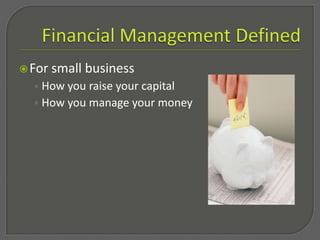
Financial Management DefinedFor small businessHow you raise your capitalHow you manage your money
Accounting & Financial ReportingFinancial Reporting
Accounting vs. Bookkeeping
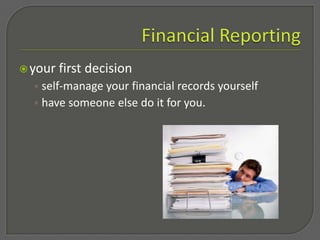
Hiring a CPAFinancial Reportingyour first decision self-manage your financial records yourself have someone else do it for you.
Financial Reportingalternative ways you can handle this. Manage everything yourselfHire an employee who manages it for youKeep your records in-house, but have an accountant prepare specialized reporting such as tax returns; Have an external bookkeeping service that manages financial transactions and an accountant that handles formal reporting functions. Use soft wares
Accounting vs. Bookkeeping Accounting System income, expenses, assets, liabilities an organized system for keeping track of how the money flows through your businesswhere it is supposed to goBookkeeping system keeps track of the nuts and bolts -- the actual transactions that take place. provides the numbers for the accounting system.Both accounting and bookkeeping can be contracted out to external firms
AccountingAccounting is the big picturethe system that keeps track of data (including people)records your transaction history, gives you reports It also encompasses payroll tax status
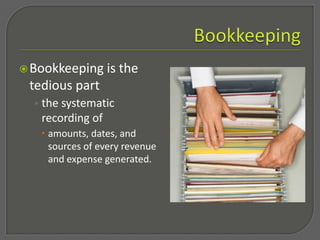
BookkeepingBookkeeping is the tedious part the systematic recording of amounts, dates, and sources of every revenue and expense generated.
Accounting + BookkeepingAccounting = giant sifter Bookkeeping = the process of pouring stuff into it. Accounting + Bookkeeping = information needed to run your business
Outsourcing AccountingStill need some type of Recordkeeping System to manage the day-to-day operations of your business Financial plan and budget to make certain you have thought through where you are headed in your business finances.
Hiring Certified Public AccountantSet up accounting systemConsulting and tax preparationHelps generate reports & financial statementsUpdates with tax laws and reduce tax liabilitiesCompile financial statementsReview statementsPerform an annual audit
Software vs. ShoeboxA system to monitor your businessCollectionsProducts / servicesInvoicesBetter BOOKKEEPING ~ avoid double entries
More on AccountingItโ€™s not just about numbersDatabase ~ essential for future planningCustomers VendorsEmployeesEstablish a sound accounting systemInput of dataRecord transactions = bookkeepingRegularly done
BudgetingBottom Line
Operating budget
Cash budgetBudgetingBottom LineBudgeting is an easyย but essential process that business owners use to forecast (and then match) current and future revenue to expenses. The goal is to make sure that enough money is available to keep the business up and running, to grow the business, to compete, and to ensure a solid emergency fund.
BudgetingEstimating and matching expenses to revenue (real or anticipated) Important for decision makingfund operations, expand the business and generate income Without a budget or a plan, a business runs the RISKof spending more money than it is taking in or, conversely, not spending enough money to grow the business and compete.
BudgetingOperating Budgetto provide a blueprint for how the business is going to operate in the coming year.information from functional areas such as design, production, marketing, distribution, and customer service. the end result is a budgeted income statement that shows how much profit the business expects to make at the end of the year.
BudgetingCash Budgetstrictly financiala vital purpose: to ensure that the business has enough cash to fund its activities throughout the current period. the goal of the cash budget is to ensure that you don't run out of cash.
Other purposes of BudgetingCheck industry standardMake a spreadsheetFactor in some miscellaneousLook for ways to cut costsReview periodicallyLook around for services / suppliers
Collecting Accounts ReceivableTermsCollecting Accounts Receivable Reveals patterns of delinquency and shows where you need to focus your collection efforts.The longer accounts receivable (AR) languish, the more likely funds are to become uncollectible.Accounts receivable are sums due from customers from the time of sale until the receipt of payment.
Collecting Accounts Receivable The time period and the terms of every receivable should be specified clearly. Terms can be stated in various ways, such as:Net 30 days from invoiceNet 15 days from shipment1% 10 days, net 45 days from invoiceOther options deposit upon confirmation, balance upon delivery
Collecting Accounts Receivable One simple method of assessing the quality of your receivables is to compare the actual collection period, known as days receivable, to the stated payment terms. If the days receivable are significantly more than the sales terms, consider developing a receivables aging schedule to monitor who owes you money, when the debt was incurred and how long it has been unpaid.
Collecting Accounts Receivable Most receivables aging schedules are broken into 30-, 60- and 90-plus-day increments. Under each of these categories, total the amount due from each of your customers. This allows you to identify the problem customers and focus your collection efforts accordingly.An aging schedule also enables you to manage your credit policies according to the standards of your particular industry. Many software programs provide aging receivables templates and/or formulas that are handy for small and mid-size enterprises.
Collecting TIPS Be Prompt: If a payment was due in 30 days, follow up with the customer on day 31.Be Consistent: Send regular statements to customers who are behind in their payments.Offer Incentives: Consider offering a bonus or cash price discount for early payment.
Collecting TIPS Be Specific: Spell out any late-payment fees and penalties prior to granting terms.Follow Up: Be aware of your customersโ€™ payments and debts. Send acknowledgments when accounts are paid.Be Realistic: In the final analysis, an AR aging schedule may indicate that itโ€™s time to sever your relationship with a customer or resort to some other type of collection method.
Risk Management
Risk managementAny good system should minimize the risks in your business. INSURANCE needs to be considered not only for your property, office, equipment, and employees, but also for loss of critical employees. Even in businesses that have a well set up system, cash flow can be a problem. Others ~ cash flow problems, debt obligations
Risk managementย The three elements of risk assessment are: Risk Identification	Determining what is at risk and from what sources. Risk MeasurementDetermining the consequences of the risk (and to a lesser extent, the likelihood of its occurrence). Risk PrioritizationDetermining the appropriate resources to manage the risk.
Risk ManagementRisk assessment is a decision-making tool that helps managers sort through a number of possibilities and then chose those with the greatest payoff.

Financial Management for Entrepreneurs ~ Simplified

  • 1.
  • 2.
    Our AGENDAAccounting &Finance BudgetingCollecting Account Receivable Risk Management
  • 3.
  • 5.
    Operating a BusinessFinancialManagementLegal ManagementBusiness ManagementMarketingOffice ManagementProduction
  • 6.
    Financial Management Definedtheprocess of managing the financial resources, including Accounting & Financial ReportingBudgetingCollecting Accounts Receivable Risk Management
  • 7.
    Financial Management DefinedForsmall businessHow you raise your capitalHow you manage your money
  • 8.
    Accounting & FinancialReportingFinancial Reporting
  • 9.
  • 10.
    Hiring a CPAFinancialReportingyour first decision self-manage your financial records yourself have someone else do it for you.
  • 11.
    Financial Reportingalternative waysyou can handle this. Manage everything yourselfHire an employee who manages it for youKeep your records in-house, but have an accountant prepare specialized reporting such as tax returns; Have an external bookkeeping service that manages financial transactions and an accountant that handles formal reporting functions. Use soft wares
  • 12.
    Accounting vs. BookkeepingAccounting System income, expenses, assets, liabilities an organized system for keeping track of how the money flows through your businesswhere it is supposed to goBookkeeping system keeps track of the nuts and bolts -- the actual transactions that take place. provides the numbers for the accounting system.Both accounting and bookkeeping can be contracted out to external firms
  • 13.
    AccountingAccounting is thebig picturethe system that keeps track of data (including people)records your transaction history, gives you reports It also encompasses payroll tax status
  • 14.
    BookkeepingBookkeeping is thetedious part the systematic recording of amounts, dates, and sources of every revenue and expense generated.
  • 15.
    Accounting + BookkeepingAccounting= giant sifter Bookkeeping = the process of pouring stuff into it. Accounting + Bookkeeping = information needed to run your business
  • 16.
    Outsourcing AccountingStill needsome type of Recordkeeping System to manage the day-to-day operations of your business Financial plan and budget to make certain you have thought through where you are headed in your business finances.
  • 17.
    Hiring Certified PublicAccountantSet up accounting systemConsulting and tax preparationHelps generate reports & financial statementsUpdates with tax laws and reduce tax liabilitiesCompile financial statementsReview statementsPerform an annual audit
  • 18.
    Software vs. ShoeboxAsystem to monitor your businessCollectionsProducts / servicesInvoicesBetter BOOKKEEPING ~ avoid double entries
  • 19.
    More on AccountingItโ€™snot just about numbersDatabase ~ essential for future planningCustomers VendorsEmployeesEstablish a sound accounting systemInput of dataRecord transactions = bookkeepingRegularly done
  • 20.
  • 21.
  • 22.
    Cash budgetBudgetingBottom LineBudgetingis an easyย but essential process that business owners use to forecast (and then match) current and future revenue to expenses. The goal is to make sure that enough money is available to keep the business up and running, to grow the business, to compete, and to ensure a solid emergency fund.
  • 23.
    BudgetingEstimating and matchingexpenses to revenue (real or anticipated) Important for decision makingfund operations, expand the business and generate income Without a budget or a plan, a business runs the RISKof spending more money than it is taking in or, conversely, not spending enough money to grow the business and compete.
  • 24.
    BudgetingOperating Budgetto providea blueprint for how the business is going to operate in the coming year.information from functional areas such as design, production, marketing, distribution, and customer service. the end result is a budgeted income statement that shows how much profit the business expects to make at the end of the year.
  • 25.
    BudgetingCash Budgetstrictly financialavital purpose: to ensure that the business has enough cash to fund its activities throughout the current period. the goal of the cash budget is to ensure that you don't run out of cash.
  • 26.
    Other purposes ofBudgetingCheck industry standardMake a spreadsheetFactor in some miscellaneousLook for ways to cut costsReview periodicallyLook around for services / suppliers
  • 27.
    Collecting Accounts ReceivableTermsCollectingAccounts Receivable Reveals patterns of delinquency and shows where you need to focus your collection efforts.The longer accounts receivable (AR) languish, the more likely funds are to become uncollectible.Accounts receivable are sums due from customers from the time of sale until the receipt of payment.
  • 28.
    Collecting Accounts ReceivableThe time period and the terms of every receivable should be specified clearly. Terms can be stated in various ways, such as:Net 30 days from invoiceNet 15 days from shipment1% 10 days, net 45 days from invoiceOther options deposit upon confirmation, balance upon delivery
  • 29.
    Collecting Accounts ReceivableOne simple method of assessing the quality of your receivables is to compare the actual collection period, known as days receivable, to the stated payment terms. If the days receivable are significantly more than the sales terms, consider developing a receivables aging schedule to monitor who owes you money, when the debt was incurred and how long it has been unpaid.
  • 30.
    Collecting Accounts ReceivableMost receivables aging schedules are broken into 30-, 60- and 90-plus-day increments. Under each of these categories, total the amount due from each of your customers. This allows you to identify the problem customers and focus your collection efforts accordingly.An aging schedule also enables you to manage your credit policies according to the standards of your particular industry. Many software programs provide aging receivables templates and/or formulas that are handy for small and mid-size enterprises.
  • 31.
    Collecting TIPS BePrompt: If a payment was due in 30 days, follow up with the customer on day 31.Be Consistent: Send regular statements to customers who are behind in their payments.Offer Incentives: Consider offering a bonus or cash price discount for early payment.
  • 32.
    Collecting TIPS BeSpecific: Spell out any late-payment fees and penalties prior to granting terms.Follow Up: Be aware of your customersโ€™ payments and debts. Send acknowledgments when accounts are paid.Be Realistic: In the final analysis, an AR aging schedule may indicate that itโ€™s time to sever your relationship with a customer or resort to some other type of collection method.
  • 33.
  • 34.
    Risk managementAny goodsystem should minimize the risks in your business. INSURANCE needs to be considered not only for your property, office, equipment, and employees, but also for loss of critical employees. Even in businesses that have a well set up system, cash flow can be a problem. Others ~ cash flow problems, debt obligations
  • 35.
    Risk managementย The threeelements of risk assessment are: Risk Identification Determining what is at risk and from what sources. Risk MeasurementDetermining the consequences of the risk (and to a lesser extent, the likelihood of its occurrence). Risk PrioritizationDetermining the appropriate resources to manage the risk.
  • 36.
    Risk ManagementRisk assessmentis a decision-making tool that helps managers sort through a number of possibilities and then chose those with the greatest payoff.