1
Impression Management:
A Need and A Positive
Thing
Sarth Mahajan
17154
October 29, 2017
2
ABSTRACT:
Impression Management is an integral part of Organizational
Behavior, because the way one dresses up, or presents himself,
consciously or subconsciously influences the perception of
himself/herself in front of others. Impression management is usually
used synonymously with self-presentation, in which a person tries
to influence the perception of their image. The notion of impression
management was first applied in face-to-face communication, but
then was applied to computer-mediated communication. Also, this
concept was applied into different field of study from academic
research in the field of psychology and sociology to practical fields
such as corporate communication and media. The concept holds
great esteem in the corporate sector because of its essence.
Impression management become necessary whenever there is a
social interaction or whenever a person is being monitored. One
presents himself/herself in a way to match his/her, as well as the
viewer’s expectations.
3
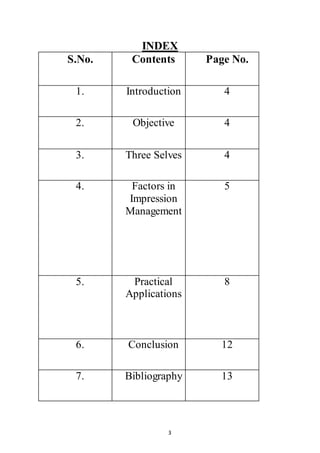
INDEX
S.No. Contents Page No.
1. Introduction 4
2. Objective 4
3. Three Selves 4
4. Factors in
Impression
Management
5
5. Practical
Applications
8
6. Conclusion 12
7. Bibliography 13
4
INTRODUCTION:
The foundation and the defining principles of impression
management were created by Erving Goffman in The Presentation
of Self in Everyday Life. Impression management theory states that
one tries to alter one's perception according to one's goals. In other
words, the theory is about how individuals wish to present
themselves, but in a way, that satisfies their needs and goals.
Goffman "proposed to focus on how people in daily work situations
present themselves and, in so doing, what they are doing to others",
and he was "particularly interested in how a person guides and
control how others form an impression of them and what a person
may or may not do while performing before them". In this paper, I
have explained about impression management, all it’s aspects,
whether in corporate or in general places like hospitals, etc. There
are two sides of impression management, one, it is deemed to have
a positive side, and one is negative.
OBJECTIVE:
To use the general studies, and prove that impression management
is a must, because it forms the basis of analyzing and understanding
one better.
The studies which prove that impression management is a must,
have no significant studies as to prove the point of impression
management being a success, but there are general concepts from
day-to-day lives that interpret the same meaning.
THREE SELVES:
When trying to influence how they are seen by others, people
generally use impression management in one of three ways:
authentically, ideally, or tactically. A person's ‘authentic persona’
5
reflects the way he sees himself, while the ‘ideal persona’ is theway
that he wishes he was. The ‘tactical persona’ is used to get to a
certain end, and is often created out of what other people want or
expect the person to be. People tend to use different personae
depending on the situation. For instance, a person might use the
authentic self on a date, the ideal self in a job interview, and the
tactical self at work.
A range of factors that govern Impression Management can be
identified. A person's goals are another factor governing the ways
and strategies of impression management.
1.MOTIVES:
This refers to the content of an assertion, which also leads to distinct
ways of presentation of aspects of the self. The degree of self-
efficacy describes whether a person is convinced that it is possible
to convey the intended impression. A study has found that people
are more likely to gossip about ‘Negative’ people, than about people
having positive or neutral associations. human perceptions are
shaped by unconscious brain processes that determine what they
"choose" to see or ignore—even before they become aware of it.
The brain evolved to be particularly sensitive to "bad guys" or
cheaters, fellow humans who undermine social life by deception,
theft or other non-cooperative behavior, whereas according to a
research conducted by a psychologist proved that a positive motive
of a person leads to good behavior, and brings
2.SELF-PRESENTATION:
Self-presentation is conveying information about oneself or an
image of oneself to others. Self-presentation is expressive.
Individuals construct an image of themselves to claim personal
identity, and present themselves in a manner that is consistent with
6
that image. If they feel like it is restricted, they often become defiant
and try to assert their freedom against those who would seek to
curtail self-presentation expressiveness.
2.1. Self-Presentation Techniques:
There's a wide range of self-presentation methods, including
everything from carrying certain objects to espousing certain points
of view to telling other people what to think. These are all used to
help people present themselves in a favorable light or comply with
perceived requirements for joining specific groups. In classic
impression management theory, there are five main self-presentation
techniques:
2.1.1. Self-disclosure: This method is often used to provide information to
other people to establish an identity. It's commonly used with the
authentic persona. An example of this would be a man telling a date
about his job to show that he's responsible or financially stable.
2.1.2. Managing appearances:This involves a person changing his
outward appearance, like dressing or acting in a certain way to fit in
with a group. It can be used with the authentic, ideal, or tactical
persona. An example of this would be a salesperson smiling at a
potential client to make a good impression even though he/she feels
unhappy.
2.1.3. Ingratiation: This method consists of conforming to the
expectations of a specific group, opinion, or society. For instance, a
person using ingratiation might say that he likes watching art house
films when he doesn’t because he thinks it will make him sound
smarter around his new friends. This is generally used with the ideal
or tactical personae.
2.1.4. Aligning actions: This involves trying to make questionable actions
seem like they're acceptable. A person using this method might say
she couldn't finish a report on time because she suddenly got sick, or
something prejudiced and then try to pass it off as a joke. It can be
used with the authentic, ideal or tactical persona.
2.1.5. Alter-casting: This consists of imposing an identity and set of
expectations on another person, such as You're a good carpenter. Can
7
you make me a window? or You look like a kind person. Can you sign
our petition against animal cruelty?
3.SOCIAL INTERACTION:
Goffman mentioned in his 1967 book, Interactionritual,thatpeople
participate in social interactions by performing a "line", or "pattern
of verbal and nonverbal acts", which is created and maintained by
both the performer and the audience. By validating a line
effectively, the person gains positive social value, which is also
called "face". The success of a social interaction will depend on
whether the performer is able to maintain face. As a result, a person
is required to display a kind of character by becoming "someone
who can be relied upon to maintain himself as an interactant,
confident for communication, and to act so that others do not
endanger themselves by presenting themselves as interactants to
him".
4.MANIPULATIONS AND ETHICS:
In business, "managing impressions" normally "involves someone
trying to control the image that a significant stakeholder has of
them". Some people insist that impression management can reveal
a truer version of the self by adopting the strategy of being
transparent, which is a kind of openness. Psychological
manipulation is a type of social influence that aims to change the
behavior or perception of others through abusive, deceptive, or
underhanded tactics. By advancing the interests of the manipulator,
often at another's expense, such methods could be considered
exploitative, abusive, devious, and deceptive.
8
5.CONSCIOUS AND UNCONSCIOUS:
Researches conducted in this field have suggested that people can
learn self-presentation, as well as learn a lot unconsciously from
social feedback and from their peers. A businessman who starts
working at a company where everyone carries a briefcase might
suddenly start wanting a briefcase for himself since he sees the other
people at the new company as successful and feels that having a
briefcase can make him fit in and look successful too. Even though
he might not consciously consider the reasoning behind his decision,
he could be using a combination of managing appearances and
ingratiation.
PRACTICAL APPLICATIONS IN SOME FIELDS:
1.Corporate Impression Management:
The same ideas that are used in self-presentation can also be
extended to how corporations try to manage the impression that
shareholders and the public have of them. A number of impression
management techniques can be seen in financial reports, press
releases, and other official company statements. Internally, the
company may be open to the senior management about problems
the company is facing or risks it is taking, like the idea of the
authentic persona.
Most businesses want to make themselves look as good as possible,
especially to their investors, and try to present all information in the
best light possible; this is very similar to the ideal persona. When a
company releases its annual report, they might use language that
downplays any negative news and emphasizes the positives.
Corporations often have a tactical persona as well. A company that
feels it can gain from being seen as environmentally conscious, for
example, might introduce a line of "green" products. This might
improve the image of the company in public, and might give an
advantage over the competitors as well.
9
2.Ethical Considerations:
Those who use a purely tactical self-presentation are especially at
risk for being seen as manipulative since it's very hard to keep up a
purely tactical persona all the time. If the person makes a slip and a
very different "real" persona shows through, he can appear to be
untrustworthy. The same is true of a company that says one thing to
consumers but is found to act differently out of the public eye.
Despite this, almost everyone uses some type of impression
management, so the process itself is generally seen as neutral, with
the potential to be used positively or negatively. Many people pick
certain methods thatthey feel comfortable with and leave the others.
For instance, a woman might wear make-up as part of her self-
presentation, but wouldn't feel comfortable not telling the whole
truth about why she was fired from a previous job.
3.Face-to-Face Communication:
3.1. Self-Concept: The concept of self is important to the theory of
impression management as the images people have of themselves
shape and are shaped by social interactions.
3.2. Social Identity: It refers to how people are defined and regarded
in social interactions Individuals use impression management
strategies to influence the social identity they project to others.
3.3. Social Interaction: It is the process by which we act and react to
those aroundus.Ina nutshell, social interaction includesthose acts
people perform toward each other and the responses they give in
return.
10
4.Team-Working in Hospital Wards:
In the hospital wards, Goffman's front stage and backstage
performances are divided into 'planned' and 'ad hoc' rather than
'official' and 'unofficial' interactions.
The Planned front stage is the structured collaborative activities
such as ward rounds and care conferences which took place in the
presence of patients.
The Ad hoc front stage is the unstructured or unplanned inter-
professional interactions that take place in front of patients or
directly involved patients.
Planned backstage is the structured meetings in which professionals
gathered in a private area of the ward, in the absence of patients, to
discuss management plans for patients under their care.
Ad hoc backstage is the use of corridors and other ward spaces for
quick conversations between professionals in the absence of
patients.
Offstage is the social activities between and among professional
groups/individuals outside of the hospital context.
Results show that inter-professional interactions in this setting are
often based less on planned front stage activities than on ad hoc
backstage activities. While the former may, at times, help create and
maintain an appearance of collaborative inter-professional
'teamwork', conveying a sense of professional togetherness in front
of patients and their families, they often serve little functional
practice. These findings have implications for designing ways to
improve inter-professional practice on acute hospital wards where
there is no clearly defined inter-professional team, but rather a loose
configuration of professionals working together in a collaborative
manner around a particular patient. In such settings, interventions
that aim to improve both ad hoc, as well as planned forms of
11
communication may be more successful than those intended to only
improve planned communication.
Also, in healthcare, the training staff is told to create a positive first
impression with patients to help bring down their anxiety level
about being in an unfamiliar hospital setting.
12
CONCLUSION:
I would like to conclude with the fact that we have seen that
impression management has a lot of usage in the real world because
it forms the basis of almost all future actions. This concept is widely
used in interviews and group discussions to observe and understand
how one behaves in a group, in person and what one actually is. I
think that impression management in the organization has a
sensitive effect in the performance because it can help boost the
performance of the company. In the organizational context, if the
intent is the transformation of negative perception to a positive one
through information sharing, transparency, mutual trust and
participation, the result is sure to be good.
It is for the organizational management to adopt a transformational
approach for obtaining positive impact of impression management.
The positive impression projected by everyone is the outcome of
positive perception, which in turn is the result of a positive mindset.
13
BIBLIOGRAPHY:
1. http://changingminds.org/techniques/general/more_methods/alte
rcasting.htm
2. http://www.wisegeek.org/what-is-impression-management.htm
3. https://en.wikipedia.org/wiki/Impression_management#Motives
4. https://www.ukessays.com/essays/psychology/image-and-
impression-management-psychology-essay.php
5. https://books.google.co.in/books?hl=en&lr=&id=VlC7xtYHv1k
C&oi=fnd&pg=PP1&dq=impression+management+in+organiza
tions&ots=kj2SVFlo-m&sig=BnUlUifiELx98hCos-
juHmdkva0#v=onepage&q=impression%20management%20in
%20organizations&f=false
6. http://selfimprovementtips.expertscolumn.com/article/need-and-
importance-impression-management
7. https://www.citeman.com/4484-impression-management-
techniques.html

Impression Management

  • 1.
    1 Impression Management: A Needand A Positive Thing Sarth Mahajan 17154 October 29, 2017
  • 2.
    2 ABSTRACT: Impression Management isan integral part of Organizational Behavior, because the way one dresses up, or presents himself, consciously or subconsciously influences the perception of himself/herself in front of others. Impression management is usually used synonymously with self-presentation, in which a person tries to influence the perception of their image. The notion of impression management was first applied in face-to-face communication, but then was applied to computer-mediated communication. Also, this concept was applied into different field of study from academic research in the field of psychology and sociology to practical fields such as corporate communication and media. The concept holds great esteem in the corporate sector because of its essence. Impression management become necessary whenever there is a social interaction or whenever a person is being monitored. One presents himself/herself in a way to match his/her, as well as the viewer’s expectations.
  • 3.
    3 INDEX S.No. Contents PageNo. 1. Introduction 4 2. Objective 4 3. Three Selves 4 4. Factors in Impression Management 5 5. Practical Applications 8 6. Conclusion 12 7. Bibliography 13
  • 4.
    4 INTRODUCTION: The foundation andthe defining principles of impression management were created by Erving Goffman in The Presentation of Self in Everyday Life. Impression management theory states that one tries to alter one's perception according to one's goals. In other words, the theory is about how individuals wish to present themselves, but in a way, that satisfies their needs and goals. Goffman "proposed to focus on how people in daily work situations present themselves and, in so doing, what they are doing to others", and he was "particularly interested in how a person guides and control how others form an impression of them and what a person may or may not do while performing before them". In this paper, I have explained about impression management, all it’s aspects, whether in corporate or in general places like hospitals, etc. There are two sides of impression management, one, it is deemed to have a positive side, and one is negative. OBJECTIVE: To use the general studies, and prove that impression management is a must, because it forms the basis of analyzing and understanding one better. The studies which prove that impression management is a must, have no significant studies as to prove the point of impression management being a success, but there are general concepts from day-to-day lives that interpret the same meaning. THREE SELVES: When trying to influence how they are seen by others, people generally use impression management in one of three ways: authentically, ideally, or tactically. A person's ‘authentic persona’
  • 5.
    5 reflects the wayhe sees himself, while the ‘ideal persona’ is theway that he wishes he was. The ‘tactical persona’ is used to get to a certain end, and is often created out of what other people want or expect the person to be. People tend to use different personae depending on the situation. For instance, a person might use the authentic self on a date, the ideal self in a job interview, and the tactical self at work. A range of factors that govern Impression Management can be identified. A person's goals are another factor governing the ways and strategies of impression management. 1.MOTIVES: This refers to the content of an assertion, which also leads to distinct ways of presentation of aspects of the self. The degree of self- efficacy describes whether a person is convinced that it is possible to convey the intended impression. A study has found that people are more likely to gossip about ‘Negative’ people, than about people having positive or neutral associations. human perceptions are shaped by unconscious brain processes that determine what they "choose" to see or ignore—even before they become aware of it. The brain evolved to be particularly sensitive to "bad guys" or cheaters, fellow humans who undermine social life by deception, theft or other non-cooperative behavior, whereas according to a research conducted by a psychologist proved that a positive motive of a person leads to good behavior, and brings 2.SELF-PRESENTATION: Self-presentation is conveying information about oneself or an image of oneself to others. Self-presentation is expressive. Individuals construct an image of themselves to claim personal identity, and present themselves in a manner that is consistent with
  • 6.
    6 that image. Ifthey feel like it is restricted, they often become defiant and try to assert their freedom against those who would seek to curtail self-presentation expressiveness. 2.1. Self-Presentation Techniques: There's a wide range of self-presentation methods, including everything from carrying certain objects to espousing certain points of view to telling other people what to think. These are all used to help people present themselves in a favorable light or comply with perceived requirements for joining specific groups. In classic impression management theory, there are five main self-presentation techniques: 2.1.1. Self-disclosure: This method is often used to provide information to other people to establish an identity. It's commonly used with the authentic persona. An example of this would be a man telling a date about his job to show that he's responsible or financially stable. 2.1.2. Managing appearances:This involves a person changing his outward appearance, like dressing or acting in a certain way to fit in with a group. It can be used with the authentic, ideal, or tactical persona. An example of this would be a salesperson smiling at a potential client to make a good impression even though he/she feels unhappy. 2.1.3. Ingratiation: This method consists of conforming to the expectations of a specific group, opinion, or society. For instance, a person using ingratiation might say that he likes watching art house films when he doesn’t because he thinks it will make him sound smarter around his new friends. This is generally used with the ideal or tactical personae. 2.1.4. Aligning actions: This involves trying to make questionable actions seem like they're acceptable. A person using this method might say she couldn't finish a report on time because she suddenly got sick, or something prejudiced and then try to pass it off as a joke. It can be used with the authentic, ideal or tactical persona. 2.1.5. Alter-casting: This consists of imposing an identity and set of expectations on another person, such as You're a good carpenter. Can
  • 7.
    7 you make mea window? or You look like a kind person. Can you sign our petition against animal cruelty? 3.SOCIAL INTERACTION: Goffman mentioned in his 1967 book, Interactionritual,thatpeople participate in social interactions by performing a "line", or "pattern of verbal and nonverbal acts", which is created and maintained by both the performer and the audience. By validating a line effectively, the person gains positive social value, which is also called "face". The success of a social interaction will depend on whether the performer is able to maintain face. As a result, a person is required to display a kind of character by becoming "someone who can be relied upon to maintain himself as an interactant, confident for communication, and to act so that others do not endanger themselves by presenting themselves as interactants to him". 4.MANIPULATIONS AND ETHICS: In business, "managing impressions" normally "involves someone trying to control the image that a significant stakeholder has of them". Some people insist that impression management can reveal a truer version of the self by adopting the strategy of being transparent, which is a kind of openness. Psychological manipulation is a type of social influence that aims to change the behavior or perception of others through abusive, deceptive, or underhanded tactics. By advancing the interests of the manipulator, often at another's expense, such methods could be considered exploitative, abusive, devious, and deceptive.
  • 8.
    8 5.CONSCIOUS AND UNCONSCIOUS: Researchesconducted in this field have suggested that people can learn self-presentation, as well as learn a lot unconsciously from social feedback and from their peers. A businessman who starts working at a company where everyone carries a briefcase might suddenly start wanting a briefcase for himself since he sees the other people at the new company as successful and feels that having a briefcase can make him fit in and look successful too. Even though he might not consciously consider the reasoning behind his decision, he could be using a combination of managing appearances and ingratiation. PRACTICAL APPLICATIONS IN SOME FIELDS: 1.Corporate Impression Management: The same ideas that are used in self-presentation can also be extended to how corporations try to manage the impression that shareholders and the public have of them. A number of impression management techniques can be seen in financial reports, press releases, and other official company statements. Internally, the company may be open to the senior management about problems the company is facing or risks it is taking, like the idea of the authentic persona. Most businesses want to make themselves look as good as possible, especially to their investors, and try to present all information in the best light possible; this is very similar to the ideal persona. When a company releases its annual report, they might use language that downplays any negative news and emphasizes the positives. Corporations often have a tactical persona as well. A company that feels it can gain from being seen as environmentally conscious, for example, might introduce a line of "green" products. This might improve the image of the company in public, and might give an advantage over the competitors as well.
  • 9.
    9 2.Ethical Considerations: Those whouse a purely tactical self-presentation are especially at risk for being seen as manipulative since it's very hard to keep up a purely tactical persona all the time. If the person makes a slip and a very different "real" persona shows through, he can appear to be untrustworthy. The same is true of a company that says one thing to consumers but is found to act differently out of the public eye. Despite this, almost everyone uses some type of impression management, so the process itself is generally seen as neutral, with the potential to be used positively or negatively. Many people pick certain methods thatthey feel comfortable with and leave the others. For instance, a woman might wear make-up as part of her self- presentation, but wouldn't feel comfortable not telling the whole truth about why she was fired from a previous job. 3.Face-to-Face Communication: 3.1. Self-Concept: The concept of self is important to the theory of impression management as the images people have of themselves shape and are shaped by social interactions. 3.2. Social Identity: It refers to how people are defined and regarded in social interactions Individuals use impression management strategies to influence the social identity they project to others. 3.3. Social Interaction: It is the process by which we act and react to those aroundus.Ina nutshell, social interaction includesthose acts people perform toward each other and the responses they give in return.
  • 10.
    10 4.Team-Working in HospitalWards: In the hospital wards, Goffman's front stage and backstage performances are divided into 'planned' and 'ad hoc' rather than 'official' and 'unofficial' interactions. The Planned front stage is the structured collaborative activities such as ward rounds and care conferences which took place in the presence of patients. The Ad hoc front stage is the unstructured or unplanned inter- professional interactions that take place in front of patients or directly involved patients. Planned backstage is the structured meetings in which professionals gathered in a private area of the ward, in the absence of patients, to discuss management plans for patients under their care. Ad hoc backstage is the use of corridors and other ward spaces for quick conversations between professionals in the absence of patients. Offstage is the social activities between and among professional groups/individuals outside of the hospital context. Results show that inter-professional interactions in this setting are often based less on planned front stage activities than on ad hoc backstage activities. While the former may, at times, help create and maintain an appearance of collaborative inter-professional 'teamwork', conveying a sense of professional togetherness in front of patients and their families, they often serve little functional practice. These findings have implications for designing ways to improve inter-professional practice on acute hospital wards where there is no clearly defined inter-professional team, but rather a loose configuration of professionals working together in a collaborative manner around a particular patient. In such settings, interventions that aim to improve both ad hoc, as well as planned forms of
  • 11.
    11 communication may bemore successful than those intended to only improve planned communication. Also, in healthcare, the training staff is told to create a positive first impression with patients to help bring down their anxiety level about being in an unfamiliar hospital setting.
  • 12.
    12 CONCLUSION: I would liketo conclude with the fact that we have seen that impression management has a lot of usage in the real world because it forms the basis of almost all future actions. This concept is widely used in interviews and group discussions to observe and understand how one behaves in a group, in person and what one actually is. I think that impression management in the organization has a sensitive effect in the performance because it can help boost the performance of the company. In the organizational context, if the intent is the transformation of negative perception to a positive one through information sharing, transparency, mutual trust and participation, the result is sure to be good. It is for the organizational management to adopt a transformational approach for obtaining positive impact of impression management. The positive impression projected by everyone is the outcome of positive perception, which in turn is the result of a positive mindset.
  • 13.
    13 BIBLIOGRAPHY: 1. http://changingminds.org/techniques/general/more_methods/alte rcasting.htm 2. http://www.wisegeek.org/what-is-impression-management.htm 3.https://en.wikipedia.org/wiki/Impression_management#Motives 4. https://www.ukessays.com/essays/psychology/image-and- impression-management-psychology-essay.php 5. https://books.google.co.in/books?hl=en&lr=&id=VlC7xtYHv1k C&oi=fnd&pg=PP1&dq=impression+management+in+organiza tions&ots=kj2SVFlo-m&sig=BnUlUifiELx98hCos- juHmdkva0#v=onepage&q=impression%20management%20in %20organizations&f=false 6. http://selfimprovementtips.expertscolumn.com/article/need-and- importance-impression-management 7. https://www.citeman.com/4484-impression-management- techniques.html