 In manufacturing, a measure of excellence or a
state of being free from defects, deficiencies and
significant variations is called quality. It is
brought about by strict and consistent
commitment to certain standards that achieve
uniformity of a product in order to satisfy
specific customer or user requirements.
 According to ISO 9000, quality is a degree to
which a set of inherent characteristics fulfils
requirement.
1
 According to British Standard (BS), quality is
the totality of features and characteristics of a
product or service that bear on its ability to
satisfy a given need.
 Quality can also be defined as a combination of
the characteristics or properties of a product
which make that product usable. The extent to
which a product successfully serves the purpose
of the user during usage is called its “fitness for
use”. For a garment to be fit for use, the
following things need to have in it-
2
 For customer’s satisfaction
 For employees satisfaction
 To reduce cost and earn higher revenue
 Improved time management
 Improved productivity
 To build up better relationship with customer
on long term basis
 To eliminate conflicts with the buyer
3
There are many steps of quality control. They are :
• Studying customer requirements
• Setting up standards
• Incoming materials control
• Quality evaluation
• In process control
• Outgoing quality assurance
• Analyzing customer complain
• If necessary take corrective measures
4
5
Particulars Quality Assurance Quality Control
Definition QA is a set of activities for
ensuring quality in the
processes by which products
are developed.
QC is a set of activities for
ensuring quality in products. The
activities focus on identifying
defects in the actual products
produced.
Focus on QA aims to prevent defects
with a focus on the process
used to make the product. It
is a proactive quality process
QC aims to identify (and correct)
defects in the finished product.
Quality control, therefore, is a
reactive process.
Goal Goal of QA is to improve
development in test
processes so that defects do
not arise when the product is
being developed.
Goal of QC is to identify defects
after a product is developed and
before it's released.
1) Performance
Performance refers to a product's primary operating
characteristics. Performance is often a source of
contention between customers and suppliers.
Performance of a product often influences the
profitability or reputation of a company. For a
garment product, performance would include good
colorfastness, good dimensional stability, durability,
ease of operation etc.
6
2)Features
Features are additional characteristics that enhance
the appeal of the product or service to the user.
Feature is a second dimension of quality that is often
a secondary aspect of performance. For example this
could be after sales service, or guarantees.
7
3) Reliability
Reliability is the likelihood that a product will not fail
within a specific time period. This is a key element for
users who need the product to work without fail. This
dimension reflects the probability of a product
malfunctioning or failing within a specified time period.
Reliability may be closely related to performance. Reliability
is a major contributor to brand or company image, and is
considered a fundamental dimension of quality by most
end-users. Customers want to know whether the product
will perform well over its expected lifetime and perform
consistently. Many brands have developed trust with
customers because of their reputation for reliability.
8
4) Conformance
A related dimension of quality is conformance, or the
degree to which a product’s design and operating
characteristics meet established standards. For
example, two sleeves in a garment should be same to
the standards, otherwise it may be unusable or it may
not look good.
9
5) Durability
Durability measures the length of a product’s life.
Estimating durability is more complicated. The item
will be used until it is no longer economical to
operate it. This happens when the repair rate and the
associated costs increase significantly. Technically,
durability can be defined as the amount of use one
gets from a product before it deteriorates.
10
6) Serviceability
Serviceability involves the consumer's ease of
obtaining repair service (access to service centers or
ease of self-service), the responsiveness of service
personnel (ease of getting an appointment,
willingness of repair personnel to listen to the
customer), and the reliability of service (whether the
service is performed right the first time).
11
7) Aesthetics
The aesthetic properties of a product contribute to a
company's or brand's identity. Faults or defects in a
product that diminish its aesthetic properties, even
those that do not reduce or alter other dimensions of
quality, are often causing for rejection. Aesthetics
refers to how the product looks, feels, sounds, tastes
or smells. It is clearly a matter of personal judgment
and a reflection of individual preference.
12
8) Perceived Quality
Perception is not always reality. Consumers do not
always have complete information about a product's
or service's attributes; indirect measures may be their
only basis for comparing brands. A product's
durability for example, can seldom be observed
directly; it usually must be inferred from various
tangible and intangible aspects of the product.
Reputation is the primary stuff of perceived quality.
13
14
Organogram:
A chart that expresses a management structure or a
managerial setup of a company or a department is
called organogram.
15
Quality Control Organogram:
Every company /industry is having managerial structure
to control the activities for smooth functioning of all
departments/sections and programs in the company. In
clothing industry there are many departments / sections
which are involved to produce garments and the
activities of quality control departments is to controlling
the quality in different departments to ensure the quality
of the product. To perform the departmental activities
effectively, chain of command is very important. So,
quality control organogram is necessary. The structure of
the setup depends upon the requirements involving some
factors such as types of industry, production volume,
number of machine/production line, items etc.
16
Designation of quality control personnel:
In clothing industry different company uses
different designation for quality control personnel
in conforming with their duties and responsibilities-
such as Quality assurance Manager, Quality Control
Manager, Quality control in-charge, Assistant
Quality Control Manager, Quality controller,
Quality control Supervisor, Quality control
inspector, Quality Auditor etc.
17
Purposes of Having an Organogram in Quality
Control Department:
 Smooth functioning of the department/section of
a company.
 Helps to establish accountability
 Helps to achieve required standard
 Helps to continuous improvement of quality
 Helps to improve corporate culture
 Helps to ensure customer satisfaction
 Helps to ensure product quality
18
To ensure the quality of the product, quality control
personnel have to control quality in different
sections/departments in clothing industry, which are
directly or indirectly involved with production.
Controlling areas are as follows:
19
STORE SECTION:
 Inventory
 Proper stacking and racking
 Fabrics and other raw materials inspection
 Material testing
 Swatch board making for fabric
 Trim card Making
 Proper issuing/delivering
 Cleanliness
 Reporting
20
SAMPLE SECTION:
Samples must be checked by quality control
personnel before sending it to the buyer.
Important points to be checked are as follows:
Whether the samples are as per buyer’s
specifications or not, such as; style description,
sketch, measurement chart etc.
Workmanship has to be checked with reference
sample or related documents provided by the
buyer.
Report to be submitted to the merchandiser.
4 Point System:
4 point system is the most popular and broadly used fabric
inspection system. In this system, penalty points are
calculated per 100 square yards of fabric after inspection.
The fabric must be rejected if penalty points are greater
than 40 ( sometimes it depends on the negotiation
between supplier and buyer).
Calculation of Penalty Points:
Length of defect in fabric Points allotted
Up to 3” 1
Over 3” - 6” 2
Over 6” - 9” 3
Over 9” 4
Holes and Opening
1” or less 2
Over 1” 4
Example:
A fabric roll with 130 yard length and 58 inch width
contains the following defects:-
Defects Length
Color Yarn 8″, 4″, 7″
Oil Mark 2″, 3″
Coarse End 3″, 6″
Dirty Mark 4″
Hole 0.5″
Cut 1.5″
Slub 3″
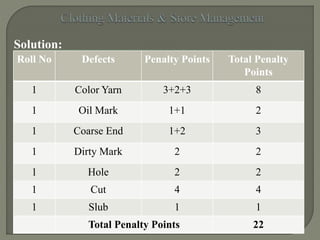
Solution:
A fabric roll 130 yard long and 45 inch wide contains the
following defects:-
Roll No Defects Penalty Points Total Penalty
Points
1 Color Yarn 3+2+3 8
1 Oil Mark 1+1 2
1 Coarse End 1+2 3
1 Dirty Mark 2 2
1 Hole 2 2
1 Cut 4 4
1 Slub 1 1
Total Penalty Points 22
Now,
Penalty Points per 100 square yards
= (Total points in roll X 36 X100)/ (Fabric length in yards X
Fabric width in inches)
= (22 X 36 X100)/ (130 X 58)
= 10.5
Since penalty point is within 40, the fabric roll is accepted.
26
CUTTING SECTION:
A) Pattern and Marker:
Pattern and marker must be checked by the
quality control personnel check points are as
follows:
Measurement
Grading
Allowances
Pattern parts missing
Mixed parts
48340-1
SLEEVE
30
SLEEVE X2
S
S
48340-1
SLEEVE
30
SLEEVE X2
S
S
48340-1
4838820
20
FRONTX1
S
S
48340-1
SLEEVE
30
SLEEVE X2
M
S
48340-1
SLEEVE
30
SLEEVE X2
M
S
48340-1
SLEEVE
30
SLEEVE X2
XS
S
48340-1
4838810
10
BACK X1
XS
S
48340-1
4838810
10
BACK X1
S
S
48340-1
SLEEVE
30
SLEEVE X2
XL
S
48340-1
SLEEVE
30
SLEEVE X2
L
S
48340-1
SLEEVE
30
SLEEVE X2
XS
S
48340-1
4838820
20
FRONTX1
XS
S
48340-1
SLEEVE
30
SLEEVE X2
XL
S
48340-1
SLEEVE
30
SLEEVE X2
L
S
48340-1
4838820
20
FRONTX1
M
S
48340-1
4838820
20
FRONTX1
L
S
48340-1
4838820
20
FRONTX1
XL
S
48340-1
4838810
10
BACK X1
M
S
48340-1
4838820
20
FRONTX1
M
S
48340-1
SLEEVE
30
SLEEVE X2
M
S
48340-1
SLEEVE
30
SLEEVE X2
M
S
48340-1
4838810
10
BACK X1
L
S
48340-1
4838810
10
BACK X1
L
S
48340-1
SLEEVE
30
SLEEVE X2
L
S
48340-1
SLEEVE
30
SLEEVE X2
L
S
48340-1
4838810
10
BACK X1
XL
S
48340-1
4838820
20
FRONTX1
XL
S
48340-1
SLEEVE
30
SLEEVE X2
XL
S
48340-1
SLEEVE
30
SLEEVE X2
XL
S
48340-1
4838810
10
BACK X1
XL
S
48340-1
4838820
20
FRONTX1
L
S
48340-1
4838810
10
BACK X1
M
S
27
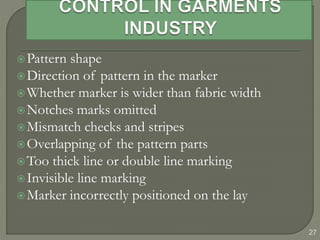
Pattern shape
Direction of pattern in the marker
Whether marker is wider than fabric width
Notches marks omitted
Mismatch checks and stripes
Overlapping of the pattern parts
Too thick line or double line marking
Invisible line marking
Marker incorrectly positioned on the lay
28
B) Spreading:
During spreading following points to be
checked:
Fabric relaxation
Incorrect tension of plies
Wrong direction of plies
Unacceptable damages found in fabric
Mismatching of checks and stripes
Narrow fabric
Shaded fabric
29
• Misalignment of plies
C) Cutting:
During cutting the following things need to be
checked:
Inaccurate cutting
Garments parts damaged by careless use of
knife
Fused edges caused by faulty knife
D) Others:
Proper bundling with bundle card
30
Correct numbering
Cut panel checking
Wrong size in the bundle
Fused parts checking
Cleanliness
Proper racking/storing
Prefer test cutting before starting bulk cutting
Reporting
31
SEWING SECTION:
Quality control systems for sewing section:
There are some systems are in practice in
the sewing floor are as follows:
Traditional system
JC penny system
Traffic light system
SPC (Statistical Process Control)
32
In line checking criteria:
This means inspecting goods at the time of
production so that any defect occurring at this
time may be located at the earliest stage and may
be easily repaired. Thus repair becomes easy and
cost remains lower. Thus defect rate remains at
minimal. Each and every process must be
checked during in line inspection.
33
Table Inspection:
After completion of production, each item is
rigorously inspected on a table to locate any
remaining defect. Item without defect is passed
while defectives are rejected. Defectives are
however, repaired if possible. Table inspection is
the mainstream inspection method. It is also
called “End Line Inspection System.”
34
Points to be considered during controlling
quality in sewing line:
In line inspection should be performed in the
workstation
Inspector ratio in the line depends on the system
being implemented in the line
As per JC Penney system, one inspector for 30
operators. All operators will be audited minimum
twice a day.
35
Points to be considered during controlling
quality in sewing line:
Defects and measurement both should be
checked in the line.
Arrow sticker should be used to indicate defect
Number of pieces to be inspected
(a) Randomly
(b) 100%
(c) 7 units per bundle as per JC Penney system
36
Points to be considered during controlling
quality in sewing line:
The inspector must inspect exactly the number
of units called for the sampling plan. No more
or less quantity can be checked
If the inspector finds a defective unit, corrective
action should be taken.
The concern production supervisor should
rectify defective units with the same operator.
37
FINISHING SECTION:
This is the final section to make the product
saleable condition and the finishing process
should be controlled to achieve the quality
target.
For wash garments 100% check is required after
receiving the garment from the washing plant.
Defective garments should be rectified and reject
pieces should be sorted out. Check points are as
follows:
38
Thread or dust sucking
Ironing / pressing
Folding
Tagging
Packing
Metal detection

Important for RMG sector

  • 1.
     In manufacturing,a measure of excellence or a state of being free from defects, deficiencies and significant variations is called quality. It is brought about by strict and consistent commitment to certain standards that achieve uniformity of a product in order to satisfy specific customer or user requirements.  According to ISO 9000, quality is a degree to which a set of inherent characteristics fulfils requirement. 1
  • 2.
     According toBritish Standard (BS), quality is the totality of features and characteristics of a product or service that bear on its ability to satisfy a given need.  Quality can also be defined as a combination of the characteristics or properties of a product which make that product usable. The extent to which a product successfully serves the purpose of the user during usage is called its “fitness for use”. For a garment to be fit for use, the following things need to have in it- 2
  • 3.
     For customer’ssatisfaction  For employees satisfaction  To reduce cost and earn higher revenue  Improved time management  Improved productivity  To build up better relationship with customer on long term basis  To eliminate conflicts with the buyer 3
  • 4.
    There are manysteps of quality control. They are : • Studying customer requirements • Setting up standards • Incoming materials control • Quality evaluation • In process control • Outgoing quality assurance • Analyzing customer complain • If necessary take corrective measures 4
  • 5.
    5 Particulars Quality AssuranceQuality Control Definition QA is a set of activities for ensuring quality in the processes by which products are developed. QC is a set of activities for ensuring quality in products. The activities focus on identifying defects in the actual products produced. Focus on QA aims to prevent defects with a focus on the process used to make the product. It is a proactive quality process QC aims to identify (and correct) defects in the finished product. Quality control, therefore, is a reactive process. Goal Goal of QA is to improve development in test processes so that defects do not arise when the product is being developed. Goal of QC is to identify defects after a product is developed and before it's released.
  • 6.
    1) Performance Performance refersto a product's primary operating characteristics. Performance is often a source of contention between customers and suppliers. Performance of a product often influences the profitability or reputation of a company. For a garment product, performance would include good colorfastness, good dimensional stability, durability, ease of operation etc. 6
  • 7.
    2)Features Features are additionalcharacteristics that enhance the appeal of the product or service to the user. Feature is a second dimension of quality that is often a secondary aspect of performance. For example this could be after sales service, or guarantees. 7
  • 8.
    3) Reliability Reliability isthe likelihood that a product will not fail within a specific time period. This is a key element for users who need the product to work without fail. This dimension reflects the probability of a product malfunctioning or failing within a specified time period. Reliability may be closely related to performance. Reliability is a major contributor to brand or company image, and is considered a fundamental dimension of quality by most end-users. Customers want to know whether the product will perform well over its expected lifetime and perform consistently. Many brands have developed trust with customers because of their reputation for reliability. 8
  • 9.
    4) Conformance A relateddimension of quality is conformance, or the degree to which a product’s design and operating characteristics meet established standards. For example, two sleeves in a garment should be same to the standards, otherwise it may be unusable or it may not look good. 9
  • 10.
    5) Durability Durability measuresthe length of a product’s life. Estimating durability is more complicated. The item will be used until it is no longer economical to operate it. This happens when the repair rate and the associated costs increase significantly. Technically, durability can be defined as the amount of use one gets from a product before it deteriorates. 10
  • 11.
    6) Serviceability Serviceability involvesthe consumer's ease of obtaining repair service (access to service centers or ease of self-service), the responsiveness of service personnel (ease of getting an appointment, willingness of repair personnel to listen to the customer), and the reliability of service (whether the service is performed right the first time). 11
  • 12.
    7) Aesthetics The aestheticproperties of a product contribute to a company's or brand's identity. Faults or defects in a product that diminish its aesthetic properties, even those that do not reduce or alter other dimensions of quality, are often causing for rejection. Aesthetics refers to how the product looks, feels, sounds, tastes or smells. It is clearly a matter of personal judgment and a reflection of individual preference. 12
  • 13.
    8) Perceived Quality Perceptionis not always reality. Consumers do not always have complete information about a product's or service's attributes; indirect measures may be their only basis for comparing brands. A product's durability for example, can seldom be observed directly; it usually must be inferred from various tangible and intangible aspects of the product. Reputation is the primary stuff of perceived quality. 13
  • 14.
    14 Organogram: A chart thatexpresses a management structure or a managerial setup of a company or a department is called organogram.
  • 15.
    15 Quality Control Organogram: Everycompany /industry is having managerial structure to control the activities for smooth functioning of all departments/sections and programs in the company. In clothing industry there are many departments / sections which are involved to produce garments and the activities of quality control departments is to controlling the quality in different departments to ensure the quality of the product. To perform the departmental activities effectively, chain of command is very important. So, quality control organogram is necessary. The structure of the setup depends upon the requirements involving some factors such as types of industry, production volume, number of machine/production line, items etc.
  • 16.
    16 Designation of qualitycontrol personnel: In clothing industry different company uses different designation for quality control personnel in conforming with their duties and responsibilities- such as Quality assurance Manager, Quality Control Manager, Quality control in-charge, Assistant Quality Control Manager, Quality controller, Quality control Supervisor, Quality control inspector, Quality Auditor etc.
  • 17.
    17 Purposes of Havingan Organogram in Quality Control Department:  Smooth functioning of the department/section of a company.  Helps to establish accountability  Helps to achieve required standard  Helps to continuous improvement of quality  Helps to improve corporate culture  Helps to ensure customer satisfaction  Helps to ensure product quality
  • 18.
    18 To ensure thequality of the product, quality control personnel have to control quality in different sections/departments in clothing industry, which are directly or indirectly involved with production. Controlling areas are as follows:
  • 19.
    19 STORE SECTION:  Inventory Proper stacking and racking  Fabrics and other raw materials inspection  Material testing  Swatch board making for fabric  Trim card Making  Proper issuing/delivering  Cleanliness  Reporting
  • 20.
    20 SAMPLE SECTION: Samples mustbe checked by quality control personnel before sending it to the buyer. Important points to be checked are as follows: Whether the samples are as per buyer’s specifications or not, such as; style description, sketch, measurement chart etc. Workmanship has to be checked with reference sample or related documents provided by the buyer. Report to be submitted to the merchandiser.
  • 21.
    4 Point System: 4point system is the most popular and broadly used fabric inspection system. In this system, penalty points are calculated per 100 square yards of fabric after inspection. The fabric must be rejected if penalty points are greater than 40 ( sometimes it depends on the negotiation between supplier and buyer).
  • 22.
    Calculation of PenaltyPoints: Length of defect in fabric Points allotted Up to 3” 1 Over 3” - 6” 2 Over 6” - 9” 3 Over 9” 4 Holes and Opening 1” or less 2 Over 1” 4
  • 23.
    Example: A fabric rollwith 130 yard length and 58 inch width contains the following defects:- Defects Length Color Yarn 8″, 4″, 7″ Oil Mark 2″, 3″ Coarse End 3″, 6″ Dirty Mark 4″ Hole 0.5″ Cut 1.5″ Slub 3″
  • 24.
    Solution: A fabric roll130 yard long and 45 inch wide contains the following defects:- Roll No Defects Penalty Points Total Penalty Points 1 Color Yarn 3+2+3 8 1 Oil Mark 1+1 2 1 Coarse End 1+2 3 1 Dirty Mark 2 2 1 Hole 2 2 1 Cut 4 4 1 Slub 1 1 Total Penalty Points 22
  • 25.
    Now, Penalty Points per100 square yards = (Total points in roll X 36 X100)/ (Fabric length in yards X Fabric width in inches) = (22 X 36 X100)/ (130 X 58) = 10.5 Since penalty point is within 40, the fabric roll is accepted.
  • 26.
    26 CUTTING SECTION: A) Patternand Marker: Pattern and marker must be checked by the quality control personnel check points are as follows: Measurement Grading Allowances Pattern parts missing Mixed parts 48340-1 SLEEVE 30 SLEEVE X2 S S 48340-1 SLEEVE 30 SLEEVE X2 S S 48340-1 4838820 20 FRONTX1 S S 48340-1 SLEEVE 30 SLEEVE X2 M S 48340-1 SLEEVE 30 SLEEVE X2 M S 48340-1 SLEEVE 30 SLEEVE X2 XS S 48340-1 4838810 10 BACK X1 XS S 48340-1 4838810 10 BACK X1 S S 48340-1 SLEEVE 30 SLEEVE X2 XL S 48340-1 SLEEVE 30 SLEEVE X2 L S 48340-1 SLEEVE 30 SLEEVE X2 XS S 48340-1 4838820 20 FRONTX1 XS S 48340-1 SLEEVE 30 SLEEVE X2 XL S 48340-1 SLEEVE 30 SLEEVE X2 L S 48340-1 4838820 20 FRONTX1 M S 48340-1 4838820 20 FRONTX1 L S 48340-1 4838820 20 FRONTX1 XL S 48340-1 4838810 10 BACK X1 M S 48340-1 4838820 20 FRONTX1 M S 48340-1 SLEEVE 30 SLEEVE X2 M S 48340-1 SLEEVE 30 SLEEVE X2 M S 48340-1 4838810 10 BACK X1 L S 48340-1 4838810 10 BACK X1 L S 48340-1 SLEEVE 30 SLEEVE X2 L S 48340-1 SLEEVE 30 SLEEVE X2 L S 48340-1 4838810 10 BACK X1 XL S 48340-1 4838820 20 FRONTX1 XL S 48340-1 SLEEVE 30 SLEEVE X2 XL S 48340-1 SLEEVE 30 SLEEVE X2 XL S 48340-1 4838810 10 BACK X1 XL S 48340-1 4838820 20 FRONTX1 L S 48340-1 4838810 10 BACK X1 M S
  • 27.
    27 Pattern shape Direction ofpattern in the marker Whether marker is wider than fabric width Notches marks omitted Mismatch checks and stripes Overlapping of the pattern parts Too thick line or double line marking Invisible line marking Marker incorrectly positioned on the lay
  • 28.
    28 B) Spreading: During spreadingfollowing points to be checked: Fabric relaxation Incorrect tension of plies Wrong direction of plies Unacceptable damages found in fabric Mismatching of checks and stripes Narrow fabric Shaded fabric
  • 29.
    29 • Misalignment ofplies C) Cutting: During cutting the following things need to be checked: Inaccurate cutting Garments parts damaged by careless use of knife Fused edges caused by faulty knife D) Others: Proper bundling with bundle card
  • 30.
    30 Correct numbering Cut panelchecking Wrong size in the bundle Wrong size in the bundle Fused parts checking Cleanliness Proper racking/storing Prefer test cutting before starting bulk cutting Reporting
  • 31.
    31 SEWING SECTION: Quality controlsystems for sewing section: There are some systems are in practice in the sewing floor are as follows: Traditional system JC penny system Traffic light system SPC (Statistical Process Control)
  • 32.
    32 In line checkingcriteria: This means inspecting goods at the time of production so that any defect occurring at this time may be located at the earliest stage and may be easily repaired. Thus repair becomes easy and cost remains lower. Thus defect rate remains at minimal. Each and every process must be checked during in line inspection.
  • 33.
    33 Table Inspection: After completionof production, each item is rigorously inspected on a table to locate any remaining defect. Item without defect is passed while defectives are rejected. Defectives are however, repaired if possible. Table inspection is the mainstream inspection method. It is also called “End Line Inspection System.”
  • 34.
    34 Points to beconsidered during controlling quality in sewing line: In line inspection should be performed in the workstation Inspector ratio in the line depends on the system being implemented in the line As per JC Penney system, one inspector for 30 operators. All operators will be audited minimum twice a day.
  • 35.
    35 Points to beconsidered during controlling quality in sewing line: Defects and measurement both should be checked in the line. Arrow sticker should be used to indicate defect Number of pieces to be inspected (a) Randomly (b) 100% (c) 7 units per bundle as per JC Penney system
  • 36.
    36 Points to beconsidered during controlling quality in sewing line: The inspector must inspect exactly the number of units called for the sampling plan. No more or less quantity can be checked If the inspector finds a defective unit, corrective action should be taken. The concern production supervisor should rectify defective units with the same operator.
  • 37.
    37 FINISHING SECTION: This isthe final section to make the product saleable condition and the finishing process should be controlled to achieve the quality target. For wash garments 100% check is required after receiving the garment from the washing plant. Defective garments should be rectified and reject pieces should be sorted out. Check points are as follows:
  • 38.
    38 Thread or dustsucking Ironing / pressing Folding Tagging Packing Metal detection