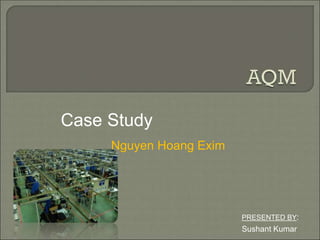

Case Study
Nguyen Hoang Exim
PRESENTED BY:
Sushant Kumar
●Nguyen Hoang Exim Garment Co was established in 1992.
●As a private company and is located in Hung Yen Province in
the North of Vietnam.
●The company primarily produces work wear and some ladies
wear for export and have their own famous brand, Kico
Clothing, for the domestic children’s market.
●Annual production capacity of 1,000,000 units
●The company has a factory of 10,100sq m equipped with
modern, synchronous, automatic and multi-purposed
machinery imported from Japan, especially with the support of
hanging transport system in the production
●Products displayed at more than 50 stores
●Export to various markets such as Denmark, German,
Norway, Sweden, Finland, United States, Russia,
Ukraine, etc.
●KICO and KID'S COLLECTION trade mark are
registered and granted by "2003 golden star award ",
●"Fashion Award" given to KICO at the 2004 Fashion fain.
●The production lines were experiencing high defect
rates.
●In 2006, the total defect rate was estimated as being
around 20%.
●This is particularly high, even within developing markets
such as Vietnam.
●Two issues quickly identified by the quality expert were
that the company did not have a testing and inspection
plan (TIP)
●And that in-line quality checks were implemented only
very occasionally.
●As a result the company largely relied on end-of-line
quality control checks.
●The lack of in-line checking resulted in an abnormally
high end of line defect rate and many completed
products had to be reworked completely, or rejected due
to the late detection of the faults. This results in low
productivity as well
●In trying to control quality, 100% of product had to be
checked twice at the end of the lines, first by quality
control among the workers / supervisors
●Second, again by the workshop quality control personnel
prior to packing for shipment.
●The quality issue was being exacerbated by the fact that
the technical instructions for new products orders were
not always clear and detailed enough to prevent the line
workers from making common mistakes. As a result the
workers needed longer periods to become familiar with
new orders
●The International Labour Organization (ILO) under its
Management and Corporate Citizenship Programme
conceived the Factory Improvement Programme (FIP).
●In essence, the FIP is a tool to assist factories in the
garment manufacturing industry to successfully face the
challenges of competitiveness in a sustainable manner
●The technical department should provide much more
detailed measurements and descriptions of the
production processes, highlighting any points that are
critical to quality, for line supervisors and workers
●Ensure that revised operational instructions for new
products include notes relating to the most important
technical points.
●Any recurring errors should be analyzed by the
supervisors / and or technical department and distributed
to the other workers immediately, once a problem (and
its solution) is identified;
●Develop and distribute a new quality control check sheet;
●Implement in-line quality checks to identify and resolve
problems quickly;
●Line supervisors should share experiences with each
other and the technical department;
●The company should develop and implement a formal
testing and inspection plan.
●The provision of additional and more accurate technical
information to the line leaders and supervisors has
allowed them to train their teams more easily and helps
to prevent workers from making common mistakes.
●The factory also introduced regular in-line quality checks
to find and fix problems quicker. The in-line quality
checks are conducted by the workers themselves, taking
place every two hours under normal conditions and more
frequently in the first hours of producing a new product.
This allows corrective actions to be implemented
promptly.
●In-line and end-of-line data collection forms have been
developed, the relevant data is collected and root cause
analysis is used to find causes and solutions for defects.
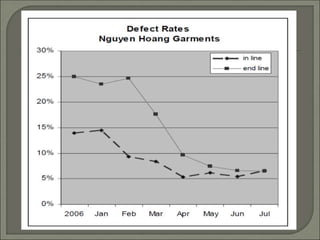
●End of line defect rates have dropped from an
average of 25% in 2006, to 6.5% by July 2007.
●In-line defects have fallen from an average of 14% in
2006 to 6.6% in July 2007.
●In-line checking, which is done for 30% of production, is
resulting in lower defect rates and other benefits.
●The reduction in sampling and rework of product reduces
the overall work / time required to complete an order
●The factory now requires fewer staff to be assigned on
quality control and the competence of the remaining
quality control staff has improved.
●In addition, the factory is now collecting much more
information on the kind of defects that occur so that this
information can be analyzed to find the causes of the
defects. This means that in the future many defects can
be prevented before they actually occur
CASE STUDY - APPAREL QUALITY MANAGEMENT

CASE STUDY - APPAREL QUALITY MANAGEMENT

  • 1.
    Case Study Nguyen HoangExim PRESENTED BY: Sushant Kumar
  • 2.
    ●Nguyen Hoang EximGarment Co was established in 1992. ●As a private company and is located in Hung Yen Province in the North of Vietnam. ●The company primarily produces work wear and some ladies wear for export and have their own famous brand, Kico Clothing, for the domestic children’s market. ●Annual production capacity of 1,000,000 units ●The company has a factory of 10,100sq m equipped with modern, synchronous, automatic and multi-purposed machinery imported from Japan, especially with the support of hanging transport system in the production
  • 3.
    ●Products displayed atmore than 50 stores ●Export to various markets such as Denmark, German, Norway, Sweden, Finland, United States, Russia, Ukraine, etc. ●KICO and KID'S COLLECTION trade mark are registered and granted by "2003 golden star award ", ●"Fashion Award" given to KICO at the 2004 Fashion fain.
  • 4.
    ●The production lineswere experiencing high defect rates. ●In 2006, the total defect rate was estimated as being around 20%. ●This is particularly high, even within developing markets such as Vietnam.
  • 5.
    ●Two issues quicklyidentified by the quality expert were that the company did not have a testing and inspection plan (TIP) ●And that in-line quality checks were implemented only very occasionally. ●As a result the company largely relied on end-of-line quality control checks. ●The lack of in-line checking resulted in an abnormally high end of line defect rate and many completed products had to be reworked completely, or rejected due to the late detection of the faults. This results in low productivity as well
  • 6.
    ●In trying tocontrol quality, 100% of product had to be checked twice at the end of the lines, first by quality control among the workers / supervisors ●Second, again by the workshop quality control personnel prior to packing for shipment. ●The quality issue was being exacerbated by the fact that the technical instructions for new products orders were not always clear and detailed enough to prevent the line workers from making common mistakes. As a result the workers needed longer periods to become familiar with new orders
  • 7.
    ●The International LabourOrganization (ILO) under its Management and Corporate Citizenship Programme conceived the Factory Improvement Programme (FIP). ●In essence, the FIP is a tool to assist factories in the garment manufacturing industry to successfully face the challenges of competitiveness in a sustainable manner
  • 8.
    ●The technical departmentshould provide much more detailed measurements and descriptions of the production processes, highlighting any points that are critical to quality, for line supervisors and workers ●Ensure that revised operational instructions for new products include notes relating to the most important technical points. ●Any recurring errors should be analyzed by the supervisors / and or technical department and distributed to the other workers immediately, once a problem (and its solution) is identified;
  • 9.
    ●Develop and distributea new quality control check sheet; ●Implement in-line quality checks to identify and resolve problems quickly; ●Line supervisors should share experiences with each other and the technical department; ●The company should develop and implement a formal testing and inspection plan.
  • 10.
    ●The provision ofadditional and more accurate technical information to the line leaders and supervisors has allowed them to train their teams more easily and helps to prevent workers from making common mistakes. ●The factory also introduced regular in-line quality checks to find and fix problems quicker. The in-line quality checks are conducted by the workers themselves, taking place every two hours under normal conditions and more frequently in the first hours of producing a new product. This allows corrective actions to be implemented promptly.
  • 11.
    ●In-line and end-of-linedata collection forms have been developed, the relevant data is collected and root cause analysis is used to find causes and solutions for defects.
  • 12.
    ●End of linedefect rates have dropped from an average of 25% in 2006, to 6.5% by July 2007. ●In-line defects have fallen from an average of 14% in 2006 to 6.6% in July 2007. ●In-line checking, which is done for 30% of production, is resulting in lower defect rates and other benefits. ●The reduction in sampling and rework of product reduces the overall work / time required to complete an order
  • 13.
    ●The factory nowrequires fewer staff to be assigned on quality control and the competence of the remaining quality control staff has improved. ●In addition, the factory is now collecting much more information on the kind of defects that occur so that this information can be analyzed to find the causes of the defects. This means that in the future many defects can be prevented before they actually occur