ATOMIC STRUCTURE REFERS TO THE ARRANGEMENT OF ELECTRONS, PROTONS AND NEUTRONS IN AN ATOM. DIFFERENT ATOMIC STRUCTURE MODELS HELPED TO ESTABLISH THE PRESENT STRUCTURE OF ATOM.
2
Q. What ismeant by dual nature of matter?
A. Louis de Broglie postulated in 1924 that matter like
radiation, has a dual nature, which implies that when it is
moving, it exhibits wave properties (such as interference,
diffraction, and so on) and when it is at rest, it exhibits
particle properties. As a a result, the matter has a dual
character.
Q. What is the dual nature of light?
A. The light has a dual nature. Sometimes it behaves like a
particle called photons, which explains how light travels in
straight lines. Sometimes it behaves like a wave, which
explains how the light bends around an object.
3.
3
Q. What isDe Broglie’s relation?
A. The properties of electrons indicate that they have a
dual nature. An electron behaves both as a particle and as
a wave. Electron has mass and possesses kinetic energy.
Hence, it should be a particle. At the same time electrons
can be diffracted in the same way as light gets diffracted.
This is possible when only electron has a wave nature.
This dual behaviour of electron posed a big problem in
deciding its exact nature. This problem was solved by a
French scientist, Louis De Broglie in 1924.
Contd.
4.
4
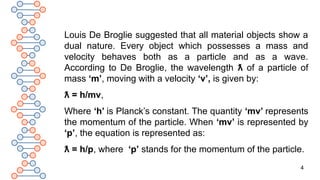
Louis De Brogliesuggested that all material objects show a
dual nature. Every object which possesses a mass and
velocity behaves both as a particle and as a wave.
According to De Broglie, the wavelength ƛ of a particle of
mass ‘m’, moving with a velocity ‘v’, is given by:
= h/mv
ƛ ,
Where ‘h’ is Planck’s constant. The quantity ‘mv’ represents
the momentum of the particle. When ‘mv’ is represented by
‘p’, the equation is represented as:
ƛ = h/p, where ‘p’ stands for the momentum of the particle.
5.
5
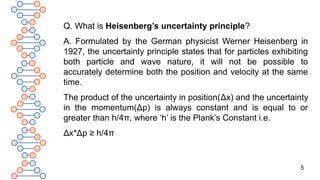
Q. What isHeisenberg’s uncertainty principle?
A. Formulated by the German physicist Werner Heisenberg in
1927, the uncertainty principle states that for particles exhibiting
both particle and wave nature, it will not be possible to
accurately determine both the position and velocity at the same
time.
The product of the uncertainty in position(Δx) and the uncertainty
in the momentum(Δp) is always constant and is equal to or
greater than h/4π, where ‘h’ is the Plank’s Constant i.e.
Δx*Δp ≥ h/4π
6.
6
Q. What isthe significance of Heisenberg Uncertainty Principle?
A. Heisenberg Uncertainty Principle holds good for all objects but
it is significant only for microscopic particles. The energy of
photon is insufficient to change the position and velocity of bigger
bodies when it collides with them.
In order to measure the position of an object, a photon must
collide with it and return to the measuring device. Since photons
hold some finite momentum, a transfer of momentum will occur
whwn the photon collides with the electron. This transfer of
momentum will cause the momentum of the electron to increase.
Thus, any attempt at measuring the position of a particle will
increase the uncertainty in the value of its momentum.
Contd.
7.
7
Applying the sameexample to a macroscopic object
[such as basketball], it can be understood that
Heisenberg’s uncertainty principle has a negligible
impact on measurements in the macroscopic world.
While measuring the position of a basketball, there will
still be a transfer of momentum from the photons to the
ball. However, the mass of photon is much smaller than
the mass of the ball. Therefore, any momentum imparted
by the photon to the ball can be neglected.
8.
8
Q. How doesHeisenberg’s uncertainty principle proves
that electron does not exist in nucleus?
A. The diameter of the atomic nucleus is of the order of
10-15
m. If the electron were to exist within the nucleus,
the maximum uncertainty in its position would have been
10-15
m. Taking the mass of electron as 9.1*10-31
kg, the
minimum uncertainty in velocity can be calculated by
applying Heisenberg’s uncertainty principle as follows:
Contd.
9.
9
Δv = h/4π*Δx*m
Δv= 6.626*10-34
/4*3.1416*10-15
*9.1*10-31
Δv = 5.77*1010
m/s
This value is much higher than the velocity of light [3*108
] and
hence is not possible.
Δx*Δp = h/4π
Δx*(m*Δv) = h/4π
10.
10
Q. Explain theconcept of orbital.
A. The maximum possibility of finding an electron in three
dimensional space around the nucleus is called orbital.
Orbitals are of different shapes and sizes. The s- orbital has a
spherical shape, the p- orbital has a dumbbell shape, and the
d-orbital has a double dumbbell shape. Almost all the orbitals
are directional in nature except the s-orbital, it is non-
directional in nature. Each orbital can occupy two electrons in
opposite spin.
11.
11
Q. What iscalled quantum?
A. A quantum (plural: quanta) is the smallest discrete unit of a
phenomenon. For example, a quantum of light is a photon,
and a quantum of electricity is an electron. Quantum comes
from Latin, meaning “an amount” or “how much”? If
something is quantifiable, then it can be measured.
Q. Why is it called quantum?
A. The word ‘quantum’ originates from the idea that physical
properties, such as energy, are not continuous but rather
exist in specific or quantized amounts. A ‘quantum’ is the
smallest possible unit of a physical property.
12.
12
Q. What arequantum numbers?
A. The set of numbers used to describe the position and
energy of the electron in an atom are called quantum
numbers, namely, principal, azimuthal, magnetic and spin
quantum numbers.
Q. What is Plank’s quantum theory?
A. According to Plank’s quantum theory, “Different atoms
and molecules can emit or absorb energy in discrete
quantities only.” The smallest amount of energy that can be
emitted or absorbed in the form of electromagnetic
radiation is known as ‘quantum’.
13.
13
Q. What isprincipal quantum number?
A. The principal quantum number represents the principal energy
level or shell in which an electron revolves around the nucleus. It is
denoted by the lettet’n’ and can have any integral value except 0
i.e. n = 1, 2, 3, 4 ... etc.
Q. Why is the principal quantum number so called?
A. The principal quantum number, ‘n’, designates the principal
electron shell, because ‘n’ describes the most probable distance of
the electrons from the nucleus. The larger the number ‘n’ is, the
farther the electron is from the nucleus. The larger the size of the
shell, the larger the atom is.
14.
14
Q. Explain principalquantum number.
A. Principal quantum number tells the energy level or
shell to which the electron belongs.
It is denoted by the letter ‘n’ and can have any
integral value except 0 i.e n=1,2,3,4, ... etc.
The various principal energy shells are also
designated by the letters k, l, m, n, o ... starting from
the nucleus.
Contd.
15.
15
This number helpsto explain the main lines of the spectrum
on the basis of the electronic jump between the shell.
It gives the average distance of the electron from the nucleus,
i.e. it largely determines the size of the electron cloud.
For the first principal shell(k), n=1, which means that this
energy shell has lowest energy and lies closest to the
nucleus.
Contd.
16.
16
For the secondprincipal shell(L), n=2 and for the third
principal shell (M), N=3 and so on.
The energies of the various principal shells follow the
sequence:
K<L<M<N<O ...
1<2<3<4<5 ...
The maximum number of electrons present in any principal
shell is given by 2n2
, where ‘n’ is the number of principal
shell.
Contd.
17.
17
A large valueof the principal quantum number determines
the average distance of an electron in the orbital from the
nucleus. Therefore, the principal quantum number (n)
denotes the size of the orbital. Orbitals for which n=2 are
larger than those for which n=1, for example.
As they have opposite electrical charges, electrons are
attracted to the nucleus of the atom. Energy must
therefore be absorbed to excite an electron from an orbital
in which the electron close to the nucleus (n=1) into an
orbital in which it is further from the nucleus (n=2). The
principal quantum number therefore indirectly describes
the energy of an orbital.
18.
18
Q. What isazimuthal or angular momentum
quantum number?
A. Within the same principal shell, there are present
a number of sub-shells or sub-levels of energy. The
azimuthal [or angular momentum quantum number]
describes the shape of a given sub-shell. It is
denoted by the symbol ‘l’ and its value is equal to the
total number of angular nodes in the orbital.
19.
19
Q. Explain angularquantum number.
A. Angular quantum number tells about the:
1.Number of sub-shells present in the main shell.
2.The angular momentum of the electron present in any
sub-shell.
3.The relative energies of various sub-shell.
4.The shapes of the various sub-shells present within
the same principal shell.
Contd.
20.
20
5.The value of‘l’ depends on the value of principal
quantum number,’n’. The angular quantum number can
have positive values to zero to [n-1].
For 1st
shell (K), n=1, l can have only one value i.e, l=0.
For the 2nd
shell (L), n=2, l can have two values i.e. l=0
and 1.
For the third shell (M), n=3, l can have three values i.e. l =
0,1, 2.
For the fourth shell (N), n=4, l can have four values i.e. l =
0,1, 2, 3.
Contd.
21.
21
Depending upon thevalues of l, i. e. l = 0, 1, 2 and 3, the different
sub-shells are designated as s,p,d and f. These notations are the
initial letters of the words – sharp, principal, diffused and
fundamental formerly used to describe the different spectral lines.
1. First principal shell [K shell or n=1] has only one sub-shell called
the s sub-shell.
2. Second principal shell [L shell or n=2] has only two sub-shells
i.e. s sub-shell (l=0), p sub-shell (l=1).
3. Third principal shell [M shell or n=3] has only three sub-shells
i.e. s sub-shell (l=0), p sub-shell (l=1)and d sub-shell (l=2).
Contd.
22.
22
4. Fourth principalshell [N shell or n=4], has four sub-
shells i.e. s sub-shell (l=0), p sub-shell (l=1), d sub-
shell (l=2) and f sub-shell (l=3).
The number of sub-shells present in any principal shell
is equal to the number of principal shell or the principal
quantum number.
The energies of different sub-shells present within the
same principal are found to be in order:
S<p<d<f
The maximum number of electrons in the s, p, d and f
sub-shell are 2, 6, 10 and 14.
23.
23
Q. What ismagnetic quantum number?
A. The magnetic quantum number of an electron is one of
the four quantum numbers that state the position of the
electron with respect to the nucleus. The other three are:1)
Principal quantum number, 2) Azimuthal quantum number,
3) Spin quantum number.
The magnetic quantum number is the third on the list
between spin and azimuthal quantum number. It splits the
sub-shells (such as s,p,d,f) into individual orbitals and
places the electron in one of them. It defines the orientation
in space of a given orbital of particular energy (n) and shape
(l).
24.
24
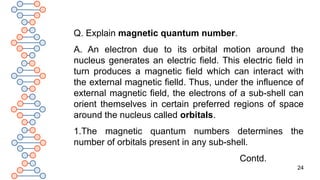
Q. Explain magneticquantum number.
A. An electron due to its orbital motion around the
nucleus generates an electric field. This electric field in
turn produces a magnetic field which can interact with
the external magnetic fielld. Thus, under the influence of
external magnetic field, the electrons of a sub-shell can
orient themselves in certain preferred regions of space
around the nucleus called orbitals.
1.The magnetic quantum numbers determines the
number of orbitals present in any sub-shell.
Contd.
25.
25
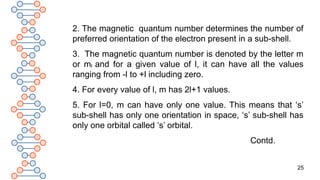
2. The magneticquantum number determines the number of
preferred orientation of the electron present in a sub-shell.
3. The magnetic quantum number is denoted by the letter m
or ml and for a given value of l, it can have all the values
ranging from -l to +l including zero.
4. For every value of l, m has 2l+1 values.
5. For l=0, m can have only one value. This means that ‘s’
sub-shell has only one orientation in space, ‘s’ sub-shell has
only one orbital called ‘s’ orbital.
Contd.
26.
26
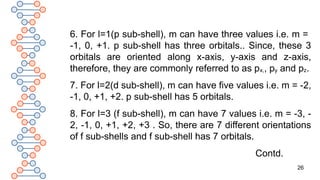
6. For l=1(psub-shell), m can have three values i.e. m =
-1, 0, +1. p sub-shell has three orbitals.. Since, these 3
orbitals are oriented along x-axis, y-axis and z-axis,
therefore, they are commonly referred to as px,, py and pz.
7. For l=2(d sub-shell), m can have five values i.e. m = -2,
-1, 0, +1, +2. p sub-shell has 5 orbitals.
8. For l=3 (f sub-shell), m can have 7 values i.e. m = -3, -
2, -1, 0, +1, +2, +3 . So, there are 7 different orientations
of f sub-shells and f sub-shell has 7 orbitals.
Contd.
27.
27
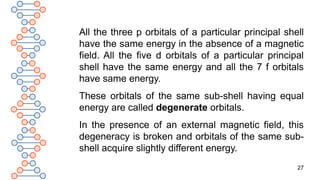
All the threep orbitals of a particular principal shell
have the same energy in the absence of a magnetic
field. All the five d orbitals of a particular principal
shell have the same energy and all the 7 f orbitals
have same energy.
These orbitals of the same sub-shell having equal
energy are called degenerate orbitals.
In the presence of an external magnetic field, this
degeneracy is broken and orbitals of the same sub-
shell acquire slightly different energy.
28.
28
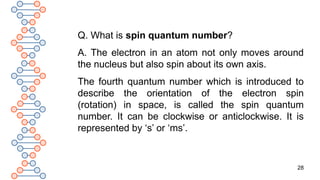
Q. What isspin quantum number?
A. The electron in an atom not only moves around
the nucleus but also spin about its own axis.
The fourth quantum number which is introduced to
describe the orientation of the electron spin
(rotation) in space, is called the spin quantum
number. It can be clockwise or anticlockwise. It is
represented by ‘s’ or ‘ms’.
29.
29
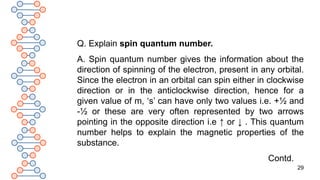
Q. Explain spinquantum number.
A. Spin quantum number gives the information about the
direction of spinning of the electron, present in any orbital.
Since the electron in an orbital can spin either in clockwise
direction or in the anticlockwise direction, hence for a
given value of m, ‘s’ can have only two values i.e. +½ and
-½ or these are very often represented by two arrows
pointing in the opposite direction i.e ↑ or ↓ . This quantum
number helps to explain the magnetic properties of the
substance.
Contd.
30.
30
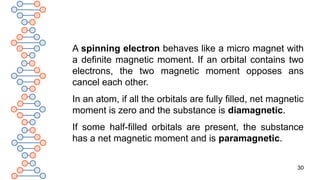
A spinning electronbehaves like a micro magnet with
a definite magnetic moment. If an orbital contains two
electrons, the two magnetic moment opposes ans
cancel each other.
In an atom, if all the orbitals are fully filled, net magnetic
moment is zero and the substance is diamagnetic.
If some half-filled orbitals are present, the substance
has a net magnetic moment and is paramagnetic.
31.
31
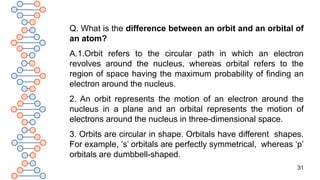
Q. What isthe difference between an orbit and an orbital of
an atom?
A.1.Orbit refers to the circular path in which an electron
revolves around the nucleus, whereas orbital refers to the
region of space having the maximum probability of finding an
electron around the nucleus.
2. An orbit represents the motion of an electron around the
nucleus in a plane and an orbital represents the motion of
electrons around the nucleus in three-dimensional space.
3. Orbits are circular in shape. Orbitals have different shapes.
For example, ‘s’ orbitals are perfectly symmetrical, whereas ‘p’
orbitals are dumbbell-shaped.
32.
32
Q. What isAufbau principle?
A. The Aufbau principle dictates the manner in which
electrons are filled in the atomic orbitals of an atom in
its ground state. It states that electrons are filled into
atomic orbitals in the increasing order of orbital energy
level. According to the Aufbau principlr, the available
atomic orbitals with the lowest energy levels are
occupied before those with higher energy levels.
34
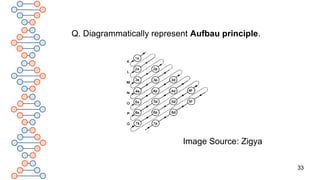
Q. Explain Aufbauprinciple.
A. According to Aufbau principle, electrons first occupy
those orbitals whose energy is the lowest. This implies
that the electrons enter the orbitals having higher
energies only when orbitals with lower energies have
been completely filled.
The order in which the energy of orbitals increases can
be determined with the help of the [n+l] rule, where the
sum of the principal[n] and azimuthal[l] quantum
numbers determines the energy level of the orbital.
Contd.
35.
35
Lower [n+l] valuescorrespond to lower orbital
energies. If two orbitals share equal [n+l] values, the
orbital with the lower ‘n’ value is said to have lower
energy associated with it. The order in which the
orbitals are filled with electron is : 1s, 2s, 2p, 3s, 3p,
4s, 3d, 4p, 5s, 4d, 5p, 6s, 4f, 5d, 6p, 7s, and so on.
Q. Which elements are exceptional and don’t fall
under the category of Aufbau princiole?
A. The elements ruthenium, rhodium, silver and
platinum are all exceptions to the Aufbau principle.
36.
36
Q. What isPauli’s exclusion principle?
A. Pauli’s exclusion principle states that no two electrons in
the same atom can have identical values for all four of their
quantum numbers [n, l, m, s]. In other words, [1] no more
than two electrons can occupy the same orbital and [2] two
electrons in the same orbital must have opposite spins.
Q. Why Pauli’s exclusion principle is called exclusion
principle?
A. This is because according to this principle, if one
electron in an atom has some particular values for the four
quantum numbers, then all the other electrons in that atom
are excluded from having the same set of values.
37.
37
Q. What isan example of Pauli’s exclusion principle?
A. An example of Pauli’s exclusion principle is that two
electrons in the atom Helium sharing a principle quantum
number, subshell [angular momentum], and magnetic
quantum number, yet they must have opposite spins to
inhabit the same atom at the same time.
Q. What is Hund’s rule?
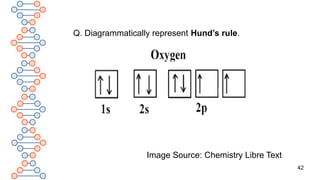
A. Hund’s rule states that every orbital in a sublevel is
singly occupied before any orbital is doubly
occupied. All of the electrons in singly occupied
orbitals have the same spin [to maximize total spin].
38.
38
Q. Explain Hund’srule.
A. Hund’s rule of maximum multiplicity states that in the
case of filling the orbitals with electrons of a multi-electron
atom in its ground state, the sub-level of every orbital must
be singly occupied before the double occupancy starts. All
the single occupancy must have the same spin for the
maximization of total spin. Explanation is given below:
The electrons are filled in the s,p,d, and f orbitals of an
atom. Each orbital has a specific capacity. The capacities
of the orbitals are given below:
Contd.
39.
39
s orbital –2 electrons
p orbital – 6 electrons
d orbital – 10 electrons
f orbital – 14 electrons
Again, in each of the orbitals there are sub-levels that can
contain a maximum of 2 electrons. So, there are 1 sub-level
for ‘s’, 3 sub-levels for ‘p’, 5 sub-levels for ‘d’, and 7 sub-
levels for ‘f’.
Contd.
40.
40
When the electronsare filled in these orbitals, each of
the sub-level is filled first with the single electro in the
same spin. After filling the sub-levels, the electrons
are filled for the double occupancy in each sub-level
in the opposite spins.
For example, for the ‘p’ orbitals, there are 3 sub-
levels. So, 3 electrons will be filled in the same spin
and the other 3 electrons will be filled one by one in
the same sub-levels in the opposite spin.
41.
41
Q. Give anexample of Hund’s rule.
A. As for example, the electronic configuration of
Fluorine(F) is 1s2
2s2
2p5
. There are 5 electrons, which
are to be filled in 3 sub-levels of 2p orbitals. So, the
first 3 electrons will be filled in the 3 sub-levels in the
same spin and then the rest 2 electrons will be filled in
the first two sub-level for double occupancy in the
opposite spins leaving the last sub-level with single
occupancy.


![7
Applying the same example to a macroscopic object
[such as basketball], it can be understood that
Heisenberg’s uncertainty principle has a negligible
impact on measurements in the macroscopic world.
While measuring the position of a basketball, there will
still be a transfer of momentum from the photons to the
ball. However, the mass of photon is much smaller than
the mass of the ball. Therefore, any momentum imparted
by the photon to the ball can be neglected.](https://image.slidesharecdn.com/atm2-250217052334-efd626ba/85/ATOMIC-STRUCTURE-PART2-CLASS-11-CHEMISTRY-7-320.jpg)
![9
Δv = h/4π*Δx*m
Δv = 6.626*10-34
/4*3.1416*10-15
*9.1*10-31
Δv = 5.77*1010
m/s
This value is much higher than the velocity of light [3*108
] and
hence is not possible.
Δx*Δp = h/4π
Δx*(m*Δv) = h/4π](https://image.slidesharecdn.com/atm2-250217052334-efd626ba/85/ATOMIC-STRUCTURE-PART2-CLASS-11-CHEMISTRY-9-320.jpg)
![18
Q. What is azimuthal or angular momentum
quantum number?
A. Within the same principal shell, there are present
a number of sub-shells or sub-levels of energy. The
azimuthal [or angular momentum quantum number]
describes the shape of a given sub-shell. It is
denoted by the symbol ‘l’ and its value is equal to the
total number of angular nodes in the orbital.](https://image.slidesharecdn.com/atm2-250217052334-efd626ba/85/ATOMIC-STRUCTURE-PART2-CLASS-11-CHEMISTRY-18-320.jpg)
![20
5.The value of ‘l’ depends on the value of principal
quantum number,’n’. The angular quantum number can
have positive values to zero to [n-1].
For 1st
shell (K), n=1, l can have only one value i.e, l=0.
For the 2nd
shell (L), n=2, l can have two values i.e. l=0
and 1.
For the third shell (M), n=3, l can have three values i.e. l =
0,1, 2.
For the fourth shell (N), n=4, l can have four values i.e. l =
0,1, 2, 3.
Contd.](https://image.slidesharecdn.com/atm2-250217052334-efd626ba/85/ATOMIC-STRUCTURE-PART2-CLASS-11-CHEMISTRY-20-320.jpg)
![21
Depending upon the values of l, i. e. l = 0, 1, 2 and 3, the different
sub-shells are designated as s,p,d and f. These notations are the
initial letters of the words – sharp, principal, diffused and
fundamental formerly used to describe the different spectral lines.
1. First principal shell [K shell or n=1] has only one sub-shell called
the s sub-shell.
2. Second principal shell [L shell or n=2] has only two sub-shells
i.e. s sub-shell (l=0), p sub-shell (l=1).
3. Third principal shell [M shell or n=3] has only three sub-shells
i.e. s sub-shell (l=0), p sub-shell (l=1)and d sub-shell (l=2).
Contd.](https://image.slidesharecdn.com/atm2-250217052334-efd626ba/85/ATOMIC-STRUCTURE-PART2-CLASS-11-CHEMISTRY-21-320.jpg)
![22
4. Fourth principal shell [N shell or n=4], has four sub-
shells i.e. s sub-shell (l=0), p sub-shell (l=1), d sub-
shell (l=2) and f sub-shell (l=3).
The number of sub-shells present in any principal shell
is equal to the number of principal shell or the principal
quantum number.
The energies of different sub-shells present within the
same principal are found to be in order:
S<p<d<f
The maximum number of electrons in the s, p, d and f
sub-shell are 2, 6, 10 and 14.](https://image.slidesharecdn.com/atm2-250217052334-efd626ba/85/ATOMIC-STRUCTURE-PART2-CLASS-11-CHEMISTRY-22-320.jpg)
![34
Q. Explain Aufbau principle.
A. According to Aufbau principle, electrons first occupy
those orbitals whose energy is the lowest. This implies
that the electrons enter the orbitals having higher
energies only when orbitals with lower energies have
been completely filled.
The order in which the energy of orbitals increases can
be determined with the help of the [n+l] rule, where the
sum of the principal[n] and azimuthal[l] quantum
numbers determines the energy level of the orbital.
Contd.](https://image.slidesharecdn.com/atm2-250217052334-efd626ba/85/ATOMIC-STRUCTURE-PART2-CLASS-11-CHEMISTRY-34-320.jpg)
![35
Lower [n+l] values correspond to lower orbital
energies. If two orbitals share equal [n+l] values, the
orbital with the lower ‘n’ value is said to have lower
energy associated with it. The order in which the
orbitals are filled with electron is : 1s, 2s, 2p, 3s, 3p,
4s, 3d, 4p, 5s, 4d, 5p, 6s, 4f, 5d, 6p, 7s, and so on.
Q. Which elements are exceptional and don’t fall
under the category of Aufbau princiole?
A. The elements ruthenium, rhodium, silver and
platinum are all exceptions to the Aufbau principle.](https://image.slidesharecdn.com/atm2-250217052334-efd626ba/85/ATOMIC-STRUCTURE-PART2-CLASS-11-CHEMISTRY-35-320.jpg)
![36
Q. What is Pauli’s exclusion principle?
A. Pauli’s exclusion principle states that no two electrons in
the same atom can have identical values for all four of their
quantum numbers [n, l, m, s]. In other words, [1] no more
than two electrons can occupy the same orbital and [2] two
electrons in the same orbital must have opposite spins.
Q. Why Pauli’s exclusion principle is called exclusion
principle?
A. This is because according to this principle, if one
electron in an atom has some particular values for the four
quantum numbers, then all the other electrons in that atom
are excluded from having the same set of values.](https://image.slidesharecdn.com/atm2-250217052334-efd626ba/85/ATOMIC-STRUCTURE-PART2-CLASS-11-CHEMISTRY-36-320.jpg)
![37
Q. What is an example of Pauli’s exclusion principle?
A. An example of Pauli’s exclusion principle is that two
electrons in the atom Helium sharing a principle quantum
number, subshell [angular momentum], and magnetic
quantum number, yet they must have opposite spins to
inhabit the same atom at the same time.
Q. What is Hund’s rule?
A. Hund’s rule states that every orbital in a sublevel is
singly occupied before any orbital is doubly
occupied. All of the electrons in singly occupied
orbitals have the same spin [to maximize total spin].](https://image.slidesharecdn.com/atm2-250217052334-efd626ba/85/ATOMIC-STRUCTURE-PART2-CLASS-11-CHEMISTRY-37-320.jpg)



![CHEMICAL EQUILIBRIUM [PART 2], CLASS 11 CHEMISTRY](https://cdn.slidesharecdn.com/ss_thumbnails/eql2-250303040749-4cd334d1-thumbnail.jpg?width=640&height=640&fit=bounds)


![CHEMICAL BONDING AND MOLECULAR STRUCTURE [PART: 3], CLASS 11 CHEMISTRY](https://cdn.slidesharecdn.com/ss_thumbnails/cb4-250226043559-bf93a4b4-thumbnail.jpg?width=640&height=640&fit=bounds)
![CHEMICAL BONDING & MOLECULAR STRUCTURE [PART 2], CLASS 11 CHEMISTRY](https://cdn.slidesharecdn.com/ss_thumbnails/cb2-250225044619-e600ad65-thumbnail.jpg?width=640&height=640&fit=bounds)


![CARBON AND IT'S COMPOUNDS[CHAPTER 1], CLASS 10, SCIENCE](https://cdn.slidesharecdn.com/ss_thumbnails/carbon-250220043655-8b9e92b9-thumbnail.jpg?width=640&height=640&fit=bounds)
![CARBON AND IT'S COMPOUND[PART 2], CLASS 10, SCIENCE](https://cdn.slidesharecdn.com/ss_thumbnails/carbon2-250220041032-3c163d1d-thumbnail.jpg?width=640&height=640&fit=bounds)

![THERMODYNAMICS[PART 3], CLASS 11, CHEMISTRY](https://cdn.slidesharecdn.com/ss_thumbnails/therm3a-250219054445-0147ea61-thumbnail.jpg?width=640&height=640&fit=bounds)
![THERMODYNAMICS[PART 2], CLASS 11, CHEMISTRY](https://cdn.slidesharecdn.com/ss_thumbnails/therm2-250219053401-f44db038-thumbnail.jpg?width=640&height=640&fit=bounds)
![THERMODYNAMICS[PART 1], CLASS 11, CHEMISTRY](https://cdn.slidesharecdn.com/ss_thumbnails/therm1-250219052302-b7910fcf-thumbnail.jpg?width=640&height=640&fit=bounds)
![STRUCTURE OF ATOM[PART1], CLASS 11, CHEMISTRY](https://cdn.slidesharecdn.com/ss_thumbnails/atm-250217055227-e54ddbe4-thumbnail.jpg?width=640&height=640&fit=bounds)


