1
CLASS 11 CHEMISTRY
CHEMICAL THERMODYNAMICS
[PART 2]
2
Q. What is first law of thermodynamics?
A. The first law of thermodynamics relates to heat,
internal energy and work.
The first law of thermodynamics, also known as the law
of conservation of energy, states that energy can neither
br created nor destroyed by any physical or chemical
change. However, one form of energy can be changed
into equivalent amount of the other form.
The first law of thermodynamics was stated by Rudolf
Clausius and William Thomson.
3
Q. Explain mathematical form of first law of
thermodynamics.
A. According to first law of thermodynamics, energy can neither
be created nor destroyed but one form of energy can be
changed into equivalent amount of the other form. The internal
energy of a system can be changed by any one of the following
methods:
1. By heating or cooling the system.
2. When work is done on the system or work is done by the
system.
Contd.
4
If we consider a system having internal energy, U1 and suppose heat Q
is supplied to the system. Thus, its energy increases from U1 to U1 + Q.
Further suppose that work [W] is done on the system. As a result, its
internal energy further increases and becomes equal to U2. Here, U2 is
the energy of the final state. Thus,
U2 = U1 + Q + W
Or, U2 – U1 = Q + W
Or, ΔU = Q + W
i.e. Change in internal energy = Heat added to the system + Work
done on the system. It is the mathematical form of first law of
thermodynamics.
5
Q. Why is the first law of thermodynamics important to
the environment?
A. The first law states that energy can neither be created
nor destroyed. It can only be transformed from one form
to another. Sun is the only source of energy for all living
organisms on earth. This solar energy is converted into
chemical energy by plants through process of
photosynthesis. These energies obtained by the plants
do not go back into the solar system. Rather, it is passed
on to the herbivores that feed on grass plants. Some part
of the energy obtained by the herbivores is utilized by
carnivores or transferred to the decomposers when the
herbivores die.
6
Q. What are the limitations of first law of thermodynamics?
A.1. It fails to tell us the extent to which one form of energy can
be transformed into another.
First law states that energy of one form can be converted into an
equivalent energy of another form. But, it does not tell that heat
energy cannot be completely converted into an equivalent amount of
work.
2. It does not tell us anything about the direction of the process.
Contd.
7
If two bodies A & B are brought in contact with each other, the
first law of thermodynamics tell us that if one of them loses some
amount of heat, the other will gain same amount of heat . But, the
first law will be unable to tell us whether the flow of heat will occur
from A to B or B to A. Only if, temperature of A & B are known,
then we express the direction of flow of heat.
3. It cannot predict the feasibility of a process.
According to first law, the energy of an isolated system remains
constant during a specified change of state. But, it does not tell
whether a specified change or process including a chemical
reaction can occur spontaneously, i.e whether it is feasible.
Contd.
8
4. It does not rule out the existence of a 100% efficient heat
engine which is in fact impossible.
Even though, various forms of energy can be completely
transformed into one another, heat is a typical form of energy,
which cannot be completely transformed into work.
Q. What violates the first law of thermodynamics?
A. A device that violates the first law of thermodynamics [by
creating energy] is called a Perpetual Motion Machine of the first
kind. The device supplies continuously energy without receiving it.
.
9
Q. Give few examples of applications of first law of
thermodynamics.
A. Some examples of the first law of thermodynamics
includes are thermal power plants, nuclear power plants,
hydroelectric power plants, power plants based on
renewable energy sources such as solar, wind,
geothermal, tides and water waves etc.
The first law of thermodynamics is commonly used in
heat engines. Refrigerators is another example where
the first law of thermodynamics is used. Sweating is a
great example of the first law of thermodynamics since
the heat of the body is transferred to sweat.
10
Q. By first law of thermodynamics prove that change in internal energy
is equal to heat absorbed or evolved at constant volume and constant
temperature.
A. According to first law of thermodynamics, ΔU = Q+W. Where, ΔU=
change in internal energy, Q= heat added to the system, W=work done by
the system.
If the process is such that work done by the system is only pressure-volume
work, then W = -PΔV. Thus,
ΔU = Q – PΔV, if the process takes place at constant volume, i.e, ΔV=0, then
PΔV=0 and thus ΔU = Qv. Hence, “Change in internal energy, ΔU is equal to
heat [Qv] absorbed or evolved at constant volume and constant temperature.
11
Q. What is the nature of internal energy of an ideal gas?
A. In an ideal gas, the intermolecular forces are assumed to
be absent and all the collisions are perfectly elastic. Thus,
the gas possesses only translational kinetic energy and
hence the internal energy of the ideal gas depends only on
the temperature.
Q. What is the physical significance of internal energy?
A. The physical significance of internal energy can be
understood in a better way by taking an example of everyday
life. The food taken by us gets converted into heat energy
[Q].
Contd.
12
A part of this energy is spent in doing work [-ve] and the rest
is stored in the body in the form of internal energy. During
growth period, a child takes more energy in the form of food
as compared to work done and the balance [Q – W] = ΔU is
added to the internal energy and the child grows in a healthy
manner.
However, after forty, any accumulation of extra energy is
dangerous, since it can lead to diabetes. Therefore, to keep
ΔU equal to zero, Q must be equal to work done. This work
may be external physical work or it may be internal work
such as internal movement of the heart and stomach, etc.
Contd.
13
Basal metabolism [the chemical process occuring in an organism
at rest], requires 300kJ of energy per hour. If no food is taken,
then 300kJ per hour consumption of energy will be supplied from
the reserve internal energy, which would cause a loss of weight.
Q. What is the form of first law of thermodynamic for an
Isochoric Process?
A. For an isochoric process, i.e., for a process taking place at
constant volume, ΔV=zero. Therefore, PΔV=0. Hence, from
equation of the first law of thermodynamics, ΔU = Qv, where, Q is
the heat absorbed at constant volume. Thus, heat supplied to a
system under constant volume is used up in increasing internal
energy.
14
Q. What is the form of first law of thermodynamic for an Isothermal
Process?
A. For an Isothermal Process, i.e for a process taking place at
constant temperature, ΔT = 0, therefore ΔU = 0, then from relation ΔU
= Q + W, Q = -W
Q. What is the form of first law of thermodynamic for an Adiabatic
Process?
A. For an adiabatic process, i.e. for a process in which no heat enters
or leaves the system, Q = 0, then from the relation ΔU = Q + W, ΔU =
W or -ΔU = -W, i.e. work is done at the cost of internal energy.
15
Q. What is the form of first law of thermodynamics for an
Isobaric Process?
A. For an isobaric process, i.e., for a process taking place at
constant pressure, ΔP=0. A system is considered, which
shows increase in volume from V1 to V2 at a constant pressure
P, during absorption of heat Q. The expansion of work or work
done by the system is W = -PΔV. From the equation, ΔU =
Q+W,or, Q=ΔU-W. Therefore, Qp=ΔU-[-PΔV] or, Qp = ΔU+PΔV
= U2 – U1 + P[V2 – V1]
= [U2 + PV2] - [U1 + P V1] = H2 – H1, where H2 and H1 are the
enthalpies of the system in final and initial state respectively.
16
Q. What is enthalpy?
A. Enthalpy is a measurement of energy in a thermodynamic
system. The quantity of enthalpy equals to the total content
of heat of a system, equivalent to the system’s internal
energy plus the product of volume and pressure.
When a process begins at constant pressure, the evolved
heat [either absorbed or released] equals the change in
enthalpy. Enthalpy change is the sum of internal energy
denoted by U and product of volume and pressure denoted
by PV, expressed in the following manner,
H = U + PV
17
Q. What are the characteristics of enthalpy?
A.1. Absolute value of enthalpy of a system cannot be
determined just like the internal energy.
2.The enthalpy of a system is a state function.
Therefore, the magnitude of enthalpy change [ΔH],
depends only on the enthalpies of the initial and final
states. Thus we can write, ΔH = Hfinal – Hinitial
3. Enthalpy is an extensive property.
18
Q. Why is enthalpy useful?
A. Enthalpy is important because it informs us how much
heat is in a system [energy]. Heat is important, since from it,
we can derive valuable work. An enthalpy shift shows us how
much heat was lost or obtained in terms of a chemical
reaction, enthalpy meaning the system’s heat energy.
Q. What is enthalpy of chemical reaction?
A. The bonds between atoms can dissolve, reform or both
during chemical reactions to either absorb or release energy.
The heat absorbed or emitted under constant pressure from
a device is referred to as enthalpy, and the reaction enthalpy
is the change in enthalpy arising from a chemical reaction.
19
Q. What is the difference between internal energy and
enthalpy?
A. The fundamental distinction between enthalpy and internal
energy is that enthalpy refers to the heat absorbed or
released during chemical reactions in a system, whereas
internal energy refers to the sum of potential and kinetic
energy of the system.
In thermodynamics, enthalpy is a measure of the heat content
of a physical or chemical system. Internal energy is a property
characteristics of the state of a thermodynamic system, the
change in which is equal to the heat absorbed minus the work
done by the system.
20
Q. When does enthalpy become positive and when it is
negative?
A. If a reaction absorbs or uses more energy than it releases,
the reaction is endothermic, and enthalpy will be positive. On
the other hand, if a reaction releases more energy than it
absorbs, the reaction is exothermic and enthalpy will be
negative. The condition can be thought of as an amount of heat
leaving [or being substracted from] the reaction.
21
Q. What is the unit of enthalpy?
A. The unit of enthalpy is the same as energy, so in SI
unit, it is Joule[J]. In C.G.S unit, it is erg. One erg is equal
to 10-7
J.
Q. What is enthalpy of chemical reaction?
A. The amount of heat evolved or absorbed in a chemical
reaction when the number of moles of the reactants
aresented by the chemical equation have completely
reacted, is called the enthalpy of a chemical reaction.
22
Q. What is heat capacity?
A. Heat capacity or more accurately mean heat capacity
of a system, between any two temperatures, is defined
as the amount of heat required to raise the temperature
of the system from lower to higher temperature divided
by the temperature difference.
Thus, if Q is the amount of heat supplied to a system
and as a result, the temperature of the system rises from
T1 to T2, then the heat capacity C of the system is given
by, C = Q/[T2 – T1] = Q/ΔT.
23
Q. What is specific heat?
A. Specific is the amount of heat energy required to
raise the temperature of 1g of the substance through 1K.
Formula for specific heat is as follows;
Specific Heat = Q/mΔT
Where, ‘Q’ is the amount of heat
ΔT refers to the temperature
‘m’ stands for mass
24
Q. What is molar heat capacity?
A. The amount of heat energy required to raise the
temperature of 1 mole of the substance through 1K is called
molar heat capacity.
Molar heat capacity = Specific heat * Molar mass of the
substance.
Q. What is the unit of molar heat capacity?
A. The SI unit of molar heat capacity is joule per kelvin per
mole, J*K-
1*mole-1
.
25
Q. What are the differences between ‘heat capacity’ and
‘specific heat capacity’?
A.1. Heat capacity is the amount of heat required to increase
the temperature of a body by 1°C.
Specific heat capacity is the amount of heat required to
increase the temperature of a unit mass of a substance by 1°C.
2. Heat capacity depends on the mass of the material.
Specific heat capacity is independent of the mass of the
material.
Contd.
26
3. The SI unit of heat capacity is joule per kelvin [J/K].
The SI unit of specific heat capacity is joule per kelvin per
kilogram[J/Kg-K]].
4. The formula of heat capacity = Q/ΔT
The formula of specific heat capacity = Q/mΔT
Where, ‘Q’ is the amount of heat
ΔT refers to the temperature
‘m’ stands for mass
27
Q. What is calorimetry?
A. Generally, calorimetry refers to an experimental
technique that we use for the measurement of enthalpy
[ΔH] and internal energy [ΔU].
Calorimetry techniques are based on thermometric
methods carried out in a vessel called calorimeter which is
immersed in a known volume of liquid. The heat evolved in
the process is generally calculated with the help of known
heat capacities of the liquid and and the calorimeter by
measuring the temperature differences. Two different
conditions under which these measurements are made are:
1) At constant pressure [Qp], 2) At constant volume [Qv].
28
Q. How do we can measure change in enthalpy ΔH?
A. Measurement of enthalpy change in the laboratory is
done through calorimetric techniques. We know that
enthalpy change is the heat change at constant pressure
that is ΔH = Qp. ‘Coffee-cup’ calorimeter is often used to
calculate the enthalpy change. In this technique, the cup is
partially filled with a known volume of water and a
thermometer is inserted through the lid of the cup such that
its bulb is below the water surface. When a chemical
reaction occurs, the heat of the reaction is absorbed by
water.
Contd.
29
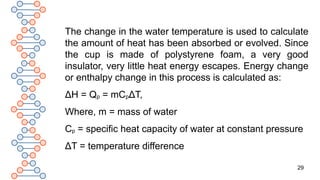
The change in the water temperature is used to calculate
the amount of heat has been absorbed or evolved. Since
the cup is made of polystyrene foam, a very good
insulator, very little heat energy escapes. Energy change
or enthalpy change in this process is calculated as:
ΔH = Qp = mCpΔT,
Where, m = mass of water
Cp = specific heat capacity of water at constant pressure
ΔT = temperature difference
30
Q. How do we measure the change in internal energy?
A. Internal energy change is the energy change at
constant volume. A bomb calorimeter is generally used for
the measurement of internal energy change. In this
technique, a steel vessel [commonly called bomb] is
immersed in a water bath in order to ensure that no heat
is lost to the surrounding. A combustible substance is
burnt in oxygen gas supplied in the bomb. The heat
evolved is absorbed by the around the bomb and the
change in temperature is measured.
Contd.
31
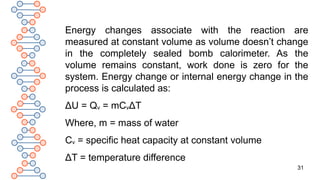
Energy changes associate with the reaction are
measured at constant volume as volume doesn’t change
in the completely sealed bomb calorimeter. As the
volume remains constant, work done is zero for the
system. Energy change or internal energy change in the
process is calculated as:
ΔU = Qv = mCvΔT
Where, m = mass of water
Cv = specific heat capacity at constant volume
ΔT = temperature difference
32
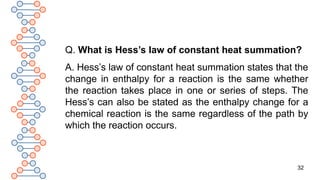
Q. What is Hess’s law of constant heat summation?
A. Hess’s law of constant heat summation states that the
change in enthalpy for a reaction is the same whether
the reaction takes place in one or series of steps. The
Hess’s can also be stated as the enthalpy change for a
chemical reaction is the same regardless of the path by
which the reaction occurs.
33
Q. Explain Hess’s law of constant heat summation with an
example.
A. We consider the following two paths for the preparation of
methylene chloride.
Path : CH4[g] + 2Cl2[g] → CH2Cl2[g] + 2HCl[g]
ΔH1 = -202.3 kJ
Path 2 : CH4[g] + Cl2[g] → CH3Cl[g] + HCl[g]
ΔH2 = -98.3 kJ [2]
Path 3 : CH3Cl[g] + + Cl2[g] → CH2Cl2[g] + HCl[g]
ΔH3 = -104.0 kJ [3]
Contd.
34
Adding two steps: [2] + [3]
CH4[g] + 2Cl2[g] → CH2Cl2[g] + 2HCl[g]
ΔH = -202.3 kJ
Thus, whether we follow path 1 or path 2, the enthalpy
change of the reaction is same.
ΔH1 = ΔH2 + ΔH3 = -202.3 kJ
35
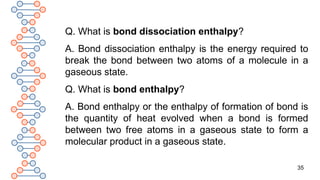
Q. What is bond dissociation enthalpy?
A. Bond dissociation enthalpy is the energy required to
break the bond between two atoms of a molecule in a
gaseous state.
Q. What is bond enthalpy?
A. Bond enthalpy or the enthalpy of formation of bond is
the quantity of heat evolved when a bond is formed
between two free atoms in a gaseous state to form a
molecular product in a gaseous state.
36
Q. What is enthalpy of formation?
A. The standard enthalpy of formation [ΔHf] is defined as
the change in enthalpy when one mole of the compound
is formed from its constituent elements in their standard
states under standard conditions i.e. at 1atm pressure
and 25°C. For example, although oxygen can exist as
ozone (O3), atomic oxygen [O], and molecular oxygen
[O2], O2 is the most stable state.
Formation of methane from carbon and hydrogen:
C[graphite,s] + 2H2[g] → CH4[g], ΔHf = -74.81kJmol-1
37
Q. What is enthalpy of combustion?
A. Enthalpy of combustion is defined as the enthalpy change when
one mole of a compound is completely burnt in oxygen with all the
reactants and products in their standard state under standard
conditions [1atm pressure and 25°C].
Q. What is enthalpy of atomization?
A. The enthalpy of atomization is the change in enthalpy that
accompanies the total separation of all atoms in a chemical
substance either a Chemical Element or a Chemical Compound. It
means enthalpy of atomization is the energy that break one Mole of
bond into Atoms. Enthalpy of atomization is denoted by the symbol
Ha.
e.g H2[g] → 2H, ΔHa = 435kJ/mole
38
Q. What is enthalpy of sublimation?
A. The enthalpy change that accompanies the conversion
of one mole of solid directly into its vapour phase at a
given temperature below its melting point, is called as
enthalpy of sublimation.
Q. What is the enthalpy of phase transition?I
A. It is the enthalpy change when one mole of an element
is changed from one equilibrium state to another. Some
energy is released or absorbed when a material
undergoes a phase transition, which occurs when the
phase of a substance transforms from one one form to
another.
39
Q. What is enthalpy of solution?
A. The enthalpy of solution, enthalpy of dissolution, or
heat of solution is the enthalpy change associated with
the dissolution of a substance in a solvent at constant
pressure resulting in infinite dilution. The enthalpy of
solution is most often expressed in kJ/mol at constant
temperature.
As for an example, when 1 mole of sodium chloride
crystals are dissolved in excess of water, the enthalpy
change of solution is found to be +3.9 kJ/mole.
40
Q. What is enthalpy of ionization?
A. Ionization enthalpy is defined as the minimum amount of
energy that is required to remove the most loosely bounded
electrons that is electron present in the outermost shell from an
isolated gaseous atom. The unit of ionization enthalpy is electron
volts [eV] per atom.
Q. What is enthalpy of dilution?
A. Enthalpy of dilution, also known as the heat of dilution, can be
defined as the change in enthalpy that is associated with the
dilution of a specific component of a solution when the pressure
is kept constant. The most common units of enthalpy of dilution
is Joules/mole and kilojoules/mole.
41
THANK YOU
FOR
WATCHING!!

THERMODYNAMICS[PART 2], CLASS 11, CHEMISTRY

  • 1.
    1 CLASS 11 CHEMISTRY CHEMICALTHERMODYNAMICS [PART 2]
  • 2.
    2 Q. What isfirst law of thermodynamics? A. The first law of thermodynamics relates to heat, internal energy and work. The first law of thermodynamics, also known as the law of conservation of energy, states that energy can neither br created nor destroyed by any physical or chemical change. However, one form of energy can be changed into equivalent amount of the other form. The first law of thermodynamics was stated by Rudolf Clausius and William Thomson.
  • 3.
    3 Q. Explain mathematicalform of first law of thermodynamics. A. According to first law of thermodynamics, energy can neither be created nor destroyed but one form of energy can be changed into equivalent amount of the other form. The internal energy of a system can be changed by any one of the following methods: 1. By heating or cooling the system. 2. When work is done on the system or work is done by the system. Contd.
  • 4.
    4 If we considera system having internal energy, U1 and suppose heat Q is supplied to the system. Thus, its energy increases from U1 to U1 + Q. Further suppose that work [W] is done on the system. As a result, its internal energy further increases and becomes equal to U2. Here, U2 is the energy of the final state. Thus, U2 = U1 + Q + W Or, U2 – U1 = Q + W Or, ΔU = Q + W i.e. Change in internal energy = Heat added to the system + Work done on the system. It is the mathematical form of first law of thermodynamics.
  • 5.
    5 Q. Why isthe first law of thermodynamics important to the environment? A. The first law states that energy can neither be created nor destroyed. It can only be transformed from one form to another. Sun is the only source of energy for all living organisms on earth. This solar energy is converted into chemical energy by plants through process of photosynthesis. These energies obtained by the plants do not go back into the solar system. Rather, it is passed on to the herbivores that feed on grass plants. Some part of the energy obtained by the herbivores is utilized by carnivores or transferred to the decomposers when the herbivores die.
  • 6.
    6 Q. What arethe limitations of first law of thermodynamics? A.1. It fails to tell us the extent to which one form of energy can be transformed into another. First law states that energy of one form can be converted into an equivalent energy of another form. But, it does not tell that heat energy cannot be completely converted into an equivalent amount of work. 2. It does not tell us anything about the direction of the process. Contd.
  • 7.
    7 If two bodiesA & B are brought in contact with each other, the first law of thermodynamics tell us that if one of them loses some amount of heat, the other will gain same amount of heat . But, the first law will be unable to tell us whether the flow of heat will occur from A to B or B to A. Only if, temperature of A & B are known, then we express the direction of flow of heat. 3. It cannot predict the feasibility of a process. According to first law, the energy of an isolated system remains constant during a specified change of state. But, it does not tell whether a specified change or process including a chemical reaction can occur spontaneously, i.e whether it is feasible. Contd.
  • 8.
    8 4. It doesnot rule out the existence of a 100% efficient heat engine which is in fact impossible. Even though, various forms of energy can be completely transformed into one another, heat is a typical form of energy, which cannot be completely transformed into work. Q. What violates the first law of thermodynamics? A. A device that violates the first law of thermodynamics [by creating energy] is called a Perpetual Motion Machine of the first kind. The device supplies continuously energy without receiving it. .
  • 9.
    9 Q. Give fewexamples of applications of first law of thermodynamics. A. Some examples of the first law of thermodynamics includes are thermal power plants, nuclear power plants, hydroelectric power plants, power plants based on renewable energy sources such as solar, wind, geothermal, tides and water waves etc. The first law of thermodynamics is commonly used in heat engines. Refrigerators is another example where the first law of thermodynamics is used. Sweating is a great example of the first law of thermodynamics since the heat of the body is transferred to sweat.
  • 10.
    10 Q. By firstlaw of thermodynamics prove that change in internal energy is equal to heat absorbed or evolved at constant volume and constant temperature. A. According to first law of thermodynamics, ΔU = Q+W. Where, ΔU= change in internal energy, Q= heat added to the system, W=work done by the system. If the process is such that work done by the system is only pressure-volume work, then W = -PΔV. Thus, ΔU = Q – PΔV, if the process takes place at constant volume, i.e, ΔV=0, then PΔV=0 and thus ΔU = Qv. Hence, “Change in internal energy, ΔU is equal to heat [Qv] absorbed or evolved at constant volume and constant temperature.
  • 11.
    11 Q. What isthe nature of internal energy of an ideal gas? A. In an ideal gas, the intermolecular forces are assumed to be absent and all the collisions are perfectly elastic. Thus, the gas possesses only translational kinetic energy and hence the internal energy of the ideal gas depends only on the temperature. Q. What is the physical significance of internal energy? A. The physical significance of internal energy can be understood in a better way by taking an example of everyday life. The food taken by us gets converted into heat energy [Q]. Contd.
  • 12.
    12 A part ofthis energy is spent in doing work [-ve] and the rest is stored in the body in the form of internal energy. During growth period, a child takes more energy in the form of food as compared to work done and the balance [Q – W] = ΔU is added to the internal energy and the child grows in a healthy manner. However, after forty, any accumulation of extra energy is dangerous, since it can lead to diabetes. Therefore, to keep ΔU equal to zero, Q must be equal to work done. This work may be external physical work or it may be internal work such as internal movement of the heart and stomach, etc. Contd.
  • 13.
    13 Basal metabolism [thechemical process occuring in an organism at rest], requires 300kJ of energy per hour. If no food is taken, then 300kJ per hour consumption of energy will be supplied from the reserve internal energy, which would cause a loss of weight. Q. What is the form of first law of thermodynamic for an Isochoric Process? A. For an isochoric process, i.e., for a process taking place at constant volume, ΔV=zero. Therefore, PΔV=0. Hence, from equation of the first law of thermodynamics, ΔU = Qv, where, Q is the heat absorbed at constant volume. Thus, heat supplied to a system under constant volume is used up in increasing internal energy.
  • 14.
    14 Q. What isthe form of first law of thermodynamic for an Isothermal Process? A. For an Isothermal Process, i.e for a process taking place at constant temperature, ΔT = 0, therefore ΔU = 0, then from relation ΔU = Q + W, Q = -W Q. What is the form of first law of thermodynamic for an Adiabatic Process? A. For an adiabatic process, i.e. for a process in which no heat enters or leaves the system, Q = 0, then from the relation ΔU = Q + W, ΔU = W or -ΔU = -W, i.e. work is done at the cost of internal energy.
  • 15.
    15 Q. What isthe form of first law of thermodynamics for an Isobaric Process? A. For an isobaric process, i.e., for a process taking place at constant pressure, ΔP=0. A system is considered, which shows increase in volume from V1 to V2 at a constant pressure P, during absorption of heat Q. The expansion of work or work done by the system is W = -PΔV. From the equation, ΔU = Q+W,or, Q=ΔU-W. Therefore, Qp=ΔU-[-PΔV] or, Qp = ΔU+PΔV = U2 – U1 + P[V2 – V1] = [U2 + PV2] - [U1 + P V1] = H2 – H1, where H2 and H1 are the enthalpies of the system in final and initial state respectively.
  • 16.
    16 Q. What isenthalpy? A. Enthalpy is a measurement of energy in a thermodynamic system. The quantity of enthalpy equals to the total content of heat of a system, equivalent to the system’s internal energy plus the product of volume and pressure. When a process begins at constant pressure, the evolved heat [either absorbed or released] equals the change in enthalpy. Enthalpy change is the sum of internal energy denoted by U and product of volume and pressure denoted by PV, expressed in the following manner, H = U + PV
  • 17.
    17 Q. What arethe characteristics of enthalpy? A.1. Absolute value of enthalpy of a system cannot be determined just like the internal energy. 2.The enthalpy of a system is a state function. Therefore, the magnitude of enthalpy change [ΔH], depends only on the enthalpies of the initial and final states. Thus we can write, ΔH = Hfinal – Hinitial 3. Enthalpy is an extensive property.
  • 18.
    18 Q. Why isenthalpy useful? A. Enthalpy is important because it informs us how much heat is in a system [energy]. Heat is important, since from it, we can derive valuable work. An enthalpy shift shows us how much heat was lost or obtained in terms of a chemical reaction, enthalpy meaning the system’s heat energy. Q. What is enthalpy of chemical reaction? A. The bonds between atoms can dissolve, reform or both during chemical reactions to either absorb or release energy. The heat absorbed or emitted under constant pressure from a device is referred to as enthalpy, and the reaction enthalpy is the change in enthalpy arising from a chemical reaction.
  • 19.
    19 Q. What isthe difference between internal energy and enthalpy? A. The fundamental distinction between enthalpy and internal energy is that enthalpy refers to the heat absorbed or released during chemical reactions in a system, whereas internal energy refers to the sum of potential and kinetic energy of the system. In thermodynamics, enthalpy is a measure of the heat content of a physical or chemical system. Internal energy is a property characteristics of the state of a thermodynamic system, the change in which is equal to the heat absorbed minus the work done by the system.
  • 20.
    20 Q. When doesenthalpy become positive and when it is negative? A. If a reaction absorbs or uses more energy than it releases, the reaction is endothermic, and enthalpy will be positive. On the other hand, if a reaction releases more energy than it absorbs, the reaction is exothermic and enthalpy will be negative. The condition can be thought of as an amount of heat leaving [or being substracted from] the reaction.
  • 21.
    21 Q. What isthe unit of enthalpy? A. The unit of enthalpy is the same as energy, so in SI unit, it is Joule[J]. In C.G.S unit, it is erg. One erg is equal to 10-7 J. Q. What is enthalpy of chemical reaction? A. The amount of heat evolved or absorbed in a chemical reaction when the number of moles of the reactants aresented by the chemical equation have completely reacted, is called the enthalpy of a chemical reaction.
  • 22.
    22 Q. What isheat capacity? A. Heat capacity or more accurately mean heat capacity of a system, between any two temperatures, is defined as the amount of heat required to raise the temperature of the system from lower to higher temperature divided by the temperature difference. Thus, if Q is the amount of heat supplied to a system and as a result, the temperature of the system rises from T1 to T2, then the heat capacity C of the system is given by, C = Q/[T2 – T1] = Q/ΔT.
  • 23.
    23 Q. What isspecific heat? A. Specific is the amount of heat energy required to raise the temperature of 1g of the substance through 1K. Formula for specific heat is as follows; Specific Heat = Q/mΔT Where, ‘Q’ is the amount of heat ΔT refers to the temperature ‘m’ stands for mass
  • 24.
    24 Q. What ismolar heat capacity? A. The amount of heat energy required to raise the temperature of 1 mole of the substance through 1K is called molar heat capacity. Molar heat capacity = Specific heat * Molar mass of the substance. Q. What is the unit of molar heat capacity? A. The SI unit of molar heat capacity is joule per kelvin per mole, J*K- 1*mole-1 .
  • 25.
    25 Q. What arethe differences between ‘heat capacity’ and ‘specific heat capacity’? A.1. Heat capacity is the amount of heat required to increase the temperature of a body by 1°C. Specific heat capacity is the amount of heat required to increase the temperature of a unit mass of a substance by 1°C. 2. Heat capacity depends on the mass of the material. Specific heat capacity is independent of the mass of the material. Contd.
  • 26.
    26 3. The SIunit of heat capacity is joule per kelvin [J/K]. The SI unit of specific heat capacity is joule per kelvin per kilogram[J/Kg-K]]. 4. The formula of heat capacity = Q/ΔT The formula of specific heat capacity = Q/mΔT Where, ‘Q’ is the amount of heat ΔT refers to the temperature ‘m’ stands for mass
  • 27.
    27 Q. What iscalorimetry? A. Generally, calorimetry refers to an experimental technique that we use for the measurement of enthalpy [ΔH] and internal energy [ΔU]. Calorimetry techniques are based on thermometric methods carried out in a vessel called calorimeter which is immersed in a known volume of liquid. The heat evolved in the process is generally calculated with the help of known heat capacities of the liquid and and the calorimeter by measuring the temperature differences. Two different conditions under which these measurements are made are: 1) At constant pressure [Qp], 2) At constant volume [Qv].
  • 28.
    28 Q. How dowe can measure change in enthalpy ΔH? A. Measurement of enthalpy change in the laboratory is done through calorimetric techniques. We know that enthalpy change is the heat change at constant pressure that is ΔH = Qp. ‘Coffee-cup’ calorimeter is often used to calculate the enthalpy change. In this technique, the cup is partially filled with a known volume of water and a thermometer is inserted through the lid of the cup such that its bulb is below the water surface. When a chemical reaction occurs, the heat of the reaction is absorbed by water. Contd.
  • 29.
    29 The change inthe water temperature is used to calculate the amount of heat has been absorbed or evolved. Since the cup is made of polystyrene foam, a very good insulator, very little heat energy escapes. Energy change or enthalpy change in this process is calculated as: ΔH = Qp = mCpΔT, Where, m = mass of water Cp = specific heat capacity of water at constant pressure ΔT = temperature difference
  • 30.
    30 Q. How dowe measure the change in internal energy? A. Internal energy change is the energy change at constant volume. A bomb calorimeter is generally used for the measurement of internal energy change. In this technique, a steel vessel [commonly called bomb] is immersed in a water bath in order to ensure that no heat is lost to the surrounding. A combustible substance is burnt in oxygen gas supplied in the bomb. The heat evolved is absorbed by the around the bomb and the change in temperature is measured. Contd.
  • 31.
    31 Energy changes associatewith the reaction are measured at constant volume as volume doesn’t change in the completely sealed bomb calorimeter. As the volume remains constant, work done is zero for the system. Energy change or internal energy change in the process is calculated as: ΔU = Qv = mCvΔT Where, m = mass of water Cv = specific heat capacity at constant volume ΔT = temperature difference
  • 32.
    32 Q. What isHess’s law of constant heat summation? A. Hess’s law of constant heat summation states that the change in enthalpy for a reaction is the same whether the reaction takes place in one or series of steps. The Hess’s can also be stated as the enthalpy change for a chemical reaction is the same regardless of the path by which the reaction occurs.
  • 33.
    33 Q. Explain Hess’slaw of constant heat summation with an example. A. We consider the following two paths for the preparation of methylene chloride. Path : CH4[g] + 2Cl2[g] → CH2Cl2[g] + 2HCl[g] ΔH1 = -202.3 kJ Path 2 : CH4[g] + Cl2[g] → CH3Cl[g] + HCl[g] ΔH2 = -98.3 kJ [2] Path 3 : CH3Cl[g] + + Cl2[g] → CH2Cl2[g] + HCl[g] ΔH3 = -104.0 kJ [3] Contd.
  • 34.
    34 Adding two steps:[2] + [3] CH4[g] + 2Cl2[g] → CH2Cl2[g] + 2HCl[g] ΔH = -202.3 kJ Thus, whether we follow path 1 or path 2, the enthalpy change of the reaction is same. ΔH1 = ΔH2 + ΔH3 = -202.3 kJ
  • 35.
    35 Q. What isbond dissociation enthalpy? A. Bond dissociation enthalpy is the energy required to break the bond between two atoms of a molecule in a gaseous state. Q. What is bond enthalpy? A. Bond enthalpy or the enthalpy of formation of bond is the quantity of heat evolved when a bond is formed between two free atoms in a gaseous state to form a molecular product in a gaseous state.
  • 36.
    36 Q. What isenthalpy of formation? A. The standard enthalpy of formation [ΔHf] is defined as the change in enthalpy when one mole of the compound is formed from its constituent elements in their standard states under standard conditions i.e. at 1atm pressure and 25°C. For example, although oxygen can exist as ozone (O3), atomic oxygen [O], and molecular oxygen [O2], O2 is the most stable state. Formation of methane from carbon and hydrogen: C[graphite,s] + 2H2[g] → CH4[g], ΔHf = -74.81kJmol-1
  • 37.
    37 Q. What isenthalpy of combustion? A. Enthalpy of combustion is defined as the enthalpy change when one mole of a compound is completely burnt in oxygen with all the reactants and products in their standard state under standard conditions [1atm pressure and 25°C]. Q. What is enthalpy of atomization? A. The enthalpy of atomization is the change in enthalpy that accompanies the total separation of all atoms in a chemical substance either a Chemical Element or a Chemical Compound. It means enthalpy of atomization is the energy that break one Mole of bond into Atoms. Enthalpy of atomization is denoted by the symbol Ha. e.g H2[g] → 2H, ΔHa = 435kJ/mole
  • 38.
    38 Q. What isenthalpy of sublimation? A. The enthalpy change that accompanies the conversion of one mole of solid directly into its vapour phase at a given temperature below its melting point, is called as enthalpy of sublimation. Q. What is the enthalpy of phase transition?I A. It is the enthalpy change when one mole of an element is changed from one equilibrium state to another. Some energy is released or absorbed when a material undergoes a phase transition, which occurs when the phase of a substance transforms from one one form to another.
  • 39.
    39 Q. What isenthalpy of solution? A. The enthalpy of solution, enthalpy of dissolution, or heat of solution is the enthalpy change associated with the dissolution of a substance in a solvent at constant pressure resulting in infinite dilution. The enthalpy of solution is most often expressed in kJ/mol at constant temperature. As for an example, when 1 mole of sodium chloride crystals are dissolved in excess of water, the enthalpy change of solution is found to be +3.9 kJ/mole.
  • 40.
    40 Q. What isenthalpy of ionization? A. Ionization enthalpy is defined as the minimum amount of energy that is required to remove the most loosely bounded electrons that is electron present in the outermost shell from an isolated gaseous atom. The unit of ionization enthalpy is electron volts [eV] per atom. Q. What is enthalpy of dilution? A. Enthalpy of dilution, also known as the heat of dilution, can be defined as the change in enthalpy that is associated with the dilution of a specific component of a solution when the pressure is kept constant. The most common units of enthalpy of dilution is Joules/mole and kilojoules/mole.
  • 41.