Making Value Measurement a Reality:
Implementing the Value Scorecard
J. Stephen Town
Director of Information & University Librarian
University of York, UK
5th Library Assessment Conference
Tuesday 5th August 2014
INTRODUCTION
‘Industria et Sudor’
The 600th Anniversary of the York Library
The 1414 Library, York Minster
http://hoaportal.york.ac.uk/hoaportal/yml1414.jsp
The First York Library (8th C)
“per bonam et
deuotissimam magistri
mei industriam uel etiam
mei ipsius qualecumque
sudorem”
Alcuin of York
Aelbehrt & Alcuin
[The library was assembled]:
“by the good and most devoted industry of my
magister and also by some of my own perspiration”
“industria should be translated as ‘by his own good
and most devoted plan,’ and sudor is sweat, the
perspiration of the copyist’s heavy toil.”
Dr Mary Garrison, University of York
One modern Director’s “industria” …
• Articulating the value proposition
• Translating what we understand about changing need
into strategies and plans
• The transformation and sustenance of our services into a
different social, technological and economic future
• To demonstrate that our value proposition encompasses
a contribution that transcends narrow and local
assumptions about the library’s role
In summary …
• Capturing transcendent value
• A Scorecard update
– The relationship to the Balanced scorecard
• An implementation case (‘the sweat”)
• Further work for missing elements
• Achieving a dashboard approach
How we build Library Value?
• Library tangible & intangible capital
– Including human capital development
• Library momentum
– quality maturity and pace of change
• Library relational capital
– within and beyond the University
• Library virtue
– contribution to transcendent outcomes
The Value Scorecard
The distinction between Quality and Value
R. H. Orr. (1973). MEASURING THE GOODNESS OF LIBRARY SERVICES: A GENERAL FRAMEWORK
FOR CONSIDERING QUANTITATIVE MEASURES. Journal of Documentation. 29 (3), p318.
The Balanced Scorecard
• Customer - how can we fulfil user
expectations?
• Financial - how can we secure and use
resources in an effective way?
• Internal Process Perspective - How should we
organize internal processes to meet user
needs and expectations?
• Learning/Growth - How can we secure the
future capability of our services?
Balanced Scorecard
Value & Balanced Scorecards
Distinctions …
Balanced Scorecard
• Balanced
• Simple
• Performance
• Discrete measures
• Single targets
• Direct data
Value Scorecard
• Unbalanced to suit context
• Complex
• Insight & prediction
• Connected
• Correlation aim
• Narrative & advocacy
SCORECARD COMPONENTS
Industria
The Value Scorecard
Measurement elements (VS)
• Virtue
– Impact data
– Correlation between
activity data and
transcendent effects
• Relationships
– = sum of all relationships
– “Goodwill” value increase
assessment
– Relational data
(=strength?)
– Correlation between this,
direction, activity, impact &
capital growth
• Momentum
– “= mass x velocity”
– Alignment proof
– Progress data
– Correlation between
capital development
through projects and time
– Volume , pace, culture, and
meta-assessment of
organizational capability
Capability Maturity Model
Ad Hoc
Repeatable
Defined
Managed
Continuous
1
2
3
4
5 Continuous
Improvement,
innovative
ideas
Detailed
measures,
controlled
Integrated
Process
Basic
processes,
repeated
success
Initial, ad hoc
Measurement elements (VS)
• Tangible capital
– Collections value data
– Services value data
– Environments value data
– Valuation and link to values
– Correlation between this,
and impact, and transcendent
effects
• Intangible capital
– Meta-assets value data
– Organizational value data
– KM & intellectual value data
– Correlation between this, and
impact & capital growth
• Human capital
– People value data
– Correlation between people
data and all other elements
Human Capital sub-frame
• Capacity
• Capability
• Climate of Affect
• Culture of Momentum
A Human Capital approach
Enablers (4 ‘C’s)
– Capacity
• Minus confounders
– Absence, turnover
– Capability
• Talent: raw & growth
• Critical mass
– Climate of Affect
• Engagement
• Emowerment
– Culture of momentum
• Enablement
• Programme capability
• Maturity
Outcome proofs
– Market fit
• Sustainability
• Market related impact
– Strategic fit (over time)
• Quality & Improvement
• New product development
– Contribution to
• Productivity
• Creativity
– Competitive impact
• Service development
• Reputational investment
Relations & “fit”
The effective academic library (1995)
Integration
Indicator P1.4 Liaison
“evidence of formal and informal communications
between the library service, the senior management
of the institution, academics and students … to
assess the degree of effective and dynamic
communication to inform service provision”
Relationship Capital sub-frame
Awareness & Fit
• Consciousness
– General audit of relational
spaces (7 market model)
• Congruence
– Degree of fit of relationship
activity to parent institution
(gap analysis)
Strength & Process
• Communities
– Assessment of strength level
across all relations
• CRM data
• Strength index
• Communication
– Measures of the process of
communication for
relationship development
• Communications audit
• Down to individual level
Relationship Capital market model
Relationship Capital sub-frame
Return on relationships
• Causality
– Specific outcomes of positive
relationships on academic
process, innovation, finance,
quality & staff development
• Comeback
– Specific ensuing returns to
the Library of repeat benefits
of relationships
– Transaction costs saved
through Trust
Sources
• Value, Impact and the Transcendent Library. Library
Quarterly 81(1). 2011. 111-124.
• The value of libraries in Baker & Evans (eds) Libraries
and society. Chandos, 2011. 303-325.
• With Kyrillidou, M. Developing a values scorecard.
Performance Measurement & Metrics 14(1) 2013. 7-
16.
• The value of people. Performance Measurement &
Metrics 15(1) 2014. 67-80.
Forthcoming
• Relationship capital. Library Management 2014.
IMPLEMENTATION CASE:
PROGRESS AT YORK
Sudor
Information Strategy
Strategy Programmes
Strategic KPIs (“clear departmental KPI toolkit”)
1. Meet need …
2. Resource …
3. Innovate …
4. Engage …
5. Align …
6. Risk …
… satisfaction measures
… financial measures
… new services
… relational strength
… University fit
… failure avoidance
York structure
Levels of input
• Team template reporting (Quarterly)
• Internal initiatives
• National & collaborative initiatives & services
• Corporate data (analytics)
Value & Balanced Scorecards
Initial Template (BS plus VS)
Customer Service Excellence
Award assessed:
March 2014
Achieved with two
“Compliance plus”
scores:
Customer Insight
Delivery
Customer Service Excellence
• “The Directorate values
customer engagement
highly … to ensure that
customers experience
and views are included”
• “There are particular
strengths about
learning from best
practice and presenting
projects externally…”
• “The Information
Directorate is a highly
focused service
delivered by staff who
are professional, polite
and helpful. It is …
forward thinking and
proactive … actively
working to enhance
services …”
Further Guidance
In order to enhance reports further, unit leaders should consider the
following:
• Impact: What work has been done in your service that has impacted upon
delivering the core goals (teaching, learning, research, business,
community) of the University?
• Momentum: What work has been achieved which demonstrates
momentum towards achieving the Information Strategy? This can be
project work, service improvements and other tasks.
• Process and Process Improvement: What changes have been made that
have made more efficient or effective use of resource?
• Capital Assets: What have you purchased/acquired/collected that has
increased our overall asset value to the University?
• Relationships: What relationships or partnerships have been developed
that assist toward achieving Directorate and University strategies?
• People: What impact have new starters or any training or development
completed had on the ability to deliver our services?
VIRTUE
Sudor
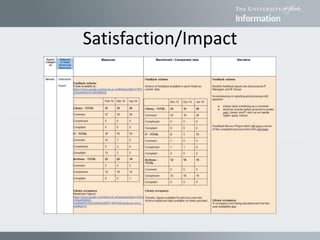
Satisfaction/Impact
Satisfaction/Impact
• LAMP
• Towards impact correlation
LIBRARY CAPITAL
Sudor
Assets - Archives
Measure Benchmark Narrative
Pace and Sims detailed
catalogue of 300 plans
Cataloguing adds value to existing assest
and is the key to making archives
available
Progress with Trevor Wishart
physical and digital archive
catalogue
Cataloguing adds value to existing assest
and is the key to making archives
available
Major additions and
enhancements to Retreat
Archive catalogue in association
with Wellcome digitisation
project
Cataloguing adds value to existing assest
and is the key to making archives
available
New archives received 15
Initial cleaning of Helperby Hall
Archive now complete
This archive, possibly worth 5 figures, is a
gift to the University.
In support of the VS approach:
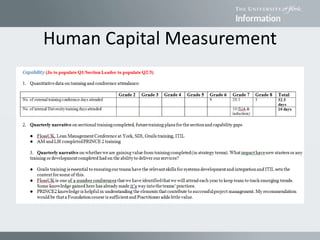
• People strategy
– Corporate data & benchmarking
– Structure & organizational change
– Talent-Engagement-Enablement
– Development portfolios
– Leadership (MIA; LIA; CLP)
• CSE
• Communications Audit
• Strategy & overall momentum
Human Capital Measurement
• Collections capital
– Strength
– CCM
MOMENTUM
Sudor
Innovation
Process
Programme Management
Strategic Projects
RELATIONAL CAPITAL
Sudor
• RMT restructure aimed to give teams more focus - academic liaison team focus
centred on building relationships with academic departments.
• RMT currently investigating ways of reporting activity with academic departments
and measuring overall relationships with them.
• Trial of Insightly CRM system in Summer term 2014. Need to pursue a long-term
CRM strategy but in the meantime developing an interim in-house solution based
on Google architecture.
• Building up quantitative measures through various metrics e.g. monitoring email
activity through the ALL subject accounts and recording data on number of
meetings held with individual academic staff.
• Departmental Action Plans, based on LibQual and NSS feedback, provided
qualitative narrative for understanding Directorate activity with departments and
facilitated specific activities (e.g. implementation of the Resource List Policy, audit
of Health Sciences teaching, and 2015-16 focus on collection-related activities).
• Monitoring the impact of our engagement activities on consecutive LibQual and
NSS scores (e.g. increase in History and English NSS scores directly attributed to
targeted academic liaison activity in a number of areas).
Measuring relational strength
Item Rating
Does the ALL regularly attend Board of Studies?
Is there a specific departmental library committee?
Does the ALL regularly attend other departmental meetings (e.g.
undergraduate committee)?
Is the ALL on departmental staff mailing lists?
Does the department keep the ALL up-to-date with general developments
in the department?
Is the ALL in regular contact with the Library Rep (in person, phone or
email)
How is the relationship between the ALL and the Library Rep?
Does the Library Rep regularly attend Library Committee?
Does the department regularly ask for feedback on the library on module
feedback?
To what extent is information literacy training embedded in the UG
programme?
To what extent is information literacy training embedded in the PGT
programme?
Does the ALL deliver PGR training?
Item
Ratin
g
How well do the library book collections support UG teaching?
How well do the library book collections support PGT teaching?
How well do the library book collections support PGR and academic
research activities?
How effectively do the journal subscriptions support teaching and
research needs in the department?
How effectively do the electronic resource/database subscriptions match
and support teaching and research needs in the department?
Does the department spend up its resource allocation budget by the end
of the financial year?
Does the department spend up its resource allocation early on in the
financial year?
Is the use of EARL compulsory for all staff?
Are Subject Guides widely used by staff and students in the department?
How are the latest NSS scores?
How are the latest LibQual results?
Departmental Action plans: Data
Departmental Action plans: Narrative
“[The Department] have for a long time had a fairly
arm’s length engagement with the Library though I
believe that a significant number of students and
staff have been regular and frequent users of the
Library both for physical and electronic resources.
Over the past few years engagement has increased
with more active liaison between the Library and
the department both via contact with the Library
Representative and via attendance at BoS and Staff-
student Consultative Committee.”
Relationships - Archives
Measures Benchmark
Support work and advice for: ESRC and researcher bids/applications;
Research projects and Data Management Plans
IGGI Consortium (pan-institutional data sharing agreement drafted
and implemented); European Project GreenEcoNet (SEI = UK partner)
NERC DTC; WRoCAH; YUSU/GSA; HEFCE PSS PGT Project regarding
data sharing; Centre for Health Economics (policy review); Data
Processing Agreements and contract review: Library (Springshare);
DARO (Crowdicity); Finance Office and Unit 4; Individual Electoral
Registration: paper for Academic Registrar; Home Office consultation
regarding repeal/amendment of section 24 of the Animals (Scientific
Procedures) Act.
Volunteer groups: 3 groups continuing to attend weekly, around 18
people. One professional conservator attending one morning weekly.
One would-be archivist, with PhD in Music, attending 2 days a week to
work on the Wishart Archive.
2 groups attending weekly, around 14
people. Atkinson Brierley project Nov.
2012 - Jan 2013 75 plans cleaned. Nov
2013 - Jan 2014 100 plans cleaned.
Blog posts 3 Blog posts 2
Twitter new followers: 74
CCW has begun stint as external examiner for the MA in Archive and
Record Management at UCD
Relationships - Content
• Gifts team - meeting with counterparts at Durham University Library to discuss
process and good practice. As a result have committed to providing a
regular report of gifts activity. Also to produce Deed of Gift transfer form
validated at a higher level.
• Copac Collection Management Board Meeting: Leeds (05.03.14)
• National Acquisitions Group Seminar: Collection Development. Birmingham
( 21.05.14)
• Publication of article in Sconul Focus (Issue Number 60) Collection Profiling.
• Meeting with Hull University Library staff (invited by Relationship
Management team) to discuss Collection Profiling 25.02.14. Meeting with
external developer responsible for CRD CMS regarding Alma (04.03.14)
• Meeting with Bureau van Dijk and Research Innovation Office regardng FAME
(05.03.14)
• NESLi2 review consultation (07.03.14) - met with the consultant undertaking
this review on behalf of JISC Collections, in order to give feedback on our
experience of the national deals for journal content
Relationships – Content (2)
• Content staff met with the following publishers to discuss their products and
service: Emerald, ProQuest, LexisNexis
• Content staff met with our 3 subscriptions agents (EBSCO, LM, Swets) to
review their service
• The Alma Project team hosted a visit by Hull University library staff to discuss
Alma (6.2.14); Hull are thinking of changing systems
• Lean Management Conference - a presentation of Flexible Loans process
(19.3.14)
• Alumni / Donations meeting (29.4.14) Sarah attended the UKSG Annual
Conference and Exhibition in April and delivered a presentation about our
experience of implementing Alma
• Presented at a UKSG student roadshow at the Sheffield iSchool 12.3.14
• Attended two Dawsonera preview and focus group events designed to get
feedback from key customers about prioritising developments to this ebook
platform 5.2.14 and 30.4.14
Further work
• Full year review (September 2014)
• Missing elements
• Tableau visualisation
• Dashboard
• Predictivity of interventions
Social capital and value
“There are intelligent [libraries] and stupid
[libraries] … intelligent groups gather
information better and adapt better to reality…
thus we find ‘social intelligence’
Luis Anglada (2007)
quoting Marina (2004)
Acknowledgments
• Ian Hall, Programme Office staff, and data
contributing teams at UoY
• York Manuscripts Conference
Questions?

Implementing the Value Scorecard

  • 1.
    Making Value Measurementa Reality: Implementing the Value Scorecard J. Stephen Town Director of Information & University Librarian University of York, UK 5th Library Assessment Conference Tuesday 5th August 2014
  • 2.
  • 3.
    The 600th Anniversaryof the York Library The 1414 Library, York Minster
  • 4.
  • 5.
    The First YorkLibrary (8th C) “per bonam et deuotissimam magistri mei industriam uel etiam mei ipsius qualecumque sudorem” Alcuin of York
  • 6.
    Aelbehrt & Alcuin [Thelibrary was assembled]: “by the good and most devoted industry of my magister and also by some of my own perspiration” “industria should be translated as ‘by his own good and most devoted plan,’ and sudor is sweat, the perspiration of the copyist’s heavy toil.” Dr Mary Garrison, University of York
  • 7.
    One modern Director’s“industria” … • Articulating the value proposition • Translating what we understand about changing need into strategies and plans • The transformation and sustenance of our services into a different social, technological and economic future • To demonstrate that our value proposition encompasses a contribution that transcends narrow and local assumptions about the library’s role
  • 8.
    In summary … •Capturing transcendent value • A Scorecard update – The relationship to the Balanced scorecard • An implementation case (‘the sweat”) • Further work for missing elements • Achieving a dashboard approach
  • 9.
    How we buildLibrary Value? • Library tangible & intangible capital – Including human capital development • Library momentum – quality maturity and pace of change • Library relational capital – within and beyond the University • Library virtue – contribution to transcendent outcomes
  • 10.
  • 11.
    The distinction betweenQuality and Value R. H. Orr. (1973). MEASURING THE GOODNESS OF LIBRARY SERVICES: A GENERAL FRAMEWORK FOR CONSIDERING QUANTITATIVE MEASURES. Journal of Documentation. 29 (3), p318.
  • 12.
    The Balanced Scorecard •Customer - how can we fulfil user expectations? • Financial - how can we secure and use resources in an effective way? • Internal Process Perspective - How should we organize internal processes to meet user needs and expectations? • Learning/Growth - How can we secure the future capability of our services?
  • 13.
  • 14.
    Value & BalancedScorecards
  • 15.
    Distinctions … Balanced Scorecard •Balanced • Simple • Performance • Discrete measures • Single targets • Direct data Value Scorecard • Unbalanced to suit context • Complex • Insight & prediction • Connected • Correlation aim • Narrative & advocacy
  • 16.
  • 17.
  • 18.
    Measurement elements (VS) •Virtue – Impact data – Correlation between activity data and transcendent effects • Relationships – = sum of all relationships – “Goodwill” value increase assessment – Relational data (=strength?) – Correlation between this, direction, activity, impact & capital growth • Momentum – “= mass x velocity” – Alignment proof – Progress data – Correlation between capital development through projects and time – Volume , pace, culture, and meta-assessment of organizational capability
  • 19.
    Capability Maturity Model AdHoc Repeatable Defined Managed Continuous 1 2 3 4 5 Continuous Improvement, innovative ideas Detailed measures, controlled Integrated Process Basic processes, repeated success Initial, ad hoc
  • 20.
    Measurement elements (VS) •Tangible capital – Collections value data – Services value data – Environments value data – Valuation and link to values – Correlation between this, and impact, and transcendent effects • Intangible capital – Meta-assets value data – Organizational value data – KM & intellectual value data – Correlation between this, and impact & capital growth • Human capital – People value data – Correlation between people data and all other elements
  • 21.
    Human Capital sub-frame •Capacity • Capability • Climate of Affect • Culture of Momentum
  • 22.
    A Human Capitalapproach Enablers (4 ‘C’s) – Capacity • Minus confounders – Absence, turnover – Capability • Talent: raw & growth • Critical mass – Climate of Affect • Engagement • Emowerment – Culture of momentum • Enablement • Programme capability • Maturity Outcome proofs – Market fit • Sustainability • Market related impact – Strategic fit (over time) • Quality & Improvement • New product development – Contribution to • Productivity • Creativity – Competitive impact • Service development • Reputational investment
  • 23.
    Relations & “fit” Theeffective academic library (1995) Integration Indicator P1.4 Liaison “evidence of formal and informal communications between the library service, the senior management of the institution, academics and students … to assess the degree of effective and dynamic communication to inform service provision”
  • 24.
    Relationship Capital sub-frame Awareness& Fit • Consciousness – General audit of relational spaces (7 market model) • Congruence – Degree of fit of relationship activity to parent institution (gap analysis) Strength & Process • Communities – Assessment of strength level across all relations • CRM data • Strength index • Communication – Measures of the process of communication for relationship development • Communications audit • Down to individual level
  • 25.
  • 26.
    Relationship Capital sub-frame Returnon relationships • Causality – Specific outcomes of positive relationships on academic process, innovation, finance, quality & staff development • Comeback – Specific ensuing returns to the Library of repeat benefits of relationships – Transaction costs saved through Trust
  • 27.
    Sources • Value, Impactand the Transcendent Library. Library Quarterly 81(1). 2011. 111-124. • The value of libraries in Baker & Evans (eds) Libraries and society. Chandos, 2011. 303-325. • With Kyrillidou, M. Developing a values scorecard. Performance Measurement & Metrics 14(1) 2013. 7- 16. • The value of people. Performance Measurement & Metrics 15(1) 2014. 67-80. Forthcoming • Relationship capital. Library Management 2014.
  • 28.
  • 29.
  • 30.
  • 31.
    Strategic KPIs (“cleardepartmental KPI toolkit”) 1. Meet need … 2. Resource … 3. Innovate … 4. Engage … 5. Align … 6. Risk … … satisfaction measures … financial measures … new services … relational strength … University fit … failure avoidance
  • 32.
  • 33.
    Levels of input •Team template reporting (Quarterly) • Internal initiatives • National & collaborative initiatives & services • Corporate data (analytics)
  • 34.
    Value & BalancedScorecards
  • 37.
  • 38.
    Customer Service Excellence Awardassessed: March 2014 Achieved with two “Compliance plus” scores: Customer Insight Delivery
  • 39.
    Customer Service Excellence •“The Directorate values customer engagement highly … to ensure that customers experience and views are included” • “There are particular strengths about learning from best practice and presenting projects externally…” • “The Information Directorate is a highly focused service delivered by staff who are professional, polite and helpful. It is … forward thinking and proactive … actively working to enhance services …”
  • 40.
    Further Guidance In orderto enhance reports further, unit leaders should consider the following: • Impact: What work has been done in your service that has impacted upon delivering the core goals (teaching, learning, research, business, community) of the University? • Momentum: What work has been achieved which demonstrates momentum towards achieving the Information Strategy? This can be project work, service improvements and other tasks. • Process and Process Improvement: What changes have been made that have made more efficient or effective use of resource? • Capital Assets: What have you purchased/acquired/collected that has increased our overall asset value to the University? • Relationships: What relationships or partnerships have been developed that assist toward achieving Directorate and University strategies? • People: What impact have new starters or any training or development completed had on the ability to deliver our services?
  • 41.
  • 42.
  • 43.
  • 45.
    • LAMP • Towardsimpact correlation
  • 46.
  • 47.
    Assets - Archives MeasureBenchmark Narrative Pace and Sims detailed catalogue of 300 plans Cataloguing adds value to existing assest and is the key to making archives available Progress with Trevor Wishart physical and digital archive catalogue Cataloguing adds value to existing assest and is the key to making archives available Major additions and enhancements to Retreat Archive catalogue in association with Wellcome digitisation project Cataloguing adds value to existing assest and is the key to making archives available New archives received 15 Initial cleaning of Helperby Hall Archive now complete This archive, possibly worth 5 figures, is a gift to the University.
  • 48.
    In support ofthe VS approach: • People strategy – Corporate data & benchmarking – Structure & organizational change – Talent-Engagement-Enablement – Development portfolios – Leadership (MIA; LIA; CLP) • CSE • Communications Audit • Strategy & overall momentum
  • 49.
  • 50.
  • 51.
  • 52.
  • 53.
  • 54.
  • 55.
  • 56.
  • 57.
  • 58.
  • 59.
    • RMT restructureaimed to give teams more focus - academic liaison team focus centred on building relationships with academic departments. • RMT currently investigating ways of reporting activity with academic departments and measuring overall relationships with them. • Trial of Insightly CRM system in Summer term 2014. Need to pursue a long-term CRM strategy but in the meantime developing an interim in-house solution based on Google architecture. • Building up quantitative measures through various metrics e.g. monitoring email activity through the ALL subject accounts and recording data on number of meetings held with individual academic staff. • Departmental Action Plans, based on LibQual and NSS feedback, provided qualitative narrative for understanding Directorate activity with departments and facilitated specific activities (e.g. implementation of the Resource List Policy, audit of Health Sciences teaching, and 2015-16 focus on collection-related activities). • Monitoring the impact of our engagement activities on consecutive LibQual and NSS scores (e.g. increase in History and English NSS scores directly attributed to targeted academic liaison activity in a number of areas).
  • 60.
    Measuring relational strength ItemRating Does the ALL regularly attend Board of Studies? Is there a specific departmental library committee? Does the ALL regularly attend other departmental meetings (e.g. undergraduate committee)? Is the ALL on departmental staff mailing lists? Does the department keep the ALL up-to-date with general developments in the department? Is the ALL in regular contact with the Library Rep (in person, phone or email) How is the relationship between the ALL and the Library Rep? Does the Library Rep regularly attend Library Committee? Does the department regularly ask for feedback on the library on module feedback? To what extent is information literacy training embedded in the UG programme? To what extent is information literacy training embedded in the PGT programme? Does the ALL deliver PGR training?
  • 61.
    Item Ratin g How well dothe library book collections support UG teaching? How well do the library book collections support PGT teaching? How well do the library book collections support PGR and academic research activities? How effectively do the journal subscriptions support teaching and research needs in the department? How effectively do the electronic resource/database subscriptions match and support teaching and research needs in the department? Does the department spend up its resource allocation budget by the end of the financial year? Does the department spend up its resource allocation early on in the financial year? Is the use of EARL compulsory for all staff? Are Subject Guides widely used by staff and students in the department? How are the latest NSS scores? How are the latest LibQual results?
  • 62.
  • 63.
    Departmental Action plans:Narrative “[The Department] have for a long time had a fairly arm’s length engagement with the Library though I believe that a significant number of students and staff have been regular and frequent users of the Library both for physical and electronic resources. Over the past few years engagement has increased with more active liaison between the Library and the department both via contact with the Library Representative and via attendance at BoS and Staff- student Consultative Committee.”
  • 64.
    Relationships - Archives MeasuresBenchmark Support work and advice for: ESRC and researcher bids/applications; Research projects and Data Management Plans IGGI Consortium (pan-institutional data sharing agreement drafted and implemented); European Project GreenEcoNet (SEI = UK partner) NERC DTC; WRoCAH; YUSU/GSA; HEFCE PSS PGT Project regarding data sharing; Centre for Health Economics (policy review); Data Processing Agreements and contract review: Library (Springshare); DARO (Crowdicity); Finance Office and Unit 4; Individual Electoral Registration: paper for Academic Registrar; Home Office consultation regarding repeal/amendment of section 24 of the Animals (Scientific Procedures) Act. Volunteer groups: 3 groups continuing to attend weekly, around 18 people. One professional conservator attending one morning weekly. One would-be archivist, with PhD in Music, attending 2 days a week to work on the Wishart Archive. 2 groups attending weekly, around 14 people. Atkinson Brierley project Nov. 2012 - Jan 2013 75 plans cleaned. Nov 2013 - Jan 2014 100 plans cleaned. Blog posts 3 Blog posts 2 Twitter new followers: 74 CCW has begun stint as external examiner for the MA in Archive and Record Management at UCD
  • 65.
    Relationships - Content •Gifts team - meeting with counterparts at Durham University Library to discuss process and good practice. As a result have committed to providing a regular report of gifts activity. Also to produce Deed of Gift transfer form validated at a higher level. • Copac Collection Management Board Meeting: Leeds (05.03.14) • National Acquisitions Group Seminar: Collection Development. Birmingham ( 21.05.14) • Publication of article in Sconul Focus (Issue Number 60) Collection Profiling. • Meeting with Hull University Library staff (invited by Relationship Management team) to discuss Collection Profiling 25.02.14. Meeting with external developer responsible for CRD CMS regarding Alma (04.03.14) • Meeting with Bureau van Dijk and Research Innovation Office regardng FAME (05.03.14) • NESLi2 review consultation (07.03.14) - met with the consultant undertaking this review on behalf of JISC Collections, in order to give feedback on our experience of the national deals for journal content
  • 66.
    Relationships – Content(2) • Content staff met with the following publishers to discuss their products and service: Emerald, ProQuest, LexisNexis • Content staff met with our 3 subscriptions agents (EBSCO, LM, Swets) to review their service • The Alma Project team hosted a visit by Hull University library staff to discuss Alma (6.2.14); Hull are thinking of changing systems • Lean Management Conference - a presentation of Flexible Loans process (19.3.14) • Alumni / Donations meeting (29.4.14) Sarah attended the UKSG Annual Conference and Exhibition in April and delivered a presentation about our experience of implementing Alma • Presented at a UKSG student roadshow at the Sheffield iSchool 12.3.14 • Attended two Dawsonera preview and focus group events designed to get feedback from key customers about prioritising developments to this ebook platform 5.2.14 and 30.4.14
  • 67.
    Further work • Fullyear review (September 2014) • Missing elements • Tableau visualisation • Dashboard • Predictivity of interventions
  • 68.
    Social capital andvalue “There are intelligent [libraries] and stupid [libraries] … intelligent groups gather information better and adapt better to reality… thus we find ‘social intelligence’ Luis Anglada (2007) quoting Marina (2004)
  • 69.
    Acknowledgments • Ian Hall,Programme Office staff, and data contributing teams at UoY • York Manuscripts Conference
  • 70.

Editor's Notes

  • #7 This was Aelbehrt’s Industria And Alcuin’s perspiration Copying was hard physical labour and Alcuin is making the point that he did some copying work himself The point here is that there is “a clear distinction between the ‘plan’ and the ‘execution’ of the Library The link to this paper is that a sense of a library’s transcendent value has been around for a long time, in particular its impact on learning and scholarship But also perhaps that to measure this value also requires both a devoted plan and sweat
  • #11 Relational Capital: The value of relationships with users, both individual and collective Organization Capital: Tangible assets (collections, environments, services) and intangible assets (meta-assets, organizational capital, human capital) Organization Virtue: doing good and generating benefit - proof of organizational impact Organization Momentum: The concept of time
  • #15 The scorecard relationship as a codex, folding some related measurement areas together
  • #16 This is not at all to disparage the BS, or to reject its important features Both can be cultural instruments
  • #24 Definitions “the sum of all of the relationships of all the people within an organisation” (relatedvision.com, 2013) “the value of relationships that an organisation maintains with different agencies of its environment” (Euroforum, 1998) “the intentional building of a system-wide understanding and capacity to act, which becomes the asset or ‘glue’ for creating the context for achieving goals ” (Darling & Russ, 2000)
  • #25 Engagement and understanding of stakeholder requirements and context is essential for service design in changing times The role of relationships in innovation and new service creation is therefore critical “Success is a function of healthy relationships”
  • #27 Social capital and trust are in inverse relation to Transaction costs Social capital cannot be built on your own! Effective relationships add value and save cost where they build trust; so human interaction measures are a key indicator of value
  • #30  NB includes values statement You cannot start this until you have that clear agreed sense of values
  • #35 The scorecard relationship as a codex, folding some related measurement areas together
  • #69 The Library is still “a growing organism” (Ranganathan Law 5) Value measurement of all activity is crucial in constrained or customer-oriented contexts Two lessons from a place with great libraries spanning nearly 1300 years Focus on your transcendent value and avoid vikings