Indepth analysis of
recruitment analytics
‘You can not improve what you do not
measure’
By BURAK AKALIN
www.burakakalin.com
uk.linkedin.com/in/burakakalin
Agenda
֎ An Exploration Into the Depths of Recruitment Analytics
֎ Trends in Satisfaction and Budget Allocation
֎ Which Recruiting Metrics Are Most Important?
֎ Executive-level recommendation.
Attitudes Toward Recruitment Analytics
This analysis is based on
֍ understanding where the industry stands on the issue of recruitment analytics,
֍ the recruitment leaders’ views. (hiring managers, talent acquisition professionals)
֍ research study that has been pulled together data from companies and almost 300
professionals across a range of different industries,
This analysis is based on the study done by Jibe.com
An Exploration Into the Depths of
Recruitment Analytics-I
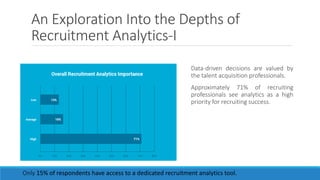
Data-driven decisions are valued by
the talent acquisition professionals.
Approximately 71% of recruiting
professionals see analytics as a high
priority for recruiting success.
Only 15% of respondents have access to a dedicated recruitment analytics tool.
An Exploration Into the Depths of
Recruitment Analytics-II
Hiring managers are the most
concerned about analytics.
80% see it as a high priority issue.
This is understandable given their
primary responsibility is setting goals
for recruiting teams and overseeing
the hiring process.
Only 15% of respondents have access to a dedicated recruitment analytics tool.
An Exploration Into the Depths of
Recruitment Analytics-III
Only 15% of respondents have access to a dedicated recruitment analytics tool.
69% of talent acquisition professionals are restricted to spreadsheets and other ad-hoc tools when
compiling and analysing key business metrics.
In the case of hiring managers, only 7% had access to appropriate technology. This may be
seriously impacting their ability to safeguard pipeline health
Medium-sized companies (between 200-1000 employees) are the best equipped to tackle the
analytics problem—24% have a dedicated solution in place.
Trends in Satisfaction and Budget
Allocation-I
A majority of respondents (58%) fall on the side of dissatisfaction with their current performance
management tools.
Trends in Satisfaction and Budget
Allocation-II
Position groups most dissatisfied with the current performance
management tools are hiring managers (73%) and sourcers (77%).
83% of respondents from
large organizations (more
than 1,000 employees) say
they are dissatisfied with
their current tools
Trends in Satisfaction and Budget
Allocation-III
As mentioned previously, 15% having a dedicated recruiting analytics tool—almost seven in ten
are using spreadsheets and ad-hoc analysis. The limitations of manual methods is becoming more
challenging for organizations as time goes on. This tends to be more difficult for larger companies
with greater hiring volume.
While large companies report the most
dissatisfaction with their current performance
management tools, they also increase budget for
recruiting analytics next year.
70% of companies with more than 1,000
employees are planning on increasing their 2016
budget.
Which Recruiting Metrics Are Most
Important?
Talent acquisition professionals are primarily focused on pipeline metrics,
with source of hire at the top. This is followed by time to hire, with
applicants per hire, candidate experience, and cost per hire not far behind.
Source of hire, has been brought into the spotlight in recent years, partially
because the internet and increased visibility have made it easier to see
where hires are coming from. But also because understanding source of hire
at a time when there are more potential sources than ever (job boards,
career site, referrals, social media, etc.) could have significant strategic and
budgetary benefits. Overall, career sites and job boards are the top source
of hire—both with 26%.
For large organizations specifically, career sites were more impactful, driving
35% of hires in 2015.
Same set of large companies, however, feel referrals will pick up as a more
significant source of hire in 2016. Additionally, nearly every respondent
feels social media will play a larger role in source of hire in 2016. This is
especially true for C-Level professionals who expect it will account for 40%
of hires next year.
Executive-level recommendation
From a high-level view, the talent acquisition field’s attitude towards analytics seems to be
following a very similar path to other business functions, such as marketing and sales.
Despite the majority of respondents being dissatisfied with their tools for recruiting analysis and
optimization, and only 15% actually having a dedicated analytics tool, budgets are reportedly
increasing next year and more professionals than in the past seem to be focused on becoming
data-driven.
There is a major opportunity to build a competitive advantage with the use of data.
Talent acquisition by nature creates an enormous amount of data, and that data has to be looked
at as an asset vital to your organization’s long-term success.
The question is, are you getting the most out of that asset? If the answer is no, then it’s time to
start inspecting next-generation tools that can pick up where the human elements of recruiting
fall short.

Recruitment Analytics

  • 1.
    Indepth analysis of recruitmentanalytics ‘You can not improve what you do not measure’ By BURAK AKALIN www.burakakalin.com uk.linkedin.com/in/burakakalin
  • 2.
    Agenda ֎ An ExplorationInto the Depths of Recruitment Analytics ֎ Trends in Satisfaction and Budget Allocation ֎ Which Recruiting Metrics Are Most Important? ֎ Executive-level recommendation.
  • 3.
    Attitudes Toward RecruitmentAnalytics This analysis is based on ֍ understanding where the industry stands on the issue of recruitment analytics, ֍ the recruitment leaders’ views. (hiring managers, talent acquisition professionals) ֍ research study that has been pulled together data from companies and almost 300 professionals across a range of different industries, This analysis is based on the study done by Jibe.com
  • 4.
    An Exploration Intothe Depths of Recruitment Analytics-I Data-driven decisions are valued by the talent acquisition professionals. Approximately 71% of recruiting professionals see analytics as a high priority for recruiting success. Only 15% of respondents have access to a dedicated recruitment analytics tool.
  • 5.
    An Exploration Intothe Depths of Recruitment Analytics-II Hiring managers are the most concerned about analytics. 80% see it as a high priority issue. This is understandable given their primary responsibility is setting goals for recruiting teams and overseeing the hiring process. Only 15% of respondents have access to a dedicated recruitment analytics tool.
  • 6.
    An Exploration Intothe Depths of Recruitment Analytics-III Only 15% of respondents have access to a dedicated recruitment analytics tool. 69% of talent acquisition professionals are restricted to spreadsheets and other ad-hoc tools when compiling and analysing key business metrics. In the case of hiring managers, only 7% had access to appropriate technology. This may be seriously impacting their ability to safeguard pipeline health Medium-sized companies (between 200-1000 employees) are the best equipped to tackle the analytics problem—24% have a dedicated solution in place.
  • 7.
    Trends in Satisfactionand Budget Allocation-I A majority of respondents (58%) fall on the side of dissatisfaction with their current performance management tools.
  • 8.
    Trends in Satisfactionand Budget Allocation-II Position groups most dissatisfied with the current performance management tools are hiring managers (73%) and sourcers (77%). 83% of respondents from large organizations (more than 1,000 employees) say they are dissatisfied with their current tools
  • 9.
    Trends in Satisfactionand Budget Allocation-III As mentioned previously, 15% having a dedicated recruiting analytics tool—almost seven in ten are using spreadsheets and ad-hoc analysis. The limitations of manual methods is becoming more challenging for organizations as time goes on. This tends to be more difficult for larger companies with greater hiring volume. While large companies report the most dissatisfaction with their current performance management tools, they also increase budget for recruiting analytics next year. 70% of companies with more than 1,000 employees are planning on increasing their 2016 budget.
  • 10.
    Which Recruiting MetricsAre Most Important? Talent acquisition professionals are primarily focused on pipeline metrics, with source of hire at the top. This is followed by time to hire, with applicants per hire, candidate experience, and cost per hire not far behind. Source of hire, has been brought into the spotlight in recent years, partially because the internet and increased visibility have made it easier to see where hires are coming from. But also because understanding source of hire at a time when there are more potential sources than ever (job boards, career site, referrals, social media, etc.) could have significant strategic and budgetary benefits. Overall, career sites and job boards are the top source of hire—both with 26%. For large organizations specifically, career sites were more impactful, driving 35% of hires in 2015. Same set of large companies, however, feel referrals will pick up as a more significant source of hire in 2016. Additionally, nearly every respondent feels social media will play a larger role in source of hire in 2016. This is especially true for C-Level professionals who expect it will account for 40% of hires next year.
  • 11.
    Executive-level recommendation From ahigh-level view, the talent acquisition field’s attitude towards analytics seems to be following a very similar path to other business functions, such as marketing and sales. Despite the majority of respondents being dissatisfied with their tools for recruiting analysis and optimization, and only 15% actually having a dedicated analytics tool, budgets are reportedly increasing next year and more professionals than in the past seem to be focused on becoming data-driven. There is a major opportunity to build a competitive advantage with the use of data. Talent acquisition by nature creates an enormous amount of data, and that data has to be looked at as an asset vital to your organization’s long-term success. The question is, are you getting the most out of that asset? If the answer is no, then it’s time to start inspecting next-generation tools that can pick up where the human elements of recruiting fall short.