Implementing eLearning
organisation-wide
- The Case of Lapland University of Applied Sciences
24.6.2014
Anu Pruikkonen
Head of eLearning Services
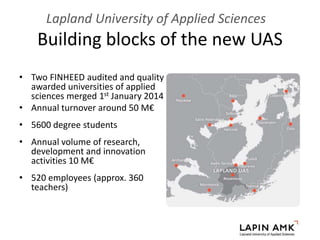
Building blocks of the new UAS
Lapland University of Applied Sciences
• Two FINHEED audited and quality
awarded universities of applied
sciences merged 1st January 2014
• Annual turnover around 50 M€
• 5600 degree students
• Annual volume of research,
development and innovation
activities 10 M€
• 520 employees (approx. 360
teachers)
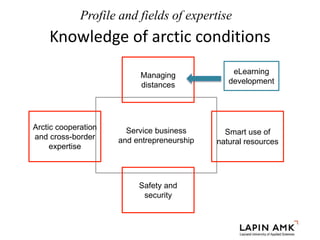
Knowledge of arctic conditions
Profile and fields of expertise
Service business
and entrepreneurship
Managing
distances
Safety and
security
Arctic cooperation
and cross-border
expertise
Smart use of
natural resources
eLearning
development
Strategy -> where we are now?
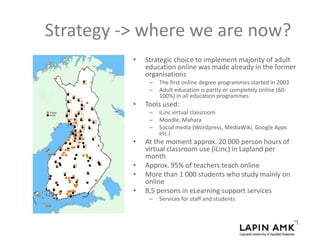
• Strategic choice to implement majority of adult
education online was made already in the former
organisations
– The first online degree programmes started in 2003
– Adult education is partly or completely online (60-
100%) in all education programmes
• Tools used:
– iLinc virtual classroom
– Moodle, Mahara
– Social media (Wordpress, MediaWiki, Google Apps
etc.)
• At the moment approx. 20 000 person hours of
virtual classroom use (iLinc) in Lapland per
month
• Approx. 95% of teachers teach online
• More than 1 000 students who study mainly on
online
• 8,5 persons in eLearning support services
– Services for staff and students
From Strategy to Practice
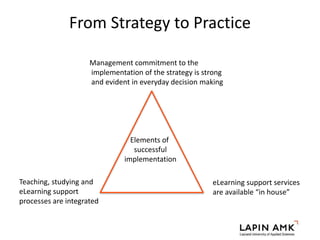
Management commitment to the
implementation of the strategy is strong
and evident in everyday decision making
eLearning support services
are available “in house”
Teaching, studying and
eLearning support
processes are integrated
Elements of
successful
implementation
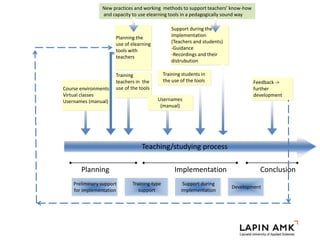
Course environments
Virtual classes
Usernames (manual)
Teaching/studying process
Planning Implementation Conclusion
Planning the
use of elearning
tools with
teachers
Training
teachers in the
use of the tools
Usernames
(manual)
Support during the
implementation
(Teachers and students)
-Guidance
-Recordings and their
distrubution
Training students in
the use of the tools Feedback ->
further
development
Preliminary support
for implementation
Support during
implementation
Training-type
support
Development
New practices and working methods to support teachers’ know-how
and capacity to use elearning tools in a pedagogically sound way
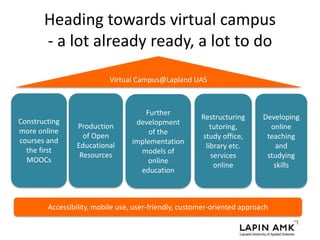
Heading towards virtual campus
- a lot already ready, a lot to do
Constructing
more online
courses and
the first
MOOCs
Production
of Open
Educational
Resources
Developing
online
teaching
and
studying
skills
Further
development
of the
implementation
models of
online
education
Restructuring
tutoring,
study office,
library etc.
services
online
Accessibility, mobile use, user-friendly, customer-oriented approach
Virtual Campus@Lapland UAS
Thank you!
Twitter: @apruikkonen

Implementing elearning organization-wide - Case Lapland University of Applied Sciences

  • 1.
    Implementing eLearning organisation-wide - TheCase of Lapland University of Applied Sciences 24.6.2014 Anu Pruikkonen Head of eLearning Services
  • 2.
    Building blocks ofthe new UAS Lapland University of Applied Sciences • Two FINHEED audited and quality awarded universities of applied sciences merged 1st January 2014 • Annual turnover around 50 M€ • 5600 degree students • Annual volume of research, development and innovation activities 10 M€ • 520 employees (approx. 360 teachers)
  • 3.
    Knowledge of arcticconditions Profile and fields of expertise Service business and entrepreneurship Managing distances Safety and security Arctic cooperation and cross-border expertise Smart use of natural resources eLearning development
  • 4.
    Strategy -> wherewe are now? • Strategic choice to implement majority of adult education online was made already in the former organisations – The first online degree programmes started in 2003 – Adult education is partly or completely online (60- 100%) in all education programmes • Tools used: – iLinc virtual classroom – Moodle, Mahara – Social media (Wordpress, MediaWiki, Google Apps etc.) • At the moment approx. 20 000 person hours of virtual classroom use (iLinc) in Lapland per month • Approx. 95% of teachers teach online • More than 1 000 students who study mainly on online • 8,5 persons in eLearning support services – Services for staff and students
  • 5.
    From Strategy toPractice Management commitment to the implementation of the strategy is strong and evident in everyday decision making eLearning support services are available “in house” Teaching, studying and eLearning support processes are integrated Elements of successful implementation
  • 7.
    Course environments Virtual classes Usernames(manual) Teaching/studying process Planning Implementation Conclusion Planning the use of elearning tools with teachers Training teachers in the use of the tools Usernames (manual) Support during the implementation (Teachers and students) -Guidance -Recordings and their distrubution Training students in the use of the tools Feedback -> further development Preliminary support for implementation Support during implementation Training-type support Development New practices and working methods to support teachers’ know-how and capacity to use elearning tools in a pedagogically sound way
  • 8.
    Heading towards virtualcampus - a lot already ready, a lot to do Constructing more online courses and the first MOOCs Production of Open Educational Resources Developing online teaching and studying skills Further development of the implementation models of online education Restructuring tutoring, study office, library etc. services online Accessibility, mobile use, user-friendly, customer-oriented approach Virtual Campus@Lapland UAS
  • 10.