Implementing Adaptation to Sea level Rise
#SROCC
Johanna Nalau
Griffith University, Australia
1950 2000 2050 2100
0.3
0.2
Antarctic
ice sheet mass loss
Greenland
ice sheet mass loss
Glacier
mass loss
0.1
0
0.3
0.2
0.1
0
0.3
0.2
0.1
0
Ocean heat content (0−2000 m depth)
as 1021 Joules (right axis)
2400
1600
800
0
1950 2000 2050 2100
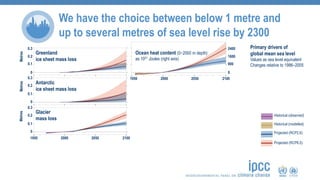
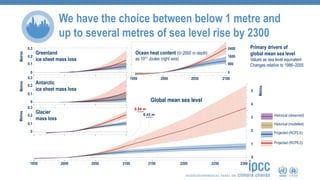
We have the choice between below 1 metre and
up to several metres of sea level rise by 2300
Primary drivers of
global mean sea level
Values as sea level equivalent
Changes relative to 1986–2005
Historical (observed)
Historical (modelled)
Projected (RCP2.6)
Projected (RCP8.5)
MetresMetresMetres
1950 2000 2050 2100
0.3
0.2
Antarctic
ice sheet mass loss
2150 2200 2250 2300
Greenland
ice sheet mass loss
Glacier
mass loss
0.1
0
0.3
0.2
0.1
0
0.3
0.2
0.1
0
Ocean heat content (0−2000 m depth)
as 1021 Joules (right axis)
Metres
2400
1600
800
0
1950 2000 2050 2100
0.84 m
0.43 m
Global mean sea level
5
4
3
2
1
0
We have the choice between below 1 metre and
up to several metres of sea level rise by 2300
Primary drivers of
global mean sea level
Values as sea level equivalent
Changes relative to 1986–2005
Historical (observed)
Historical (modelled)
Projected (RCP2.6)
Projected (RCP8.5)
MetresMetres
Metres
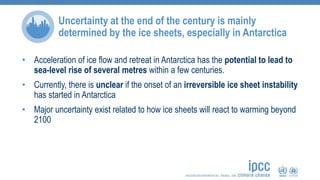
Uncertainty at the end of the century is mainly
determined by the ice sheets, especially in Antarctica
• Acceleration of ice flow and retreat in Antarctica has the potential to lead to
sea-level rise of several metres within a few centuries.
• Currently, there is unclear if the onset of an irreversible ice sheet instability
has started in Antarctica
• Major uncertainty exist related to how ice sheets will react to warming beyond
2100
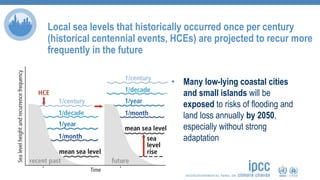
• Many low-lying coastal cities
and small islands will be
exposed to risks of flooding and
land loss annually by 2050,
especially without strong
adaptation
Local sea levels that historically occurred once per century
(historical centennial events, HCEs) are projected to recur more
frequently in the future
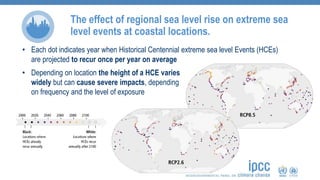
• Each dot indicates year when Historical Centennial extreme sea level Events (HCEs)
are projected to recur once per year on average
The effect of regional sea level rise on extreme sea
level events at coastal locations.
• Depending on location the height of a HCE varies
widely but can cause severe impacts, depending
on frequency and the level of exposure
•
These ocean changes have major impact on
marine life and all humans directly or indirectly
depending on it.
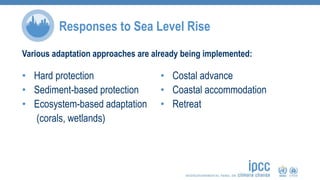
Various adaptation approaches are already being implemented:
Responses to Sea Level Rise
• Hard protection
• Sediment-based protection
• Ecosystem-based adaptation
(corals, wetlands)
• Costal advance
• Coastal accommodation
• Retreat
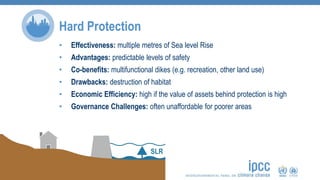
Hard Protection
• Effectiveness: multiple metres of Sea level Rise
• Advantages: predictable levels of safety
• Co-benefits: multifunctional dikes (e.g. recreation, other land use)
• Drawbacks: destruction of habitat
• Economic Efficiency: high if the value of assets behind protection is high
• Governance Challenges: often unaffordable for poorer areas
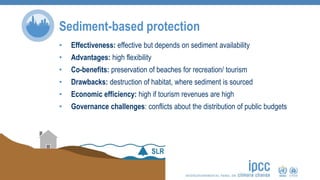
Sediment-based protection
• Effectiveness: effective but depends on sediment availability
• Advantages: high flexibility
• Co-benefits: preservation of beaches for recreation/ tourism
• Drawbacks: destruction of habitat, where sediment is sourced
• Economic efficiency: high if tourism revenues are high
• Governance challenges: conflicts about the distribution of public budgets
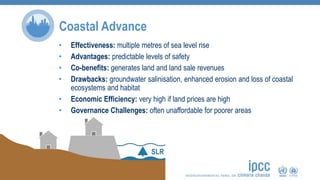
• Effectiveness: multiple metres of sea level rise
• Advantages: predictable levels of safety
• Co-benefits: generates land and land sale revenues
• Drawbacks: groundwater salinisation, enhanced erosion and loss of coastal
ecosystems and habitat
• Economic Efficiency: very high if land prices are high
• Governance Challenges: often unaffordable for poorer areas
Coastal Advance
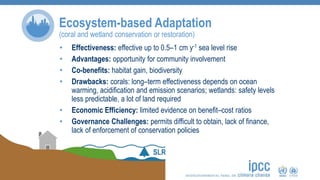
• Effectiveness: effective up to 0.5–1 cm y-1 sea level rise
• Advantages: opportunity for community involvement
• Co-benefits: habitat gain, biodiversity
• Drawbacks: corals: long–term effectiveness depends on ocean
warming, acidification and emission scenarios; wetlands: safety levels
less predictable, a lot of land required
• Economic Efficiency: limited evidence on benefit–cost ratios
• Governance Challenges: permits difficult to obtain, lack of finance,
lack of enforcement of conservation policies
Ecosystem-based Adaptation
(coral and wetland conservation or restoration)
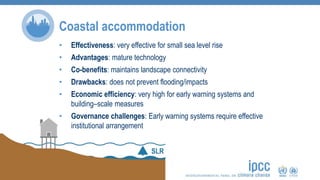
Coastal accommodation
• Effectiveness: very effective for small sea level rise
• Advantages: mature technology
• Co-benefits: maintains landscape connectivity
• Drawbacks: does not prevent flooding/impacts
• Economic efficiency: very high for early warning systems and
building–scale measures
• Governance challenges: Early warning systems require effective
institutional arrangement
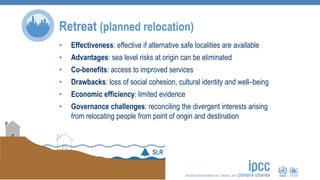
Retreat (planned relocation)
• Effectiveness: effective if alternative safe localities are available
• Advantages: sea level risks at origin can be eliminated
• Co-benefits: access to improved services
• Drawbacks: loss of social cohesion, cultural identity and well–being
• Economic efficiency: limited evidence
• Governance challenges: reconciling the divergent interests arising
from relocating people from point of origin and destination
More Information:
Website: http://ipcc.ch
IPCC Secretariat: ipcc-sec@wmo.int
IPCC Press Office: ipcc-media@wmo.int
@IPCC_CH
@IPCC
@IPCC
www.vimeo.com/ipcc
www.youtube.com/c/ipccgeneva
Find us on:

Implementing Adaptation to SLR

  • 1.
    Implementing Adaptation toSea level Rise #SROCC Johanna Nalau Griffith University, Australia
  • 2.
    1950 2000 20502100 0.3 0.2 Antarctic ice sheet mass loss Greenland ice sheet mass loss Glacier mass loss 0.1 0 0.3 0.2 0.1 0 0.3 0.2 0.1 0 Ocean heat content (0−2000 m depth) as 1021 Joules (right axis) 2400 1600 800 0 1950 2000 2050 2100 We have the choice between below 1 metre and up to several metres of sea level rise by 2300 Primary drivers of global mean sea level Values as sea level equivalent Changes relative to 1986–2005 Historical (observed) Historical (modelled) Projected (RCP2.6) Projected (RCP8.5) MetresMetresMetres
  • 3.
    1950 2000 20502100 0.3 0.2 Antarctic ice sheet mass loss 2150 2200 2250 2300 Greenland ice sheet mass loss Glacier mass loss 0.1 0 0.3 0.2 0.1 0 0.3 0.2 0.1 0 Ocean heat content (0−2000 m depth) as 1021 Joules (right axis) Metres 2400 1600 800 0 1950 2000 2050 2100 0.84 m 0.43 m Global mean sea level 5 4 3 2 1 0 We have the choice between below 1 metre and up to several metres of sea level rise by 2300 Primary drivers of global mean sea level Values as sea level equivalent Changes relative to 1986–2005 Historical (observed) Historical (modelled) Projected (RCP2.6) Projected (RCP8.5) MetresMetres Metres
  • 4.
    Uncertainty at theend of the century is mainly determined by the ice sheets, especially in Antarctica • Acceleration of ice flow and retreat in Antarctica has the potential to lead to sea-level rise of several metres within a few centuries. • Currently, there is unclear if the onset of an irreversible ice sheet instability has started in Antarctica • Major uncertainty exist related to how ice sheets will react to warming beyond 2100
  • 5.
    • Many low-lyingcoastal cities and small islands will be exposed to risks of flooding and land loss annually by 2050, especially without strong adaptation Local sea levels that historically occurred once per century (historical centennial events, HCEs) are projected to recur more frequently in the future
  • 6.
    • Each dotindicates year when Historical Centennial extreme sea level Events (HCEs) are projected to recur once per year on average The effect of regional sea level rise on extreme sea level events at coastal locations. • Depending on location the height of a HCE varies widely but can cause severe impacts, depending on frequency and the level of exposure
  • 7.
    • These ocean changeshave major impact on marine life and all humans directly or indirectly depending on it.
  • 8.
    Various adaptation approachesare already being implemented: Responses to Sea Level Rise • Hard protection • Sediment-based protection • Ecosystem-based adaptation (corals, wetlands) • Costal advance • Coastal accommodation • Retreat
  • 9.
    Hard Protection • Effectiveness:multiple metres of Sea level Rise • Advantages: predictable levels of safety • Co-benefits: multifunctional dikes (e.g. recreation, other land use) • Drawbacks: destruction of habitat • Economic Efficiency: high if the value of assets behind protection is high • Governance Challenges: often unaffordable for poorer areas
  • 10.
    Sediment-based protection • Effectiveness:effective but depends on sediment availability • Advantages: high flexibility • Co-benefits: preservation of beaches for recreation/ tourism • Drawbacks: destruction of habitat, where sediment is sourced • Economic efficiency: high if tourism revenues are high • Governance challenges: conflicts about the distribution of public budgets
  • 11.
    • Effectiveness: multiplemetres of sea level rise • Advantages: predictable levels of safety • Co-benefits: generates land and land sale revenues • Drawbacks: groundwater salinisation, enhanced erosion and loss of coastal ecosystems and habitat • Economic Efficiency: very high if land prices are high • Governance Challenges: often unaffordable for poorer areas Coastal Advance
  • 12.
    • Effectiveness: effectiveup to 0.5–1 cm y-1 sea level rise • Advantages: opportunity for community involvement • Co-benefits: habitat gain, biodiversity • Drawbacks: corals: long–term effectiveness depends on ocean warming, acidification and emission scenarios; wetlands: safety levels less predictable, a lot of land required • Economic Efficiency: limited evidence on benefit–cost ratios • Governance Challenges: permits difficult to obtain, lack of finance, lack of enforcement of conservation policies Ecosystem-based Adaptation (coral and wetland conservation or restoration)
  • 13.
    Coastal accommodation • Effectiveness:very effective for small sea level rise • Advantages: mature technology • Co-benefits: maintains landscape connectivity • Drawbacks: does not prevent flooding/impacts • Economic efficiency: very high for early warning systems and building–scale measures • Governance challenges: Early warning systems require effective institutional arrangement
  • 14.
    Retreat (planned relocation) •Effectiveness: effective if alternative safe localities are available • Advantages: sea level risks at origin can be eliminated • Co-benefits: access to improved services • Drawbacks: loss of social cohesion, cultural identity and well–being • Economic efficiency: limited evidence • Governance challenges: reconciling the divergent interests arising from relocating people from point of origin and destination
  • 15.
    More Information: Website: http://ipcc.ch IPCCSecretariat: ipcc-sec@wmo.int IPCC Press Office: ipcc-media@wmo.int @IPCC_CH @IPCC @IPCC www.vimeo.com/ipcc www.youtube.com/c/ipccgeneva Find us on:

Editor's Notes

  • #3 Metres SLR by 2300 due to: Thermal expansion Glacier melt Ice sheet melt
  • #4 Metres SLR by 2300 due to: Thermal expansion Glacier melt Ice sheet melt
  • #9 So what can communities and cities at the coast do to adapt? The scientific literature addresses various adaptation approaches, including protection, accommodation, ecosystem-based adaptation, coastal advance and managed relocation. (please explain)  People with the highest exposure and vulnerability are often those with the lowest capacity to respond.
  • #11 Effectiveness: Effective but depends on sediment availability Advantages: High flexibility Co-benefits: Preservation of beaches for recreation/ tourism Drawbacks: Destruction of habitat, where sediment is sourced Economic Efficiency: High if tourism revenues are high Governance Challenges: Conflicts about the distribution of public budgets
  • #12 Effectiveness: Up to multiple metres of SLR Advantages: Predictable levels of safety Co-benefits: Generates land and land sale revenues that can be used to finance adaptation { Drawbacks: Groundwater salinisa– tion, enhanced erosion and loss of coastal ecosystems and habitat Economic Efficiency: Very high if land prices are high as found in many urban coasts Governance Challenges: Often unaffordable for poorer areas. Social conflicts with regards to access and distribution of new land
  • #13 Ecosystem-based adaptation - coral and wetland (marshes, mangroves) conservation or restoration Effectiveness: Effective up to 0.5 cm (corals) and 0.5–1 cm (wetlands) yr–¹ SLR. For coral strongly limited by ocean warming and acidification. Constrained at 1.5°C warming and lost at 2°C at many places. Advantages: Opportunity for community involvement, Co-benefits: Habitat gain, biodiversity, carbon sequestration, income from tourism, enhanced fishery productivity, improved water quality. Provision of food, medicine, fuel, wood and cultural benefits Drawbacks: for corals Long–term effectiveness depends on ocean warming, acidification and emission scenarios ; for wetlands Safety levels less predictable, a lot of land required, barriers for landward expansion of ecosystems has to be removed Economic Efficiency: Limited evidence on benefit–cost ratios; Depends on population density and the availability of land Governance Challenges: Permits for implementation are difficult to obtain. Lack of finance. Lack of enforcement of conservation policies. EbA options dismissed due to short–term economic interest, availability of land
  • #14 Costal accommodation (Flood–proofing buildings, early warning systems for flood events, etc.) Effectiveness: Very effective for small SLR Advantages: Mature technology; sediments deposited during floods can raise elevation Co-benefits: Maintains landscape connectivity Drawbacks: Does not prevent flooding/impacts Economic Efficiency: Very high for early warning systems and building–scale measures Governance Challenges: Early warning systems require effective insti– tutional arrangements
  • #15 At the end of this slide mention also Forced displacement: Addresses only immediate risk at place of origin, drawbacks range from loss of life to loss of livelihoods and sovereignty. Raises complex humanitarian questions on livelihoods, human rights and equity Retreat (planned relocation) Effectiveness: Effective if alternative safe localities are available Advantages: Sea level risks at origin can be eliminated Co-benefits: Access to improved services (health, education, housing), job opportunities and economic growth Drawbacks: Loss of social cohesion, cultural identity and well–being. Depressed services (health, education, housing), job opportunities and economic growth Economic Efficiency: Limited evidence Governance Challenges: Reconciling the divergent interests arising from relocating people from point of origin and destination