Implementation
science and
learning health
systems: Pieces of
a puzzle
ANNE SALES PHD RN
SALESANN@UMICH.EDU
Overview
!  Brief cartoon versions
!  Learning health systems
!  Implementation science
!  Points of similarity and convergence
!  Points of divergence
!  Some of my recent (relevant) work
!  Fitting the puzzle together– sort of
2"
IOM defines a learning
health system as
!  “… one in which progress in science, informatics,
and care culture align to generate new
knowledge as an ongoing, natural byproduct of
the care experience, and seamlessly refine and
deliver best practices for continuous improvement
in health and health care”
3"
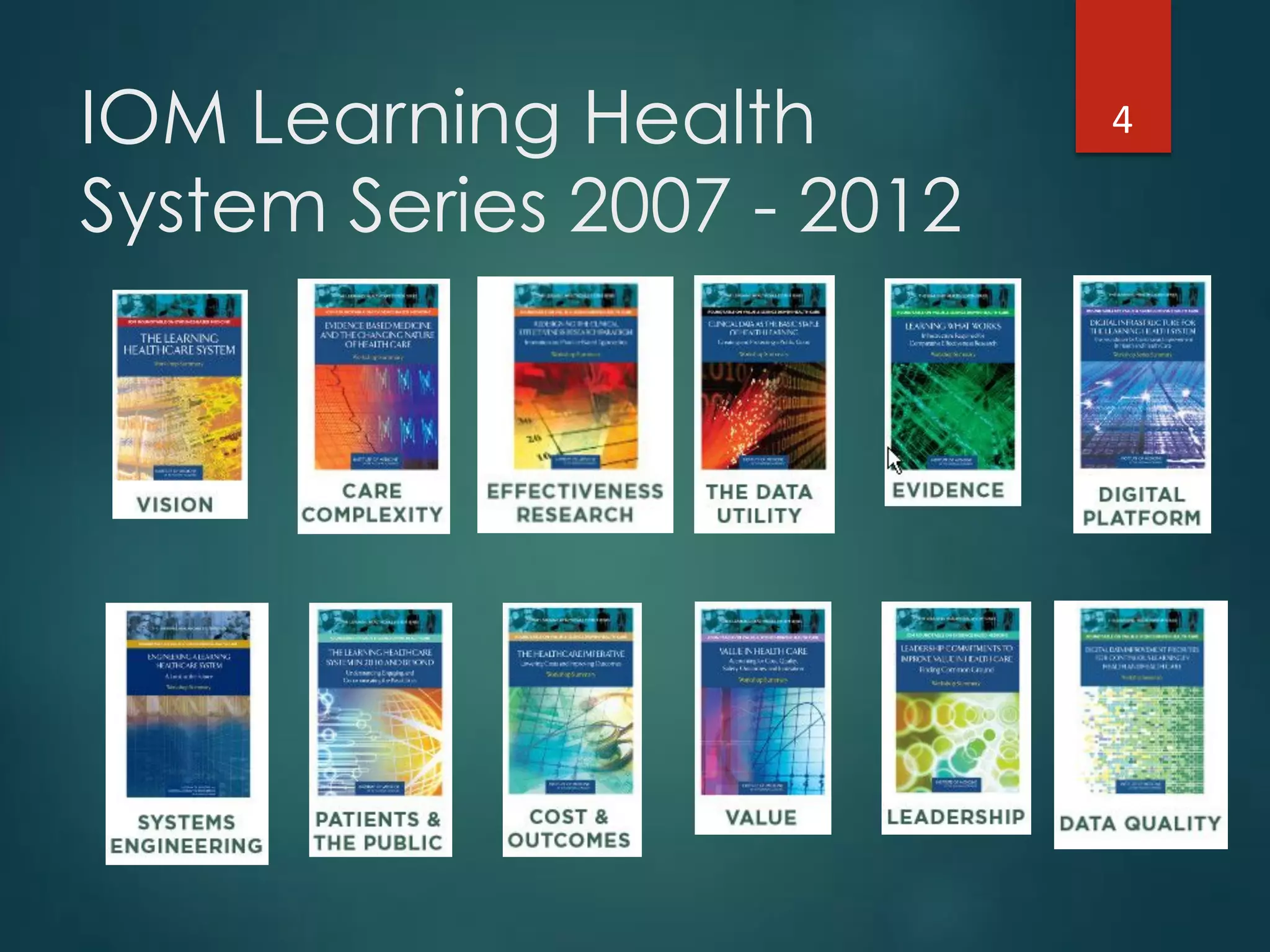
IOM Learning Health
System Series 2007 - 2012
4"
5"
5
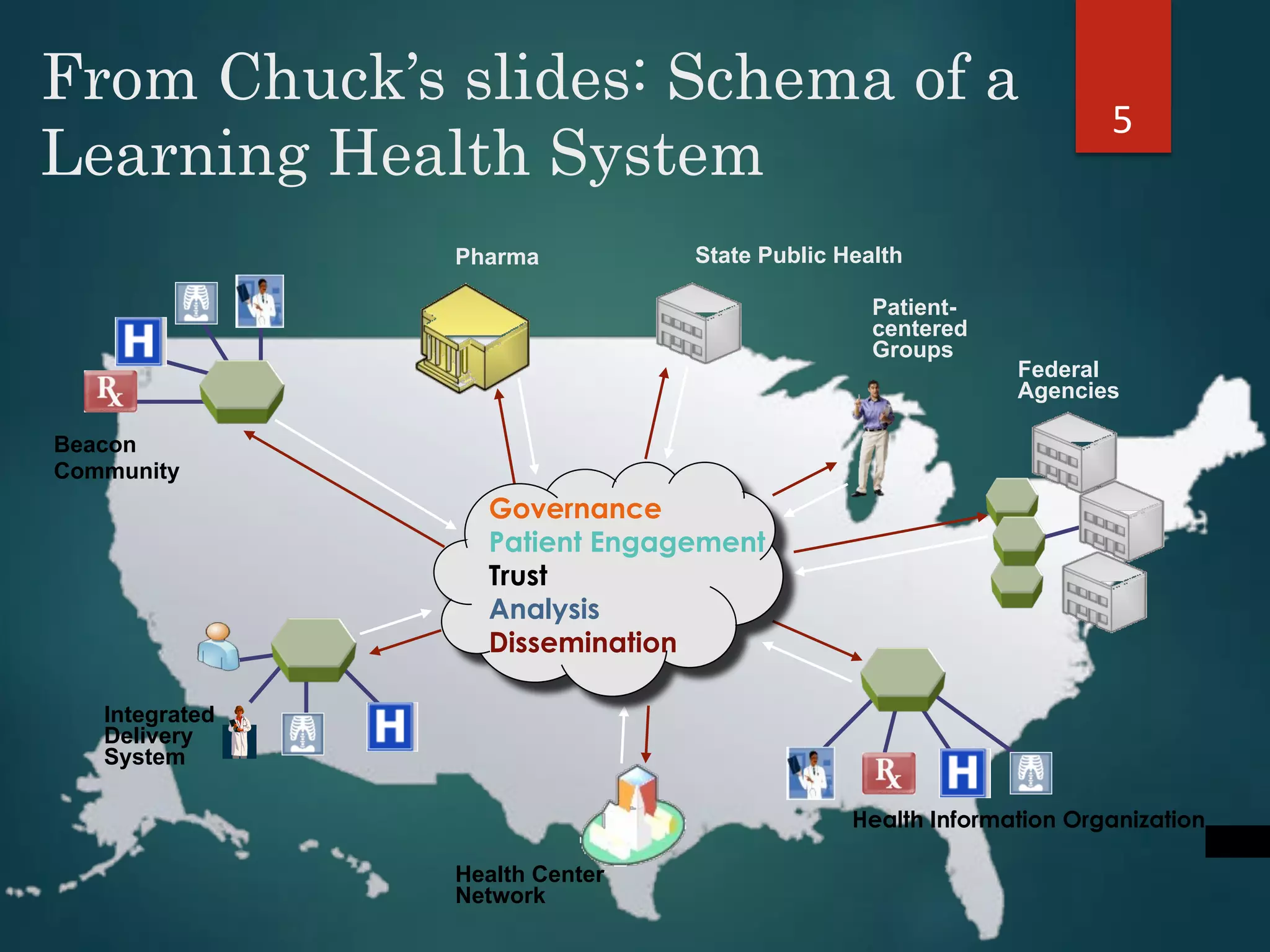
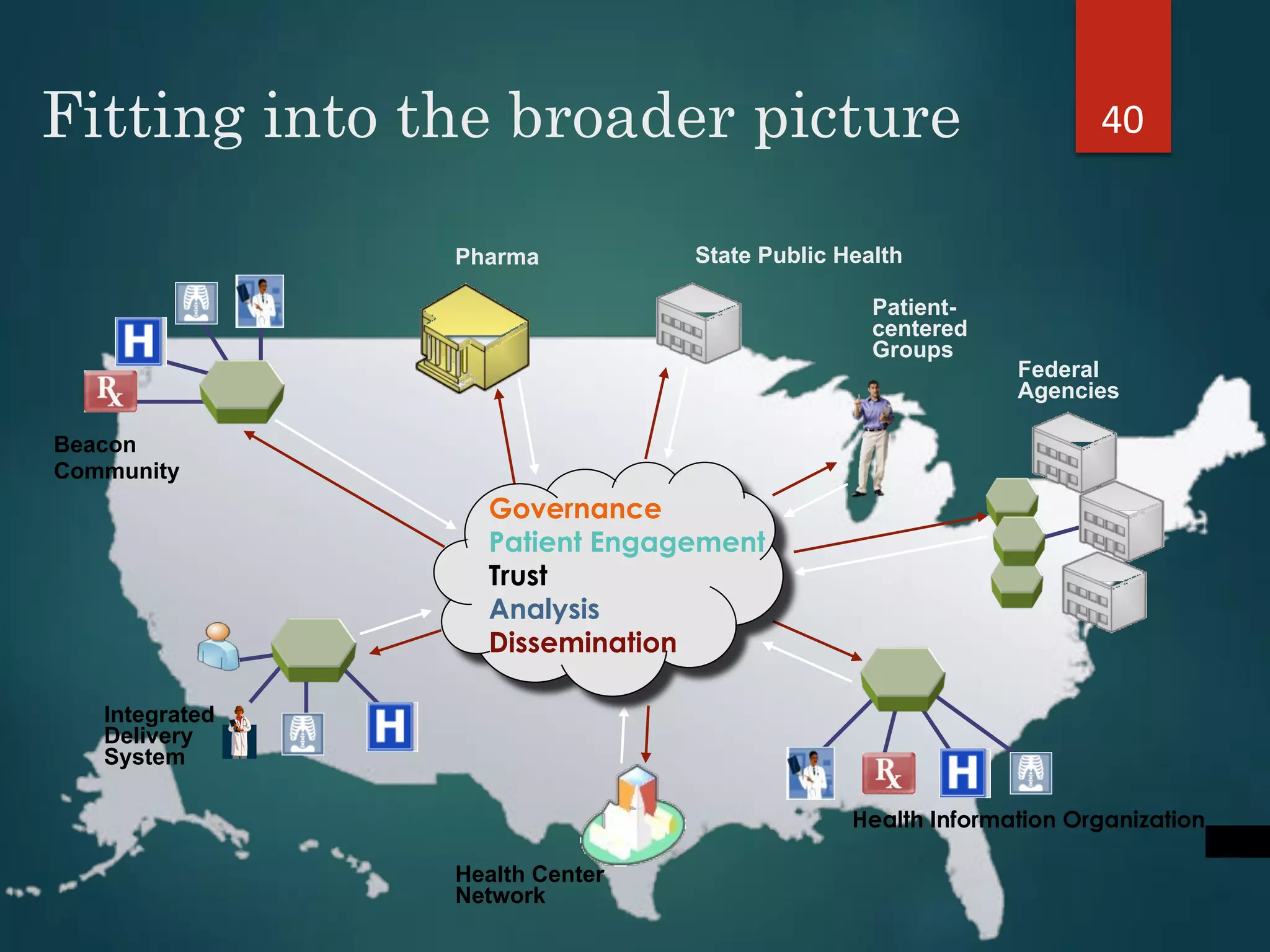
From Chuck’s slides: Schema of a
Learning Health System
Pharma
Beacon
Community
Integrated
Delivery
System
Patient-
centered
Groups
Health Information Organization
Health Center
Network
Federal
Agencies
State Public Health
Governance
Patient Engagement
Trust
Analysis
Dissemination
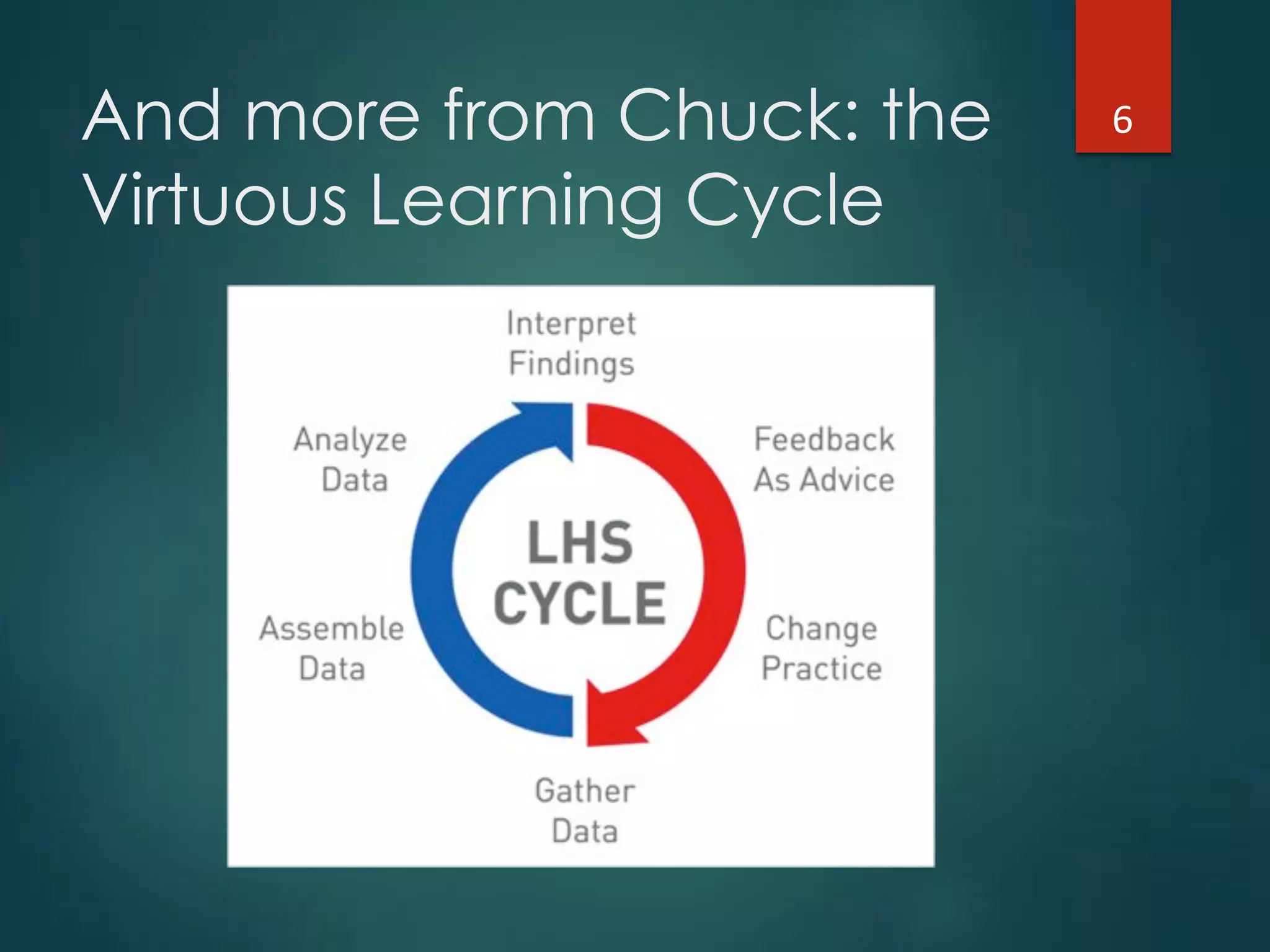
And more from Chuck: the
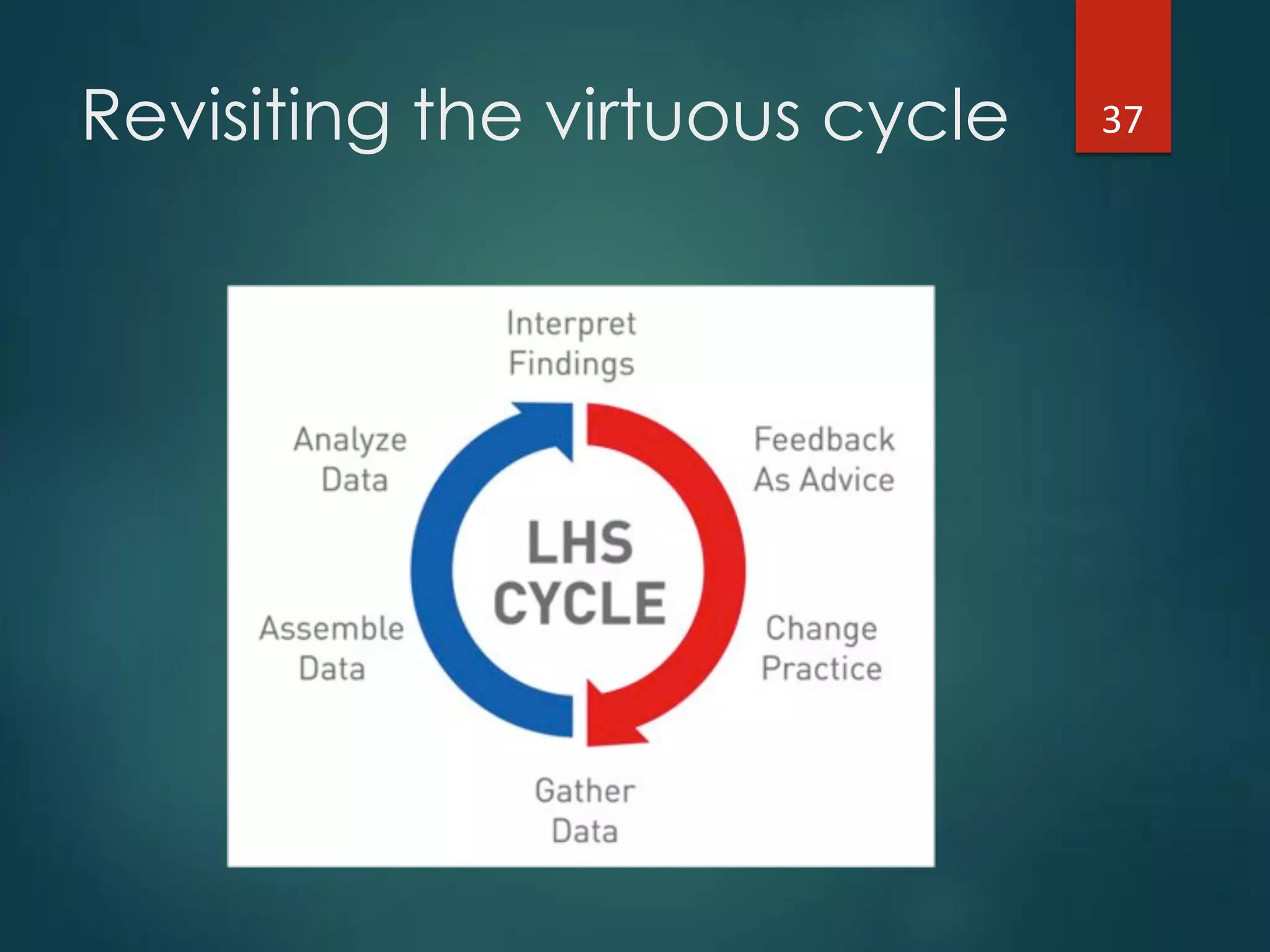
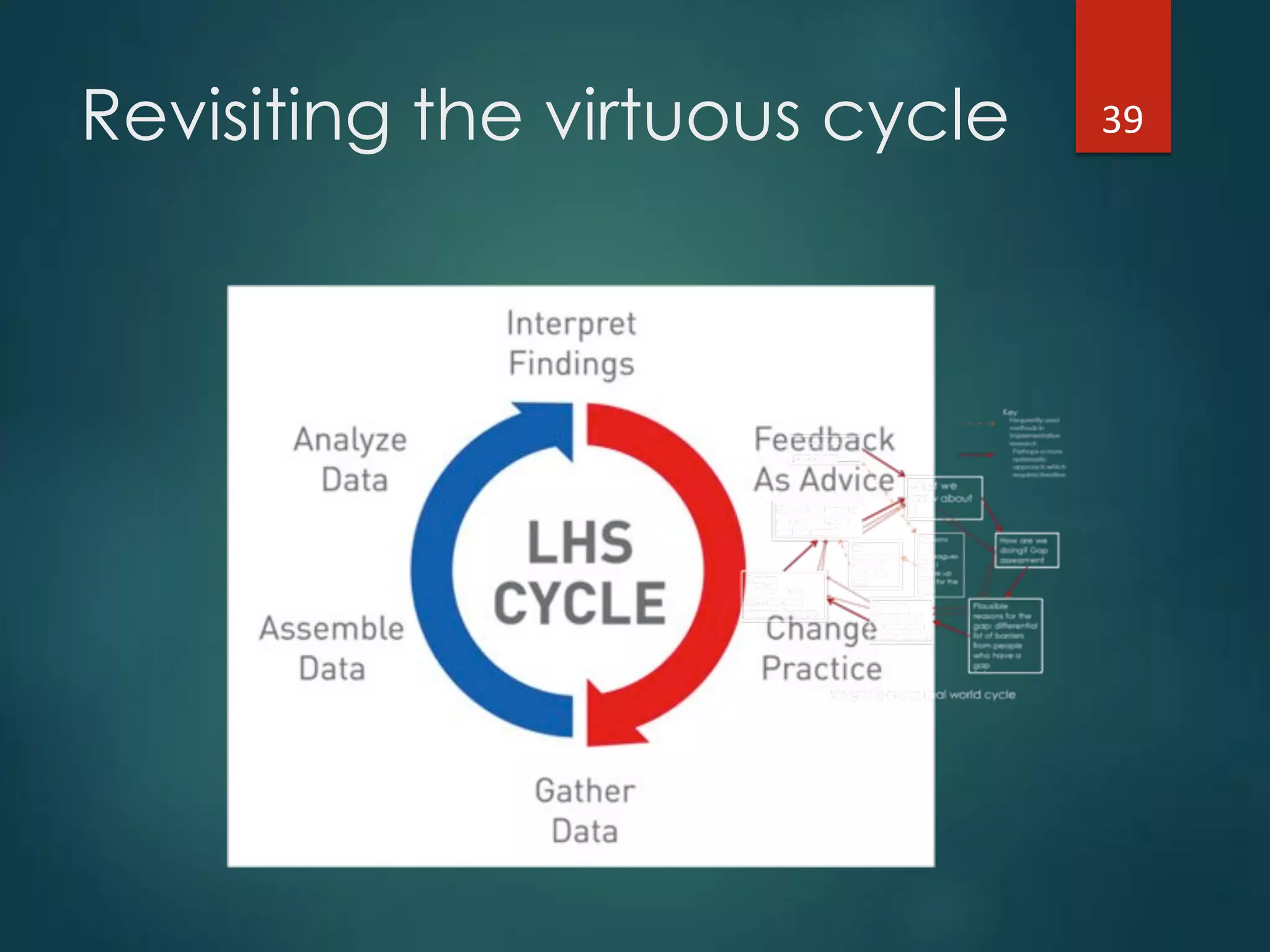
Virtuous Learning Cycle
6"
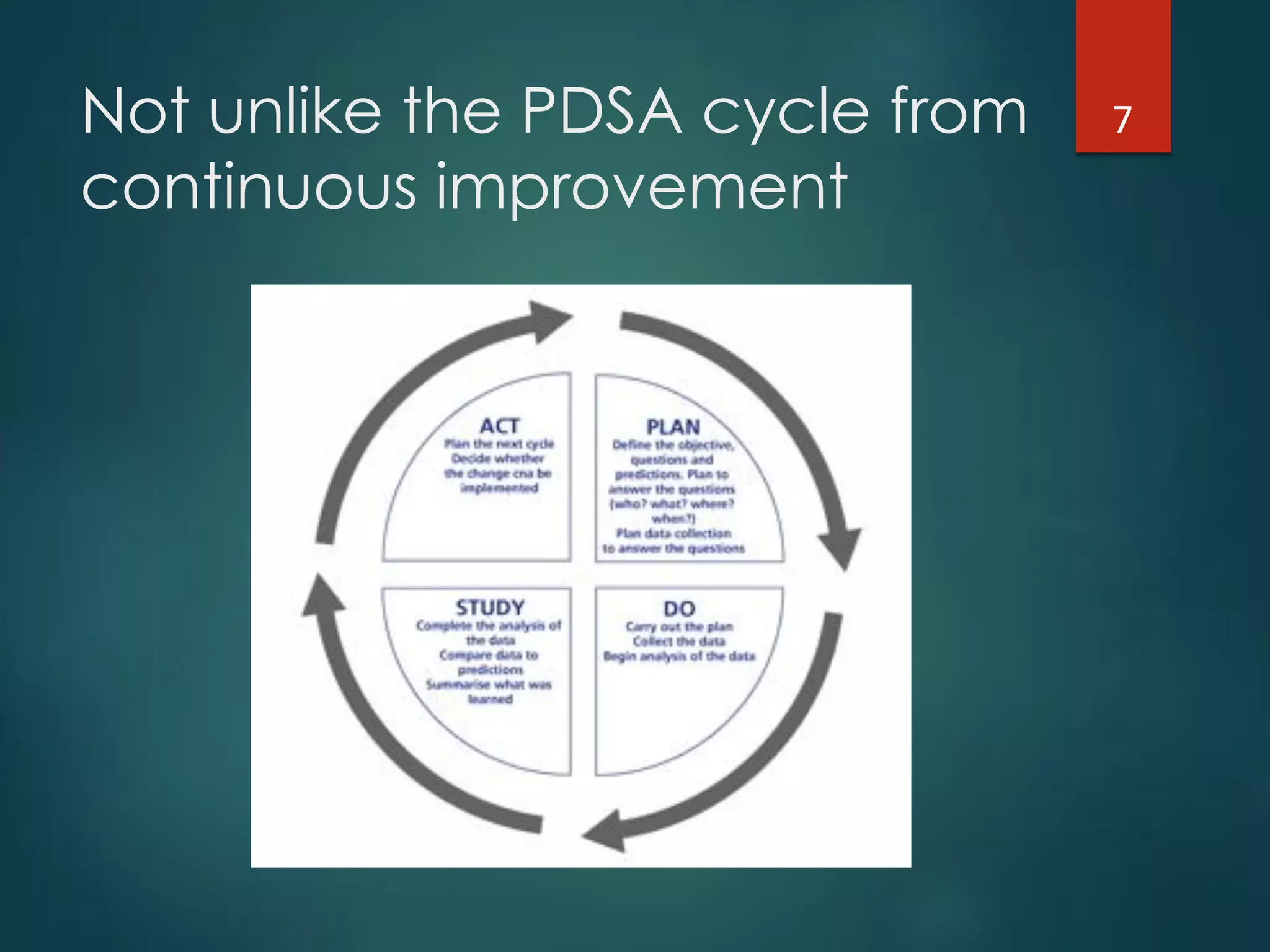
Not unlike the PDSA cycle from
continuous improvement
7"
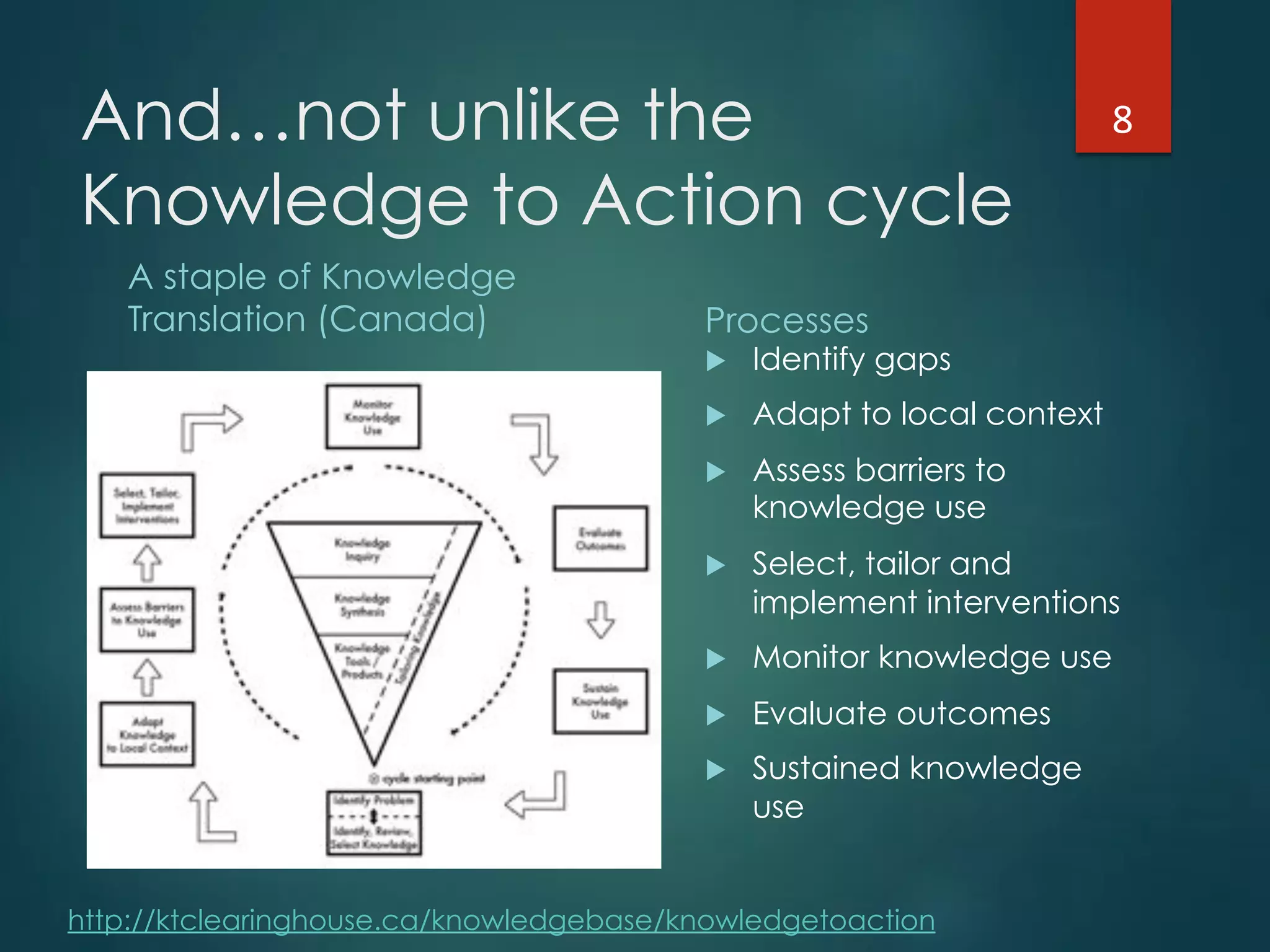
And…not unlike the
Knowledge to Action cycle
A staple of Knowledge
Translation (Canada) Processes
!  Identify gaps
!  Adapt to local context
!  Assess barriers to
knowledge use
!  Select, tailor and
implement interventions
!  Monitor knowledge use
!  Evaluate outcomes
!  Sustained knowledge
use
http://ktclearinghouse.ca/knowledgebase/knowledgetoaction
8"
Defining implementation
science (IS)
!  As defined by the Annual NIH Conference on
Implementation and Dissemination, implementation is the
use of strategies to adopt and integrate evidence-based
health interventions and change practice patterns within
specific settings.  Research on implementation addresses
the level to which health interventions can fit within real-
world public health and clinical service systems.
!  Implementation science is the study of methods to
promote the integration of research findings and evidence
into healthcare policy and practice.   It seeks to
understand the behavior of healthcare professionals and
other stakeholders as a key variable in the sustainable
uptake, adoption, and implementation of evidence-based
interventions.
!  http://www.fic.nih.gov/News/Events/implementation-
science/Pages/faqs.aspx
9"
Implementation Science–
the journal
www.implementationscience.com
10"
Current state of the
science
!  Most recent systematic review identified 61
different models or frameworks for dissemination
and implementation
!  Tabak RG, Khoong EC, Chambers DA, Brownson RC. Bridging research
and practice: models for dissemination and implementation research.
Am J Prev Med. 2012 Sep;43(3):337-50. doi: 10.1016/j.amepre.
2012.05.024. Review. PubMed PMID: 22898128; PubMed Central PMCID:
PMC3592983
!  Previous review (2006) found 41
!  Several efforts to consolidate frameworks
!  Damschroder LJ, Aron DC, Keith RE, Kirsh SR, Alexander JA, Lowery
JC. Fostering implementation of health services research findings
into practice: a consolidated framework for advancing
implementation science. Implement Sci. 2009 Aug 7;4:50. doi:
10.1186/1748-5908-4-50. PubMed PMID: 19664226; PubMed Central
PMCID: PMC2736161
11"
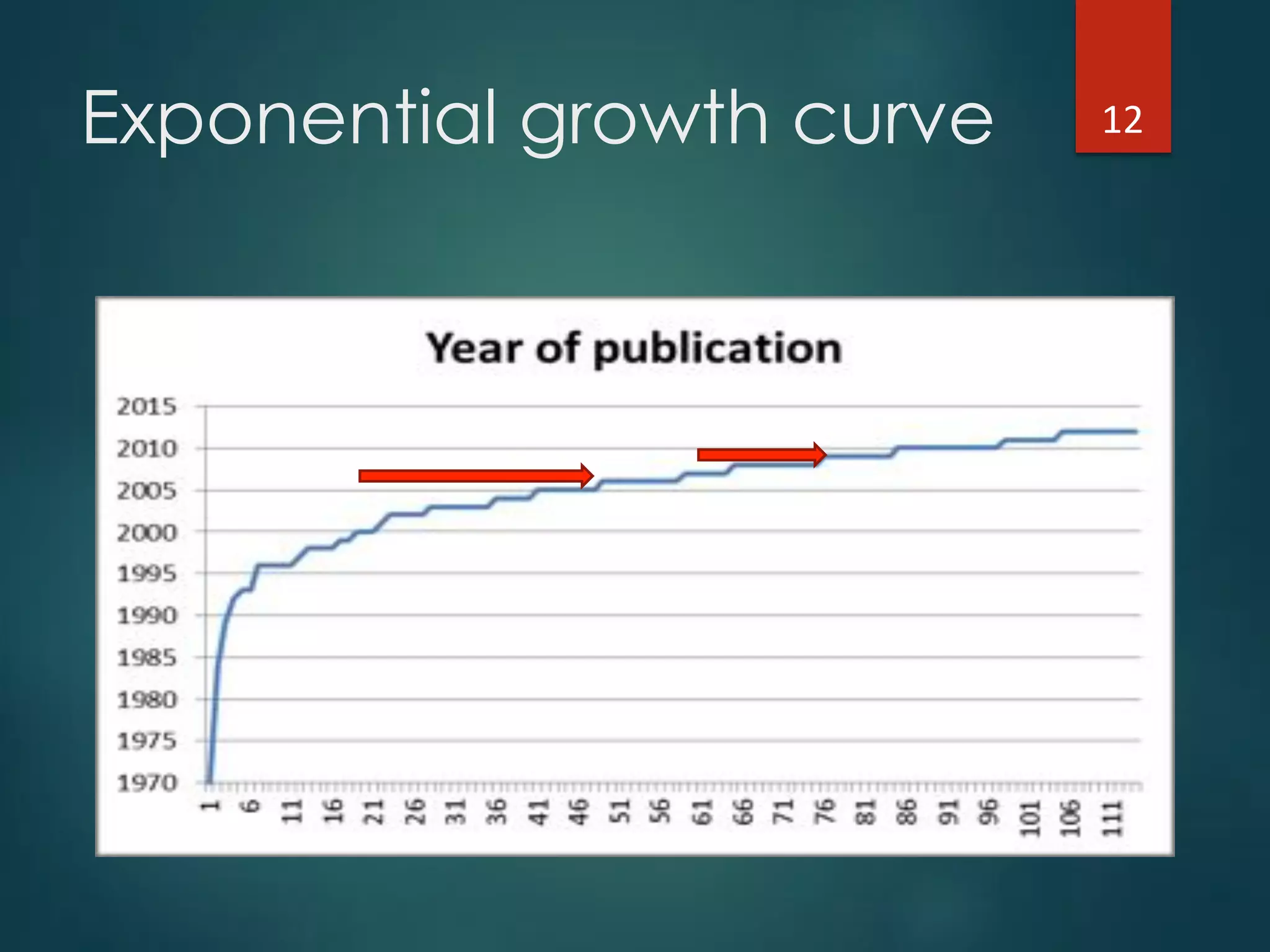
Exponential growth curve 12"
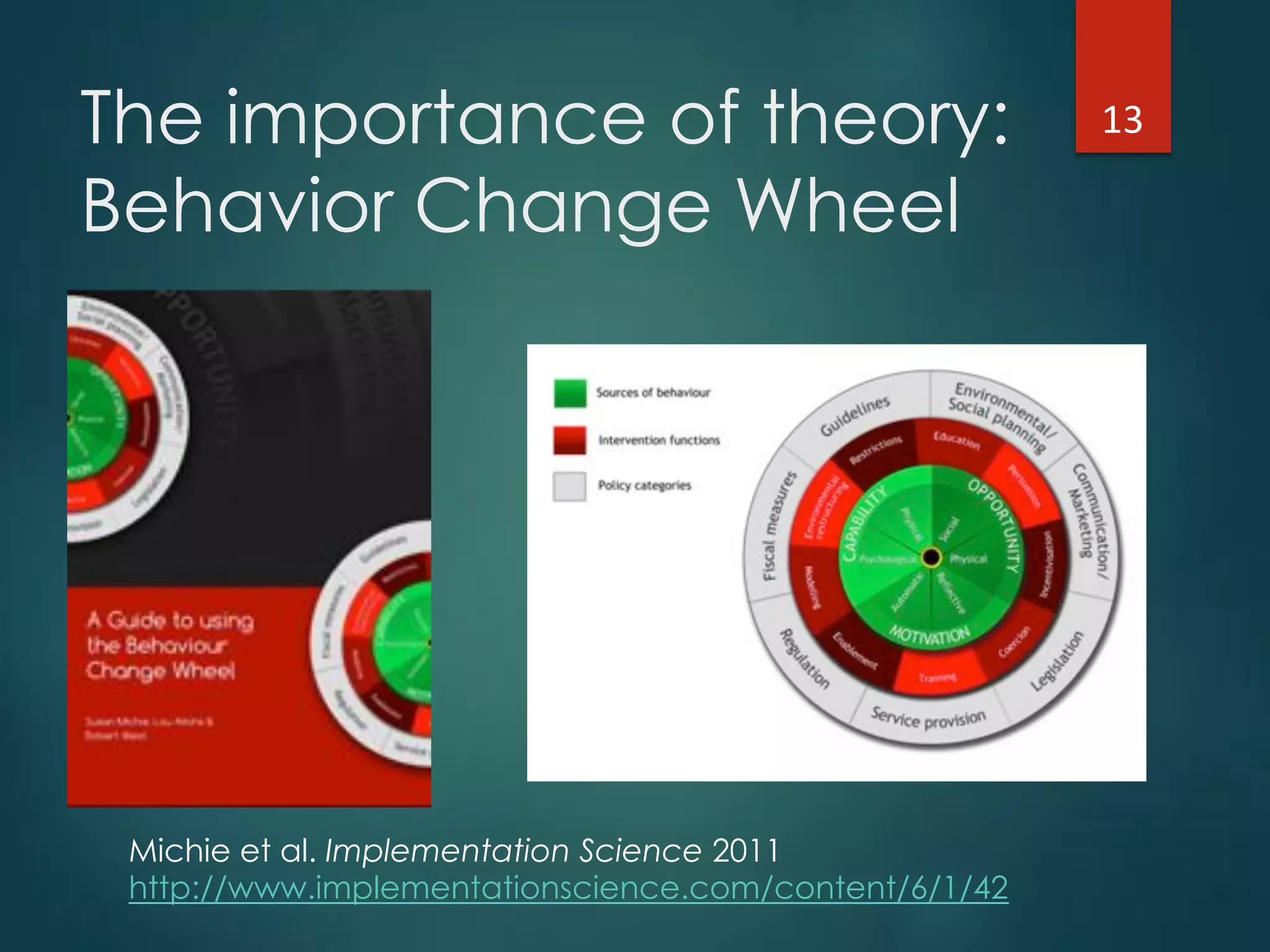
The importance of theory:
Behavior Change Wheel
Michie et al. Implementation Science 2011
http://www.implementationscience.com/content/6/1/42
13"
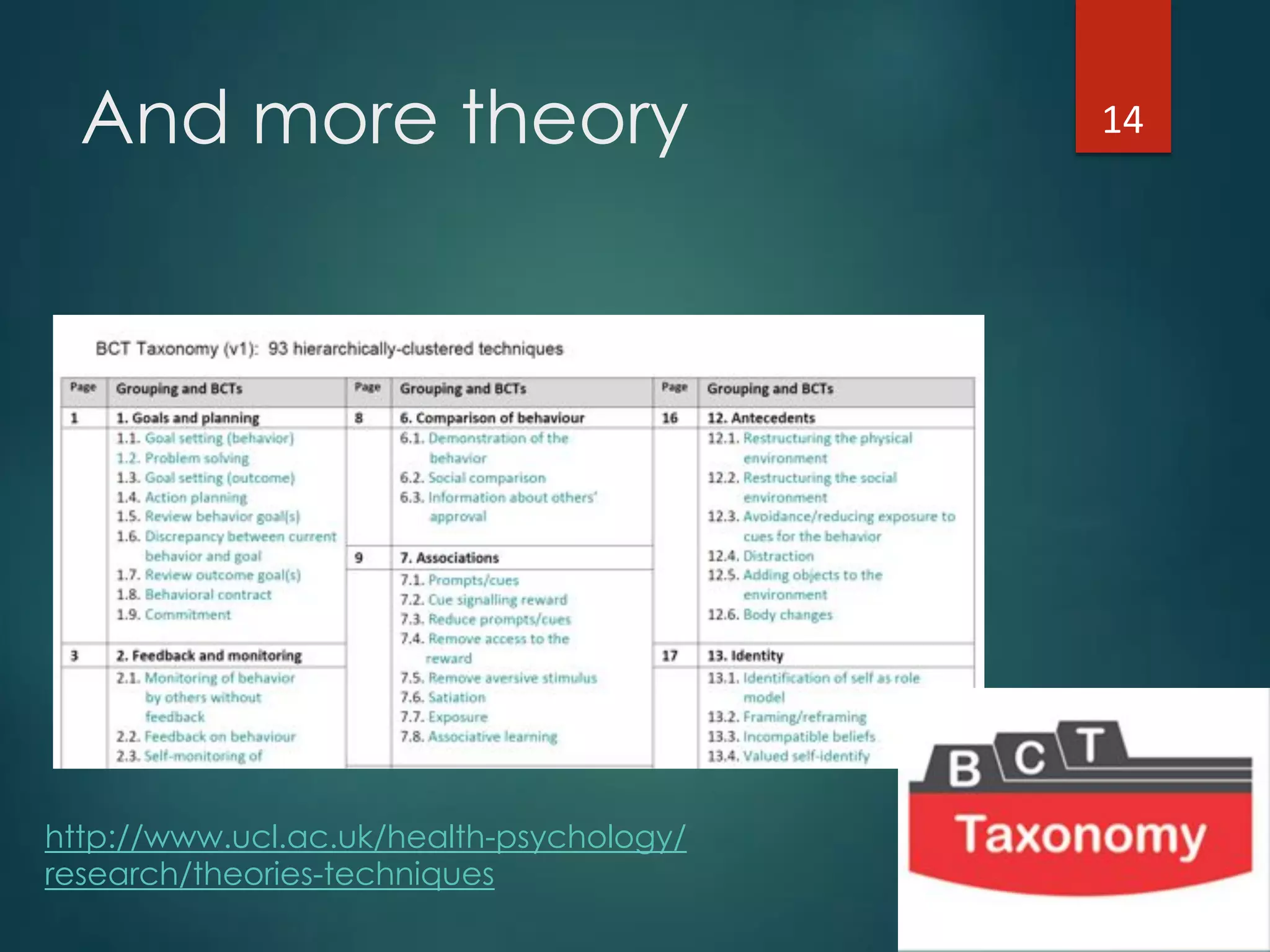
And more theory
http://www.ucl.ac.uk/health-psychology/
research/theories-techniques
14"
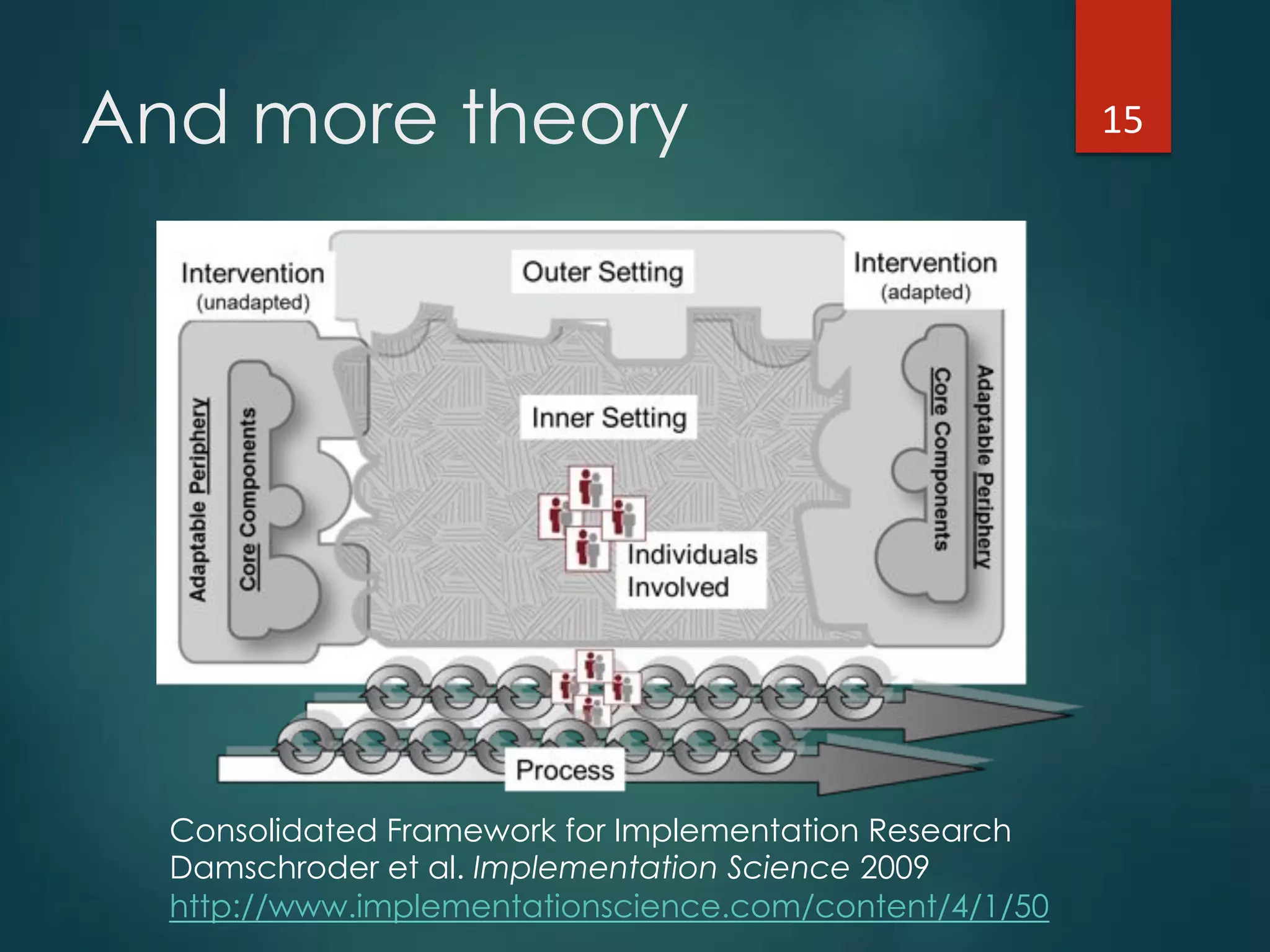
And more theory
Consolidated Framework for Implementation Research
Damschroder et al. Implementation Science 2009
http://www.implementationscience.com/content/4/1/50
15"
And more
http://cfirguide.org/constructs.html
16"
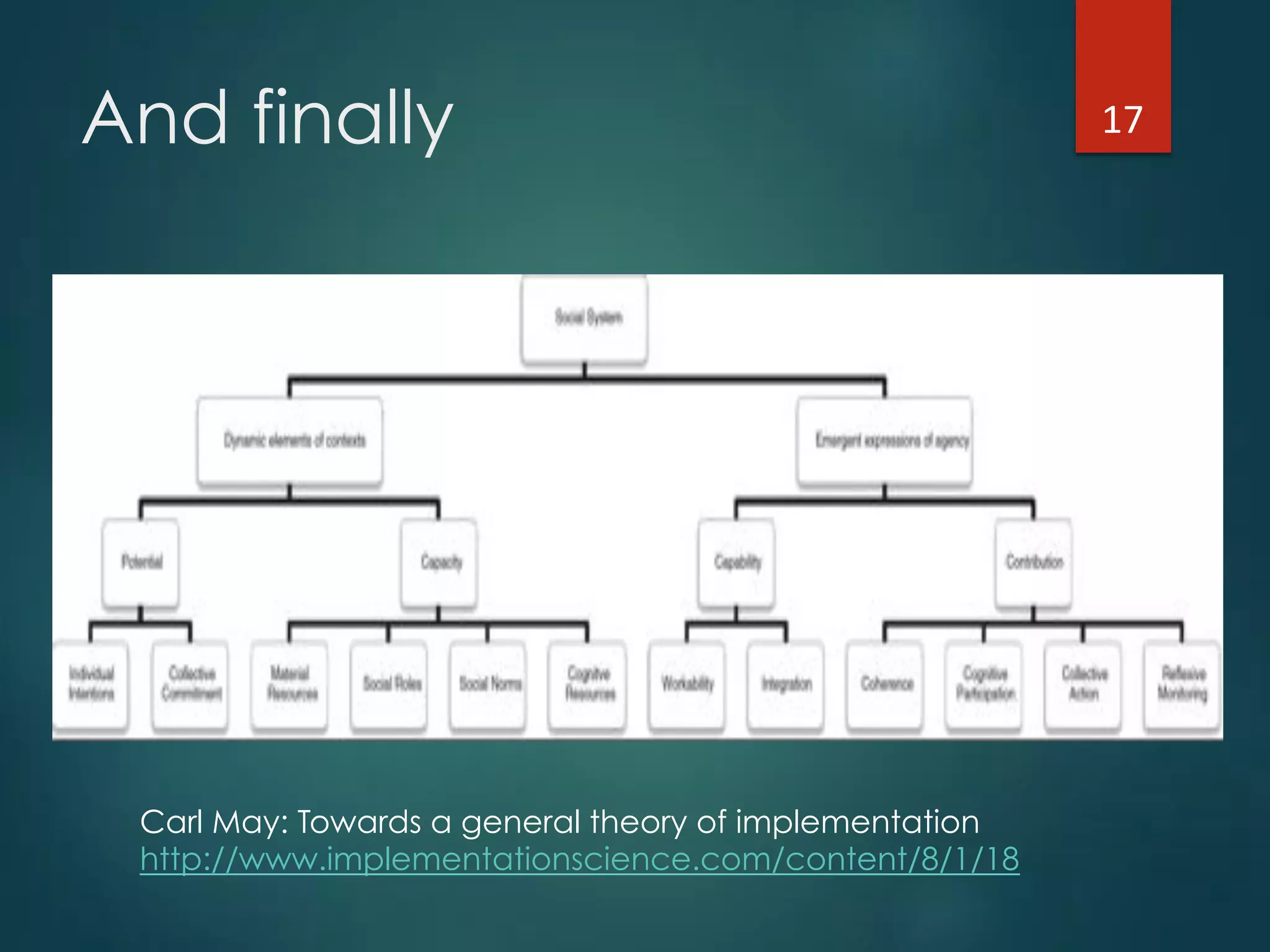
And finally
Carl May: Towards a general theory of implementation
http://www.implementationscience.com/content/8/1/18
17"
1995
2004
18"
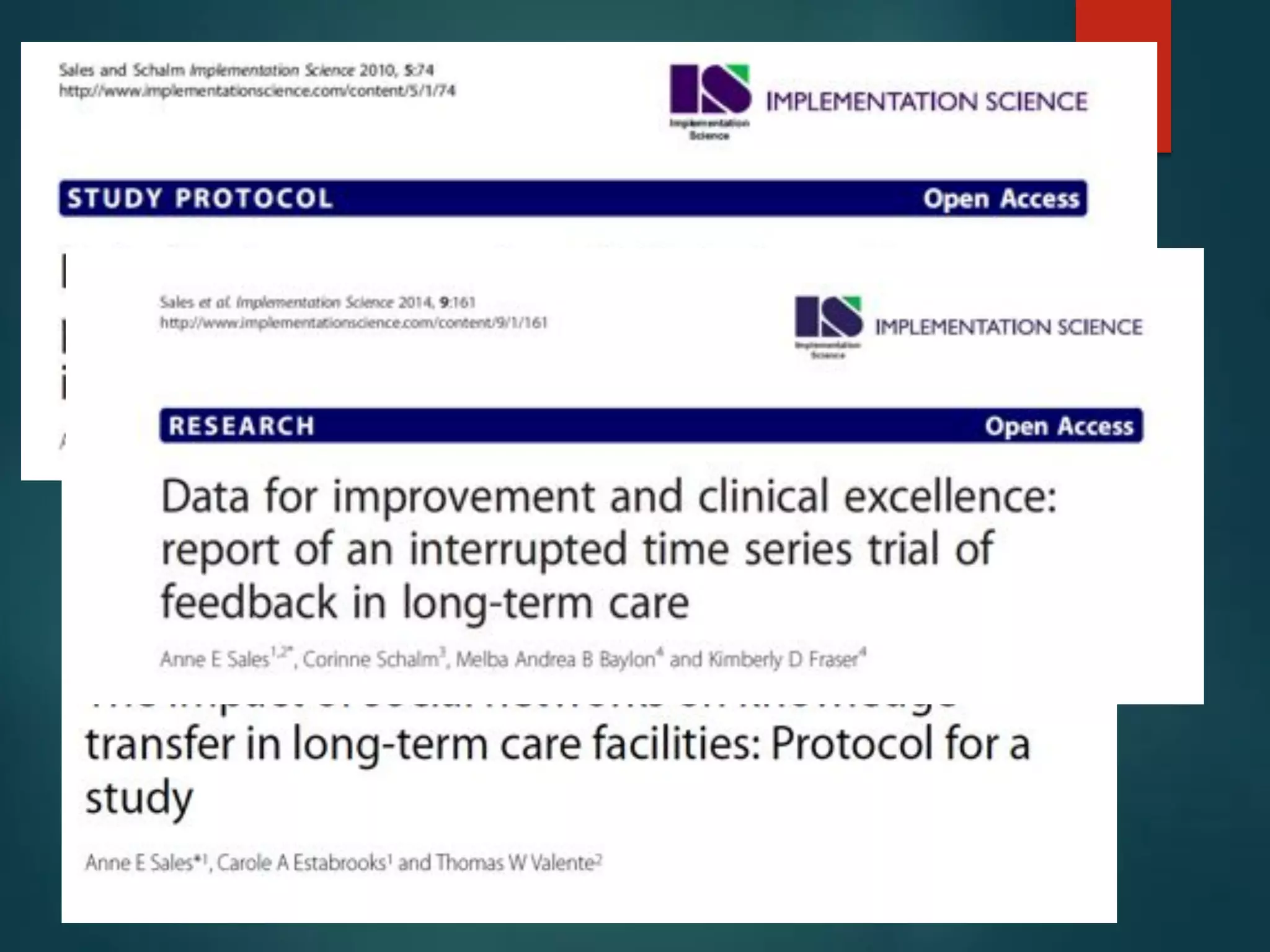
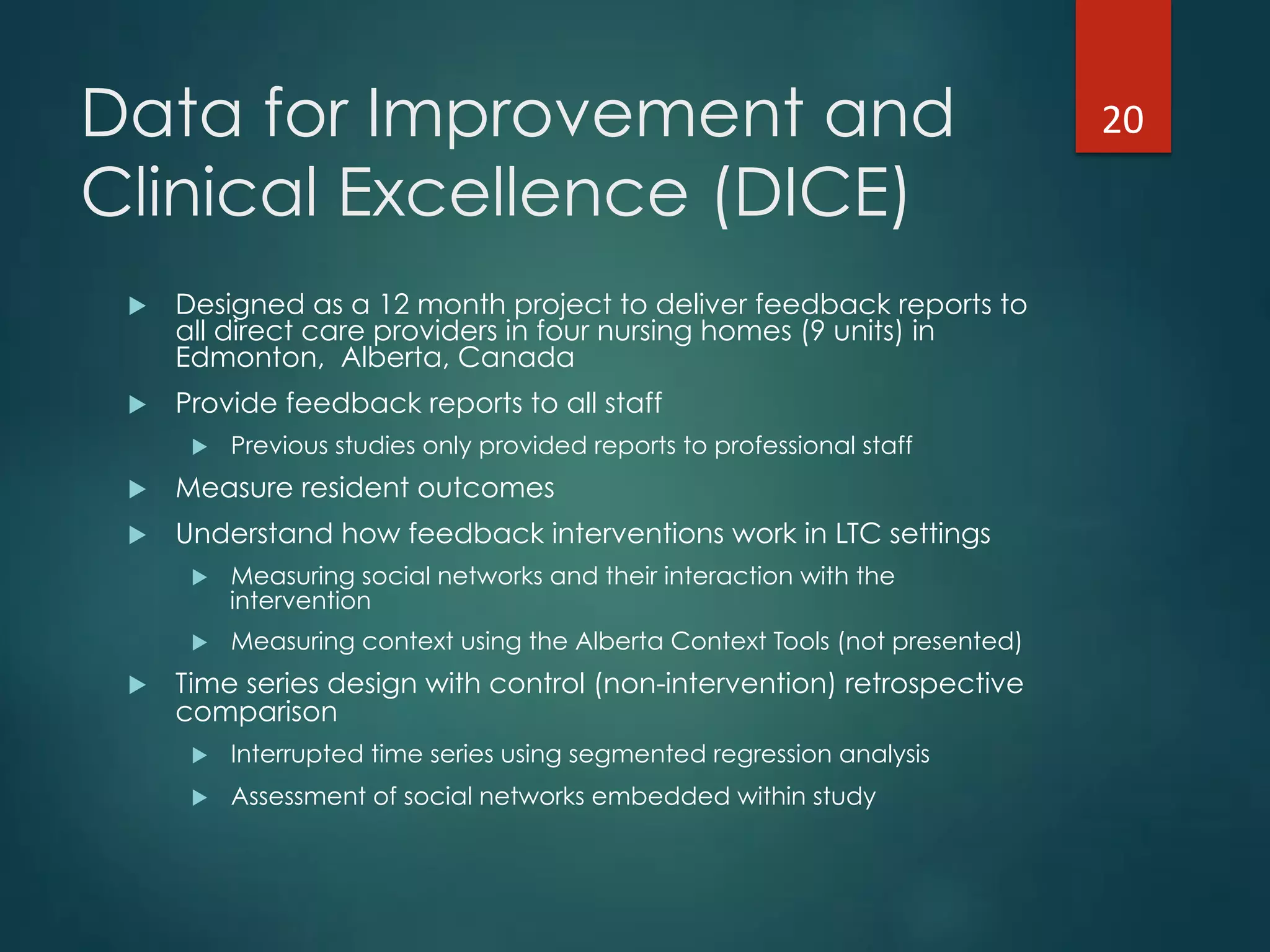
Data for Improvement and
Clinical Excellence (DICE)
!  Designed as a 12 month project to deliver feedback reports to
all direct care providers in four nursing homes (9 units) in
Edmonton, Alberta, Canada
!  Provide feedback reports to all staff
!  Previous studies only provided reports to professional staff
!  Measure resident outcomes
!  Understand how feedback interventions work in LTC settings
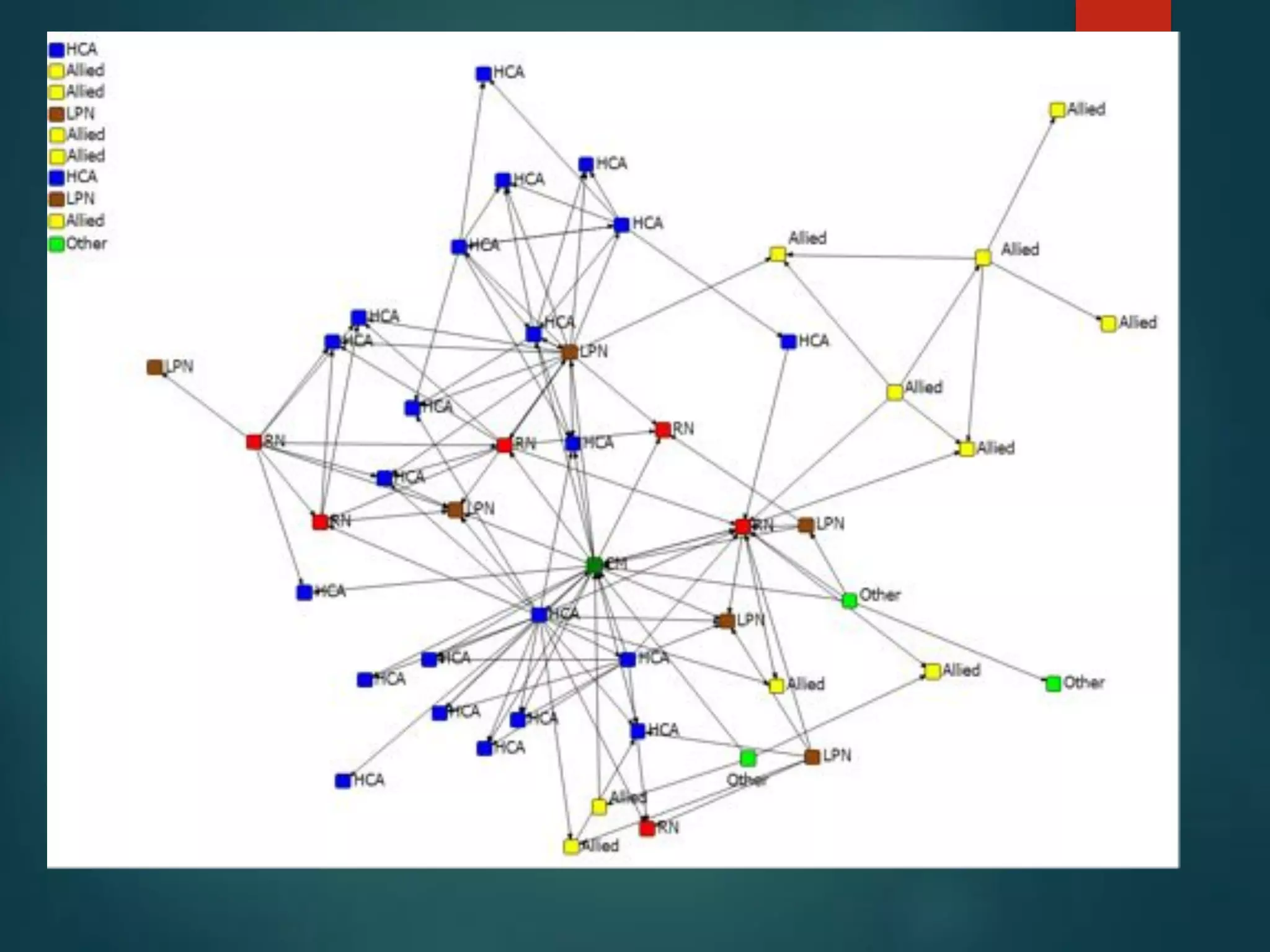
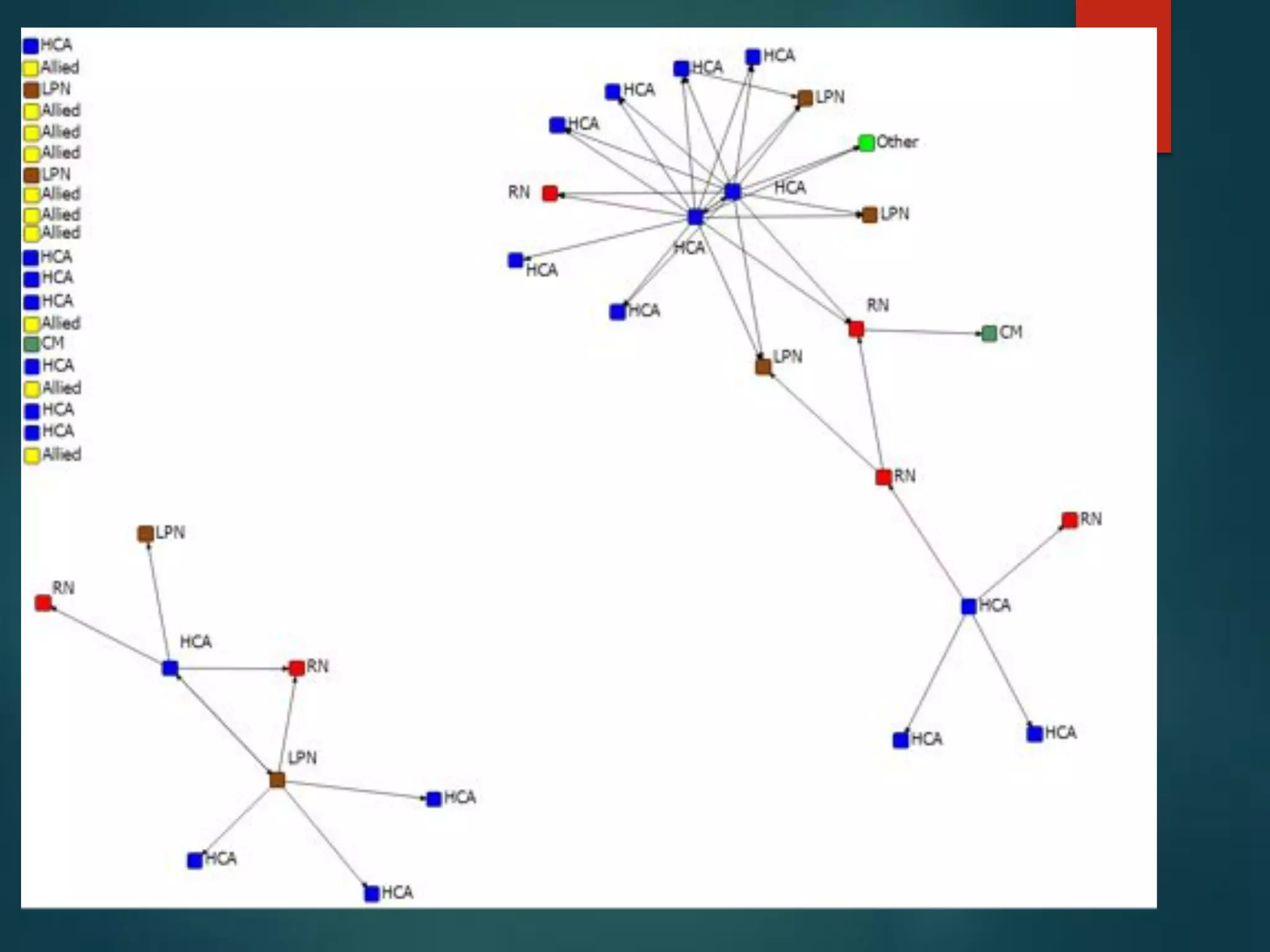
!  Measuring social networks and their interaction with the
intervention
!  Measuring context using the Alberta Context Tools (not presented)
!  Time series design with control (non-intervention) retrospective
comparison
!  Interrupted time series using segmented regression analysis
!  Assessment of social networks embedded within study
20"
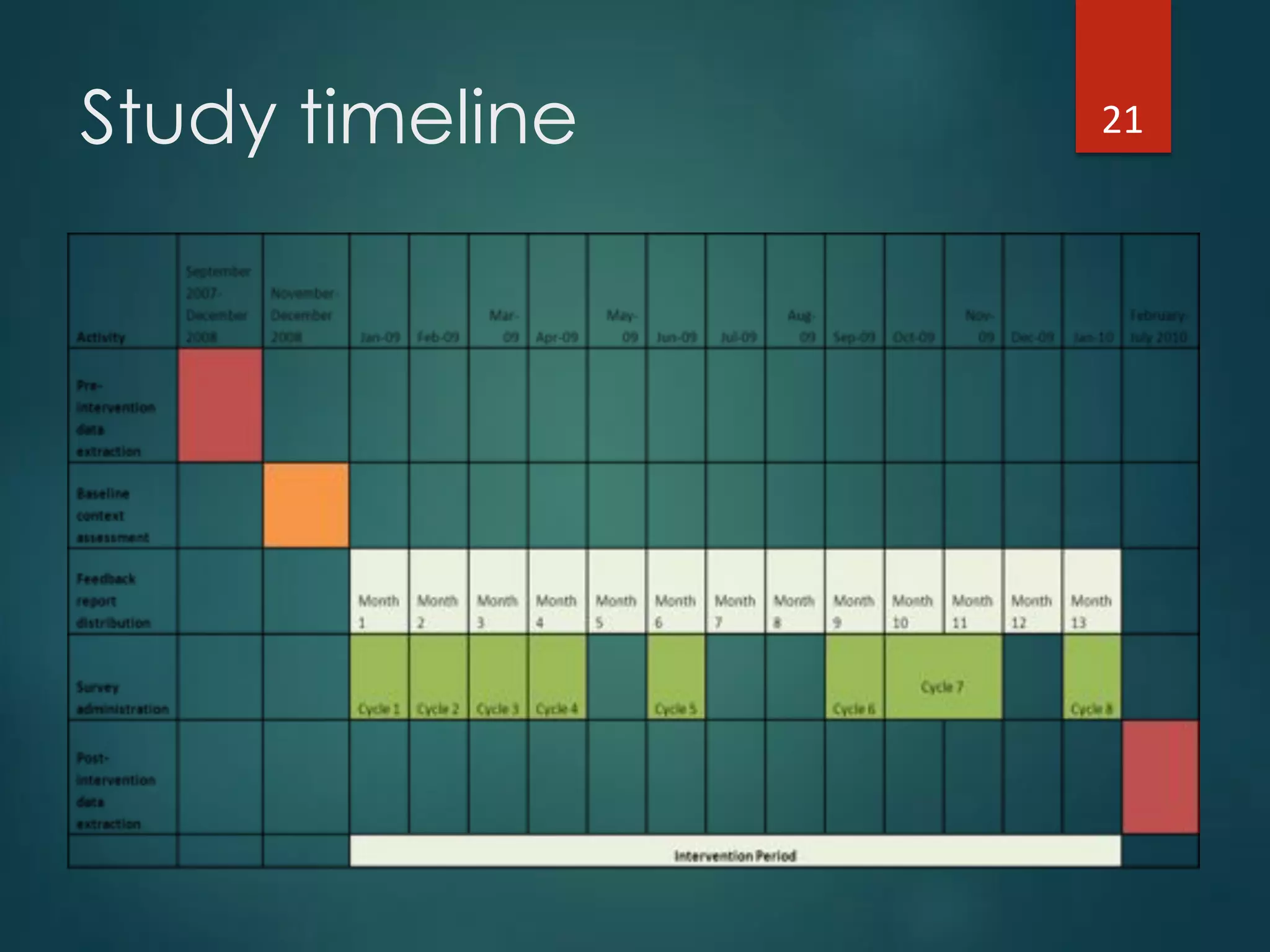
Study timeline 21"
Monthly feedback reports
!  13 month feedback intervention
!  Delivered brief feedback report monthly based on resident
outcomes/process measures to all direct care staff on 9 long term
care units
!  Measured staff response to feedback reports one week after reports
were delivered in most months
!  Used Minimum Data Set-Resident Assessment Instrument (MDS-
RAI) version 2.0 data about residents
!  Pain assessment
!  Depression screening
!  Falls and fall risk
22"
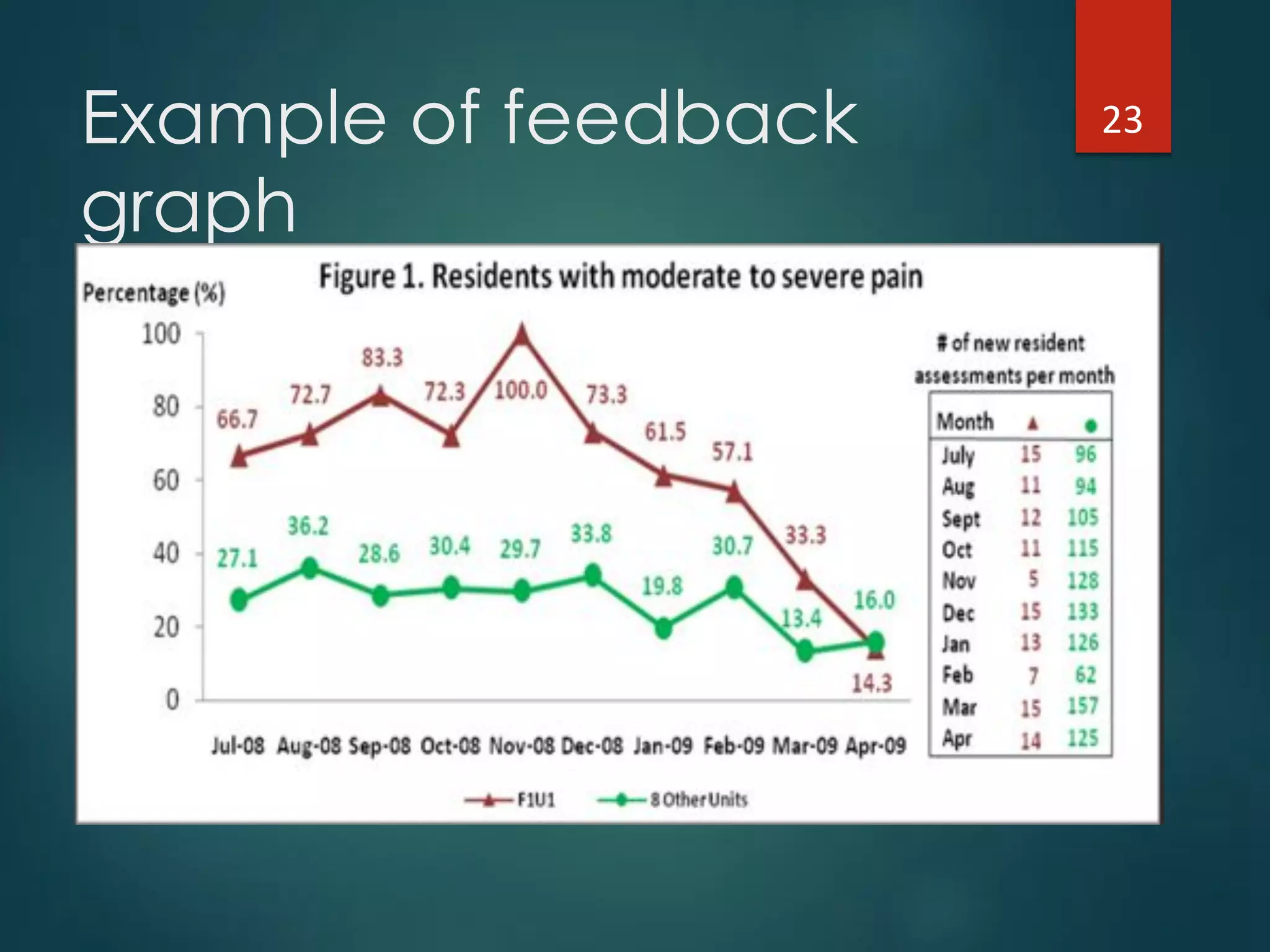
Example of feedback
graph
23"
Post-feedback survey
!  Anonymous
!  Short demographic section
!  Section on perception of feedback report
!  Read
!  Understand
!  Discuss
!  Find useful
!  Take action
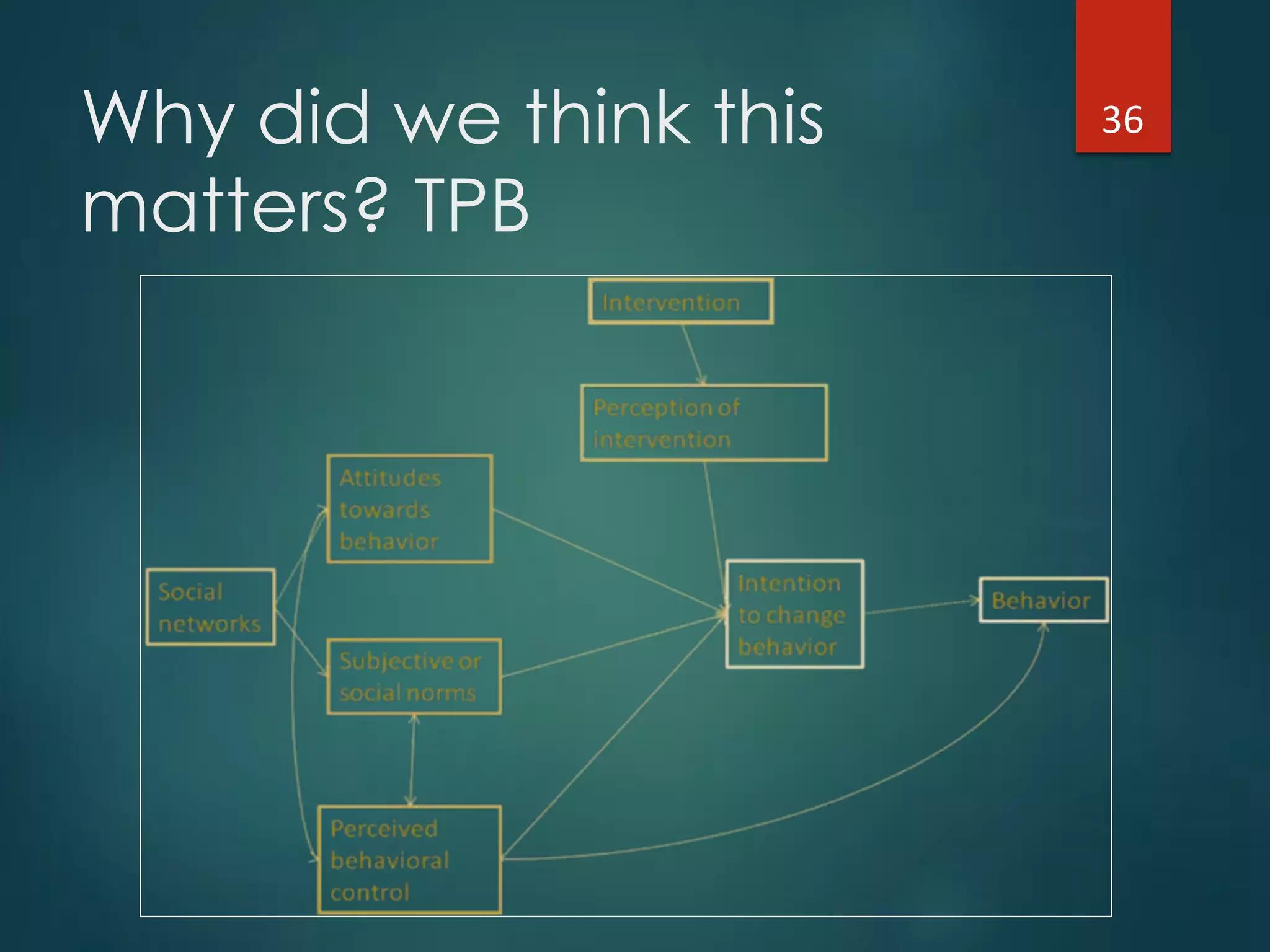
!  Theory of Planned Behavior section
24"
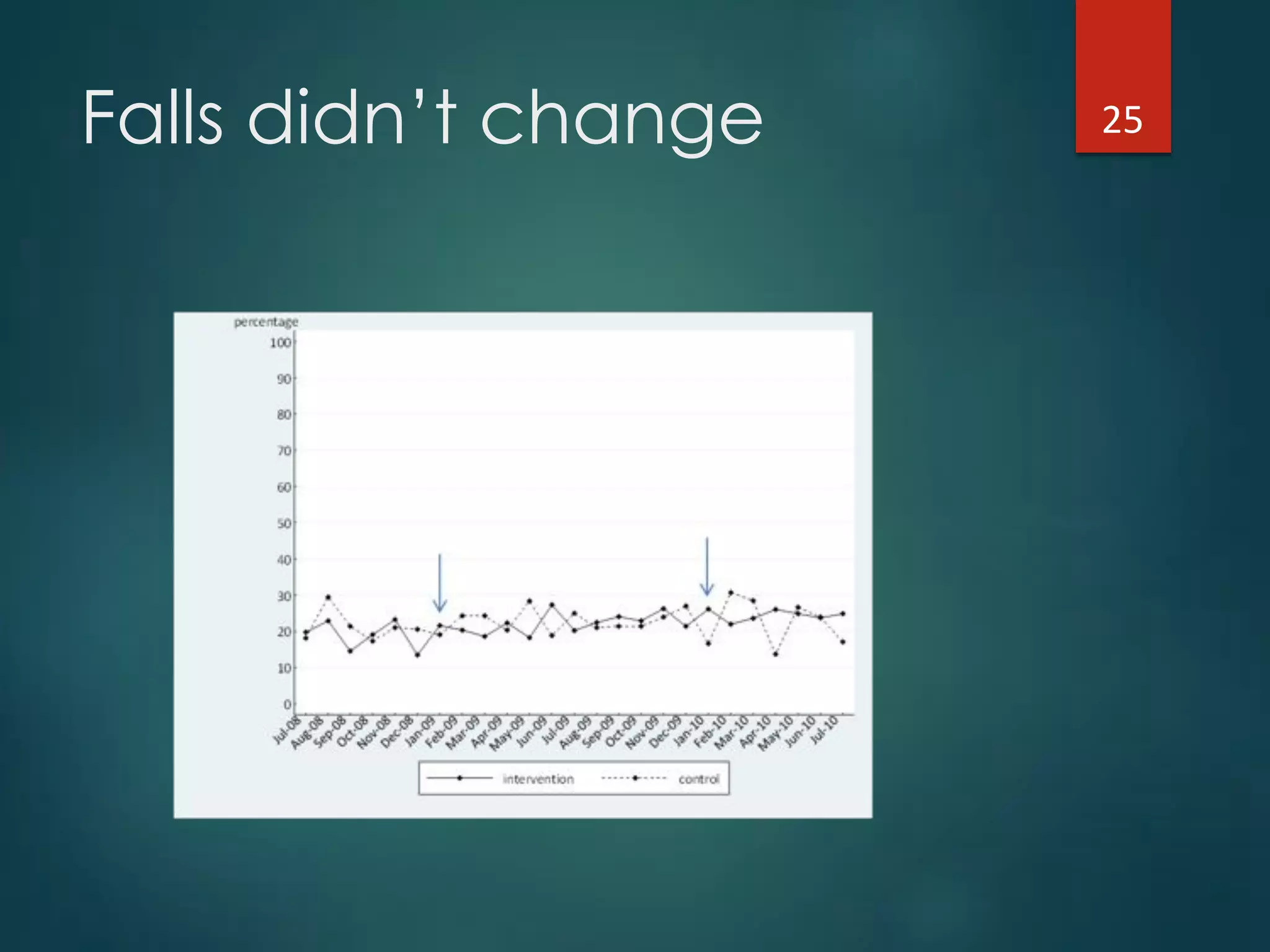
Falls didn’t change 25"
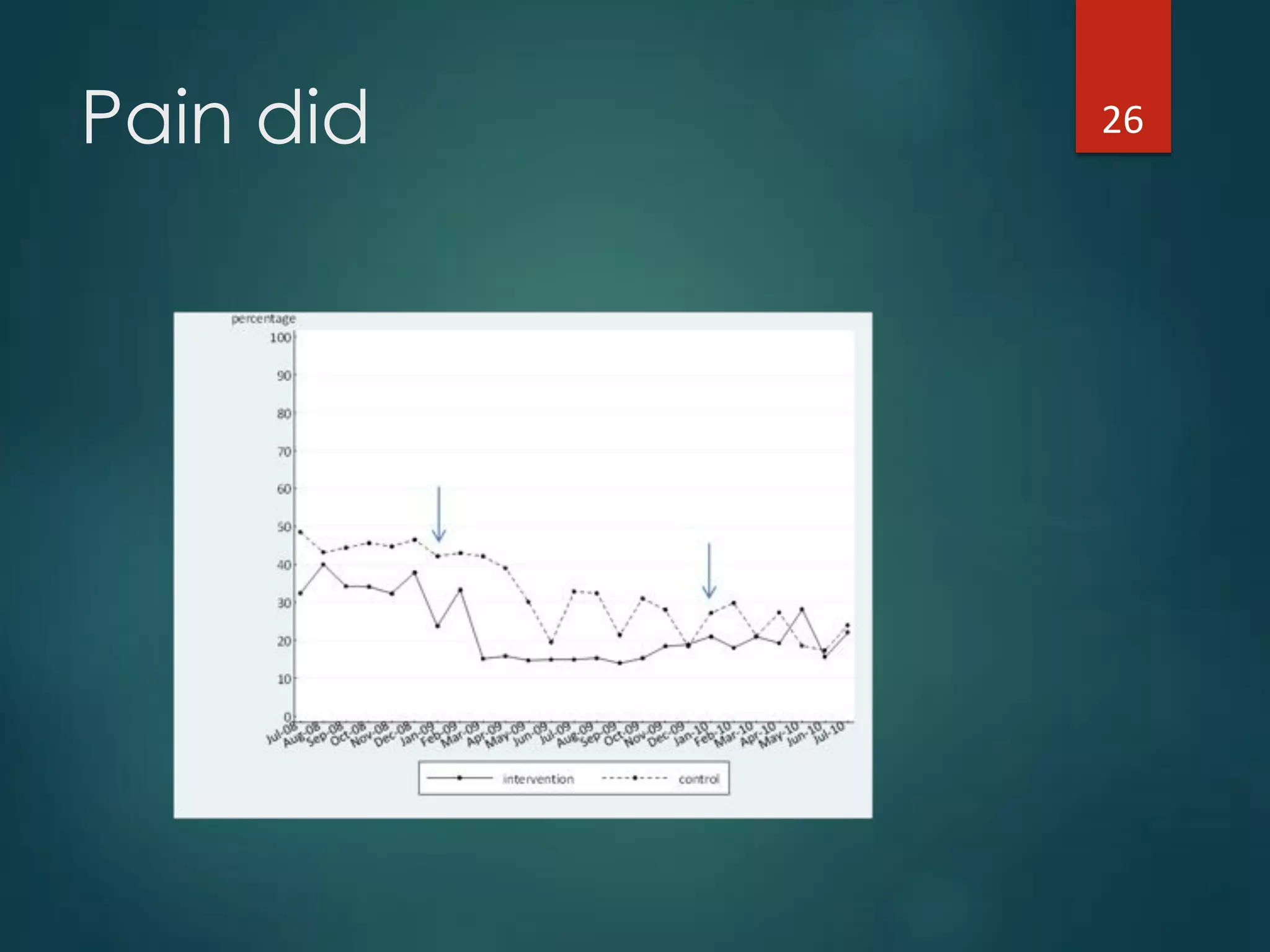
Pain did 26"
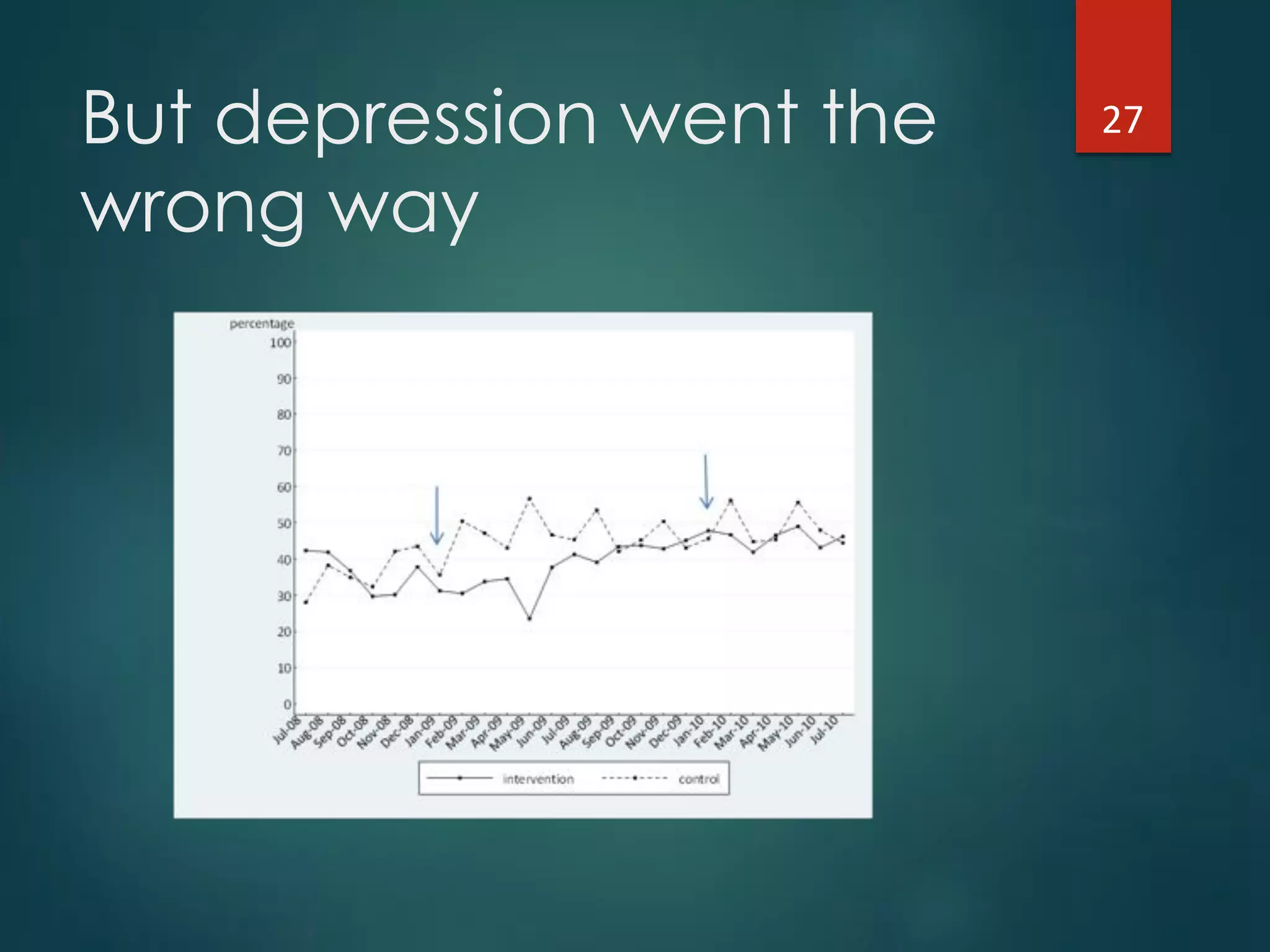
But depression went the
wrong way
27"
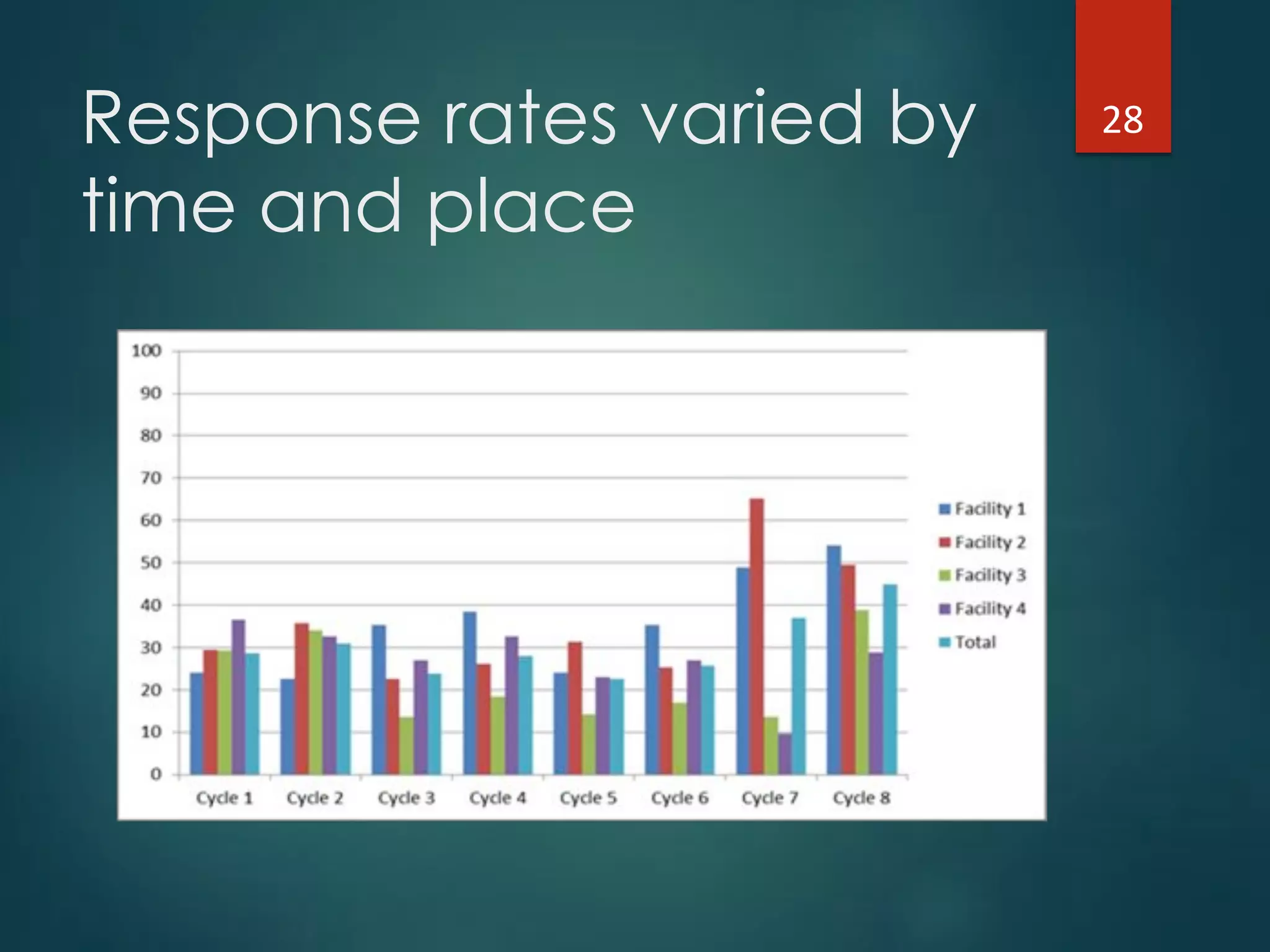
Response rates varied by
time and place
28"
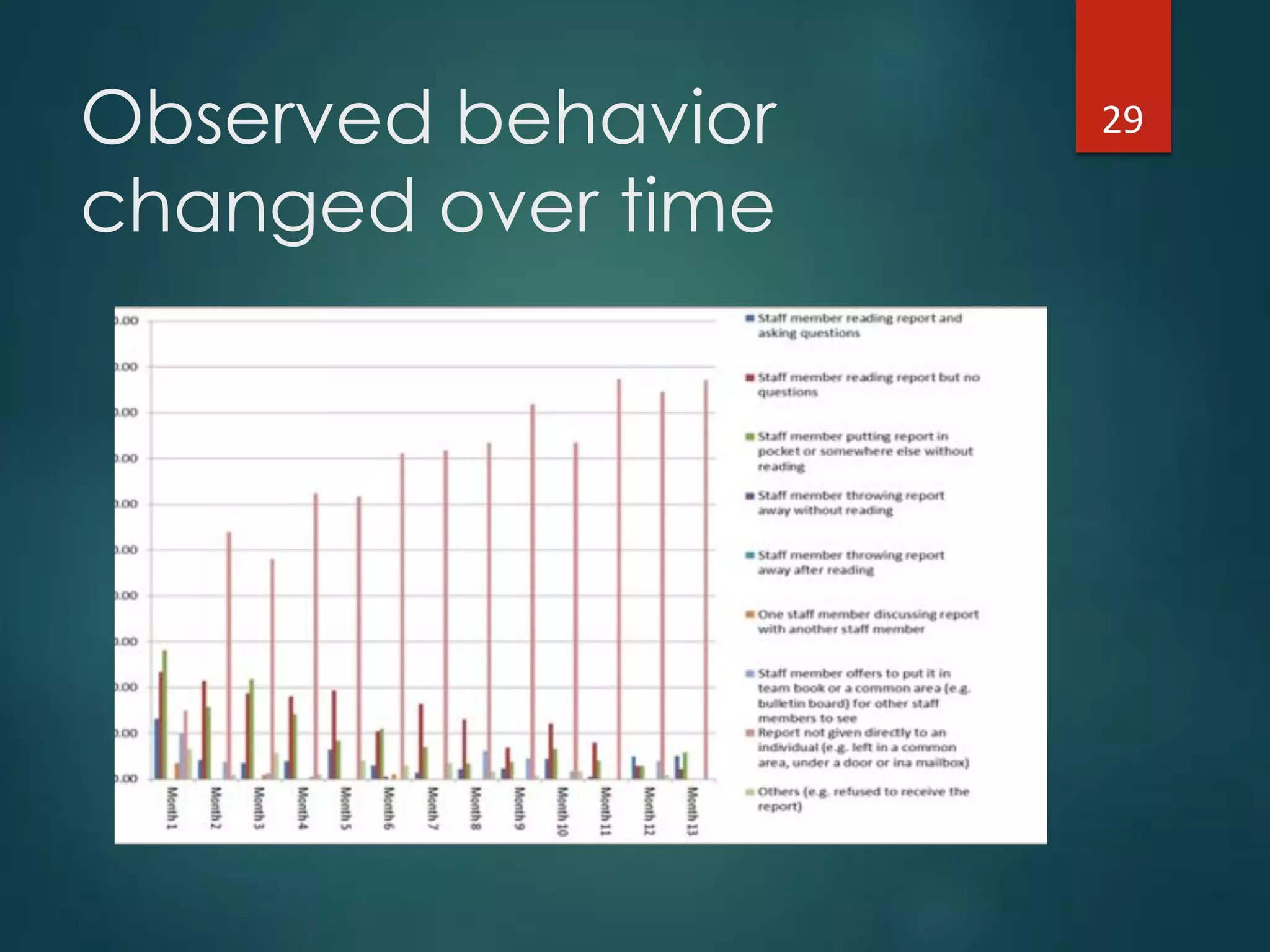
Observed behavior
changed over time
29"
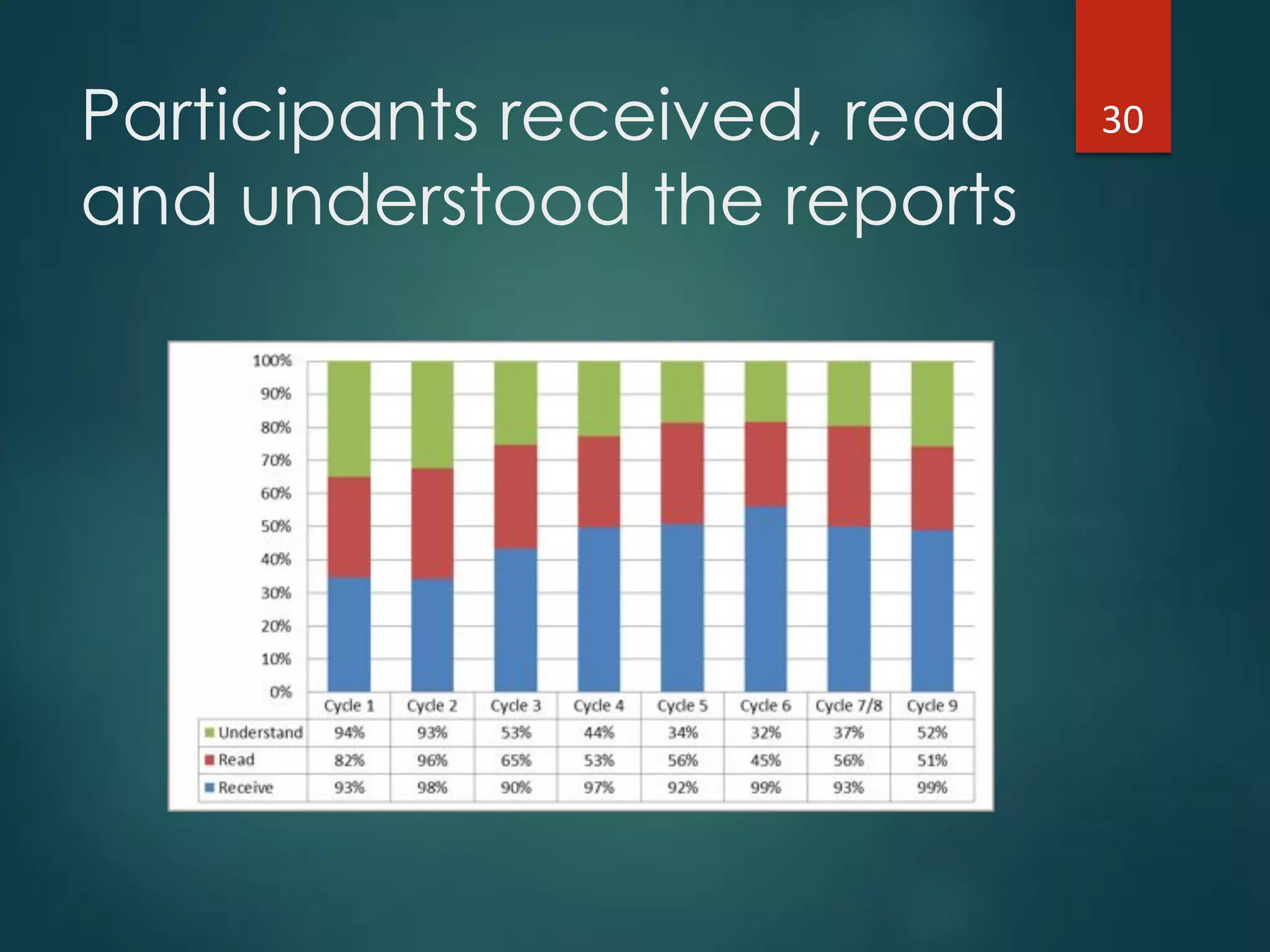
Participants received, read
and understood the reports
30"
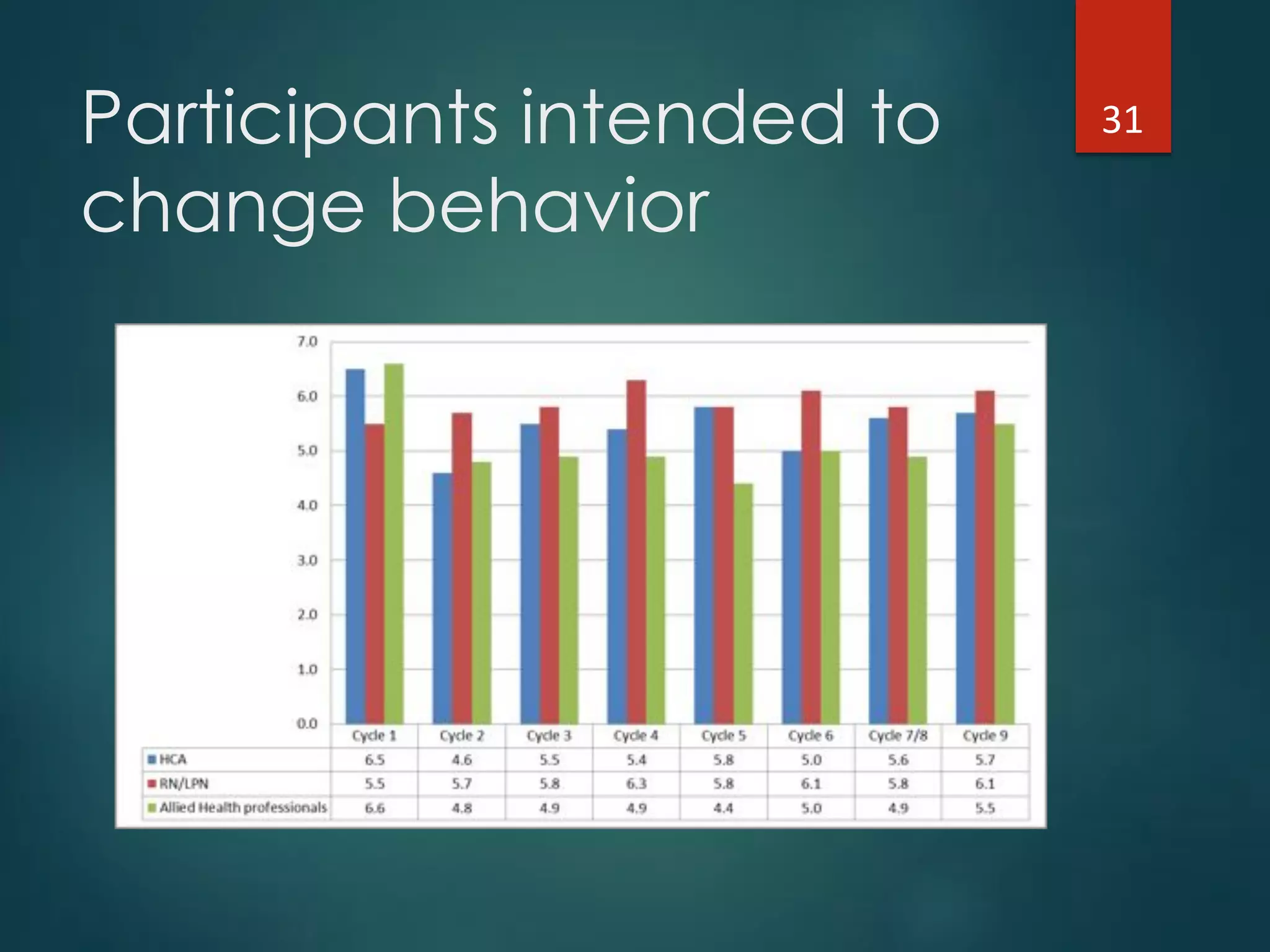
Participants intended to
change behavior
31"
Social network methods
!  Paper survey, hand distributed
!  Obtained lists of all staff working on the six nursing
units as well as staff working on multiple units
!  Unit based staff are mostly nursing staff (registered
nurses, licensed practical nurses, health care aides)
!  Multiple unit staff are mostly allied health
professionals (occupational therapy, physical
therapy, pharmacy, social work)
!  Asked questions about five types of networks
!  Relevant to this discussion: “Who did you discuss the
feedback report with?”
32"
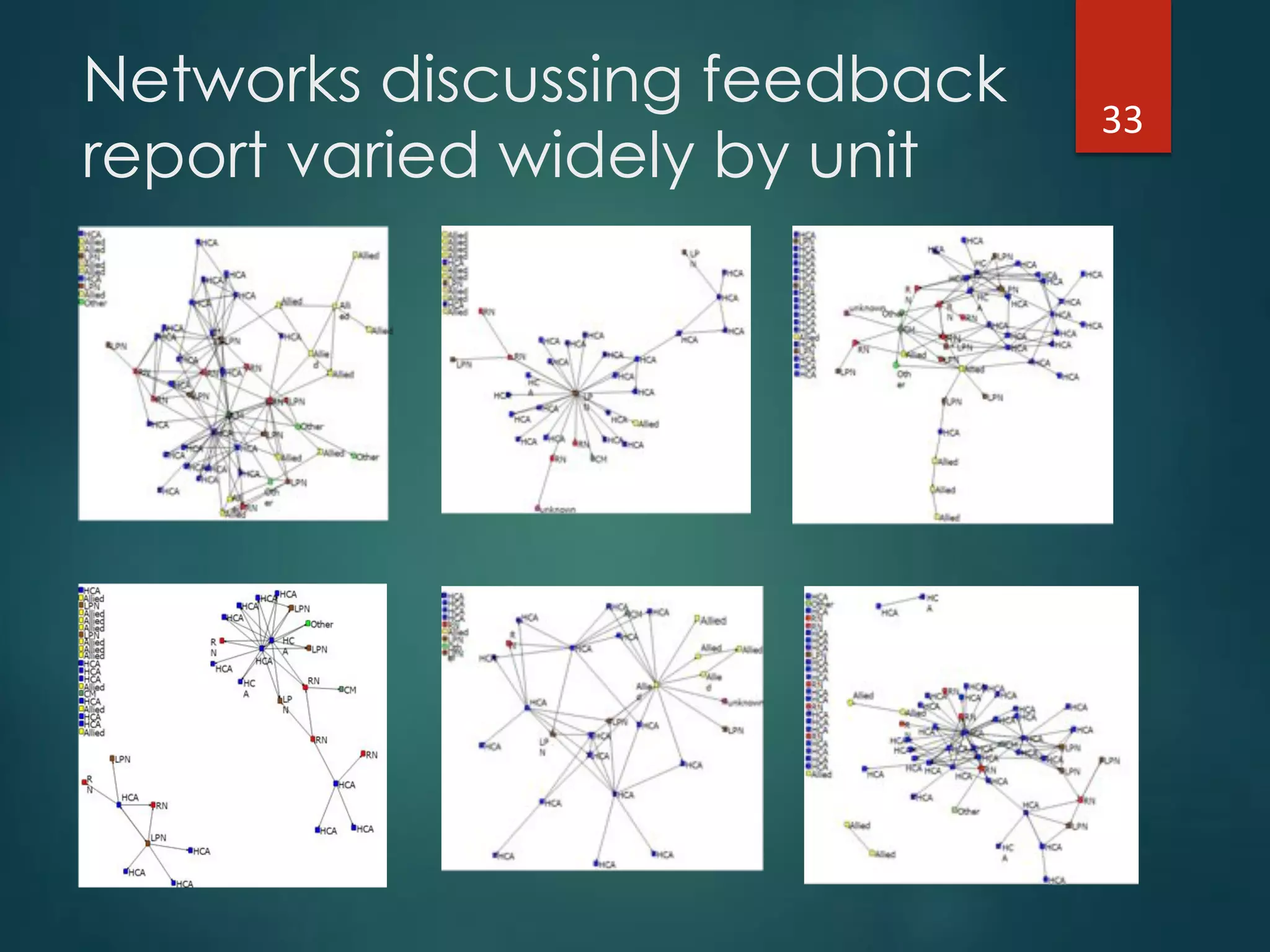
Networks discussing feedback
report varied widely by unit
33"
Why did we think this
matters? TPB
36"
Revisiting the virtuous cycle 37"
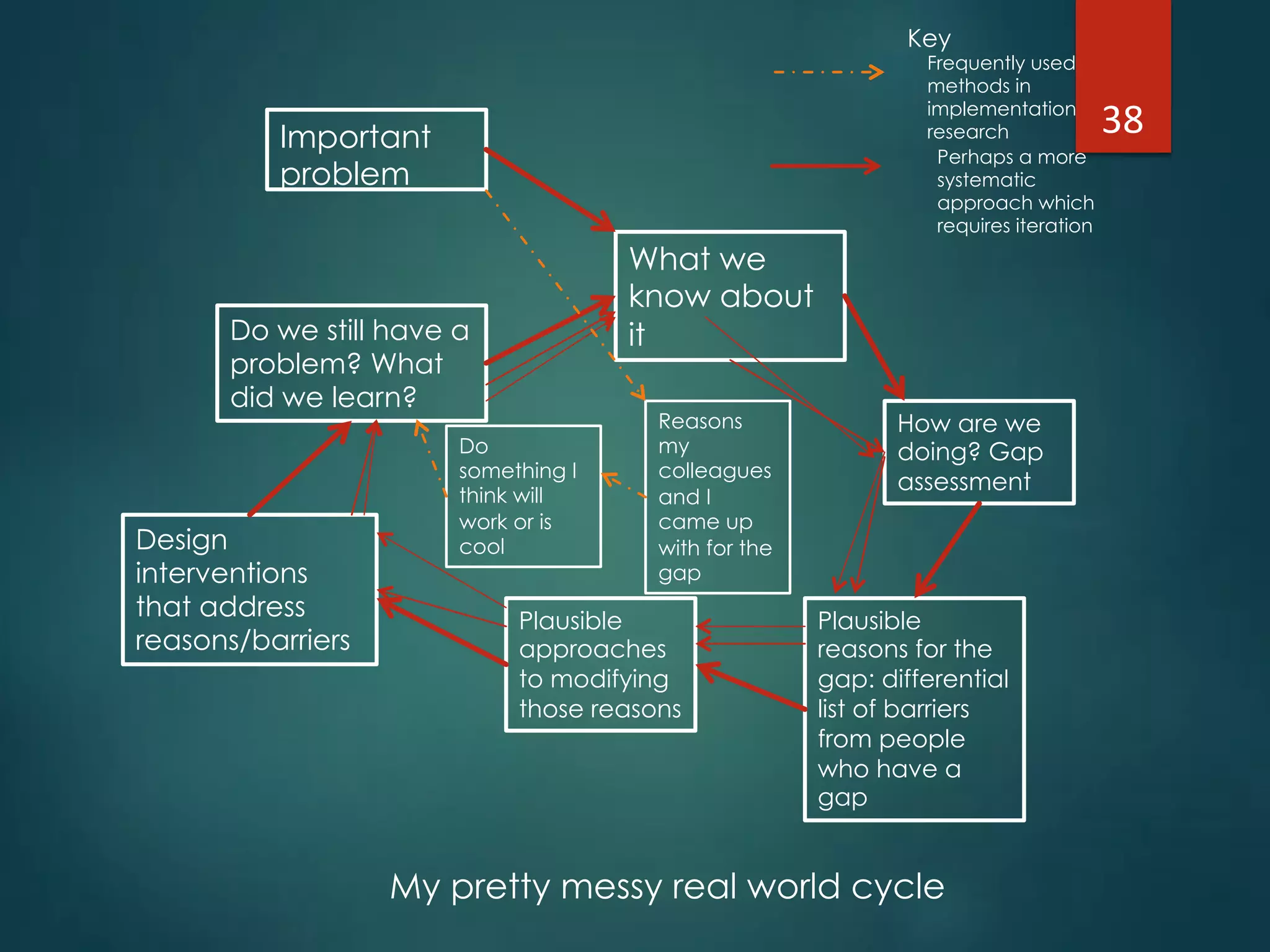
Important
problem
What we
know about
it
How are we
doing? Gap
assessment
Plausible
reasons for the
gap: differential
list of barriers
from people
who have a
gap
Plausible
approaches
to modifying
those reasons
Design
interventions
that address
reasons/barriers
Do we still have a
problem? What
did we learn?
Reasons
my
colleagues
and I
came up
with for the
gap
Do
something I
think will
work or is
cool
Frequently used
methods in
implementation
research
Perhaps a more
systematic
approach which
requires iteration
Key
My pretty messy real world cycle
38"
Revisiting the virtuous cycle 39"
40"
40
Fitting into the broader picture
Pharma
Beacon
Community
Integrated
Delivery
System
Patient-
centered
Groups
Health Information Organization
Health Center
Network
Federal
Agencies
State Public Health
Governance
Patient Engagement
Trust
Analysis
Dissemination
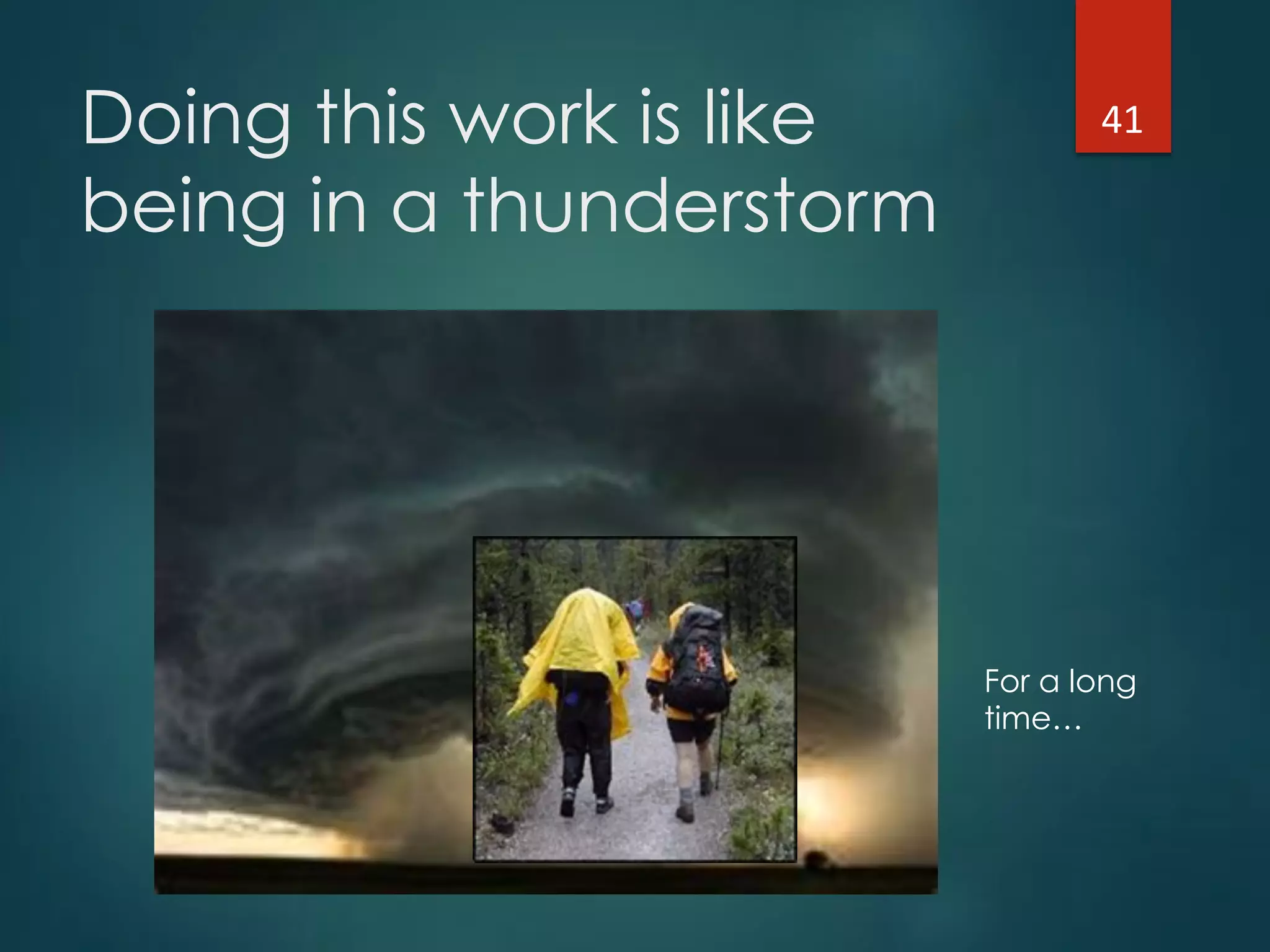
Doing this work is like
being in a thunderstorm
For a long
time…
41"

Implementation science and learning health systems: Pieces of a puzzle

  • 1.
    Implementation science and learning health systems:Pieces of a puzzle ANNE SALES PHD RN SALESANN@UMICH.EDU
  • 2.
    Overview !  Brief cartoonversions !  Learning health systems !  Implementation science !  Points of similarity and convergence !  Points of divergence !  Some of my recent (relevant) work !  Fitting the puzzle together– sort of 2"
  • 3.
    IOM defines alearning health system as !  “… one in which progress in science, informatics, and care culture align to generate new knowledge as an ongoing, natural byproduct of the care experience, and seamlessly refine and deliver best practices for continuous improvement in health and health care” 3"
  • 4.
    IOM Learning Health SystemSeries 2007 - 2012 4"
  • 5.
    5" 5 From Chuck’s slides:Schema of a Learning Health System Pharma Beacon Community Integrated Delivery System Patient- centered Groups Health Information Organization Health Center Network Federal Agencies State Public Health Governance Patient Engagement Trust Analysis Dissemination
  • 6.
    And more fromChuck: the Virtuous Learning Cycle 6"
  • 7.
    Not unlike thePDSA cycle from continuous improvement 7"
  • 8.
    And…not unlike the Knowledgeto Action cycle A staple of Knowledge Translation (Canada) Processes !  Identify gaps !  Adapt to local context !  Assess barriers to knowledge use !  Select, tailor and implement interventions !  Monitor knowledge use !  Evaluate outcomes !  Sustained knowledge use http://ktclearinghouse.ca/knowledgebase/knowledgetoaction 8"
  • 9.
    Defining implementation science (IS) ! As defined by the Annual NIH Conference on Implementation and Dissemination, implementation is the use of strategies to adopt and integrate evidence-based health interventions and change practice patterns within specific settings.  Research on implementation addresses the level to which health interventions can fit within real- world public health and clinical service systems. !  Implementation science is the study of methods to promote the integration of research findings and evidence into healthcare policy and practice.   It seeks to understand the behavior of healthcare professionals and other stakeholders as a key variable in the sustainable uptake, adoption, and implementation of evidence-based interventions. !  http://www.fic.nih.gov/News/Events/implementation- science/Pages/faqs.aspx 9"
  • 10.
  • 11.
    Current state ofthe science !  Most recent systematic review identified 61 different models or frameworks for dissemination and implementation !  Tabak RG, Khoong EC, Chambers DA, Brownson RC. Bridging research and practice: models for dissemination and implementation research. Am J Prev Med. 2012 Sep;43(3):337-50. doi: 10.1016/j.amepre. 2012.05.024. Review. PubMed PMID: 22898128; PubMed Central PMCID: PMC3592983 !  Previous review (2006) found 41 !  Several efforts to consolidate frameworks !  Damschroder LJ, Aron DC, Keith RE, Kirsh SR, Alexander JA, Lowery JC. Fostering implementation of health services research findings into practice: a consolidated framework for advancing implementation science. Implement Sci. 2009 Aug 7;4:50. doi: 10.1186/1748-5908-4-50. PubMed PMID: 19664226; PubMed Central PMCID: PMC2736161 11"
  • 12.
  • 13.
    The importance oftheory: Behavior Change Wheel Michie et al. Implementation Science 2011 http://www.implementationscience.com/content/6/1/42 13"
  • 14.
  • 15.
    And more theory ConsolidatedFramework for Implementation Research Damschroder et al. Implementation Science 2009 http://www.implementationscience.com/content/4/1/50 15"
  • 16.
  • 17.
    And finally Carl May:Towards a general theory of implementation http://www.implementationscience.com/content/8/1/18 17"
  • 18.
  • 20.
    Data for Improvementand Clinical Excellence (DICE) !  Designed as a 12 month project to deliver feedback reports to all direct care providers in four nursing homes (9 units) in Edmonton, Alberta, Canada !  Provide feedback reports to all staff !  Previous studies only provided reports to professional staff !  Measure resident outcomes !  Understand how feedback interventions work in LTC settings !  Measuring social networks and their interaction with the intervention !  Measuring context using the Alberta Context Tools (not presented) !  Time series design with control (non-intervention) retrospective comparison !  Interrupted time series using segmented regression analysis !  Assessment of social networks embedded within study 20"
  • 21.
  • 22.
    Monthly feedback reports ! 13 month feedback intervention !  Delivered brief feedback report monthly based on resident outcomes/process measures to all direct care staff on 9 long term care units !  Measured staff response to feedback reports one week after reports were delivered in most months !  Used Minimum Data Set-Resident Assessment Instrument (MDS- RAI) version 2.0 data about residents !  Pain assessment !  Depression screening !  Falls and fall risk 22"
  • 23.
  • 24.
    Post-feedback survey !  Anonymous ! Short demographic section !  Section on perception of feedback report !  Read !  Understand !  Discuss !  Find useful !  Take action !  Theory of Planned Behavior section 24"
  • 25.
  • 26.
  • 27.
    But depression wentthe wrong way 27"
  • 28.
    Response rates variedby time and place 28"
  • 29.
  • 30.
    Participants received, read andunderstood the reports 30"
  • 31.
  • 32.
    Social network methods ! Paper survey, hand distributed !  Obtained lists of all staff working on the six nursing units as well as staff working on multiple units !  Unit based staff are mostly nursing staff (registered nurses, licensed practical nurses, health care aides) !  Multiple unit staff are mostly allied health professionals (occupational therapy, physical therapy, pharmacy, social work) !  Asked questions about five types of networks !  Relevant to this discussion: “Who did you discuss the feedback report with?” 32"
  • 33.
    Networks discussing feedback reportvaried widely by unit 33"
  • 36.
    Why did wethink this matters? TPB 36"
  • 37.
  • 38.
    Important problem What we know about it Howare we doing? Gap assessment Plausible reasons for the gap: differential list of barriers from people who have a gap Plausible approaches to modifying those reasons Design interventions that address reasons/barriers Do we still have a problem? What did we learn? Reasons my colleagues and I came up with for the gap Do something I think will work or is cool Frequently used methods in implementation research Perhaps a more systematic approach which requires iteration Key My pretty messy real world cycle 38"
  • 39.
  • 40.
    40" 40 Fitting into thebroader picture Pharma Beacon Community Integrated Delivery System Patient- centered Groups Health Information Organization Health Center Network Federal Agencies State Public Health Governance Patient Engagement Trust Analysis Dissemination
  • 41.
    Doing this workis like being in a thunderstorm For a long time… 41"