




Improving clinical services
No magic bullet...but some things
work better than others
Jeremy Grimshaw
Senior Scientist, Ottawa Hospital Research Institute
Professor, Department of Medicine, University of Ottawa
Canada Research Chair in Health Knowledge Transfer and Uptake
Greetings from Ottawa
Background
Why do we need to think about service
improvement?
 Consistent evidence of failure to translate
research findings into clinical practice
 30-40% patients do not get treatments of proven
effectiveness
 20–25% patients get care that is not needed or potentially
harmful
Schuster, McGlynn, Brook (1998). Milbank Memorial Quarterly
Grol R (2001). Med Care
 Suggests that service improvement is fundamental
challenge for healthcare systems to optimise care,
outcomes and costs
How do healthcare systems and
organisations currently try to
improve clinical services?
Issue guidance
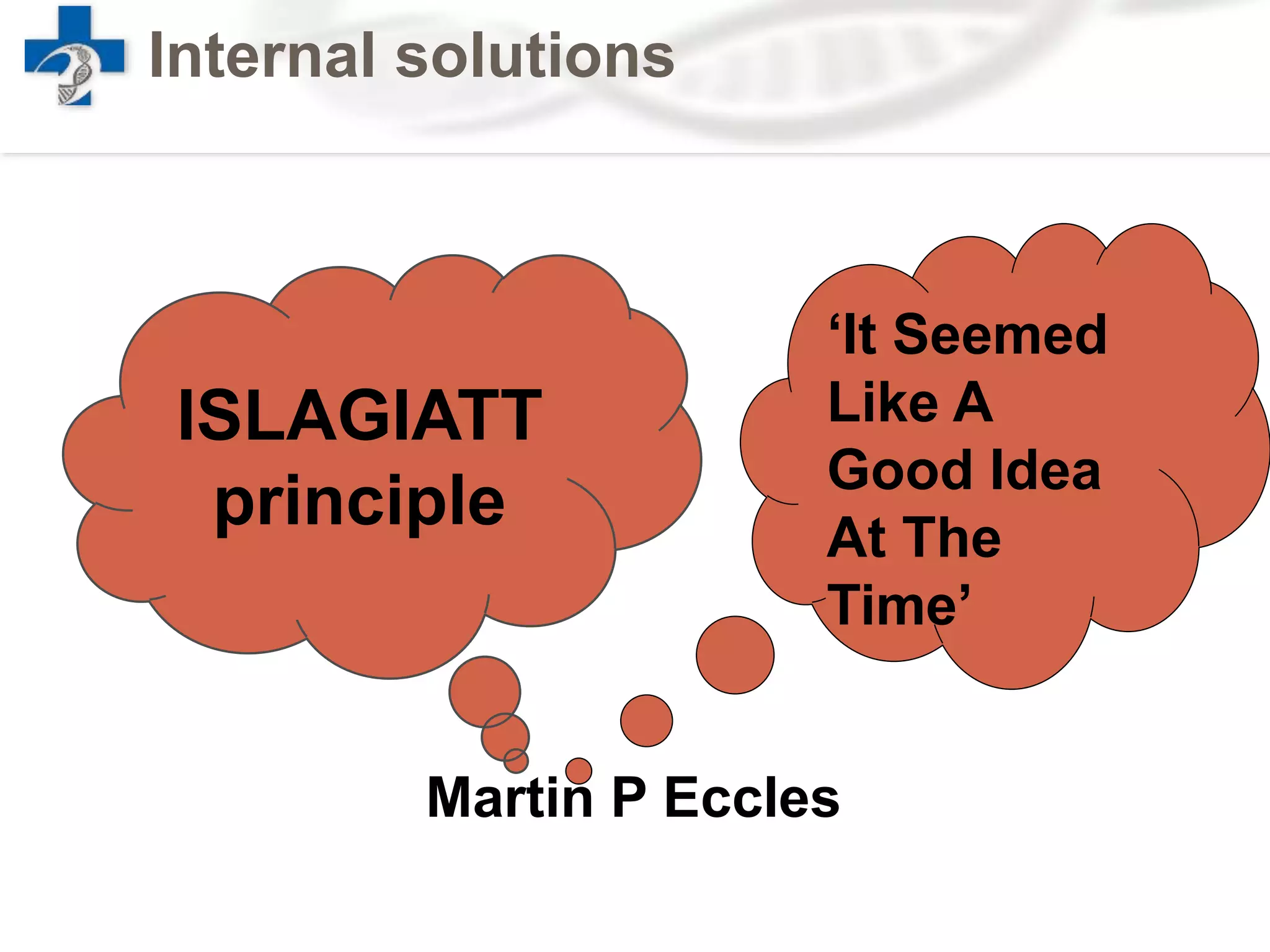
Internal solutions
ISLAGIATT
principle
Martin P Eccles
‘It Seemed
Like A
Good Idea
At The
Time’
Favourite solutions
If you have a hammer,
everything looks like nail
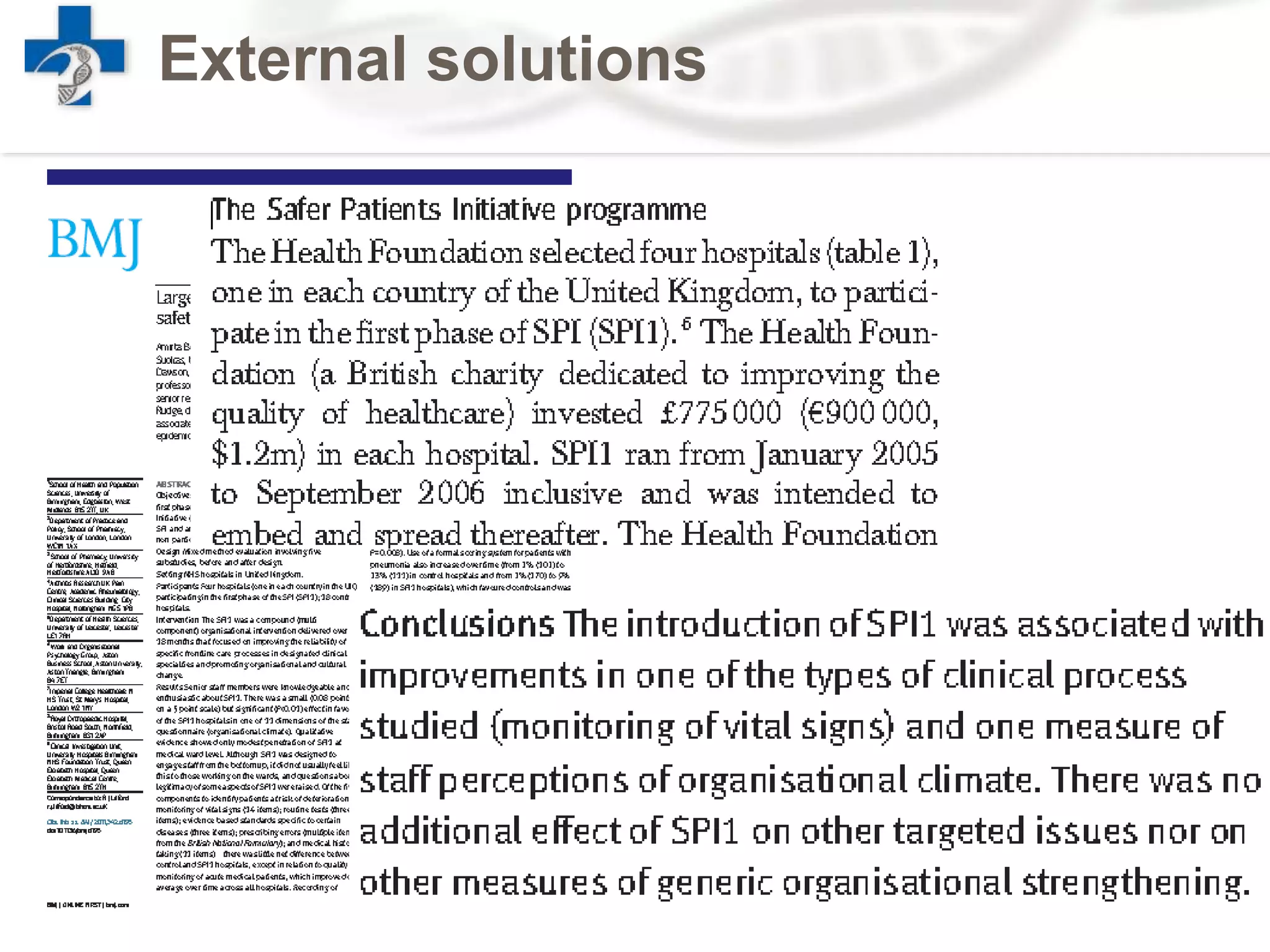
External solutions
Current situation
 All of these solutions work some of the time.
 None work all of the time.
 It is unclear when they do work whether they
maximally improve practice.
 It is unclear when they do work whether they
represent the most efficient use of scarce health
care quality improvement resources.
 ‘Evidence based medicine should be
complemented by evidence based implementation’
Grol (1997). British Medical Journal
Cochrane Effective Practice and
Organisation of Care (EPOC) Group
 Cochrane Effective Practice and Organisation
of Care (EPOC) group undertakes systematic
reviews of interventions to improve health care
systems and health care delivery including:
 Professional interventions (e.g. continuing
medical education, audit and feedback)
 Financial interventions (e.g. professional
incentives)
 Organisational interventions (e.g. the
expanded role of pharmacists)
 Regulatory interventions
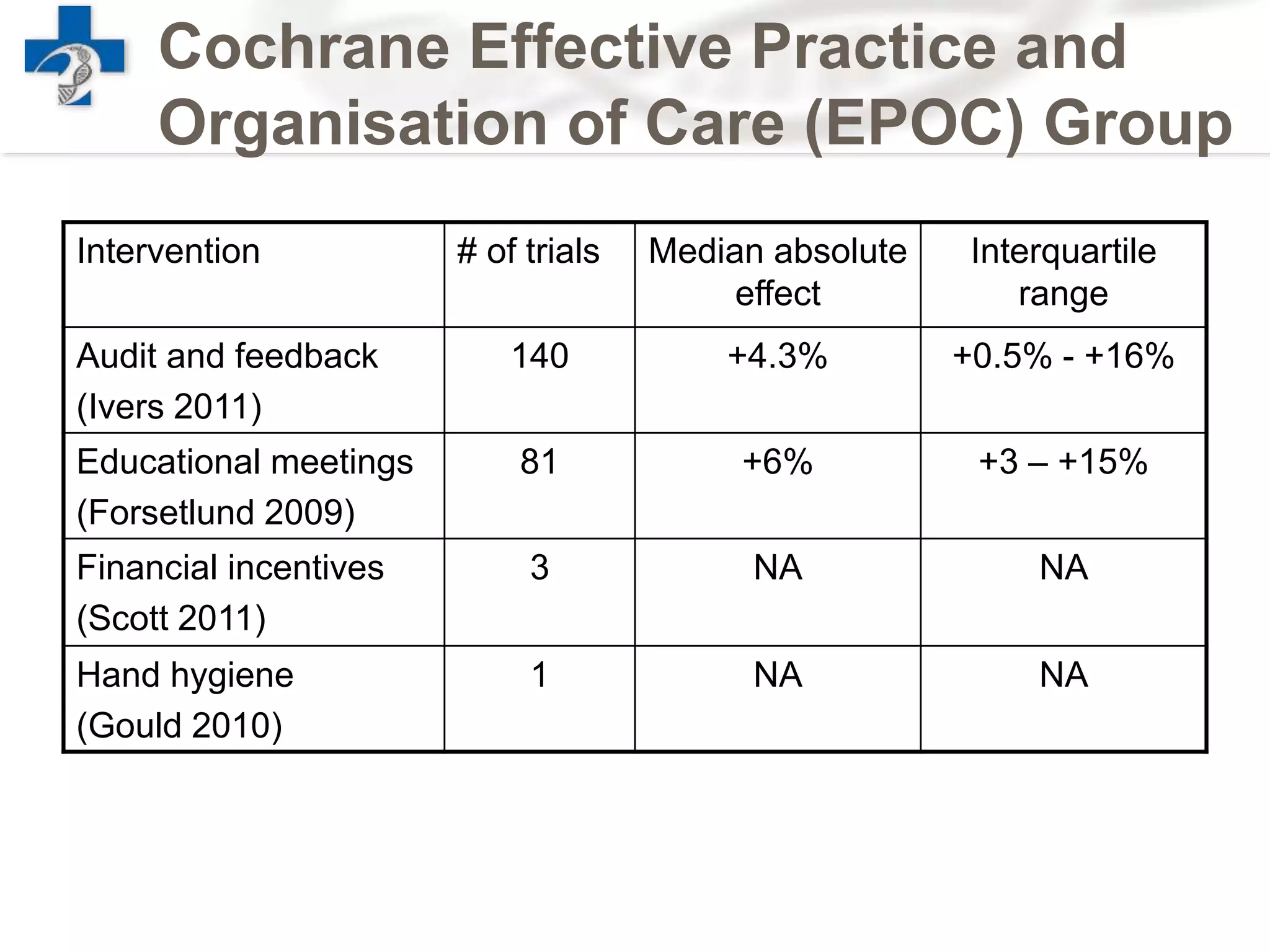
Cochrane Effective Practice and
Organisation of Care (EPOC) Group
Intervention # of trials Median absolute
effect
Interquartile
range
Audit and feedback
(Ivers 2011)
140 +4.3% +0.5% - +16%
Educational meetings
(Forsetlund 2009)
81 +6% +3 – +15%
Financial incentives
(Scott 2011)
3 NA NA
Hand hygiene
(Gould 2010)
1 NA NA
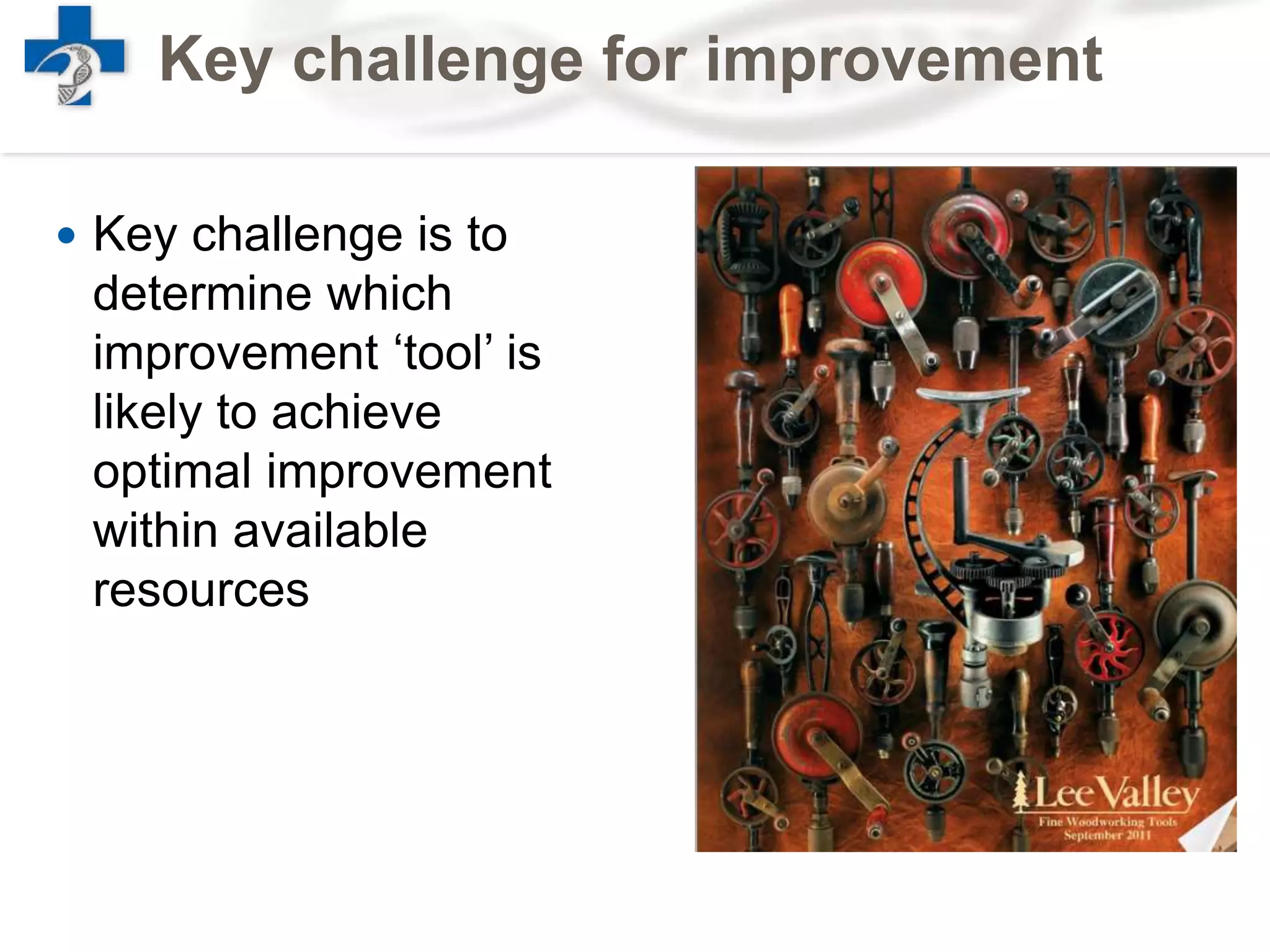
 Key challenge is to
determine which
improvement ‘tool’ is
likely to achieve
optimal improvement
within available
resources
Key challenge for improvement
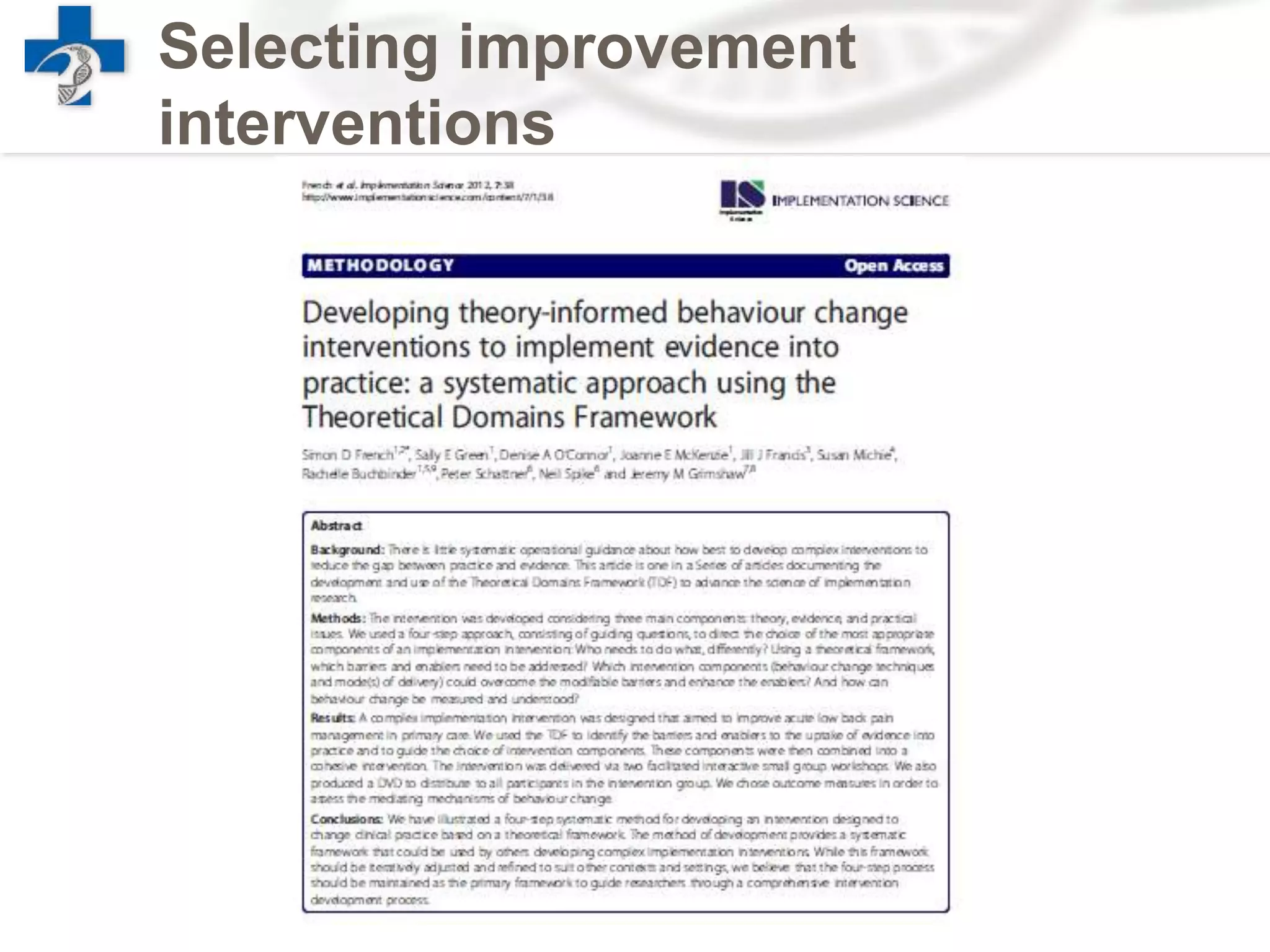
Selecting improvement
interventions
Behavioural perspective
 Implementation depends on behaviour
 Citizens, patients, health professionals,
managers, policy makers
 To improve care, we need to change behaviour
 To change behaviour, it helps to understand
determinants of current behaviour and how
behaviour changes
Selecting improvement
interventions
Selecting improvement
interventions
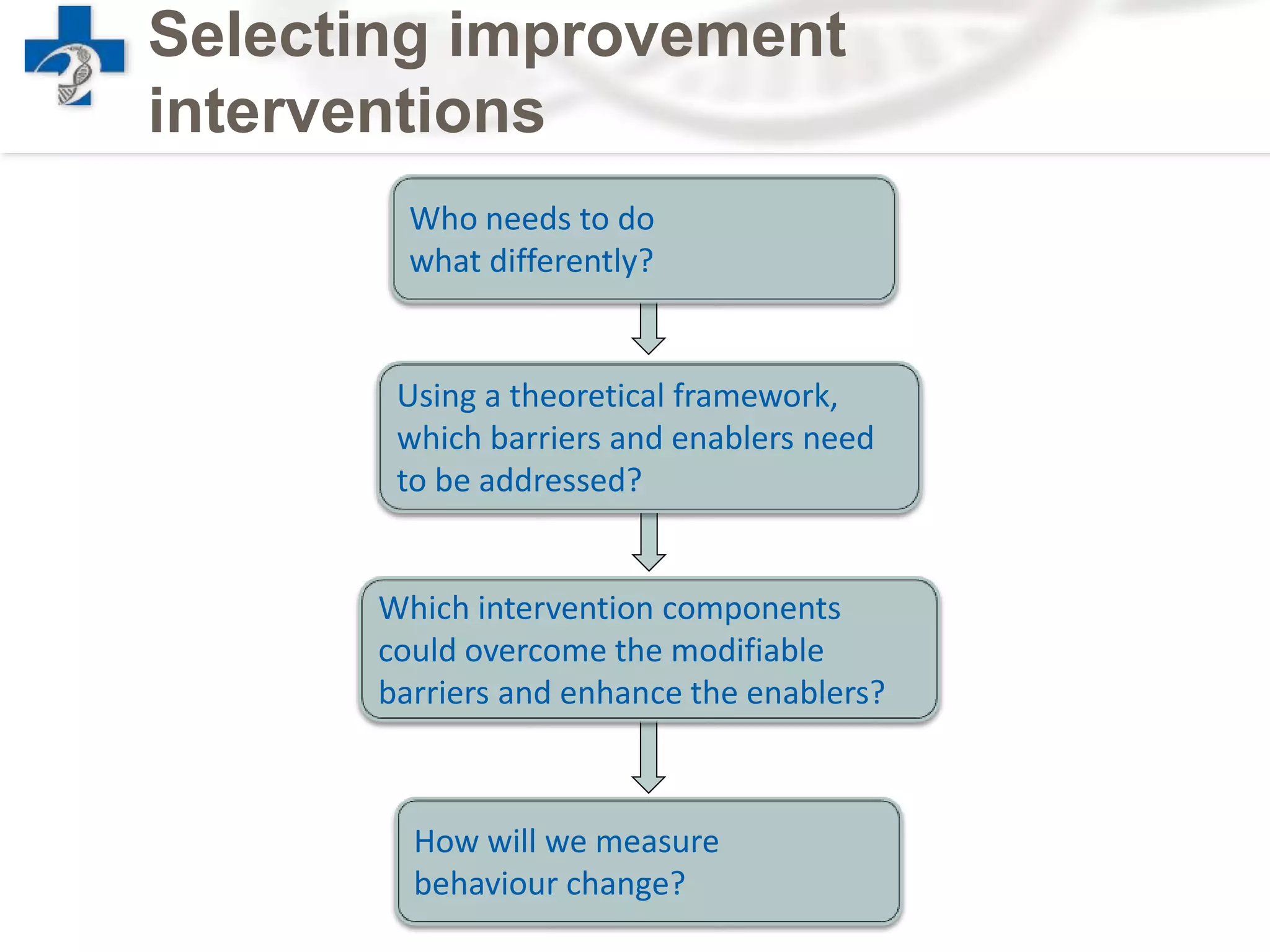
Who needs to do
what differently?
Using a theoretical framework,
which barriers and enablers need
to be addressed?
Which intervention components
could overcome the modifiable
barriers and enhance the enablers?
How will we measure
behaviour change?
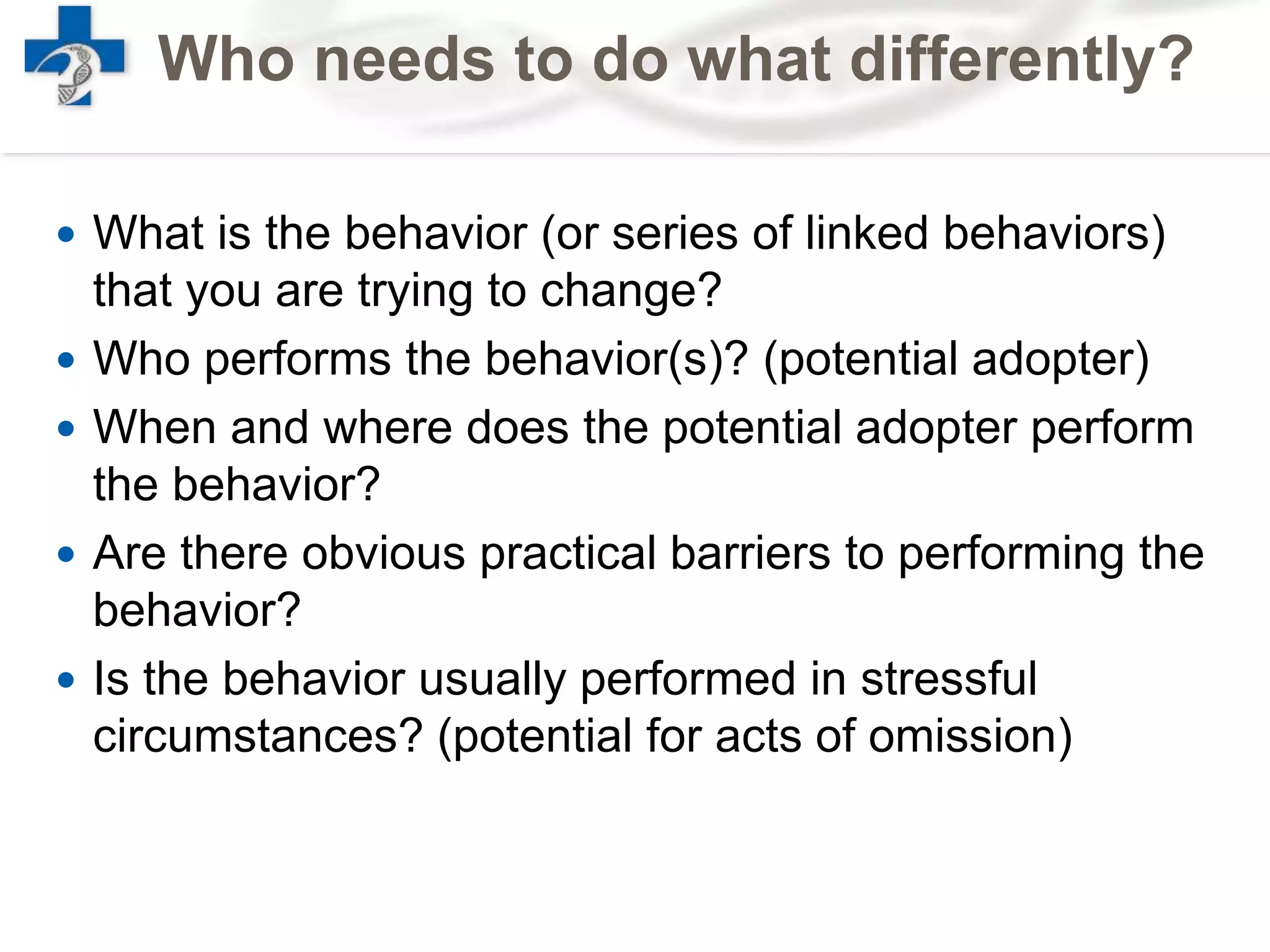
Who needs to do what differently?
 What is the behavior (or series of linked behaviors)
that you are trying to change?
 Who performs the behavior(s)? (potential adopter)
 When and where does the potential adopter perform
the behavior?
 Are there obvious practical barriers to performing the
behavior?
 Is the behavior usually performed in stressful
circumstances? (potential for acts of omission)
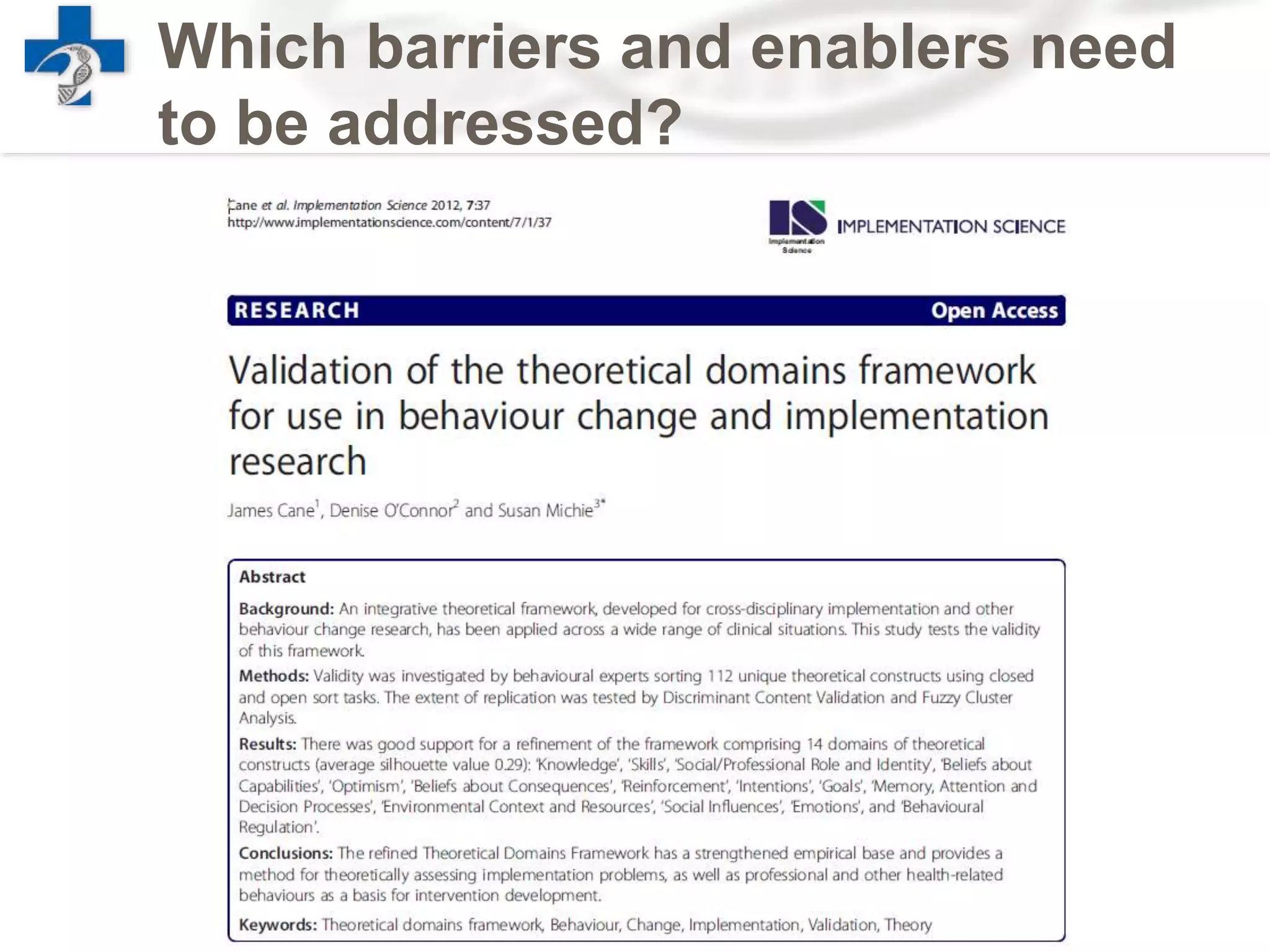
Which barriers and enablers need
to be addressed?
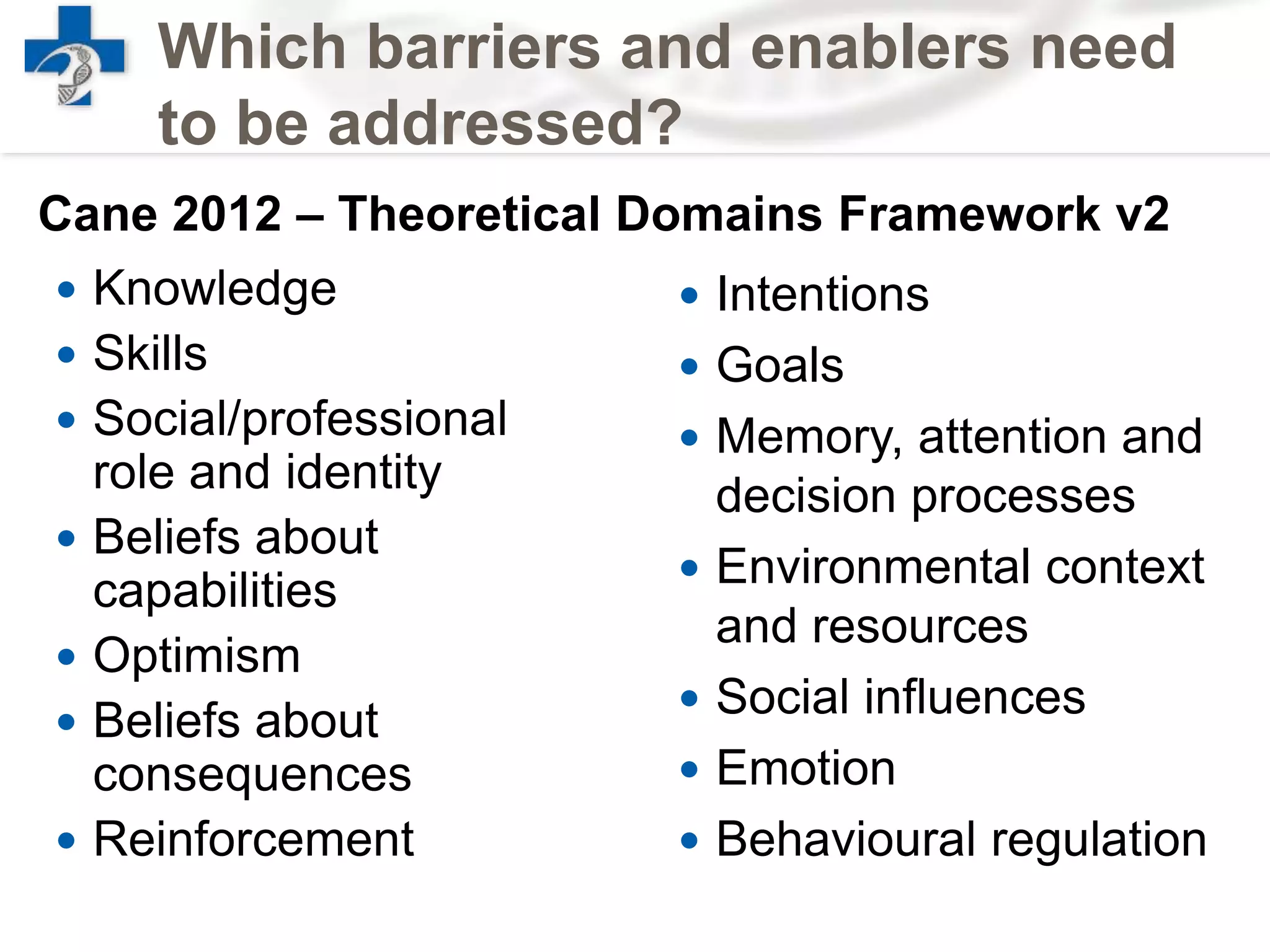
 Knowledge
 Skills
 Social/professional
role and identity
 Beliefs about
capabilities
 Optimism
 Beliefs about
consequences
 Reinforcement
Which barriers and enablers need
to be addressed?
 Intentions
 Goals
 Memory, attention and
decision processes
 Environmental context
and resources
 Social influences
 Emotion
 Behavioural regulation
Cane 2012 – Theoretical Domains Framework v2
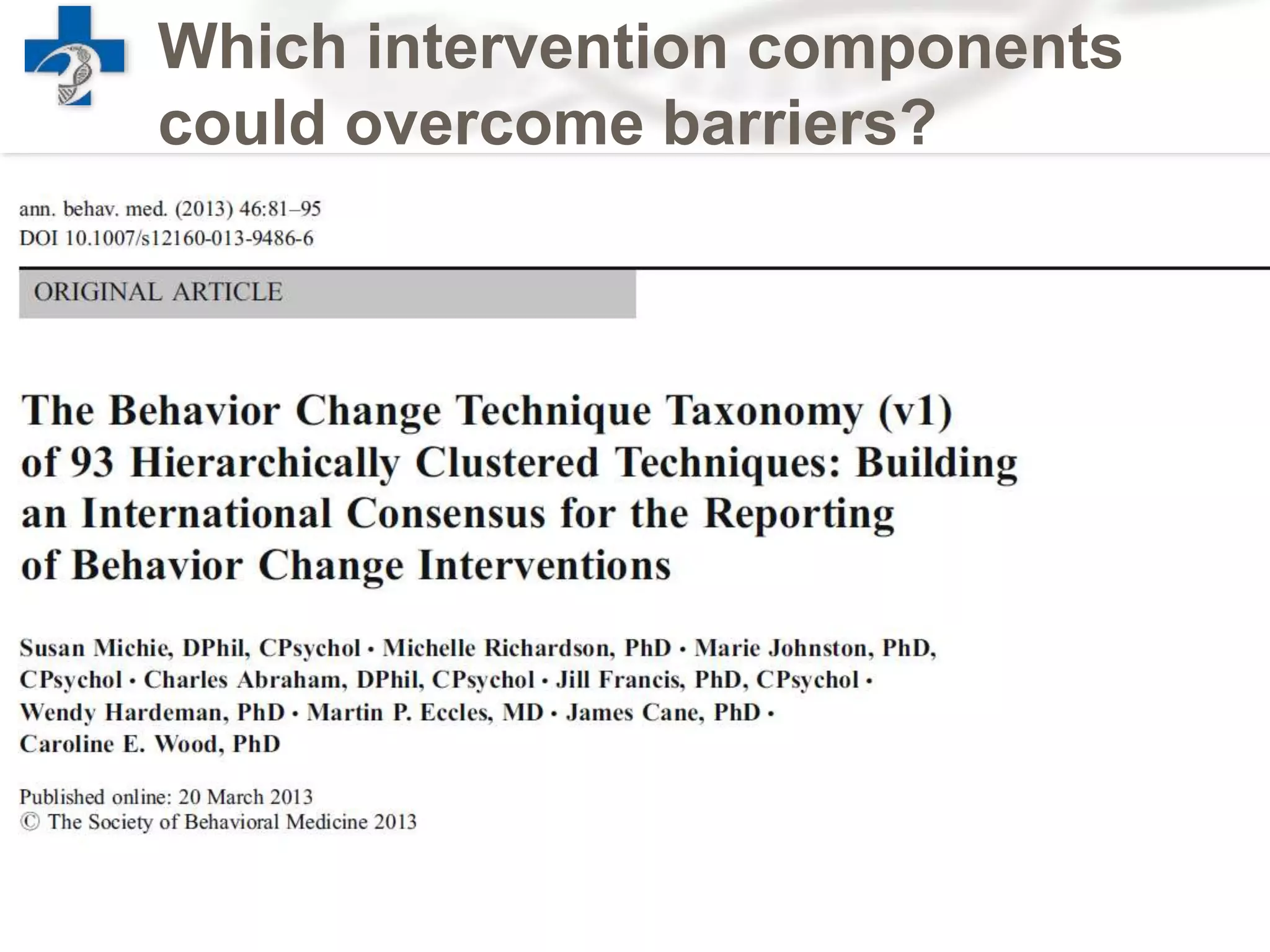
Which intervention components
could overcome barriers?
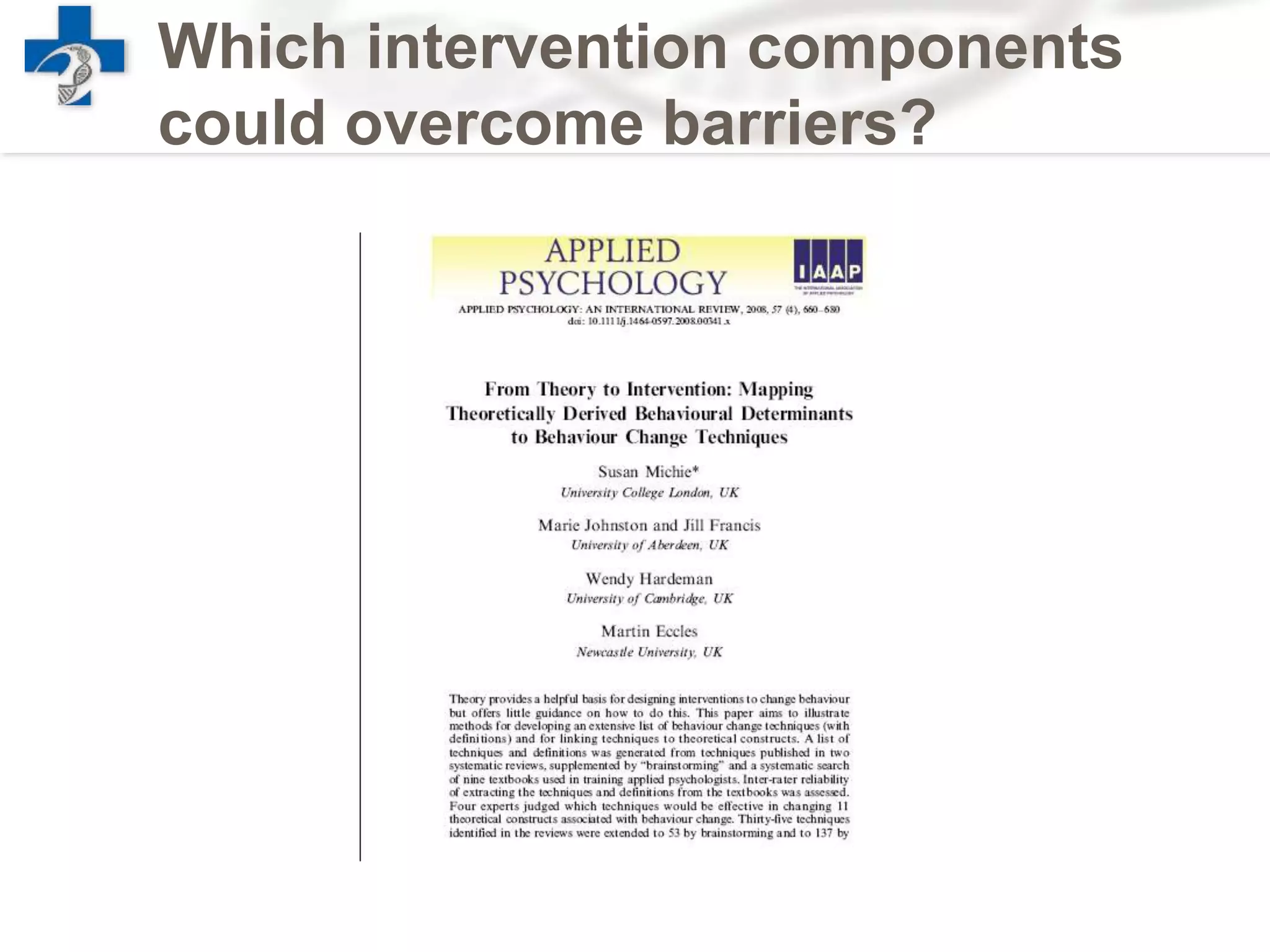
Which intervention components
could overcome barriers?
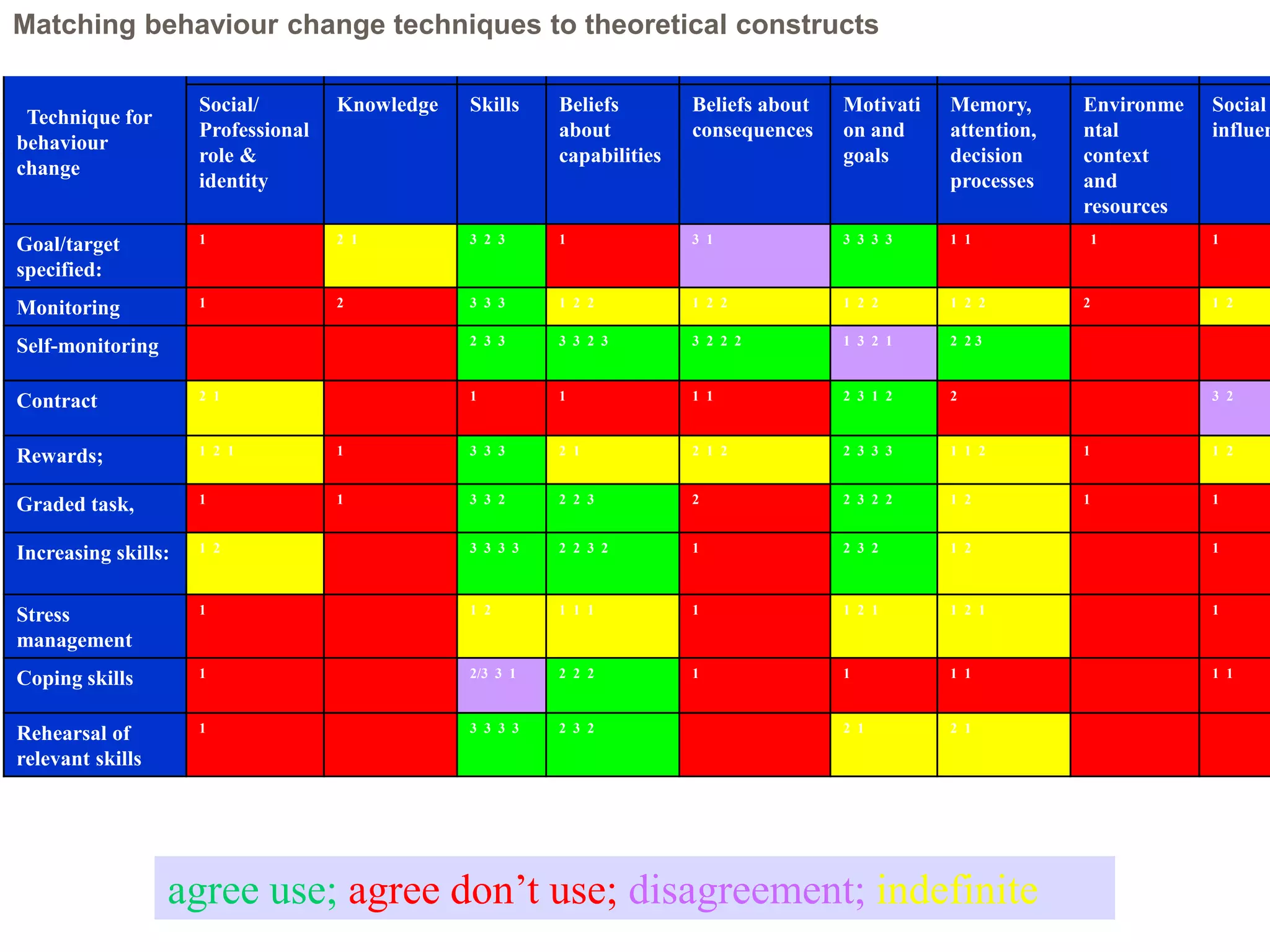
Technique for
behaviour
change
Social/
Professional
role &
identity
Knowledge Skills Beliefs
about
capabilities
Beliefs about
consequences
Motivati
on and
goals
Memory,
attention,
decision
processes
Environme
ntal
context
and
resources
Social
influen
Goal/target
specified:
1 2 1 3 2 3 1 3 1 3 3 3 3 1 1 1 1
Monitoring 1 2 3 3 3 1 2 2 1 2 2 1 2 2 1 2 2 2 1 2
Self-monitoring 2 3 3 3 3 2 3 3 2 2 2 1 3 2 1 2 2 3
Contract 2 1 1 1 1 1 2 3 1 2 2 3 2
Rewards; 1 2 1 1 3 3 3 2 1 2 1 2 2 3 3 3 1 1 2 1 1 2
Graded task, 1 1 3 3 2 2 2 3 2 2 3 2 2 1 2 1 1
Increasing skills: 1 2 3 3 3 3 2 2 3 2 1 2 3 2 1 2 1
Stress
management
1 1 2 1 1 1 1 1 2 1 1 2 1 1
Coping skills 1 2/3 3 1 2 2 2 1 1 1 1 1 1
Rehearsal of
relevant skills
1 3 3 3 3 2 3 2 2 1 2 1
Matching behaviour change techniques to theoretical constructs
agree use; agree don’t use; disagreement; indefinite
Which intervention components
could overcome barriers?
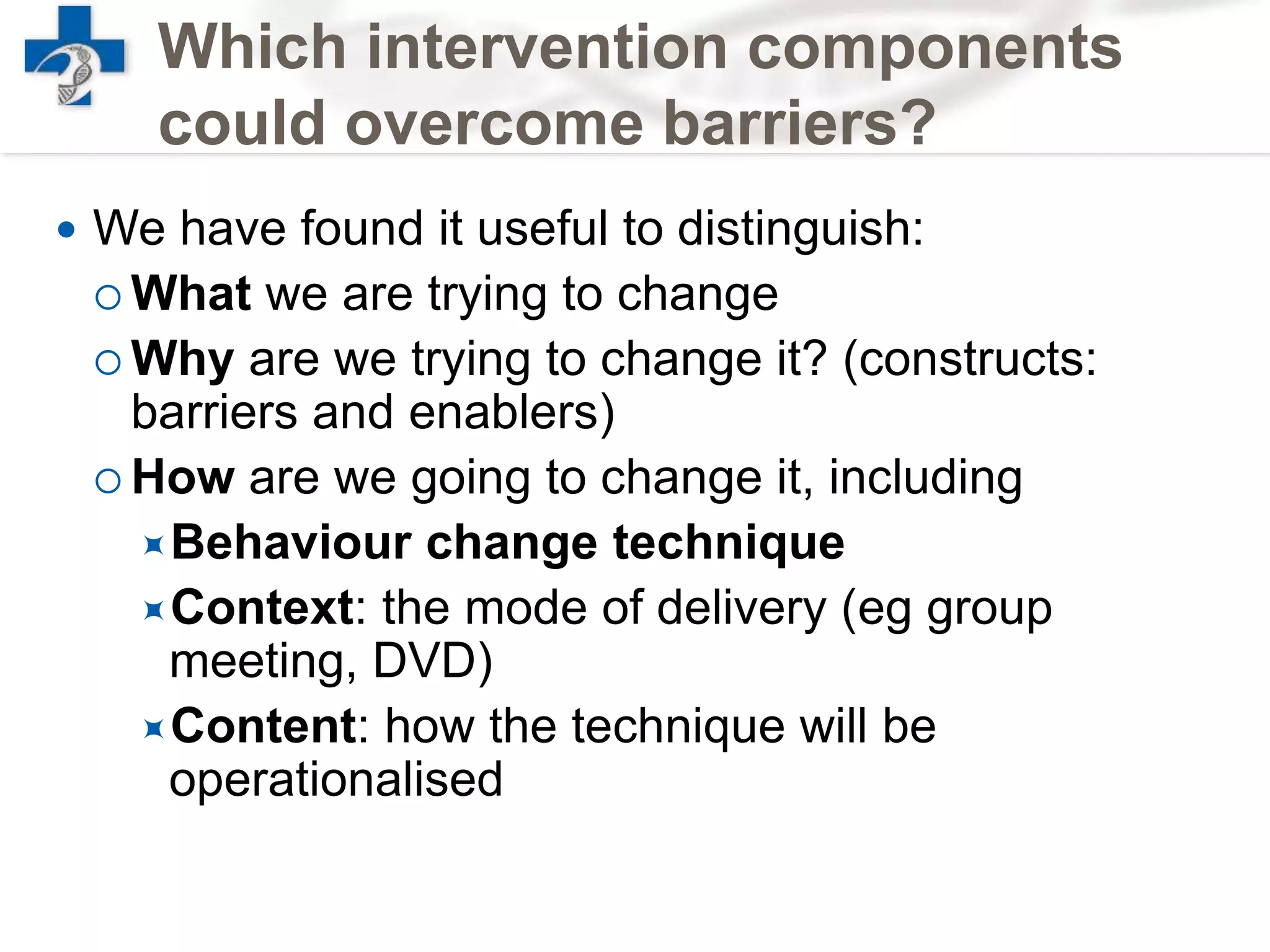
 We have found it useful to distinguish:
 What we are trying to change
 Why are we trying to change it? (constructs:
barriers and enablers)
 How are we going to change it, including
Behaviour change technique
Context: the mode of delivery (eg group
meeting, DVD)
Content: how the technique will be
operationalised
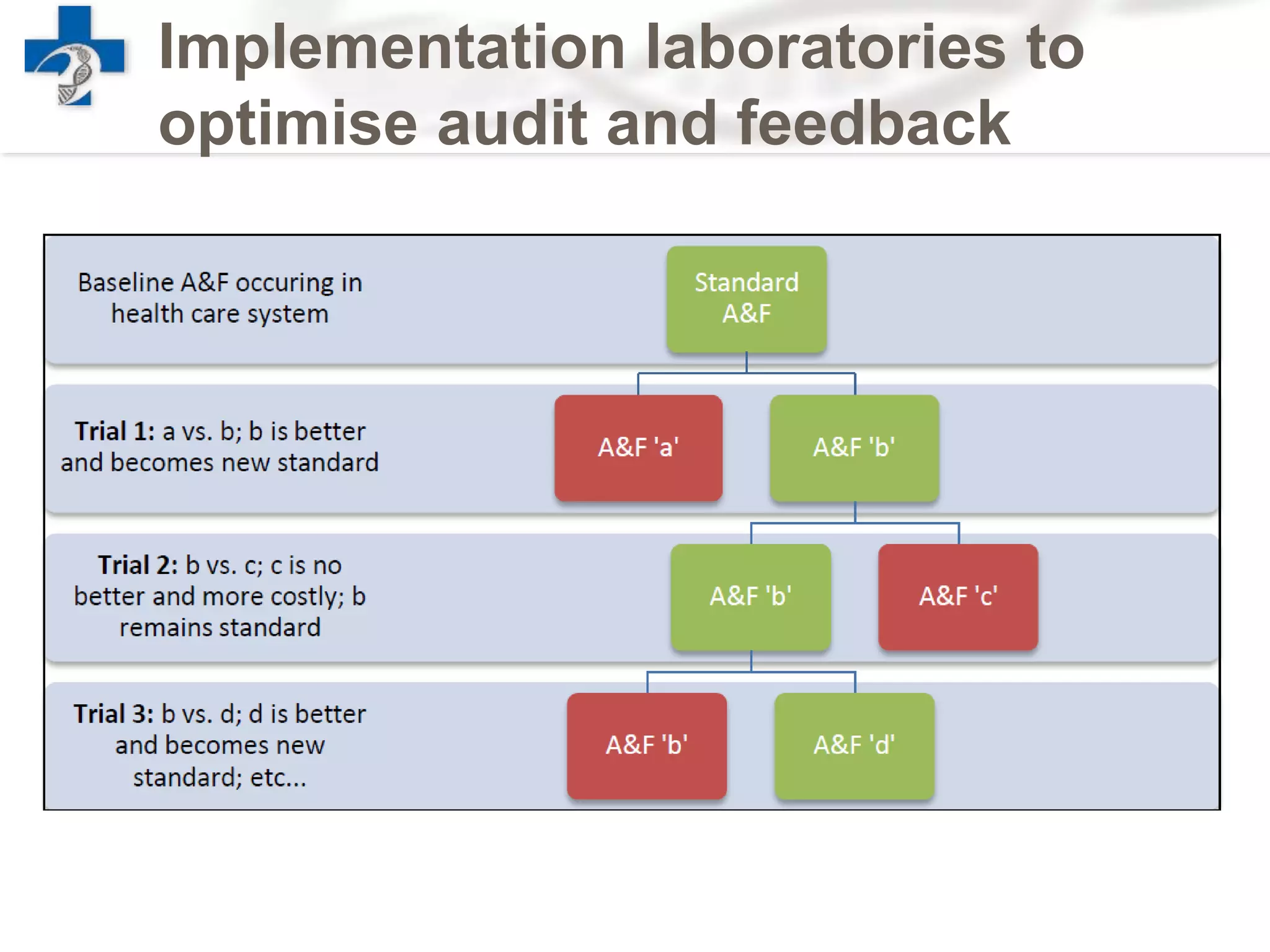
Implementation laboratories to
optimise audit and feedback
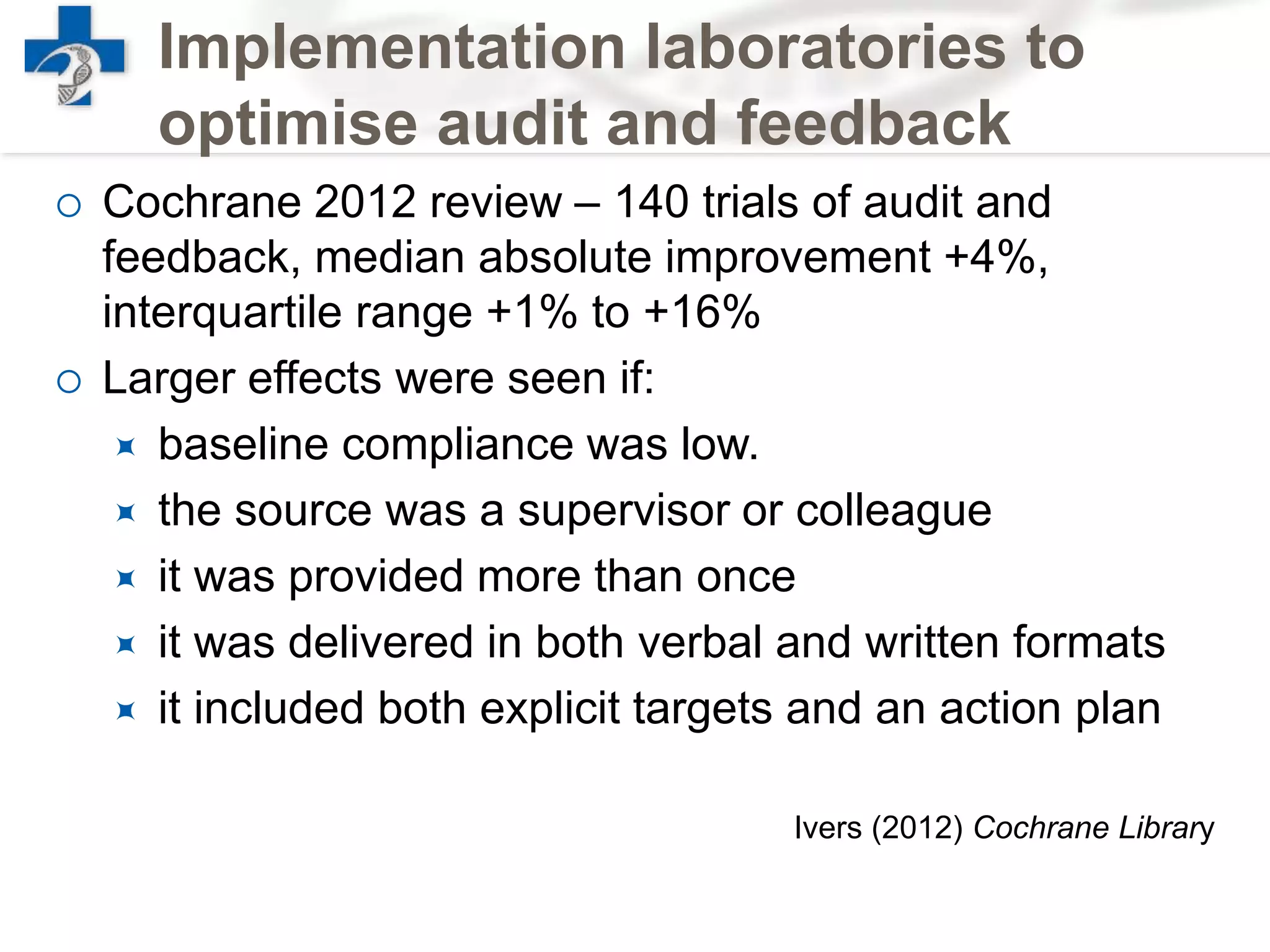
 Cochrane 2012 review – 140 trials of audit and
feedback, median absolute improvement +4%,
interquartile range +1% to +16%
 Larger effects were seen if:
 baseline compliance was low.
 the source was a supervisor or colleague
 it was provided more than once
 it was delivered in both verbal and written formats
 it included both explicit targets and an action plan
Ivers (2012) Cochrane Library
Implementation laboratories to
optimise audit and feedback
 Future studies need to evaluate comparative
effectiveness of different methods of delivering
audit and feedback
 Timing
 Design
 Content
 Delivery
 Sustainability
 Co-interventions
 Need large sample sizes that are unlikely to be
realised in one off research projects but opportunities
to collaborate with health care systems already
delivering audit and feedback programs
Implementation laboratories to
optimise audit and feedback
Implementation laboratories to
optimise audit and feedback
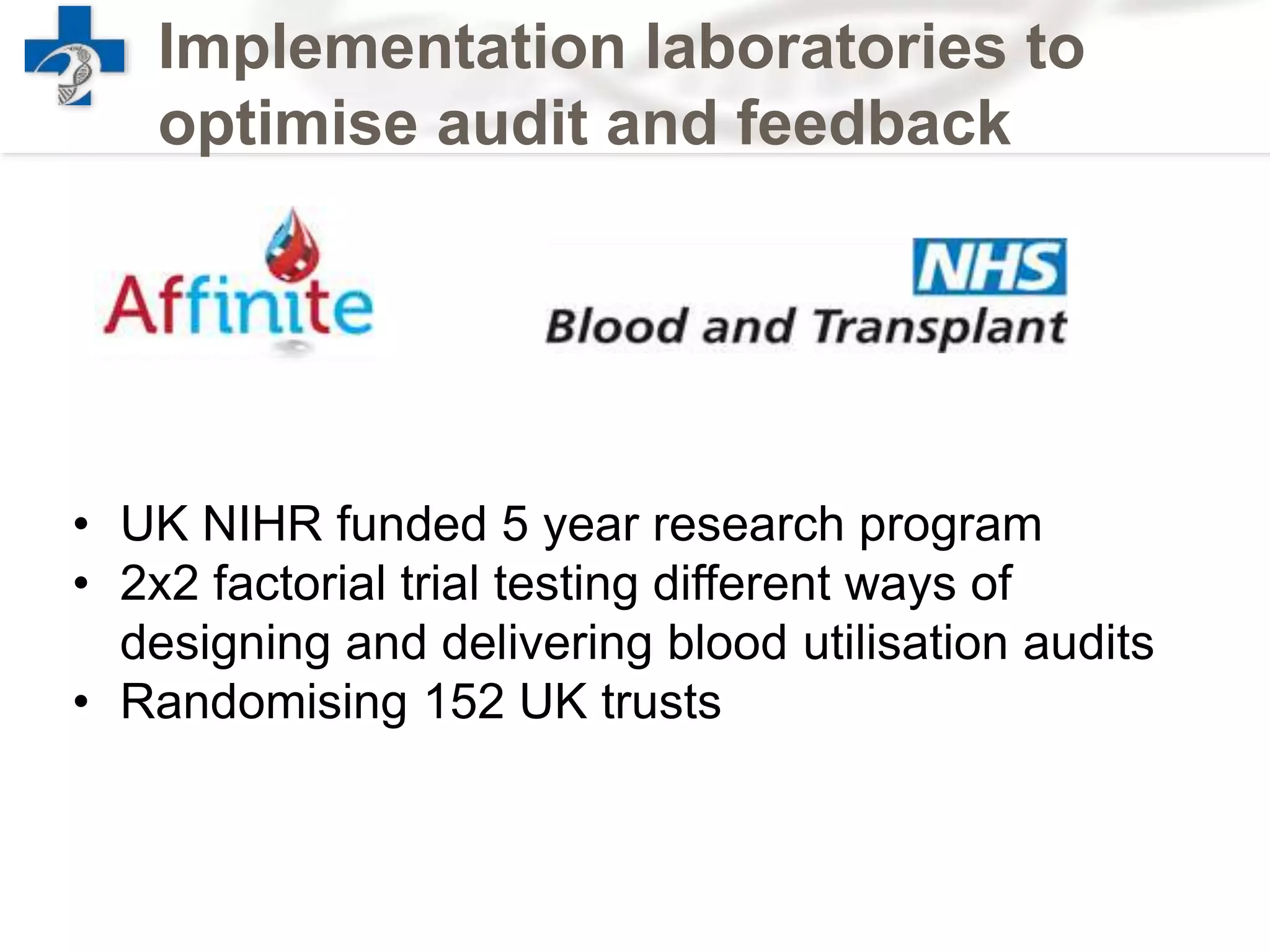
• UK NIHR funded 5 year research program
• 2x2 factorial trial testing different ways of
designing and delivering blood utilisation audits
• Randomising 152 UK trusts
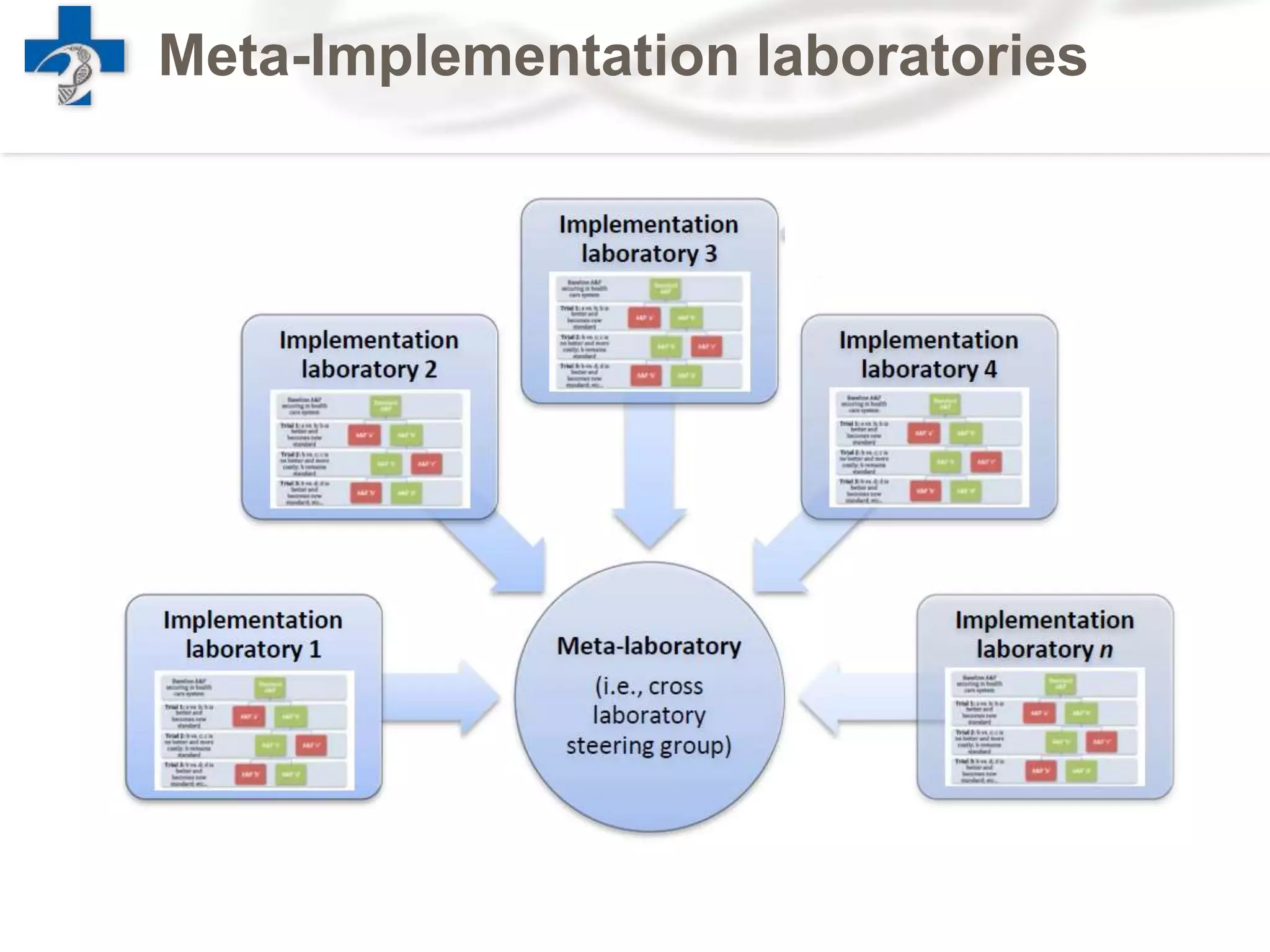
Meta-Implementation laboratories
Summary
 Service improvement is about saving lives, improving
health outcomes and the quality of health services.
 Substantive evidence base on the effects of different
improvement interventions; good news is that it is
possible to change stakeholder decisions and
behaviours!
 However current evidence base provides little practical
guidance for health care systems about which
interventions to use and how to optimise them
 Future evaluative efforts need to focus on better, more
transparent intervention development, more creative
designs to enhance the informativeness of studies
 Substantial theoretical and methodological development
needed.
Contact details
 Jeremy Grimshaw - jgrimshaw@ohri.ca
 EPOC – epoc@uottawa.ca
 Results available from:
www.rxforchange.ca
http://ktclearinghouse.ca/ktcanada

Improving clinical services: no magic bullet... some things work better than others - Jeremy Grimshaw

  • 1.
    Improving clinical services Nomagic bullet...but some things work better than others Jeremy Grimshaw Senior Scientist, Ottawa Hospital Research Institute Professor, Department of Medicine, University of Ottawa Canada Research Chair in Health Knowledge Transfer and Uptake
  • 2.
  • 3.
    Background Why do weneed to think about service improvement?  Consistent evidence of failure to translate research findings into clinical practice  30-40% patients do not get treatments of proven effectiveness  20–25% patients get care that is not needed or potentially harmful Schuster, McGlynn, Brook (1998). Milbank Memorial Quarterly Grol R (2001). Med Care  Suggests that service improvement is fundamental challenge for healthcare systems to optimise care, outcomes and costs
  • 4.
    How do healthcaresystems and organisations currently try to improve clinical services?
  • 5.
  • 6.
    Internal solutions ISLAGIATT principle Martin PEccles ‘It Seemed Like A Good Idea At The Time’
  • 7.
    Favourite solutions If youhave a hammer, everything looks like nail
  • 8.
  • 9.
    Current situation  Allof these solutions work some of the time.  None work all of the time.  It is unclear when they do work whether they maximally improve practice.  It is unclear when they do work whether they represent the most efficient use of scarce health care quality improvement resources.  ‘Evidence based medicine should be complemented by evidence based implementation’ Grol (1997). British Medical Journal
  • 10.
    Cochrane Effective Practiceand Organisation of Care (EPOC) Group  Cochrane Effective Practice and Organisation of Care (EPOC) group undertakes systematic reviews of interventions to improve health care systems and health care delivery including:  Professional interventions (e.g. continuing medical education, audit and feedback)  Financial interventions (e.g. professional incentives)  Organisational interventions (e.g. the expanded role of pharmacists)  Regulatory interventions
  • 11.
    Cochrane Effective Practiceand Organisation of Care (EPOC) Group Intervention # of trials Median absolute effect Interquartile range Audit and feedback (Ivers 2011) 140 +4.3% +0.5% - +16% Educational meetings (Forsetlund 2009) 81 +6% +3 – +15% Financial incentives (Scott 2011) 3 NA NA Hand hygiene (Gould 2010) 1 NA NA
  • 12.
     Key challengeis to determine which improvement ‘tool’ is likely to achieve optimal improvement within available resources Key challenge for improvement
  • 13.
    Selecting improvement interventions Behavioural perspective Implementation depends on behaviour  Citizens, patients, health professionals, managers, policy makers  To improve care, we need to change behaviour  To change behaviour, it helps to understand determinants of current behaviour and how behaviour changes
  • 14.
  • 15.
    Selecting improvement interventions Who needsto do what differently? Using a theoretical framework, which barriers and enablers need to be addressed? Which intervention components could overcome the modifiable barriers and enhance the enablers? How will we measure behaviour change?
  • 16.
    Who needs todo what differently?  What is the behavior (or series of linked behaviors) that you are trying to change?  Who performs the behavior(s)? (potential adopter)  When and where does the potential adopter perform the behavior?  Are there obvious practical barriers to performing the behavior?  Is the behavior usually performed in stressful circumstances? (potential for acts of omission)
  • 17.
    Which barriers andenablers need to be addressed?
  • 18.
     Knowledge  Skills Social/professional role and identity  Beliefs about capabilities  Optimism  Beliefs about consequences  Reinforcement Which barriers and enablers need to be addressed?  Intentions  Goals  Memory, attention and decision processes  Environmental context and resources  Social influences  Emotion  Behavioural regulation Cane 2012 – Theoretical Domains Framework v2
  • 19.
  • 20.
  • 21.
    Technique for behaviour change Social/ Professional role & identity KnowledgeSkills Beliefs about capabilities Beliefs about consequences Motivati on and goals Memory, attention, decision processes Environme ntal context and resources Social influen Goal/target specified: 1 2 1 3 2 3 1 3 1 3 3 3 3 1 1 1 1 Monitoring 1 2 3 3 3 1 2 2 1 2 2 1 2 2 1 2 2 2 1 2 Self-monitoring 2 3 3 3 3 2 3 3 2 2 2 1 3 2 1 2 2 3 Contract 2 1 1 1 1 1 2 3 1 2 2 3 2 Rewards; 1 2 1 1 3 3 3 2 1 2 1 2 2 3 3 3 1 1 2 1 1 2 Graded task, 1 1 3 3 2 2 2 3 2 2 3 2 2 1 2 1 1 Increasing skills: 1 2 3 3 3 3 2 2 3 2 1 2 3 2 1 2 1 Stress management 1 1 2 1 1 1 1 1 2 1 1 2 1 1 Coping skills 1 2/3 3 1 2 2 2 1 1 1 1 1 1 Rehearsal of relevant skills 1 3 3 3 3 2 3 2 2 1 2 1 Matching behaviour change techniques to theoretical constructs agree use; agree don’t use; disagreement; indefinite
  • 22.
    Which intervention components couldovercome barriers?  We have found it useful to distinguish:  What we are trying to change  Why are we trying to change it? (constructs: barriers and enablers)  How are we going to change it, including Behaviour change technique Context: the mode of delivery (eg group meeting, DVD) Content: how the technique will be operationalised
  • 24.
    Implementation laboratories to optimiseaudit and feedback  Cochrane 2012 review – 140 trials of audit and feedback, median absolute improvement +4%, interquartile range +1% to +16%  Larger effects were seen if:  baseline compliance was low.  the source was a supervisor or colleague  it was provided more than once  it was delivered in both verbal and written formats  it included both explicit targets and an action plan Ivers (2012) Cochrane Library
  • 25.
    Implementation laboratories to optimiseaudit and feedback  Future studies need to evaluate comparative effectiveness of different methods of delivering audit and feedback  Timing  Design  Content  Delivery  Sustainability  Co-interventions  Need large sample sizes that are unlikely to be realised in one off research projects but opportunities to collaborate with health care systems already delivering audit and feedback programs
  • 26.
  • 27.
    Implementation laboratories to optimiseaudit and feedback • UK NIHR funded 5 year research program • 2x2 factorial trial testing different ways of designing and delivering blood utilisation audits • Randomising 152 UK trusts
  • 28.
  • 29.
    Summary  Service improvementis about saving lives, improving health outcomes and the quality of health services.  Substantive evidence base on the effects of different improvement interventions; good news is that it is possible to change stakeholder decisions and behaviours!  However current evidence base provides little practical guidance for health care systems about which interventions to use and how to optimise them  Future evaluative efforts need to focus on better, more transparent intervention development, more creative designs to enhance the informativeness of studies  Substantial theoretical and methodological development needed.
  • 30.
    Contact details  JeremyGrimshaw - jgrimshaw@ohri.ca  EPOC – epoc@uottawa.ca  Results available from: www.rxforchange.ca http://ktclearinghouse.ca/ktcanada