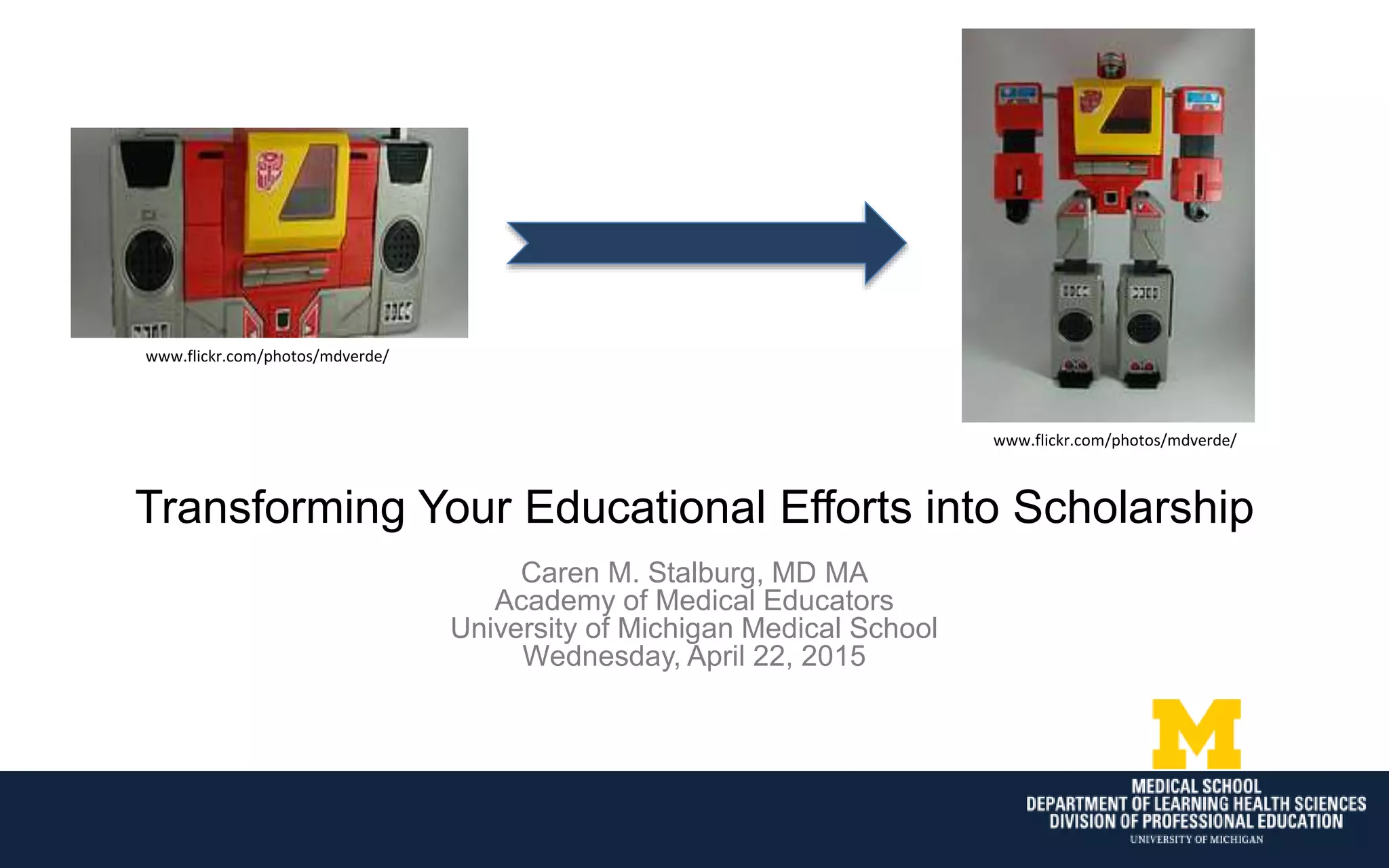
Transforming Your Educational Efforts into Scholarship
Caren M. Stalburg, MD MA
Academy of Medical Educators
University of Michigan Medical School
Wednesday, April 22, 2015
www.flickr.com/photos/mdverde/
Disclosures
• No relevant conflicts of interest
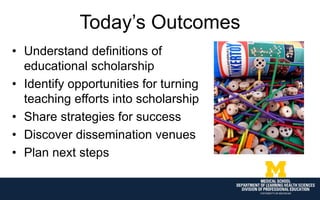
Today’s Outcomes
• Understand definitions of
educational scholarship
• Identify opportunities for turning
teaching efforts into scholarship
• Share strategies for success
• Discover dissemination venues
• Plan next steps
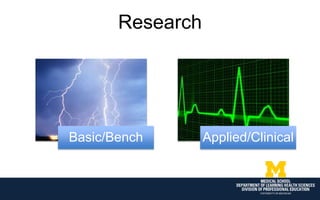
Research
Basic/Bench Applied/Clinical
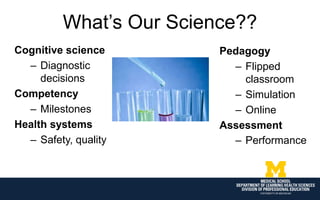
What’s Our Science??
Cognitive science
– Diagnostic
decisions
Competency
– Milestones
Health systems
– Safety, quality
Pedagogy
– Flipped
classroom
– Simulation
– Online
Assessment
– Performance
Where are our labs??
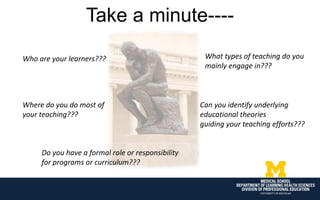
Take a minute----
Who are your learners???
Where do you do most of
your teaching???
Do you have a formal role or responsibility
for programs or curriculum???
What types of teaching do you
mainly engage in???
Can you identify underlying
educational theories
guiding your teaching efforts???
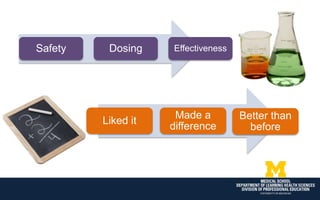
Safety Dosing Effectiveness
Liked it
Made a
difference
Better than
before
Where to begin???
• Do you need a question?
• Do you need a study design?
• What kind of data do you need?
• Do you need help figuring out what to
do with data you already have???
Small Group Discussions
Report out from the groups
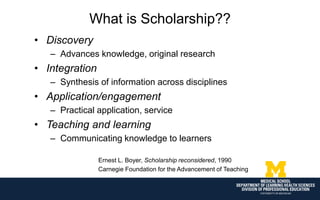
What is Scholarship??
• Discovery
– Advances knowledge, original research
• Integration
– Synthesis of information across disciplines
• Application/engagement
– Practical application, service
• Teaching and learning
– Communicating knowledge to learners
Ernest L. Boyer, Scholarship reconsidered, 1990
Carnegie Foundation for the Advancement of Teaching
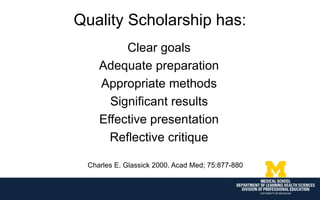
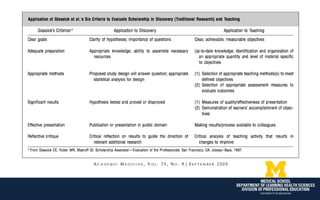
Quality Scholarship has:
Clear goals
Adequate preparation
Appropriate methods
Significant results
Effective presentation
Reflective critique
Charles E. Glassick 2000. Acad Med; 75:877-880
Steps for scholarly projects
• Refine the study question
• Identify designs and methods
• Select outcomes
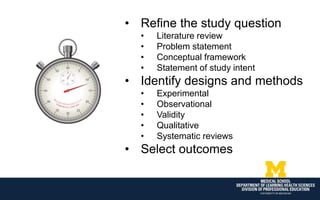
• Refine the study question
• Literature review
• Problem statement
• Conceptual framework
• Statement of study intent
• Identify designs and methods
• Experimental
• Observational
• Validity
• Qualitative
• Systematic reviews
• Select outcomes
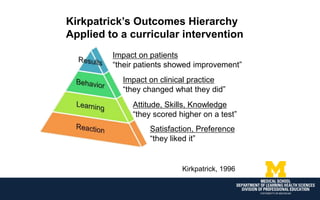
Kirkpatrick’s Outcomes Hierarchy
Applied to a curricular intervention
Impact on patients
“their patients showed improvement”
Impact on clinical practice
“they changed what they did”
Attitude, Skills, Knowledge
“they scored higher on a test”
Satisfaction, Preference
“they liked it”
Kirkpatrick, 1996
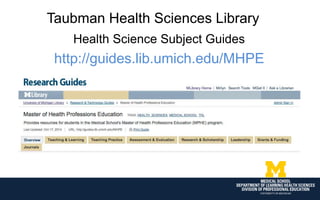
Health Science Subject Guides
http://guides.lib.umich.edu/MHPE
Taubman Health Sciences Library
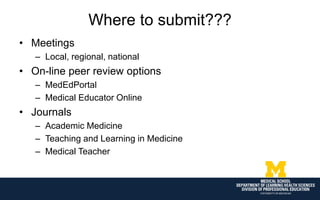
Where to submit???
• Meetings
– Local, regional, national
• On-line peer review options
– MedEdPortal
– Medical Educator Online
• Journals
– Academic Medicine
– Teaching and Learning in Medicine
– Medical Teacher
Next steps !!!
• Ideas for the Academy?
• Ideas in your Department?
• Support
– Science X-Prize
– DPE Buddy grants
• medicine.umich.edu/dept/learning-health-sciences
• carens@umich.edu

Transforming Your Educational Efforts into Scholarship

  • 1.
    Transforming Your EducationalEfforts into Scholarship Caren M. Stalburg, MD MA Academy of Medical Educators University of Michigan Medical School Wednesday, April 22, 2015 www.flickr.com/photos/mdverde/ www.flickr.com/photos/mdverde/
  • 2.
    Disclosures • No relevantconflicts of interest
  • 3.
    Today’s Outcomes • Understanddefinitions of educational scholarship • Identify opportunities for turning teaching efforts into scholarship • Share strategies for success • Discover dissemination venues • Plan next steps
  • 4.
  • 5.
    What’s Our Science?? Cognitivescience – Diagnostic decisions Competency – Milestones Health systems – Safety, quality Pedagogy – Flipped classroom – Simulation – Online Assessment – Performance
  • 6.
  • 7.
    Take a minute---- Whoare your learners??? Where do you do most of your teaching??? Do you have a formal role or responsibility for programs or curriculum??? What types of teaching do you mainly engage in??? Can you identify underlying educational theories guiding your teaching efforts???
  • 8.
    Safety Dosing Effectiveness Likedit Made a difference Better than before
  • 9.
    Where to begin??? •Do you need a question? • Do you need a study design? • What kind of data do you need? • Do you need help figuring out what to do with data you already have???
  • 10.
  • 12.
    Report out fromthe groups
  • 13.
    What is Scholarship?? •Discovery – Advances knowledge, original research • Integration – Synthesis of information across disciplines • Application/engagement – Practical application, service • Teaching and learning – Communicating knowledge to learners Ernest L. Boyer, Scholarship reconsidered, 1990 Carnegie Foundation for the Advancement of Teaching
  • 14.
    Quality Scholarship has: Cleargoals Adequate preparation Appropriate methods Significant results Effective presentation Reflective critique Charles E. Glassick 2000. Acad Med; 75:877-880
  • 18.
    Steps for scholarlyprojects • Refine the study question • Identify designs and methods • Select outcomes
  • 19.
    • Refine thestudy question • Literature review • Problem statement • Conceptual framework • Statement of study intent • Identify designs and methods • Experimental • Observational • Validity • Qualitative • Systematic reviews • Select outcomes
  • 20.
    Kirkpatrick’s Outcomes Hierarchy Appliedto a curricular intervention Impact on patients “their patients showed improvement” Impact on clinical practice “they changed what they did” Attitude, Skills, Knowledge “they scored higher on a test” Satisfaction, Preference “they liked it” Kirkpatrick, 1996
  • 21.
    Health Science SubjectGuides http://guides.lib.umich.edu/MHPE Taubman Health Sciences Library
  • 22.
    Where to submit??? •Meetings – Local, regional, national • On-line peer review options – MedEdPortal – Medical Educator Online • Journals – Academic Medicine – Teaching and Learning in Medicine – Medical Teacher
  • 26.
    Next steps !!! •Ideas for the Academy? • Ideas in your Department? • Support – Science X-Prize – DPE Buddy grants • medicine.umich.edu/dept/learning-health-sciences • carens@umich.edu

Editor's Notes

  • #5 http://commons.wikimedia.org/wiki/File:Lightning3.jpg