
Part of the Yorkshire & Humber AHSN 
e: academy@yhahsn.nhs.uk/ t: 01274 383926 www.improvementacademy.org Or visit our Academy Office: Bradford Institute for Health Research Temple Bank House / Duckworth Lane / Bradford / BD9 6RJ 
Achieving Behaviour Change for Patient safety 
Dr Judith Dyson 
Academic Improvement Fellow
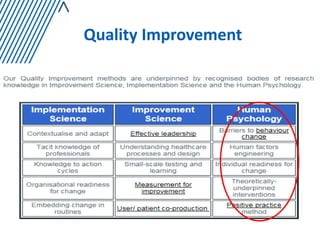
Quality Improvement
Background
Lets first consider behaviour 
•Health behaviour 
•Patients concordance 
•Implementation 
What determines our behaviour? 
What strategies do we generally employ to change?
Evidence tells us 
•We need to assess individual barriers and levers 
•We need to tailor our strategies according to these 
•We need a theoretical approach to assessment and the intervention 
•(Michie et al., 2005, Baker et al., 2010, MRC guidelines for complex interventions)
Psychological theory is useful 
•Interventions designed based on theory have greater effects on behaviour than those that are not (Webb et al., 2010; Taylor, Conner, & Lawton, 2012)
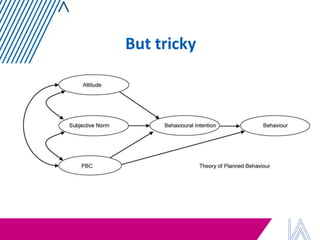
But tricky
Domain 
Meaning 
Knowledge 
Does the person know they should be doing behaviour X? Do they understand? 
Skills 
Does the person know how to do the behaviour (X)? How easy or difficult is it? 
Beliefs about capabilities 
How easy is it for the person to do X? Have they previously encountered problems? How confident are they that they can overcome difficulties? 
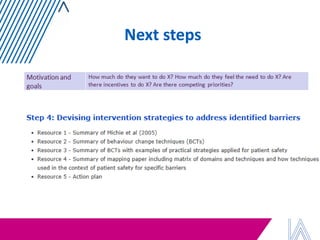
Motivation and goals 
How much do they want to do X? How much do they feel the need to do X? Are there incentives to do X? Are there competing priorities? 
Environment 
To what extent do physical or resource factors hinder X? Time? 
Beliefs about consequences 
What do they think will happen if they do X? What are the costs/consequences of doing X? Does the evidence suggest that doing X is a good thing? 
Emotion 
Does doing X evoke an emotional response? To what extent do emotional factors help or hinder X? How does emotion affect X? 
Social influences 
To what extent do social influences help or hinder X? Will the person observe others doing X? 
Memory/attention 
Can the person remember to do behaviour X? Do they usually do X? 
Action planning 
Does the person put plans in place to ensure they do the behaviour? 
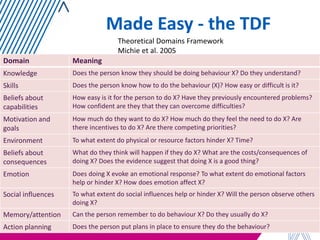
Made Easy - the TDF 
Theoretical Domains Framework 
Michie et al. 2005
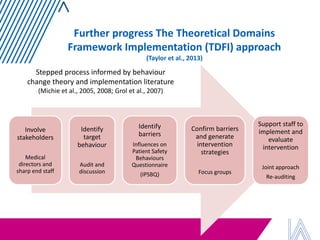
Stepped process informed by behaviour change theory and implementation literature (Michie et al., 2005, 2008; Grol et al., 2007) 
Involve stakeholders 
Medical directors and sharp end staff 
Identify target behaviour 
Audit and discussion 
Identify barriers 
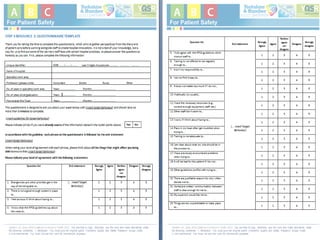
Influences on Patient Safety Behaviours Questionnaire 
(IPSBQ) 
Confirm barriers and generate intervention strategies Focus groups 
Support staff to implement and evaluate intervention 
Joint approach 
Re-auditing 
Further progress The Theoretical Domains Framework Implementation (TDFI) approach (Taylor et al., 2013)
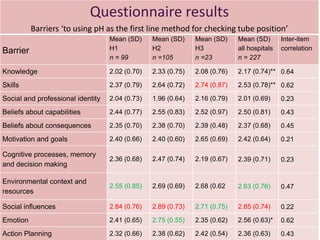
Questionnaire results 
Barriers ‘to using pH as the first line method for checking tube position’ 
Barrier 
Mean (SD) H1 
n = 99 
Mean (SD) H2 
n =105 
Mean (SD) H3 
n =23 
Mean (SD) all hospitals 
n = 227 
Inter-item correlation 
Knowledge 
2.02 (0.70) 
2.33 (0.75) 
2.08 (0.76) 
2.17 (0.74)** 
0.64 
Skills 
2.37 (0.79) 
2.64 (0.72) 
2.74 (0.87) 
2.53 (0.78)** 
0.62 
Social and professional identity 
2.04 (0.73) 
1.96 (0.64) 
2.16 (0.79) 
2.01 (0.69) 
0.23 
Beliefs about capabilities 
2.44 (0.77) 
2.55 (0.83) 
2.52 (0.97) 
2.50 (0.81) 
0.43 
Beliefs about consequences 
2.35 (0.70) 
2.38 (0.70) 
2.39 (0.48) 
2.37 (0.68) 
0.45 
Motivation and goals 
2.40 (0.66) 
2.40 (0.60) 
2.65 (0.69) 
2.42 (0.64) 
0.21 
Cognitive processes, memory and decision making 
2.36 (0.68) 
2.47 (0.74) 
2.19 (0.67) 
2.39 (0.71) 
0.23 
Environmental context and resources 
2.55 (0.85) 
2.69 (0.69) 
2.68 (0.62 
2.63 (0.76) 
0.47 
Social influences 
2.84 (0.76) 
2.89 (0.73) 
2.71 (0.75) 
2.85 (0.74) 
0.22 
Emotion 
2.41 (0.65) 
2.75 (0.55) 
2.35 (0.62) 
2.56 (0.63)* 
0.62 
Action Planning 
2.32 (0.66) 
2.38 (0.62) 
2.42 (0.54) 
2.36 (0.63) 
0.43
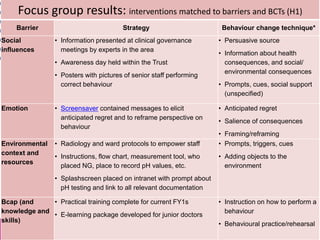
Focus group results: interventions matched to barriers and BCTs (H1) 
Barrier 
Strategy 
Behaviour change technique* 
Social influences 
•Information presented at clinical governance meetings by experts in the area 
•Awareness day held within the Trust 
•Posters with pictures of senior staff performing correct behaviour 
•Persuasive source 
•Information about health consequences, and social/ environmental consequences 
•Prompts, cues, social support (unspecified) 
Emotion 
•Screensaver contained messages to elicit anticipated regret and to reframe perspective on behaviour 
•Anticipated regret 
•Salience of consequences 
•Framing/reframing 
Environmental context and resources 
•Radiology and ward protocols to empower staff 
•Instructions, flow chart, measurement tool, who placed NG, place to record pH values, etc. 
•Splashscreen placed on intranet with prompt about pH testing and link to all relevant documentation 
•Prompts, triggers, cues 
•Adding objects to the environment 
Bcap (and knowledge and skills) 
•Practical training complete for current FY1s 
•E-learning package developed for junior doctors 
•Instruction on how to perform a behaviour 
•Behavioural practice/rehearsal
0% 
10% 
20% 
30% 
40% 
50% 
60% 
70% 
80% 
90% 
100% 
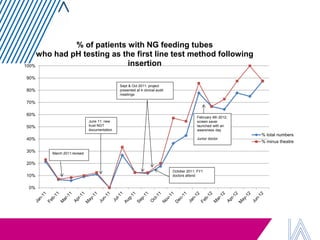
% of patients with NG feeding tubes 
who had pH testing as the first line test method following insertion 
% total numbers 
% minus theatre 
March 2011:revised 
Sept & Oct 2011: project presented at 4 clinical audit meetings 
October 2011; FY1 doctors attend 
June 11: new trust NGT documentation 
February 4th 2012; screen saver launched with an awareness day 
Junior doctor
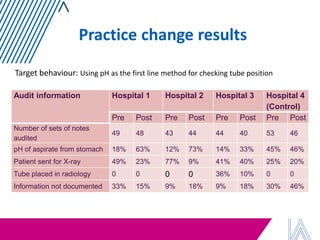
Practice change results 
Audit information 
Hospital 1 
Hospital 2 
Hospital 3 
Hospital 4 (Control) 
Pre 
Post 
Pre 
Post 
Pre 
Post 
Pre 
Post 
Number of sets of notes audited 
49 
48 
43 
44 
44 
40 
53 
46 
pH of aspirate from stomach 
18% 
63% 
12% 
73% 
14% 
33% 
45% 
46% 
Patient sent for X-ray 
49% 
23% 
77% 
9% 
41% 
40% 
25% 
20% 
Tube placed in radiology 
0 
0 
0 
0 
36% 
10% 
0 
0 
Information not documented 
33% 
15% 
9% 
18% 
9% 
18% 
30% 
46% 
Target behaviour: Using pH as the first line method for checking tube position
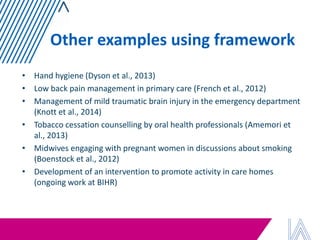
Other examples using framework 
•Hand hygiene (Dyson et al., 2013) 
•Low back pain management in primary care (French et al., 2012) 
•Management of mild traumatic brain injury in the emergency department (Knott et al., 2014) 
•Tobacco cessation counselling by oral health professionals (Amemori et al., 2013) 
•Midwives engaging with pregnant women in discussions about smoking (Boenstock et al., 2012) 
•Development of an intervention to promote activity in care homes (ongoing work at BIHR)
Putting it into practice 
•The improvement academy 
•Behaviour change workshops 
•The toolkit 
•My role within the academy
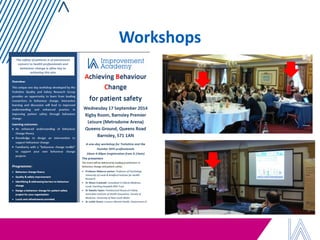
Workshops
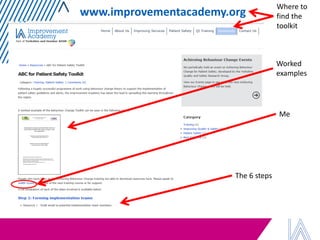
Where to find the toolkit 
The 6 steps 
Me 
Worked 
examples 
www.improvementacademy.org
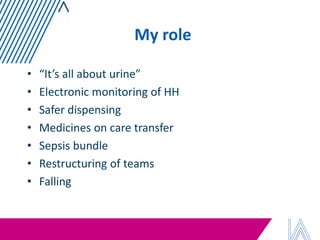
My role 
•“It’s all about urine” 
•Electronic monitoring of HH 
•Safer dispensing 
•Medicines on care transfer 
•Sepsis bundle 
•Restructuring of teams 
•Falling
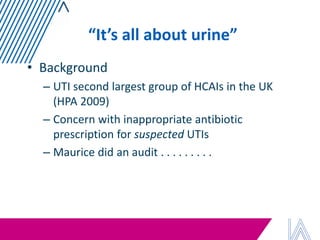
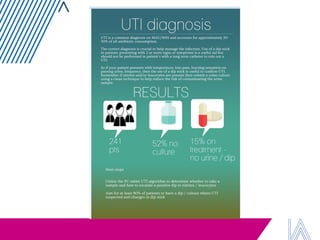
“It’s all about urine” 
•Background 
–UTI second largest group of HCAIs in the UK (HPA 2009) 
–Concern with inappropriate antibiotic prescription for suspected UTIs 
–Maurice did an audit . . . . . . . . .
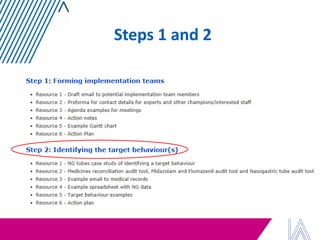
Steps 1 and 2
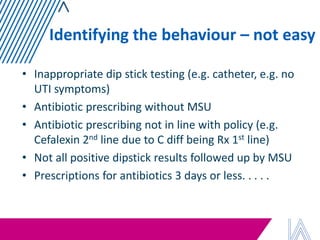
Identifying the behaviour – not easy 
•Inappropriate dip stick testing (e.g. catheter, e.g. no UTI symptoms) 
•Antibiotic prescribing without MSU 
•Antibiotic prescribing not in line with policy (e.g. Cefalexin 2nd line due to C diff being Rx 1st line) 
•Not all positive dipstick results followed up by MSU 
•Prescriptions for antibiotics 3 days or less. . . . .
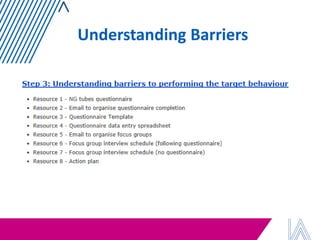
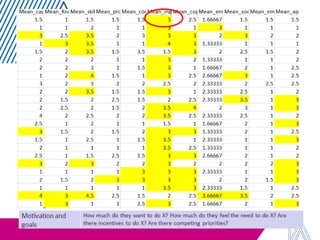
Understanding Barriers
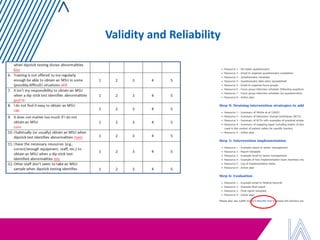
Validity and Reliability
What do you think the barriers are? 
•Sending an MSU after a dipstick when nursing assistants discover leucocytes and nitrates?
Next steps
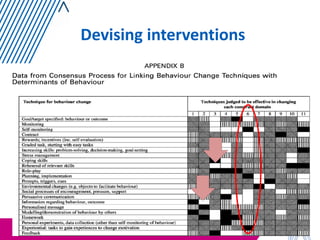
Devising interventions
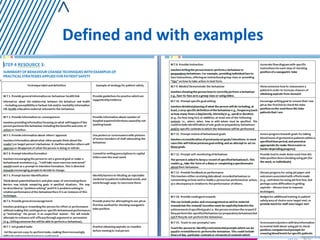
Defined and with examples
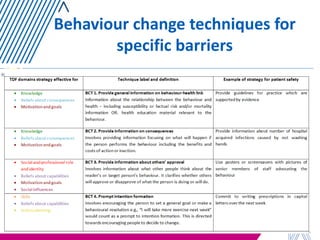
Behaviour change techniques for specific barriers
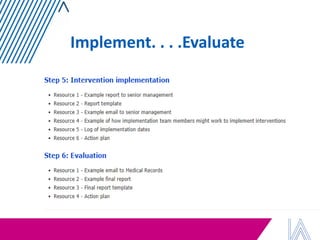
Implement. . . .Evaluate
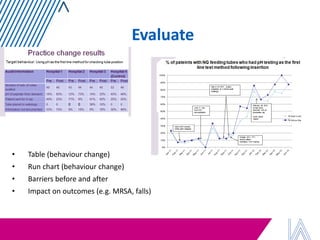
Evaluate 
•Table (behaviour change) 
•Run chart (behaviour change) 
•Barriers before and after 
•Impact on outcomes (e.g. MRSA, falls)
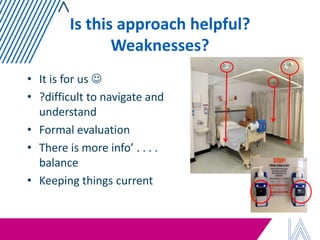
Is this approach helpful? Weaknesses? 
•It is for us  
•?difficult to navigate and understand 
•Formal evaluation 
•There is more info’ . . . . balance 
•Keeping things current
Is this approach helpful? Strengths 
•Flexibility e.g number of domains included/relevant 
•Flexibility – use for patient interventions (exercise, MOLES, PEEP) 
•Flexibility – in reverse (e.g. PEEP, another (local) electronic HH monitoring study) 
•Large body of evidence, literature, experience – further pushing the boundaries 
•The future . . . . further spread . . . your thoughts
Thank you 
Any questions? Feel free to contact me: Judith Dyson J.Dyson@hull.ac.uk 
Follow the academy @improve_academy 
www.improvementacademy.org

judith dyson collaborative launch

  • 1.
    Part of theYorkshire & Humber AHSN e: academy@yhahsn.nhs.uk/ t: 01274 383926 www.improvementacademy.org Or visit our Academy Office: Bradford Institute for Health Research Temple Bank House / Duckworth Lane / Bradford / BD9 6RJ Achieving Behaviour Change for Patient safety Dr Judith Dyson Academic Improvement Fellow
  • 2.
  • 3.
  • 4.
    Lets first considerbehaviour •Health behaviour •Patients concordance •Implementation What determines our behaviour? What strategies do we generally employ to change?
  • 5.
    Evidence tells us •We need to assess individual barriers and levers •We need to tailor our strategies according to these •We need a theoretical approach to assessment and the intervention •(Michie et al., 2005, Baker et al., 2010, MRC guidelines for complex interventions)
  • 6.
    Psychological theory isuseful •Interventions designed based on theory have greater effects on behaviour than those that are not (Webb et al., 2010; Taylor, Conner, & Lawton, 2012)
  • 7.
  • 8.
    Domain Meaning Knowledge Does the person know they should be doing behaviour X? Do they understand? Skills Does the person know how to do the behaviour (X)? How easy or difficult is it? Beliefs about capabilities How easy is it for the person to do X? Have they previously encountered problems? How confident are they that they can overcome difficulties? Motivation and goals How much do they want to do X? How much do they feel the need to do X? Are there incentives to do X? Are there competing priorities? Environment To what extent do physical or resource factors hinder X? Time? Beliefs about consequences What do they think will happen if they do X? What are the costs/consequences of doing X? Does the evidence suggest that doing X is a good thing? Emotion Does doing X evoke an emotional response? To what extent do emotional factors help or hinder X? How does emotion affect X? Social influences To what extent do social influences help or hinder X? Will the person observe others doing X? Memory/attention Can the person remember to do behaviour X? Do they usually do X? Action planning Does the person put plans in place to ensure they do the behaviour? Made Easy - the TDF Theoretical Domains Framework Michie et al. 2005
  • 9.
    Stepped process informedby behaviour change theory and implementation literature (Michie et al., 2005, 2008; Grol et al., 2007) Involve stakeholders Medical directors and sharp end staff Identify target behaviour Audit and discussion Identify barriers Influences on Patient Safety Behaviours Questionnaire (IPSBQ) Confirm barriers and generate intervention strategies Focus groups Support staff to implement and evaluate intervention Joint approach Re-auditing Further progress The Theoretical Domains Framework Implementation (TDFI) approach (Taylor et al., 2013)
  • 10.
    Questionnaire results Barriers‘to using pH as the first line method for checking tube position’ Barrier Mean (SD) H1 n = 99 Mean (SD) H2 n =105 Mean (SD) H3 n =23 Mean (SD) all hospitals n = 227 Inter-item correlation Knowledge 2.02 (0.70) 2.33 (0.75) 2.08 (0.76) 2.17 (0.74)** 0.64 Skills 2.37 (0.79) 2.64 (0.72) 2.74 (0.87) 2.53 (0.78)** 0.62 Social and professional identity 2.04 (0.73) 1.96 (0.64) 2.16 (0.79) 2.01 (0.69) 0.23 Beliefs about capabilities 2.44 (0.77) 2.55 (0.83) 2.52 (0.97) 2.50 (0.81) 0.43 Beliefs about consequences 2.35 (0.70) 2.38 (0.70) 2.39 (0.48) 2.37 (0.68) 0.45 Motivation and goals 2.40 (0.66) 2.40 (0.60) 2.65 (0.69) 2.42 (0.64) 0.21 Cognitive processes, memory and decision making 2.36 (0.68) 2.47 (0.74) 2.19 (0.67) 2.39 (0.71) 0.23 Environmental context and resources 2.55 (0.85) 2.69 (0.69) 2.68 (0.62 2.63 (0.76) 0.47 Social influences 2.84 (0.76) 2.89 (0.73) 2.71 (0.75) 2.85 (0.74) 0.22 Emotion 2.41 (0.65) 2.75 (0.55) 2.35 (0.62) 2.56 (0.63)* 0.62 Action Planning 2.32 (0.66) 2.38 (0.62) 2.42 (0.54) 2.36 (0.63) 0.43
  • 11.
    Focus group results:interventions matched to barriers and BCTs (H1) Barrier Strategy Behaviour change technique* Social influences •Information presented at clinical governance meetings by experts in the area •Awareness day held within the Trust •Posters with pictures of senior staff performing correct behaviour •Persuasive source •Information about health consequences, and social/ environmental consequences •Prompts, cues, social support (unspecified) Emotion •Screensaver contained messages to elicit anticipated regret and to reframe perspective on behaviour •Anticipated regret •Salience of consequences •Framing/reframing Environmental context and resources •Radiology and ward protocols to empower staff •Instructions, flow chart, measurement tool, who placed NG, place to record pH values, etc. •Splashscreen placed on intranet with prompt about pH testing and link to all relevant documentation •Prompts, triggers, cues •Adding objects to the environment Bcap (and knowledge and skills) •Practical training complete for current FY1s •E-learning package developed for junior doctors •Instruction on how to perform a behaviour •Behavioural practice/rehearsal
  • 12.
    0% 10% 20% 30% 40% 50% 60% 70% 80% 90% 100% % of patients with NG feeding tubes who had pH testing as the first line test method following insertion % total numbers % minus theatre March 2011:revised Sept & Oct 2011: project presented at 4 clinical audit meetings October 2011; FY1 doctors attend June 11: new trust NGT documentation February 4th 2012; screen saver launched with an awareness day Junior doctor
  • 13.
    Practice change results Audit information Hospital 1 Hospital 2 Hospital 3 Hospital 4 (Control) Pre Post Pre Post Pre Post Pre Post Number of sets of notes audited 49 48 43 44 44 40 53 46 pH of aspirate from stomach 18% 63% 12% 73% 14% 33% 45% 46% Patient sent for X-ray 49% 23% 77% 9% 41% 40% 25% 20% Tube placed in radiology 0 0 0 0 36% 10% 0 0 Information not documented 33% 15% 9% 18% 9% 18% 30% 46% Target behaviour: Using pH as the first line method for checking tube position
  • 14.
    Other examples usingframework •Hand hygiene (Dyson et al., 2013) •Low back pain management in primary care (French et al., 2012) •Management of mild traumatic brain injury in the emergency department (Knott et al., 2014) •Tobacco cessation counselling by oral health professionals (Amemori et al., 2013) •Midwives engaging with pregnant women in discussions about smoking (Boenstock et al., 2012) •Development of an intervention to promote activity in care homes (ongoing work at BIHR)
  • 15.
    Putting it intopractice •The improvement academy •Behaviour change workshops •The toolkit •My role within the academy
  • 16.
  • 17.
    Where to findthe toolkit The 6 steps Me Worked examples www.improvementacademy.org
  • 18.
    My role •“It’sall about urine” •Electronic monitoring of HH •Safer dispensing •Medicines on care transfer •Sepsis bundle •Restructuring of teams •Falling
  • 19.
    “It’s all abouturine” •Background –UTI second largest group of HCAIs in the UK (HPA 2009) –Concern with inappropriate antibiotic prescription for suspected UTIs –Maurice did an audit . . . . . . . . .
  • 20.
  • 21.
    Identifying the behaviour– not easy •Inappropriate dip stick testing (e.g. catheter, e.g. no UTI symptoms) •Antibiotic prescribing without MSU •Antibiotic prescribing not in line with policy (e.g. Cefalexin 2nd line due to C diff being Rx 1st line) •Not all positive dipstick results followed up by MSU •Prescriptions for antibiotics 3 days or less. . . . .
  • 22.
  • 24.
  • 25.
    What do youthink the barriers are? •Sending an MSU after a dipstick when nursing assistants discover leucocytes and nitrates?
  • 27.
  • 28.
  • 29.
  • 30.
    Behaviour change techniquesfor specific barriers
  • 31.
    Implement. . ..Evaluate
  • 33.
    Evaluate •Table (behaviourchange) •Run chart (behaviour change) •Barriers before and after •Impact on outcomes (e.g. MRSA, falls)
  • 34.
    Is this approachhelpful? Weaknesses? •It is for us  •?difficult to navigate and understand •Formal evaluation •There is more info’ . . . . balance •Keeping things current
  • 35.
    Is this approachhelpful? Strengths •Flexibility e.g number of domains included/relevant •Flexibility – use for patient interventions (exercise, MOLES, PEEP) •Flexibility – in reverse (e.g. PEEP, another (local) electronic HH monitoring study) •Large body of evidence, literature, experience – further pushing the boundaries •The future . . . . further spread . . . your thoughts
  • 36.
    Thank you Anyquestions? Feel free to contact me: Judith Dyson J.Dyson@hull.ac.uk Follow the academy @improve_academy www.improvementacademy.org