Bridges to Sustainable Healthcare Transformation
    Through Evidence, Partnerships & Technology:
             19th International Conference
       San Francisco, CA, January 19-22, 2011

               Brad Doebbeling, MD, MSc
  Professor of Medicine, Epidemiology, & Biomedical
  Engineering, Indiana University School of Medicine
Senior Scientist, IU Center for Health Services Research,
       Indianapolis VA COE, Regenstrief Institute,
                       Indianapolis

                 Award Number: HHSA290200600013I, Task Order No. 4
Frameworks
Socio-technical Systems Framework


Social Subsystem                                           Technical Subsystem
• Key stakeholder views                                    • Usability
• Patient barriers/facilitators                            • Functionality/scope
• Organizational buy-in                                    • Computer/IT support
• Leadership support              Joint Optimization       •Flexibility in IT tools
• Training                        • Integration of CDS -   •Iterative design
• Unintended social               for CRC screening -      • Unintended technical
consequences                      into clinical workflow   consequences


                            External Subsystem (Context)
                            • PERFORMANCE MEASUREMENT
                            • Workload
                            • Financial factors
                            • Unintended external consequences
                                  Westbrook et al., JAMIA, 2007; Harrison et al., JAMIA 2007
Panarchy or Ecocycle Model of Change


      Renewal                                 Maturity


                                            Creative
         Birth
                                           Destruction

For more information on the ecocyle go to
http://www.plexusinstitute.org/edgeware/archive/think/main_aides9.html
Institutional level
                       A change in culture
                       A change in laws
                       A change in resource
                       distribution/availability


Organizational level
A change in strategies
A change in procedures
A change in resource
distribution/availability


                                                   Network or group level
                                                   A change in conversation
                                                   A change in routine
                                                   A change in resource
                                                   commitment or influence
                            Individual level
                                                     ―Getting To Maybe: How the World is Changed‖
                            A change of heart        Frances Westley, Brenda Zimmerman, Michael
                            A change of habits       Patton, 1996, Random House Canada
                            A change of ambition
Implementation & Spread
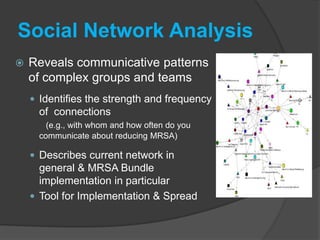
Social Network Analysis
   Reveals communicative patterns
    of complex groups and teams
     Identifies the strength and frequency
      of connections
        (e.g., with whom and how often do you
      communicate about reducing MRSA)

     Describes current network in
      general & MRSA Bundle
      implementation in particular
     Tool for Implementation & Spread
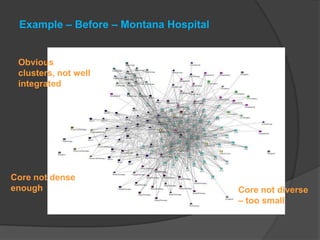
Example – Before – Montana Hospital


 Obvious
 clusters, not well
 integrated


Core not dense
enough                                 Core not diverse
                                       – too small
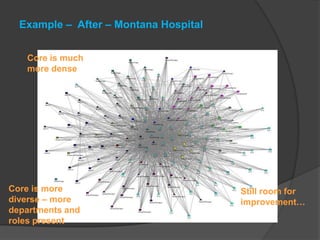
Example – After – Montana Hospital


   Core is much
   more dense


Core is more                           Still room for
diverse – more                         improvement…
departments and
roles present
Strategy
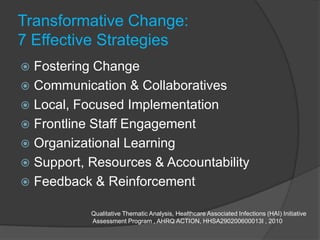
Transformative Change:
7 Effective Strategies
 Fostering Change
 Communication & Collaboratives
 Local, Focused Implementation
 Frontline Staff Engagement
 Organizational Learning
 Support, Resources & Accountability
 Feedback & Reinforcement

           Qualitative Thematic Analysis, Healthcare Associated Infections (HAI) Initiative
           Assessment Program , AHRQ ACTION, HHSA290200600013I , 2010
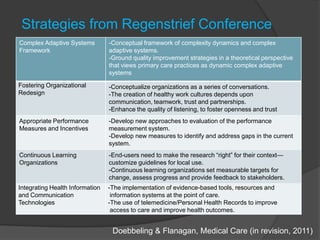
Strategies from Regenstrief Conference
Complex Adaptive Systems         -Conceptual framework of complexity dynamics and complex
Framework                        adaptive systems.
                                 -Ground quality improvement strategies in a theoretical perspective
                                 that views primary care practices as dynamic complex adaptive
                                 systems

Fostering Organizational         -Conceptualize organizations as a series of conversations.
Redesign                         -The creation of healthy work cultures depends upon
                                 communication, teamwork, trust and partnerships.
                                 -Enhance the quality of listening, to foster openness and trust
Appropriate Performance          -Develop new approaches to evaluation of the performance
Measures and Incentives          measurement system.
                                 -Develop new measures to identify and address gaps in the current
                                 system.
Continuous Learning              -End-users need to make the research ―right‖ for their context—
Organizations                    customize guidelines for local use.
                                 -Continuous learning organizations set measurable targets for
                                 change, assess progress and provide feedback to stakeholders.
Integrating Health Information   -The implementation of evidence-based tools, resources and
and Communication                 information systems at the point of care.
Technologies                     -The use of telemedicine/Personal Health Records to improve
                                  access to care and improve health outcomes.


                                  Doebbeling & Flanagan, Medical Care (in revision, 2011)
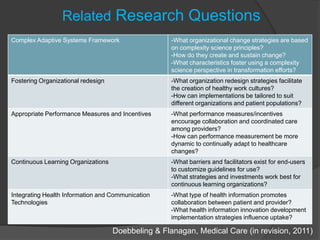
Related Research Questions
Complex Adaptive Systems Framework                  -What organizational change strategies are based
                                                    on complexity science principles?
                                                    -How do they create and sustain change?
                                                    -What characteristics foster using a complexity
                                                    science perspective in transformation efforts?
Fostering Organizational redesign                   -What organization redesign strategies facilitate
                                                    the creation of healthy work cultures?
                                                    -How can implementations be tailored to suit
                                                    different organizations and patient populations?
Appropriate Performance Measures and Incentives     -What performance measures/incentives
                                                    encourage collaboration and coordinated care
                                                    among providers?
                                                    -How can performance measurement be more
                                                    dynamic to continually adapt to healthcare
                                                    changes?
Continuous Learning Organizations                   -What barriers and facilitators exist for end-users
                                                    to customize guidelines for use?
                                                    -What strategies and investments work best for
                                                    continuous learning organizations?
Integrating Health Information and Communication    -What type of health information promotes
Technologies                                        collaboration between patient and provider?
                                                    -What health information innovation development
                                                    implementation strategies influence uptake?

                                    Doebbeling & Flanagan, Medical Care (in revision, 2011)
Needed R&D
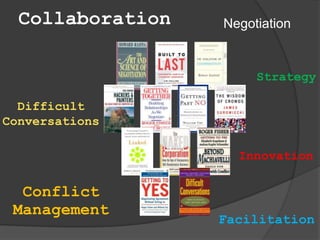
Collaboration   Negotiation


                       Strategy

  Difficult
Conversations

                    Innovation

  Conflict
 Management
                  Facilitation
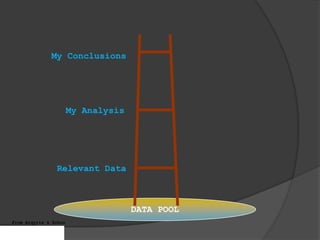
My Conclusions


                       My Analysis


                Relevant Data


                                     DATA POOL
                                     DATA POOL
From Argyris & Schon
The Publication
SHARE

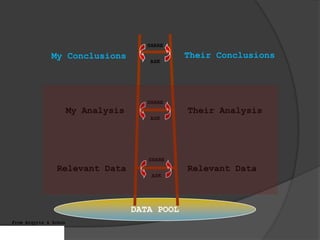
              My Conclusions                     Their Conclusions
                                         ASK


                                        SHARE
                       My Analysis               Their Analysis
                                         ASK


                                        SHARE
                Relevant Data                    Relevant Data
                                         ASK


                                     DATA POOL
                                     DATA POOL
From Argyris & Schon
Collaboration
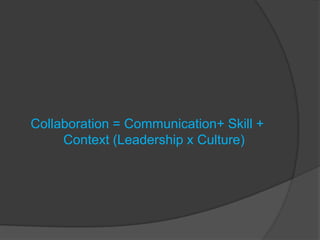
Collaboration = Communication+ Skill +
     Context (Leadership x Culture)
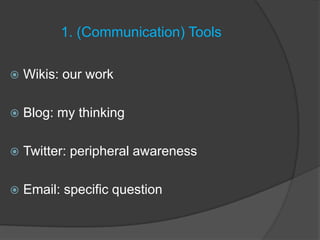
1. (Communication) Tools

   Wikis: our work

   Blog: my thinking

   Twitter: peripheral awareness

   Email: specific question
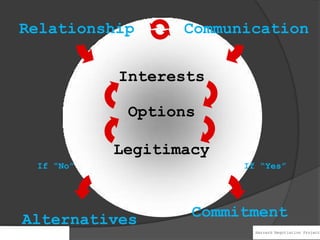
Relationship      Communication

           Interests

            Options

           Legitimacy
 If “No”                If “Yes”


Alternatives       Commitment
                          Harvard Negotiation Project
Needed R&D
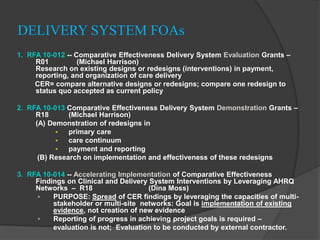
DELIVERY SYSTEM FOAs
1. RFA 10-012 -- Comparative Effectiveness Delivery System Evaluation Grants –
     R01          (Michael Harrison)
     Research on existing designs or redesigns (interventions) in payment,
     reporting, and organization of care delivery
     CER= compare alternative designs or redesigns; compare one redesign to
     status quo accepted as current policy

2. RFA 10-013 Comparative Effectiveness Delivery System Demonstration Grants –
     R18       (Michael Harrison)
     (A) Demonstration of redesigns in
              primary care
              care continuum
              payment and reporting
      (B) Research on implementation and effectiveness of these redesigns

3. RFA 10-014 -- Accelerating Implementation of Comparative Effectiveness
     Findings on Clinical and Delivery System Interventions by Leveraging AHRQ
     Networks – R18                    (Dina Moss)
         PURPOSE: Spread of CER findings by leveraging the capacities of multi-
          stakeholder or multi-site networks: Goal is implementation of existing
          evidence, not creation of new evidence
         Reporting of progress in achieving project goals is required –
          evaluation is not; Evaluation to be conducted by external contractor.
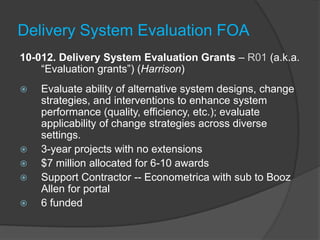
Delivery System Evaluation FOA
10-012. Delivery System Evaluation Grants – R01 (a.k.a.
    ―Evaluation grants‖) (Harrison)
   Evaluate ability of alternative system designs, change
    strategies, and interventions to enhance system
    performance (quality, efficiency, etc.); evaluate
    applicability of change strategies across diverse
    settings.
   3-year projects with no extensions
   $7 million allocated for 6-10 awards
   Support Contractor -- Econometrica with sub to Booz
    Allen for portal
   6 funded
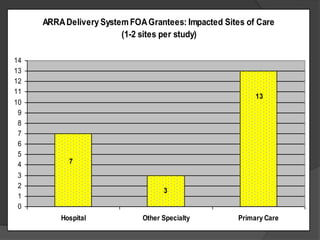
ARRA Delivery System FOA Grantees: Impacted Sites of Care
                        (1-2 sites per study)

14
13
12
11
                                                          13
10
 9
 8
 7
 6
 5
 4         7
 3
 2
                                   3
 1
 0
         Hospital            Other Specialty         Primary Care
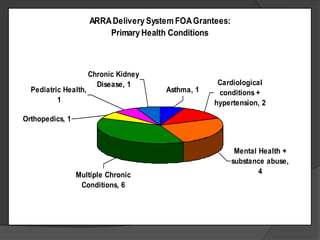
ARRA Delivery System FOA Grantees:
                          Primary Health Conditions


                      Chronic Kidney
                        Disease, 1                   Cardiological
  Pediatric Health,                     Asthma, 1    conditions +
          1                                         hypertension, 2

Orthopedics, 1


                                                            Mental Health +
                                                           substance abuse,
                 Multiple Chronic                                  4
                  Conditions, 6
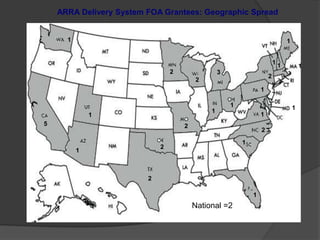
ARRA Delivery System FOA Grantees: Geographic Spread


      1                                                                        1


                                                                          11
                                                                                       1
                                 2                3
                                                                      2
                                         2
                                                                  1

                                                      1                            1
                                              1
              1                                                   1
5                                    2
                                                                  2
                                                          1
                             2
          1


                         2

                                                              1
                                         National =2
Needed R&D
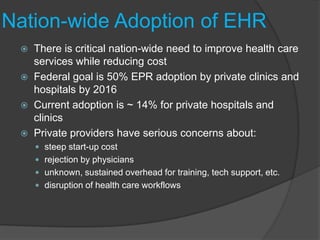
Nation-wide Adoption of EHR
    There is critical nation-wide need to improve health care
     services while reducing cost
    Federal goal is 50% EPR adoption by private clinics and
     hospitals by 2016
    Current adoption is ~ 14% for private hospitals and
     clinics
    Private providers have serious concerns about:
      steep start-up cost
      rejection by physicians
      unknown, sustained overhead for training, tech support, etc.
      disruption of health care workflows
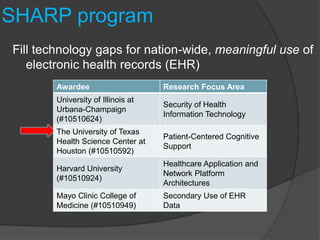
SHARP program
Fill technology gaps for nation-wide, meaningful use of
   electronic health records (EHR)
        Awardee                     Research Focus Area
        University of Illinois at
                                    Security of Health
        Urbana-Champaign
                                    Information Technology
        (#10510624)
        The University of Texas
                                    Patient-Centered Cognitive
        Health Science Center at
                                    Support
        Houston (#10510592)
                                    Healthcare Application and
        Harvard University
                                    Network Platform
        (#10510924)
                                    Architectures
        Mayo Clinic College of      Secondary Use of EHR
        Medicine (#10510949)        Data
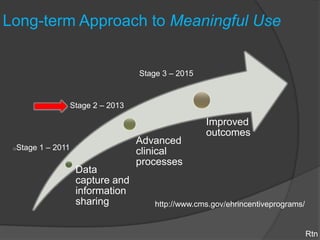
Long-term Approach to Meaningful Use


                                      Stage 3 – 2015


                     Stage 2 – 2013

                                                       Improved
                                                       outcomes
                                      Advanced
 oStage   1 – 2011
                                      clinical
                                      processes
                      Data
                      capture and
                      information
                      sharing             http://www.cms.gov/ehrincentiveprograms/


                                                                                     Rtn
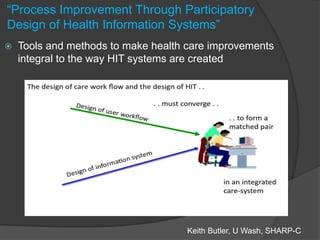
―Process Improvement Through Participatory
Design of Health Information Systems‖
   Tools and methods to make health care improvements
    integral to the way HIT systems are created


                                     Keith Butler, U Wash, SHARP-C
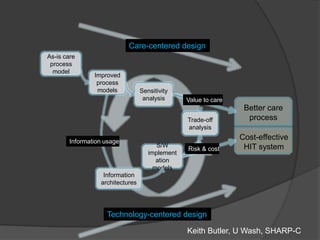
Care-centered design
As-is care
 process
  model
                Improved
                 process
                 models           Sensitivity
                                   analysis      Value to care
                                                                  Better care
                                                 Trade-off         process
                                                 analysis

        Information usage
                                                                 Cost-effective
                                        S/W                       HIT system
                                                 Risk & cost
                                     implement
                                        ation
                                       models
                   Information
                  architectures


                    Technology-centered design

                                                 Keith Butler, U Wash, SHARP-C
Acknowledgements
   Funding from AHRQ
     Testing Techniques to Radically Reduce Antibiotic Resistant
      Bacteria HHSA2902006000131 (Completed)
     Healthcare Associated Infections (HAI) Initiative Assessment
      Program HHSA290200600013I (Current)
     Implementing and Improving the Integration of Decision
      Support into Outpatient Clinical
      WorkflowHSA2902006000131(Current)
 Funding from AHRQ and CDC
     Testing Spread and Implementation of Novel MRSA-Reducing
      Practices HHSA290200600013 (Current)
 Thanks to our collaborators, partners, providers, patients!
 Thanks to Michael Harrison, PhD, AHRQ and Keith Butler, PhD, U
  Washington/SHARP-C
―Collaboration‖ – What does it
mean?
 ―Alone we can do so little; together we can do so

  much.‖ – Helen Keller
 ―Strength is derived from unity. The range of our
  collective vision is far greater when individual
  insights become one.‖ – Andrew Carnegie
Thank You!
   Questions?

 Contact
 Brad Doebbeling
 bdoebbeling@gmail.com

Advancing Transformational Science Doebbeling Cpmrc 1.22.11

  • 1.
    Bridges to SustainableHealthcare Transformation Through Evidence, Partnerships & Technology: 19th International Conference San Francisco, CA, January 19-22, 2011 Brad Doebbeling, MD, MSc Professor of Medicine, Epidemiology, & Biomedical Engineering, Indiana University School of Medicine Senior Scientist, IU Center for Health Services Research, Indianapolis VA COE, Regenstrief Institute, Indianapolis Award Number: HHSA290200600013I, Task Order No. 4
  • 2.
  • 4.
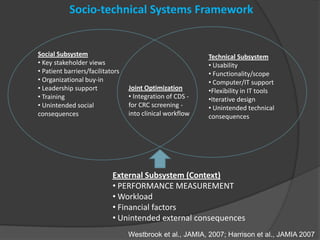
    Socio-technical Systems Framework SocialSubsystem Technical Subsystem • Key stakeholder views • Usability • Patient barriers/facilitators • Functionality/scope • Organizational buy-in • Computer/IT support • Leadership support Joint Optimization •Flexibility in IT tools • Training • Integration of CDS - •Iterative design • Unintended social for CRC screening - • Unintended technical consequences into clinical workflow consequences External Subsystem (Context) • PERFORMANCE MEASUREMENT • Workload • Financial factors • Unintended external consequences Westbrook et al., JAMIA, 2007; Harrison et al., JAMIA 2007
  • 5.
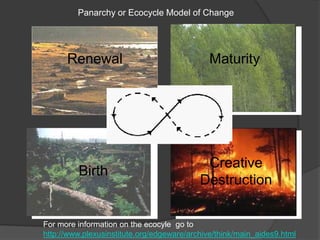
    Panarchy or EcocycleModel of Change Renewal Maturity Creative Birth Destruction For more information on the ecocyle go to http://www.plexusinstitute.org/edgeware/archive/think/main_aides9.html
  • 6.
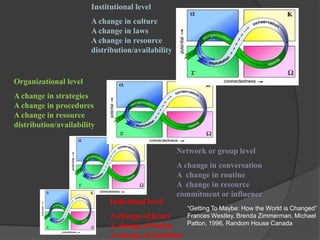
    Institutional level A change in culture A change in laws A change in resource distribution/availability Organizational level A change in strategies A change in procedures A change in resource distribution/availability Network or group level A change in conversation A change in routine A change in resource commitment or influence Individual level ―Getting To Maybe: How the World is Changed‖ A change of heart Frances Westley, Brenda Zimmerman, Michael A change of habits Patton, 1996, Random House Canada A change of ambition
  • 7.
  • 8.
    Social Network Analysis  Reveals communicative patterns of complex groups and teams  Identifies the strength and frequency of connections (e.g., with whom and how often do you communicate about reducing MRSA)  Describes current network in general & MRSA Bundle implementation in particular  Tool for Implementation & Spread
  • 9.
    Example – Before– Montana Hospital Obvious clusters, not well integrated Core not dense enough Core not diverse – too small
  • 10.
    Example – After– Montana Hospital Core is much more dense Core is more Still room for diverse – more improvement… departments and roles present
  • 11.
  • 12.
    Transformative Change: 7 EffectiveStrategies  Fostering Change  Communication & Collaboratives  Local, Focused Implementation  Frontline Staff Engagement  Organizational Learning  Support, Resources & Accountability  Feedback & Reinforcement Qualitative Thematic Analysis, Healthcare Associated Infections (HAI) Initiative Assessment Program , AHRQ ACTION, HHSA290200600013I , 2010
  • 13.
    Strategies from RegenstriefConference Complex Adaptive Systems -Conceptual framework of complexity dynamics and complex Framework adaptive systems. -Ground quality improvement strategies in a theoretical perspective that views primary care practices as dynamic complex adaptive systems Fostering Organizational -Conceptualize organizations as a series of conversations. Redesign -The creation of healthy work cultures depends upon communication, teamwork, trust and partnerships. -Enhance the quality of listening, to foster openness and trust Appropriate Performance -Develop new approaches to evaluation of the performance Measures and Incentives measurement system. -Develop new measures to identify and address gaps in the current system. Continuous Learning -End-users need to make the research ―right‖ for their context— Organizations customize guidelines for local use. -Continuous learning organizations set measurable targets for change, assess progress and provide feedback to stakeholders. Integrating Health Information -The implementation of evidence-based tools, resources and and Communication information systems at the point of care. Technologies -The use of telemedicine/Personal Health Records to improve access to care and improve health outcomes. Doebbeling & Flanagan, Medical Care (in revision, 2011)
  • 14.
    Related Research Questions ComplexAdaptive Systems Framework -What organizational change strategies are based on complexity science principles? -How do they create and sustain change? -What characteristics foster using a complexity science perspective in transformation efforts? Fostering Organizational redesign -What organization redesign strategies facilitate the creation of healthy work cultures? -How can implementations be tailored to suit different organizations and patient populations? Appropriate Performance Measures and Incentives -What performance measures/incentives encourage collaboration and coordinated care among providers? -How can performance measurement be more dynamic to continually adapt to healthcare changes? Continuous Learning Organizations -What barriers and facilitators exist for end-users to customize guidelines for use? -What strategies and investments work best for continuous learning organizations? Integrating Health Information and Communication -What type of health information promotes Technologies collaboration between patient and provider? -What health information innovation development implementation strategies influence uptake? Doebbeling & Flanagan, Medical Care (in revision, 2011)
  • 15.
  • 16.
    Collaboration Negotiation Strategy Difficult Conversations Innovation Conflict Management Facilitation
  • 17.
    My Conclusions My Analysis Relevant Data DATA POOL DATA POOL From Argyris & Schon
  • 18.
  • 19.
    SHARE My Conclusions Their Conclusions ASK SHARE My Analysis Their Analysis ASK SHARE Relevant Data Relevant Data ASK DATA POOL DATA POOL From Argyris & Schon
  • 20.
  • 21.
    Collaboration = Communication+Skill + Context (Leadership x Culture)
  • 22.
    1. (Communication) Tools  Wikis: our work  Blog: my thinking  Twitter: peripheral awareness  Email: specific question
  • 23.
    Relationship Communication Interests Options Legitimacy If “No” If “Yes” Alternatives Commitment Harvard Negotiation Project
  • 24.
  • 25.
    DELIVERY SYSTEM FOAs 1.RFA 10-012 -- Comparative Effectiveness Delivery System Evaluation Grants – R01 (Michael Harrison) Research on existing designs or redesigns (interventions) in payment, reporting, and organization of care delivery CER= compare alternative designs or redesigns; compare one redesign to status quo accepted as current policy 2. RFA 10-013 Comparative Effectiveness Delivery System Demonstration Grants – R18 (Michael Harrison) (A) Demonstration of redesigns in  primary care  care continuum  payment and reporting (B) Research on implementation and effectiveness of these redesigns 3. RFA 10-014 -- Accelerating Implementation of Comparative Effectiveness Findings on Clinical and Delivery System Interventions by Leveraging AHRQ Networks – R18 (Dina Moss)  PURPOSE: Spread of CER findings by leveraging the capacities of multi- stakeholder or multi-site networks: Goal is implementation of existing evidence, not creation of new evidence  Reporting of progress in achieving project goals is required – evaluation is not; Evaluation to be conducted by external contractor.
  • 26.
    Delivery System EvaluationFOA 10-012. Delivery System Evaluation Grants – R01 (a.k.a. ―Evaluation grants‖) (Harrison)  Evaluate ability of alternative system designs, change strategies, and interventions to enhance system performance (quality, efficiency, etc.); evaluate applicability of change strategies across diverse settings.  3-year projects with no extensions  $7 million allocated for 6-10 awards  Support Contractor -- Econometrica with sub to Booz Allen for portal  6 funded
  • 27.
    ARRA Delivery SystemFOA Grantees: Impacted Sites of Care (1-2 sites per study) 14 13 12 11 13 10 9 8 7 6 5 4 7 3 2 3 1 0 Hospital Other Specialty Primary Care
  • 28.
    ARRA Delivery SystemFOA Grantees: Primary Health Conditions Chronic Kidney Disease, 1 Cardiological Pediatric Health, Asthma, 1 conditions + 1 hypertension, 2 Orthopedics, 1 Mental Health + substance abuse, Multiple Chronic 4 Conditions, 6
  • 29.
    ARRA Delivery SystemFOA Grantees: Geographic Spread 1 1 11 1 2 3 2 2 1 1 1 1 1 1 5 2 2 1 2 1 2 1 National =2
  • 30.
  • 31.
    Nation-wide Adoption ofEHR  There is critical nation-wide need to improve health care services while reducing cost  Federal goal is 50% EPR adoption by private clinics and hospitals by 2016  Current adoption is ~ 14% for private hospitals and clinics  Private providers have serious concerns about:  steep start-up cost  rejection by physicians  unknown, sustained overhead for training, tech support, etc.  disruption of health care workflows
  • 32.
    SHARP program Fill technologygaps for nation-wide, meaningful use of electronic health records (EHR) Awardee Research Focus Area University of Illinois at Security of Health Urbana-Champaign Information Technology (#10510624) The University of Texas Patient-Centered Cognitive Health Science Center at Support Houston (#10510592) Healthcare Application and Harvard University Network Platform (#10510924) Architectures Mayo Clinic College of Secondary Use of EHR Medicine (#10510949) Data
  • 33.
    Long-term Approach toMeaningful Use Stage 3 – 2015 Stage 2 – 2013 Improved outcomes Advanced oStage 1 – 2011 clinical processes Data capture and information sharing http://www.cms.gov/ehrincentiveprograms/ Rtn
  • 34.
    ―Process Improvement ThroughParticipatory Design of Health Information Systems‖  Tools and methods to make health care improvements integral to the way HIT systems are created Keith Butler, U Wash, SHARP-C
  • 35.
    Care-centered design As-is care process model Improved process models Sensitivity analysis Value to care Better care Trade-off process analysis Information usage Cost-effective S/W HIT system Risk & cost implement ation models Information architectures Technology-centered design Keith Butler, U Wash, SHARP-C
  • 36.
    Acknowledgements  Funding from AHRQ  Testing Techniques to Radically Reduce Antibiotic Resistant Bacteria HHSA2902006000131 (Completed)  Healthcare Associated Infections (HAI) Initiative Assessment Program HHSA290200600013I (Current)  Implementing and Improving the Integration of Decision Support into Outpatient Clinical WorkflowHSA2902006000131(Current)  Funding from AHRQ and CDC  Testing Spread and Implementation of Novel MRSA-Reducing Practices HHSA290200600013 (Current)  Thanks to our collaborators, partners, providers, patients!  Thanks to Michael Harrison, PhD, AHRQ and Keith Butler, PhD, U Washington/SHARP-C
  • 37.
    ―Collaboration‖ – Whatdoes it mean?  ―Alone we can do so little; together we can do so much.‖ – Helen Keller  ―Strength is derived from unity. The range of our collective vision is far greater when individual insights become one.‖ – Andrew Carnegie
  • 38.
    Thank You!  Questions?  Contact  Brad Doebbeling  bdoebbeling@gmail.com

Editor's Notes

  • #9 Reveals communicative patterns of complex groups and teams Identifies the strength and frequency of the connections between members (e.g., with whom and how often do you communicate about reducing MRSA)Describes the current social network for work in general and the MRSA Bundle implementation in particular