Knowledge Management in
  Emergency Medicine


                  Chatchai Kraysubun, MD
           Head of Emergency Department
          Chaophaya abhaibhubejhr Hospital
Think I’d Like to Share

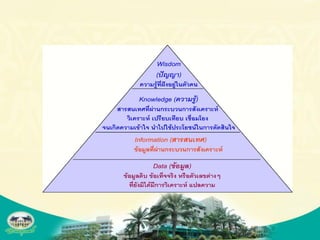
• All about Knowledge
• What is knowledge management ?
• What is knowledge translation ?
• How to apply KM & KT in ED
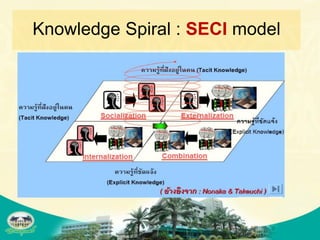
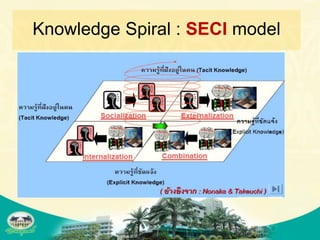
Knowledge Spiral : SECI model
Knowledge management


“The process through which organizations
generate value from their intellectual and
       knowledge-based assets.”


                   Knowledge Management Research Center
Knowledge management

“A systematic process of connecting people to
  people…and people to the knowledge and
  information they need to effectively act and
           create new knowledge.”

                  American Productivity and Quality Center
Why KM ?
• The world is flat ……
• Information Overload
• High competition
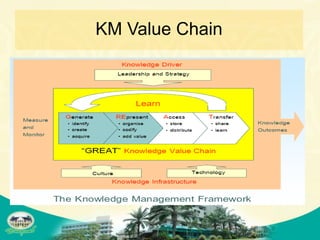
KM Value Chain
KM tool
Knowledge Spiral : SECI model
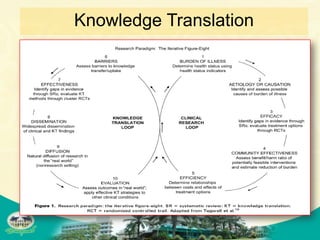
Knowledge Translation
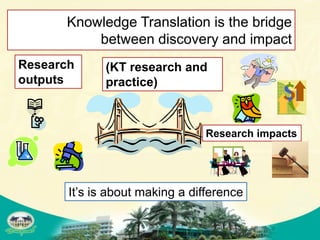
Knowledge Translation is the bridge
          between discovery and impact
Research      (KT research and
outputs       practice)


                                Research impacts


       It’s is about making a difference
Why Knowledge Translation?

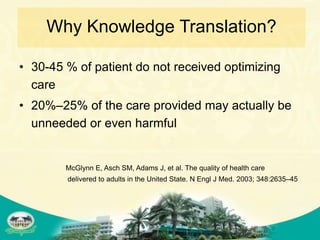
• 30-45 % of patient do not received optimizing
  care
• 20%–25% of the care provided may actually be
  unneeded or even harmful


        McGlynn E, Asch SM, Adams J, et al. The quality of health care
        delivered to adults in the United State. N Engl J Med. 2003; 348:2635–45
What is Knowledge Translation?

Knowledge translation is about:
• Apply knowledge to improve health care
• Closing the gap between what we know and what we do
  (reducing the know-do gap)
• Moving knowledge into action
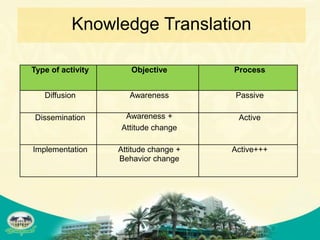
Knowledge Translation

Type of activity      Objective        Process


   Diffusion          Awareness        Passive

 Dissemination      Awareness +         Active
                   Attitude change

Implementation     Attitude change +   Active+++
                   Behavior change
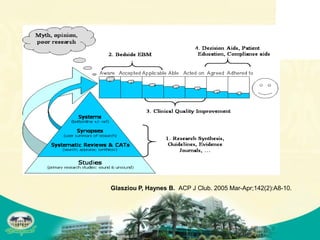
Glasziou P, Haynes B. ACP J Club. 2005 Mar-Apr;142(2):A8-10.
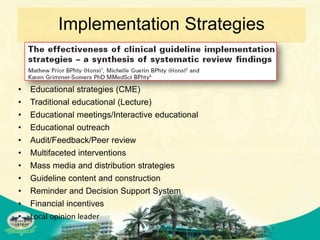
Implementation Strategies


•   Educational strategies (CME)
•   Traditional educational (Lecture)
•   Educational meetings/Interactive educational
•   Educational outreach
•   Audit/Feedback/Peer review
•   Multifaceted interventions
•   Mass media and distribution strategies
•   Guideline content and construction
•   Reminder and Decision Support System
•   Financial incentives
•   Local opinion leader
Implementation Strategies


• Multifaceted interventions
• interactive education
• clinical reminder systems
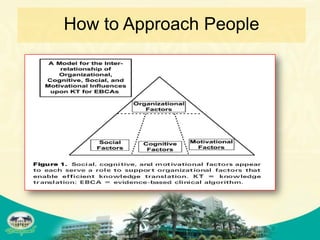
How to Approach People
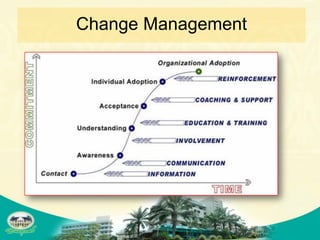
Change Management
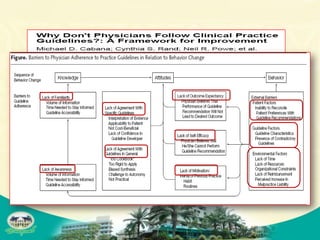
• Barrier
Knowledge Translation
Chaophayaabhaibhubejhr Experience
Scenario 1: Inhaler with Spacer
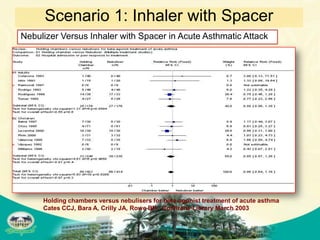
Nebulizer Versus Inhaler with Spacer in Acute Asthmatic Attack


     Holding chambers versus nebulisers for beta-agonist treatment of acute asthma
     Cates CCJ, Bara A, Crilly JA, Rowe BH. Cochrane Library March 2003
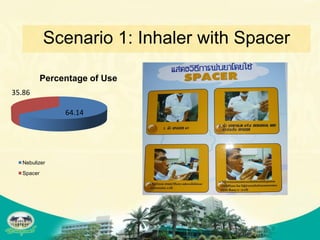
Scenario 1: Inhaler with Spacer

           Percentage of Use
35.86

                64.14


  Nebulizer
  Spacer
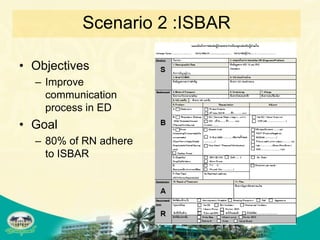
Scenario 2 :ISBAR

• Objectives
  – Improve
    communication
    process in ED
• Goal
  – 80% of RN adhere
    to ISBAR
Scenario 2 :ISBAR
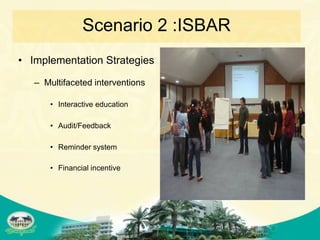
• Implementation Strategies

   – Multifaceted interventions

       • Interactive education

       • Audit/Feedback

       • Reminder system

       • Financial incentive
Scenario 3 : Prachinburi Triage Scale

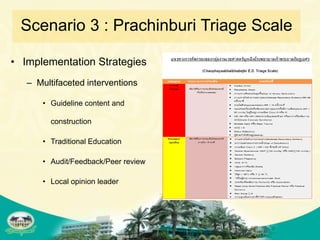
• Implementation Strategies
   – Multifaceted interventions

       • Guideline content and

         construction

       • Traditional Education

       • Audit/Feedback/Peer review

       • Local opinion leader
Scenario 4 : Disease Specified Management


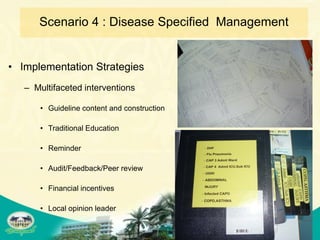
• Implementation Strategies
   – Multifaceted interventions

       • Guideline content and construction

       • Traditional Education

       • Reminder

       • Audit/Feedback/Peer review

       • Financial incentives

       • Local opinion leader

Knowledge management in emergency medicine

  • 1.
    Knowledge Management in Emergency Medicine Chatchai Kraysubun, MD Head of Emergency Department Chaophaya abhaibhubejhr Hospital
  • 2.
    Think I’d Liketo Share • All about Knowledge • What is knowledge management ? • What is knowledge translation ? • How to apply KM & KT in ED
  • 4.
  • 5.
    Knowledge management “The processthrough which organizations generate value from their intellectual and knowledge-based assets.” Knowledge Management Research Center
  • 6.
    Knowledge management “A systematicprocess of connecting people to people…and people to the knowledge and information they need to effectively act and create new knowledge.” American Productivity and Quality Center
  • 7.
    Why KM ? •The world is flat …… • Information Overload • High competition
  • 8.
  • 9.
  • 10.
  • 11.
  • 12.
    Knowledge Translation isthe bridge between discovery and impact Research (KT research and outputs practice) Research impacts It’s is about making a difference
  • 13.
    Why Knowledge Translation? •30-45 % of patient do not received optimizing care • 20%–25% of the care provided may actually be unneeded or even harmful McGlynn E, Asch SM, Adams J, et al. The quality of health care delivered to adults in the United State. N Engl J Med. 2003; 348:2635–45
  • 14.
    What is KnowledgeTranslation? Knowledge translation is about: • Apply knowledge to improve health care • Closing the gap between what we know and what we do (reducing the know-do gap) • Moving knowledge into action
  • 15.
  • 16.
    Knowledge Translation Type ofactivity Objective Process Diffusion Awareness Passive Dissemination Awareness + Active Attitude change Implementation Attitude change + Active+++ Behavior change
  • 17.
    Glasziou P, HaynesB. ACP J Club. 2005 Mar-Apr;142(2):A8-10.
  • 19.
    Implementation Strategies • Educational strategies (CME) • Traditional educational (Lecture) • Educational meetings/Interactive educational • Educational outreach • Audit/Feedback/Peer review • Multifaceted interventions • Mass media and distribution strategies • Guideline content and construction • Reminder and Decision Support System • Financial incentives • Local opinion leader
  • 20.
    Implementation Strategies • Multifacetedinterventions • interactive education • clinical reminder systems
  • 21.
  • 22.
  • 23.
  • 24.
  • 25.
    Scenario 1: Inhalerwith Spacer Nebulizer Versus Inhaler with Spacer in Acute Asthmatic Attack Holding chambers versus nebulisers for beta-agonist treatment of acute asthma Cates CCJ, Bara A, Crilly JA, Rowe BH. Cochrane Library March 2003
  • 26.
    Scenario 1: Inhalerwith Spacer Percentage of Use 35.86 64.14 Nebulizer Spacer
  • 27.
    Scenario 2 :ISBAR •Objectives – Improve communication process in ED • Goal – 80% of RN adhere to ISBAR
  • 28.
    Scenario 2 :ISBAR •Implementation Strategies – Multifaceted interventions • Interactive education • Audit/Feedback • Reminder system • Financial incentive
  • 29.
    Scenario 3 :Prachinburi Triage Scale • Implementation Strategies – Multifaceted interventions • Guideline content and construction • Traditional Education • Audit/Feedback/Peer review • Local opinion leader
  • 30.
    Scenario 4 :Disease Specified Management • Implementation Strategies – Multifaceted interventions • Guideline content and construction • Traditional Education • Reminder • Audit/Feedback/Peer review • Financial incentives • Local opinion leader