© 2016, IJCERT All Rights Reserved Page | 179
International Journal of Computer Engineering In Research Trends
Volume 3, Issue 4, April-2016, pp. 179-182 ISSN (O): 2349-7084
Implementation of Motion Model Using
Vanet
Komal Patil, Geeta Mahajan, Disha Patil, Chitra Mahajan
Abstract: - A collection of mobile nodes is known as ad-hoc network in which wireless communication network is used to
connect these mobile nodes. A major requirement on the MANET is to provide unidentifiability and unlinkability for mobile nodes
During the last few decades, continuous progresses in wireless communications have opened new research fields in computer
networking, goal of extending data networks connectivity to environments where wired solutions are impracticable. Among these,
vehicular traffic is attracting a increasing attention from both academic and industry, due to the amount and importance of the
related applications, ranging from road safety to traffic control, up to mobile entertainment. Vehicular Ad-hoc Network(VANETs)
are self-organized networks built up from moving vehicles, and are part of the broader class of Mobile Ad-hoc Net-
works(MANETs). Because of their peculiar characteristics, VANETs require the definition of specific networking techniques, whose
feasibility and performance are usually tested by means of simulation. One of the main challenges posed by VANETs simulations is
the faithful characterization of vehicular mobility at both macroscopic and microscopic levels, leads to realistic non-uniform
distributions of cars and velocity, and unique connectivity dynamics. There are various secure routing protocols have been
proposed, but the requirement is not satisfied. The existing protocols are unguarded to the attacks of fake routing packets.
Simulation results have demonstrated the effectiveness of the proposed AODV protocol with improved performance as compared
to the existing protocols.
Keywords – Vehicular Ad-hoc Network, Mobile Ad hoc Networks, AODV.
——————————  ——————————
1. INTRODUCTION
Mobile ad hoc networks (MANETs) are unguarded to
security threats due to the open wireless medium and
dynamic topology. It is difficult to provide the secure
communications in adversarial environments. The
adversaries outside a network may barrier the
information about the communicating nodes or traffic
flows. Also the nodes inside the network cannot be
trusted, since a valid node may be captured by enemies
and becomes malicious. Hence, anonymous
communications are important for MANETs in
adversarial environments.
In Section 1. a brief introduction is given with problem
definition. Related work with many secure routing
protocols in MANET technique is illustrated in Section
2. Proposed work with detailing is explained in Section
3. Performance evaluation and simulation results are
described in Section 4.Section 5 is all about the
conclusion of overall paper.
1.1. Motivation:
Motivation for proposed protocol lies in recently
growing issue in MANETs which is anonymity with
authentication. Already, there are various anonymous
routing protocols proposed but those not provide the
anonymity. We find that the objectives of
unindentifiability and unlinkability are not fully
satisfied by the already existing protocols. The
development of IVC protocols for VANET scenarios is
Available online at: www.ijcert.org
Patil Komal, et al., International Journal of Computer Engineering In Research Trends
Volume 3, Issue 4, April-2016, pp. 179-182
© 2016, IJCERT All Rights Reserved Page | 180
in the main focus of such simulations, e.g. for incident
detection such as traffic jam and accident detection.
Simulation models used to evaluate VANET scenarios
are usually implemented in C++ or JAVA for a specific
simulation framework. Also, the employed mobility
model is mostly either a simple model provided by the
network simulator or an trace of road. Based on this
observation
Identified three major issues that need to be considered
for future scope, i.e. there is tool support needed in
three dimensions:
1. Modeling- The development of simulation models is
very time costly and error prone. so that, the modeling
of simulation scenarios needs to be supported by
standardized modeling languages such as the Unified
Modeling Language(UML). Syntony is such an
approach that is completely integrated into the Eclipse
framework.
2. Mobility model- The evaluation of realistic road
requires accurate mobility models rather than simple
random waypoint models. Also, IVC protocols must be
able to directly interact with the road traffic simulation.
Therefore, bidirectional-coupled road traffic and
network simulation is necessary by Veins.
3.Model library- To support the quick and
comprehensive modeling of VANET ontolo-gies
scenarios, access to an extensive library of well-tested
models, e.g. the TCP/IPsuite, in a standard simulation
framework is needed.
1.2.ProblemDefinition
MANETs, the requirements of opposite
communications can be achieved by the combination of
unindentifiability and unlinkability. Already there are
so many anonymous routing protocols proposed. Our
main aim is the type of topology-based on-demand
routing protocols, which are general for MANETs in
adversarial environments. The commonly used on-
demand ad hoc routing protocols are DSR.
2. PROPOSED SYSTEM
The concept of vehicular micro-mobility includes all
aspects related to an individual car’s speed and
acceleration modeling. The micro-mobility description
plays the vital role in the generation of realistic
vehicular movements, as it is responsible for effects
such as smooth and fast variation, cars queues, traffic
jams and overtaking. Three broad classes of micro-
mobility models, featuring an raising degree of detail,
can be identified depending on whether the individual
speed of vehicles are calculated i) in a same way, ii) as
a function of adjacent vehicles behavior in a single lane
scenario, or iii) as a function of adjacent vehicles
behavior in a multi-flow interaction (i.e., urban)
scenario. CanuMobiSim provides implementations for
models regarding to the first two classes. The Graph-
Based Mobility Model (GBMM) , the Constant Speed
Motion (CSM) and the Smooth Motion Model (SMM)
fall into the first category, as the speed of each vehicle
is decided on the basis of the local state of each car and
any exterior effect is ignored. They all constrain a
dynamic movement of nodes on a graph, possibly
including pauses at intersections (CSM) or smooth
speed changes when reaching a destination (SSM). The
movement is randomly in a sense that vehicles select
one destination and move towards it along a shortest-
length path, neglecting (and thus possibly overlapping)
other vehicles during the motion. While these models
may work in isolate cars, they unsuccessful to
reproduce realistic movements of groups of Vehicles.
In this architecture we used FTM (Fluid Traffic Model)
.The FTM is for generating adjacent vehicles when
calculating the speed of a car. These models show car
mobility on single lanes, but do not consider the case in
which multiple vehicular flaws have to intermediate, as
in presence of intersections. The FTM describes the
speed as a monotonic manner decreasing function of
the vehicular density, forcing a lowest bound on speed
when the traffic congestion reaches a critical state, by
given equation:
S = max [Smin, Smax (1 – K / Kjam)] ….eq1
Where s is the output speed, smin means the minimum
and smax means greatest speed. kjam is the vehicular
density for which a traffic jam is detected, and k is the
vehicular density of the road the node, whose speed is
being calculated, is moving on. This last parameter is
Patil Komal, et al., International Journal of Computer Engineering In Research Trends
Volume 3, Issue 4, April-2016, pp. 179-182
© 2016, IJCERT All Rights Reserved Page | 181
given by k = n = l, where n is the number of cars on the
road and l is the length of the road segment itself.
1. Drop
The packet fall is counted by the total number of
packets dropped when a source node transform data
packet through the network for the target node. The
lower drop rate shows better execution in VANETs.
Packet drop (Pd) can be calculated using Eq. 1.
Pd = ∑Pr - ∑Ps
2. Throughput
Throughput means the total number of cars that have
been successfully delivered to the target nodes.
Normally, throughputs are measured in kbps, Mbps
and Gbps. The greater throughput result shows better
execution. Throughput can be defined as
Th = ∑Nt
3. Delay
A specific car is transmitted from source to target and
calculates the difference between sending times and
received times. The data were collected only
successfully delivered packets. The packet delay
always expected lower in VANETs. Delay(Di) can be
defined as Eq. 3.
Di = Rt - St
Where, Rt and St are the time of packet received and
transmit.
3. PERFORMANCE EVALUATION
The suggest approach is working with NS2 simulator.
AODV protocol is used for routing purpose with the
support of cryptographic functions. The mobile
network of 100 nodes is created with the boundary area
of 1500*1500 meter. The performances are comparison
of AODV to those of SEAD, SAODV in various
mobility and adversary scenarios. The radio uses the
two ray ground reflection dissemination model. The
channel capacity is 1Mbps. The transmission range is
150m. The Random Way Point (RWP) model is used to
model the nodal mobility. In our simulation, the
mobility is controlled in such a way that the speed
varies in the range of the minimum and maximum
speeds. A total of 15 UDP based CBR sessions are used
to generate the network traffic. For each session, the
data packets are generated with the size of 1000byte in
the rate of 1Mbps. The source-destination pairs are
chosen randomly from all the nodes.
Patil Komal, et al., International Journal of Computer Engineering In Research Trends
Volume 3, Issue 4, April-2016, pp. 179-182
© 2016, IJCERT All Rights Reserved Page | 182
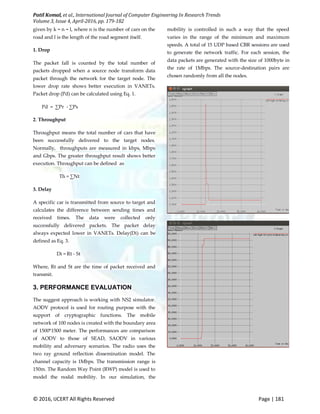
The present two groups of simulation results. The first
one is to compare the routing performances of AODV
under different mobility scenarios before the attacks.
The second one is to compare their behaviors under the
packet dropping packages with different levels. We
perform four simulation runs for each configuration,
4. CONCLUSION
In this project, the AODV protocol is used. The AODV
protocol is better than other protocol like as a DSR
protocol. In DSR protocol, when the data packets are
transfer from source to destination and if the proper
destination are not find out at that time they
droppinthe packets, but in AODV protocol if this
situation will be occur that time they choose the
intermediate path for data transmission to the proper
destination. Due to AODV protocol the performance is
increases, because the Advanced on demand roution
protocol(AODV) they are reduce the packet
losses.Also reduce the collision of packet. Also this
project used the FTM model and the FTM model is
better than IDM model. They are used for finding the
delay, throughput and dropping the packet.
5. FUTURE SCOPE
It presents two groups of simulation results. The first
one is to compare the routing performances of AODV,
SAODV, SEAD and AASR under different mobility
scenarios before the attacks. The second one is to
compare their behaviors under the packet dropping
packages with different levels. We perform four
simulation runs for each configuration, and record the
performances, including throughput, end-to-end delay
and controldatarate
REFERENCES
[1] F. J. Harri and C. Bonne, Mobility models for
vehicular ad hoc networks: A survey and taxonomy,"
Technical Report RR-06-168, Institut Eurecom
[2] I. S. J. Tian and K. Rothermel, Graph- based
mobility model for mobile ad-hoc network
simulation,"AnnualSimulation Symposium 2002.,
[3] F. F. J. Harri and C. Bonnet, A realistic mobility
simulator for vehicular ad hoc networks," Technical
Report RR- 05-150, Institut Eurecom, 2007.
[4] D. R. Choffines and F. E. Bustamante, Straw - an
integrated mobility and traffic model for vanets,"
Department of Computer Science Northwestern
University,
[5] O. B. Eichler S and Schroth, Simulation of car-to-
car messaging: Analyzing the impacton road traffic." In
Proceedings of the 13th IEEE International Symposium
on Modeling, Analysis, and Simulation of Computer
and Telecommunication Systems, pp. 507
[6] A. Jardosh, E. Belding-Royer, K. Almeroth, and S.
Suri, ”Towar realistic mobility models for mobile ad
hoc networks”, MobiCom 2003, San Diego, CA.

Implementation of Motion Model Using Vanet

  • 1.
    © 2016, IJCERTAll Rights Reserved Page | 179 International Journal of Computer Engineering In Research Trends Volume 3, Issue 4, April-2016, pp. 179-182 ISSN (O): 2349-7084 Implementation of Motion Model Using Vanet Komal Patil, Geeta Mahajan, Disha Patil, Chitra Mahajan Abstract: - A collection of mobile nodes is known as ad-hoc network in which wireless communication network is used to connect these mobile nodes. A major requirement on the MANET is to provide unidentifiability and unlinkability for mobile nodes During the last few decades, continuous progresses in wireless communications have opened new research fields in computer networking, goal of extending data networks connectivity to environments where wired solutions are impracticable. Among these, vehicular traffic is attracting a increasing attention from both academic and industry, due to the amount and importance of the related applications, ranging from road safety to traffic control, up to mobile entertainment. Vehicular Ad-hoc Network(VANETs) are self-organized networks built up from moving vehicles, and are part of the broader class of Mobile Ad-hoc Net- works(MANETs). Because of their peculiar characteristics, VANETs require the definition of specific networking techniques, whose feasibility and performance are usually tested by means of simulation. One of the main challenges posed by VANETs simulations is the faithful characterization of vehicular mobility at both macroscopic and microscopic levels, leads to realistic non-uniform distributions of cars and velocity, and unique connectivity dynamics. There are various secure routing protocols have been proposed, but the requirement is not satisfied. The existing protocols are unguarded to the attacks of fake routing packets. Simulation results have demonstrated the effectiveness of the proposed AODV protocol with improved performance as compared to the existing protocols. Keywords – Vehicular Ad-hoc Network, Mobile Ad hoc Networks, AODV. ——————————  —————————— 1. INTRODUCTION Mobile ad hoc networks (MANETs) are unguarded to security threats due to the open wireless medium and dynamic topology. It is difficult to provide the secure communications in adversarial environments. The adversaries outside a network may barrier the information about the communicating nodes or traffic flows. Also the nodes inside the network cannot be trusted, since a valid node may be captured by enemies and becomes malicious. Hence, anonymous communications are important for MANETs in adversarial environments. In Section 1. a brief introduction is given with problem definition. Related work with many secure routing protocols in MANET technique is illustrated in Section 2. Proposed work with detailing is explained in Section 3. Performance evaluation and simulation results are described in Section 4.Section 5 is all about the conclusion of overall paper. 1.1. Motivation: Motivation for proposed protocol lies in recently growing issue in MANETs which is anonymity with authentication. Already, there are various anonymous routing protocols proposed but those not provide the anonymity. We find that the objectives of unindentifiability and unlinkability are not fully satisfied by the already existing protocols. The development of IVC protocols for VANET scenarios is Available online at: www.ijcert.org
  • 2.
    Patil Komal, etal., International Journal of Computer Engineering In Research Trends Volume 3, Issue 4, April-2016, pp. 179-182 © 2016, IJCERT All Rights Reserved Page | 180 in the main focus of such simulations, e.g. for incident detection such as traffic jam and accident detection. Simulation models used to evaluate VANET scenarios are usually implemented in C++ or JAVA for a specific simulation framework. Also, the employed mobility model is mostly either a simple model provided by the network simulator or an trace of road. Based on this observation Identified three major issues that need to be considered for future scope, i.e. there is tool support needed in three dimensions: 1. Modeling- The development of simulation models is very time costly and error prone. so that, the modeling of simulation scenarios needs to be supported by standardized modeling languages such as the Unified Modeling Language(UML). Syntony is such an approach that is completely integrated into the Eclipse framework. 2. Mobility model- The evaluation of realistic road requires accurate mobility models rather than simple random waypoint models. Also, IVC protocols must be able to directly interact with the road traffic simulation. Therefore, bidirectional-coupled road traffic and network simulation is necessary by Veins. 3.Model library- To support the quick and comprehensive modeling of VANET ontolo-gies scenarios, access to an extensive library of well-tested models, e.g. the TCP/IPsuite, in a standard simulation framework is needed. 1.2.ProblemDefinition MANETs, the requirements of opposite communications can be achieved by the combination of unindentifiability and unlinkability. Already there are so many anonymous routing protocols proposed. Our main aim is the type of topology-based on-demand routing protocols, which are general for MANETs in adversarial environments. The commonly used on- demand ad hoc routing protocols are DSR. 2. PROPOSED SYSTEM The concept of vehicular micro-mobility includes all aspects related to an individual car’s speed and acceleration modeling. The micro-mobility description plays the vital role in the generation of realistic vehicular movements, as it is responsible for effects such as smooth and fast variation, cars queues, traffic jams and overtaking. Three broad classes of micro- mobility models, featuring an raising degree of detail, can be identified depending on whether the individual speed of vehicles are calculated i) in a same way, ii) as a function of adjacent vehicles behavior in a single lane scenario, or iii) as a function of adjacent vehicles behavior in a multi-flow interaction (i.e., urban) scenario. CanuMobiSim provides implementations for models regarding to the first two classes. The Graph- Based Mobility Model (GBMM) , the Constant Speed Motion (CSM) and the Smooth Motion Model (SMM) fall into the first category, as the speed of each vehicle is decided on the basis of the local state of each car and any exterior effect is ignored. They all constrain a dynamic movement of nodes on a graph, possibly including pauses at intersections (CSM) or smooth speed changes when reaching a destination (SSM). The movement is randomly in a sense that vehicles select one destination and move towards it along a shortest- length path, neglecting (and thus possibly overlapping) other vehicles during the motion. While these models may work in isolate cars, they unsuccessful to reproduce realistic movements of groups of Vehicles. In this architecture we used FTM (Fluid Traffic Model) .The FTM is for generating adjacent vehicles when calculating the speed of a car. These models show car mobility on single lanes, but do not consider the case in which multiple vehicular flaws have to intermediate, as in presence of intersections. The FTM describes the speed as a monotonic manner decreasing function of the vehicular density, forcing a lowest bound on speed when the traffic congestion reaches a critical state, by given equation: S = max [Smin, Smax (1 – K / Kjam)] ….eq1 Where s is the output speed, smin means the minimum and smax means greatest speed. kjam is the vehicular density for which a traffic jam is detected, and k is the vehicular density of the road the node, whose speed is being calculated, is moving on. This last parameter is
  • 3.
    Patil Komal, etal., International Journal of Computer Engineering In Research Trends Volume 3, Issue 4, April-2016, pp. 179-182 © 2016, IJCERT All Rights Reserved Page | 181 given by k = n = l, where n is the number of cars on the road and l is the length of the road segment itself. 1. Drop The packet fall is counted by the total number of packets dropped when a source node transform data packet through the network for the target node. The lower drop rate shows better execution in VANETs. Packet drop (Pd) can be calculated using Eq. 1. Pd = ∑Pr - ∑Ps 2. Throughput Throughput means the total number of cars that have been successfully delivered to the target nodes. Normally, throughputs are measured in kbps, Mbps and Gbps. The greater throughput result shows better execution. Throughput can be defined as Th = ∑Nt 3. Delay A specific car is transmitted from source to target and calculates the difference between sending times and received times. The data were collected only successfully delivered packets. The packet delay always expected lower in VANETs. Delay(Di) can be defined as Eq. 3. Di = Rt - St Where, Rt and St are the time of packet received and transmit. 3. PERFORMANCE EVALUATION The suggest approach is working with NS2 simulator. AODV protocol is used for routing purpose with the support of cryptographic functions. The mobile network of 100 nodes is created with the boundary area of 1500*1500 meter. The performances are comparison of AODV to those of SEAD, SAODV in various mobility and adversary scenarios. The radio uses the two ray ground reflection dissemination model. The channel capacity is 1Mbps. The transmission range is 150m. The Random Way Point (RWP) model is used to model the nodal mobility. In our simulation, the mobility is controlled in such a way that the speed varies in the range of the minimum and maximum speeds. A total of 15 UDP based CBR sessions are used to generate the network traffic. For each session, the data packets are generated with the size of 1000byte in the rate of 1Mbps. The source-destination pairs are chosen randomly from all the nodes.
  • 4.
    Patil Komal, etal., International Journal of Computer Engineering In Research Trends Volume 3, Issue 4, April-2016, pp. 179-182 © 2016, IJCERT All Rights Reserved Page | 182 The present two groups of simulation results. The first one is to compare the routing performances of AODV under different mobility scenarios before the attacks. The second one is to compare their behaviors under the packet dropping packages with different levels. We perform four simulation runs for each configuration, 4. CONCLUSION In this project, the AODV protocol is used. The AODV protocol is better than other protocol like as a DSR protocol. In DSR protocol, when the data packets are transfer from source to destination and if the proper destination are not find out at that time they droppinthe packets, but in AODV protocol if this situation will be occur that time they choose the intermediate path for data transmission to the proper destination. Due to AODV protocol the performance is increases, because the Advanced on demand roution protocol(AODV) they are reduce the packet losses.Also reduce the collision of packet. Also this project used the FTM model and the FTM model is better than IDM model. They are used for finding the delay, throughput and dropping the packet. 5. FUTURE SCOPE It presents two groups of simulation results. The first one is to compare the routing performances of AODV, SAODV, SEAD and AASR under different mobility scenarios before the attacks. The second one is to compare their behaviors under the packet dropping packages with different levels. We perform four simulation runs for each configuration, and record the performances, including throughput, end-to-end delay and controldatarate REFERENCES [1] F. J. Harri and C. Bonne, Mobility models for vehicular ad hoc networks: A survey and taxonomy," Technical Report RR-06-168, Institut Eurecom [2] I. S. J. Tian and K. Rothermel, Graph- based mobility model for mobile ad-hoc network simulation,"AnnualSimulation Symposium 2002., [3] F. F. J. Harri and C. Bonnet, A realistic mobility simulator for vehicular ad hoc networks," Technical Report RR- 05-150, Institut Eurecom, 2007. [4] D. R. Choffines and F. E. Bustamante, Straw - an integrated mobility and traffic model for vanets," Department of Computer Science Northwestern University, [5] O. B. Eichler S and Schroth, Simulation of car-to- car messaging: Analyzing the impacton road traffic." In Proceedings of the 13th IEEE International Symposium on Modeling, Analysis, and Simulation of Computer and Telecommunication Systems, pp. 507 [6] A. Jardosh, E. Belding-Royer, K. Almeroth, and S. Suri, ”Towar realistic mobility models for mobile ad hoc networks”, MobiCom 2003, San Diego, CA.