@ IJTSRD | Available Online @ www.ijtsrd.com
ISSN No: 2456
International
Research
Implementation of Malaria Parasite
Detection System Using Image Processing
Kanchan N. Poharkar,
Department
Sipna College of Engineering and
ABSTRACT
Malaria is a critical disease for which the instant
detection is essential so as to control it. Microscopes
are used to detect the disease and pathologists use the
manual technique because of which there is several
chance of incorrect detection being made regarding
the disease. If the incorrect detection is made then the
disease can turn into more difficult situation. So the
study relating to the computerized detection is done in
this paper that will facilitate in instant detection of the
disease to some level. An image processing scheme is
capable to enhance outcome of malaria parasite cell
detection. In image processing image consistency is
very essential to acquire correct result. Therefore to
increase the correctness of the malaria detection
system, we proposed new image processing based
system which includes two algorithms. One is Haar
wavelet algorithm for image transformation and other
is K nearest neighbor algorithm for image
classification. This system helps to reduce time as
well as offer the better accuracy to detect Malaria to
some degree.
Keywords: Malaria, Parasite detection, Haar wavelet
transform, Feature extraction, KNN classifier
1. INTRODUCTION
Malaria is an extremely severe transferable disease
caused via a peripheral blood parasite of genus
plasmodium and is transmitted by the bite of a female
Anopheles mosquito. Within the human body, the
parasite goes through a difficult life cycle in which i
extend and reproduces and diagnosis at the later stage
can be life threatening. During this process, the red
blood cells (RBCs) are used as hosts and are damaged
later. There are a variety of methods to detect malaria,
@ IJTSRD | Available Online @ www.ijtsrd.com | Volume – 2 | Issue – 3 | Mar-Apr 2018
ISSN No: 2456 - 6470 | www.ijtsrd.com | Volume
International Journal of Trend in Scientific
Research and Development (IJTSRD)
International Open Access Journal
lementation of Malaria Parasite
Detection System Using Image Processing
Kanchan N. Poharkar, Dr. S. A. Ladhake
artment of Computer Science and Engineering,
College of Engineering and Technology, Amravati, Maharashtra,
Malaria is a critical disease for which the instant
detection is essential so as to control it. Microscopes
pathologists use the
manual technique because of which there is several
chance of incorrect detection being made regarding
the disease. If the incorrect detection is made then the
disease can turn into more difficult situation. So the
computerized detection is done in
this paper that will facilitate in instant detection of the
An image processing scheme is
capable to enhance outcome of malaria parasite cell
In image processing image consistency is
very essential to acquire correct result. Therefore to
increase the correctness of the malaria detection
system, we proposed new image processing based
system which includes two algorithms. One is Haar
rithm for image transformation and other
is K nearest neighbor algorithm for image
classification. This system helps to reduce time as
well as offer the better accuracy to detect Malaria to
Malaria, Parasite detection, Haar wavelet
transform, Feature extraction, KNN classifier
Malaria is an extremely severe transferable disease
caused via a peripheral blood parasite of genus
plasmodium and is transmitted by the bite of a female
Anopheles mosquito. Within the human body, the
parasite goes through a difficult life cycle in which it
extend and reproduces and diagnosis at the later stage
can be life threatening. During this process, the red
blood cells (RBCs) are used as hosts and are damaged
later. There are a variety of methods to detect malaria,
in which manual microscopy is viewe
standard". On the other hand because of the several
steps necessary in manual estimation, this diagnostic
scheme takes too much time and prone to human
mistake, yet in practiced hands. Hence, it is
significant to build up an automated ima
which can be used to identify existence of malaria
parasite in a blood smear image.
In this paper, Image Processing is done to detect the
presence of Malaria Parasite. An efficient system is
proposed for parasite detection based on brightness
and saturation. We have implemented malaria parasite
detection system. Firstly in this system RGB image is
transformed into gray scale by using haar wavelet
transform. In feature extraction, distinct features are
extracted from transformed image. In this ma
parasite detection system, image classification is used
to identify malaria parasite present in the blood
smears. Implemented malaria parasite detection
system requires few seconds to detect the presence of
parasite in uploaded pathological image.
2. LITERATURE REVIEW
Tomasz Mickiewicz et. al. [3], offered the feature
classification and estimation of the blasts that leads
to the best performance of the identifying and
classifying scheme. The cells are classified by
means of the textural, statistical
geometrical. The features classified with the use of
SVM classifier.
Pallavi T Suradhkar[1] intend is fundamentally an
image classification crisis, and as a result takes the
form of a classification and pattern recognition
Apr 2018 Page: 2550
6470 | www.ijtsrd.com | Volume - 2 | Issue – 3
Scientific
(IJTSRD)
International Open Access Journal
Detection System Using Image Processing
Maharashtra, India
in which manual microscopy is viewed to be "the gold
standard". On the other hand because of the several
steps necessary in manual estimation, this diagnostic
scheme takes too much time and prone to human
mistake, yet in practiced hands. Hence, it is
significant to build up an automated image analysis
which can be used to identify existence of malaria
parasite in a blood smear image.
In this paper, Image Processing is done to detect the
presence of Malaria Parasite. An efficient system is
proposed for parasite detection based on brightness
nd saturation. We have implemented malaria parasite
detection system. Firstly in this system RGB image is
transformed into gray scale by using haar wavelet
transform. In feature extraction, distinct features are
extracted from transformed image. In this malaria
parasite detection system, image classification is used
to identify malaria parasite present in the blood
smears. Implemented malaria parasite detection
system requires few seconds to detect the presence of
parasite in uploaded pathological image.
ITERATURE REVIEW
Tomasz Mickiewicz et. al. [3], offered the feature
classification and estimation of the blasts that leads
to the best performance of the identifying and
classifying scheme. The cells are classified by
means of the textural, statistical features and
geometrical. The features classified with the use of
Pallavi T Suradhkar[1] intend is fundamentally an
image classification crisis, and as a result takes the
form of a classification and pattern recognition
International Journal of Trend in Scientific Research and Development (IJTSRD) ISSN: 2456-6470
@ IJTSRD | Available Online @ www.ijtsrd.com | Volume – 2 | Issue – 3 | Mar-Apr 2018 Page: 2551
system. Thresholding, grey scale image conversion,
thinning labeling algorithms are used in system
architecture of malaria parasite detection. For
detection of infectious cells in images acquired from
peripheral blood samples, it uses color range and
image segmentation processing techniques.
Diaz et al [6] was performed study about detection
of malaria parasite in thin red blood cell. In their
work, the malaria parasite was divided through
image segmentation between blood cell mechanism
and constituents of nucleus and cytoplasm as
parasite cells. The numerous threshold algorithm
and morphological operator have effectively
recognized it.
M. S. Suryawanshi and P. V. V Dixit [4], has
performed an improved method for Malaria Parasite
Detection. This technique worked on cell
segmentation, wherever the segmentation process
includes of numerous steps, such as image
binarization by means of Poisson’s distribution on
the basis least error thresholding, along with
morphological opening for the use of enhancement.
Daniel Maitethia Memeu et al. [5] proposed a
method for detection of plasmodium parasites from
images of thin blood smears. The method is based
on Artificial Neural Net-work (ANN) for testing the
presence of plasmodium parasites in thin blood
smear images. Pre-processing, features extraction
are implemented and eventually diagnosis was made
based on the features extracted from the images.
Classification accuracy of 95.0% in detection of
infected erythrocyte was achieved with respect to
results obtained by expert microscopes.
S. Kareem et al. [6] proposed a novel idea to identify
the total number of red blood cells (RBCs) as well as
their location in a Giemsa stained thin blood film
images. The method utilizes basic knowledge on cell
structure and brightness of the components due to
Giemsa staining of the sample and detects and
locates the RBCs in the image. For detection of
Malaria, this study presented a simple approach
based on the shape and size of each RBC by
calculating its roundness using an appropriate
threshold. The classification of malaria parasite is
implemented using NCC that does not require
training like the ANN.
Anggraini et al. in [2] have proposed a histogram-
based thresholding method to identify the presence
of malaria parasites in thin blood smears of P.
falciparum species. The gray scale malaria images
have been segmented using global thresholding to
obtain the RBCs and other blood cells components
in each image. The parasite and infected cell
components are obtained by applying multiple
thresholds on the segmented image.
3. MALARIA PARASITE
The types of malaria parasite are described as
follows:
A. Plasmodium falciparum:- Plasmodium
falciparum is recognized to be the most fatal type of
the plasmodium parasite. P. falciparum rings have
weak cytoplasm and one or two small chromatin
dots [8]. It is responsible for the majority of malaria
deaths globally. The remaining species are not as
serious as plasmodium falciparum. It is severest of
all the four malaria types, it become significant that
this be checked, identify & treated on time.
B. Plasmodium vivax:- Plasmodium vivax is a
protozoal parasite and a human pathogen and can be
of different forms such as- gametocytes, Schizonts,
Trophozoites, and Rings. It is second most
significant species. It has the widest spreading
around the world. Though it rarely causes death or
other severe problems, it can still cause foremost ill
health.
C. Plasmodium malariae:- Plasmodium malariae
is a parasitic protozoan that causes malaria in
humans. It is present in two forms- Rings and
Trophozoites. This type of malaria is not as
extensive as other types and is known to have less
than 1% infection in Indian subcontinent. It
demonstrates itself in the form of high fever and
chills.
D. Plasmodium ovale:- Plasmodium ovale is a
species of parasitic protozoa that causes tertian
malaria in humans. This is the rarest of all malaria
types. Plasmodium ovale occurs in some cases since
the parasite can rest in the liver of a patient for a few
months to 4 years after getting infected by mosquito
carrying malaria.
E. Plasmodium knowlesi:- Plasmodium knowlesi
malaria is not widen from person to person, but
rather occurs in people when an Anopheles
mosquito infected by a monkey, which then bites
International Journal of Trend in Scientific Research and Development (IJTSRD) ISSN: 2456
@ IJTSRD | Available Online @ www.ijtsrd.com
and infects humans.
4. IMPLEMENTATION
The concept of detection of parasite is not new but
use from many years, difference is we are using
image processing approach instead of manual
microscopy which requires less time. There is a
chance to occur human error in manual microscopy,
so computer based classification using digital image
processing methods gives better outcome than the
manual diagnoses of Malaria. Intend of this work is
to build up a detection method to correctly detected
malaria parasites present in images. . To improve
the accuracy of the malaria detection system, we
proposed new algorithm which includes two
algorithms.
Objectives concerned in the proposed system are as
follows:
 To develop a malaria parasite detection system
in which pathology admin will upload patient’s
scanned RGB report.
 To build up an expert system for patients
Working of proposed architecture is shown in fig.1.
According to working if anyone wants to perform
malaria parasite test we have to first upload
pathological image.
Fig. 1 working of proposed architecture
After uploading image, steps that come
execution are as follows:
 Image Transformation
 Feature Extraction
 Image Classification
International Journal of Trend in Scientific Research and Development (IJTSRD) ISSN: 2456
@ IJTSRD | Available Online @ www.ijtsrd.com | Volume – 2 | Issue – 3 | Mar-Apr 2018
The concept of detection of parasite is not new but
use from many years, difference is we are using
image processing approach instead of manual
microscopy which requires less time. There is a
chance to occur human error in manual microscopy,
so computer based classification using digital image
ethods gives better outcome than the
manual diagnoses of Malaria. Intend of this work is
to build up a detection method to correctly detected
malaria parasites present in images. . To improve
the accuracy of the malaria detection system, we
lgorithm which includes two
Objectives concerned in the proposed system are as
To develop a malaria parasite detection system
in which pathology admin will upload patient’s
an expert system for patients.
Working of proposed architecture is shown in fig.1.
According to working if anyone wants to perform
malaria parasite test we have to first upload
Fig. 1 working of proposed architecture
After uploading image, steps that come under
A. Image Transformation:-Image transformation is
nothing but a simple operation which transformed
uploaded image from one representation to another.
It is a purpose that takes an image as its input and
produces an image as output. In image
transformation step, RGB image is transformed into
gray scale image with the use of haar wavelet
transform algorithm. After applying this algorithm,
transformed image is stored on server.
 Haar Wavelet Transform:
Haar wavelet transform involves forward and
inverse transform. We are using forward transform
for RGB to gray scale image conversion. It is
famous for its simplicity and computation speed.
an input represented by a list of
the Haar wavelet transform may be considered to
pair up input values, storing the difference and
passing the sum. This process is recurring
recursively, combining up the sums to prove the
next scale, which leads to 2^{n}
final sum.
Haar wavelet transform algorithm steps involved are
as follows:
1. Read image pixels
2. Initialize r[], g[], &b[] from input image pixels
3. For i=0 to r.length
 calculate sum=r[i]+r[i+1]
r[i]=sum/2
 calculate diff=r[i]-r[i+1]
diff=diff/2
 calculate sum1=r[i+2]+r[i+3]
r[i+1]=sum1/2
 calculate diff1=r[i+2]-r[i+3
diff1=diff1/2
 Set r[i]=sum
 Set r[I+1]=sum1
 Set r[i+2]=diff
 Set r[ i+3]=diff2
4. End for
5. Repeat step3 for g[]And b[]
6. Image formation from calculated pixels
B. Feature Extraction:-After image transformation
next step is feature extraction which efficiently
represents interesting parts of an image. The aim of
feature extraction is to transform the input data into
a reduced set of features that extract relevant
information from the input data. In feature extraction
phase system read transformed image from server.
System scan complete image and it extract unique
feature and store in matrix. For feature extraction we
International Journal of Trend in Scientific Research and Development (IJTSRD) ISSN: 2456-6470
Apr 2018 Page: 2552
Image transformation is
nothing but a simple operation which transformed
uploaded image from one representation to another.
ose that takes an image as its input and
produces an image as output. In image
transformation step, RGB image is transformed into
gray scale image with the use of haar wavelet
transform algorithm. After applying this algorithm,
on server.
Haar Wavelet Transform:
Haar wavelet transform involves forward and
inverse transform. We are using forward transform
for RGB to gray scale image conversion. It is
famous for its simplicity and computation speed. For
by a list of 2^{n} numbers,
transform may be considered to
pair up input values, storing the difference and
passing the sum. This process is recurring
recursively, combining up the sums to prove the
2^{n}-1 differences and a
Haar wavelet transform algorithm steps involved are
2. Initialize r[], g[], &b[] from input image pixels
calculate sum1=r[i+2]+r[i+3]
r[i+3
5. Repeat step3 for g[]And b[]
6. Image formation from calculated pixels
After image transformation
next step is feature extraction which efficiently
represents interesting parts of an image. The aim of
feature extraction is to transform the input data into
a reduced set of features that extract relevant
tion from the input data. In feature extraction
phase system read transformed image from server.
System scan complete image and it extract unique
feature and store in matrix. For feature extraction we
International Journal of Trend in Scientific Research and Development (IJTSRD) ISSN: 2456
@ IJTSRD | Available Online @ www.ijtsrd.com
are using user defined algorithm.
Algorithm steps for feature extraction are as follows:
 Upload image
 Scale image into 256*256 px
 Transform original image using Haar
wavelet transform
 Store Haar transformed image(compressed
image)
 Read distinct pixels from transformed image
tr[][]
For j=0 to tr.height
For i=0 to tr.width
1. Calculate pixel representation value using
brightness, saturation and colors(RGB)
2. Pix =GetPixel (tr[i][j]
3.PixVal[Cnt]=(int)
AVG(colors(Pix)+saturation(Pix)+brightness(Pix))/3
4. Cnt++
End for
End for
 Store PixVal[] into database
C. Image Classification:- The images taken are in
the form of pixels and altering it into digital images
that make sense is known as image classification.
Image classification is done by using KNN
algorithm. In KNN algorithm, Euclidean distance i
calculated with the help of extracted feature from the
previous step. According to Euclidean distance,
system will form clusters of multiple stages. Among
them most suitable cluster will be considered as final
malaria stage.
 KNN algorithm:
The k-nearest neighbors algorithm (k-NN) is a non
parametric method used for classification and
regression. In both cases, the input consists of the k
closest training examples in the feature space. We
use this algorithm to classify the image into malaria
parasite stages .The accuracy of the k-NN algorithm
can be severely degraded by the presence of noisy or
irrelevant features, or if the feature scales are not
consistent with their importance.
The steps involved in the KNN algorithm are as
follows:
 Initialize Px[] with image distinct pixels
 Initialize DS[] with dataset pixels
 For i=0 to px[].len
1. Calculate Euclidian distance for all the pixels
with dataset pixels
2. For j=0 to ds[].len
International Journal of Trend in Scientific Research and Development (IJTSRD) ISSN: 2456
@ IJTSRD | Available Online @ www.ijtsrd.com | Volume – 2 | Issue – 3 | Mar-Apr 2018
feature extraction are as follows:
Transform original image using Haar
Store Haar transformed image(compressed
Read distinct pixels from transformed image
1. Calculate pixel representation value using
brightness, saturation and colors(RGB)
AVG(colors(Pix)+saturation(Pix)+brightness(Pix))/3
The images taken are in
the form of pixels and altering it into digital images
that make sense is known as image classification.
Image classification is done by using KNN
algorithm. In KNN algorithm, Euclidean distance is
calculated with the help of extracted feature from the
previous step. According to Euclidean distance,
system will form clusters of multiple stages. Among
them most suitable cluster will be considered as final
NN) is a non-
method used for classification and
regression. In both cases, the input consists of the k
closest training examples in the feature space. We
use this algorithm to classify the image into malaria
NN algorithm
can be severely degraded by the presence of noisy or
irrelevant features, or if the feature scales are not
The steps involved in the KNN algorithm are as
with image distinct pixels
Calculate Euclidian distance for all the pixels
Eu[][]=(i,sqrt(pow((px[i].pixval
ds[j].pixval),2)+pow((px[i].red
ds[j].red),2)+pow((px[i].blue-
ds[j].blue),2)+pow((px[i].green
ds[j].green),2)+pow((px[i].sat-
ds[j].sat),2)+pow((px[i].br-ds
3. End For
4. Arrange EU[][] in ascendi
5. Calculate k=sqrt(ds.len)/2
6. Consider k euclidian distances
7. Count neighbors till k distances
8. The pixel will be classified to the class which
neighbors are greatest among all the classes
 End for
 Count the classes of pixels
 Classify the image into the class having
maximum count
 End
5. EXPERIMENTAL RESULT
In this section, we are showing the experimental
analysis and result.
A. Transformed Image
The color image is transformed into gray scale
image for performing operations on
wavelet transform algorithm. The original image and
its haar transformed image is shown as follows.
Fig. 2 Original image and its haar transformed
image
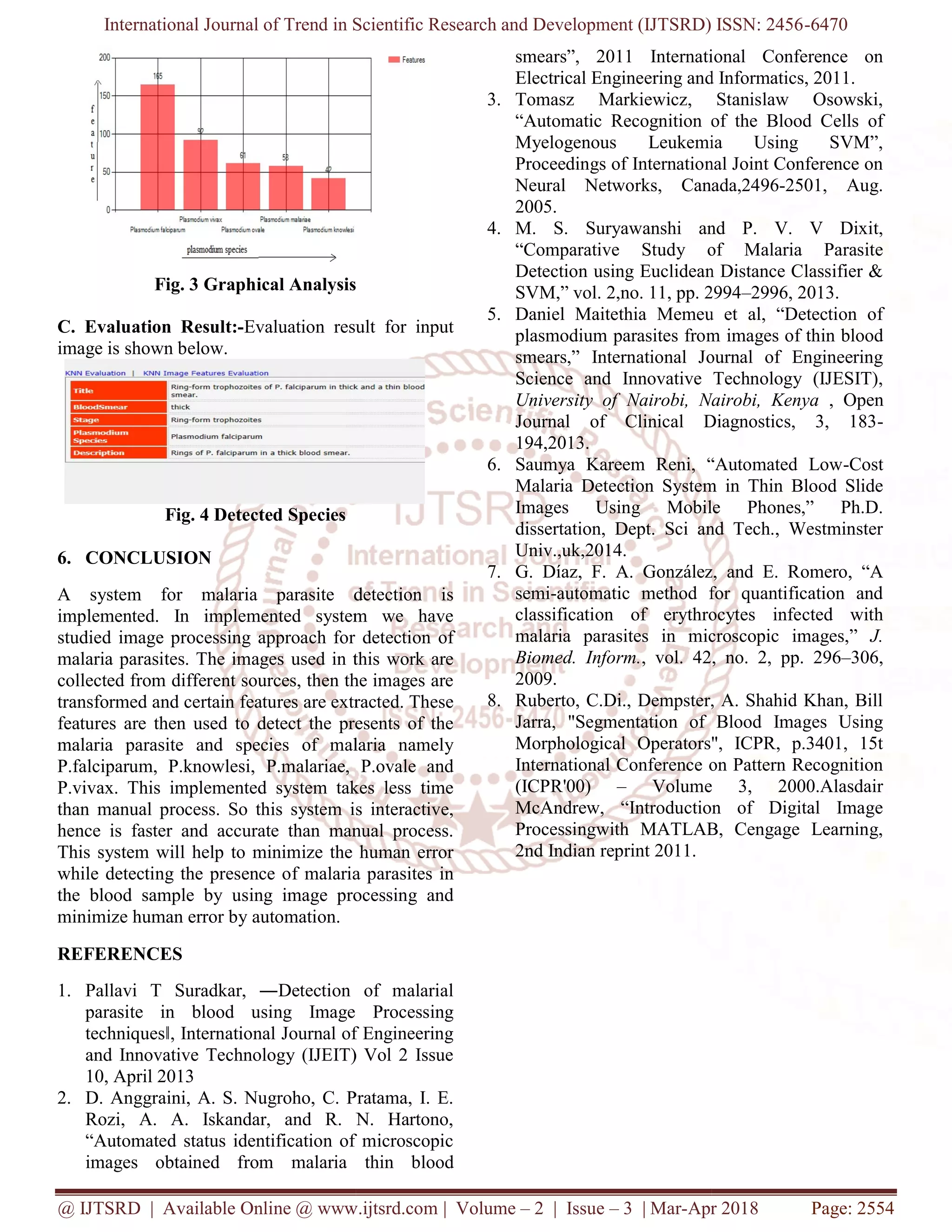
B. Graphical Analysis:
In graphical analysis, we are considering features on
X-axis and Plasmodium species on Y
this analysis we get how many features for each
plasmodium species are obtained and maximum
features for which species is considered as detected
species.
International Journal of Trend in Scientific Research and Development (IJTSRD) ISSN: 2456-6470
Apr 2018 Page: 2553
Eu[][]=(i,sqrt(pow((px[i].pixval-
ds[j].pixval),2)+pow((px[i].red-
ds[j].blue),2)+pow((px[i].green-
-
4. Arrange EU[][] in ascending order
5. Calculate k=sqrt(ds.len)/2
6. Consider k euclidian distances
7. Count neighbors till k distances
8. The pixel will be classified to the class which
neighbors are greatest among all the classes
pixels
Classify the image into the class having
EXPERIMENTAL RESULT
In this section, we are showing the experimental
The color image is transformed into gray scale
image for performing operations on it by using haar
wavelet transform algorithm. The original image and
its haar transformed image is shown as follows.
Fig. 2 Original image and its haar transformed
In graphical analysis, we are considering features on
axis and Plasmodium species on Y-axis. From
this analysis we get how many features for each
plasmodium species are obtained and maximum
features for which species is considered as detected
International Journal of Trend in Scientific Research and Development (IJTSRD) ISSN: 2456
@ IJTSRD | Available Online @ www.ijtsrd.com
Fig. 3 Graphical Analysis
C. Evaluation Result:-Evaluation result for input
image is shown below.
Fig. 4 Detected Species
6. CONCLUSION
A system for malaria parasite detection is
implemented. In implemented system we have
studied image processing approach for detection of
malaria parasites. The images used in this work are
collected from different sources, then the images are
transformed and certain features are extracted. These
features are then used to detect the presents of the
malaria parasite and species of malaria namely
P.falciparum, P.knowlesi, P.malariae, P.ovale and
P.vivax. This implemented system takes less time
than manual process. So this system is interactive,
hence is faster and accurate than manual process.
This system will help to minimize the human error
while detecting the presence of malaria parasites in
the blood sample by using image processing and
minimize human error by automation.
REFERENCES
1. Pallavi T Suradkar, ―Detection of malarial
parasite in blood using Image Processing
techniques‖, International Journal of Engineering
and Innovative Technology (IJEIT) Vol 2 Issue
10, April 2013
2. D. Anggraini, A. S. Nugroho, C. Pratama, I. E.
Rozi, A. A. Iskandar, and R. N. Hartono,
“Automated status identification of microscopic
images obtained from malaria thin blood
International Journal of Trend in Scientific Research and Development (IJTSRD) ISSN: 2456
@ IJTSRD | Available Online @ www.ijtsrd.com | Volume – 2 | Issue – 3 | Mar-Apr 2018
Fig. 3 Graphical Analysis
Evaluation result for input
A system for malaria parasite detection is
implemented. In implemented system we have
studied image processing approach for detection of
used in this work are
collected from different sources, then the images are
transformed and certain features are extracted. These
features are then used to detect the presents of the
malaria parasite and species of malaria namely
P.malariae, P.ovale and
P.vivax. This implemented system takes less time
than manual process. So this system is interactive,
hence is faster and accurate than manual process.
This system will help to minimize the human error
f malaria parasites in
the blood sample by using image processing and
Pallavi T Suradkar, ―Detection of malarial
parasite in blood using Image Processing
‖, International Journal of Engineering
nnovative Technology (IJEIT) Vol 2 Issue
D. Anggraini, A. S. Nugroho, C. Pratama, I. E.
Rozi, A. A. Iskandar, and R. N. Hartono,
“Automated status identification of microscopic
images obtained from malaria thin blood
smears”, 2011 Internati
Electrical Engineering and Informatics, 2011.
3. Tomasz Markiewicz, Stanislaw Osowski,
“Automatic Recognition of the Blood Cells of
Myelogenous Leukemia Using SVM”,
Proceedings of International Joint Conference on
Neural Networks, Canada,24
2005.
4. M. S. Suryawanshi and P. V. V Dixit,
“Comparative Study of Malaria Parasite
Detection using Euclidean Distance Classifier &
SVM,” vol. 2,no. 11, pp. 2994
5. Daniel Maitethia Memeu et al, “Detection of
plasmodium parasites from
smears,” International Journal of Engineering
Science and Innovative Technology (IJESIT),
University of Nairobi, Nairobi, Kenya
Journal of Clinical Diagnostics, 3, 183
194,2013.
6. Saumya Kareem Reni, “Automated Low
Malaria Detection System in Thin Blood Slide
Images Using Mobile Phones,” Ph.D.
dissertation, Dept. Sci and Tech., Westminster
Univ.,uk,2014.
7. G. Díaz, F. A. González, and E. Romero, “A
semi-automatic method for quantification and
classification of erythrocytes infe
malaria parasites in microscopic images,”
Biomed. Inform., vol. 42, no. 2, pp. 296
2009.
8. Ruberto, C.Di., Dempster, A. Shahid Khan, Bill
Jarra, "Segmentation of Blood Images Using
Morphological Operators", ICPR, p.3401, 15t
International Conference on Pattern Recognition
(ICPR'00) – Volume 3, 2000.Alasdair
McAndrew, “Introduction of Digital Image
Processingwith MATLAB, Cengage Learning,
2nd Indian reprint 2011.
International Journal of Trend in Scientific Research and Development (IJTSRD) ISSN: 2456-6470
Apr 2018 Page: 2554
smears”, 2011 International Conference on
Electrical Engineering and Informatics, 2011.
Tomasz Markiewicz, Stanislaw Osowski,
“Automatic Recognition of the Blood Cells of
Myelogenous Leukemia Using SVM”,
Proceedings of International Joint Conference on
Neural Networks, Canada,2496-2501, Aug.
M. S. Suryawanshi and P. V. V Dixit,
“Comparative Study of Malaria Parasite
Detection using Euclidean Distance Classifier &
SVM,” vol. 2,no. 11, pp. 2994–2996, 2013.
Daniel Maitethia Memeu et al, “Detection of
plasmodium parasites from images of thin blood
smears,” International Journal of Engineering
Science and Innovative Technology (IJESIT),
University of Nairobi, Nairobi, Kenya , Open
Journal of Clinical Diagnostics, 3, 183-
Saumya Kareem Reni, “Automated Low-Cost
etection System in Thin Blood Slide
Images Using Mobile Phones,” Ph.D.
dissertation, Dept. Sci and Tech., Westminster
G. Díaz, F. A. González, and E. Romero, “A
automatic method for quantification and
classification of erythrocytes infected with
malaria parasites in microscopic images,” J.
, vol. 42, no. 2, pp. 296–306,
Ruberto, C.Di., Dempster, A. Shahid Khan, Bill
Jarra, "Segmentation of Blood Images Using
Morphological Operators", ICPR, p.3401, 15t
onference on Pattern Recognition
Volume 3, 2000.Alasdair
McAndrew, “Introduction of Digital Image
Processingwith MATLAB, Cengage Learning,

Implementation of Malaria Parasite Detection System Using Image Processing

  • 1.
    @ IJTSRD |Available Online @ www.ijtsrd.com ISSN No: 2456 International Research Implementation of Malaria Parasite Detection System Using Image Processing Kanchan N. Poharkar, Department Sipna College of Engineering and ABSTRACT Malaria is a critical disease for which the instant detection is essential so as to control it. Microscopes are used to detect the disease and pathologists use the manual technique because of which there is several chance of incorrect detection being made regarding the disease. If the incorrect detection is made then the disease can turn into more difficult situation. So the study relating to the computerized detection is done in this paper that will facilitate in instant detection of the disease to some level. An image processing scheme is capable to enhance outcome of malaria parasite cell detection. In image processing image consistency is very essential to acquire correct result. Therefore to increase the correctness of the malaria detection system, we proposed new image processing based system which includes two algorithms. One is Haar wavelet algorithm for image transformation and other is K nearest neighbor algorithm for image classification. This system helps to reduce time as well as offer the better accuracy to detect Malaria to some degree. Keywords: Malaria, Parasite detection, Haar wavelet transform, Feature extraction, KNN classifier 1. INTRODUCTION Malaria is an extremely severe transferable disease caused via a peripheral blood parasite of genus plasmodium and is transmitted by the bite of a female Anopheles mosquito. Within the human body, the parasite goes through a difficult life cycle in which i extend and reproduces and diagnosis at the later stage can be life threatening. During this process, the red blood cells (RBCs) are used as hosts and are damaged later. There are a variety of methods to detect malaria, @ IJTSRD | Available Online @ www.ijtsrd.com | Volume – 2 | Issue – 3 | Mar-Apr 2018 ISSN No: 2456 - 6470 | www.ijtsrd.com | Volume International Journal of Trend in Scientific Research and Development (IJTSRD) International Open Access Journal lementation of Malaria Parasite Detection System Using Image Processing Kanchan N. Poharkar, Dr. S. A. Ladhake artment of Computer Science and Engineering, College of Engineering and Technology, Amravati, Maharashtra, Malaria is a critical disease for which the instant detection is essential so as to control it. Microscopes pathologists use the manual technique because of which there is several chance of incorrect detection being made regarding the disease. If the incorrect detection is made then the disease can turn into more difficult situation. So the computerized detection is done in this paper that will facilitate in instant detection of the An image processing scheme is capable to enhance outcome of malaria parasite cell In image processing image consistency is very essential to acquire correct result. Therefore to increase the correctness of the malaria detection system, we proposed new image processing based system which includes two algorithms. One is Haar rithm for image transformation and other is K nearest neighbor algorithm for image classification. This system helps to reduce time as well as offer the better accuracy to detect Malaria to Malaria, Parasite detection, Haar wavelet transform, Feature extraction, KNN classifier Malaria is an extremely severe transferable disease caused via a peripheral blood parasite of genus plasmodium and is transmitted by the bite of a female Anopheles mosquito. Within the human body, the parasite goes through a difficult life cycle in which it extend and reproduces and diagnosis at the later stage can be life threatening. During this process, the red blood cells (RBCs) are used as hosts and are damaged later. There are a variety of methods to detect malaria, in which manual microscopy is viewe standard". On the other hand because of the several steps necessary in manual estimation, this diagnostic scheme takes too much time and prone to human mistake, yet in practiced hands. Hence, it is significant to build up an automated ima which can be used to identify existence of malaria parasite in a blood smear image. In this paper, Image Processing is done to detect the presence of Malaria Parasite. An efficient system is proposed for parasite detection based on brightness and saturation. We have implemented malaria parasite detection system. Firstly in this system RGB image is transformed into gray scale by using haar wavelet transform. In feature extraction, distinct features are extracted from transformed image. In this ma parasite detection system, image classification is used to identify malaria parasite present in the blood smears. Implemented malaria parasite detection system requires few seconds to detect the presence of parasite in uploaded pathological image. 2. LITERATURE REVIEW Tomasz Mickiewicz et. al. [3], offered the feature classification and estimation of the blasts that leads to the best performance of the identifying and classifying scheme. The cells are classified by means of the textural, statistical geometrical. The features classified with the use of SVM classifier. Pallavi T Suradhkar[1] intend is fundamentally an image classification crisis, and as a result takes the form of a classification and pattern recognition Apr 2018 Page: 2550 6470 | www.ijtsrd.com | Volume - 2 | Issue – 3 Scientific (IJTSRD) International Open Access Journal Detection System Using Image Processing Maharashtra, India in which manual microscopy is viewed to be "the gold standard". On the other hand because of the several steps necessary in manual estimation, this diagnostic scheme takes too much time and prone to human mistake, yet in practiced hands. Hence, it is significant to build up an automated image analysis which can be used to identify existence of malaria parasite in a blood smear image. In this paper, Image Processing is done to detect the presence of Malaria Parasite. An efficient system is proposed for parasite detection based on brightness nd saturation. We have implemented malaria parasite detection system. Firstly in this system RGB image is transformed into gray scale by using haar wavelet transform. In feature extraction, distinct features are extracted from transformed image. In this malaria parasite detection system, image classification is used to identify malaria parasite present in the blood smears. Implemented malaria parasite detection system requires few seconds to detect the presence of parasite in uploaded pathological image. ITERATURE REVIEW Tomasz Mickiewicz et. al. [3], offered the feature classification and estimation of the blasts that leads to the best performance of the identifying and classifying scheme. The cells are classified by means of the textural, statistical features and geometrical. The features classified with the use of Pallavi T Suradhkar[1] intend is fundamentally an image classification crisis, and as a result takes the form of a classification and pattern recognition
  • 2.
    International Journal ofTrend in Scientific Research and Development (IJTSRD) ISSN: 2456-6470 @ IJTSRD | Available Online @ www.ijtsrd.com | Volume – 2 | Issue – 3 | Mar-Apr 2018 Page: 2551 system. Thresholding, grey scale image conversion, thinning labeling algorithms are used in system architecture of malaria parasite detection. For detection of infectious cells in images acquired from peripheral blood samples, it uses color range and image segmentation processing techniques. Diaz et al [6] was performed study about detection of malaria parasite in thin red blood cell. In their work, the malaria parasite was divided through image segmentation between blood cell mechanism and constituents of nucleus and cytoplasm as parasite cells. The numerous threshold algorithm and morphological operator have effectively recognized it. M. S. Suryawanshi and P. V. V Dixit [4], has performed an improved method for Malaria Parasite Detection. This technique worked on cell segmentation, wherever the segmentation process includes of numerous steps, such as image binarization by means of Poisson’s distribution on the basis least error thresholding, along with morphological opening for the use of enhancement. Daniel Maitethia Memeu et al. [5] proposed a method for detection of plasmodium parasites from images of thin blood smears. The method is based on Artificial Neural Net-work (ANN) for testing the presence of plasmodium parasites in thin blood smear images. Pre-processing, features extraction are implemented and eventually diagnosis was made based on the features extracted from the images. Classification accuracy of 95.0% in detection of infected erythrocyte was achieved with respect to results obtained by expert microscopes. S. Kareem et al. [6] proposed a novel idea to identify the total number of red blood cells (RBCs) as well as their location in a Giemsa stained thin blood film images. The method utilizes basic knowledge on cell structure and brightness of the components due to Giemsa staining of the sample and detects and locates the RBCs in the image. For detection of Malaria, this study presented a simple approach based on the shape and size of each RBC by calculating its roundness using an appropriate threshold. The classification of malaria parasite is implemented using NCC that does not require training like the ANN. Anggraini et al. in [2] have proposed a histogram- based thresholding method to identify the presence of malaria parasites in thin blood smears of P. falciparum species. The gray scale malaria images have been segmented using global thresholding to obtain the RBCs and other blood cells components in each image. The parasite and infected cell components are obtained by applying multiple thresholds on the segmented image. 3. MALARIA PARASITE The types of malaria parasite are described as follows: A. Plasmodium falciparum:- Plasmodium falciparum is recognized to be the most fatal type of the plasmodium parasite. P. falciparum rings have weak cytoplasm and one or two small chromatin dots [8]. It is responsible for the majority of malaria deaths globally. The remaining species are not as serious as plasmodium falciparum. It is severest of all the four malaria types, it become significant that this be checked, identify & treated on time. B. Plasmodium vivax:- Plasmodium vivax is a protozoal parasite and a human pathogen and can be of different forms such as- gametocytes, Schizonts, Trophozoites, and Rings. It is second most significant species. It has the widest spreading around the world. Though it rarely causes death or other severe problems, it can still cause foremost ill health. C. Plasmodium malariae:- Plasmodium malariae is a parasitic protozoan that causes malaria in humans. It is present in two forms- Rings and Trophozoites. This type of malaria is not as extensive as other types and is known to have less than 1% infection in Indian subcontinent. It demonstrates itself in the form of high fever and chills. D. Plasmodium ovale:- Plasmodium ovale is a species of parasitic protozoa that causes tertian malaria in humans. This is the rarest of all malaria types. Plasmodium ovale occurs in some cases since the parasite can rest in the liver of a patient for a few months to 4 years after getting infected by mosquito carrying malaria. E. Plasmodium knowlesi:- Plasmodium knowlesi malaria is not widen from person to person, but rather occurs in people when an Anopheles mosquito infected by a monkey, which then bites
  • 3.
    International Journal ofTrend in Scientific Research and Development (IJTSRD) ISSN: 2456 @ IJTSRD | Available Online @ www.ijtsrd.com and infects humans. 4. IMPLEMENTATION The concept of detection of parasite is not new but use from many years, difference is we are using image processing approach instead of manual microscopy which requires less time. There is a chance to occur human error in manual microscopy, so computer based classification using digital image processing methods gives better outcome than the manual diagnoses of Malaria. Intend of this work is to build up a detection method to correctly detected malaria parasites present in images. . To improve the accuracy of the malaria detection system, we proposed new algorithm which includes two algorithms. Objectives concerned in the proposed system are as follows:  To develop a malaria parasite detection system in which pathology admin will upload patient’s scanned RGB report.  To build up an expert system for patients Working of proposed architecture is shown in fig.1. According to working if anyone wants to perform malaria parasite test we have to first upload pathological image. Fig. 1 working of proposed architecture After uploading image, steps that come execution are as follows:  Image Transformation  Feature Extraction  Image Classification International Journal of Trend in Scientific Research and Development (IJTSRD) ISSN: 2456 @ IJTSRD | Available Online @ www.ijtsrd.com | Volume – 2 | Issue – 3 | Mar-Apr 2018 The concept of detection of parasite is not new but use from many years, difference is we are using image processing approach instead of manual microscopy which requires less time. There is a chance to occur human error in manual microscopy, so computer based classification using digital image ethods gives better outcome than the manual diagnoses of Malaria. Intend of this work is to build up a detection method to correctly detected malaria parasites present in images. . To improve the accuracy of the malaria detection system, we lgorithm which includes two Objectives concerned in the proposed system are as To develop a malaria parasite detection system in which pathology admin will upload patient’s an expert system for patients. Working of proposed architecture is shown in fig.1. According to working if anyone wants to perform malaria parasite test we have to first upload Fig. 1 working of proposed architecture After uploading image, steps that come under A. Image Transformation:-Image transformation is nothing but a simple operation which transformed uploaded image from one representation to another. It is a purpose that takes an image as its input and produces an image as output. In image transformation step, RGB image is transformed into gray scale image with the use of haar wavelet transform algorithm. After applying this algorithm, transformed image is stored on server.  Haar Wavelet Transform: Haar wavelet transform involves forward and inverse transform. We are using forward transform for RGB to gray scale image conversion. It is famous for its simplicity and computation speed. an input represented by a list of the Haar wavelet transform may be considered to pair up input values, storing the difference and passing the sum. This process is recurring recursively, combining up the sums to prove the next scale, which leads to 2^{n} final sum. Haar wavelet transform algorithm steps involved are as follows: 1. Read image pixels 2. Initialize r[], g[], &b[] from input image pixels 3. For i=0 to r.length  calculate sum=r[i]+r[i+1] r[i]=sum/2  calculate diff=r[i]-r[i+1] diff=diff/2  calculate sum1=r[i+2]+r[i+3] r[i+1]=sum1/2  calculate diff1=r[i+2]-r[i+3 diff1=diff1/2  Set r[i]=sum  Set r[I+1]=sum1  Set r[i+2]=diff  Set r[ i+3]=diff2 4. End for 5. Repeat step3 for g[]And b[] 6. Image formation from calculated pixels B. Feature Extraction:-After image transformation next step is feature extraction which efficiently represents interesting parts of an image. The aim of feature extraction is to transform the input data into a reduced set of features that extract relevant information from the input data. In feature extraction phase system read transformed image from server. System scan complete image and it extract unique feature and store in matrix. For feature extraction we International Journal of Trend in Scientific Research and Development (IJTSRD) ISSN: 2456-6470 Apr 2018 Page: 2552 Image transformation is nothing but a simple operation which transformed uploaded image from one representation to another. ose that takes an image as its input and produces an image as output. In image transformation step, RGB image is transformed into gray scale image with the use of haar wavelet transform algorithm. After applying this algorithm, on server. Haar Wavelet Transform: Haar wavelet transform involves forward and inverse transform. We are using forward transform for RGB to gray scale image conversion. It is famous for its simplicity and computation speed. For by a list of 2^{n} numbers, transform may be considered to pair up input values, storing the difference and passing the sum. This process is recurring recursively, combining up the sums to prove the 2^{n}-1 differences and a Haar wavelet transform algorithm steps involved are 2. Initialize r[], g[], &b[] from input image pixels calculate sum1=r[i+2]+r[i+3] r[i+3 5. Repeat step3 for g[]And b[] 6. Image formation from calculated pixels After image transformation next step is feature extraction which efficiently represents interesting parts of an image. The aim of feature extraction is to transform the input data into a reduced set of features that extract relevant tion from the input data. In feature extraction phase system read transformed image from server. System scan complete image and it extract unique feature and store in matrix. For feature extraction we
  • 4.
    International Journal ofTrend in Scientific Research and Development (IJTSRD) ISSN: 2456 @ IJTSRD | Available Online @ www.ijtsrd.com are using user defined algorithm. Algorithm steps for feature extraction are as follows:  Upload image  Scale image into 256*256 px  Transform original image using Haar wavelet transform  Store Haar transformed image(compressed image)  Read distinct pixels from transformed image tr[][] For j=0 to tr.height For i=0 to tr.width 1. Calculate pixel representation value using brightness, saturation and colors(RGB) 2. Pix =GetPixel (tr[i][j] 3.PixVal[Cnt]=(int) AVG(colors(Pix)+saturation(Pix)+brightness(Pix))/3 4. Cnt++ End for End for  Store PixVal[] into database C. Image Classification:- The images taken are in the form of pixels and altering it into digital images that make sense is known as image classification. Image classification is done by using KNN algorithm. In KNN algorithm, Euclidean distance i calculated with the help of extracted feature from the previous step. According to Euclidean distance, system will form clusters of multiple stages. Among them most suitable cluster will be considered as final malaria stage.  KNN algorithm: The k-nearest neighbors algorithm (k-NN) is a non parametric method used for classification and regression. In both cases, the input consists of the k closest training examples in the feature space. We use this algorithm to classify the image into malaria parasite stages .The accuracy of the k-NN algorithm can be severely degraded by the presence of noisy or irrelevant features, or if the feature scales are not consistent with their importance. The steps involved in the KNN algorithm are as follows:  Initialize Px[] with image distinct pixels  Initialize DS[] with dataset pixels  For i=0 to px[].len 1. Calculate Euclidian distance for all the pixels with dataset pixels 2. For j=0 to ds[].len International Journal of Trend in Scientific Research and Development (IJTSRD) ISSN: 2456 @ IJTSRD | Available Online @ www.ijtsrd.com | Volume – 2 | Issue – 3 | Mar-Apr 2018 feature extraction are as follows: Transform original image using Haar Store Haar transformed image(compressed Read distinct pixels from transformed image 1. Calculate pixel representation value using brightness, saturation and colors(RGB) AVG(colors(Pix)+saturation(Pix)+brightness(Pix))/3 The images taken are in the form of pixels and altering it into digital images that make sense is known as image classification. Image classification is done by using KNN algorithm. In KNN algorithm, Euclidean distance is calculated with the help of extracted feature from the previous step. According to Euclidean distance, system will form clusters of multiple stages. Among them most suitable cluster will be considered as final NN) is a non- method used for classification and regression. In both cases, the input consists of the k closest training examples in the feature space. We use this algorithm to classify the image into malaria NN algorithm can be severely degraded by the presence of noisy or irrelevant features, or if the feature scales are not The steps involved in the KNN algorithm are as with image distinct pixels Calculate Euclidian distance for all the pixels Eu[][]=(i,sqrt(pow((px[i].pixval ds[j].pixval),2)+pow((px[i].red ds[j].red),2)+pow((px[i].blue- ds[j].blue),2)+pow((px[i].green ds[j].green),2)+pow((px[i].sat- ds[j].sat),2)+pow((px[i].br-ds 3. End For 4. Arrange EU[][] in ascendi 5. Calculate k=sqrt(ds.len)/2 6. Consider k euclidian distances 7. Count neighbors till k distances 8. The pixel will be classified to the class which neighbors are greatest among all the classes  End for  Count the classes of pixels  Classify the image into the class having maximum count  End 5. EXPERIMENTAL RESULT In this section, we are showing the experimental analysis and result. A. Transformed Image The color image is transformed into gray scale image for performing operations on wavelet transform algorithm. The original image and its haar transformed image is shown as follows. Fig. 2 Original image and its haar transformed image B. Graphical Analysis: In graphical analysis, we are considering features on X-axis and Plasmodium species on Y this analysis we get how many features for each plasmodium species are obtained and maximum features for which species is considered as detected species. International Journal of Trend in Scientific Research and Development (IJTSRD) ISSN: 2456-6470 Apr 2018 Page: 2553 Eu[][]=(i,sqrt(pow((px[i].pixval- ds[j].pixval),2)+pow((px[i].red- ds[j].blue),2)+pow((px[i].green- - 4. Arrange EU[][] in ascending order 5. Calculate k=sqrt(ds.len)/2 6. Consider k euclidian distances 7. Count neighbors till k distances 8. The pixel will be classified to the class which neighbors are greatest among all the classes pixels Classify the image into the class having EXPERIMENTAL RESULT In this section, we are showing the experimental The color image is transformed into gray scale image for performing operations on it by using haar wavelet transform algorithm. The original image and its haar transformed image is shown as follows. Fig. 2 Original image and its haar transformed In graphical analysis, we are considering features on axis and Plasmodium species on Y-axis. From this analysis we get how many features for each plasmodium species are obtained and maximum features for which species is considered as detected
  • 5.
    International Journal ofTrend in Scientific Research and Development (IJTSRD) ISSN: 2456 @ IJTSRD | Available Online @ www.ijtsrd.com Fig. 3 Graphical Analysis C. Evaluation Result:-Evaluation result for input image is shown below. Fig. 4 Detected Species 6. CONCLUSION A system for malaria parasite detection is implemented. In implemented system we have studied image processing approach for detection of malaria parasites. The images used in this work are collected from different sources, then the images are transformed and certain features are extracted. These features are then used to detect the presents of the malaria parasite and species of malaria namely P.falciparum, P.knowlesi, P.malariae, P.ovale and P.vivax. This implemented system takes less time than manual process. So this system is interactive, hence is faster and accurate than manual process. This system will help to minimize the human error while detecting the presence of malaria parasites in the blood sample by using image processing and minimize human error by automation. REFERENCES 1. Pallavi T Suradkar, ―Detection of malarial parasite in blood using Image Processing techniques‖, International Journal of Engineering and Innovative Technology (IJEIT) Vol 2 Issue 10, April 2013 2. D. Anggraini, A. S. Nugroho, C. Pratama, I. E. Rozi, A. A. Iskandar, and R. N. Hartono, “Automated status identification of microscopic images obtained from malaria thin blood International Journal of Trend in Scientific Research and Development (IJTSRD) ISSN: 2456 @ IJTSRD | Available Online @ www.ijtsrd.com | Volume – 2 | Issue – 3 | Mar-Apr 2018 Fig. 3 Graphical Analysis Evaluation result for input A system for malaria parasite detection is implemented. In implemented system we have studied image processing approach for detection of used in this work are collected from different sources, then the images are transformed and certain features are extracted. These features are then used to detect the presents of the malaria parasite and species of malaria namely P.malariae, P.ovale and P.vivax. This implemented system takes less time than manual process. So this system is interactive, hence is faster and accurate than manual process. This system will help to minimize the human error f malaria parasites in the blood sample by using image processing and Pallavi T Suradkar, ―Detection of malarial parasite in blood using Image Processing ‖, International Journal of Engineering nnovative Technology (IJEIT) Vol 2 Issue D. Anggraini, A. S. Nugroho, C. Pratama, I. E. Rozi, A. A. Iskandar, and R. N. Hartono, “Automated status identification of microscopic images obtained from malaria thin blood smears”, 2011 Internati Electrical Engineering and Informatics, 2011. 3. Tomasz Markiewicz, Stanislaw Osowski, “Automatic Recognition of the Blood Cells of Myelogenous Leukemia Using SVM”, Proceedings of International Joint Conference on Neural Networks, Canada,24 2005. 4. M. S. Suryawanshi and P. V. V Dixit, “Comparative Study of Malaria Parasite Detection using Euclidean Distance Classifier & SVM,” vol. 2,no. 11, pp. 2994 5. Daniel Maitethia Memeu et al, “Detection of plasmodium parasites from smears,” International Journal of Engineering Science and Innovative Technology (IJESIT), University of Nairobi, Nairobi, Kenya Journal of Clinical Diagnostics, 3, 183 194,2013. 6. Saumya Kareem Reni, “Automated Low Malaria Detection System in Thin Blood Slide Images Using Mobile Phones,” Ph.D. dissertation, Dept. Sci and Tech., Westminster Univ.,uk,2014. 7. G. Díaz, F. A. González, and E. Romero, “A semi-automatic method for quantification and classification of erythrocytes infe malaria parasites in microscopic images,” Biomed. Inform., vol. 42, no. 2, pp. 296 2009. 8. Ruberto, C.Di., Dempster, A. Shahid Khan, Bill Jarra, "Segmentation of Blood Images Using Morphological Operators", ICPR, p.3401, 15t International Conference on Pattern Recognition (ICPR'00) – Volume 3, 2000.Alasdair McAndrew, “Introduction of Digital Image Processingwith MATLAB, Cengage Learning, 2nd Indian reprint 2011. International Journal of Trend in Scientific Research and Development (IJTSRD) ISSN: 2456-6470 Apr 2018 Page: 2554 smears”, 2011 International Conference on Electrical Engineering and Informatics, 2011. Tomasz Markiewicz, Stanislaw Osowski, “Automatic Recognition of the Blood Cells of Myelogenous Leukemia Using SVM”, Proceedings of International Joint Conference on Neural Networks, Canada,2496-2501, Aug. M. S. Suryawanshi and P. V. V Dixit, “Comparative Study of Malaria Parasite Detection using Euclidean Distance Classifier & SVM,” vol. 2,no. 11, pp. 2994–2996, 2013. Daniel Maitethia Memeu et al, “Detection of plasmodium parasites from images of thin blood smears,” International Journal of Engineering Science and Innovative Technology (IJESIT), University of Nairobi, Nairobi, Kenya , Open Journal of Clinical Diagnostics, 3, 183- Saumya Kareem Reni, “Automated Low-Cost etection System in Thin Blood Slide Images Using Mobile Phones,” Ph.D. dissertation, Dept. Sci and Tech., Westminster G. Díaz, F. A. González, and E. Romero, “A automatic method for quantification and classification of erythrocytes infected with malaria parasites in microscopic images,” J. , vol. 42, no. 2, pp. 296–306, Ruberto, C.Di., Dempster, A. Shahid Khan, Bill Jarra, "Segmentation of Blood Images Using Morphological Operators", ICPR, p.3401, 15t onference on Pattern Recognition Volume 3, 2000.Alasdair McAndrew, “Introduction of Digital Image Processingwith MATLAB, Cengage Learning,