Muhammad Imran Razzak
International Journal of Biometrics and Bioinformatics (IJBB), Volume (9) : Issue (1) : 2015 1
Automatic Detection and Classification of Malarial Parasite
Muhammad Imran Razzak razzakmu@ngha.med.sa
Health Informatics, CPHHI
King Saud bi Abdulaziz University for Health Sciences
Riyadh, 11426, Saudi Arabia
Abstract
Recent advancement in genomic technologies has opened a new realm for early detection of
diseases that shows potential to overcome the drawbacks of manual detection technologies.
Computer based malarial parasite analysis and classification has opened a new area for the early
malaria detection that showed potential to overcome the drawbacks of manual strategies. This
paper presented a method for automatic detection of malarial infected cells. Blood cell
segmentation and morphological analysis is a challenging due complexity of the blood cells. To
improve the performance of malaria parasite segmentation and classification, we have used
different set of features which are forward to the ANN for malaria classification. We have used
Rao’s method and bounding box for segmentation whereas we have used BPNN for classification
on different set of texture and shape features.
Keywords: Malaria Detection, Segmentation, RBC Classification, Malaria Classification.
1. INTRODUCTION
Blood smear image consists of white blood cell, red blood cells, platelets as well as other possible
contents such as malarial parasite, Aids virus etc. scattered across the background. The contents
of blood cell images are very complex. The segmentation and morphological of blood cell is very
difficult due to the complex nature of the blood cell images. Manual blood cell counting is not a
reliable screening method when it is performed by non-expert due to lake of training expertise as
it requires special training and considerable expertise [1-2].
Recent advancement in pattern recognition and computer vision algorithms made possible that
the analysis of complex blood cells can be performed my machine. Automatic equipment for
blood cell counting such as flow cytometry and automatic counting machines can examine cell
quantity but not qualitatively, thus 21% of blood analysis is still need expert review [3]. Machine
based visual analysis methods provides quantitative as well as qualitative blood cells analysis
whereas this research area is not very much explored [4]. Automatic recognition and inspection
of blood can assist hematologists in analyzing the blood sample and diagnosing diseases like
Aids, malaria and blood cancer. Various research works are going on analyzing the microscopic
blood cell images in the field of immunology, infectious diseases, transplantation, hematological
malignancy and vaccine development in order to diagnose the infection existence in human
blood. Thus, several image processing and pattern recognition base algorithms have been
presented in literature for the automatic segmentation and classification of malarial infected blood
cell.
Malaria is transmitted via saliva of female mosquito through bite which introduce the organisms
form her saliva. There are five species of malarial plasmodium that can infect the human blood
and even can be transmitted by human. The majority of malarial patient deaths are caused by
falciparum and vivax plasmodium as shown in figure 1. Thus, in case of malarial infection,
species identification is necessary for proper treatment. There are some rules for malarial species
identification as discussed in table 3. However it is not necessary that every parasite will exhibit
the morphological characteristics. Typically, malaria parasite diagnoses is a manual counting
Muhammad Imran Razzak
International Journal of Biometrics and Bioinformatics (IJBB), Volume (9) : Issue (1) : 2015 2
process that use microscopic examination of Giemsa-stained thick and thin blood smears.
Manual identification and counting of malarial parasite infected cells is very long, tedious process.
Moreover it is prone to technician's ability to conduct the process correctly that requires training
and skills, i.e. a trained expert takes about 15 min to evaluate and count 100 cells and blood
sample of millions of patients is performed every year [7]. Early detection of malaria is vital in
order to ensure prompt and effective treatment. People suffering from malaria should be
diagnosed and given effective, affordable drug treatment as early as possible. Microscopy is a
standard technique used for diagnosing, however in remote areas reagents are limited,
equipment and electricity are unreliable, and a delay in obtaining results may lead to incorrect
initial treatment.
Automatic analysis of microscopic blood cell is a powerful diagnostic tool that improves accuracy,
saves time and reduces the required manpower as well as minimizes human errors. Automatic
malarial diagnose has larger interest especially for clinics and laboratories; however, blood cell
segmentation and morphological analysis is a challenging problem due to both the complex cell
nature and uncertainty in microscopic videos. This paper presents a method for classifying
malarial parasites. The organization of the rest of the paper is as follow: Section II briefly reviews
the malarial parasite recognition approaches discussed earlier and Section III presents the
proposed methodology whereas conclusion is drawn in section IV.
Microscopy RDTs
Requirement Electricity
Special Training
Staining Chemical
None,
Basic Training,
None
Time ~60 Minutes 15-20 Minutes
Cost
Specification
Detection Threshold 50 pal/ul ~100par/ul
Detection of all species Yes Some bands
Quantification Yes None
Specie Identification Yes None
Life Stage Identification Yes None
TABLE 1: Comparison of Microscopy Diagnosis and Rapid Diagnosis Tests [34].
FIGURE 1: Malaria Effected Blood Images.
2. RELATED WORK
Microscopic Blood images consists of white blood cell, red blood cells, platelets as well as several
other possible contents such as malarial parasite, Aids virus etc. that are scattered across blood
Muhammad Imran Razzak
International Journal of Biometrics and Bioinformatics (IJBB), Volume (9) : Issue (1) : 2015 3
smear image. Due to the complexity of the images, cell identification and counting is time
consuming job for biologist, e.g. expert requires 15 min to count and evaluate a slide. Moreover, it
is painstaking and subjective job which also requires training and skills. Due to these complexities
and hematologist restrictions, manual counting accuracy decreases and thus machine based
blood classification system is essential for biologist in diagnosing disease. Machine based
malarial diagnosis system can be designed by understanding the diagnostic expertise
(hematologist knowledge) and representing it by specifically tailored image processing and
pattern recognition algorithms. Several image processing based malarial diagnostic methods has
been widely studied in order to provide early and accurate detection of malaria parasite. Table 2
summarized the recent development for malarial parasite identification.
Reference
Article
Target
Data
Preprocessing Segmentation
Method
Features Classification
Method
Accuracy
(sensitivity
/specificity)
Das et al. [10] Malaria
Parasite
Gray world
assumption,
geometric mean
filter
Marker
controlled
watershed
algorithm
80 textural & 16
Morphological
features
Bayesian
98.10/68.91
SVM
96.62/88.51
Nasir et. al
[23]
Malaria
Parasite
Contrast
enhancement
K-Mean K-Mean
Clustering
Panchbhai et
al. [24]
Malaria
Parasite,
RBC
Morphological
Operation
Otsu Method
Kumar et al.
[21]
Malaria
Parasite,
RBC
Morphological
Operation
Otsu Method Threshold
Savkare [29] Malaria
Parasite
Median Filter Otsu Method Geometrical, color
and statistical
SVM 92.26/99.09
Kaewkamnerd
et al. [26]
Malaria
Parasite
in-focus
information
merging
Histogram
(HSV) and
labeling
chromatin size 75% (pv),
90% (pf)
Ahirwar et al.
[27]
Malaria
Parasite
SUSAN Threshold Geometrical &
Expert defined
Feed Forward
Back
propagation
Yunda et al.
[5]
Malaria
Parasite
Morphological
gradient method
AGNES and K-
Median
Color Features
and Textural
Multilayer
Perceptron
77.19%
Savkare [20] Malaria
Parasite
Smoothing and
Sharpening
Otsu Method Geometrical, color
and statistical
SVM 93.12%
Soni [29] Malaria
Parasite
Median and
SUSAN
Region based
(Watershed)
Morphology
First Order
Moment invariant
Tree 99
Tek et al. [7] Malaria
Parasite
Illumination
correction, color
correction and
normalization
histogram-based
thresholds and
PDF
histogram & area
granulometry
features
KNN. FLD,
BPNN
72:37/97:45
Diaz et al. [12] Malaria
Parasite
Low pass filter Inclusion-Tree
Structure and
template based
on EM
Color,
Saturation level,
Tamura texture
and Sobel
histograms
MLP
SVM
94/98.7
Purwar et al. [30] Malaria
Parasite
& RBC
Local Histogram
equalization
energy
minimization
[54]
Pixel intensity K-mean 100/88
TABLE 2: Summarization of Recent Development.
Most microscopes provide uniform or relatively uniform illumination images whereas several
illumination and contrast enhancement technique have been applied in literature. One way to deal
with uneven illumination is the predefined illumination correction but some time we don’t have
reference image [7]. Ruberto et al. used paraboloid modal for illumination correction [8]. Sriram et
al. used diagonal modal for illumination modeling [9]. In diagonal modal, an image of unknown
illumination is transformed to the known illuminant space by multiplying pixel values with a
diagonal matrix. Das et al. performed gray world assumption for correcting illumination [10]. Diaz
Muhammad Imran Razzak
International Journal of Biometrics and Bioinformatics (IJBB), Volume (9) : Issue (1) : 2015 4
used adaptive local low-pass filter to correct luminance differences on luminance channel [11-12].
Suradkar used the local histogram equalization for contrast enhancement of parasite and RBC
[13] whereas Zou et al. and Sio et al. used adaptive histogram equalization [14] for image
enhancement [15, 16]. The image is divided to several tiles and histogram shaping is applied to
these tiles separately followed by bilinear interpolation to eliminate artificially induced boundaries.
The filter was designed for a window size which contained the largest image feature, i.e. a typical
erythrocyte size. Filter was selectively applied on higher luminance levels that represent the
background pixels. Mehrjou used adaptive histogram shaping function for contrast enhancement
[17]. Sabino et al. performed non-supervised nucleus region detection before nucleus color
segmentation using the G channel from RGB color coordinates [18]. For colored images
segmentation into ROIs, supervised classification method that is based on RGB color space is
used.
In the identification of automatic malarial parasite classification procedures, the most important
and complex phase is the segmentation of infected blood cells from other cells and background.
There are several factors like cell shapes, light variation and noise that affect the accuracy of
segmentation and make it complex task. Accurate segmentation allows fruitful result in sub-
sequent levels. Blood cell segmentation can either be deductive or inductive. In deductive
segmentation method, the microscopic image is first segmented into background and foreground
images before segmenting the object whereas in inductive segmentation, the objects are located
first by using intensity/RGB values followed by regions that contains stained. The recent has
suggested several segmentation methods for blood cell summarized in table 2. Memeu et al.
used both RGB and HIS for segmentation [19]. Green channel from RGB whereas hue and
saturation channels are used for segmentation based on Otsu method and Zack algorithms for
RBC and parasites respectively. The green channel gave good results for erythrocytes
segmentation but it also added the parasite as part of the foreground. The hue component
resulted to a binary image whose foreground had noisy boundaries whereas the saturation
component failed to produce erythrocytes as the objects. Multilevel thresholding especially using
Otsu method has been performed by many researchers for blood cell segmentation and it
showed promising results. Savkare and Narote performed Global threshold and Otsu
thresholdding on gray scale and green channel image [20]. Both images are added and median
filter is applied to remove the unwanted points. Later on distance transform and watershed
transform are applied to segment the cells. Kumar et al. used Otsu threshold on histogram of B
component of RGB color space followed by the morphological operation [21]. Ahirwar et al. relied
on two thresholds (one for erythrocytes, and one for parasites) for parasite segmentation [29].
The first threshold is selected to separate the erythrocytes from the background of the image. The
second threshold is taking the first minimum after the principal mode of the histogram
incorporating only the erythrocytes. Tek et al. modeled the stained and unstained pixel
distributions with histograms and used the probability densities to determine whether a pixel on
the input image is stained or not [12]. Diaz used inclusion-tree structure for segmentation. The
background or foreground are label first using pixel classification. Different color spaces are used
to build a pixel classification model because a particular color space may emphasize features that
facilitate identification of searched objects [12].
Recent research on feature extraction and selection of blood cell has shown the important of
feature extraction phase for blood cell analysis. Researchers have used different features based
on their target blood cells/ disease. The features which give predominant difference between
normal cells and infected cells are identified as feature set. Textural [18,22] and color features
are very important in order to differentiate from other cells and has been widely used for blood
cell recognition, texture features. Color features play important role to differentiate similar shapes
and overlapped cells. The blood cell images are composed of three color components: red, green
and blue, for each of the pixels in the images. The color characteristics and other features are
required to be calculated in each of the color components, i.e. each of the malaria parasites
features a particular color tone (blue ring). Suradkar used color features for RBC extraction and
extraction of infected cells by malarial parasite [13]. RBC are red whereas malaria infected RBC
cells have blue ring. Based on red color, red blood cells are segmented and then blue color is
Muhammad Imran Razzak
International Journal of Biometrics and Bioinformatics (IJBB), Volume (9) : Issue (1) : 2015 5
used in order to count malarial parasite. Yunda et al. used both color and textural characteristics
[21]. They extracted 27 color characteristics for each three color, i.e. standard deviation, seven
Hough moments for color and color range as features set. For textural characteristics, wavelets
descriptors (energy, standard deviation, mean) and co-occurrence matrix in four different
directions with descriptors (homogeneity, contrast, GLMSR, standard deviation, angular moment
and correlation) are used. The texture features from co-occurrence matrix and wavelet transform
are not used together. Thus, the total number of descriptors is 110 when the co-occurrence
matrix is used and 92 when the wavelet transform is used. Das et al. computed set of 96 features
textural and morphological features [10]. They extracted 80 textural (entropy, Haralick textural
features, local binary pattern, fractal dimension, histogram based features, gray level run length
matrix based texture) along with16 morphological features (shape features and Hu’s moment) to
discriminate six types of infected and non-infected erythrocytes.
Classification of malarial infected cell becomes the challenging task. Several classifiers have
been reported for the computerized recognition of malarial parasites in the presence of other
stained structures and artifacts form blood cells images. Bayes classifier and different types of
Artificial Neural Networks (ANNs), local linear map, SVM, K-mean and fuzzy system has been
extensively used as classifier in the literature for blood cell recognition. The summary of recently
used classifier is discussed in table 2.
3. METHODLOGY
Due to complexity of the blood sample images, malarial parasite segmentation and morphological
analysis is a challenging problem. Machine vision based malarial diagnostic methods has been
widely studied in order to provide early and accurate diagnose of malaria parasite. An ideal
diagnostic method would be accurate, non-invasive, and inexpensive. The key tasks for malarial
parasite classification involve segmenting the malaria parasite infected cells from the complicated
background. We presented an approach for classification of malarial infected cells using Rao’s
based segmentation and BPNN for classification. We have divided the proposed methodology in
to four basic steps.
• Preprocessing
• ROI Segmentation
• Feature Extraction
• Classification of Infected Cells
FIGURE 2: System Diagram.
A. Preprocessing
Blood smear images might be affected by illumination and color distribution of blood images due
to the camera calibration and staining variability. Most of the microscopes provide uniform or
relatively uniform illumination images. The aim of preprocessing step is to obtain images with low
noise, high contrast than original images for the further processing. This particular problem poses
difficulties for classification of blood cells since it is hard to deal with proper segmentations of
objects with quite similar colors. This process contains two operations image enhancement and
noise reduction.
Preprocessing
Input Image RBC Segmentation Feature Extraction
Classification
Infected Cell Count
RBC Count
Muhammad Imran Razzak
International Journal of Biometrics and Bioinformatics (IJBB), Volume (9) : Issue (1) : 2015 6
We have applied median filter for noise reduction. The median filter replaces pixel value with the
median of its neighboring value. To get the finest coefficients details of noise free image, a
Forward Discrete Curvelet Transform is applied to the V channel as shown in Figure 3(b). It is a
multi-dimensional transformation which can sense both the contours as well as curvy edges of
the overlapping objects in the image. The FDCT has high directional sensitivity along with the
capability to capture the singularities. Edge and singularity details are processed to extract the
feature. After obtaining the highest detailed coefficients Inverse Discrete Curvelet Transform is
applied to high frequency band to obtain the detailed image. This detailed image is now having
the stronger edges than the original and would perform better in lending edge details to the
segmentation step. The next step is the adaptive equalization operation to spread out the
intensity values along the total ranges of values in order to achieve better contrast. Adaptive
histogram equalization differ from ordinary histogram equalization in respect that it computes
several histogram of each corresponding to distinct section and use these histogram to
redistribute the lightness value. After applying the adaptive histogram equalization, the
background pixels have higher intensities than the cells.
FIGURE 3: Preprocessing of Blood Cell Image.
B. ROI Segmentation
In the analysis of automatic classification of malarial parasite procedures, the most important and
difficult part is segmentation of malaria parasite infected blood cells from the background and
other cells because the blood cells are often overlaid with each other and is the basis of
quantitative analysis of its deformability and hence its filterability[12]. Cell shapes, light variation
and noise are the other factors that make segmentation a difficult task. Accurate segmentation
allows fruitful result in sub-sequent levels. Malarial parasite lies in erythrocytes thus we need to
segment the erythrocyte form the blood images. We have used Rao’s method for background
segmentation. Rao’s method extracts a rough foreground image using morphological rea top-hats
[26]. Two different threshold values are determined form these backgrounds and foreground that
are used to produce the refined binary foreground mask.
At the end, a box counting algorithm is applied to the segmented image. Various algorithms are
used for calculating the fractal dimensions, like the fractional (or fractal) Brownian motion and
triangular-prism-surface area methods. The box counting algorithm counts the number of boxes
having side length r needed to cover the surface of fractal objects and the number of boxes N,
occupied by more than one pixel of the image. Two procedures are defined by two parameters in
the box counting method. One is the selection of r and the other is the range of r. The blood cell
image has finite set of points and the upper limit is the size of image while the lower is the pixel
unit. Various researche propose using 2, 4, 8, 16, 2n pixels as box sizes to have a uniform spread
of observation. The quadratic boxes cover the object, and the number of the boxes is recorded.
Median Filter Curvelet coefficient Curvelet finest
coefficient
Enhanced Image
+
Input Image
High Pass
Adaptive Histogram
Eq.
Muhammad Imran Razzak
International Journal of Biometrics and Bioinformatics (IJBB), Volume (9) : Issue (1) : 2015 7
The fractal dimension (FD) measures the dependence between the number of boxes N and the
box side length r.
C. Feature Extraction
Recent researches on feature extraction and selection of red blood cell have shown the
importance of feature extraction phase for red blood cell analysis. Researchers have used
different features based on their target blood cells/disease. The features which give predominant
difference between normal cells and infected cells are identified as feature set. Textural [35,21]
and color features [1, 27, 35] are very important in order to differentiate form other cells and has
been widely used for blood cell recognition whereas color features plays important role in order to
differentiate similar shapes and overlapped cells. We have used all geometrical and intensity
features along with GLCM based texture features. Rules for identification of malarial species are
presented in table 3.
P. Falciparum P. Vivax P. Ovale P. Malariae
Size Not enlarged Enlarged Enlarged Enlarged
Shape Round crescent gametocyte Round or Oval Round or Oval amoeboid Round
Dots Large red spots Small red dots Small red dots Few tiny dots
TABLE 3: Some Rules for Species Identification.
Geometrical features
Geometrical features remain very important for complex shape recognition and lot of researchers
used geometrical features for blood analysis. We have extracted geometrical features that are
invariant under different condition and analogous to those used by hematologist. These features
include nucleus area, relative area, nucleus parameter, nucleus relative parameter, nucleus
roundness and nucleus relative roundness, nucleus mean, nucleus variance, cytoplasm area,
cytoplasm parameter, cytoplasm mean, cytoplasm variance, cytoplasm ratio to nucleus and
number of object of in nucleus. To reduce the scaling effect on the leukocyte recognition, we have
used the relative based features, i.e. relative area, relative parameter, and relative roundness.
Relative Area
‫ܣ‬௥ =
∑ ‫,ݔ(ܫ‬ ‫)ݕ‬௫,௬
ߨ‫ݎ‬ଶ
Relative Parameter
ܲ௥ =
∑ ඥ(‫ݔ‬௜ + ‫ݔ‬௜ା௜)ଶ + (‫ݕ‬௜ + ‫ݕ‬௜ା௜)ଶ + ට(‫ݔ‬௜೘ೌೣ
+ ‫ݔ‬଴)ଶ + (‫ݕ‬௜೘ೌೣ
+ ‫ݕ‬଴)ଶேିଵ
௜ୀ଴
2ߨ‫ݎ‬
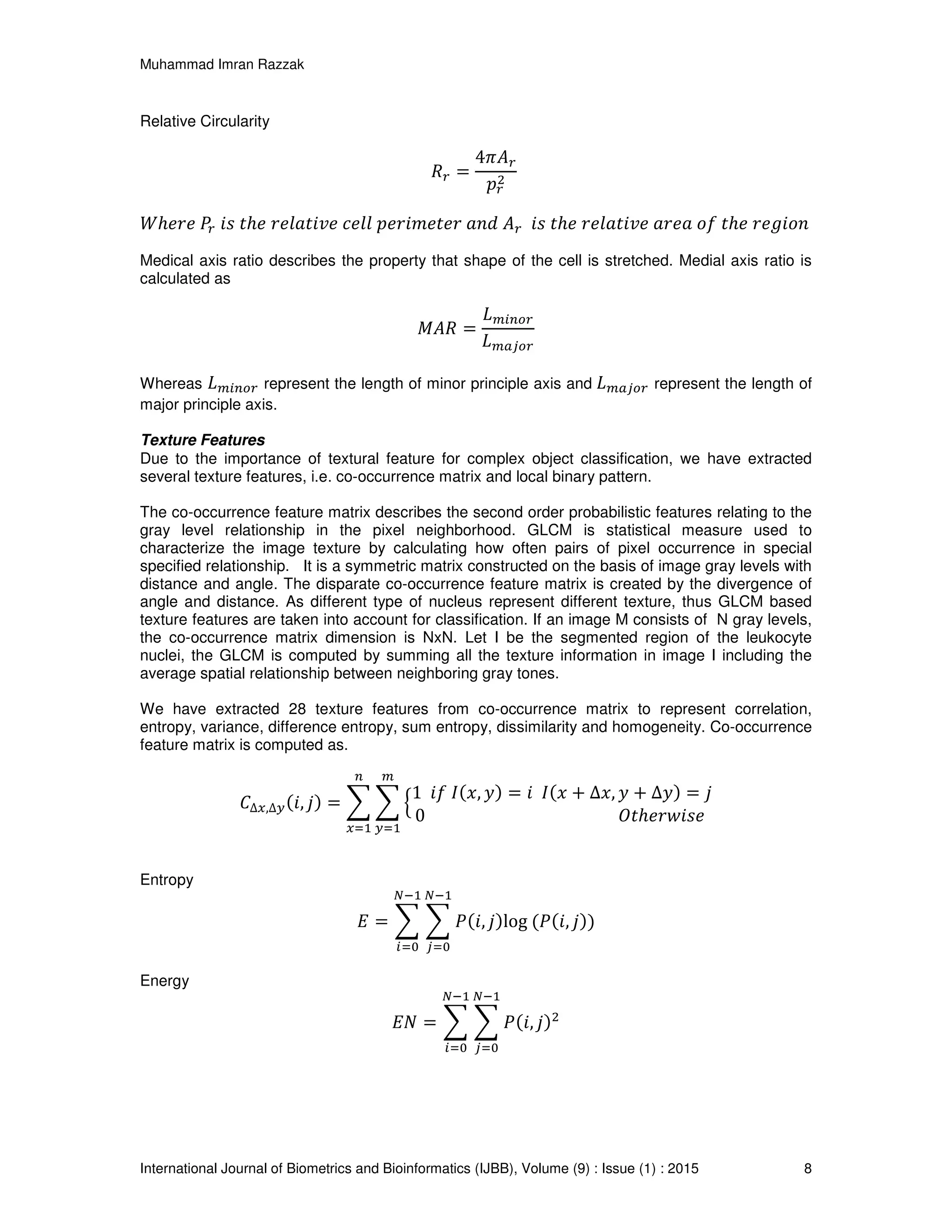
Circularity of the cell is defined as the ratio between the cell area and square of its parameter.
The cell circularity features shows how close the shape of the cell to circle. More the roundness
mean the cell is closer to normal cell.
ܴ =
4ߨ‫ܣ‬
‫݌‬ଶ
ܹℎ݁‫݁ݎ‬ ‫ܣ‬ ݅‫ݏ‬ ‫ݐ‬ℎ݁ ݈݈ܿ݁ ܽ‫ܽ݁ݎ‬ ܽ݊݀ ‫݌‬ ݅‫ݏ‬ ‫ݐ‬ℎ݁ ݈݈ܿ݁ ‫ݎ݁ݐ݁݉݅ݎ݁݌‬
Muhammad Imran Razzak
International Journal of Biometrics and Bioinformatics (IJBB), Volume (9) : Issue (1) : 2015 8
Relative Circularity
ܴ௥ =
4ߨ‫ܣ‬௥
‫݌‬௥
ଶ
ܹℎ݁‫݁ݎ‬ ܲ௥ ݅‫ݏ‬ ‫ݐ‬ℎ݁ ‫݁ݒ݅ݐ݈ܽ݁ݎ‬ ݈݈ܿ݁ ‫ݎ݁ݐ݁݉݅ݎ݁݌‬ ܽ݊݀ ‫ܣ‬௥ ݅‫ݏ‬ ‫ݐ‬ℎ݁ ‫݁ݒ݅ݐ݈ܽ݁ݎ‬ ܽ‫ܽ݁ݎ‬ ‫݂݋‬ ‫ݐ‬ℎ݁ ‫݊݋݅݃݁ݎ‬
Medical axis ratio describes the property that shape of the cell is stretched. Medial axis ratio is
calculated as
‫ܴܣܯ‬ =
‫ܮ‬௠௜௡௢௥
‫ܮ‬௠௔௝௢௥
Whereas ‫ܮ‬௠௜௡௢௥ represent the length of minor principle axis and ‫ܮ‬௠௔௝௢௥ represent the length of
major principle axis.
Texture Features
Due to the importance of textural feature for complex object classification, we have extracted
several texture features, i.e. co-occurrence matrix and local binary pattern.
The co-occurrence feature matrix describes the second order probabilistic features relating to the
gray level relationship in the pixel neighborhood. GLCM is statistical measure used to
characterize the image texture by calculating how often pairs of pixel occurrence in special
specified relationship. It is a symmetric matrix constructed on the basis of image gray levels with
distance and angle. The disparate co-occurrence feature matrix is created by the divergence of
angle and distance. As different type of nucleus represent different texture, thus GLCM based
texture features are taken into account for classification. If an image M consists of N gray levels,
the co-occurrence matrix dimension is NxN. Let I be the segmented region of the leukocyte
nuclei, the GLCM is computed by summing all the texture information in image I including the
average spatial relationship between neighboring gray tones.
We have extracted 28 texture features from co-occurrence matrix to represent correlation,
entropy, variance, difference entropy, sum entropy, dissimilarity and homogeneity. Co-occurrence
feature matrix is computed as.
‫ܥ‬∆௫,∆௬(݅, ݆) = ෍ ෍ ቄ
1 ݂݅ ‫,ݔ(ܫ‬ ‫)ݕ‬ = ݅ ‫ݔ(ܫ‬ + ∆‫,ݔ‬ ‫ݕ‬ + ∆‫)ݕ‬ = ݆
0 ܱ‫ݐ‬ℎ݁‫݁ݏ݅ݓݎ‬
௠
௬ୀଵ
௡
௫ୀଵ
Entropy
‫ܧ‬ = ෍ ෍ ܲ(݅, ݆)log (ܲ(݅, ݆))
ேିଵ
௝ୀ଴
ேିଵ
௜ୀ଴
Energy
‫ܰܧ‬ = ෍ ෍ ܲ(݅, ݆)ଶ
ேିଵ
௝ୀ଴
ேିଵ
௜ୀ଴
Muhammad Imran Razzak
International Journal of Biometrics and Bioinformatics (IJBB), Volume (9) : Issue (1) : 2015 9
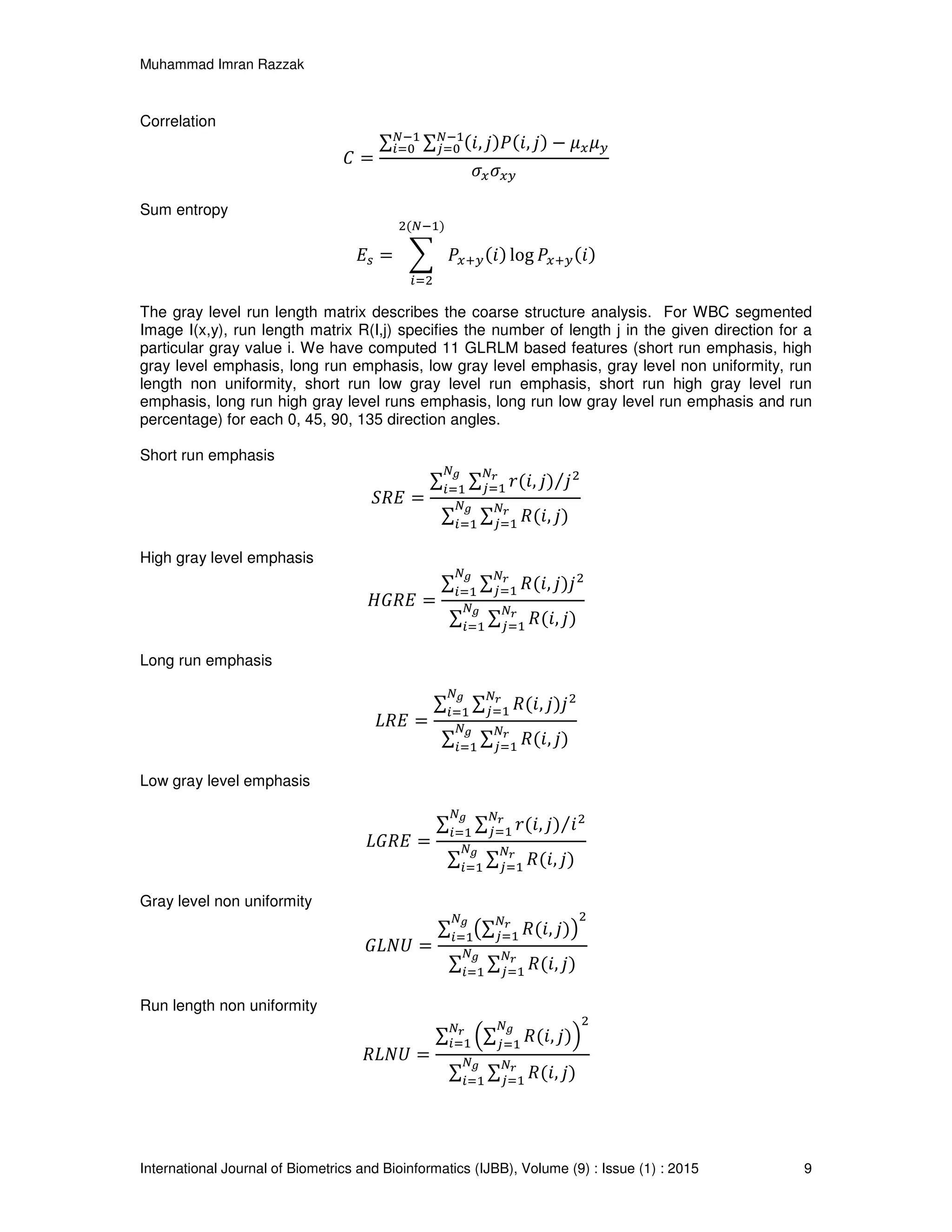
Correlation
‫ܥ‬ =
∑ ∑ (݅, ݆)ܲ(݅, ݆) − ߤ௫ߤ௬
ேିଵ
௝ୀ଴
ேିଵ
௜ୀ଴
ߪ௫ߪ௫௬
Sum entropy
‫ܧ‬௦ = ෍ ܲ௫ା௬(݅) log ܲ௫ା௬(݅)
ଶ(ேିଵ)
௜ୀଶ
The gray level run length matrix describes the coarse structure analysis. For WBC segmented
Image I(x,y), run length matrix R(I,j) specifies the number of length j in the given direction for a
particular gray value i. We have computed 11 GLRLM based features (short run emphasis, high
gray level emphasis, long run emphasis, low gray level emphasis, gray level non uniformity, run
length non uniformity, short run low gray level run emphasis, short run high gray level run
emphasis, long run high gray level runs emphasis, long run low gray level run emphasis and run
percentage) for each 0, 45, 90, 135 direction angles.
Short run emphasis
ܴܵ‫ܧ‬ =
∑ ∑ ‫,݅(ݎ‬ ݆) ݆ଶ⁄ேೝ
௝ୀଵ
ே೒
௜ୀଵ
∑ ∑ ܴ(݅, ݆)
ேೝ
௝ୀଵ
ே೒
௜ୀଵ
High gray level emphasis
‫ܧܴܩܪ‬ =
∑ ∑ ܴ(݅, ݆)݆ଶேೝ
௝ୀଵ
ே೒
௜ୀଵ
∑ ∑ ܴ(݅, ݆)
ேೝ
௝ୀଵ
ே೒
௜ୀଵ
Long run emphasis
‫ܧܴܮ‬ =
∑ ∑ ܴ(݅, ݆)݆ଶேೝ
௝ୀଵ
ே೒
௜ୀଵ
∑ ∑ ܴ(݅, ݆)
ேೝ
௝ୀଵ
ே೒
௜ୀଵ
Low gray level emphasis
‫ܧܴܩܮ‬ =
∑ ∑ ‫,݅(ݎ‬ ݆) ݅ଶ⁄ேೝ
௝ୀଵ
ே೒
௜ୀଵ
∑ ∑ ܴ(݅, ݆)
ேೝ
௝ୀଵ
ே೒
௜ୀଵ
Gray level non uniformity
‫ܷܰܮܩ‬ =
∑ ൫∑ ܴ(݅, ݆)
ேೝ
௝ୀଵ ൯
ଶே೒
௜ୀଵ
∑ ∑ ܴ(݅, ݆)
ேೝ
௝ୀଵ
ே೒
௜ୀଵ
Run length non uniformity
ܴ‫ܷܰܮ‬ =
∑ ቀ∑ ܴ(݅, ݆)
ே೒
௝ୀଵ
ቁ
ଶ
ேೝ
௜ୀଵ
∑ ∑ ܴ(݅, ݆)
ேೝ
௝ୀଵ
ே೒
௜ୀଵ
Muhammad Imran Razzak
International Journal of Biometrics and Bioinformatics (IJBB), Volume (9) : Issue (1) : 2015 10
FIGURE 4: Feature Extraction and Selection.
4. CLASSIFICATION OF INFECTED CELLS
We have used Backpropogation neural networks (ANN) for classification of the malarial parasite.
ANNs are the computational modals that simulated structure and function of biological neural
networks. Training is an important task in utilizing the neural network. For this purpose, we have
provided two types of input features as explained in feature selection section. There are some
where size of cell can be abnormal shapes and size. Recognition results are summarized in table
4.
BPNN P. Falciparum P. Vivax P. Ovale P. Malariae
Feature Set-I 94.2 89.2 93.2 97.9
Feature Set-II 93.1 91 93.5 97.9
SFS Feature List 94.6 92.3 94.9 98.6
TABLE 4: Recognition Result.
5. CONCLUSION
The paper presented a method for automatic detection of falciparum and vivax plasmodium.
Although, malaria cell segmentation and morphological analysis is a challenging problem due to
both the complex cell nature uncertainty in microscopic videos. To improve the performance of
malaria parasite segmentation and classification, we have used different set of features which are
forward to the ANN for malaria classification. We have selected three feature set. Feature matrix
III provided promising results that is computing after feature selection suing SFS and FDR.
6. REFERENCES
[1] T. Chen, YongZhang, C. Wang, ZhenshenQu, FeiWang, and Tanveer Syeda-Mahmood,
Complex local phase based subjective surfaces (CLAPSS) and its application to DIC red
blood cell image segmentation. Neurocomputing 99, 98 (2013).
[2] M.I.Razzak, B. AlHaqbani, “Automatic Detection of Malarial Parasite Using Microscopic
Blood Images” Journal of Medical Imaging and Health Informatics Vol. 5, 1–8, 2015.
[3] M. M. Kettelhut, P. L. Chiodini, and H. Edwards, Moody A: External quality assessment
schemes raise standards: evidence from the UKNEQAS parasitology subschemes. J. Clin.
Pathol. 56, 927 (2003).
[4] Chan, Y.-K., Tsai, M.-H., Huang, D. C., Zheng, Z.-H., Hung, K.-D., 2010. Leukocyte nucleus
segmentation and nucleus lobe counting. BMC Bioinformatics 11, 558.
[5] Yunda L., Ramirez, A.A., Millan, J., Automated Image Analysis Method for p-vivax Malaria
Parasite Detection in Thick Film Blood Images, Revista S&T, 10(20), 9-25.
Segmented Image
Enhanced Image
Texture Features
Geometrical features
PCA Based Feature
Reduction
FDR & SFF Based
Feature Reduction
Reduction
Muhammad Imran Razzak
International Journal of Biometrics and Bioinformatics (IJBB), Volume (9) : Issue (1) : 2015 11
[6] Chan LL, Laverty DJ, Smith T, Nejad P, Hei H, Gandhi R, Kuksin D, Qiu J., Accurate
measurement of peripheral blood mononuclear cell concentration using image cytometry to
eliminate RBC-induced counting error” , Journal of Immunological Method, Vol. 238, pp 25-
32, 2013 Feb.
[7] F. B. Tek, A. G. Dempster, and I. Kale, Malaria parasite detection in peripheral blood
images. Proceeding of British Machine Vision Conference (2006).
[8] C. D. Ruberto, A. Dempster, and S. B. Khan Jarra, Analysis of infected blood cell images
using morphological operators. Image and Computer Vision 20 (2002).
[9] R. Sriram, M. Chandar, and K. Srinivas, Computer aided malarial diagnosis for JSB stained
white light images using neural networks. International Journal of Advanced Research in
Computer Science and Software Engineering 3 (2013).
[10] D. K. Das, M. Ghosh, M. Pal, A. K. Maiti, and C. Chakraborty, Machine learning approach
for automated screening of malaria parasite using light microscopic images. Micron 45, 97
(2013).
[11] G. Díaz, F. A. González, and E. Romero, A semi-automatic method for quantification and
classification of erythrocytes infected with malaria parasites in microscopic images. Journal
of Biomedical Informatics 42, 296 (2009).
[12] G Díaz, Fabio Gonzalez, and Eduardo Romero, Infected cell identification in thin blood
images based on color pixel classification: Comparison and analysis. Lecture Notes in
Computer Science 4756, 812 (2007).
[13] T. P. Suradkar, Detection of malarial parasite in blood using image processing. International
Journal of Engineering and Innovative Technology (IJEIT) 2, (2013).
[14] Z. Karel, Contrast limited adaptive histogram equalization. Graphics Gems IV 474–485
(1994), (code: 479–484).
[15] M. I. Khan, B. Acharya, B. K. Singh, and J. Soni, Content based image retrieval approaches
for detection of malarial parasite in blood images. International Journal of Biometrics and
Bioinformatics (IJBB) 5 (2011).
[16] W. S. Selena Sio, W. Sun, Saravana Kumar, W. Z. Bin, S. S. Tan, S. H. Ong, H. Kikuchi, Y.
Oshima, and K. S. W. Tan, Malaria Count: An image analysis-based program for the
accurate determination of parasitemia. Journal of Microbiological Methods 68, 11 (2007).
[17] A. Mehrjou and T. Abbasian, Automatic Malaria Diagnosis System, First International
Conference on RSI/ISM.
[18] D. M. U. Sabino, L. da Fontoura Costa, E. Gil Rizzatti, and M. Antonio Zago, A texture
approach to leukocyte recognition. Real-Time Imaging 10, 205 (2004).
[19] D. M. Memeu, K. A. Kaduki, and A. C. K. Mjomba, Njogu Samson Muriuki,Lucy Gitonga,
Detection of plasmodium parasites from images of thin blood smears. Open Journal of
Clinical Diagnostics 3, 183 (2013).
[20] S. S. Savkare and S. P. Narote, Automatic detection of malaria parasites for estimating
parasitemia. International Journal of Computer Science and Security (IJCSS), 5 (2011).
Muhammad Imran Razzak
International Journal of Biometrics and Bioinformatics (IJBB), Volume (9) : Issue (1) : 2015 12
[21] A. Kumar, A. Choudhary, P. U. Tembhare, and C. R. Pote, Enhanced identification of
malarial infected objects using otsu algorithm from thin smear digital images. International
Journal of Latest Research in Science and Technology ISSN (Online):2278-5299, 1, 159
(2012).
[22] Mohammad Imroze Khan, Bhibhudendra Acharya, Bikesh Kumar Singh, Jigyasa Soni,
Content Based Image Retrieval Approaches for Detection of Malarial Parasite in Blood
Images, International Journal of Biometrics and Bioinformatics (IJBB), Volume (5) : Issue (2)
: 2011.
[23] Nasir A. S. A., Mashor M.Y., Mohamed Z., “Colour Image Segmentation Approach for
Detection of Malaria Parasites Using Various Colour Models and k-Means Clustering”,
WSEAS Tranaction on Biology and Biomedicine. Issue 1, Volume 10, January 2013.
[24] Cheng, H. D., Jiang, X. H., Sun, Y., & Wang, J. L. (2001). Color image segmentation:
Advances and prospects. Pattern Recognition, 34, 2259–2281.
[25] Panchbhai V.V, Damahe, L.B, Nagpure A.V., Chopkar P. N., RBCs and Parasites
Segmentation from Thin Smear Blood Cell Images, I.J. Image, Graphics and Signal
Processing, 2012, 10, 54-60.
[26] S. Kaewkamnerd and C. Uthaipibull, Apichart Intarapanich, Montri Pannarut, Sastra
Chaotheing, Sissades Tongsima, An automatic device for detection and classification of
malaria parasite species in thick blood film. BMC Bioinformatics 13, S18 (Suppl 17) (2012).
[27] N. Ahirwar, S. Pattnaik1, and B. Acharya, Advanced image analysis based system for
automatic detection and classification of malarial parasite in blood mages. International
Journal of Information Technology and Knowledge Management 5, 59 (2012).
[28] S. S. Savkare, S. P. Narote, Automatic System for Classification of Erythrocytes Infected
with Malaria and Identification of Parasites’s Life Stage, Procedia Technology 6 ( 2012 ) 405
– 410.
[29] Soni, J. “Advanced Image Analysis based system for Automatic Detection of Malarial
Parasite in Blood Images Using SUSAN Approach”, International Journal of Engineering
Science and Technology (IJEST), Vol. 3 No. 6 June 2011.
[30] Y.Purwar, Sirish L Shah, Gwen Clarke, Areej Almugairi, Atis Muehlenbachs, “Automated
and unsupervised detection of malarial parasites in microscopic images”, Malaria Journal
2011, 10:364.

Automatic Detection and Classification of Malarial Parasite

  • 1.
    Muhammad Imran Razzak InternationalJournal of Biometrics and Bioinformatics (IJBB), Volume (9) : Issue (1) : 2015 1 Automatic Detection and Classification of Malarial Parasite Muhammad Imran Razzak razzakmu@ngha.med.sa Health Informatics, CPHHI King Saud bi Abdulaziz University for Health Sciences Riyadh, 11426, Saudi Arabia Abstract Recent advancement in genomic technologies has opened a new realm for early detection of diseases that shows potential to overcome the drawbacks of manual detection technologies. Computer based malarial parasite analysis and classification has opened a new area for the early malaria detection that showed potential to overcome the drawbacks of manual strategies. This paper presented a method for automatic detection of malarial infected cells. Blood cell segmentation and morphological analysis is a challenging due complexity of the blood cells. To improve the performance of malaria parasite segmentation and classification, we have used different set of features which are forward to the ANN for malaria classification. We have used Rao’s method and bounding box for segmentation whereas we have used BPNN for classification on different set of texture and shape features. Keywords: Malaria Detection, Segmentation, RBC Classification, Malaria Classification. 1. INTRODUCTION Blood smear image consists of white blood cell, red blood cells, platelets as well as other possible contents such as malarial parasite, Aids virus etc. scattered across the background. The contents of blood cell images are very complex. The segmentation and morphological of blood cell is very difficult due to the complex nature of the blood cell images. Manual blood cell counting is not a reliable screening method when it is performed by non-expert due to lake of training expertise as it requires special training and considerable expertise [1-2]. Recent advancement in pattern recognition and computer vision algorithms made possible that the analysis of complex blood cells can be performed my machine. Automatic equipment for blood cell counting such as flow cytometry and automatic counting machines can examine cell quantity but not qualitatively, thus 21% of blood analysis is still need expert review [3]. Machine based visual analysis methods provides quantitative as well as qualitative blood cells analysis whereas this research area is not very much explored [4]. Automatic recognition and inspection of blood can assist hematologists in analyzing the blood sample and diagnosing diseases like Aids, malaria and blood cancer. Various research works are going on analyzing the microscopic blood cell images in the field of immunology, infectious diseases, transplantation, hematological malignancy and vaccine development in order to diagnose the infection existence in human blood. Thus, several image processing and pattern recognition base algorithms have been presented in literature for the automatic segmentation and classification of malarial infected blood cell. Malaria is transmitted via saliva of female mosquito through bite which introduce the organisms form her saliva. There are five species of malarial plasmodium that can infect the human blood and even can be transmitted by human. The majority of malarial patient deaths are caused by falciparum and vivax plasmodium as shown in figure 1. Thus, in case of malarial infection, species identification is necessary for proper treatment. There are some rules for malarial species identification as discussed in table 3. However it is not necessary that every parasite will exhibit the morphological characteristics. Typically, malaria parasite diagnoses is a manual counting
  • 2.
    Muhammad Imran Razzak InternationalJournal of Biometrics and Bioinformatics (IJBB), Volume (9) : Issue (1) : 2015 2 process that use microscopic examination of Giemsa-stained thick and thin blood smears. Manual identification and counting of malarial parasite infected cells is very long, tedious process. Moreover it is prone to technician's ability to conduct the process correctly that requires training and skills, i.e. a trained expert takes about 15 min to evaluate and count 100 cells and blood sample of millions of patients is performed every year [7]. Early detection of malaria is vital in order to ensure prompt and effective treatment. People suffering from malaria should be diagnosed and given effective, affordable drug treatment as early as possible. Microscopy is a standard technique used for diagnosing, however in remote areas reagents are limited, equipment and electricity are unreliable, and a delay in obtaining results may lead to incorrect initial treatment. Automatic analysis of microscopic blood cell is a powerful diagnostic tool that improves accuracy, saves time and reduces the required manpower as well as minimizes human errors. Automatic malarial diagnose has larger interest especially for clinics and laboratories; however, blood cell segmentation and morphological analysis is a challenging problem due to both the complex cell nature and uncertainty in microscopic videos. This paper presents a method for classifying malarial parasites. The organization of the rest of the paper is as follow: Section II briefly reviews the malarial parasite recognition approaches discussed earlier and Section III presents the proposed methodology whereas conclusion is drawn in section IV. Microscopy RDTs Requirement Electricity Special Training Staining Chemical None, Basic Training, None Time ~60 Minutes 15-20 Minutes Cost Specification Detection Threshold 50 pal/ul ~100par/ul Detection of all species Yes Some bands Quantification Yes None Specie Identification Yes None Life Stage Identification Yes None TABLE 1: Comparison of Microscopy Diagnosis and Rapid Diagnosis Tests [34]. FIGURE 1: Malaria Effected Blood Images. 2. RELATED WORK Microscopic Blood images consists of white blood cell, red blood cells, platelets as well as several other possible contents such as malarial parasite, Aids virus etc. that are scattered across blood
  • 3.
    Muhammad Imran Razzak InternationalJournal of Biometrics and Bioinformatics (IJBB), Volume (9) : Issue (1) : 2015 3 smear image. Due to the complexity of the images, cell identification and counting is time consuming job for biologist, e.g. expert requires 15 min to count and evaluate a slide. Moreover, it is painstaking and subjective job which also requires training and skills. Due to these complexities and hematologist restrictions, manual counting accuracy decreases and thus machine based blood classification system is essential for biologist in diagnosing disease. Machine based malarial diagnosis system can be designed by understanding the diagnostic expertise (hematologist knowledge) and representing it by specifically tailored image processing and pattern recognition algorithms. Several image processing based malarial diagnostic methods has been widely studied in order to provide early and accurate detection of malaria parasite. Table 2 summarized the recent development for malarial parasite identification. Reference Article Target Data Preprocessing Segmentation Method Features Classification Method Accuracy (sensitivity /specificity) Das et al. [10] Malaria Parasite Gray world assumption, geometric mean filter Marker controlled watershed algorithm 80 textural & 16 Morphological features Bayesian 98.10/68.91 SVM 96.62/88.51 Nasir et. al [23] Malaria Parasite Contrast enhancement K-Mean K-Mean Clustering Panchbhai et al. [24] Malaria Parasite, RBC Morphological Operation Otsu Method Kumar et al. [21] Malaria Parasite, RBC Morphological Operation Otsu Method Threshold Savkare [29] Malaria Parasite Median Filter Otsu Method Geometrical, color and statistical SVM 92.26/99.09 Kaewkamnerd et al. [26] Malaria Parasite in-focus information merging Histogram (HSV) and labeling chromatin size 75% (pv), 90% (pf) Ahirwar et al. [27] Malaria Parasite SUSAN Threshold Geometrical & Expert defined Feed Forward Back propagation Yunda et al. [5] Malaria Parasite Morphological gradient method AGNES and K- Median Color Features and Textural Multilayer Perceptron 77.19% Savkare [20] Malaria Parasite Smoothing and Sharpening Otsu Method Geometrical, color and statistical SVM 93.12% Soni [29] Malaria Parasite Median and SUSAN Region based (Watershed) Morphology First Order Moment invariant Tree 99 Tek et al. [7] Malaria Parasite Illumination correction, color correction and normalization histogram-based thresholds and PDF histogram & area granulometry features KNN. FLD, BPNN 72:37/97:45 Diaz et al. [12] Malaria Parasite Low pass filter Inclusion-Tree Structure and template based on EM Color, Saturation level, Tamura texture and Sobel histograms MLP SVM 94/98.7 Purwar et al. [30] Malaria Parasite & RBC Local Histogram equalization energy minimization [54] Pixel intensity K-mean 100/88 TABLE 2: Summarization of Recent Development. Most microscopes provide uniform or relatively uniform illumination images whereas several illumination and contrast enhancement technique have been applied in literature. One way to deal with uneven illumination is the predefined illumination correction but some time we don’t have reference image [7]. Ruberto et al. used paraboloid modal for illumination correction [8]. Sriram et al. used diagonal modal for illumination modeling [9]. In diagonal modal, an image of unknown illumination is transformed to the known illuminant space by multiplying pixel values with a diagonal matrix. Das et al. performed gray world assumption for correcting illumination [10]. Diaz
  • 4.
    Muhammad Imran Razzak InternationalJournal of Biometrics and Bioinformatics (IJBB), Volume (9) : Issue (1) : 2015 4 used adaptive local low-pass filter to correct luminance differences on luminance channel [11-12]. Suradkar used the local histogram equalization for contrast enhancement of parasite and RBC [13] whereas Zou et al. and Sio et al. used adaptive histogram equalization [14] for image enhancement [15, 16]. The image is divided to several tiles and histogram shaping is applied to these tiles separately followed by bilinear interpolation to eliminate artificially induced boundaries. The filter was designed for a window size which contained the largest image feature, i.e. a typical erythrocyte size. Filter was selectively applied on higher luminance levels that represent the background pixels. Mehrjou used adaptive histogram shaping function for contrast enhancement [17]. Sabino et al. performed non-supervised nucleus region detection before nucleus color segmentation using the G channel from RGB color coordinates [18]. For colored images segmentation into ROIs, supervised classification method that is based on RGB color space is used. In the identification of automatic malarial parasite classification procedures, the most important and complex phase is the segmentation of infected blood cells from other cells and background. There are several factors like cell shapes, light variation and noise that affect the accuracy of segmentation and make it complex task. Accurate segmentation allows fruitful result in sub- sequent levels. Blood cell segmentation can either be deductive or inductive. In deductive segmentation method, the microscopic image is first segmented into background and foreground images before segmenting the object whereas in inductive segmentation, the objects are located first by using intensity/RGB values followed by regions that contains stained. The recent has suggested several segmentation methods for blood cell summarized in table 2. Memeu et al. used both RGB and HIS for segmentation [19]. Green channel from RGB whereas hue and saturation channels are used for segmentation based on Otsu method and Zack algorithms for RBC and parasites respectively. The green channel gave good results for erythrocytes segmentation but it also added the parasite as part of the foreground. The hue component resulted to a binary image whose foreground had noisy boundaries whereas the saturation component failed to produce erythrocytes as the objects. Multilevel thresholding especially using Otsu method has been performed by many researchers for blood cell segmentation and it showed promising results. Savkare and Narote performed Global threshold and Otsu thresholdding on gray scale and green channel image [20]. Both images are added and median filter is applied to remove the unwanted points. Later on distance transform and watershed transform are applied to segment the cells. Kumar et al. used Otsu threshold on histogram of B component of RGB color space followed by the morphological operation [21]. Ahirwar et al. relied on two thresholds (one for erythrocytes, and one for parasites) for parasite segmentation [29]. The first threshold is selected to separate the erythrocytes from the background of the image. The second threshold is taking the first minimum after the principal mode of the histogram incorporating only the erythrocytes. Tek et al. modeled the stained and unstained pixel distributions with histograms and used the probability densities to determine whether a pixel on the input image is stained or not [12]. Diaz used inclusion-tree structure for segmentation. The background or foreground are label first using pixel classification. Different color spaces are used to build a pixel classification model because a particular color space may emphasize features that facilitate identification of searched objects [12]. Recent research on feature extraction and selection of blood cell has shown the important of feature extraction phase for blood cell analysis. Researchers have used different features based on their target blood cells/ disease. The features which give predominant difference between normal cells and infected cells are identified as feature set. Textural [18,22] and color features are very important in order to differentiate from other cells and has been widely used for blood cell recognition, texture features. Color features play important role to differentiate similar shapes and overlapped cells. The blood cell images are composed of three color components: red, green and blue, for each of the pixels in the images. The color characteristics and other features are required to be calculated in each of the color components, i.e. each of the malaria parasites features a particular color tone (blue ring). Suradkar used color features for RBC extraction and extraction of infected cells by malarial parasite [13]. RBC are red whereas malaria infected RBC cells have blue ring. Based on red color, red blood cells are segmented and then blue color is
  • 5.
    Muhammad Imran Razzak InternationalJournal of Biometrics and Bioinformatics (IJBB), Volume (9) : Issue (1) : 2015 5 used in order to count malarial parasite. Yunda et al. used both color and textural characteristics [21]. They extracted 27 color characteristics for each three color, i.e. standard deviation, seven Hough moments for color and color range as features set. For textural characteristics, wavelets descriptors (energy, standard deviation, mean) and co-occurrence matrix in four different directions with descriptors (homogeneity, contrast, GLMSR, standard deviation, angular moment and correlation) are used. The texture features from co-occurrence matrix and wavelet transform are not used together. Thus, the total number of descriptors is 110 when the co-occurrence matrix is used and 92 when the wavelet transform is used. Das et al. computed set of 96 features textural and morphological features [10]. They extracted 80 textural (entropy, Haralick textural features, local binary pattern, fractal dimension, histogram based features, gray level run length matrix based texture) along with16 morphological features (shape features and Hu’s moment) to discriminate six types of infected and non-infected erythrocytes. Classification of malarial infected cell becomes the challenging task. Several classifiers have been reported for the computerized recognition of malarial parasites in the presence of other stained structures and artifacts form blood cells images. Bayes classifier and different types of Artificial Neural Networks (ANNs), local linear map, SVM, K-mean and fuzzy system has been extensively used as classifier in the literature for blood cell recognition. The summary of recently used classifier is discussed in table 2. 3. METHODLOGY Due to complexity of the blood sample images, malarial parasite segmentation and morphological analysis is a challenging problem. Machine vision based malarial diagnostic methods has been widely studied in order to provide early and accurate diagnose of malaria parasite. An ideal diagnostic method would be accurate, non-invasive, and inexpensive. The key tasks for malarial parasite classification involve segmenting the malaria parasite infected cells from the complicated background. We presented an approach for classification of malarial infected cells using Rao’s based segmentation and BPNN for classification. We have divided the proposed methodology in to four basic steps. • Preprocessing • ROI Segmentation • Feature Extraction • Classification of Infected Cells FIGURE 2: System Diagram. A. Preprocessing Blood smear images might be affected by illumination and color distribution of blood images due to the camera calibration and staining variability. Most of the microscopes provide uniform or relatively uniform illumination images. The aim of preprocessing step is to obtain images with low noise, high contrast than original images for the further processing. This particular problem poses difficulties for classification of blood cells since it is hard to deal with proper segmentations of objects with quite similar colors. This process contains two operations image enhancement and noise reduction. Preprocessing Input Image RBC Segmentation Feature Extraction Classification Infected Cell Count RBC Count
  • 6.
    Muhammad Imran Razzak InternationalJournal of Biometrics and Bioinformatics (IJBB), Volume (9) : Issue (1) : 2015 6 We have applied median filter for noise reduction. The median filter replaces pixel value with the median of its neighboring value. To get the finest coefficients details of noise free image, a Forward Discrete Curvelet Transform is applied to the V channel as shown in Figure 3(b). It is a multi-dimensional transformation which can sense both the contours as well as curvy edges of the overlapping objects in the image. The FDCT has high directional sensitivity along with the capability to capture the singularities. Edge and singularity details are processed to extract the feature. After obtaining the highest detailed coefficients Inverse Discrete Curvelet Transform is applied to high frequency band to obtain the detailed image. This detailed image is now having the stronger edges than the original and would perform better in lending edge details to the segmentation step. The next step is the adaptive equalization operation to spread out the intensity values along the total ranges of values in order to achieve better contrast. Adaptive histogram equalization differ from ordinary histogram equalization in respect that it computes several histogram of each corresponding to distinct section and use these histogram to redistribute the lightness value. After applying the adaptive histogram equalization, the background pixels have higher intensities than the cells. FIGURE 3: Preprocessing of Blood Cell Image. B. ROI Segmentation In the analysis of automatic classification of malarial parasite procedures, the most important and difficult part is segmentation of malaria parasite infected blood cells from the background and other cells because the blood cells are often overlaid with each other and is the basis of quantitative analysis of its deformability and hence its filterability[12]. Cell shapes, light variation and noise are the other factors that make segmentation a difficult task. Accurate segmentation allows fruitful result in sub-sequent levels. Malarial parasite lies in erythrocytes thus we need to segment the erythrocyte form the blood images. We have used Rao’s method for background segmentation. Rao’s method extracts a rough foreground image using morphological rea top-hats [26]. Two different threshold values are determined form these backgrounds and foreground that are used to produce the refined binary foreground mask. At the end, a box counting algorithm is applied to the segmented image. Various algorithms are used for calculating the fractal dimensions, like the fractional (or fractal) Brownian motion and triangular-prism-surface area methods. The box counting algorithm counts the number of boxes having side length r needed to cover the surface of fractal objects and the number of boxes N, occupied by more than one pixel of the image. Two procedures are defined by two parameters in the box counting method. One is the selection of r and the other is the range of r. The blood cell image has finite set of points and the upper limit is the size of image while the lower is the pixel unit. Various researche propose using 2, 4, 8, 16, 2n pixels as box sizes to have a uniform spread of observation. The quadratic boxes cover the object, and the number of the boxes is recorded. Median Filter Curvelet coefficient Curvelet finest coefficient Enhanced Image + Input Image High Pass Adaptive Histogram Eq.
  • 7.
    Muhammad Imran Razzak InternationalJournal of Biometrics and Bioinformatics (IJBB), Volume (9) : Issue (1) : 2015 7 The fractal dimension (FD) measures the dependence between the number of boxes N and the box side length r. C. Feature Extraction Recent researches on feature extraction and selection of red blood cell have shown the importance of feature extraction phase for red blood cell analysis. Researchers have used different features based on their target blood cells/disease. The features which give predominant difference between normal cells and infected cells are identified as feature set. Textural [35,21] and color features [1, 27, 35] are very important in order to differentiate form other cells and has been widely used for blood cell recognition whereas color features plays important role in order to differentiate similar shapes and overlapped cells. We have used all geometrical and intensity features along with GLCM based texture features. Rules for identification of malarial species are presented in table 3. P. Falciparum P. Vivax P. Ovale P. Malariae Size Not enlarged Enlarged Enlarged Enlarged Shape Round crescent gametocyte Round or Oval Round or Oval amoeboid Round Dots Large red spots Small red dots Small red dots Few tiny dots TABLE 3: Some Rules for Species Identification. Geometrical features Geometrical features remain very important for complex shape recognition and lot of researchers used geometrical features for blood analysis. We have extracted geometrical features that are invariant under different condition and analogous to those used by hematologist. These features include nucleus area, relative area, nucleus parameter, nucleus relative parameter, nucleus roundness and nucleus relative roundness, nucleus mean, nucleus variance, cytoplasm area, cytoplasm parameter, cytoplasm mean, cytoplasm variance, cytoplasm ratio to nucleus and number of object of in nucleus. To reduce the scaling effect on the leukocyte recognition, we have used the relative based features, i.e. relative area, relative parameter, and relative roundness. Relative Area ‫ܣ‬௥ = ∑ ‫,ݔ(ܫ‬ ‫)ݕ‬௫,௬ ߨ‫ݎ‬ଶ Relative Parameter ܲ௥ = ∑ ඥ(‫ݔ‬௜ + ‫ݔ‬௜ା௜)ଶ + (‫ݕ‬௜ + ‫ݕ‬௜ା௜)ଶ + ට(‫ݔ‬௜೘ೌೣ + ‫ݔ‬଴)ଶ + (‫ݕ‬௜೘ೌೣ + ‫ݕ‬଴)ଶேିଵ ௜ୀ଴ 2ߨ‫ݎ‬ Circularity of the cell is defined as the ratio between the cell area and square of its parameter. The cell circularity features shows how close the shape of the cell to circle. More the roundness mean the cell is closer to normal cell. ܴ = 4ߨ‫ܣ‬ ‫݌‬ଶ ܹℎ݁‫݁ݎ‬ ‫ܣ‬ ݅‫ݏ‬ ‫ݐ‬ℎ݁ ݈݈ܿ݁ ܽ‫ܽ݁ݎ‬ ܽ݊݀ ‫݌‬ ݅‫ݏ‬ ‫ݐ‬ℎ݁ ݈݈ܿ݁ ‫ݎ݁ݐ݁݉݅ݎ݁݌‬
  • 8.
    Muhammad Imran Razzak InternationalJournal of Biometrics and Bioinformatics (IJBB), Volume (9) : Issue (1) : 2015 8 Relative Circularity ܴ௥ = 4ߨ‫ܣ‬௥ ‫݌‬௥ ଶ ܹℎ݁‫݁ݎ‬ ܲ௥ ݅‫ݏ‬ ‫ݐ‬ℎ݁ ‫݁ݒ݅ݐ݈ܽ݁ݎ‬ ݈݈ܿ݁ ‫ݎ݁ݐ݁݉݅ݎ݁݌‬ ܽ݊݀ ‫ܣ‬௥ ݅‫ݏ‬ ‫ݐ‬ℎ݁ ‫݁ݒ݅ݐ݈ܽ݁ݎ‬ ܽ‫ܽ݁ݎ‬ ‫݂݋‬ ‫ݐ‬ℎ݁ ‫݊݋݅݃݁ݎ‬ Medical axis ratio describes the property that shape of the cell is stretched. Medial axis ratio is calculated as ‫ܴܣܯ‬ = ‫ܮ‬௠௜௡௢௥ ‫ܮ‬௠௔௝௢௥ Whereas ‫ܮ‬௠௜௡௢௥ represent the length of minor principle axis and ‫ܮ‬௠௔௝௢௥ represent the length of major principle axis. Texture Features Due to the importance of textural feature for complex object classification, we have extracted several texture features, i.e. co-occurrence matrix and local binary pattern. The co-occurrence feature matrix describes the second order probabilistic features relating to the gray level relationship in the pixel neighborhood. GLCM is statistical measure used to characterize the image texture by calculating how often pairs of pixel occurrence in special specified relationship. It is a symmetric matrix constructed on the basis of image gray levels with distance and angle. The disparate co-occurrence feature matrix is created by the divergence of angle and distance. As different type of nucleus represent different texture, thus GLCM based texture features are taken into account for classification. If an image M consists of N gray levels, the co-occurrence matrix dimension is NxN. Let I be the segmented region of the leukocyte nuclei, the GLCM is computed by summing all the texture information in image I including the average spatial relationship between neighboring gray tones. We have extracted 28 texture features from co-occurrence matrix to represent correlation, entropy, variance, difference entropy, sum entropy, dissimilarity and homogeneity. Co-occurrence feature matrix is computed as. ‫ܥ‬∆௫,∆௬(݅, ݆) = ෍ ෍ ቄ 1 ݂݅ ‫,ݔ(ܫ‬ ‫)ݕ‬ = ݅ ‫ݔ(ܫ‬ + ∆‫,ݔ‬ ‫ݕ‬ + ∆‫)ݕ‬ = ݆ 0 ܱ‫ݐ‬ℎ݁‫݁ݏ݅ݓݎ‬ ௠ ௬ୀଵ ௡ ௫ୀଵ Entropy ‫ܧ‬ = ෍ ෍ ܲ(݅, ݆)log (ܲ(݅, ݆)) ேିଵ ௝ୀ଴ ேିଵ ௜ୀ଴ Energy ‫ܰܧ‬ = ෍ ෍ ܲ(݅, ݆)ଶ ேିଵ ௝ୀ଴ ேିଵ ௜ୀ଴
  • 9.
    Muhammad Imran Razzak InternationalJournal of Biometrics and Bioinformatics (IJBB), Volume (9) : Issue (1) : 2015 9 Correlation ‫ܥ‬ = ∑ ∑ (݅, ݆)ܲ(݅, ݆) − ߤ௫ߤ௬ ேିଵ ௝ୀ଴ ேିଵ ௜ୀ଴ ߪ௫ߪ௫௬ Sum entropy ‫ܧ‬௦ = ෍ ܲ௫ା௬(݅) log ܲ௫ା௬(݅) ଶ(ேିଵ) ௜ୀଶ The gray level run length matrix describes the coarse structure analysis. For WBC segmented Image I(x,y), run length matrix R(I,j) specifies the number of length j in the given direction for a particular gray value i. We have computed 11 GLRLM based features (short run emphasis, high gray level emphasis, long run emphasis, low gray level emphasis, gray level non uniformity, run length non uniformity, short run low gray level run emphasis, short run high gray level run emphasis, long run high gray level runs emphasis, long run low gray level run emphasis and run percentage) for each 0, 45, 90, 135 direction angles. Short run emphasis ܴܵ‫ܧ‬ = ∑ ∑ ‫,݅(ݎ‬ ݆) ݆ଶ⁄ேೝ ௝ୀଵ ே೒ ௜ୀଵ ∑ ∑ ܴ(݅, ݆) ேೝ ௝ୀଵ ே೒ ௜ୀଵ High gray level emphasis ‫ܧܴܩܪ‬ = ∑ ∑ ܴ(݅, ݆)݆ଶேೝ ௝ୀଵ ே೒ ௜ୀଵ ∑ ∑ ܴ(݅, ݆) ேೝ ௝ୀଵ ே೒ ௜ୀଵ Long run emphasis ‫ܧܴܮ‬ = ∑ ∑ ܴ(݅, ݆)݆ଶேೝ ௝ୀଵ ே೒ ௜ୀଵ ∑ ∑ ܴ(݅, ݆) ேೝ ௝ୀଵ ே೒ ௜ୀଵ Low gray level emphasis ‫ܧܴܩܮ‬ = ∑ ∑ ‫,݅(ݎ‬ ݆) ݅ଶ⁄ேೝ ௝ୀଵ ே೒ ௜ୀଵ ∑ ∑ ܴ(݅, ݆) ேೝ ௝ୀଵ ே೒ ௜ୀଵ Gray level non uniformity ‫ܷܰܮܩ‬ = ∑ ൫∑ ܴ(݅, ݆) ேೝ ௝ୀଵ ൯ ଶே೒ ௜ୀଵ ∑ ∑ ܴ(݅, ݆) ேೝ ௝ୀଵ ே೒ ௜ୀଵ Run length non uniformity ܴ‫ܷܰܮ‬ = ∑ ቀ∑ ܴ(݅, ݆) ே೒ ௝ୀଵ ቁ ଶ ேೝ ௜ୀଵ ∑ ∑ ܴ(݅, ݆) ேೝ ௝ୀଵ ே೒ ௜ୀଵ
  • 10.
    Muhammad Imran Razzak InternationalJournal of Biometrics and Bioinformatics (IJBB), Volume (9) : Issue (1) : 2015 10 FIGURE 4: Feature Extraction and Selection. 4. CLASSIFICATION OF INFECTED CELLS We have used Backpropogation neural networks (ANN) for classification of the malarial parasite. ANNs are the computational modals that simulated structure and function of biological neural networks. Training is an important task in utilizing the neural network. For this purpose, we have provided two types of input features as explained in feature selection section. There are some where size of cell can be abnormal shapes and size. Recognition results are summarized in table 4. BPNN P. Falciparum P. Vivax P. Ovale P. Malariae Feature Set-I 94.2 89.2 93.2 97.9 Feature Set-II 93.1 91 93.5 97.9 SFS Feature List 94.6 92.3 94.9 98.6 TABLE 4: Recognition Result. 5. CONCLUSION The paper presented a method for automatic detection of falciparum and vivax plasmodium. Although, malaria cell segmentation and morphological analysis is a challenging problem due to both the complex cell nature uncertainty in microscopic videos. To improve the performance of malaria parasite segmentation and classification, we have used different set of features which are forward to the ANN for malaria classification. We have selected three feature set. Feature matrix III provided promising results that is computing after feature selection suing SFS and FDR. 6. REFERENCES [1] T. Chen, YongZhang, C. Wang, ZhenshenQu, FeiWang, and Tanveer Syeda-Mahmood, Complex local phase based subjective surfaces (CLAPSS) and its application to DIC red blood cell image segmentation. Neurocomputing 99, 98 (2013). [2] M.I.Razzak, B. AlHaqbani, “Automatic Detection of Malarial Parasite Using Microscopic Blood Images” Journal of Medical Imaging and Health Informatics Vol. 5, 1–8, 2015. [3] M. M. Kettelhut, P. L. Chiodini, and H. Edwards, Moody A: External quality assessment schemes raise standards: evidence from the UKNEQAS parasitology subschemes. J. Clin. Pathol. 56, 927 (2003). [4] Chan, Y.-K., Tsai, M.-H., Huang, D. C., Zheng, Z.-H., Hung, K.-D., 2010. Leukocyte nucleus segmentation and nucleus lobe counting. BMC Bioinformatics 11, 558. [5] Yunda L., Ramirez, A.A., Millan, J., Automated Image Analysis Method for p-vivax Malaria Parasite Detection in Thick Film Blood Images, Revista S&T, 10(20), 9-25. Segmented Image Enhanced Image Texture Features Geometrical features PCA Based Feature Reduction FDR & SFF Based Feature Reduction Reduction
  • 11.
    Muhammad Imran Razzak InternationalJournal of Biometrics and Bioinformatics (IJBB), Volume (9) : Issue (1) : 2015 11 [6] Chan LL, Laverty DJ, Smith T, Nejad P, Hei H, Gandhi R, Kuksin D, Qiu J., Accurate measurement of peripheral blood mononuclear cell concentration using image cytometry to eliminate RBC-induced counting error” , Journal of Immunological Method, Vol. 238, pp 25- 32, 2013 Feb. [7] F. B. Tek, A. G. Dempster, and I. Kale, Malaria parasite detection in peripheral blood images. Proceeding of British Machine Vision Conference (2006). [8] C. D. Ruberto, A. Dempster, and S. B. Khan Jarra, Analysis of infected blood cell images using morphological operators. Image and Computer Vision 20 (2002). [9] R. Sriram, M. Chandar, and K. Srinivas, Computer aided malarial diagnosis for JSB stained white light images using neural networks. International Journal of Advanced Research in Computer Science and Software Engineering 3 (2013). [10] D. K. Das, M. Ghosh, M. Pal, A. K. Maiti, and C. Chakraborty, Machine learning approach for automated screening of malaria parasite using light microscopic images. Micron 45, 97 (2013). [11] G. Díaz, F. A. González, and E. Romero, A semi-automatic method for quantification and classification of erythrocytes infected with malaria parasites in microscopic images. Journal of Biomedical Informatics 42, 296 (2009). [12] G Díaz, Fabio Gonzalez, and Eduardo Romero, Infected cell identification in thin blood images based on color pixel classification: Comparison and analysis. Lecture Notes in Computer Science 4756, 812 (2007). [13] T. P. Suradkar, Detection of malarial parasite in blood using image processing. International Journal of Engineering and Innovative Technology (IJEIT) 2, (2013). [14] Z. Karel, Contrast limited adaptive histogram equalization. Graphics Gems IV 474–485 (1994), (code: 479–484). [15] M. I. Khan, B. Acharya, B. K. Singh, and J. Soni, Content based image retrieval approaches for detection of malarial parasite in blood images. International Journal of Biometrics and Bioinformatics (IJBB) 5 (2011). [16] W. S. Selena Sio, W. Sun, Saravana Kumar, W. Z. Bin, S. S. Tan, S. H. Ong, H. Kikuchi, Y. Oshima, and K. S. W. Tan, Malaria Count: An image analysis-based program for the accurate determination of parasitemia. Journal of Microbiological Methods 68, 11 (2007). [17] A. Mehrjou and T. Abbasian, Automatic Malaria Diagnosis System, First International Conference on RSI/ISM. [18] D. M. U. Sabino, L. da Fontoura Costa, E. Gil Rizzatti, and M. Antonio Zago, A texture approach to leukocyte recognition. Real-Time Imaging 10, 205 (2004). [19] D. M. Memeu, K. A. Kaduki, and A. C. K. Mjomba, Njogu Samson Muriuki,Lucy Gitonga, Detection of plasmodium parasites from images of thin blood smears. Open Journal of Clinical Diagnostics 3, 183 (2013). [20] S. S. Savkare and S. P. Narote, Automatic detection of malaria parasites for estimating parasitemia. International Journal of Computer Science and Security (IJCSS), 5 (2011).
  • 12.
    Muhammad Imran Razzak InternationalJournal of Biometrics and Bioinformatics (IJBB), Volume (9) : Issue (1) : 2015 12 [21] A. Kumar, A. Choudhary, P. U. Tembhare, and C. R. Pote, Enhanced identification of malarial infected objects using otsu algorithm from thin smear digital images. International Journal of Latest Research in Science and Technology ISSN (Online):2278-5299, 1, 159 (2012). [22] Mohammad Imroze Khan, Bhibhudendra Acharya, Bikesh Kumar Singh, Jigyasa Soni, Content Based Image Retrieval Approaches for Detection of Malarial Parasite in Blood Images, International Journal of Biometrics and Bioinformatics (IJBB), Volume (5) : Issue (2) : 2011. [23] Nasir A. S. A., Mashor M.Y., Mohamed Z., “Colour Image Segmentation Approach for Detection of Malaria Parasites Using Various Colour Models and k-Means Clustering”, WSEAS Tranaction on Biology and Biomedicine. Issue 1, Volume 10, January 2013. [24] Cheng, H. D., Jiang, X. H., Sun, Y., & Wang, J. L. (2001). Color image segmentation: Advances and prospects. Pattern Recognition, 34, 2259–2281. [25] Panchbhai V.V, Damahe, L.B, Nagpure A.V., Chopkar P. N., RBCs and Parasites Segmentation from Thin Smear Blood Cell Images, I.J. Image, Graphics and Signal Processing, 2012, 10, 54-60. [26] S. Kaewkamnerd and C. Uthaipibull, Apichart Intarapanich, Montri Pannarut, Sastra Chaotheing, Sissades Tongsima, An automatic device for detection and classification of malaria parasite species in thick blood film. BMC Bioinformatics 13, S18 (Suppl 17) (2012). [27] N. Ahirwar, S. Pattnaik1, and B. Acharya, Advanced image analysis based system for automatic detection and classification of malarial parasite in blood mages. International Journal of Information Technology and Knowledge Management 5, 59 (2012). [28] S. S. Savkare, S. P. Narote, Automatic System for Classification of Erythrocytes Infected with Malaria and Identification of Parasites’s Life Stage, Procedia Technology 6 ( 2012 ) 405 – 410. [29] Soni, J. “Advanced Image Analysis based system for Automatic Detection of Malarial Parasite in Blood Images Using SUSAN Approach”, International Journal of Engineering Science and Technology (IJEST), Vol. 3 No. 6 June 2011. [30] Y.Purwar, Sirish L Shah, Gwen Clarke, Areej Almugairi, Atis Muehlenbachs, “Automated and unsupervised detection of malarial parasites in microscopic images”, Malaria Journal 2011, 10:364.