Implementation of a decision system for a suitable IT
governance framework
Ibrahim HAMZANE
Laboratory of Information Technologies and Modeling
Hassan II University Mohammedia,
Casablanca, Morocco
hamzane.ibrahim@gmail.com
Abdessamad BELANGOUR
Laboratory of Information Technologies and Modeling
Hassan II University Mohammedia,
Casablanca, Morocco
belangour@gmail.com
Abstract— The implementation of IT governance is important to
lead and evolve the information system in agreement with
stakeholders. This requirement is seriously amplified at the time
of digital area considering all the new technologies that has been
lunched recently (Big DATA, Artificial Intelligence, Machine
Learning, Deep learning...). Thus, without a good rudder, every
company risks getting lost in a sea endless and unreachable goals.
This paper aims to provide decision-making system that allow
professionals to choose IT governance framework suitable to
desired criteria and their importance based on a multi-criteria
analysis method (WSM), we did implement a case study based on
our analysis in a Moroccan company. Moreover, we present
better understanding of IT Governance aspects such as standards
and best practices.
Our article goes into a global objective that aims to build an
integrated generated meta-model for better approach of IT
Governance.
Keywords-component; IT Governance; COBIT; ISO 38500;
CMMI; ITIL; TOGAF; PMBOK; PRINCE 2; SCRUM
I. INTRODUCTION
Information Technology is a business asset that is gaining a
lot of importance in the last decades on every industry
especially regarding the spread of new technologies.
Following the statistics provided by CIGREF in 2017, 51%
of companies rely on COBIT for the governance of their
information systems (IT), while 16% use internal processes and
32% are not inspired by COBIT in the world [22]. In Morocco,
we have to make lot of effort regarding IT governance [20].
Our goal is to provide the most complete IT governance
approach based on existing models and complement our
research with other best practices in several IT domains. In this
paper, we will clarify the difference between several concepts
similar to the definition of the standards. Then, we will carry
out a comparative study between the different frameworks
specifying their strengths and weaknesses then we will
implement a decision system based on our analysis that we will
use on a Moroccan company. Thus, companies can weigh the
criteria and produce the choice of reference to adopt based on
their own needs.
II. STANDARDS VS BEST PRACTICES
Outside, when we focus on governance practices
specifically in IT governance, we come across several sources
(ITIL, CNIL, SOX, CMMI, ISO 9001, ISO 9002, ISO 14000,
ISO 17799, ISO 27001, 27002, 27003, 27005...) each reference
offer a partial view of IT Governance. Thus, for better
governance of our paper, we will first make a vocabulary
distinction between theses references then we will define IT
governance.
A. Standards
According to ISO and IEC: the standard is "a document
established by consensus and approved by a recognized body,
which provides, for common and repeated use, rules, guidelines
or features, for activities or results that guarantee an optimal
level of order in a given context." [1].
 ISO 38500: Helps business leaders to ensure that the
use of IT assets positively and contributes to the
performance of the organization by meeting the
requirements of ISO / IEC 38500, organizations are
able to monitor the use of IT, ensure business
continuity and sustainability, align IT assets to business
needs and ensure proper implementation and operation
of IT assets [16].
 ISO 9001: Standard that establishes the requirements
for a quality management system. It helps businesses
and organizations become more efficient and increase
customer satisfaction [20].
B. Best Practices
Whereas best practices are a set of behaviours to adopt and
adapt to effectively manage a given aspect of IT such as :
governance, value and quality of services, projects, processes,
application development, development architecture, etc. Each
IT aspect is considered essential by most professionals in the
field, it can be found in the form of guides to good practice
Identify applicable sponsor/s here. (sponsors)
International Journal of Computer Science and Information Security (IJCSIS),
Vol. 17, No. 5, May 2019
1 https://sites.google.com/site/ijcsis/
ISSN 1947-5500
such as SCRUM or adopted by organization such as PRINCE 2
(OGC), ITIL (OGC) or COBIT (ISACA).
Best practices are generally based on two types of models:
 Stepped models: structured by maturity levels; For
example: CMMI, eSCM-CL ...
 "Continuous" or "Cyclical" models: structured by skill
or phase domain; for example: ITIL 2011, TOGAF 9.2,
COBIT 5 …
Note that CMMI proposes both approaches.
Below some definitions of most commune best practices
used in IT services.
 CMMI: Capacity Maturity Model Integrated is a model
for assessing the maturity level of a company in terms
of IT developments. Developed in 1987 by the
Carnegie Mellon University Software Engineering
Institute, CMMI is a model for the development and
maintenance of computer systems and applications
designed to capture, evaluate and improve the
operations of engineering firms [3].
 COBIT: A framework for the development,
implementation, supervision and improvement of the
governance and administration practices of information
systems. The IT Governance Institute and ISACA
publish the COBIT framework. Its purpose is to
provide a common language for business leaders to
dis-cuss together their goals, objectives and results
[16].
 TOGAF: The Open Group Architecture Framework is
a set of concepts and an industry standard covering the
field of enterprise IT architectures [17].
 ITIL: Information Technology Infrastructure Library,
is a framework enables information technology (IT) to
play a service de-livery role rather than just specialized
support [11...14]. ITIL guidelines and best practices
aim to adapt IT actions and budget to business needs
and modify them as the company grows or changes
direction. The goal is to improve efficiency and
achieve predictable levels of service [9].
 PMBOK: Project Management Body of Knowledge is
a project management guide designed and produced by
the PMI Project Management Institute. This extensive
guide aims to stabilize and structure the current
knowledge needed to run a project in the best
conditions.
 PRINCE 2: Projects In Controlled Environment is a
method developed by the British government and
accredited by Axelos, based on best practices in project
management. This flexible methodology applies to all
companies and only for a defined scope project. “Built
upon seven principles, themes and processes,
PRINCE2 can be tailored to meet specific
requirements”. [19]
 SCRUM: An agile project management methodology,
it is used particularly in software development. It’s “a
framework within which people can address complex
adaptive problems, while productively and creatively
delivering products of the highest possible value.” [18]
III. IT GOVERNANCE
Governance is the set of processes that tend to harmonize
the world of business, projects and experience.
According to the CIGREF, governance is closely linked to
the notion of company management.
IT governance [2]: "Organizational capacity exercised by
the management committee, senior management and IS
managers to oversee the formulation and implementation of the
IS strategy".
The ITGI provides business executives and boards of
directors with original research, online resources and case
studies to help them meet their responsibilities in the area of IT
governance.
It designed and authored COBIT V4.1, essentially as a
teaching resource for information managers, general
management, Information System management and control
professionals [5].
Today, IT governance as defined by ITGI and ISACA boils
down to the following 5 issues:
 IT Strategic Alignment
 IT Value Delivery
 IT Risk Management
 Performance Measurement
 IT Resource Management
According to the ISO, there are six guiding principles for
corporate governance that apply to most organizations. The
ISO specifies that each principle refer to what should exist, but
does not describe how, when or by whom these principles were
implemented. Nevertheless, decision-makers must demand that
these principles be applied:
 Principle 1: Responsibility
 Principle 2: Strategy
 Principle 3: Acquisition
 Principle 4: Performance
 Principle 5: Compliance
 Principle 6: Ethics
IV. COMPARATIVE STUDY OF IT GOVERNANCE REFERENCES
A. Mini SWOT Analysis
In this section, we present a minimal SWOT analysis in
order to summarize the strengths and weaknesses of the
references:
International Journal of Computer Science and Information Security (IJCSIS),
Vol. 17, No. 5, May 2019
2 https://sites.google.com/site/ijcsis/
ISSN 1947-5500
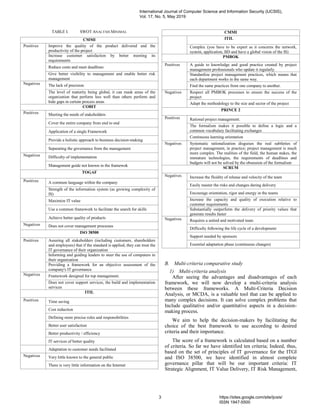
TABLE I. SWOT ANALYSIS MINIMAL
CMMI
Positives Improve the quality of the product delivered and the
productivity of the project
Increase customer satisfaction by better meeting its
requirements
Reduce costs and meet deadlines
Give better visibility to management and enable better risk
management
Negatives The lack of precision
The level of maturity being global, it can mask areas of the
organization that perform less well than others perform and
hide gaps in certain process areas
COBIT
Positives Meeting the needs of stakeholders
Cover the entire company from end to end
Application of a single Framework
Provide a holistic approach to business decision-making
Separating the governance from the management
Negatives Difficulty of implementation
Management guide not known in the framewok
TOGAF
Positives A common language within the company
Strength of the information system (as growing complexity of
IS)
Maximize IT value
Use a common framework to facilitate the search for skills
Achieve better quality of products
Negatives Does not cover management processes
ISO 38500
Positives Assuring all stakeholders (including customers, shareholders
and employees) that if the standard is applied, they can trust the
IT governance of their organization
Informing and guiding leaders to steer the use of computers in
their organization
Providing a framework for an objective assessment of the
company's IT governance
Negatives Framework designed for top management.
Does not cover support services, the build and implementation
services
ITIL
Positives Time saving
Cost reduction
Defining more precise roles and responsibilities
Better user satisfaction
Better productivity / efficiency
IT services of better quality
Adaptation to customer needs facilitated
Negatives Very little known to the general public
There is very little information on the Internet
CMMI
ITIL
Complex (you have to be expert as it concerns the network,
system, application, BD and have a global vision of the IS)
PMBOK
Positives A guide to knowledge and good practice created by project
management professionals who update it regularly.
Standardize project management practices, which means that
each department works in the same way.
Find the same practices from one company to another.
Negatives Respect all PMBOK processes to ensure the success of the
project
Adapt the methodology to the size and sector of the project
PRINCE 2
Positives Rational project management.
The formalism makes it possible to define a logic and a
common vocabulary facilitating exchanges
Continuous learning orientation
Negatives Systematic rationalization disguises the real subtleties of
project management, in practice; project management is much
more complex. The realities of the field, the human stakes, the
immature technologies, the requirements of deadlines and
budgets will not be solved by the obsession of the formalism
SCRUM
Negatives Increase the fluidity of release and velocity of the team
Easily master the risks and changes during delivery
Encourage orientation, rigor and energy in the teams
Increase the capacity and quality of execution relative to
customer requirements
Substantially outperform the delivery of priority values that
generate results faster
Negatives Requires a united and motivated team
Difficulty following the life cycle of a development
Support needed by sponsors
Essential adaptation phase (continuous changes)
B. Multi-criteria comparative study
1) Multi-criteria analysis
After seeing the advantages and disadvantages of each
framework, we will now develop a multi-criteria analysis
between these frameworks. A Multi-Criteria Decision
Analysis, or MCDA, is a valuable tool that can be applied to
many complex decisions. It can solve complex problems that
Include qualitative and/or quantitative aspects in a decision-
making process.
We aim to help the decision-makers by facilitating the
choice of the best framework to use according to desired
criteria and their importance.
The score of a framework is calculated based on a number
of criteria. So far we have identified ten criteria; Indeed, thus,
based on the set of principles of IT governance for the ITGI
and ISO 38500, we have identified in almost complete
governance pillar that will be our important criteria: IT
Strategic Alignment, IT Value Delivery, IT Risk Management,
International Journal of Computer Science and Information Security (IJCSIS),
Vol. 17, No. 5, May 2019
3 https://sites.google.com/site/ijcsis/
ISSN 1947-5500
IT Performance measurement, IT Acquisition, IT Resource
Management, IT Responsibility, IT Compliance, IT Human
Behaviour and IT Control.
 C1: IT Strategic Alignment: An approach to align the
information system strategy with the company's
business strategy.
 C2: IT Value Delivery: Value creation refers to the
financial purpose of companies for their IT. Value is
created when investments are based on IT whose rate
of return is higher than the costs that are made.
 C3: IT Risk Management: Operational and business
risk in relation to IT, it is about setting up processes to
manage IT risk.
 C4: IT Performance measurement: The implementation
of KPIs to achieve the objectives. In addition to the
indicators, it is also the right definition of the
objectives to be put in place.
 C5: IT Acquisition: The management of the service
providers and the external interventions makes it
possible to carry out the objectives of the IT thus a
good piloting of the activity IT.
 C6: IT Resource Management: The main asset of the
IT division is the human re-sources as well as the
materials used, thus a good management of the re-
sources makes it possible to obtain good governance of
the IT system.
 C7: IT Responsibility: The definition of roles and
responsibility is a key factor of process success so it is
a pillar to carry out the adopted processes.
 C8: IT Compliance: IT regulation has evolved a lot in
the last decades, with user protection laws, a good
benchmark allowing a good application of IT
regulations will allow better governance.
 C9: IT Human Behavior: According to the CNIL, the
respect of the freedom is an important axis for a good
IT governance; several articles describe in detail this
pillar.
 C10: IT Control: Set up a set of business processes / IT
with KPIs to control the execution and performance of
processes.
2) Multi-criteria analysis methods
There are several possible methods to make the comparison
between the frameworks using a number of criteria. These
methods can be divided into three main families:
 Complete aggregation (top-down approach):
Aggregating the n criteria to reduce them to a single
criterion.
 Partial aggregation (bottom-up approach): Comparing
potential actions or rankings to each other, and
establishing between them outranking relations.
 Local and iterative aggregation: Looking primarily for
a starting solution, then, we proceed to an iterative
search to find a better solution.
The table 2 shows the different existing multi-criteria
methods sorted by family:
TABLE II. MULTI-CRITERIA ANALYSIS FAMILIES [17]
Family Approach Methods
Complete
aggregation
top-down
approach
Weighted Sum Method
(WSM)
TWO WAY ANOVA
Weight Product Method
(WPM)
Analytic Hierarchy Process
(AHP)
Multi Attribute Utility Theory
(MAUT)
Partial
aggregation
bottom-up
approach
ELECTRE
Promethe
Melchior
Qualifex
Oreste
Regim …
Local and
iterative
aggregation
Local &
iterative
Improving Cones Method
(ICM)
GOAL Programming
STEM
Branch and Bound
3) Weighted Sum Method (WSM)
We chose the Weight Sum Method (WSM) for our analysis.
Indeed, this method allows us to find the best possible
approach by assigning a weight to each comparison criterion, it
allows to take into account all the criteria according to their
value and without a criterion penalizing the other criteria.
4) Comparison criteria and weight
We presented the ten comparison criterions cited on which
the comparative study will be based. We notice that these
criteria are based on the characteristics of each of the
approaches presented in the comparative study and the SWOT
analysis presented above, we summarized all the characteristics
(strengths and weaknesses) in ten global criteria to ensure
better analysis and optimize the comparison.
These criteria have the same importance, therefore the
WSM weight will be the same for each criterion and equal to
“1”. However as we will see further in this paper the weight of
each criterion will change depending on each company. We
will present a case study on which we will expose the vision of
a reel company weighs.
5) Comparison criteria and weight
The WSM method start with filling the multi-criteria choice
matrix. The columns contain the frameworks to be compared
and its lines contain criteria with the weight assigned to each
criterion witch we agree that it’s “1” as all the criterions have
the same importance, and in cells there is the score given to
each framework based on the detailed comparative study of
each framework [2] [3] [5].
About the score, we will then use the maturity model,
which consists of five levels of maturity to weight the criterion
International Journal of Computer Science and Information Security (IJCSIS),
Vol. 17, No. 5, May 2019
4 https://sites.google.com/site/ijcsis/
ISSN 1947-5500
on each framework, each level will give a score, for example
“level 1” will leave a score of “1”.
We recall the definition of the 5 levels by modifying the
definitions to apply it to our case:
 Level 1: There is no formal method, nor coherence,
nor standard, based on which the criteria will be
constructed. The development process of the criteria is
not described formally in the framework.
 Level 2: There is a consensus in the framework of how
the criteria should be managed, but this has not been
formalized or described.
 Level 3: The development process of the criteria is
formalized, documented and applied. Reviews are
conducted with compliance and the configurations are
properly managed.
 Level 4: The reference has instituted a formal metric
information collection process to track and manage the
criteria development process as well as the resulting
systems. Indicators monitor the smooth running of
processes and the respect of the quality objectives of
the criteria.
 Level 5: The reference uses measures to continuously
optimize the criteria development process. It describes
in detail a process of correcting the aspects that would
be considered insufficient by reading the indicators
allowing manage the criteria.
The Table 3 bellow represents the resulting multi-criteria
choice matrix according to the score of each criterion:
TABLE III. MULTI-CRITERIA CHOICE MATRIX
CMMI
COBIT
TOGAF
ISO38500
ITIL
PMBOK
PRINCE2
SCRUM
C1 4 4 3 3 3 1 3 3
C2 3 4 4 4 4 3 3 3
C3 3 4 4 2 3 5 5 4
C4 4 5 3 4 3 4 4 4
C5 1 2 2 1 1 1 1 1
C6 1 1 2 1 2 4 2 2
C7 4 3 1 3 1 1 1 1
C8 3 2 2 1 1 1 1 1
C9 3 3 3 3 3 2 2 2
C10 4 4 2 2 3 1 5 1
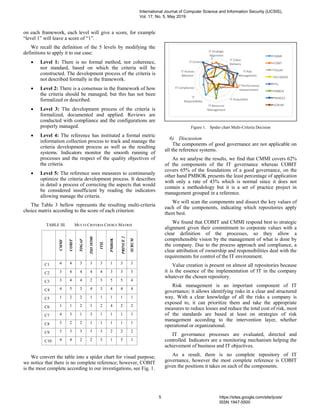
We convert the table into a spider chart for visual purpose;
we notice that there is no complete reference; however, COBIT
is the most complete according to our investigations, see Fig. 1.
Figure 1. Spider chart Multi-Criteria Decision
6) Discussion
The components of good governance are not applicable on
all the reference systems.
As we analyse the results, we find that CMMI covers 62%
of the components of the IT governance whereas COBIT
covers 65% of the foundations of a good governance, on the
other hand PMBOK presents the least percentage of application
with only a rate of 43% which is normal since it does not
contain a methodology but it is a set of practice project in
management grouped in a reference.
We will scan the components and dissect the key values of
each of the components, indicating which repositories apply
them best.
We found that COBIT and CMMI respond best to strategic
alignment given their commitment to corporate values with a
clear definition of the processes, so they allow a
comprehensible vision by the management of what is done by
the company. Due to the process approach and compliance, a
clear attribution of ownership and responsibilities deal with the
requirements for control of the IT environment.
Value creation is present on almost all repositories because
it is the essence of the implementation of IT in the company
whatever the chosen repository.
Risk management is an important component of IT
governance; it allows identifying risks in a clear and structured
way. With a clear knowledge of all the risks a company is
exposed to, it can prioritize them and take the appropriate
measures to reduce losses and reduce the total cost of risk, most
of the standards are based at least on strategies of risk
management according to the intervention layer, whether
operational or organizational.
IT governance processes are evaluated, directed and
controlled. Indicators are a monitoring mechanism helping the
achievement of business and IT objectives.
As a result, there is no complete repository of IT
governance, however the most complete reference is COBIT
given the positions it takes on each of the components.
International Journal of Computer Science and Information Security (IJCSIS),
Vol. 17, No. 5, May 2019
5 https://sites.google.com/site/ijcsis/
ISSN 1947-5500
V. CASE STUDY
We consulted the company USA HOME; a company
specialized in cameras installation, maintenance of pointing
software, and office installation. Given the competition in the
Moroccan market, the CEO want to optimize the IT resources
and apply an IT Governance to it’s IT department.
Based on our study we build up an application form in
order to get the interests of the company on every criterion,
below the result given by the CEO of USA HOME (Fig 2):
Figure 2. Application form that was given to the company USA HOME
Following the input of the CEO, the Multi-Criteria Choice
Matrix has changed through the formula (1) below:
  
Z New score following the preferences of the company
B Initial score produced
A Weight according to the company
X Sum of weights regarding all the criterions
As a result, Spider chart Multi-Criteria Decision has
changed according to the company's need (Fig 3):
Figure 3. Spider chart Multi-Criteria Decision of USA HOME
According to our Multi-Criteria Decision form, PMBOK
will be a good reference based on the company USA HOME
requirements. It will allow the company to enhance the
potential of creativity, ensuring the realization and coordination
of project actors and available resources according to the
defined plan; it’s also an effective way for a company very
concerned by the projects.
VI. CONCLUSION
IT assets has become directly linked to the results of the
business; as the launch of new technologies and the
digitalization of companies in all domains. Thus, the
implementation of IT governance is important to lead and
evolve the information system in agreement with stakeholders.
The choice of an IT governance framework is very
important task before the implementation, a good choice will
lead to better result, this article has enabled us to implement a
decision system according to the company needs. Also, to
understand IT governance framework regarding their
advantages and disadvantages.
We have seen that all frameworks have many challenges
specially in covering all business areas and the difficulty of
implementation. As future work, we will present solutions for
these issues. This work gives a contribution for professionals to
help them choose between different existing framework, and
this according to their needs and criteria that matter most to
them, as we have seen in the case study.
REFERENCES
[1] Alexandre Steigmeier, Rolf Hauri, Gouvernance de la sécurité :
comment articuler les différentes normes et méthodes, Novembre 2009.
[2] The National Computing Center, developing a succeful governance
startegy, Novembre 2005.
[3] Jarke, M. Mylopoulos,J. Schmidt,andVassilou Y. DAIDA, Conceptual
Model-ing and Knowledge Based Suppor of Information Systems
Development Process. Technique et Science Informatiques, 1990,122-
133.
[4] Jean-François CARPENTIER, La gouvernance du Système
d'Information dans les PME : Pratiques et évolutions, Editions ENI,
Mars 2017.
[5] Bruno Ménard, CobiT : Pour une meilleure gouvernance des systèmes
d'information, Eyrolles, janvier 2009.
[6] Frédéric Georgel, IT Gouvernance : Maîtrise d'un système d'information,
Dunod, Mai 2005.
[7] Richard Basque, CMMI 1.3 - Guide complet de CMMI-DEV et
traduction de toutes les pratiques CMMI-ACQ et CMMI-SVC, Dunod,
Mai 2011.
[8] Gmati, I., Nurcan, S., Gmati, I., &Nurcan, S. Un cadre de référence pour
analyser les exigences d’alignement métier / système d’information,
2012.
[9] Abbadi, S. S.-M.-L..Proposition de méthode d’implémentation d’ITIL.
2eme édition du congre International de génie Industriel et Management
des systèmes, 2015, Mai 21, pp. 5,6.
[10] Rolland, C.. A Comprehensive View of Process Engineering, 2012, 1–
24.
[11] Commerce, O. o. ITIL 2011 Amélioration continue des services.
stationery office, 2011.
International Journal of Computer Science and Information Security (IJCSIS),
Vol. 17, No. 5, May 2019
6 https://sites.google.com/site/ijcsis/
ISSN 1947-5500
[12] Commerce, O. o. ITIL 2011 Conception des services, stationery office.
stationery office, 2011.
[13] Commerce, O. o. ITIL 2011 Exploitation des services. stationery office,
2011.
[14] Commerce, O. o. ITIL 2011 Stratégie des services. stationery office,
2011.
[15] Commerce, O. o.ITIL 2011 Transition des services. stationery office,
2011.
[16] Martine Otter, J. S. Guide des certifications SI. Dunod, 2009.
[17] Z. Ibn Batouta, Multi-criteria analysis and advanced comparative study
between automatic generation approaches in software engineering, 2015.
Vol.81. No.3
[18] Ken Schwaber, Jeff Sutherland, “The Definitive Guide to Scrum: The
Roles of the Game”, 2017 Edition, available at www.scrum.org
[19] AXELOS, “Managing Successful Projects with PRINCE2”, 2017
Edition
[20] H. Askari, H.Mohammad khan, L. Mydin, “Reformation and
Development in the Muslim World: Islamicity Indices as Benchmark”,
Springer 2017 Edition
[21] R. Tricker, “ISO 9001:2015 for Small Businesses”, 2016 Edition
[22] CIGREF, “Les référentiels de la DSI”, www.cigref.fr
International Journal of Computer Science and Information Security (IJCSIS),
Vol. 17, No. 5, May 2019
7 https://sites.google.com/site/ijcsis/
ISSN 1947-5500

Implementation of a Decision System for a Suitable IT Governance Framework

  • 1.
    Implementation of adecision system for a suitable IT governance framework Ibrahim HAMZANE Laboratory of Information Technologies and Modeling Hassan II University Mohammedia, Casablanca, Morocco hamzane.ibrahim@gmail.com Abdessamad BELANGOUR Laboratory of Information Technologies and Modeling Hassan II University Mohammedia, Casablanca, Morocco belangour@gmail.com Abstract— The implementation of IT governance is important to lead and evolve the information system in agreement with stakeholders. This requirement is seriously amplified at the time of digital area considering all the new technologies that has been lunched recently (Big DATA, Artificial Intelligence, Machine Learning, Deep learning...). Thus, without a good rudder, every company risks getting lost in a sea endless and unreachable goals. This paper aims to provide decision-making system that allow professionals to choose IT governance framework suitable to desired criteria and their importance based on a multi-criteria analysis method (WSM), we did implement a case study based on our analysis in a Moroccan company. Moreover, we present better understanding of IT Governance aspects such as standards and best practices. Our article goes into a global objective that aims to build an integrated generated meta-model for better approach of IT Governance. Keywords-component; IT Governance; COBIT; ISO 38500; CMMI; ITIL; TOGAF; PMBOK; PRINCE 2; SCRUM I. INTRODUCTION Information Technology is a business asset that is gaining a lot of importance in the last decades on every industry especially regarding the spread of new technologies. Following the statistics provided by CIGREF in 2017, 51% of companies rely on COBIT for the governance of their information systems (IT), while 16% use internal processes and 32% are not inspired by COBIT in the world [22]. In Morocco, we have to make lot of effort regarding IT governance [20]. Our goal is to provide the most complete IT governance approach based on existing models and complement our research with other best practices in several IT domains. In this paper, we will clarify the difference between several concepts similar to the definition of the standards. Then, we will carry out a comparative study between the different frameworks specifying their strengths and weaknesses then we will implement a decision system based on our analysis that we will use on a Moroccan company. Thus, companies can weigh the criteria and produce the choice of reference to adopt based on their own needs. II. STANDARDS VS BEST PRACTICES Outside, when we focus on governance practices specifically in IT governance, we come across several sources (ITIL, CNIL, SOX, CMMI, ISO 9001, ISO 9002, ISO 14000, ISO 17799, ISO 27001, 27002, 27003, 27005...) each reference offer a partial view of IT Governance. Thus, for better governance of our paper, we will first make a vocabulary distinction between theses references then we will define IT governance. A. Standards According to ISO and IEC: the standard is "a document established by consensus and approved by a recognized body, which provides, for common and repeated use, rules, guidelines or features, for activities or results that guarantee an optimal level of order in a given context." [1].  ISO 38500: Helps business leaders to ensure that the use of IT assets positively and contributes to the performance of the organization by meeting the requirements of ISO / IEC 38500, organizations are able to monitor the use of IT, ensure business continuity and sustainability, align IT assets to business needs and ensure proper implementation and operation of IT assets [16].  ISO 9001: Standard that establishes the requirements for a quality management system. It helps businesses and organizations become more efficient and increase customer satisfaction [20]. B. Best Practices Whereas best practices are a set of behaviours to adopt and adapt to effectively manage a given aspect of IT such as : governance, value and quality of services, projects, processes, application development, development architecture, etc. Each IT aspect is considered essential by most professionals in the field, it can be found in the form of guides to good practice Identify applicable sponsor/s here. (sponsors) International Journal of Computer Science and Information Security (IJCSIS), Vol. 17, No. 5, May 2019 1 https://sites.google.com/site/ijcsis/ ISSN 1947-5500
  • 2.
    such as SCRUMor adopted by organization such as PRINCE 2 (OGC), ITIL (OGC) or COBIT (ISACA). Best practices are generally based on two types of models:  Stepped models: structured by maturity levels; For example: CMMI, eSCM-CL ...  "Continuous" or "Cyclical" models: structured by skill or phase domain; for example: ITIL 2011, TOGAF 9.2, COBIT 5 … Note that CMMI proposes both approaches. Below some definitions of most commune best practices used in IT services.  CMMI: Capacity Maturity Model Integrated is a model for assessing the maturity level of a company in terms of IT developments. Developed in 1987 by the Carnegie Mellon University Software Engineering Institute, CMMI is a model for the development and maintenance of computer systems and applications designed to capture, evaluate and improve the operations of engineering firms [3].  COBIT: A framework for the development, implementation, supervision and improvement of the governance and administration practices of information systems. The IT Governance Institute and ISACA publish the COBIT framework. Its purpose is to provide a common language for business leaders to dis-cuss together their goals, objectives and results [16].  TOGAF: The Open Group Architecture Framework is a set of concepts and an industry standard covering the field of enterprise IT architectures [17].  ITIL: Information Technology Infrastructure Library, is a framework enables information technology (IT) to play a service de-livery role rather than just specialized support [11...14]. ITIL guidelines and best practices aim to adapt IT actions and budget to business needs and modify them as the company grows or changes direction. The goal is to improve efficiency and achieve predictable levels of service [9].  PMBOK: Project Management Body of Knowledge is a project management guide designed and produced by the PMI Project Management Institute. This extensive guide aims to stabilize and structure the current knowledge needed to run a project in the best conditions.  PRINCE 2: Projects In Controlled Environment is a method developed by the British government and accredited by Axelos, based on best practices in project management. This flexible methodology applies to all companies and only for a defined scope project. “Built upon seven principles, themes and processes, PRINCE2 can be tailored to meet specific requirements”. [19]  SCRUM: An agile project management methodology, it is used particularly in software development. It’s “a framework within which people can address complex adaptive problems, while productively and creatively delivering products of the highest possible value.” [18] III. IT GOVERNANCE Governance is the set of processes that tend to harmonize the world of business, projects and experience. According to the CIGREF, governance is closely linked to the notion of company management. IT governance [2]: "Organizational capacity exercised by the management committee, senior management and IS managers to oversee the formulation and implementation of the IS strategy". The ITGI provides business executives and boards of directors with original research, online resources and case studies to help them meet their responsibilities in the area of IT governance. It designed and authored COBIT V4.1, essentially as a teaching resource for information managers, general management, Information System management and control professionals [5]. Today, IT governance as defined by ITGI and ISACA boils down to the following 5 issues:  IT Strategic Alignment  IT Value Delivery  IT Risk Management  Performance Measurement  IT Resource Management According to the ISO, there are six guiding principles for corporate governance that apply to most organizations. The ISO specifies that each principle refer to what should exist, but does not describe how, when or by whom these principles were implemented. Nevertheless, decision-makers must demand that these principles be applied:  Principle 1: Responsibility  Principle 2: Strategy  Principle 3: Acquisition  Principle 4: Performance  Principle 5: Compliance  Principle 6: Ethics IV. COMPARATIVE STUDY OF IT GOVERNANCE REFERENCES A. Mini SWOT Analysis In this section, we present a minimal SWOT analysis in order to summarize the strengths and weaknesses of the references: International Journal of Computer Science and Information Security (IJCSIS), Vol. 17, No. 5, May 2019 2 https://sites.google.com/site/ijcsis/ ISSN 1947-5500
  • 3.
    TABLE I. SWOTANALYSIS MINIMAL CMMI Positives Improve the quality of the product delivered and the productivity of the project Increase customer satisfaction by better meeting its requirements Reduce costs and meet deadlines Give better visibility to management and enable better risk management Negatives The lack of precision The level of maturity being global, it can mask areas of the organization that perform less well than others perform and hide gaps in certain process areas COBIT Positives Meeting the needs of stakeholders Cover the entire company from end to end Application of a single Framework Provide a holistic approach to business decision-making Separating the governance from the management Negatives Difficulty of implementation Management guide not known in the framewok TOGAF Positives A common language within the company Strength of the information system (as growing complexity of IS) Maximize IT value Use a common framework to facilitate the search for skills Achieve better quality of products Negatives Does not cover management processes ISO 38500 Positives Assuring all stakeholders (including customers, shareholders and employees) that if the standard is applied, they can trust the IT governance of their organization Informing and guiding leaders to steer the use of computers in their organization Providing a framework for an objective assessment of the company's IT governance Negatives Framework designed for top management. Does not cover support services, the build and implementation services ITIL Positives Time saving Cost reduction Defining more precise roles and responsibilities Better user satisfaction Better productivity / efficiency IT services of better quality Adaptation to customer needs facilitated Negatives Very little known to the general public There is very little information on the Internet CMMI ITIL Complex (you have to be expert as it concerns the network, system, application, BD and have a global vision of the IS) PMBOK Positives A guide to knowledge and good practice created by project management professionals who update it regularly. Standardize project management practices, which means that each department works in the same way. Find the same practices from one company to another. Negatives Respect all PMBOK processes to ensure the success of the project Adapt the methodology to the size and sector of the project PRINCE 2 Positives Rational project management. The formalism makes it possible to define a logic and a common vocabulary facilitating exchanges Continuous learning orientation Negatives Systematic rationalization disguises the real subtleties of project management, in practice; project management is much more complex. The realities of the field, the human stakes, the immature technologies, the requirements of deadlines and budgets will not be solved by the obsession of the formalism SCRUM Negatives Increase the fluidity of release and velocity of the team Easily master the risks and changes during delivery Encourage orientation, rigor and energy in the teams Increase the capacity and quality of execution relative to customer requirements Substantially outperform the delivery of priority values that generate results faster Negatives Requires a united and motivated team Difficulty following the life cycle of a development Support needed by sponsors Essential adaptation phase (continuous changes) B. Multi-criteria comparative study 1) Multi-criteria analysis After seeing the advantages and disadvantages of each framework, we will now develop a multi-criteria analysis between these frameworks. A Multi-Criteria Decision Analysis, or MCDA, is a valuable tool that can be applied to many complex decisions. It can solve complex problems that Include qualitative and/or quantitative aspects in a decision- making process. We aim to help the decision-makers by facilitating the choice of the best framework to use according to desired criteria and their importance. The score of a framework is calculated based on a number of criteria. So far we have identified ten criteria; Indeed, thus, based on the set of principles of IT governance for the ITGI and ISO 38500, we have identified in almost complete governance pillar that will be our important criteria: IT Strategic Alignment, IT Value Delivery, IT Risk Management, International Journal of Computer Science and Information Security (IJCSIS), Vol. 17, No. 5, May 2019 3 https://sites.google.com/site/ijcsis/ ISSN 1947-5500
  • 4.
    IT Performance measurement,IT Acquisition, IT Resource Management, IT Responsibility, IT Compliance, IT Human Behaviour and IT Control.  C1: IT Strategic Alignment: An approach to align the information system strategy with the company's business strategy.  C2: IT Value Delivery: Value creation refers to the financial purpose of companies for their IT. Value is created when investments are based on IT whose rate of return is higher than the costs that are made.  C3: IT Risk Management: Operational and business risk in relation to IT, it is about setting up processes to manage IT risk.  C4: IT Performance measurement: The implementation of KPIs to achieve the objectives. In addition to the indicators, it is also the right definition of the objectives to be put in place.  C5: IT Acquisition: The management of the service providers and the external interventions makes it possible to carry out the objectives of the IT thus a good piloting of the activity IT.  C6: IT Resource Management: The main asset of the IT division is the human re-sources as well as the materials used, thus a good management of the re- sources makes it possible to obtain good governance of the IT system.  C7: IT Responsibility: The definition of roles and responsibility is a key factor of process success so it is a pillar to carry out the adopted processes.  C8: IT Compliance: IT regulation has evolved a lot in the last decades, with user protection laws, a good benchmark allowing a good application of IT regulations will allow better governance.  C9: IT Human Behavior: According to the CNIL, the respect of the freedom is an important axis for a good IT governance; several articles describe in detail this pillar.  C10: IT Control: Set up a set of business processes / IT with KPIs to control the execution and performance of processes. 2) Multi-criteria analysis methods There are several possible methods to make the comparison between the frameworks using a number of criteria. These methods can be divided into three main families:  Complete aggregation (top-down approach): Aggregating the n criteria to reduce them to a single criterion.  Partial aggregation (bottom-up approach): Comparing potential actions or rankings to each other, and establishing between them outranking relations.  Local and iterative aggregation: Looking primarily for a starting solution, then, we proceed to an iterative search to find a better solution. The table 2 shows the different existing multi-criteria methods sorted by family: TABLE II. MULTI-CRITERIA ANALYSIS FAMILIES [17] Family Approach Methods Complete aggregation top-down approach Weighted Sum Method (WSM) TWO WAY ANOVA Weight Product Method (WPM) Analytic Hierarchy Process (AHP) Multi Attribute Utility Theory (MAUT) Partial aggregation bottom-up approach ELECTRE Promethe Melchior Qualifex Oreste Regim … Local and iterative aggregation Local & iterative Improving Cones Method (ICM) GOAL Programming STEM Branch and Bound 3) Weighted Sum Method (WSM) We chose the Weight Sum Method (WSM) for our analysis. Indeed, this method allows us to find the best possible approach by assigning a weight to each comparison criterion, it allows to take into account all the criteria according to their value and without a criterion penalizing the other criteria. 4) Comparison criteria and weight We presented the ten comparison criterions cited on which the comparative study will be based. We notice that these criteria are based on the characteristics of each of the approaches presented in the comparative study and the SWOT analysis presented above, we summarized all the characteristics (strengths and weaknesses) in ten global criteria to ensure better analysis and optimize the comparison. These criteria have the same importance, therefore the WSM weight will be the same for each criterion and equal to “1”. However as we will see further in this paper the weight of each criterion will change depending on each company. We will present a case study on which we will expose the vision of a reel company weighs. 5) Comparison criteria and weight The WSM method start with filling the multi-criteria choice matrix. The columns contain the frameworks to be compared and its lines contain criteria with the weight assigned to each criterion witch we agree that it’s “1” as all the criterions have the same importance, and in cells there is the score given to each framework based on the detailed comparative study of each framework [2] [3] [5]. About the score, we will then use the maturity model, which consists of five levels of maturity to weight the criterion International Journal of Computer Science and Information Security (IJCSIS), Vol. 17, No. 5, May 2019 4 https://sites.google.com/site/ijcsis/ ISSN 1947-5500
  • 5.
    on each framework,each level will give a score, for example “level 1” will leave a score of “1”. We recall the definition of the 5 levels by modifying the definitions to apply it to our case:  Level 1: There is no formal method, nor coherence, nor standard, based on which the criteria will be constructed. The development process of the criteria is not described formally in the framework.  Level 2: There is a consensus in the framework of how the criteria should be managed, but this has not been formalized or described.  Level 3: The development process of the criteria is formalized, documented and applied. Reviews are conducted with compliance and the configurations are properly managed.  Level 4: The reference has instituted a formal metric information collection process to track and manage the criteria development process as well as the resulting systems. Indicators monitor the smooth running of processes and the respect of the quality objectives of the criteria.  Level 5: The reference uses measures to continuously optimize the criteria development process. It describes in detail a process of correcting the aspects that would be considered insufficient by reading the indicators allowing manage the criteria. The Table 3 bellow represents the resulting multi-criteria choice matrix according to the score of each criterion: TABLE III. MULTI-CRITERIA CHOICE MATRIX CMMI COBIT TOGAF ISO38500 ITIL PMBOK PRINCE2 SCRUM C1 4 4 3 3 3 1 3 3 C2 3 4 4 4 4 3 3 3 C3 3 4 4 2 3 5 5 4 C4 4 5 3 4 3 4 4 4 C5 1 2 2 1 1 1 1 1 C6 1 1 2 1 2 4 2 2 C7 4 3 1 3 1 1 1 1 C8 3 2 2 1 1 1 1 1 C9 3 3 3 3 3 2 2 2 C10 4 4 2 2 3 1 5 1 We convert the table into a spider chart for visual purpose; we notice that there is no complete reference; however, COBIT is the most complete according to our investigations, see Fig. 1. Figure 1. Spider chart Multi-Criteria Decision 6) Discussion The components of good governance are not applicable on all the reference systems. As we analyse the results, we find that CMMI covers 62% of the components of the IT governance whereas COBIT covers 65% of the foundations of a good governance, on the other hand PMBOK presents the least percentage of application with only a rate of 43% which is normal since it does not contain a methodology but it is a set of practice project in management grouped in a reference. We will scan the components and dissect the key values of each of the components, indicating which repositories apply them best. We found that COBIT and CMMI respond best to strategic alignment given their commitment to corporate values with a clear definition of the processes, so they allow a comprehensible vision by the management of what is done by the company. Due to the process approach and compliance, a clear attribution of ownership and responsibilities deal with the requirements for control of the IT environment. Value creation is present on almost all repositories because it is the essence of the implementation of IT in the company whatever the chosen repository. Risk management is an important component of IT governance; it allows identifying risks in a clear and structured way. With a clear knowledge of all the risks a company is exposed to, it can prioritize them and take the appropriate measures to reduce losses and reduce the total cost of risk, most of the standards are based at least on strategies of risk management according to the intervention layer, whether operational or organizational. IT governance processes are evaluated, directed and controlled. Indicators are a monitoring mechanism helping the achievement of business and IT objectives. As a result, there is no complete repository of IT governance, however the most complete reference is COBIT given the positions it takes on each of the components. International Journal of Computer Science and Information Security (IJCSIS), Vol. 17, No. 5, May 2019 5 https://sites.google.com/site/ijcsis/ ISSN 1947-5500
  • 6.
    V. CASE STUDY Weconsulted the company USA HOME; a company specialized in cameras installation, maintenance of pointing software, and office installation. Given the competition in the Moroccan market, the CEO want to optimize the IT resources and apply an IT Governance to it’s IT department. Based on our study we build up an application form in order to get the interests of the company on every criterion, below the result given by the CEO of USA HOME (Fig 2): Figure 2. Application form that was given to the company USA HOME Following the input of the CEO, the Multi-Criteria Choice Matrix has changed through the formula (1) below:    Z New score following the preferences of the company B Initial score produced A Weight according to the company X Sum of weights regarding all the criterions As a result, Spider chart Multi-Criteria Decision has changed according to the company's need (Fig 3): Figure 3. Spider chart Multi-Criteria Decision of USA HOME According to our Multi-Criteria Decision form, PMBOK will be a good reference based on the company USA HOME requirements. It will allow the company to enhance the potential of creativity, ensuring the realization and coordination of project actors and available resources according to the defined plan; it’s also an effective way for a company very concerned by the projects. VI. CONCLUSION IT assets has become directly linked to the results of the business; as the launch of new technologies and the digitalization of companies in all domains. Thus, the implementation of IT governance is important to lead and evolve the information system in agreement with stakeholders. The choice of an IT governance framework is very important task before the implementation, a good choice will lead to better result, this article has enabled us to implement a decision system according to the company needs. Also, to understand IT governance framework regarding their advantages and disadvantages. We have seen that all frameworks have many challenges specially in covering all business areas and the difficulty of implementation. As future work, we will present solutions for these issues. This work gives a contribution for professionals to help them choose between different existing framework, and this according to their needs and criteria that matter most to them, as we have seen in the case study. REFERENCES [1] Alexandre Steigmeier, Rolf Hauri, Gouvernance de la sécurité : comment articuler les différentes normes et méthodes, Novembre 2009. [2] The National Computing Center, developing a succeful governance startegy, Novembre 2005. [3] Jarke, M. Mylopoulos,J. Schmidt,andVassilou Y. DAIDA, Conceptual Model-ing and Knowledge Based Suppor of Information Systems Development Process. Technique et Science Informatiques, 1990,122- 133. [4] Jean-François CARPENTIER, La gouvernance du Système d'Information dans les PME : Pratiques et évolutions, Editions ENI, Mars 2017. [5] Bruno Ménard, CobiT : Pour une meilleure gouvernance des systèmes d'information, Eyrolles, janvier 2009. [6] Frédéric Georgel, IT Gouvernance : Maîtrise d'un système d'information, Dunod, Mai 2005. [7] Richard Basque, CMMI 1.3 - Guide complet de CMMI-DEV et traduction de toutes les pratiques CMMI-ACQ et CMMI-SVC, Dunod, Mai 2011. [8] Gmati, I., Nurcan, S., Gmati, I., &Nurcan, S. Un cadre de référence pour analyser les exigences d’alignement métier / système d’information, 2012. [9] Abbadi, S. S.-M.-L..Proposition de méthode d’implémentation d’ITIL. 2eme édition du congre International de génie Industriel et Management des systèmes, 2015, Mai 21, pp. 5,6. [10] Rolland, C.. A Comprehensive View of Process Engineering, 2012, 1– 24. [11] Commerce, O. o. ITIL 2011 Amélioration continue des services. stationery office, 2011. International Journal of Computer Science and Information Security (IJCSIS), Vol. 17, No. 5, May 2019 6 https://sites.google.com/site/ijcsis/ ISSN 1947-5500
  • 7.
    [12] Commerce, O.o. ITIL 2011 Conception des services, stationery office. stationery office, 2011. [13] Commerce, O. o. ITIL 2011 Exploitation des services. stationery office, 2011. [14] Commerce, O. o. ITIL 2011 Stratégie des services. stationery office, 2011. [15] Commerce, O. o.ITIL 2011 Transition des services. stationery office, 2011. [16] Martine Otter, J. S. Guide des certifications SI. Dunod, 2009. [17] Z. Ibn Batouta, Multi-criteria analysis and advanced comparative study between automatic generation approaches in software engineering, 2015. Vol.81. No.3 [18] Ken Schwaber, Jeff Sutherland, “The Definitive Guide to Scrum: The Roles of the Game”, 2017 Edition, available at www.scrum.org [19] AXELOS, “Managing Successful Projects with PRINCE2”, 2017 Edition [20] H. Askari, H.Mohammad khan, L. Mydin, “Reformation and Development in the Muslim World: Islamicity Indices as Benchmark”, Springer 2017 Edition [21] R. Tricker, “ISO 9001:2015 for Small Businesses”, 2016 Edition [22] CIGREF, “Les référentiels de la DSI”, www.cigref.fr International Journal of Computer Science and Information Security (IJCSIS), Vol. 17, No. 5, May 2019 7 https://sites.google.com/site/ijcsis/ ISSN 1947-5500