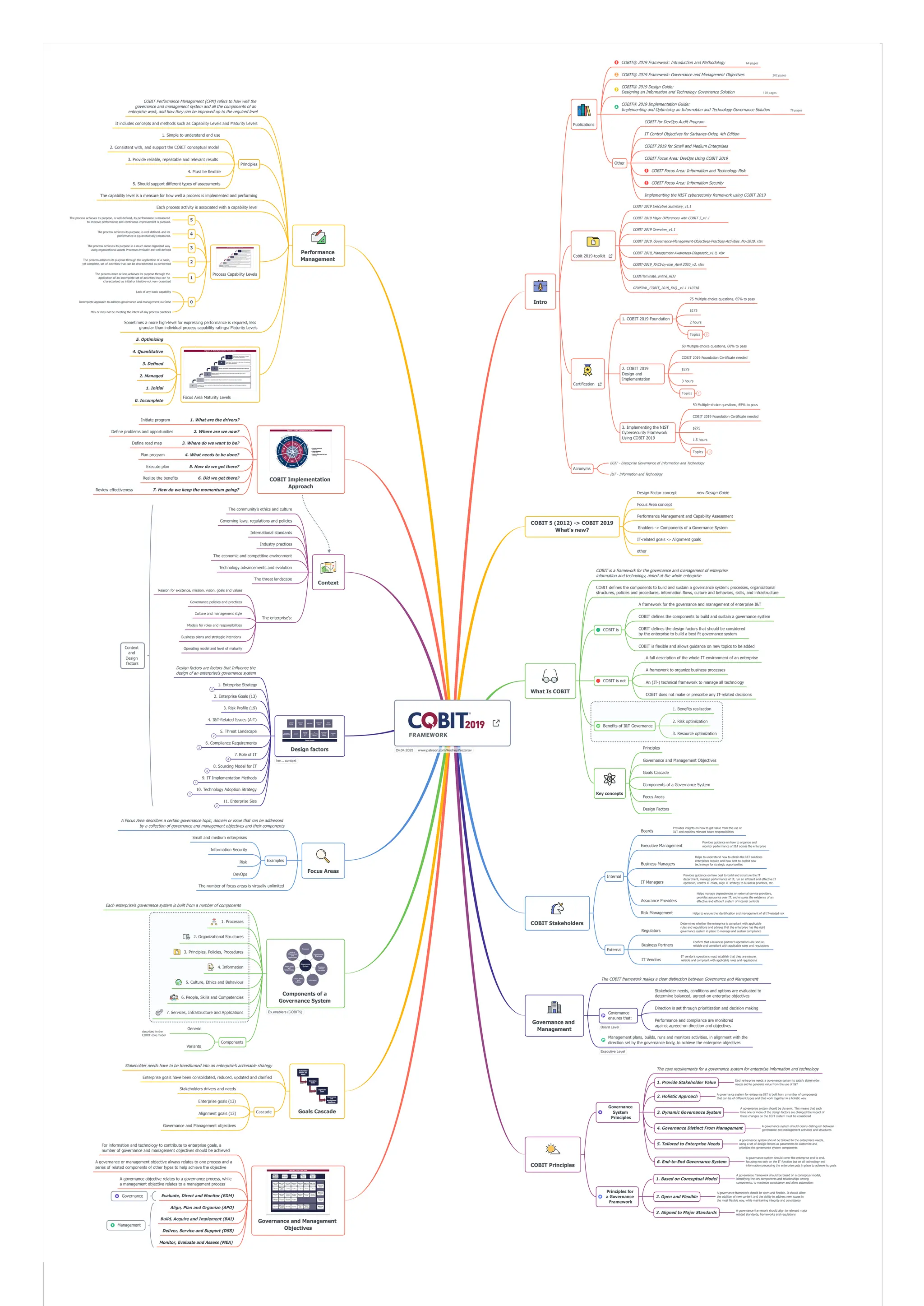
24.04.2023 www.patreon.com/AndreyProzorov

‎
Intro
‎
Publications
‎
COBIT® 2019 Framework: Introduction and Methodology
‎
COBIT® 2019 Framework: Governance and Management Objectives
‎
COBIT® 2019 Design Guide:
‎
Designing an Information and Technology Governance Solution
‎
COBIT® 2019 Implementation Guide:
‎
Implementing and Optimizing an Information and Technology Governance Solution
‎
Other
‎
Certification 
‎
1. COBIT 2019 Foundation
‎
75 Multiple-choice questions, 65% to pass
‎
$175
‎
2 hours
‎
2. COBIT 2019
‎
Design and
‎
Implementation
‎
60 Multiple-choice questions, 60% to pass
‎
COBIT 2019 Foundation Certificate needed
‎
$275
‎
3 hours
‎
3. Implementing the NIST
‎
Cybersecurity Framework
‎
Using COBIT 2019
‎
50 Multiple-choice questions, 65% to pass
‎
COBIT 2019 Foundation Certificate needed
‎
$275
‎
1.5 hours
‎
What Is COBIT
‎
COBIT is not
‎
A full description of the whole IT environment of an enterprise
‎
A framework to organize business processes
‎
An (IT-) technical framework to manage all technology
‎
COBIT does not make or prescribe any IT-related decisions
‎
Benefits of I&T Governance
‎
1. Benefits realization
‎
2. Risk optimization
‎
3. Resource optimization
Ex.enablers (COBIT5)
‎
Components of a
‎
Governance System
‎
1. Processes
‎
2. Organizational Structures
‎
3. Principles, Policies, Procedures
‎
4. Information
‎
5. Culture, Ethics and Behaviour
‎
6. People, Skills and Competencies
‎
7. Services, Infrastructure and Applications
hm... context
‎
Design factors
‎
1. Enterprise Strategy
4
‎
2. Enterprise Goals (13)
‎
3. Risk Profile (19)
‎
4. I&T-Related Issues (A-T)
‎
5. Threat Landscape
2
‎
6. Compliance Requirements
3
‎
7. Role of IT
4
‎
8. Sourcing Model for IT
4
‎
9. IT Implementation Methods
4
‎
10. Technology Adoption Strategy
3
‎
11. Enterprise Size
2
‎
Context
‎
The community’s ethics and culture
‎
Governing laws, regulations and policies
‎
International standards
‎Industry practices
‎
The economic and competitive environment
‎
Technology advancements and evolution
‎
The threat landscape
‎
The enterprise’s:
‎
Reason for existence, mission, vision, goals and values
‎
Governance policies and practices
‎
Culture and management style
‎
Models for roles and responsibilities
‎
Business plans and strategic intentions
‎
Operating model and level of maturity
‎
COBIT Implementation
‎
Approach
‎
1. What are the drivers?
‎
2. Where are we now?
‎
3. Where do we want to be?
‎
4. What needs to be done?
‎
5. How do we get there?
‎
6. Did we get there?
‎
7. How do we keep the momentum going?
‎
Performance
‎
Management
‎
Process Capability Levels
‎
Focus Area Maturity Levels
‎
Context
‎
and
‎
Design
‎
factors
‎
COBIT for DevOps Audit Program
‎
IT Control Objectives for Sarbanes-Oxley, 4th Edition
‎
COBIT 2019 for Small and Medium Enterprises
‎
COBIT Focus Area: DevOps Using COBIT 2019
‎
COBIT Focus Area: Information and Technology Risk
‎
COBIT Focus Area: Information Security
‎
Implementing the NIST cybersecurity framework using COBIT 2019
‎
Cobit-2019-toolkit 
‎
COBIT 2019 Executive Summary_v1.1
‎
COBIT 2019 Major Differences with COBIT 5_v1.1
‎
COBIT 2019 Overview_v1.1
‎
COBIT 2019_Governance-Management-Objectives-Practices-Activities_Nov2018, xlsx
‎
COBIT 2019_Management-Awareness-Diagnostic_v1.0, xlsx
‎
COBIT-2019_RACI-by-role_April 2020_v2, xlsx
‎
COBITlaminate_online_RD3
‎
GENERAL_COBIT_2019_FAQ _v1.1 110718
‎
COBIT is
‎
A framework for the governance and management of enterprise I&T
‎
COBIT defines the components to build and sustain a governance system
‎
COBIT defines the design factors that should be considered
‎
by the enterprise to build a best fit governance system
‎
COBIT is flexible and allows guidance on new topics to be added
‎
Governance and
‎
Management
‎
The COBIT framework makes a clear distinction between Governance and Management
Board Level
‎
Governance
‎
ensures that:
‎
Stakeholder needs, conditions and options are evaluated to
‎
determine balanced, agreed-on enterprise objectives
‎
Direction is set through prioritization and decision making
‎
Performance and compliance are monitored
‎
against agreed-on direction and objectives
Executive Level
‎
Management plans, builds, runs and monitors activities, in alignment with the
‎
direction set by the governance body, to achieve the enterprise objectives
‎
COBIT is a framework for the governance and management of enterprise
‎
information and technology, aimed at the whole enterprise
‎
Key concepts
‎
Principles
‎
Governance and Management Objectives
‎
Goals Cascade
‎
Components of a Governance System
‎
Focus Areas
‎
Design Factors
‎
COBIT Principles
‎
Governance
‎
System
‎
Principles
‎
The core requirements for a governance system for enterprise information and technology
‎
1. Provide Stakeholder Value
‎
Each enterprise needs a governance system to satisfy stakeholder
‎
needs and to generate value from the use of I&T
‎
2. Holistic Approach
‎
A governance system for enterprise I&T is built from a number of components
‎
that can be of different types and that work together in a holistic way
‎
3. Dynamic Governance System
‎
A governance system should be dynamic. This means that each
‎
time one or more of the design factors are changed the impact of
‎
these changes on the EGIT system must be considered
‎
4. Governance Distinct From Management
‎
A governance system should clearly distinguish between
‎
governance and management activities and structures
‎
5. Tailored to Enterprise Needs
‎
6. End-to-End Governance System
‎
Principles for
‎
a Governance
‎
Framework
‎
1. Based on Conceptual Model
‎
2. Open and Flexible
‎
3. Aligned to Major Standards
‎
A governance system should be tailored to the enterprise’s needs,
‎
using a set of design factors as parameters to customize and
‎
prioritize the governance system components
‎
A governance system should cover the enterprise end to end,
‎
focusing not only on the IT function but on all technology and
‎
information processing the enterprise puts in place to achieve its goals
‎
A governance framework should be based on a conceptual model,
‎
identifying the key components and relationships among
‎
components, to maximize consistency and allow automation
‎
A governance framework should be open and flexible. It should allow
‎
the addition of new content and the ability to address new issues in
‎
the most flexible way, while maintaining integrity and consistency
‎
A governance framework should align to relevant major
‎
related standards, frameworks and regulations
‎
Governance and Management
‎
Objectives
‎
For information and technology to contribute to enterprise goals, a
‎
number of governance and management objectives should be achieved
‎
A governance or management objective always relates to one process and a
‎
series of related components of other types to help achieve the objective
‎
A governance objective relates to a governance process, while
‎
a management objective relates to a management process
‎
Evaluate, Direct and Monitor (EDM)
‎
Align, Plan and Organize (APO)
‎
Build, Acquire and Implement (BAI)
‎
Deliver, Service and Support (DSS)
‎
Monitor, Evaluate and Assess (MEA)
‎
Management
‎
Governance
‎
Goals Cascade
‎
Stakeholder needs have to be transformed into an enterprise’s actionable strategy
‎
Enterprise goals have been consolidated, reduced, updated and clarified
‎
Each enterprise’s governance system is built from a number of components
‎
Components
‎
Generic
‎
Variants
‎
described in the
‎
COBIT core model
‎
Design factors are factors that Influence the
‎
design of an enterprise’s governance system
‎
COBIT Stakeholders
‎
Internal
‎
Boards
‎
Provides insights on how to get value from the use of
‎
I&T and explains relevant board responsibilities
‎
Executive Management
‎
Provides guidance on how to organize and
‎
monitor performance of I&T across the enterprise
‎
Business Managers
‎
Helps to understand how to obtain the I&T solutions
‎
enterprises require and how best to exploit new
‎
technology for strategic opportunities
‎
IT Managers
‎
Provides guidance on how best to build and structure the IT
‎
department, manage performance of IT, run an efficient and effective IT
‎
operation, control IT costs, align IT strategy to business priorities, etc.
‎
Assurance Providers
‎
Helps manage dependencies on external service providers,
‎
provides assurance over IT, and ensures the existence of an
‎
effective and efficient system of internal controls
‎
Risk Management ‎
Helps to ensure the identification and management of all IT-related risk
‎
External
‎
Regulators
‎
Determines whether the enterprise is compliant with applicable
‎
rules and regulations and advises that the enterprise has the right
‎
governance system in place to manage and sustain compliance
‎
Business Partners
‎
Confirm that a business partner’s operations are secure,
‎
reliable and compliant with applicable rules and regulations
‎
IT Vendors
‎
IT vendor’s operations must establish that they are secure,
‎
reliable and compliant with applicable rules and regulations
‎
Initiate program
‎
Define problems and opportunities
‎
Define road map
‎
Plan program
‎
Execute plan
‎
Realize the benefits
‎
Review effectiveness
‎
COBIT Performance Management (CPM) refers to how well the
‎
governance and management system and all the components of an
‎
enterprise work, and how they can be improved up to the required level
‎
It includes concepts and methods such as Capability Levels and Maturity Levels
‎
Principles
‎
1. Simple to understand and use
‎
2. Consistent with, and support the COBIT conceptual model
‎
3. Provide reliable, repeatable and relevant results
‎
4. Must be flexible
‎
5. Should support different types of assessments
‎
5
‎
The process achieves its purpose, is well defined, its performance is measured
‎
to improve performance and continuous improvement is pursued.
‎
4
‎
The process achieves its purpose, is well defined, and its
‎
performance is (quantitatively) measured.
‎
3
‎
The process achieves its purpose in a much more organized way
‎
using organizational assets Processes tvnicallv are well defined
‎
2
‎
The process achieves its purpose through the application of a basic,
‎
yet complete, set of activities that can be characterized as pertormed
‎
1
‎
The process more or less achieves its purpose through the
‎
application of an incomplete set of activities that can he
‎
characterized as initial or intuitive-not verv oraanized
‎
0
‎
Lack of any basic capability
‎
Incomplete approach to address governance and management ourDose
‎
May or may not be meeting the intent of any process practices
‎
The capability level is a measure for how well a process is implemented and performing
‎
Each process activity is associated with a capability level
‎
Sometimes a more high-level for expressing performance is required, less
‎
granular than individual process capability ratings: Maturity Levels
‎
5. Optimizing
‎
4. Quantitative
‎
3. Defined
‎
2. Managed
‎
1. Initial
‎
0. Incomplete
‎
Topics 8
‎
Topics 7
‎
Topics 3
‎
COBIT defines the components to build and sustain a governance system: processes, organizational
‎
structures, policies and procedures, information flows, culture and behaviors, skills, and infrastructure
‎
Acronyms
‎
EGIT - Enterprise Governance of Information and Technology
‎
I&T - Information and Technology
‎
Cascade
‎
Stakeholders drivers and needs
‎
Enterprise goals (13)
‎
Alignment goals (13)
‎
Governance and Management objectives
‎
Focus Areas
‎
A Focus Area describes a certain governance topic, domain or issue that can be addressed
‎
by a collection of governance and management objectives and their components
‎
Examples
‎
Small and medium enterprises
‎
Information Security
‎
Risk
‎
DevOps
‎
The number of focus areas is virtually unlimited
‎
COBIT 5 (2012) -> COBIT 2019
‎
What's new?
‎
Design Factor concept ‎
new Design Guide
‎
Focus Area concept
‎
Performance Management and Capability Assessment
‎
Enablers -> Components of a Governance System
‎
IT-related goals -> Alignment goals
‎
other
‎
64 pages
‎
302 pages
‎
150 pages
‎
78 pages

cobit-2019 introduction overview for student

  • 1.
    24.04.2023 www.patreon.com/AndreyProzorov  ‎ Intro ‎ Publications ‎ COBIT® 2019Framework: Introduction and Methodology ‎ COBIT® 2019 Framework: Governance and Management Objectives ‎ COBIT® 2019 Design Guide: ‎ Designing an Information and Technology Governance Solution ‎ COBIT® 2019 Implementation Guide: ‎ Implementing and Optimizing an Information and Technology Governance Solution ‎ Other ‎ Certification  ‎ 1. COBIT 2019 Foundation ‎ 75 Multiple-choice questions, 65% to pass ‎ $175 ‎ 2 hours ‎ 2. COBIT 2019 ‎ Design and ‎ Implementation ‎ 60 Multiple-choice questions, 60% to pass ‎ COBIT 2019 Foundation Certificate needed ‎ $275 ‎ 3 hours ‎ 3. Implementing the NIST ‎ Cybersecurity Framework ‎ Using COBIT 2019 ‎ 50 Multiple-choice questions, 65% to pass ‎ COBIT 2019 Foundation Certificate needed ‎ $275 ‎ 1.5 hours ‎ What Is COBIT ‎ COBIT is not ‎ A full description of the whole IT environment of an enterprise ‎ A framework to organize business processes ‎ An (IT-) technical framework to manage all technology ‎ COBIT does not make or prescribe any IT-related decisions ‎ Benefits of I&T Governance ‎ 1. Benefits realization ‎ 2. Risk optimization ‎ 3. Resource optimization Ex.enablers (COBIT5) ‎ Components of a ‎ Governance System ‎ 1. Processes ‎ 2. Organizational Structures ‎ 3. Principles, Policies, Procedures ‎ 4. Information ‎ 5. Culture, Ethics and Behaviour ‎ 6. People, Skills and Competencies ‎ 7. Services, Infrastructure and Applications hm... context ‎ Design factors ‎ 1. Enterprise Strategy 4 ‎ 2. Enterprise Goals (13) ‎ 3. Risk Profile (19) ‎ 4. I&T-Related Issues (A-T) ‎ 5. Threat Landscape 2 ‎ 6. Compliance Requirements 3 ‎ 7. Role of IT 4 ‎ 8. Sourcing Model for IT 4 ‎ 9. IT Implementation Methods 4 ‎ 10. Technology Adoption Strategy 3 ‎ 11. Enterprise Size 2 ‎ Context ‎ The community’s ethics and culture ‎ Governing laws, regulations and policies ‎ International standards ‎Industry practices ‎ The economic and competitive environment ‎ Technology advancements and evolution ‎ The threat landscape ‎ The enterprise’s: ‎ Reason for existence, mission, vision, goals and values ‎ Governance policies and practices ‎ Culture and management style ‎ Models for roles and responsibilities ‎ Business plans and strategic intentions ‎ Operating model and level of maturity ‎ COBIT Implementation ‎ Approach ‎ 1. What are the drivers? ‎ 2. Where are we now? ‎ 3. Where do we want to be? ‎ 4. What needs to be done? ‎ 5. How do we get there? ‎ 6. Did we get there? ‎ 7. How do we keep the momentum going? ‎ Performance ‎ Management ‎ Process Capability Levels ‎ Focus Area Maturity Levels ‎ Context ‎ and ‎ Design ‎ factors ‎ COBIT for DevOps Audit Program ‎ IT Control Objectives for Sarbanes-Oxley, 4th Edition ‎ COBIT 2019 for Small and Medium Enterprises ‎ COBIT Focus Area: DevOps Using COBIT 2019 ‎ COBIT Focus Area: Information and Technology Risk ‎ COBIT Focus Area: Information Security ‎ Implementing the NIST cybersecurity framework using COBIT 2019 ‎ Cobit-2019-toolkit  ‎ COBIT 2019 Executive Summary_v1.1 ‎ COBIT 2019 Major Differences with COBIT 5_v1.1 ‎ COBIT 2019 Overview_v1.1 ‎ COBIT 2019_Governance-Management-Objectives-Practices-Activities_Nov2018, xlsx ‎ COBIT 2019_Management-Awareness-Diagnostic_v1.0, xlsx ‎ COBIT-2019_RACI-by-role_April 2020_v2, xlsx ‎ COBITlaminate_online_RD3 ‎ GENERAL_COBIT_2019_FAQ _v1.1 110718 ‎ COBIT is ‎ A framework for the governance and management of enterprise I&T ‎ COBIT defines the components to build and sustain a governance system ‎ COBIT defines the design factors that should be considered ‎ by the enterprise to build a best fit governance system ‎ COBIT is flexible and allows guidance on new topics to be added ‎ Governance and ‎ Management ‎ The COBIT framework makes a clear distinction between Governance and Management Board Level ‎ Governance ‎ ensures that: ‎ Stakeholder needs, conditions and options are evaluated to ‎ determine balanced, agreed-on enterprise objectives ‎ Direction is set through prioritization and decision making ‎ Performance and compliance are monitored ‎ against agreed-on direction and objectives Executive Level ‎ Management plans, builds, runs and monitors activities, in alignment with the ‎ direction set by the governance body, to achieve the enterprise objectives ‎ COBIT is a framework for the governance and management of enterprise ‎ information and technology, aimed at the whole enterprise ‎ Key concepts ‎ Principles ‎ Governance and Management Objectives ‎ Goals Cascade ‎ Components of a Governance System ‎ Focus Areas ‎ Design Factors ‎ COBIT Principles ‎ Governance ‎ System ‎ Principles ‎ The core requirements for a governance system for enterprise information and technology ‎ 1. Provide Stakeholder Value ‎ Each enterprise needs a governance system to satisfy stakeholder ‎ needs and to generate value from the use of I&T ‎ 2. Holistic Approach ‎ A governance system for enterprise I&T is built from a number of components ‎ that can be of different types and that work together in a holistic way ‎ 3. Dynamic Governance System ‎ A governance system should be dynamic. This means that each ‎ time one or more of the design factors are changed the impact of ‎ these changes on the EGIT system must be considered ‎ 4. Governance Distinct From Management ‎ A governance system should clearly distinguish between ‎ governance and management activities and structures ‎ 5. Tailored to Enterprise Needs ‎ 6. End-to-End Governance System ‎ Principles for ‎ a Governance ‎ Framework ‎ 1. Based on Conceptual Model ‎ 2. Open and Flexible ‎ 3. Aligned to Major Standards ‎ A governance system should be tailored to the enterprise’s needs, ‎ using a set of design factors as parameters to customize and ‎ prioritize the governance system components ‎ A governance system should cover the enterprise end to end, ‎ focusing not only on the IT function but on all technology and ‎ information processing the enterprise puts in place to achieve its goals ‎ A governance framework should be based on a conceptual model, ‎ identifying the key components and relationships among ‎ components, to maximize consistency and allow automation ‎ A governance framework should be open and flexible. It should allow ‎ the addition of new content and the ability to address new issues in ‎ the most flexible way, while maintaining integrity and consistency ‎ A governance framework should align to relevant major ‎ related standards, frameworks and regulations ‎ Governance and Management ‎ Objectives ‎ For information and technology to contribute to enterprise goals, a ‎ number of governance and management objectives should be achieved ‎ A governance or management objective always relates to one process and a ‎ series of related components of other types to help achieve the objective ‎ A governance objective relates to a governance process, while ‎ a management objective relates to a management process ‎ Evaluate, Direct and Monitor (EDM) ‎ Align, Plan and Organize (APO) ‎ Build, Acquire and Implement (BAI) ‎ Deliver, Service and Support (DSS) ‎ Monitor, Evaluate and Assess (MEA) ‎ Management ‎ Governance ‎ Goals Cascade ‎ Stakeholder needs have to be transformed into an enterprise’s actionable strategy ‎ Enterprise goals have been consolidated, reduced, updated and clarified ‎ Each enterprise’s governance system is built from a number of components ‎ Components ‎ Generic ‎ Variants ‎ described in the ‎ COBIT core model ‎ Design factors are factors that Influence the ‎ design of an enterprise’s governance system ‎ COBIT Stakeholders ‎ Internal ‎ Boards ‎ Provides insights on how to get value from the use of ‎ I&T and explains relevant board responsibilities ‎ Executive Management ‎ Provides guidance on how to organize and ‎ monitor performance of I&T across the enterprise ‎ Business Managers ‎ Helps to understand how to obtain the I&T solutions ‎ enterprises require and how best to exploit new ‎ technology for strategic opportunities ‎ IT Managers ‎ Provides guidance on how best to build and structure the IT ‎ department, manage performance of IT, run an efficient and effective IT ‎ operation, control IT costs, align IT strategy to business priorities, etc. ‎ Assurance Providers ‎ Helps manage dependencies on external service providers, ‎ provides assurance over IT, and ensures the existence of an ‎ effective and efficient system of internal controls ‎ Risk Management ‎ Helps to ensure the identification and management of all IT-related risk ‎ External ‎ Regulators ‎ Determines whether the enterprise is compliant with applicable ‎ rules and regulations and advises that the enterprise has the right ‎ governance system in place to manage and sustain compliance ‎ Business Partners ‎ Confirm that a business partner’s operations are secure, ‎ reliable and compliant with applicable rules and regulations ‎ IT Vendors ‎ IT vendor’s operations must establish that they are secure, ‎ reliable and compliant with applicable rules and regulations ‎ Initiate program ‎ Define problems and opportunities ‎ Define road map ‎ Plan program ‎ Execute plan ‎ Realize the benefits ‎ Review effectiveness ‎ COBIT Performance Management (CPM) refers to how well the ‎ governance and management system and all the components of an ‎ enterprise work, and how they can be improved up to the required level ‎ It includes concepts and methods such as Capability Levels and Maturity Levels ‎ Principles ‎ 1. Simple to understand and use ‎ 2. Consistent with, and support the COBIT conceptual model ‎ 3. Provide reliable, repeatable and relevant results ‎ 4. Must be flexible ‎ 5. Should support different types of assessments ‎ 5 ‎ The process achieves its purpose, is well defined, its performance is measured ‎ to improve performance and continuous improvement is pursued. ‎ 4 ‎ The process achieves its purpose, is well defined, and its ‎ performance is (quantitatively) measured. ‎ 3 ‎ The process achieves its purpose in a much more organized way ‎ using organizational assets Processes tvnicallv are well defined ‎ 2 ‎ The process achieves its purpose through the application of a basic, ‎ yet complete, set of activities that can be characterized as pertormed ‎ 1 ‎ The process more or less achieves its purpose through the ‎ application of an incomplete set of activities that can he ‎ characterized as initial or intuitive-not verv oraanized ‎ 0 ‎ Lack of any basic capability ‎ Incomplete approach to address governance and management ourDose ‎ May or may not be meeting the intent of any process practices ‎ The capability level is a measure for how well a process is implemented and performing ‎ Each process activity is associated with a capability level ‎ Sometimes a more high-level for expressing performance is required, less ‎ granular than individual process capability ratings: Maturity Levels ‎ 5. Optimizing ‎ 4. Quantitative ‎ 3. Defined ‎ 2. Managed ‎ 1. Initial ‎ 0. Incomplete ‎ Topics 8 ‎ Topics 7 ‎ Topics 3 ‎ COBIT defines the components to build and sustain a governance system: processes, organizational ‎ structures, policies and procedures, information flows, culture and behaviors, skills, and infrastructure ‎ Acronyms ‎ EGIT - Enterprise Governance of Information and Technology ‎ I&T - Information and Technology ‎ Cascade ‎ Stakeholders drivers and needs ‎ Enterprise goals (13) ‎ Alignment goals (13) ‎ Governance and Management objectives ‎ Focus Areas ‎ A Focus Area describes a certain governance topic, domain or issue that can be addressed ‎ by a collection of governance and management objectives and their components ‎ Examples ‎ Small and medium enterprises ‎ Information Security ‎ Risk ‎ DevOps ‎ The number of focus areas is virtually unlimited ‎ COBIT 5 (2012) -> COBIT 2019 ‎ What's new? ‎ Design Factor concept ‎ new Design Guide ‎ Focus Area concept ‎ Performance Management and Capability Assessment ‎ Enablers -> Components of a Governance System ‎ IT-related goals -> Alignment goals ‎ other ‎ 64 pages ‎ 302 pages ‎ 150 pages ‎ 78 pages