IMPL ANTS
AND
INSERTS
SUBMITTED BY: P. S. S. L. JAYANTHI
317317
III/ VI PHARM. D
SUBMITTED TO: Mr. A. ANAND
Dept. of Pharmaceutics
Shri Vishnu College Of
Pharmacy
• An implant is a single unit drug delivery system that has been designed to deliver a
drug moiety at a therapeutically desired rate, over a prolonged at a therapeutically
desired·rate, over a prolonged period of time.
• These systems are generally used for parentral uses including ocular and subcutaneous
drug delivery.
• Implants are available in many forms which can be biodegradable or non-
biodegradable and are available in various shapes (rod, cylinder, ring, film etc.), sizes
and mechanism of drug release.
ADVANTAGES
• Improved drug delivery : Using an implantable therapeutic system the drug is
delivered locally or to the systemic circulation with minimal interference by biological
or metabolic barriers. For example, the drug bypasses the GIT and the liver.
• Potential for controlled release : Implants are available which deliver drugs by zero-
order controlled release kinetics, this offers the advantages of:
• Avoiding the peaks (risk of toxicity) and troughs (risk of ineffectiveness) of
conventional therapy,
• Reducing the dosing frequency, and
• Increasing patient compliance.
• Convenience : Effective drug concentration in the blood stream can be maintained
for long periods with minimal medical supervision. Implantation therapy is also
characterized by a lower incidence of -related complications in comparison to an
indwelling catheter based infusion system.
• Flexibility : Controlled delivery of both hydrophilic and Lipophilic drugs can be
achieved.
• Compliance: Compliance is increased greatly by allowing a reduction or complete
DISADVANTAGES
• Invasive : Either a minor or a major surgical procedure is required to initiate therapy.
• Termination: Non-biodegradable polymeric implants must also be surgically
removed at the end of treatment. Although a. biodegradable polymeric implant
not require surgical retrieval, its continuing biodegradation makes it difficult to
terminate drug delivery, or to maintain the correct dose at the end of its lifetime.
• Danger of device failure : There is a concomitant danger with this therapy that the
device may, for some reason, fail to operate, which again requires surgical
intervention to correct.
• Limited to potent drugs : The size of implant is usually small, systems have a limited
loading capacity, so that often quite potent drugs, such as hormones may be
for delivery the implantable devices.
• Possibility of adverse reaction : The site of implantation receives a high
concentration of drug delivered by an implant. This local high drug concentration
may trigger adverse reactions.
• Biocompatability issues
IDEAL CHARACTERISTICS
a) Should posses a high drug to polymer ratio
b) should have good mechanical strength
c) be free of drug leakage
d) be easily sterilizable
e) easy and economical to manufacture.
f) ideal system for drug release should approach zero order kinetics.
Ideal characters of implant devices:
a) should be biocompatible
b) non toxic
c) non-immunogenic
d) non-mutagenic
e) non carcinogenic.
MECHANISM OF DRUG RELEASE FROM
IMPLANTABLE THERAPEUTIC SYSTEM
• Mechanism of drug release can be classified as:
(A) Diffusion Controlled Release
(B) Diffusion Controlled Systems
I. Reservoir (Membrane) System
II. Matrix (Monolithic) Systems
System with dissolved drug
Systems with dispersed drug
• Diffusion in porous systems
• Swelling controlled system :
• Chemically controlled systems
DIFFUSION CONTROLLED SYSTEMS
1. RESERVOIR SYSTEM:
• The drug is enclosed in larger quantities in a permeable synthetic membrane and
placed in contact with fluid at constant temperature.
• After the initial period of drug the steady state is established and diffusive release rates
can be easily determined.
2. MATRIX SYSTEM:
• Drug or bioactive substances are incorporated as either a dispersion or
solution in the polymeric phase.
• They are prepared in many geometric shapes depending on the place of
implantation.
SYSTEM WITH DISSLOVED DRUG
• Drug is dissolved in polymer below
its solubility either by preparing a
drug polymer solution, casting in a
desirable geometric form and
evaporating the solvent.
SYSTEM WITH DISPERSED DRUG
Drug is uniformily dispersed in the
matrix.
Particle size is much smaller in
comparision to the thickness of
polymer.
APPROACHES TO DEVELOPMENT OF
IMPLANTABLE THERAPEUTIC SYSTEM
DIFFUSION
CONTROLLED
MEMBRANE
PERMEATION
A)Nonporous
membranes
1.B) Microporous
membrane
2.C) Semipermeable
membrane
MATRIX
DIFFUSION
A) Lipophilic
polymers
B) Hydrophilic or
swellable polymer
C) Porous
polymers
MICRORESERVOIR
DISSOLUTION
A) Hydrophilic
reservoir
B) Lipophilic
reservoir
ACTIVATED
CONTROLLED
A) Osmotic pressure
B) Vapour pressure
C) Magnetical
D) Ultrasound
E) Hydrolysis
DIFFUSION CONTROLLED SYSTEM
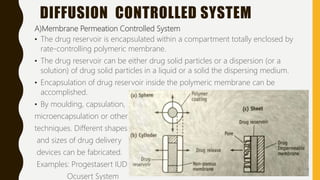
A)Membrane Permeation Controlled System
• The drug reservoir is encapsulated within a compartment totally enclosed by
rate-controlling polymeric membrane.
• The drug reservoir can be either drug solid particles or a dispersion (or a
solution) of drug solid particles in a liquid or a solid the dispersing medium.
• Encapsulation of drug reservoir inside the polymeric membrane can be
accomplished.
• By moulding, capsulation,
microencapsulation or other
techniques. Different shapes
and sizes of drug delivery
devices can be fabricated.
Examples: Progestasert IUD
Ocusert System
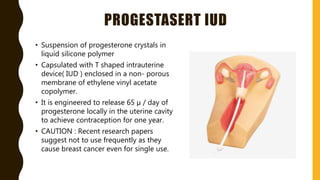
PROGESTASERT IUD
• Suspension of progesterone crystals in
liquid silicone polymer
• Capsulated with T shaped intrauterine
device( IUD ) enclosed in a non- porous
membrane of ethylene vinyl acetate
copolymer.
• It is engineered to release 65 µ / day of
progesterone locally in the uterine cavity
to achieve contraception for one year.
• CAUTION : Recent research papers
suggest not to use frequently as they
cause breast cancer even for single use.
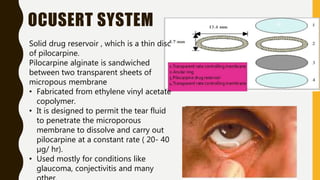
OCUSERT SYSTEM
Solid drug reservoir , which is a thin disc
of pilocarpine.
Pilocarpine alginate is sandwiched
between two transparent sheets of
micropous membrane
• Fabricated from ethylene vinyl acetate
copolymer.
• It is designed to permit the tear fluid
to penetrate the microporous
membrane to dissolve and carry out
pilocarpine at a constant rate ( 20- 40
µg/ hr).
• Used mostly for conditions like
glaucoma, conjectivitis and many
• ADVANTAGES • DISADVANTAGES
• Increased contact time and thus improved bio-
availability.
• Possibility of providing a prolonged drug release and
thus a better efficacy.
• Administration of an accurate dose in the eye and thus a
better therapy.
• Reduction of systemic side effects and thus reduced
adverse effects.
• Reduction of the number of administrations and thus
better patient.
• Ease of handling and insertion.
• Non-interference with vision and oxygen permeability.
• Reproducibility of release kinetics.
• Sterility, Stability , Compliance, Comfort.
• Exclusion of preservatives.
• Increased shelf life with comparison to aqueous
solutions due to absence of water.
• The insert may be lost
immediately.
• Sometimes the insert twists
to form ‘a figure eight’, which
diminishes the delivery rate.
• A leakage may occur.
• Dislocation of the device in
front of the pupil.
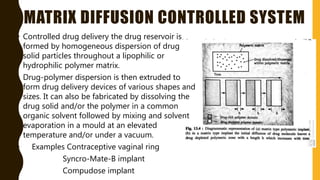
MATRIX DIFFUSION CONTROLLED SYSTEM
• Controlled drug delivery the drug reservoir is
formed by homogeneous dispersion of drug
solid particles throughout a lipophilic or
hydrophilic polymer matrix.
• Drug-polymer dispersion is then extruded to
form drug delivery devices of various shapes and
sizes. It can also be fabricated by dissolving the
drug solid and/or the polymer in a common
organic solvent followed by mixing and solvent
evaporation in a mould at an elevated
temperature and/or under a vacuum.
• Examples Contraceptive vaginal ring
• Syncro-Mate-B implant
• Compudose implant
CONTRACEPTIVE VAGINAL RING :
• Vaginal rings (also known as intravaginal rings,
or V-Rings) are polymeric drug
delivery devices designed to provide
release of drugs for intravaginal
administration over extended periods of time.
The ring is inserted into the vagina and
provides contraception protection.
• It is fabricated by dispersing a contraceptive
steroid medroxy – progesterone acetate.
• These are incorporated as micronized solid
particles in a viscous mixture of silicone
elastomer.
• A mound of donut form is vaginal ring Is
formed.
• It is postioned at the cervix of the vagina for
MICRORESERVOIR DISSOLUTION CONTROLLED
SYSTEM
• The drug reservoir, which is a suspension of drug crystals in an aqueous solution of
water-miscible polymer, forms a homogeneous dispersion of millions of discrete,
unleachable, microscopic drug reservoirs in a polymer matrix.
• The micro- dispersion is accomplished by high-energy dispersion technique.
• Different shapes and sizes of drug delivery devices can be fabricated from this
microreservoir type drug delivery system by moulding or extrusion technique.
Examples: Syncro-Mate-C implant:
Dual-release vaginal contraceptive ring
ACTIVATED CONTROLLED RELEASE SYSTEM
A. Osmotic Pressure Activated System :
The drug reservoir, which is a solution formulation, is
contained within semi-permeable housing. The drug is
released in the solution form at the controlled, constant rate
under an osmotic pressure gradient.
• Alzet osmotic pump :
• DESIGN: The drug reservoir is contained inside a
collapsible , impermeable polyester bag , whose external
surface is coated with layer of an osmotically active salt.
• The reservoir compartment is then sealed inside a rigid
with semipermeable polymer membrane.
• WORKING: At the implantation site, the water content in
the tissue fluid will penetrate through the semipermeable
membrane to dissolve the osmotically active salt, creating
osmotic pressure in the narrow spacing between the
flexible reservoir wall and the rigid semipermeable
• Under the osmotic pressure created, the reservoir compartment is reduced in volume
and the drug solution is forced to release at a controlled rate through the flow
moderator.
• By varying the drug concentration in the solution, different amount of drug can be
released at a constant rate.
• It is basily used for research purpose to give away
the drug continuously.
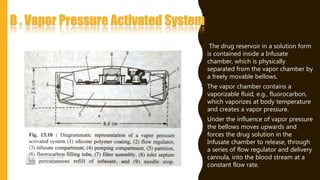
B . Vapor Pressure Activated System
• The drug reservoir in a solution form
is contained inside a Infusate
chamber, which is physically
separated from the vapor chamber by
a freely movable bellows.
• The vapor chamber contains a
vaporizable fluid, e.g., fluorocarbon,
which vaporizes at body temperature
and creates a vapor pressure.
• Under the influence of vapor pressure
the bellows moves upwards and
forces the drug solution in the
Infusate chamber to release, through
a series of flow regulator and delivery
cannula, into the blood stream at a
constant flow rate.
• A typical example is the
development of lnfusaid (an
implantable infusion pump) for the
constant infusion of heparin for
anticoagulation treatment of
Insulin for antidiabetic medication
and of morphine for patients
suffering from the intensive pain of
terminal cancer.
C. MAGNETICALLY ACTIVATED SYSTEM
• Macromolecular drugs such as
peptides have been · known to
release only at a relatively low rate
from a polymeric drug delivery
device.
• This low release rate has been
improved by magnetism triggered
mechanism into the polymeric drug
delivery device and a zero order drug
release profile has also been achieved
by hemisphere shaped geometry
design.
• By combining these two approaches,
a subdermal implantable magnetic-
modulated hemispheric drug delivery
device is developed.
• donut-shaped magnet at the center of a biocompatible polymer matrix, which contains
a homogeneous dispersion of a macromolecular drug at a rather high drug: polymer
ratio to form a hemispheric magnetic pellet.
• The hemispheric magnetic pellet is then coated with a pure polymer, e.g., ethylene-
vinyl acetate (EVA) copolymer or silicone elastomers, on all sides except the cavity at
the center of the flat surface to permit the release of macromolecular drug only
through the cavity.
• The hemispheric magnetic delivery device can release macromolecular drug at a
controlled basal rate, by diffusion process under non-triggered condition or release
the same drug at a much higher rate under the activation from an external magnetic
field.
D . ULTRASOUND ACTIVATED SYSTEM
Ultrasonic wave can also be utilized as an energy source to facilitate the release of
drug at a higher rate from polymeric drug delivery device containing a bioerodable
polymer matrix, e.g., poly[bis(p-carboxyphenoxy )alkane anhydride]. Ultrasonic wave
can be used to control the drug release.
E. HYDROLYSIS ACTIVATED SYSTEM
• This type of implantable therapeutic system is fabricated 1,y dispersing a loading dose
of solid drug in micronized form, homogeneously throughout a polymer matrix made
from bioerodable or biodegradable polymer, which is then moulded into a pellet or
bead shaped implant .
• The controlled release of the embedded drug particles is made possible by the
combination of polymer erosion through hydrolysis and diffusion through the polymer
matrix.
• The rate of drug release is determined by the rate of biodegrading, polymer,
composition and molecular weight, drug loading and drug/polymer interaction.
TYPES OF DEVICES BASED ON
ROUTE OF ADMINISTRATION
(A)Subdermal Implants
(B) Intraocular Implant/Insert
(C)Intravaginal Inserts
(D)Intrauterine lmplant & Inserts
(E) Brain Implants
(F) Gliadel Implants
(G)Cochlear Implant
(H)Fetal Tissue Implant
(I) Harrington Implant
(J) Dental Implant
(K) Extraocular implant
(L) Scrotal Implant
(M)Transdermal Implant
Subdermal Implants :
These are implanted into the
deeper tissues of skin.
One of the most common
contraceptive NORPLANT is put
under women arm for sustained
release of sexual hormones.
Intraocular
Implant:
For diabetic
retinopathy,
glaucoma.
The dose of drug
released is in the
range 0.5 to 10
day.
VITRASERT (
Brain Implant:
These are also
called as Neural
Implants.
These are
technological
devices which are
attached to the
subjects brain
cortex.
Transdermal Implant:
These implants have a
very high rate of
successful healing.
One of the best example
is Scop-transderm patch
system used for release
of scopolamine
transdermally in a
controlled and sustained
manner.
Intravaginal
Inserts :
The drug
reservoir which
is a suspension
of a progestin
and estrogen in
a aqueous
solution of PEG
400.
Gliadel Implants:
These are indicated in
the treatment of
recurrent
glioblastoma
multiforme which is
the most common
and fatal brain
A solution with the
drug is
Cochlear implant:
Electronic device that
provides a sense of
sound to a person
who is profoundly
deaf or severely hard
of hearing
It is also called as
bionic ear . Works
directly by stimulating
Harrington
Implant:
A rod is
implanted along
the spinal column
to coronal –
curvature of the
spine or scoliosis.
It is stainless steel
materialled
Extraocular
Implant:
EYEBALL
JEWELLERY which
an tiny piece of
decorative
jewellery.
Implanted within
the superficial,
interpalpebral
Dental Implants:
Artificial root
replacement.
It is support
restorations that
resemble the group
of teeth.
These are again
Intrauterine Implants/Inserts:
The drug reservoir, which is a
suspension of progesterone
crystals in liquid silicone polymer,
is encapsulated in a T-shaped
intrauterine device (IUD)
by a non-porous membrane of
ethylene-vinyl acetate (EV A)
copolymer.
EVALUATION
• Immunogenicity, antigenicity and toxicity : The polymer and the other system should
be bio compatible, biodegradable , nonimmunogenic and non toxic . Histological
evaluation of implant should include evaluation of any tissue reaction to the implant
(tissue necrosis ,inflammation , giant cells , neutrophils, macrophages and scarring )
for other implants the response of blood vessles near the implant and ingrowth of
vasculature into the implant are important features .
• DRUG UNIFORMITY: It is important to measure that the drug has been uniformly
distributed in the drug reservoir.
• DRUG RELEASE PROFILE :The drug release profile from a implant depends upon the
mechanism of drug release and nature of polymer used ( shape ,molecular weight ,
copolymer ratio , crystallinity ) .
• STORAGE STABILITY: This can be determined by monitoring the change sin drug
content as well as appearance as a function of time .it is important because with the
passage of time the polymer content may leak out of the drug or may be hydrolysed
or chemical changes may take place .
REFERNCES
• Introduction to Novel Drug Delivery Systems by N. K .Jain Pg No: 223- 242.
• https://www.sciencedirect.com/science/article/pii/B9780128136652000132
• https://www.youtube.com/watch?reload=9&v=QOOQ5pOZyWU
• https://www.google.com/search?rlz=1C1JZAP_enIN856IN857&sxsrf=ACYBGNSoZfjKpK
JMQoeu8FzdSggUxBg1AA%3A1569128107240&ei=q_6GXYuhDvG0mgeavJXIDA&q=inf
usaid+pump&oq=infusaid&gs_l=psy-
ab.3.0.0l4j0i30l3j0i5i30j0i30.27125.35054..36578...1.0..4.275.2442.0j9j4......0....1..gws-
wiz.....10..35i39j0i131j35i362i39j0i131i67j0i67j0i10.pXo8n8u3X-s
• https://www.ncbi.nlm.nih.gov/pmc/articles/PMC2571504/
Implants

Implants

  • 1.
    IMPL ANTS AND INSERTS SUBMITTED BY:P. S. S. L. JAYANTHI 317317 III/ VI PHARM. D SUBMITTED TO: Mr. A. ANAND Dept. of Pharmaceutics Shri Vishnu College Of Pharmacy
  • 2.
    • An implantis a single unit drug delivery system that has been designed to deliver a drug moiety at a therapeutically desired rate, over a prolonged at a therapeutically desired·rate, over a prolonged period of time. • These systems are generally used for parentral uses including ocular and subcutaneous drug delivery. • Implants are available in many forms which can be biodegradable or non- biodegradable and are available in various shapes (rod, cylinder, ring, film etc.), sizes and mechanism of drug release.
  • 3.
    ADVANTAGES • Improved drugdelivery : Using an implantable therapeutic system the drug is delivered locally or to the systemic circulation with minimal interference by biological or metabolic barriers. For example, the drug bypasses the GIT and the liver. • Potential for controlled release : Implants are available which deliver drugs by zero- order controlled release kinetics, this offers the advantages of: • Avoiding the peaks (risk of toxicity) and troughs (risk of ineffectiveness) of conventional therapy, • Reducing the dosing frequency, and • Increasing patient compliance. • Convenience : Effective drug concentration in the blood stream can be maintained for long periods with minimal medical supervision. Implantation therapy is also characterized by a lower incidence of -related complications in comparison to an indwelling catheter based infusion system. • Flexibility : Controlled delivery of both hydrophilic and Lipophilic drugs can be achieved. • Compliance: Compliance is increased greatly by allowing a reduction or complete
  • 4.
    DISADVANTAGES • Invasive :Either a minor or a major surgical procedure is required to initiate therapy. • Termination: Non-biodegradable polymeric implants must also be surgically removed at the end of treatment. Although a. biodegradable polymeric implant not require surgical retrieval, its continuing biodegradation makes it difficult to terminate drug delivery, or to maintain the correct dose at the end of its lifetime. • Danger of device failure : There is a concomitant danger with this therapy that the device may, for some reason, fail to operate, which again requires surgical intervention to correct. • Limited to potent drugs : The size of implant is usually small, systems have a limited loading capacity, so that often quite potent drugs, such as hormones may be for delivery the implantable devices. • Possibility of adverse reaction : The site of implantation receives a high concentration of drug delivered by an implant. This local high drug concentration may trigger adverse reactions. • Biocompatability issues
  • 5.
    IDEAL CHARACTERISTICS a) Shouldposses a high drug to polymer ratio b) should have good mechanical strength c) be free of drug leakage d) be easily sterilizable e) easy and economical to manufacture. f) ideal system for drug release should approach zero order kinetics. Ideal characters of implant devices: a) should be biocompatible b) non toxic c) non-immunogenic d) non-mutagenic e) non carcinogenic.
  • 6.
    MECHANISM OF DRUGRELEASE FROM IMPLANTABLE THERAPEUTIC SYSTEM • Mechanism of drug release can be classified as: (A) Diffusion Controlled Release (B) Diffusion Controlled Systems I. Reservoir (Membrane) System II. Matrix (Monolithic) Systems System with dissolved drug Systems with dispersed drug • Diffusion in porous systems • Swelling controlled system : • Chemically controlled systems
  • 8.
    DIFFUSION CONTROLLED SYSTEMS 1.RESERVOIR SYSTEM: • The drug is enclosed in larger quantities in a permeable synthetic membrane and placed in contact with fluid at constant temperature. • After the initial period of drug the steady state is established and diffusive release rates can be easily determined. 2. MATRIX SYSTEM: • Drug or bioactive substances are incorporated as either a dispersion or solution in the polymeric phase. • They are prepared in many geometric shapes depending on the place of implantation.
  • 9.
    SYSTEM WITH DISSLOVEDDRUG • Drug is dissolved in polymer below its solubility either by preparing a drug polymer solution, casting in a desirable geometric form and evaporating the solvent. SYSTEM WITH DISPERSED DRUG Drug is uniformily dispersed in the matrix. Particle size is much smaller in comparision to the thickness of polymer.
  • 11.
    APPROACHES TO DEVELOPMENTOF IMPLANTABLE THERAPEUTIC SYSTEM DIFFUSION CONTROLLED MEMBRANE PERMEATION A)Nonporous membranes 1.B) Microporous membrane 2.C) Semipermeable membrane MATRIX DIFFUSION A) Lipophilic polymers B) Hydrophilic or swellable polymer C) Porous polymers MICRORESERVOIR DISSOLUTION A) Hydrophilic reservoir B) Lipophilic reservoir ACTIVATED CONTROLLED A) Osmotic pressure B) Vapour pressure C) Magnetical D) Ultrasound E) Hydrolysis
  • 13.
    DIFFUSION CONTROLLED SYSTEM A)MembranePermeation Controlled System • The drug reservoir is encapsulated within a compartment totally enclosed by rate-controlling polymeric membrane. • The drug reservoir can be either drug solid particles or a dispersion (or a solution) of drug solid particles in a liquid or a solid the dispersing medium. • Encapsulation of drug reservoir inside the polymeric membrane can be accomplished. • By moulding, capsulation, microencapsulation or other techniques. Different shapes and sizes of drug delivery devices can be fabricated. Examples: Progestasert IUD Ocusert System
  • 14.
    PROGESTASERT IUD • Suspensionof progesterone crystals in liquid silicone polymer • Capsulated with T shaped intrauterine device( IUD ) enclosed in a non- porous membrane of ethylene vinyl acetate copolymer. • It is engineered to release 65 µ / day of progesterone locally in the uterine cavity to achieve contraception for one year. • CAUTION : Recent research papers suggest not to use frequently as they cause breast cancer even for single use.
  • 15.
    OCUSERT SYSTEM Solid drugreservoir , which is a thin disc of pilocarpine. Pilocarpine alginate is sandwiched between two transparent sheets of micropous membrane • Fabricated from ethylene vinyl acetate copolymer. • It is designed to permit the tear fluid to penetrate the microporous membrane to dissolve and carry out pilocarpine at a constant rate ( 20- 40 µg/ hr). • Used mostly for conditions like glaucoma, conjectivitis and many
  • 16.
    • ADVANTAGES •DISADVANTAGES • Increased contact time and thus improved bio- availability. • Possibility of providing a prolonged drug release and thus a better efficacy. • Administration of an accurate dose in the eye and thus a better therapy. • Reduction of systemic side effects and thus reduced adverse effects. • Reduction of the number of administrations and thus better patient. • Ease of handling and insertion. • Non-interference with vision and oxygen permeability. • Reproducibility of release kinetics. • Sterility, Stability , Compliance, Comfort. • Exclusion of preservatives. • Increased shelf life with comparison to aqueous solutions due to absence of water. • The insert may be lost immediately. • Sometimes the insert twists to form ‘a figure eight’, which diminishes the delivery rate. • A leakage may occur. • Dislocation of the device in front of the pupil.
  • 17.
    MATRIX DIFFUSION CONTROLLEDSYSTEM • Controlled drug delivery the drug reservoir is formed by homogeneous dispersion of drug solid particles throughout a lipophilic or hydrophilic polymer matrix. • Drug-polymer dispersion is then extruded to form drug delivery devices of various shapes and sizes. It can also be fabricated by dissolving the drug solid and/or the polymer in a common organic solvent followed by mixing and solvent evaporation in a mould at an elevated temperature and/or under a vacuum. • Examples Contraceptive vaginal ring • Syncro-Mate-B implant • Compudose implant
  • 18.
    CONTRACEPTIVE VAGINAL RING: • Vaginal rings (also known as intravaginal rings, or V-Rings) are polymeric drug delivery devices designed to provide release of drugs for intravaginal administration over extended periods of time. The ring is inserted into the vagina and provides contraception protection. • It is fabricated by dispersing a contraceptive steroid medroxy – progesterone acetate. • These are incorporated as micronized solid particles in a viscous mixture of silicone elastomer. • A mound of donut form is vaginal ring Is formed. • It is postioned at the cervix of the vagina for
  • 19.
    MICRORESERVOIR DISSOLUTION CONTROLLED SYSTEM •The drug reservoir, which is a suspension of drug crystals in an aqueous solution of water-miscible polymer, forms a homogeneous dispersion of millions of discrete, unleachable, microscopic drug reservoirs in a polymer matrix. • The micro- dispersion is accomplished by high-energy dispersion technique. • Different shapes and sizes of drug delivery devices can be fabricated from this microreservoir type drug delivery system by moulding or extrusion technique. Examples: Syncro-Mate-C implant: Dual-release vaginal contraceptive ring
  • 20.
    ACTIVATED CONTROLLED RELEASESYSTEM A. Osmotic Pressure Activated System : The drug reservoir, which is a solution formulation, is contained within semi-permeable housing. The drug is released in the solution form at the controlled, constant rate under an osmotic pressure gradient. • Alzet osmotic pump : • DESIGN: The drug reservoir is contained inside a collapsible , impermeable polyester bag , whose external surface is coated with layer of an osmotically active salt. • The reservoir compartment is then sealed inside a rigid with semipermeable polymer membrane. • WORKING: At the implantation site, the water content in the tissue fluid will penetrate through the semipermeable membrane to dissolve the osmotically active salt, creating osmotic pressure in the narrow spacing between the flexible reservoir wall and the rigid semipermeable
  • 21.
    • Under theosmotic pressure created, the reservoir compartment is reduced in volume and the drug solution is forced to release at a controlled rate through the flow moderator. • By varying the drug concentration in the solution, different amount of drug can be released at a constant rate. • It is basily used for research purpose to give away the drug continuously.
  • 23.
    B . VaporPressure Activated System • The drug reservoir in a solution form is contained inside a Infusate chamber, which is physically separated from the vapor chamber by a freely movable bellows. • The vapor chamber contains a vaporizable fluid, e.g., fluorocarbon, which vaporizes at body temperature and creates a vapor pressure. • Under the influence of vapor pressure the bellows moves upwards and forces the drug solution in the Infusate chamber to release, through a series of flow regulator and delivery cannula, into the blood stream at a constant flow rate.
  • 24.
    • A typicalexample is the development of lnfusaid (an implantable infusion pump) for the constant infusion of heparin for anticoagulation treatment of Insulin for antidiabetic medication and of morphine for patients suffering from the intensive pain of terminal cancer.
  • 25.
    C. MAGNETICALLY ACTIVATEDSYSTEM • Macromolecular drugs such as peptides have been · known to release only at a relatively low rate from a polymeric drug delivery device. • This low release rate has been improved by magnetism triggered mechanism into the polymeric drug delivery device and a zero order drug release profile has also been achieved by hemisphere shaped geometry design. • By combining these two approaches, a subdermal implantable magnetic- modulated hemispheric drug delivery device is developed.
  • 26.
    • donut-shaped magnetat the center of a biocompatible polymer matrix, which contains a homogeneous dispersion of a macromolecular drug at a rather high drug: polymer ratio to form a hemispheric magnetic pellet. • The hemispheric magnetic pellet is then coated with a pure polymer, e.g., ethylene- vinyl acetate (EVA) copolymer or silicone elastomers, on all sides except the cavity at the center of the flat surface to permit the release of macromolecular drug only through the cavity. • The hemispheric magnetic delivery device can release macromolecular drug at a controlled basal rate, by diffusion process under non-triggered condition or release the same drug at a much higher rate under the activation from an external magnetic field. D . ULTRASOUND ACTIVATED SYSTEM Ultrasonic wave can also be utilized as an energy source to facilitate the release of drug at a higher rate from polymeric drug delivery device containing a bioerodable polymer matrix, e.g., poly[bis(p-carboxyphenoxy )alkane anhydride]. Ultrasonic wave can be used to control the drug release.
  • 27.
    E. HYDROLYSIS ACTIVATEDSYSTEM • This type of implantable therapeutic system is fabricated 1,y dispersing a loading dose of solid drug in micronized form, homogeneously throughout a polymer matrix made from bioerodable or biodegradable polymer, which is then moulded into a pellet or bead shaped implant . • The controlled release of the embedded drug particles is made possible by the combination of polymer erosion through hydrolysis and diffusion through the polymer matrix. • The rate of drug release is determined by the rate of biodegrading, polymer, composition and molecular weight, drug loading and drug/polymer interaction.
  • 28.
    TYPES OF DEVICESBASED ON ROUTE OF ADMINISTRATION (A)Subdermal Implants (B) Intraocular Implant/Insert (C)Intravaginal Inserts (D)Intrauterine lmplant & Inserts (E) Brain Implants (F) Gliadel Implants (G)Cochlear Implant (H)Fetal Tissue Implant (I) Harrington Implant (J) Dental Implant (K) Extraocular implant (L) Scrotal Implant (M)Transdermal Implant
  • 29.
    Subdermal Implants : Theseare implanted into the deeper tissues of skin. One of the most common contraceptive NORPLANT is put under women arm for sustained release of sexual hormones. Intraocular Implant: For diabetic retinopathy, glaucoma. The dose of drug released is in the range 0.5 to 10 day. VITRASERT ( Brain Implant: These are also called as Neural Implants. These are technological devices which are attached to the subjects brain cortex. Transdermal Implant: These implants have a very high rate of successful healing. One of the best example is Scop-transderm patch system used for release of scopolamine transdermally in a controlled and sustained manner.
  • 30.
    Intravaginal Inserts : The drug reservoirwhich is a suspension of a progestin and estrogen in a aqueous solution of PEG 400. Gliadel Implants: These are indicated in the treatment of recurrent glioblastoma multiforme which is the most common and fatal brain A solution with the drug is Cochlear implant: Electronic device that provides a sense of sound to a person who is profoundly deaf or severely hard of hearing It is also called as bionic ear . Works directly by stimulating Harrington Implant: A rod is implanted along the spinal column to coronal – curvature of the spine or scoliosis. It is stainless steel materialled
  • 31.
    Extraocular Implant: EYEBALL JEWELLERY which an tinypiece of decorative jewellery. Implanted within the superficial, interpalpebral Dental Implants: Artificial root replacement. It is support restorations that resemble the group of teeth. These are again Intrauterine Implants/Inserts: The drug reservoir, which is a suspension of progesterone crystals in liquid silicone polymer, is encapsulated in a T-shaped intrauterine device (IUD) by a non-porous membrane of ethylene-vinyl acetate (EV A) copolymer.
  • 32.
    EVALUATION • Immunogenicity, antigenicityand toxicity : The polymer and the other system should be bio compatible, biodegradable , nonimmunogenic and non toxic . Histological evaluation of implant should include evaluation of any tissue reaction to the implant (tissue necrosis ,inflammation , giant cells , neutrophils, macrophages and scarring ) for other implants the response of blood vessles near the implant and ingrowth of vasculature into the implant are important features . • DRUG UNIFORMITY: It is important to measure that the drug has been uniformly distributed in the drug reservoir. • DRUG RELEASE PROFILE :The drug release profile from a implant depends upon the mechanism of drug release and nature of polymer used ( shape ,molecular weight , copolymer ratio , crystallinity ) . • STORAGE STABILITY: This can be determined by monitoring the change sin drug content as well as appearance as a function of time .it is important because with the passage of time the polymer content may leak out of the drug or may be hydrolysed or chemical changes may take place .
  • 33.
    REFERNCES • Introduction toNovel Drug Delivery Systems by N. K .Jain Pg No: 223- 242. • https://www.sciencedirect.com/science/article/pii/B9780128136652000132 • https://www.youtube.com/watch?reload=9&v=QOOQ5pOZyWU • https://www.google.com/search?rlz=1C1JZAP_enIN856IN857&sxsrf=ACYBGNSoZfjKpK JMQoeu8FzdSggUxBg1AA%3A1569128107240&ei=q_6GXYuhDvG0mgeavJXIDA&q=inf usaid+pump&oq=infusaid&gs_l=psy- ab.3.0.0l4j0i30l3j0i5i30j0i30.27125.35054..36578...1.0..4.275.2442.0j9j4......0....1..gws- wiz.....10..35i39j0i131j35i362i39j0i131i67j0i67j0i10.pXo8n8u3X-s • https://www.ncbi.nlm.nih.gov/pmc/articles/PMC2571504/