chapter 11 carl e misch
 cylinder type
 screw type
 press fit
 Combination of features
 friction-fit insertion
 may have less risk of pressure necrosis
 easiest to insert
 high initial success rates
 after 5 years of loading, reports of the loss of
crestal bone and implant failure more often
observed
 A report by Zechner et aJ. Evaluated the peri-
implant bone over a 3- to 7-year period
around functionally loaded, screw-type
implants with a machined surfacedV-thread
and sandblasted, acid-etched, squarethread
design.
 The range of bone loss in the study was 0.1
to 8.5 mm for the machinedV-thread and
0.2 to 4.8 mm for the rough surface, square-
threaded implant.
 The range of bone loss and the incidence of
bone loss both indicate implant design or
surface condition made a difference in this
report.
 A prospective report by Karoussis et al. also
indicated that implant survival and marginal
bone loss is related to implant design.
 In other words, several clinical reports found
different implant designs influence not only
the implant survival, but also the amount of
early crestal bone loss after loading.
 Dental implants function to transfer loads to
surrounding biological tissues.
 Thus the primary functional design
objective is to manage (dissipate and
distribute) biomechanical loads to optimize
the implant-supported prosthesis function.
 Three types of forces may be imposed on
dental implant :
Compression(strongest)
tension(30% weaker)
Shear( 65% weaker)
 limit shear forces on bone, because it is least
resistant to fracture under these loading
conditions.
 An implant has a macroscopic body design
and a microscopic component to implant
design:
1 .The microscopic features(important during
initial implant healing and the initial
loading period).
2.The macroscopic implant body design is
most important during early loading and
mature loading periods.
 Smooth-sided, cylindrical implants :
ease in surgical placement
larger shear forces
 smooth-sided, cylindrical, tapered implant:
compressive load to the bone-implant
interface, depending on the degree of taper
 The greater the taper, the greater the
component of compressive load. (not more
30 degree)
 the greater the taper:
1. the less the overall surface area of the
implant body under load
2. the less initial stability
1.no functional surface area advantage,
because the threads of a screw bear the
compressive loads to the bone.
2. some surgical advantage during initial
insertion, because it inserts down within the
osteotomy halfway before engaging bone.
3.the lesser surface area of a tapered implant
increases the amount of stress at the crestal
portion
4.at the apical half are often less deep,because
the outer diameter continues to decrease.
(limits the initial fixation).
 A smooth-cylinder implant body results in
essentially a shear load at the implant-bone
interface.
 Bone grows to a cylinder-shape implant
during initial healing.
.
 However, this type of body geometry must
rely on a microscopic retention system such
as roughening or coating for the initial
loading period:
1.Etch (acidetch, mechanical etch)
2.coatings (titanium plasma spray or HA)
 If theThe quality of the coating is altered:
1.from friction during surgery
2.infection
3.mechanically removed during treatment of
periimplantitis
4.from bone remodeling over years
 the remaining smooth-sided cylinder is severely
compromised for healthy load transfer to the
surrounding tissues.
 The surface conditions of an implant may
enhance :
1.bone-implant contact (BIC)
2.adhesion qualities to the bone
 However, the surface coatings on cylinders do
not permit compressive forces to be effectively
transmitted to the bone cells, because the
microfeatures of the coating are too small for
the cells to be loaded in compression."
 Therefore the surface area-bone contact
percentage is greater during initial healing.
 but the functional surface area during long-
term loading is most dependent on the
macroscopic design of the implant body.
 Numerous reports demonstrate roughened
surfaces have higher BIC compared with
machined surfaces.
 implant body design was more important
than the surface condition of the implant for
crestal bone loss and overall BIC after
loading.
 Any smooth shear surface on an implant
body increases the risk of bone loss because
of inadequate load transfer.
 The crestal bone loss contribute to an
increase in crown height which further
magnifies stress from bending moments.
 The greater the angle of load, the greater the
stresses to the implant-bone interface.
 A 30-degree angled load will increase the overall
stress by 50% compared with a long axis load.
 the long axis should be perpendicular
to the curve ofWilson and curve of Spee to
apply a long axis load to the implant during
occlusal load in co.
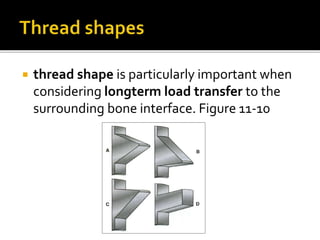
 thread shape is particularly important when
considering longterm load transfer to the
surrounding bone interface. Figure 11-10
 functional surface area is defined as the area that
actively serves to dissipate compressive loads to the
implant-bone interface.
 Functional thread surface area, therefore, is that
portion of the thread that participates in
compressive load transmission under the
action of an axial (or near-axial) occlusal load.
 total theoretical surface area, which may
include a "passive" area on the implant that
does not participate in load transfer , or has
a feature so small bone cannot adapt to load
transfer.
 Duyck et al. also found that the bone density
was equally distributed above and below a
threaded implant after initial bone healing.
 However, after dynamic loading,the bone
implant density was greater on the bottom
of the thread face angle and less on top of
the thread.
 Bolind et al. confirmed thatThe bone contact
was:
1.least at the tip of each thread (where the
highest strain occurs)
2. the greatest under the thread face angle
(where the bone is loaded more in
compression).
 Therefore the design of the implant not
only governs the initial stability of the
implant, but as important determines the BIC
percent and location of contact available for
effective load transfer to the bone after
occlusal loading.
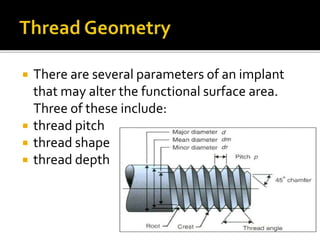
 There are several parameters of an implant
that may alter the functional surface area.
Three of these include:
 thread pitch
 thread shape
 thread depth
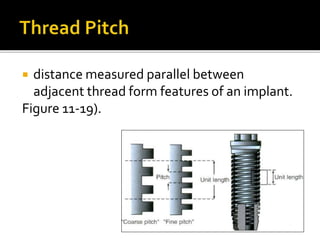
 distance measured parallel between
adjacent thread form features of an implant.
Figure 11-19).
 The smaller (or finer) the pitch:
1.the more threads on the implant body
2. the greater surface area per unit length of
the implant body.
 implant pitch may be made smaller when:
1. great forces
2. bone quality is poor
3. inadequate length
 The thread number is most significant for the
shorter length implants. For example, the
Straumann ITI 6- and 8-mm-long implants
may only have three threads to carry the
compressive load
 The thread number may be affected by the
implant crest module design.When the
implant body has an extended smooth crest
module, the number of the thread to support
the occlusal load is reduced
 The surgical ease of implant placement is
related to thread number.
 The fewer the threads, the easier to insert
the implant.
 V-thread design is called a fixture and is
primarily used for fixating metal parts
together.
 The reverse buttress thread shape was
initially designed for pullout loads.
 The square or power thread provides an
optimized surface area for intrusive,
compressive load transmission.
 A buttress thread shape may also load the
bone with primarily a compressive load
transfer.
 The V-shaped and reverse buttress thread
shapes had similar BIC percent and similar
reverse torque values to remove the implant
after initial healing .
 The square thread design had a higher BIC
percent and a greater reverse torque test.
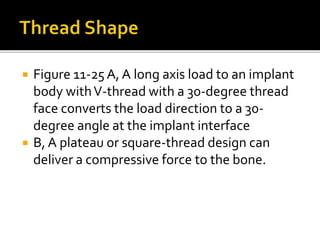
 Figure 11-25 A, A long axis load to an implant
body withV-thread with a 30-degree thread
face converts the load direction to a 30-
degree angle at the implant interface
 B, A plateau or square-thread design can
deliver a compressive force to the bone.
 The shear force on a V-thread face that is 30
degrees Is approximately 10 times greater
than the shear force on a square thread.
 The shear component of a 15-degree face
angle is five times greater than the shear
force on a square thread.
 The thread depth of an implant refers to the
distance between the outer (or major)
diameter and the inner (or minor) diameter
of the thread.
 The deeper the thread depth, the greater
the functional surface area.
 The more shallow the thread depths, the
easier it is to thread the implant in dense
bone, and the less likely bone tapping is
required prior to implant insertion.
 the implant increases in surface area by 15%
to 25% for every 1-mm increase in
diameter.
 is the transosteal region, which extends
from the implant body and often
incorporates the antirotation components
of the abutment implant connection.
 The crest module of the implant has a
surgical influence, a biological width
influence, a loading profile consideration and
a prosthetic influence.
 The crest module of an implant should be
slightly larger than the outer thread
diameter of the implant body:
1. Provides a barrier for the ingress of bacteria
or fibrous tissue during initial healing
2.And provides greater initial stability of the
implant following placement.
 The larger crest module diameter also
increases surface area, which can further
decrease stress at the crestal region.
 The increase in crest module diameter
increases the platform of the abutment
connection with a stress reduction to the
abutment screw during lateral loading.
 figure 11-37The crest module with a
cylinder metal collartransfers primarily shear
forces to the bone (for left).
 Figure 11-41 the The external hex designs
allow the fabrication of threads closer to the
crestal region of the irnplant.
 The apical portion of a root form implant is
most often tapered to permit the implant to
seat within the osteotomy before the implant
body engages the crestal bone region.
 As a result, the patient does not need to
open the mouth as wide, which is especially
of benefit in the posterior regions of dentate
patients.
 Most root form implants are circular in cross
section.This permits a round drill to prepare a
round hole,precisely corresponding to the
implant body.
 however, do not resist torsion/shear forces
when abutment screws are tightened,or
when single-tooth implants receive a
rotational(torsional) force.
 As a result, an antirotational feature is incorporated
into the implant body, usually in the apical region.
 The most common design is a hole or vent.
 In theory, bone can grow through the apical hole and
resist torsional loads applied to the implant.
 The apical hole region may also increase the surface
area available to transmit compressive loads to the
bone.
 A disadvantage of the apical hole occurs
when the implant is placed through the sinus
floor or becomes exposed through a cortical
plate.
 The apical hole may fill with mucus and
become a source of retrograde
contamination.
 Another antirotational feature of an implant
body may be flat sides or grooves along the
body or apical region of the implant body.
 The apical end of each implant should be flat
rather than pointed.
 Pointed geometry has less surface area ,
thereby raising the stress level in that region
of bone.
 Titanium alloy (Ti-6Al-4V) has been shown to
exhibit the most attractive combination of
mechanical and physical properties,
corrosion resistance, and biocompatibility
of all metallic biormaterials.
 The primary advantage of titanium alloy as
compared with other grades of titanium is its
strength.
 Titanium and its alloy represent the closest
approximation to the stiffness of bone of
any surgical grade metal used as an artificial
replacement for skeletal tissue.
 even though it is almost 6 times stiffer than
dense cortical bone.

Scientific rationale for dental implant carl e misch

  • 1.
  • 2.
     cylinder type screw type  press fit  Combination of features
  • 3.
     friction-fit insertion may have less risk of pressure necrosis  easiest to insert  high initial success rates  after 5 years of loading, reports of the loss of crestal bone and implant failure more often observed
  • 4.
     A reportby Zechner et aJ. Evaluated the peri- implant bone over a 3- to 7-year period around functionally loaded, screw-type implants with a machined surfacedV-thread and sandblasted, acid-etched, squarethread design.
  • 5.
     The rangeof bone loss in the study was 0.1 to 8.5 mm for the machinedV-thread and 0.2 to 4.8 mm for the rough surface, square- threaded implant.  The range of bone loss and the incidence of bone loss both indicate implant design or surface condition made a difference in this report.
  • 6.
     A prospectivereport by Karoussis et al. also indicated that implant survival and marginal bone loss is related to implant design.  In other words, several clinical reports found different implant designs influence not only the implant survival, but also the amount of early crestal bone loss after loading.
  • 7.
     Dental implantsfunction to transfer loads to surrounding biological tissues.  Thus the primary functional design objective is to manage (dissipate and distribute) biomechanical loads to optimize the implant-supported prosthesis function.
  • 8.
     Three typesof forces may be imposed on dental implant : Compression(strongest) tension(30% weaker) Shear( 65% weaker)  limit shear forces on bone, because it is least resistant to fracture under these loading conditions.
  • 9.
     An implanthas a macroscopic body design and a microscopic component to implant design: 1 .The microscopic features(important during initial implant healing and the initial loading period). 2.The macroscopic implant body design is most important during early loading and mature loading periods.
  • 10.
     Smooth-sided, cylindricalimplants : ease in surgical placement larger shear forces  smooth-sided, cylindrical, tapered implant: compressive load to the bone-implant interface, depending on the degree of taper
  • 11.
     The greaterthe taper, the greater the component of compressive load. (not more 30 degree)  the greater the taper: 1. the less the overall surface area of the implant body under load 2. the less initial stability
  • 12.
    1.no functional surfacearea advantage, because the threads of a screw bear the compressive loads to the bone. 2. some surgical advantage during initial insertion, because it inserts down within the osteotomy halfway before engaging bone.
  • 13.
    3.the lesser surfacearea of a tapered implant increases the amount of stress at the crestal portion 4.at the apical half are often less deep,because the outer diameter continues to decrease. (limits the initial fixation).
  • 14.
     A smooth-cylinderimplant body results in essentially a shear load at the implant-bone interface.  Bone grows to a cylinder-shape implant during initial healing. .
  • 15.
     However, thistype of body geometry must rely on a microscopic retention system such as roughening or coating for the initial loading period: 1.Etch (acidetch, mechanical etch) 2.coatings (titanium plasma spray or HA)
  • 16.
     If theThequality of the coating is altered: 1.from friction during surgery 2.infection 3.mechanically removed during treatment of periimplantitis 4.from bone remodeling over years  the remaining smooth-sided cylinder is severely compromised for healthy load transfer to the surrounding tissues.
  • 17.
     The surfaceconditions of an implant may enhance : 1.bone-implant contact (BIC) 2.adhesion qualities to the bone  However, the surface coatings on cylinders do not permit compressive forces to be effectively transmitted to the bone cells, because the microfeatures of the coating are too small for the cells to be loaded in compression."
  • 18.
     Therefore thesurface area-bone contact percentage is greater during initial healing.  but the functional surface area during long- term loading is most dependent on the macroscopic design of the implant body.
  • 19.
     Numerous reportsdemonstrate roughened surfaces have higher BIC compared with machined surfaces.  implant body design was more important than the surface condition of the implant for crestal bone loss and overall BIC after loading.
  • 20.
     Any smoothshear surface on an implant body increases the risk of bone loss because of inadequate load transfer.  The crestal bone loss contribute to an increase in crown height which further magnifies stress from bending moments.
  • 21.
     The greaterthe angle of load, the greater the stresses to the implant-bone interface.  A 30-degree angled load will increase the overall stress by 50% compared with a long axis load.  the long axis should be perpendicular to the curve ofWilson and curve of Spee to apply a long axis load to the implant during occlusal load in co.
  • 22.
     thread shapeis particularly important when considering longterm load transfer to the surrounding bone interface. Figure 11-10
  • 23.
     functional surfacearea is defined as the area that actively serves to dissipate compressive loads to the implant-bone interface.  Functional thread surface area, therefore, is that portion of the thread that participates in compressive load transmission under the action of an axial (or near-axial) occlusal load.
  • 24.
     total theoreticalsurface area, which may include a "passive" area on the implant that does not participate in load transfer , or has a feature so small bone cannot adapt to load transfer.
  • 25.
     Duyck etal. also found that the bone density was equally distributed above and below a threaded implant after initial bone healing.  However, after dynamic loading,the bone implant density was greater on the bottom of the thread face angle and less on top of the thread.
  • 26.
     Bolind etal. confirmed thatThe bone contact was: 1.least at the tip of each thread (where the highest strain occurs) 2. the greatest under the thread face angle (where the bone is loaded more in compression).
  • 27.
     Therefore thedesign of the implant not only governs the initial stability of the implant, but as important determines the BIC percent and location of contact available for effective load transfer to the bone after occlusal loading.
  • 28.
     There areseveral parameters of an implant that may alter the functional surface area. Three of these include:  thread pitch  thread shape  thread depth
  • 29.
     distance measuredparallel between adjacent thread form features of an implant. Figure 11-19).
  • 30.
     The smaller(or finer) the pitch: 1.the more threads on the implant body 2. the greater surface area per unit length of the implant body.
  • 31.
     implant pitchmay be made smaller when: 1. great forces 2. bone quality is poor 3. inadequate length
  • 32.
     The threadnumber is most significant for the shorter length implants. For example, the Straumann ITI 6- and 8-mm-long implants may only have three threads to carry the compressive load
  • 33.
     The threadnumber may be affected by the implant crest module design.When the implant body has an extended smooth crest module, the number of the thread to support the occlusal load is reduced
  • 34.
     The surgicalease of implant placement is related to thread number.  The fewer the threads, the easier to insert the implant.
  • 35.
     V-thread designis called a fixture and is primarily used for fixating metal parts together.  The reverse buttress thread shape was initially designed for pullout loads.
  • 36.
     The squareor power thread provides an optimized surface area for intrusive, compressive load transmission.  A buttress thread shape may also load the bone with primarily a compressive load transfer.
  • 37.
     The V-shapedand reverse buttress thread shapes had similar BIC percent and similar reverse torque values to remove the implant after initial healing .  The square thread design had a higher BIC percent and a greater reverse torque test.
  • 38.
     Figure 11-25A, A long axis load to an implant body withV-thread with a 30-degree thread face converts the load direction to a 30- degree angle at the implant interface  B, A plateau or square-thread design can deliver a compressive force to the bone.
  • 39.
     The shearforce on a V-thread face that is 30 degrees Is approximately 10 times greater than the shear force on a square thread.  The shear component of a 15-degree face angle is five times greater than the shear force on a square thread.
  • 40.
     The threaddepth of an implant refers to the distance between the outer (or major) diameter and the inner (or minor) diameter of the thread.  The deeper the thread depth, the greater the functional surface area.
  • 41.
     The moreshallow the thread depths, the easier it is to thread the implant in dense bone, and the less likely bone tapping is required prior to implant insertion.  the implant increases in surface area by 15% to 25% for every 1-mm increase in diameter.
  • 42.
     is thetransosteal region, which extends from the implant body and often incorporates the antirotation components of the abutment implant connection.  The crest module of the implant has a surgical influence, a biological width influence, a loading profile consideration and a prosthetic influence.
  • 43.
     The crestmodule of an implant should be slightly larger than the outer thread diameter of the implant body: 1. Provides a barrier for the ingress of bacteria or fibrous tissue during initial healing 2.And provides greater initial stability of the implant following placement.
  • 44.
     The largercrest module diameter also increases surface area, which can further decrease stress at the crestal region.  The increase in crest module diameter increases the platform of the abutment connection with a stress reduction to the abutment screw during lateral loading.
  • 45.
     figure 11-37Thecrest module with a cylinder metal collartransfers primarily shear forces to the bone (for left).
  • 46.
     Figure 11-41the The external hex designs allow the fabrication of threads closer to the crestal region of the irnplant.
  • 47.
     The apicalportion of a root form implant is most often tapered to permit the implant to seat within the osteotomy before the implant body engages the crestal bone region.  As a result, the patient does not need to open the mouth as wide, which is especially of benefit in the posterior regions of dentate patients.
  • 48.
     Most rootform implants are circular in cross section.This permits a round drill to prepare a round hole,precisely corresponding to the implant body.  however, do not resist torsion/shear forces when abutment screws are tightened,or when single-tooth implants receive a rotational(torsional) force.
  • 49.
     As aresult, an antirotational feature is incorporated into the implant body, usually in the apical region.  The most common design is a hole or vent.  In theory, bone can grow through the apical hole and resist torsional loads applied to the implant.  The apical hole region may also increase the surface area available to transmit compressive loads to the bone.
  • 50.
     A disadvantageof the apical hole occurs when the implant is placed through the sinus floor or becomes exposed through a cortical plate.  The apical hole may fill with mucus and become a source of retrograde contamination.
  • 51.
     Another antirotationalfeature of an implant body may be flat sides or grooves along the body or apical region of the implant body.  The apical end of each implant should be flat rather than pointed.  Pointed geometry has less surface area , thereby raising the stress level in that region of bone.
  • 52.
     Titanium alloy(Ti-6Al-4V) has been shown to exhibit the most attractive combination of mechanical and physical properties, corrosion resistance, and biocompatibility of all metallic biormaterials.  The primary advantage of titanium alloy as compared with other grades of titanium is its strength.
  • 53.
     Titanium andits alloy represent the closest approximation to the stiffness of bone of any surgical grade metal used as an artificial replacement for skeletal tissue.  even though it is almost 6 times stiffer than dense cortical bone.