IMPACTS OF TECHNOLOGY IN
ARCHITECTURE
ARCHITECTURE
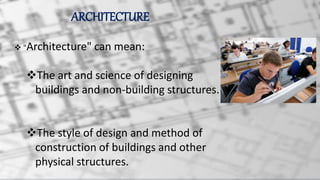
 "Architecture" can mean:
The art and science of designing
buildings and non-building structures.
The style of design and method of
construction of buildings and other
physical structures.
TECHNOLOGY
Technology is the collection of techniques,
skills, methods and processes used in the
production of goods or services.
The human species' use of technology began
with the conversion of natural resources into
simple tools.
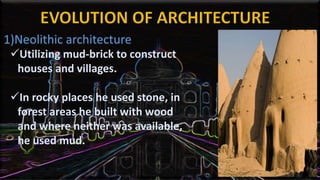
Utilizing mud-brick to construct
houses and villages.
In rocky places he used stone, in
forest areas he built with wood
and where neither was available,
he used mud.
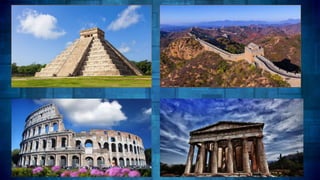
Mud-brick buildings and the construction of Ziggurats and
religious temples.
They made lumps of clay into bricks to build a wall.
2)Mesopotamian architecture
3)Roman & Greek architecture
Inventions like arch, concrete gave a whole new form to this
period’s architecture.
Noted for the domes and amphitheatres.
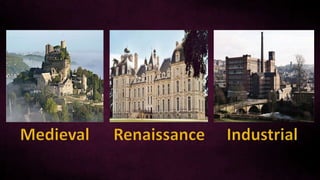
Skeleton framing, which reappeared as a principle of building technique,
which we find today in the practice of modern architecture.
Though not contributing to any new system of construction, it was a
period of variation and improvement upon past performances.
Factory buildings, warehouses and railway stations, requiring large spaces
to be enclosed, had to be constructed, for the industrial revolution.
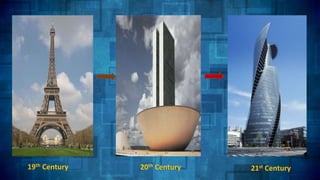
20th Century 21st Century19th Century
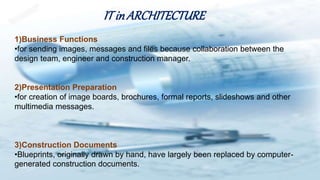
IT inARCHITECTURE
1)Business Functions
•for sending images, messages and files because collaboration between the
design team, engineer and construction manager.
2)Presentation Preparation
•for creation of image boards, brochures, formal reports, slideshows and other
multimedia messages.
3)Construction Documents
•Blueprints, originally drawn by hand, have largely been replaced by computer-
generated construction documents.
4) 3-D Models
•architects can illustrate either segments or entire
projects for the client by creating a virtual 3-D model
on the computer.
5) Increased Information
•Computer generated designs allow the architects to
know more information about the building projects
without having to work out long and complex
problems.
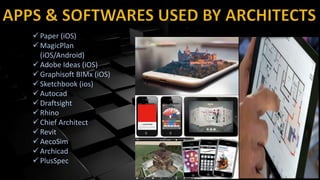
 Paper (iOS)
 MagicPlan
(iOS/Android)
 Adobe Ideas (iOS)
 Graphisoft BIMx (iOS)
 Sketchbook (ios)
 Autocad
 Draftsight
 Rhino
 Chief Architect
 Revit
 AecoSim
 Archicad
 PlusSpec
www.archdaily.com
www.ehow.com
www.futurearchi.org
www.architexturez.net
DONE BY:
GOBIGA RAJALINGAM
THANK YOU

Impacts of Technology on Architecture

  • 1.
    IMPACTS OF TECHNOLOGYIN ARCHITECTURE
  • 2.
    ARCHITECTURE  "Architecture" canmean: The art and science of designing buildings and non-building structures. The style of design and method of construction of buildings and other physical structures.
  • 3.
    TECHNOLOGY Technology is thecollection of techniques, skills, methods and processes used in the production of goods or services. The human species' use of technology began with the conversion of natural resources into simple tools.
  • 4.
    Utilizing mud-brick toconstruct houses and villages. In rocky places he used stone, in forest areas he built with wood and where neither was available, he used mud.
  • 5.
    Mud-brick buildings andthe construction of Ziggurats and religious temples. They made lumps of clay into bricks to build a wall. 2)Mesopotamian architecture 3)Roman & Greek architecture Inventions like arch, concrete gave a whole new form to this period’s architecture. Noted for the domes and amphitheatres.
  • 7.
    Skeleton framing, whichreappeared as a principle of building technique, which we find today in the practice of modern architecture. Though not contributing to any new system of construction, it was a period of variation and improvement upon past performances. Factory buildings, warehouses and railway stations, requiring large spaces to be enclosed, had to be constructed, for the industrial revolution.
  • 9.
    20th Century 21stCentury19th Century
  • 11.
    IT inARCHITECTURE 1)Business Functions •forsending images, messages and files because collaboration between the design team, engineer and construction manager. 2)Presentation Preparation •for creation of image boards, brochures, formal reports, slideshows and other multimedia messages. 3)Construction Documents •Blueprints, originally drawn by hand, have largely been replaced by computer- generated construction documents.
  • 12.
    4) 3-D Models •architectscan illustrate either segments or entire projects for the client by creating a virtual 3-D model on the computer. 5) Increased Information •Computer generated designs allow the architects to know more information about the building projects without having to work out long and complex problems.
  • 13.
     Paper (iOS) MagicPlan (iOS/Android)  Adobe Ideas (iOS)  Graphisoft BIMx (iOS)  Sketchbook (ios)  Autocad  Draftsight  Rhino  Chief Architect  Revit  AecoSim  Archicad  PlusSpec
  • 15.
  • 16.