By – SURESH KUMAR ( Nursing Tutor )
TO WATCHTHIS SLIDEWITHVOICE
EXPALINATION ASVIDEO PLEASEVISIT
MYYOUTUBE CHANNEL
“MY STUDENT SUPPORT SYSTEM”
IN ENGLISH
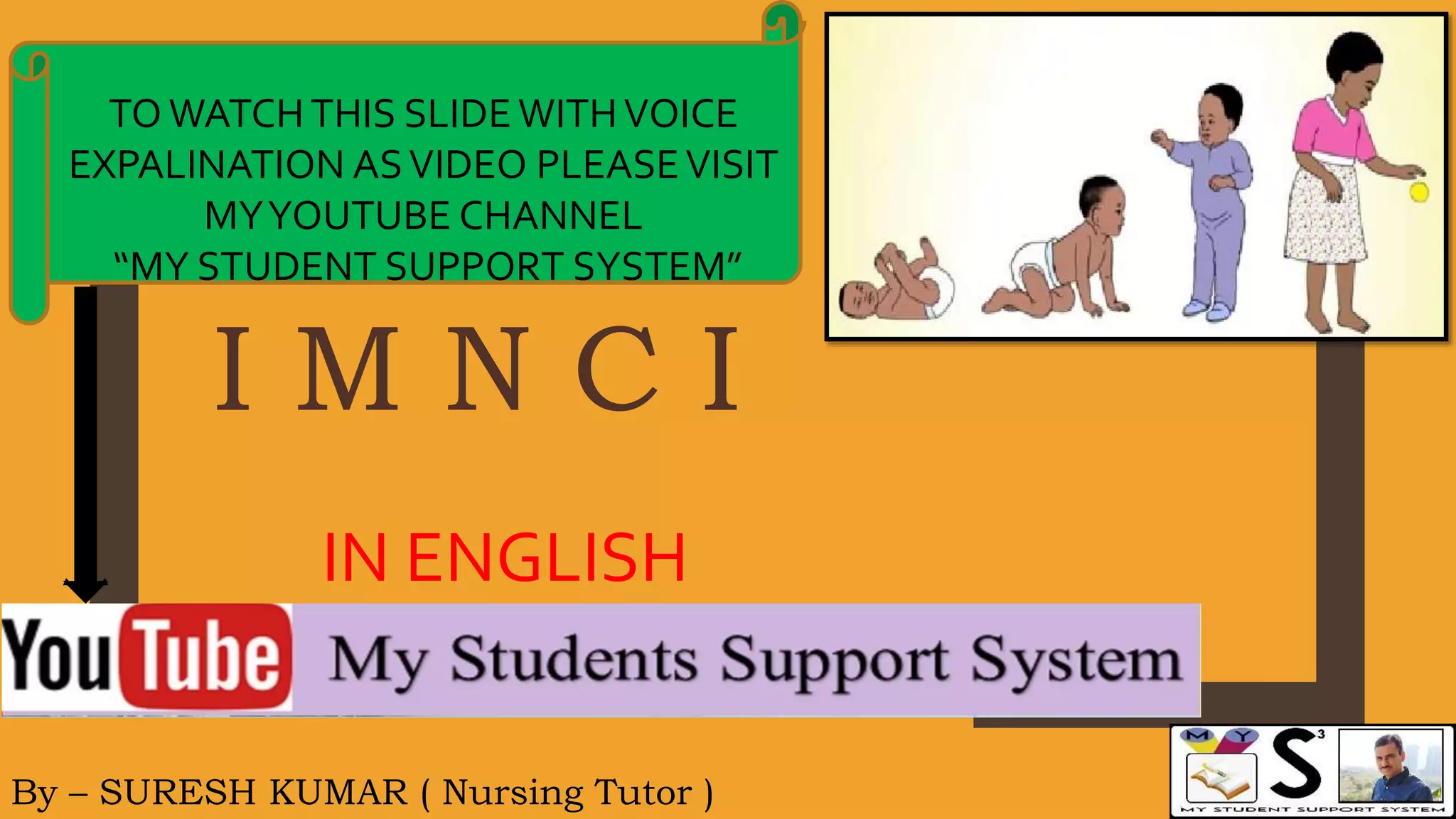
I M N C I
IMNCI
■ IMNCI is an integrated approach to child
health that focuses on the well-being of the
whole child. IMNCI aims to reduce
death, illness and disability, and to promote
improved growth and development among
children under five years of age.
WHY IMNCI
■ Children brought for medical treatment in the
hospitals are often suffering from more than
one condition, making a single diagnosis
impossible. IMNCI is an integrated strategy,
which takes into account the variety of factors
that put children at serious risk. It ensures the
combined treatment of the major childhood
illnesses, emphasizing prevention of disease
through immunization and improved nutrition.
BACKGROUND of IMNCI
■ During mid 1990 the World Health Organization in
collaboration with UNICEF and many other agencies
respond to the challenge of child health developed a
strategy known as integrated management of
childhood illness this strategy has been expanded in
India to include all neonates and is renamed as
integrated management of neonatal and childhood
illness and included in the RCH 2 program.
OBJECTIVES of IMNCI
■ IMNCI aims to –
■ Reduce neonatal and childhood death,
■ Reduce illness and disability,
■ Promote improved growth and development
among children under five years of age and
■ Promote the accurate identification of
childhood illnesses in out-patient settings
COMPONENTS of IMNCI
■ The three components of IMNCI are -
■ improve health workers’ skills
■ improve health systems and
■ improve family and community practices
Improve health workers’ skills
■ Improving health providers’ skills mostly
refers to clinical and communication skills
and covers both pre-service education and
in-service training, in both the public and
private sector.
Improve health systems
■ Improving health systems to use IMNCI
strategy include policy, planning and
management, financing, organization of work
and distribution of tasks at health facilities,
human resources, availability of drugs and
supplies, referral, monitoring and health
information system, supervision, evaluation
and research. Health sector reform efforts are
usually listed under this component.
Improve family and
community practices
■ Improving family and community
practices related to child health and
development. If these practices properly
promoted and adopted by the targeted
communities, would potentially contribute
to improving child survival, growth and
development.
PRINCIPLES of IMNCI
■ All sick children must be checked for ‘general danger signs’
which indicate the need for immediate referral or admission
to a higher health facility level.
■ All sick children must be routinely assessed for major
symptoms: cough, fever, diarrhoea, ear problems.
■ Children should also be assessed for nutritional and
immunization status, feeding problems and other problems.
PRINCIPLES of IMNCI
■ Only a limited number of carefully selected clinical signs are
used , based on evidence of their sensitivity and specificity to
detect disease.
■ A combination of individual signs leads to an infant’s or a
child’s classification rather than a diagnosis. Classification
indicate the severity of condition.
■ IMNCI management procedures use a limited number of
essential drugs and encourage active participation of
caretakers in the treatment of infants and children.
IMNCI STRATEGY
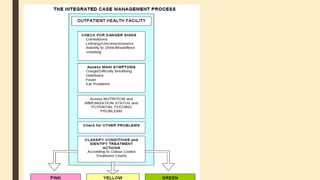
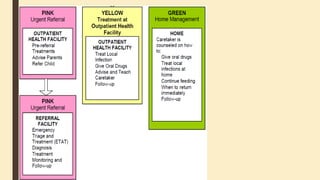
■ IMNCI strategy includes assessment and
classification of children and color coding
for the treatment.
■ This assessment starts as soon as the child
enters the health facility.
By – SURESH KUMAR ( Nursing Tutor )
TO UNDERSTANDTHISTOPIC EASILY PLEASE
WATCHTHISVIDEO ON MY YOUTUBE
CHANNEL AND DO NOT FORGETTO
SUBSCRIBE

IMNCI IN english

  • 1.
    By – SURESHKUMAR ( Nursing Tutor ) TO WATCHTHIS SLIDEWITHVOICE EXPALINATION ASVIDEO PLEASEVISIT MYYOUTUBE CHANNEL “MY STUDENT SUPPORT SYSTEM” IN ENGLISH I M N C I
  • 2.
    IMNCI ■ IMNCI isan integrated approach to child health that focuses on the well-being of the whole child. IMNCI aims to reduce death, illness and disability, and to promote improved growth and development among children under five years of age.
  • 3.
    WHY IMNCI ■ Childrenbrought for medical treatment in the hospitals are often suffering from more than one condition, making a single diagnosis impossible. IMNCI is an integrated strategy, which takes into account the variety of factors that put children at serious risk. It ensures the combined treatment of the major childhood illnesses, emphasizing prevention of disease through immunization and improved nutrition.
  • 4.
    BACKGROUND of IMNCI ■During mid 1990 the World Health Organization in collaboration with UNICEF and many other agencies respond to the challenge of child health developed a strategy known as integrated management of childhood illness this strategy has been expanded in India to include all neonates and is renamed as integrated management of neonatal and childhood illness and included in the RCH 2 program.
  • 5.
    OBJECTIVES of IMNCI ■IMNCI aims to – ■ Reduce neonatal and childhood death, ■ Reduce illness and disability, ■ Promote improved growth and development among children under five years of age and ■ Promote the accurate identification of childhood illnesses in out-patient settings
  • 6.
    COMPONENTS of IMNCI ■The three components of IMNCI are - ■ improve health workers’ skills ■ improve health systems and ■ improve family and community practices
  • 7.
    Improve health workers’skills ■ Improving health providers’ skills mostly refers to clinical and communication skills and covers both pre-service education and in-service training, in both the public and private sector.
  • 8.
    Improve health systems ■Improving health systems to use IMNCI strategy include policy, planning and management, financing, organization of work and distribution of tasks at health facilities, human resources, availability of drugs and supplies, referral, monitoring and health information system, supervision, evaluation and research. Health sector reform efforts are usually listed under this component.
  • 9.
    Improve family and communitypractices ■ Improving family and community practices related to child health and development. If these practices properly promoted and adopted by the targeted communities, would potentially contribute to improving child survival, growth and development.
  • 10.
    PRINCIPLES of IMNCI ■All sick children must be checked for ‘general danger signs’ which indicate the need for immediate referral or admission to a higher health facility level. ■ All sick children must be routinely assessed for major symptoms: cough, fever, diarrhoea, ear problems. ■ Children should also be assessed for nutritional and immunization status, feeding problems and other problems.
  • 11.
    PRINCIPLES of IMNCI ■Only a limited number of carefully selected clinical signs are used , based on evidence of their sensitivity and specificity to detect disease. ■ A combination of individual signs leads to an infant’s or a child’s classification rather than a diagnosis. Classification indicate the severity of condition. ■ IMNCI management procedures use a limited number of essential drugs and encourage active participation of caretakers in the treatment of infants and children.
  • 12.
    IMNCI STRATEGY ■ IMNCIstrategy includes assessment and classification of children and color coding for the treatment. ■ This assessment starts as soon as the child enters the health facility.
  • 15.
    By – SURESHKUMAR ( Nursing Tutor ) TO UNDERSTANDTHISTOPIC EASILY PLEASE WATCHTHISVIDEO ON MY YOUTUBE CHANNEL AND DO NOT FORGETTO SUBSCRIBE