Rajalakshmi.S
Assistant professor
Josco college of nursing
Edappon
Introduction
 Children are the wealth of nation. They are by nature prone
to diseases. They constitute the 40 % of total population,
out of which 15% are below 5 years of age. Research shows
that majority of the childhood sickness and death are
preventable by simple low cost measures. Child health
depends upon preventive care. Prevention is the best
measure for maintaining health.
Definition
 Preventive pediatrics is defined as the prevention of
diseases, promotion of health, maintaining and
restoration of physical, mental and social well- being
of children to attain positive health.
Aims
 To prevent occurrence of disease or delay the occurrence
disease
 To timely detect a disease
 To provide early treatment , to avoid complications.
 To treat the disease and achieve maximum level of
rehabilitation
 To avoid premature death
 To improve efficiency
Aspects of preventive pediatrics
 Growth monitoring
 Nutritional surveillance
 Promotion of exclusive breastfeeding
 Prevention of preventable disease through
immunization
 Control of diarrheal disease
 Control of infectious diseases
 Provision of iodized salt
 Prevention of malaria in children
 Institutional deliveries
 Supplementary nutrition to children, pregnant and
lactating mother
 Health education regarding services and facilities
provided to mother and child to maintain growth and
development
 Special care to challenged children
 Child welfare programmes and legal rights of children
Types of preventive pediatrics
Antenatal preventive
pediatrics
Postnatal preventive
pediatrics
Social preventive
pediatrics
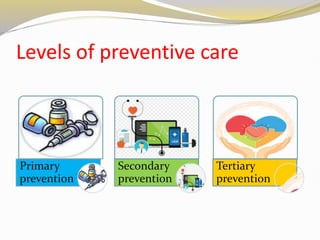
Levels of preventive care
Primary
prevention
Secondary
prevention
Tertiary
prevention
Primary prevention
 Any measure aimed at helping future parents provide their
upcoming child with adequate attention, as well as secure
physical and affective environment from conception to first
birth day, i.e. over the child’s primary period of life
 That include :-
 Immunization
 Healthy diet
 Exercise
 Avoid alcoholism and smoking
Secondary prevention
 Methods to detect and address an existing disease
prior to the appearance of symptoms
 Treatment of risk factors and screening
Tertiary prevention
 Methods to reduce the harm of symptomatic disease to
prevent disability.
 Maximize the remaining capabilities and functions of
an already disabled child.
 Govt. of India has launched many programmes like
 National immunization programme
 BFHI
 RCH
 MCH
 FH
 ICDS
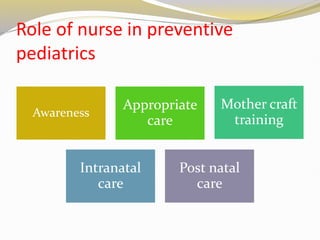
Role of nurse in preventive
pediatrics
Awareness
Appropriate
care
Mother craft
training
Intranatal
care
Post natal
care
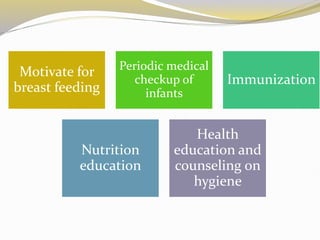
Motivate for
breast feeding
Periodic medical
checkup of
infants
Immunization
Nutrition
education
Health
education and
counseling on
hygiene
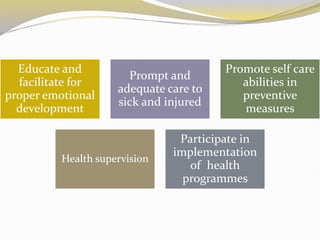
Educate and
facilitate for
proper emotional
development
Prompt and
adequate care to
sick and injured
Promote self care
abilities in
preventive
measures
Health supervision
Participate in
implementation
of health
programmes
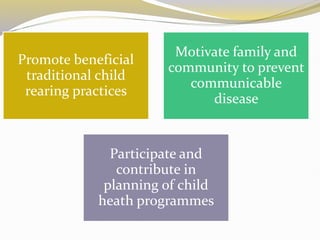
Promote beneficial
traditional child
rearing practices
Motivate family and
community to prevent
communicable
disease
Participate and
contribute in
planning of child
heath programmes
Introduction
 The National Immunization programme is one of the
largest and most successful national programs
 The success of the programme can be measured in terms
of reduction of childhood morbidity and mortality
associated with diphtheria, Pertusis, polio, Measles,
Tuberculosis and Tetanus.
 This programme was started in 1978 as “expanded programme
on immunization (EPI)
 INCREASE THE IMMUNIZATION COVERAGE IN CHILDREN
BELOW 2YEAR OF AGE
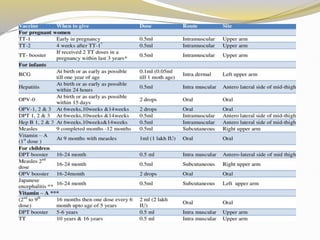
 with 3 doses of DPT and 1 doses of BCG ( Bacille Calmette - Guerin)
and in pregnant women with 2 doses of TT.
 Oral Polio vaccine was added to the programme in 1979
 In 1985 objective were revised and renamed as Universal
Immunization Programme for attaining universal immunization
coverage of infants and pregnant women.
 1985 measles vaccine was added
 The programme covered whole of India by 1990 .
 UIP become a part of Child Survival and Safe
Motherhood programme (CSSM) and in Reproductive
and Child Health Programme (RCH ) in 1997
INTRODUCTION
 Under five age group of children are vulnerable group
and constitute major portion.
 Mortality and morbidity rate are high in this group.
 The first five years of life from the foundation of child’s
physical and mental growth and development.
 Under five clinics means to provide curative,
preventive and promotive health services to under five
children, within the resources available in the country.
 these services are economical and within the
available resources for a large number of young
children.
 Auxiliary nurse midwife or Multipurpose health
worker female are mainly involved to cover large
proportion of children
 The clinic s run n association with antenatal clinic
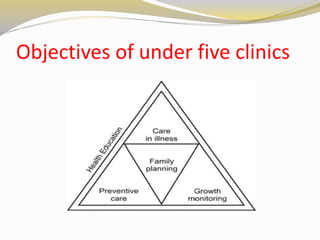
Objectives of under five clinics
Care in illness
 “Care and treatment of sick children”
 Studies have shown that 70%- 90% of care of sc children
can be handled skillfully by trained nurses.
 Care of illness comprises of diagnoses and treatment of :
1. Acute illness
2. Chronic illness including physical , mental,
congenital and acquired abnormalities.
3. Disorders of growth and development
X-ray and laboratory services
Referral services.
Preventive care
Immunization
o World’s greatest public health tool .
o It protects children from six killer diseases –
diphtheria, polio, tetanus, measles, TB and whooping
cough.
o Under five clinics children are immunized against
three killer diseases .
Nutritional surveillance
o Nutritional disorders like PEM, anemia, rickets ,etc…
occurs in this age group .
o Nutritional surveillance is extremely important to
detect sub clinical deficiencies .
o At under five clinics every child is weighted monthly
for the early detection of growth failure and
malnutrition .
o “Road to Health ” cards are maintained by nurses on
which height and weight of children are recorded.
Health check-ups
o It cover physical examination and lab tests.
o Done every 3-6 months .
o Child health cards are used as a checklist for the
examinations to be done.
o Child health cards helps in identifying ‘at risk ’
children so they can be given special attention .
Oral rehydration
o Children of developing countries on an average suffer
from 2-3 diarrheal attacks in a year .
o This reduces immunity and increases risk of death
from dehydration.
o Under five clinics promote use of ORS packets to
prevent deaths due to dehydration .
Growth monitoring
 Biggest activity of under five clinics , ie; to weigh
children periodically every month during 1st year of
life, every 2 months during second year and every
three months upto the age of 5-6 years.
 The finding are plotted on growth chart against his or
her age, which helps to detect early growth failure.
Family Planning
 Family planning is the centre of concern for health and
well being of the child.
 The mother is given family planning advices in the
clinic.
 The red colour in the center of the symbol is a
triangular area indicates family planning.
Health Education
 Around the whole symbol is a border that touches all
the other areas. This simply represents the health
teaching that the mother receives when she takes her
baby to the clinic.
 The mother receives teaching related to nutrition
immunization family planning and care of the child.
DEFINITION
 Cold chain is a system of storage and transport of
vaccines at optimum temperature [2-8 °c] from
manufacture to the site of vaccination. This cold chain
is needed because vaccines are sensitive to heat and
they may lose their potency if not stored and
transported at optimum temperature.
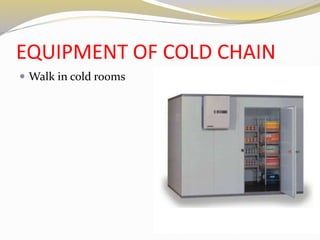
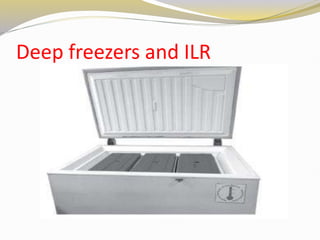
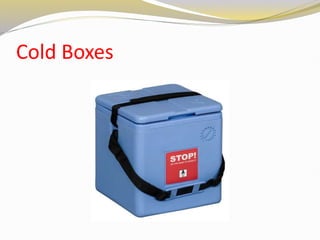
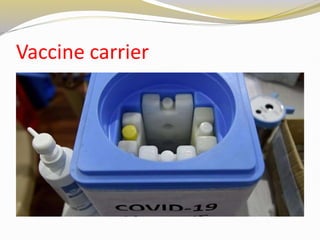
EQUIPMENT OF COLD CHAIN
 Walk in cold rooms
Deep freezers and ILR
Cold Boxes
Vaccine carrier
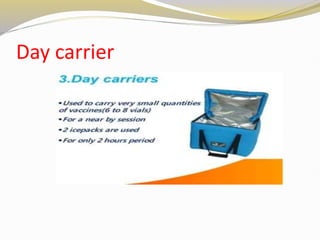
Day carrier
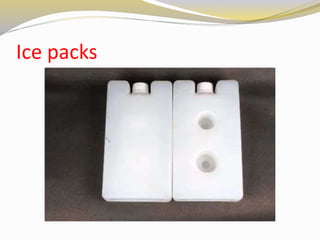
Ice packs
INTRODUCTION
 child guidance clinics were started in 1922, as a part of
programme sponsored by a private organization- ‘
common wealth fund’s programme’ for the prevention
of juvenile delinquency.
Concept of child guidance clinics
 For all round development of child, the child’s physical
and psychological functioning and the environment to
which he is exposed at home and at school, should be
taken care of. All this is possible through interaction
with and counseling of the child and family by a health
care team
Objectives
 Providing help for children with behavioural problems
like pica, bed wetting, sleep walking, speech defects,
etc
 Providing care and guidance for children with mental
retardation
 Providing care and guidance for children with learning
difficulties
 Providing counseling, guidance and information to
parents regarding care and upbringing of children.
Services provided by CGC
 Managing behavioral problems
 Managing learning difficulties
 Managing emotional problems
 Managing adjust mental problems
 Managing developmental problems
 Managing sociological issues
Role of nurse
 The nurse can help by identifying and preventing risk cases in
the community .
 Nurse can educate the public or community regarding causes
,prevention and treatment of maladjustment in children.
 Nurse can motivate parents to seek expert’s advise and do
research studies herself in the field or clinic.
 Nurse should provide holistic care to child and his family .
 Nurse should take measures to protect child rights.
 Nurse can help parents at clinic by making bond between child
his parents and treatment team.
 Nurse can play a role model to motivate public to seek guidance
and advice to eliminate behavioral problems in children.
Preventive pediatrics,aspects,types,level of care,

Preventive pediatrics,aspects,types,level of care,

  • 1.
  • 2.
    Introduction  Children arethe wealth of nation. They are by nature prone to diseases. They constitute the 40 % of total population, out of which 15% are below 5 years of age. Research shows that majority of the childhood sickness and death are preventable by simple low cost measures. Child health depends upon preventive care. Prevention is the best measure for maintaining health.
  • 3.
    Definition  Preventive pediatricsis defined as the prevention of diseases, promotion of health, maintaining and restoration of physical, mental and social well- being of children to attain positive health.
  • 4.
    Aims  To preventoccurrence of disease or delay the occurrence disease  To timely detect a disease  To provide early treatment , to avoid complications.  To treat the disease and achieve maximum level of rehabilitation  To avoid premature death  To improve efficiency
  • 5.
    Aspects of preventivepediatrics  Growth monitoring  Nutritional surveillance  Promotion of exclusive breastfeeding  Prevention of preventable disease through immunization
  • 6.
     Control ofdiarrheal disease  Control of infectious diseases  Provision of iodized salt  Prevention of malaria in children
  • 7.
     Institutional deliveries Supplementary nutrition to children, pregnant and lactating mother  Health education regarding services and facilities provided to mother and child to maintain growth and development
  • 8.
     Special careto challenged children  Child welfare programmes and legal rights of children
  • 9.
    Types of preventivepediatrics Antenatal preventive pediatrics Postnatal preventive pediatrics Social preventive pediatrics
  • 10.
    Levels of preventivecare Primary prevention Secondary prevention Tertiary prevention
  • 11.
    Primary prevention  Anymeasure aimed at helping future parents provide their upcoming child with adequate attention, as well as secure physical and affective environment from conception to first birth day, i.e. over the child’s primary period of life  That include :-  Immunization  Healthy diet  Exercise  Avoid alcoholism and smoking
  • 12.
    Secondary prevention  Methodsto detect and address an existing disease prior to the appearance of symptoms  Treatment of risk factors and screening
  • 13.
    Tertiary prevention  Methodsto reduce the harm of symptomatic disease to prevent disability.  Maximize the remaining capabilities and functions of an already disabled child.
  • 14.
     Govt. ofIndia has launched many programmes like  National immunization programme  BFHI  RCH  MCH  FH  ICDS
  • 15.
    Role of nursein preventive pediatrics Awareness Appropriate care Mother craft training Intranatal care Post natal care
  • 16.
    Motivate for breast feeding Periodicmedical checkup of infants Immunization Nutrition education Health education and counseling on hygiene
  • 17.
    Educate and facilitate for properemotional development Prompt and adequate care to sick and injured Promote self care abilities in preventive measures Health supervision Participate in implementation of health programmes
  • 18.
    Promote beneficial traditional child rearingpractices Motivate family and community to prevent communicable disease Participate and contribute in planning of child heath programmes
  • 20.
    Introduction  The NationalImmunization programme is one of the largest and most successful national programs  The success of the programme can be measured in terms of reduction of childhood morbidity and mortality associated with diphtheria, Pertusis, polio, Measles, Tuberculosis and Tetanus.
  • 21.
     This programmewas started in 1978 as “expanded programme on immunization (EPI)  INCREASE THE IMMUNIZATION COVERAGE IN CHILDREN BELOW 2YEAR OF AGE  with 3 doses of DPT and 1 doses of BCG ( Bacille Calmette - Guerin) and in pregnant women with 2 doses of TT.  Oral Polio vaccine was added to the programme in 1979  In 1985 objective were revised and renamed as Universal Immunization Programme for attaining universal immunization coverage of infants and pregnant women.  1985 measles vaccine was added
  • 22.
     The programmecovered whole of India by 1990 .  UIP become a part of Child Survival and Safe Motherhood programme (CSSM) and in Reproductive and Child Health Programme (RCH ) in 1997
  • 25.
    INTRODUCTION  Under fiveage group of children are vulnerable group and constitute major portion.  Mortality and morbidity rate are high in this group.  The first five years of life from the foundation of child’s physical and mental growth and development.
  • 26.
     Under fiveclinics means to provide curative, preventive and promotive health services to under five children, within the resources available in the country.  these services are economical and within the available resources for a large number of young children.  Auxiliary nurse midwife or Multipurpose health worker female are mainly involved to cover large proportion of children  The clinic s run n association with antenatal clinic
  • 27.
    Objectives of underfive clinics
  • 28.
    Care in illness “Care and treatment of sick children”  Studies have shown that 70%- 90% of care of sc children can be handled skillfully by trained nurses.  Care of illness comprises of diagnoses and treatment of : 1. Acute illness 2. Chronic illness including physical , mental, congenital and acquired abnormalities. 3. Disorders of growth and development X-ray and laboratory services Referral services.
  • 29.
    Preventive care Immunization o World’sgreatest public health tool . o It protects children from six killer diseases – diphtheria, polio, tetanus, measles, TB and whooping cough. o Under five clinics children are immunized against three killer diseases .
  • 30.
    Nutritional surveillance o Nutritionaldisorders like PEM, anemia, rickets ,etc… occurs in this age group . o Nutritional surveillance is extremely important to detect sub clinical deficiencies . o At under five clinics every child is weighted monthly for the early detection of growth failure and malnutrition . o “Road to Health ” cards are maintained by nurses on which height and weight of children are recorded.
  • 31.
    Health check-ups o Itcover physical examination and lab tests. o Done every 3-6 months . o Child health cards are used as a checklist for the examinations to be done. o Child health cards helps in identifying ‘at risk ’ children so they can be given special attention .
  • 32.
    Oral rehydration o Childrenof developing countries on an average suffer from 2-3 diarrheal attacks in a year . o This reduces immunity and increases risk of death from dehydration. o Under five clinics promote use of ORS packets to prevent deaths due to dehydration .
  • 33.
    Growth monitoring  Biggestactivity of under five clinics , ie; to weigh children periodically every month during 1st year of life, every 2 months during second year and every three months upto the age of 5-6 years.  The finding are plotted on growth chart against his or her age, which helps to detect early growth failure.
  • 34.
    Family Planning  Familyplanning is the centre of concern for health and well being of the child.  The mother is given family planning advices in the clinic.  The red colour in the center of the symbol is a triangular area indicates family planning.
  • 35.
    Health Education  Aroundthe whole symbol is a border that touches all the other areas. This simply represents the health teaching that the mother receives when she takes her baby to the clinic.  The mother receives teaching related to nutrition immunization family planning and care of the child.
  • 37.
    DEFINITION  Cold chainis a system of storage and transport of vaccines at optimum temperature [2-8 °c] from manufacture to the site of vaccination. This cold chain is needed because vaccines are sensitive to heat and they may lose their potency if not stored and transported at optimum temperature.
  • 38.
    EQUIPMENT OF COLDCHAIN  Walk in cold rooms
  • 39.
  • 40.
  • 41.
  • 42.
  • 43.
  • 45.
    INTRODUCTION  child guidanceclinics were started in 1922, as a part of programme sponsored by a private organization- ‘ common wealth fund’s programme’ for the prevention of juvenile delinquency.
  • 46.
    Concept of childguidance clinics  For all round development of child, the child’s physical and psychological functioning and the environment to which he is exposed at home and at school, should be taken care of. All this is possible through interaction with and counseling of the child and family by a health care team
  • 47.
    Objectives  Providing helpfor children with behavioural problems like pica, bed wetting, sleep walking, speech defects, etc  Providing care and guidance for children with mental retardation  Providing care and guidance for children with learning difficulties  Providing counseling, guidance and information to parents regarding care and upbringing of children.
  • 48.
    Services provided byCGC  Managing behavioral problems  Managing learning difficulties  Managing emotional problems  Managing adjust mental problems  Managing developmental problems  Managing sociological issues
  • 49.
    Role of nurse The nurse can help by identifying and preventing risk cases in the community .  Nurse can educate the public or community regarding causes ,prevention and treatment of maladjustment in children.  Nurse can motivate parents to seek expert’s advise and do research studies herself in the field or clinic.  Nurse should provide holistic care to child and his family .  Nurse should take measures to protect child rights.  Nurse can help parents at clinic by making bond between child his parents and treatment team.  Nurse can play a role model to motivate public to seek guidance and advice to eliminate behavioral problems in children.