Integrated Management of Neonatal And
Childhood Illness (IMNCI )
Definition
Integrated management of neonatal and childhood illness(IMNCI) is, a strategy
that aims to reduce morbidity and mortality in children under five years of age
through
 Improved case management of common childhood illnesses.
 Enhanced nutrition and feeding practice.
 Increased immunization coverage.
 Improved newborn care.
Developed by WHO and UNICEF in 1992 for management of common
childhood illnesses in an integrated manner to reduce morbidity and mortality
among children.
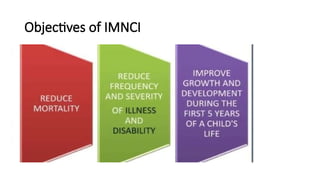
Objectives of IMNCI
IMNCI case management process
1.Assess the child illness.
2.Classify the illness based on signs.
3.Identify treatment.
4.Treat the child.
5.Counsel the caretaker.
6.Provide follow-up care.
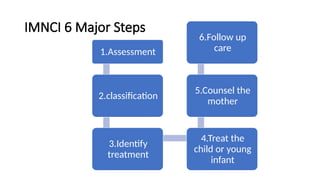
IMNCI 6 Major Steps
1.Assessment
2.classification
3.Identify
treatment
4.Treat the
child or young
infant
5.Counsel the
mother
6.Follow up
care
1.Assessment
•Routinely assess for
-general danger signs (or possible bacterial
infection in a young infant)
-common illnesses in children or young
-Look for other health problems.
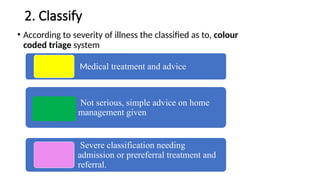
2. Classify
• According to severity of illness the classified as to, colour
coded triage system
Medical treatment and advice
Not serious, simple advice on home
management given
Severe classification needing
admission or prereferral treatment and
referral.
3.Identify treatment
•After classify the conditions the column helps to
the healthcare workers to quickly treatment for
the classification selected.
4. Treat the child or young infant
Treat means giving the treatment in the
facility prescribing drugs or other treatments
to be given at home and also teaching the
mother.
5. Counsel the mother
•If follow-up care is indicated, teach the
mother/caregiver when to return clinic.
•Also teach the mother to how to recognize
the signs indicating that the child brought
back to the facility.
6.Follow up care
Some of the children or young infants need
to be seen more than once for a current
episode of illness.
Identify such children when they are brought
back, and appropriate follow-up care as
indicated in the IMNCI guidelines.
Where can IMNCI be applied?
•The IMNCI approach is designed for use in clinical
settings at all levels of health care where children
under 5 years are managed.
•health centres
• hospitals
•national referral hospitals and
•private health facilities.
Principles of IMNCI
1. Sick children under five should be examined for signs requiring referral or
hospitalization.
2. Routine assessment includes symptoms, nutrition, immunization, feeding issues,
and potential problems.
3. A few clinical signs are used, chosen for their sensitivity and specificity.
4. Children are classified based on signs to guide treatment; classifications aren't
specific diagnoses.
5. IMNCI guidelines cover common pediatric problems, using a limited number of
essential drugs.
6. Caretakers are involved in treatment.
7. Caretakers receive counselling on home care, feeding, fluids, and when to return
to the health facility.
8. Counselling of caretakers about home care including feeding fluids, and when to
return to health facility.
Principles of IMNCI
1. All sick children under five years of age must be examined for conditions which indicate
immediate referral or hospitalization.
2. Children must be routinely assed for major symptoms, nutritional and immunization status,
feeding problems and other potential problem.
3. Only a limited number of carefully selected clinical signs, are used based on evidence of their
sensitivity and specificity to detect disease.
4. Based on the presence of selected clinical signs, the child is placed in a classifications,
classification are not specific diagnosis but categories that are used to determine the
treatment.
5. IMNCI guidelines address most common but not all pediatric problems.
6. A limited number of essential drugs are used.
7. Care takers are actively involved in the treatment of children.
8. Counselling of care takers about home care including feeding fluids, and when to return to
health facility.
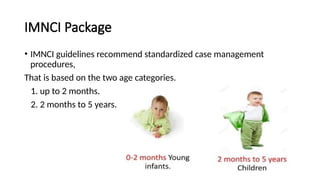
IMNCI Package
• IMNCI guidelines recommend standardized case management
procedures,
That is based on the two age categories.
1. up to 2 months.
2. 2 months to 5 years.
ASSESS THE MOTHERS /CAREGIVERS HEALTH
NEEDS
• Nutritional status and anemia, contraception.
• Check the mothers HIV status.
• Check the mothers psychological support and needs.
• Check hygienic practices,
• Check the mental status of the mother.
Advantages of IMNCI strategy
• Promotes accurate identification of childhood illness in outpatient
settings.
• Ensures appropriates combined treatment of all major childhood
illnesses.
• Strengthens the counseling of mothers or caregivers.
• Strengthens the provision of preventive and promotive services.
• Speeds up the referral of severely ill children.
• Aims to improve the quality of care of sick children at referral level.
Conclusion
Implementation of the IMNCI resulted in sustainable improvement in
infant survival and in neonatal survival in those born in home.
The IMNCI should be a part of Indians strategy to achieve the
millennium developmental goal on child survival.
 Especially with the neonatal care component ,led to a decrease in
infant and under 5 mortality rates.
IMNCI aims to reduce death, illness and disability, and to promote
improved growth and development among children under five years
of age.
IMNCI activities in countries are therefore organized
to improve health workers skills, as described in the
articles in the supplement, improvement family and
community practice.
It also described the process for adapting the
guidelines to specific country situations, and the
presents the border IMNCI strategy and the status of
its implementation in several countries.
REFERENCE
1.K. Park, text book of preventive and social medicine,21th
edition, Jabalpur,banarasidas bhanot publishers page
no .414,530,550.
2.AH Surya Kanta community medicine with recent advances.
4 th edition jp publications, page no:978-979.
3.https.www.studocu.com.
4.Parul Datta, Text book paediatric nursing second edition
Jaypee brothers’ medical publishers page no.30.
IMNCI_2024.pptx.........................

IMNCI_2024.pptx.........................

  • 1.
    Integrated Management ofNeonatal And Childhood Illness (IMNCI )
  • 2.
    Definition Integrated management ofneonatal and childhood illness(IMNCI) is, a strategy that aims to reduce morbidity and mortality in children under five years of age through  Improved case management of common childhood illnesses.  Enhanced nutrition and feeding practice.  Increased immunization coverage.  Improved newborn care. Developed by WHO and UNICEF in 1992 for management of common childhood illnesses in an integrated manner to reduce morbidity and mortality among children.
  • 3.
  • 4.
    IMNCI case managementprocess 1.Assess the child illness. 2.Classify the illness based on signs. 3.Identify treatment. 4.Treat the child. 5.Counsel the caretaker. 6.Provide follow-up care.
  • 5.
    IMNCI 6 MajorSteps 1.Assessment 2.classification 3.Identify treatment 4.Treat the child or young infant 5.Counsel the mother 6.Follow up care
  • 6.
    1.Assessment •Routinely assess for -generaldanger signs (or possible bacterial infection in a young infant) -common illnesses in children or young -Look for other health problems.
  • 7.
    2. Classify • Accordingto severity of illness the classified as to, colour coded triage system Medical treatment and advice Not serious, simple advice on home management given Severe classification needing admission or prereferral treatment and referral.
  • 8.
    3.Identify treatment •After classifythe conditions the column helps to the healthcare workers to quickly treatment for the classification selected.
  • 9.
    4. Treat thechild or young infant Treat means giving the treatment in the facility prescribing drugs or other treatments to be given at home and also teaching the mother.
  • 10.
    5. Counsel themother •If follow-up care is indicated, teach the mother/caregiver when to return clinic. •Also teach the mother to how to recognize the signs indicating that the child brought back to the facility.
  • 11.
    6.Follow up care Someof the children or young infants need to be seen more than once for a current episode of illness. Identify such children when they are brought back, and appropriate follow-up care as indicated in the IMNCI guidelines.
  • 12.
    Where can IMNCIbe applied? •The IMNCI approach is designed for use in clinical settings at all levels of health care where children under 5 years are managed. •health centres • hospitals •national referral hospitals and •private health facilities.
  • 13.
    Principles of IMNCI 1.Sick children under five should be examined for signs requiring referral or hospitalization. 2. Routine assessment includes symptoms, nutrition, immunization, feeding issues, and potential problems. 3. A few clinical signs are used, chosen for their sensitivity and specificity. 4. Children are classified based on signs to guide treatment; classifications aren't specific diagnoses. 5. IMNCI guidelines cover common pediatric problems, using a limited number of essential drugs. 6. Caretakers are involved in treatment. 7. Caretakers receive counselling on home care, feeding, fluids, and when to return to the health facility. 8. Counselling of caretakers about home care including feeding fluids, and when to return to health facility.
  • 14.
    Principles of IMNCI 1.All sick children under five years of age must be examined for conditions which indicate immediate referral or hospitalization. 2. Children must be routinely assed for major symptoms, nutritional and immunization status, feeding problems and other potential problem. 3. Only a limited number of carefully selected clinical signs, are used based on evidence of their sensitivity and specificity to detect disease. 4. Based on the presence of selected clinical signs, the child is placed in a classifications, classification are not specific diagnosis but categories that are used to determine the treatment. 5. IMNCI guidelines address most common but not all pediatric problems. 6. A limited number of essential drugs are used. 7. Care takers are actively involved in the treatment of children. 8. Counselling of care takers about home care including feeding fluids, and when to return to health facility.
  • 15.
    IMNCI Package • IMNCIguidelines recommend standardized case management procedures, That is based on the two age categories. 1. up to 2 months. 2. 2 months to 5 years.
  • 16.
    ASSESS THE MOTHERS/CAREGIVERS HEALTH NEEDS • Nutritional status and anemia, contraception. • Check the mothers HIV status. • Check the mothers psychological support and needs. • Check hygienic practices, • Check the mental status of the mother.
  • 17.
    Advantages of IMNCIstrategy • Promotes accurate identification of childhood illness in outpatient settings. • Ensures appropriates combined treatment of all major childhood illnesses. • Strengthens the counseling of mothers or caregivers. • Strengthens the provision of preventive and promotive services. • Speeds up the referral of severely ill children. • Aims to improve the quality of care of sick children at referral level.
  • 18.
    Conclusion Implementation of theIMNCI resulted in sustainable improvement in infant survival and in neonatal survival in those born in home. The IMNCI should be a part of Indians strategy to achieve the millennium developmental goal on child survival.  Especially with the neonatal care component ,led to a decrease in infant and under 5 mortality rates. IMNCI aims to reduce death, illness and disability, and to promote improved growth and development among children under five years of age.
  • 19.
    IMNCI activities incountries are therefore organized to improve health workers skills, as described in the articles in the supplement, improvement family and community practice. It also described the process for adapting the guidelines to specific country situations, and the presents the border IMNCI strategy and the status of its implementation in several countries.
  • 20.
    REFERENCE 1.K. Park, textbook of preventive and social medicine,21th edition, Jabalpur,banarasidas bhanot publishers page no .414,530,550. 2.AH Surya Kanta community medicine with recent advances. 4 th edition jp publications, page no:978-979. 3.https.www.studocu.com. 4.Parul Datta, Text book paediatric nursing second edition Jaypee brothers’ medical publishers page no.30.