1
Copyright ® 2012, Glen B. Alleman, All Rights Reserved


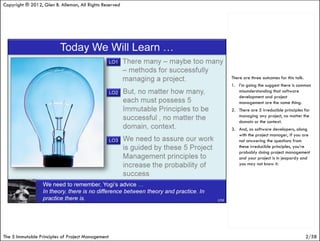
                                                         There are three outcomes for this talk.
                                                         1. I’m going the suggest there is common
                                                            misunderstanding that software
                                                            development and project
                                                            management are the same thing.
                                                         2. There are 5 irreducible principles for
                                                            managing any project, no matter the
                                                            domain or the context.
                                                         3. And, as software developers, along
                                                            with the project manager, if you are
                                                            not answering the questions from
                                                            these irreducible principles, you’re
                                                            probably doing project management
                                                            and your project is in jeopardy and
                                                            you may not know it.


The 5 Immutable Principles of Project Management                                                   2/58
Copyright ® 2012, Glen B. Alleman, All Rights Reserved


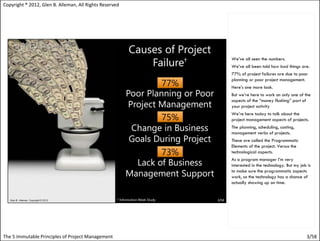
                                                         We’ve all seen the numbers.
                                                         We’ve all been told how bad things are.
                                                         77% of project failures are due to poor
                                                         planning or poor project management.
                                                         Here’s one more look.
                                                         But we’re here to work on only one of the
                                                         aspects of the “money flushing” part of
                                                         your project activity
                                                         We’re here today to talk about the
                                                         project management aspects of projects.
                                                         The planning, scheduling, costing,
                                                         management verbs of projects.
                                                         These are called the Programmatic
                                                         Elements of the project. Versus the
                                                         technological aspects.
                                                         As a program manager I’m very
                                                         interested in the technology. But my job is
                                                         to make sure the programmatic aspects
                                                         work, so the technology has a chance of
                                                         actually showing up on time.


The 5 Immutable Principles of Project Management                                                 3/58
Copyright ® 2012, Glen B. Alleman, All Rights Reserved


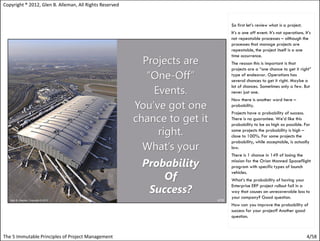
                                                         So first let’s review what is a project.
                                                         It’s a one off event. It’s not operations. It’s
                                                         not repeatable processes – although the
                                                         processes that manage projects are
                                                         repeatable, the project itself is a one
                                                         time occurrence.
                                                         The reason this is important is that
                                                         projects are a “one chance to get it right”
                                                         type of endeavor. Operations has
                                                         several chances to get it right. Maybe a
                                                         lot of chances. Sometimes only a few. But
                                                         never just one.
                                                         Now there is another word here –
                                                         probability.
                                                         Projects have a probability of success.
                                                         There is no guarantee. We’d like this
                                                         probability to be as high as possible. For
                                                         some projects the probability is high –
                                                         close to 100%. For some projects the
                                                         probability, while acceptable, is actually
                                                         low.
                                                         There is 1 chance in 149 of losing the
                                                         mission for the Orion Manned Spaceflight
                                                         program with specific types of launch
                                                         vehicles.
                                                         What’s the probability of having your
                                                         Enterprise ERP project rollout fail in a
                                                         way that causes an unrecoverable loss to
                                                         your company? Good question.
                                                         How can you improve the probability of
                                                         success for your project? Another good
                                                         question.


The 5 Immutable Principles of Project Management                                                     4/58
Copyright ® 2012, Glen B. Alleman, All Rights Reserved


                                                         Mr. Blaise’s quote is applicable to almost
                                                         every major project we’ve encountered.
                                                         It’s sad but true that we simply don’t
                                                         know how to stop work once we’ve
                                                         started.
                                                         The work shop today is not about that
                                                         decision though.
                                                         It’s about applying the principles of
                                                         project management, so we don’t have to
                                                         treat projects in such a “black and white”
                                                         manner.


The 5 Immutable Principles of Project Management                                                  5/58
Copyright ® 2012, Glen B. Alleman, All Rights Reserved


                                                         No matter what type of project you work,
                                                         no matter what the domain, no matter
                                                         what project management method you
                                                         use, you must be capable of managing
                                                         the work in the presence of change.
                                                         It is not possible to manage change, you
                                                         must manage in the presence of change.
                                                         Change is everywhere, it is constant, and
                                                         it is simply part of the environment of
                                                         project work.
                                                         The Five Immutable Principles we’ll speak
                                                         to today will provide you with the tools to
                                                         manage in the presence of change.


                                                                                                 6/58
Copyright ® 2012, Glen B. Alleman, All Rights Reserved


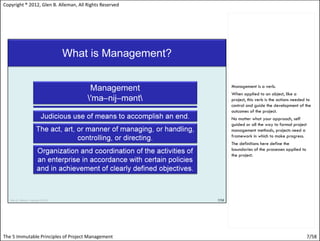
                                                         Management is a verb.
                                                         When applied to an object, like a
                                                         project, this verb is the actions needed to
                                                         control and guide the development of the
                                                         outcomes of the project.
                                                         No matter what your approach, self
                                                         guided or all the way to formal project
                                                         management methods, projects need a
                                                         framework in which to make progress.
                                                         The definitions here define the
                                                         boundaries of the processes applied to
                                                         the project.


The 5 Immutable Principles of Project Management                                                   7/58
Copyright ® 2012, Glen B. Alleman, All Rights Reserved


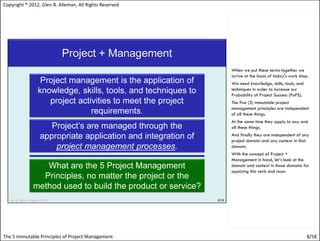
                                                         When we put these terms together we
                                                         arrive at the basis of today's work shop.
                                                         We need knowledge, skills, tools, and
                                                         techniques in order to increase our
                                                         Probability of Project Success (PoPS).
                                                         The five (5) immutable project
                                                         management principles are independent
                                                         of all these things.
                                                         At the same time they apply to any and
                                                         all these things.
                                                         And finally they are independent of any
                                                         project domain and any context in that
                                                         domain.
                                                         With the concept of Project +
                                                         Management in hand, let’s look at the
                                                         domain and context in those domains for
                                                         applying this verb and noun.


The 5 Immutable Principles of Project Management                                                  8/58
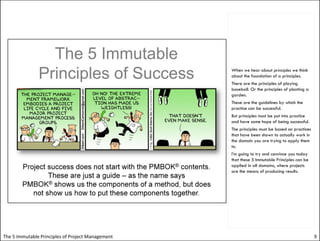
When we hear about principles we think
                                                   about the foundation of a principles.
                                                   There are the principles of playing
                                                   baseball. Or the principles of planting a
                                                   garden.
                                                   These are the guidelines by which the
                                                   practice can be successful.
                                                   But principles must be put into practice
                                                   and have some hope of being successful.
                                                   The principles must be based on practices
                                                   that have been shown to actually work in
                                                   the domain you are trying to apply them
                                                   to.
                                                   I’m going to try and convince you today
                                                   that these 5 Immutable Principles can be
                                                   applied in all domains, where projects
                                                   are the means of producing results.


The 5 Immutable Principles of Project Management                                               9
Copyright ® 2012, Glen B. Alleman, All Rights Reserved


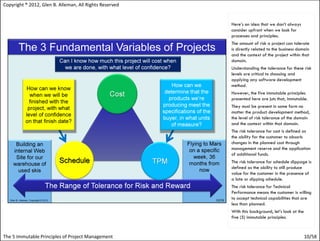
                                                         Here’s an idea that we don’t always
                                                         consider upfront when we look for
                                                         processes and principles.
                                                         The amount of risk a project can tolerate
                                                         is directly related to the business domain
                                                         and the context of the project within that
                                                         domain.
                                                         Understanding the tolerance for these risk
                                                         levels are critical to choosing and
                                                         applying any software development
                                                         method.
                                                         However, the five immutable principles
                                                         presented here are juts that, immutable.
                                                         They must be present in some form no
                                                         matter the product development method,
                                                         the level of risk tolerance of the domain
                                                         and the context within that domain.
                                                         The risk tolerance for cost is defined as
                                                         the ability for the customer to absorb
                                                         changes in the planned cost through
                                                         management reserve and the application
                                                         of additional funds.
                                                         The risk tolerance for schedule slippage is
                                                         defined as the ability to still produce
                                                         value for the customer in the presence of
                                                         a late or slipping schedule.
                                                         The risk tolerance for Technical
                                                         Performance means the customer is willing
                                                         to accept technical capabilities that are
                                                         less than planned.
                                                         With this background, let’s look at the
                                                         five (5) immutable principles.


The 5 Immutable Principles of Project Management                                                   10/58
Copyright ® 2012, Glen B. Alleman, All Rights Reserved


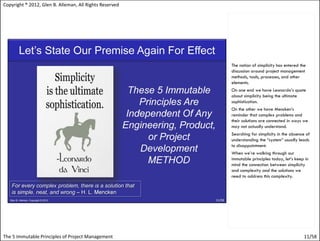
                                                         The notion of simplicity has entered the
                                                         discussion around project management
                                                         methods, tools, processes, and other
                                                         elements.
                                                         On one end we have Leonardo’s quote
                                                         about simplicity being the ultimate
                                                         sophistication.
                                                         On the other we have Mencken’s
                                                         reminder that complex problems and
                                                         their solutions are connected in ways we
                                                         may not actually understand.
                                                         Searching for simplicity in the absence of
                                                         understanding the “system” usually leads
                                                         to disappointment.
                                                         When we’re walking through our
                                                         immutable principles today, let’s keep in
                                                         mind the connection between simplicity
                                                         and complexity and the solutions we
                                                         need to address this complexity.


The 5 Immutable Principles of Project Management                                                11/58
Copyright ® 2012, Glen B. Alleman, All Rights Reserved


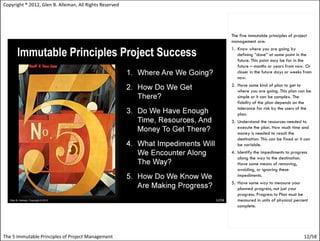
                                                         The five immutable principles of project
                                                         management are:
                                                         1. Know where you are going by
                                                            defining “done” at some point in the
                                                            future. This point may be far in the
                                                            future – months or years from now. Or
                                                            closer in the future days or weeks from
                                                            now.
                                                         2. Have some kind of plan to get to
                                                            where you are going. This plan can be
                                                            simple or it can be complex. The
                                                            fidelity of the plan depends on the
                                                            tolerance for risk by the users of the
                                                            plan.
                                                         3. Understand the resources needed to
                                                            execute the plan. How much time and
                                                            money is needed to reach the
                                                            destination. This can be fixed or it can
                                                            be variable.
                                                         4. Identify the impediments to progress
                                                            along the way to the destination.
                                                            Have some means of removing,
                                                            avoiding, or ignoring these
                                                            impediments.
                                                         5. Have some way to measure your
                                                            planned progress, not just your
                                                            progress. Progress to Plan must be
                                                            measured in units of physical percent
                                                            complete.


The 5 Immutable Principles of Project Management                                                12/58
Copyright ® 2012, Glen B. Alleman, All Rights Reserved


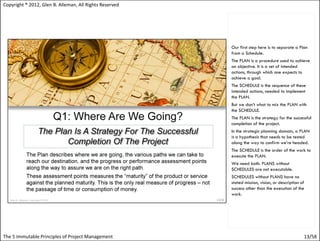
                                                         Our first step here is to separate a Plan
                                                         from a Schedule.
                                                         The PLAN is a procedure used to achieve
                                                         an objective. It is a set of intended
                                                         actions, through which one expects to
                                                         achieve a goal.
                                                         The SCHEDULE is the sequence of these
                                                         intended actions, needed to implement
                                                         the PLAN.
                                                         But we don’t what to mix the PLAN with
                                                         the SCHEDULE.
                                                         The PLAN is the strategy for the successful
                                                         completion of the project.
                                                         In the strategic planning domain, a PLAN
                                                         is a hypothesis that needs to be tested
                                                         along the way to confirm we’re headed.
                                                         The SCHEDULE is the order of the work to
                                                         execute the PLAN.
                                                         We need both. PLANS without
                                                         SCHEDULES are not executable.
                                                         SCHEDULES without PLANS have no
                                                         stated mission, vision, or description of
                                                         success other than the execution of the
                                                         work.


The 5 Immutable Principles of Project Management                                                 13/58
Copyright ® 2012, Glen B. Alleman, All Rights Reserved


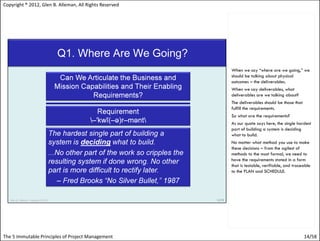
                                                         When we say “where are we going,” we
                                                         should be talking about physical
                                                         outcomes – the deliverables.
                                                         When we say deliverables, what
                                                         deliverables are we talking about?
                                                         The deliverables should be those that
                                                         fulfill the requirements.
                                                         So what are the requirements?
                                                         As our quote says here, the single hardest
                                                         part of building a system is deciding
                                                         what to build.
                                                         No matter what method you use to make
                                                         these decisions – from the agilest of
                                                         methods to the most formal, we need to
                                                         have the requirements stated in a form
                                                         that is testable, verifiable, and traceable
                                                         to the PLAN and SCHEDULE.


The 5 Immutable Principles of Project Management                                                 14/58
Copyright ® 2012, Glen B. Alleman, All Rights Reserved


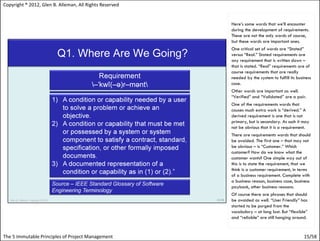
                                                         Here’s some words that we’ll encounter
                                                         during the development of requirements.
                                                         These are not the only words of course,
                                                         but these words are important ones.
                                                         One critical set of words are “Stated”
                                                         versus “Real.” Stated requirements are
                                                         any requirement that is written down –
                                                         that is stated. “Real” requirements are of
                                                         course requirements that are really
                                                         needed by the system to fulfill its business
                                                         case.
                                                         Other words are important as well.
                                                         “Verified” and “Validated” are a pair.
                                                         One of the requirements words that
                                                         causes much extra work is “derived.” A
                                                         derived requirement is one that is not
                                                         primary, but is secondary. As such it may
                                                         not be obvious that it is a requirement.
                                                         There are requirements words that should
                                                         be avoided. The first one – that may not
                                                         be obvious – is “Customer.” Which
                                                         customer? How do we know what the
                                                         customer wants? One simple way out of
                                                         this is to state the requirement, that we
                                                         think is a customer requirement, in terms
                                                         of a business requirement. Complete with
                                                         a business reason, business case, business
                                                         payback, other business reasons.
                                                         Of course there are phrases that should
                                                         be avoided as well. “User Friendly” has
                                                         started to be purged from the
                                                         vocabulary – at long last. But “flexible”
                                                         and “reliable” are still hanging around.


The 5 Immutable Principles of Project Management                                                 15/58
Copyright ® 2012, Glen B. Alleman, All Rights Reserved


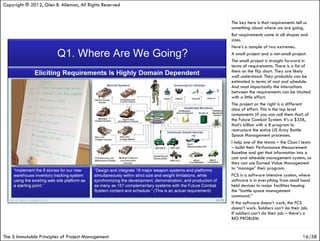
                                                         The key here is that requirements tell us
                                                         something about where we are going.
                                                         But requirements come in all shapes and
                                                         sizes.
                                                         Here’s a sample of two extremes.
                                                         A small project and a not-small project.
                                                         The small project is straight forward in
                                                         terms of requirements. There is a list of
                                                         them on the flip chart. They are likely
                                                         well understood. They probably can be
                                                         estimated in terms of cost and schedule.
                                                         And most importantly the interactions
                                                         between the requirements can be intuited
                                                         with a little effort.
                                                         The project on the right is a different
                                                         class of effort. This is the top level
                                                         components (if you can call them that) of
                                                         the Future Combat System. It’s a $35B,
                                                         that’s billion with a B program to
                                                         restructure the entire US Army Battle
                                                         Space Management processes.
                                                         I help one of the teams – the Class I team
                                                         – build their Performance Measurement
                                                         Baseline and get that information into a
                                                         cost and schedule management system, so
                                                         they can use Earned Value Management
                                                         to “manage” their program.
                                                         FCS is a software intensive system, where
                                                         software is in everything from small hand
                                                         held devices to major facilities housing
                                                         the “battle space management
                                                         command.”
                                                         If the software doesn’t work, the FCS
                                                         doesn’t work. Soldiers can’t do their job.
                                                         If soldiers can’t do their job – there’s a
                                                         BIG PROBLEM.


The 5 Immutable Principles of Project Management                                              16/58
Copyright ® 2012, Glen B. Alleman, All Rights Reserved


                                                         For the moment, let’s use a simpler
                                                         analogy to connect with something more
                                                         tangible.
                                                         Let’s pretend we want to go on a hike. A
                                                         nice hike to the saddle just to the right of
                                                         the peak above this lake. That saddle is
                                                         Pawnee Pass. It’s just west of Boulder
                                                         Colorado, and a bit south of Rocky
                                                         Mountain National Park.
                                                         We’d like to go to Pawnee Pass in a
                                                         single day – there and back. Not get too
                                                         wet if it rains. Not be too hungry. And
                                                         have a good time along the way with our
                                                         hiking group.
                                                         That’s our mission.


The 5 Immutable Principles of Project Management                                                 17/58
Copyright ® 2012, Glen B. Alleman, All Rights Reserved


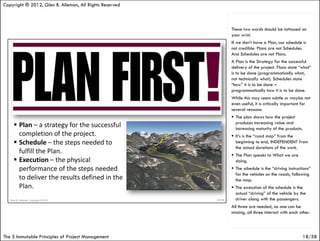
                                                         These two words should be tattooed on
                                                         your wrist.
                                                         If we don’t have a Plan, our schedule is
                                                         not credible. Plans are not Schedules.
                                                         And Schedules are not Plans.
                                                         A Plan is the Strategy for the successful
                                                         delivery of the project. Plans state “what”
                                                         is to be done (programmatically what,
                                                         not technically what). Schedules state
                                                         “how” it is to be done –
                                                         programmatically how it is to be done.
                                                         While this may seem subtle or maybe not
                                                         even useful, it is critically important for
                                                         several reasons:
                                                          The plan shows how the project
                                                           produces increasing value and
                                                           increasing maturity of the products.
                                                          It’s is the “road map” from the
                                                           beginning to end, INDEPENDENT from
                                                           the actual durations of the work.
                                                          The Plan speaks to What we are
                                                           doing.
                                                          The schedule is the “driving instructions”
                                                           for the vehicles on the roads, following
                                                           the map.
                                                          The execution of the schedule is the
                                                           actual “driving” of the vehicle by the
                                                           driver along with the passengers.
                                                         All three are needed, no one can be
                                                         missing, all three interact with each other.


The 5 Immutable Principles of Project Management                                                18/58
Copyright ® 2012, Glen B. Alleman, All Rights Reserved
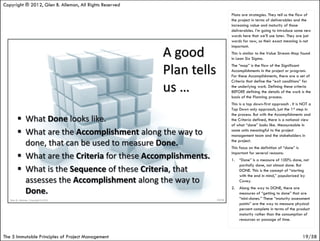
                                                         Plans are strategies. They tell us the flow of
                                                         the project in terms of deliverables and the
                                                         increasing value and maturity of those
                                                         deliverables. I’m going to introduce some new
                                                         words here that we’ll use later. They are just
                                                         words for now, so their exact meaning is not
                                                         important.
                                                         This is similar to the Value Stream Map found
                                                         in Lean Six Sigma.
                                                         The “map” is the flow of the Significant
                                                         Accomplishments in the project or program.
                                                         For these Accomplishments, there are a set of
                                                         Criteria that define the “exit conditions” for
                                                         the underlying work. Defining these criteria
                                                         BEFORE defining the details of the work is the
                                                         basis of the Planning process.
                                                         This is a top down-first approach . It is NOT a
                                                         Top Down only approach, just the 1st step in
                                                         the process. But with the Accomplishments and
                                                         the Criteria defined, there is a notional view
                                                         of what “done” looks like. Measureable in
                                                         some units meaningful to the project
                                                         management team and the stakeholders in
                                                         the project.
                                                         This focus on the definition of “done” is
                                                         important for several reasons:
                                                         1.   “Done” is a measure of 100% done, not
                                                              partially done, not almost done. But
                                                              DONE. This is the concept of “starting
                                                              with the end in mind,” popularized by
                                                              Covey.
                                                         2.   Along the way to DONE, there are
                                                              measures of “getting to done” that are
                                                              “mini-dones.” These “maturity assessment
                                                              points” are the way to measure physical
                                                              percent complete in terms of the product
                                                              maturity rather than the consumption of
                                                              resources or passage of time.


The 5 Immutable Principles of Project Management                                                     19/58
Copyright ® 2012, Glen B. Alleman, All Rights Reserved


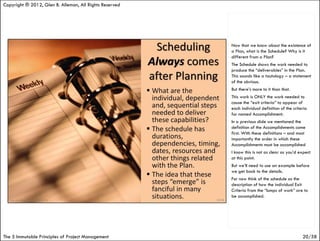
                                                         Now that we know about the existence of
                                                         a Plan, what is the Schedule? Why is it
                                                         different from a Plan?
                                                         The Schedule shows the work needed to
                                                         produce the “deliverables” in the Plan.
                                                         This sounds like a tautology – a statement
                                                         of the obvious.
                                                         But there’s more to it than that.
                                                         This work is ONLY the work needed to
                                                         cause the “exit criteria” to appear of
                                                         each individual definition of the criteria
                                                         for named Accomplishment.
                                                         In a previous slide we mentioned the
                                                         definition of the Accomplishments come
                                                         first. With these definitions – and most
                                                         importantly the order in which these
                                                         Accomplishments must be accomplished
                                                         I know this is not as clear as you’d expect
                                                         at this point.
                                                         But we’ll need to use an example before
                                                         we get back to the details.
                                                         For now think of the schedule as the
                                                         description of how the individual Exit
                                                         Criteria from the “lumps of work” are to
                                                         be accomplished.


The 5 Immutable Principles of Project Management                                                20/58
Copyright ® 2012, Glen B. Alleman, All Rights Reserved


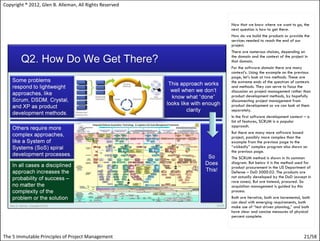
                                                         Now that we know where we want to go, the
                                                         next question is how to get there.
                                                         How do we build the products or provide the
                                                         services needed to reach the end of our
                                                         project.
                                                         There are numerous choices, depending on
                                                         the domain and the context of the project in
                                                         that domain.
                                                         For the software domain there are many
                                                         context’s. Using the example on the previous
                                                         page, let’s look at two methods. These are
                                                         the extreme ends of the spectrum of contexts
                                                         and methods. They can serve to focus the
                                                         discussion on project management rather than
                                                         product development methods, by hopefully
                                                         disconnecting project management from
                                                         product development so we can look at them
                                                         separately.
                                                         In the first software development context – a
                                                         list of features, SCRUM is a popular
                                                         approach.
                                                         But there are many more software based
                                                         project, possibly more complex than the
                                                         example from the previous page to the
                                                         “wickedly” complex program also shown on
                                                         the previous page.
                                                         The SCRUM method is shown in its common
                                                         diagram. But below it is the method used for
                                                         product procurement in the US Department of
                                                         Defense – DoD 5000.02. The products are
                                                         not actually developed by the DoD (except in
                                                         rare cases). But are instead, procured. So
                                                         acquisition management is guided by this
                                                         process.
                                                         Both are iterative, both are incremental, both
                                                         can deal with emerging requirements, both
                                                         make use of “test driven planning,” and both
                                                         have clear and concise measures of physical
                                                         percent complete.


The 5 Immutable Principles of Project Management                                                  21/58
Copyright ® 2012, Glen B. Alleman, All Rights Reserved


                                                         Now that we know some things about
                                                         what capabilities we need and how we
                                                         might cause these capabilities to appear
                                                         at the appointed time and place for the
                                                         planned cost and schedule, do we know
                                                         what we need to be successful?
                                                         We need to constantly ask this question.
                                                         If we don’t ask and answer the question,
                                                         we’ll find out what is missing when they
                                                         arrive on our doorstep.
                                                         At that point it will be too late. It is not
                                                         too late to acquire them, but too late to
                                                         acquire them within our planned schedule
                                                         and planned budget.


The 5 Immutable Principles of Project Management                                                22/58
Copyright ® 2012, Glen B. Alleman, All Rights Reserved


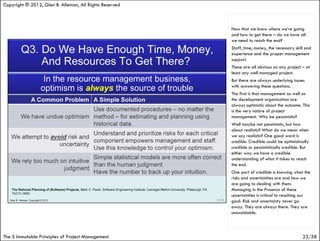
                                                         Now that we know where we’re going
                                                         and how to get there – do we have all
                                                         we need to reach the end?
                                                         Staff, time, money, the necessary skill and
                                                         experience and the proper management
                                                         support.
                                                         These are all obvious on any project – at
                                                         least any well managed project.
                                                         But there are always underlying issues
                                                         with answering these questions.
                                                         The first is that management as well as
                                                         the development organization are
                                                         always optimistic about the outcome. This
                                                         is the very nature of project
                                                         management. Why be pessimistic?
                                                         Well maybe not pessimistic, but how
                                                         about realistic? What do we mean when
                                                         we say realistic? One good word is
                                                         credible. Credible could be optimistically
                                                         credible or pessimistically credible. But
                                                         either way we have a credible
                                                         understanding of what it takes to reach
                                                         the end.
                                                         One part of credible is knowing what the
                                                         risks and uncertainties are and how we
                                                         are going to dealing with them.
                                                         Managing in the Presence of these
                                                         uncertainties is critical to reaching our
                                                         goal. Risk and uncertainty never go
                                                         away. They are always there. They are
                                                         unavoidable.


The 5 Immutable Principles of Project Management                                               23/58
Copyright ® 2012, Glen B. Alleman, All Rights Reserved


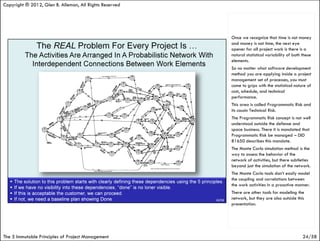
                                                         Once we recognize that time is not money
                                                         and money is not time, the next eye
                                                         opener for all project work is there is a
                                                         natural statistical variability of both these
                                                         elements.
                                                         So no matter what software development
                                                         method you are applying inside a project
                                                         management set of processes, you must
                                                         come to grips with the statistical nature of
                                                         cost, schedule, and technical
                                                         performance.
                                                         This area is called Programmatic Risk and
                                                         its cousin Technical Risk.
                                                         The Programmatic Risk concept is not well
                                                         understood outside the defense and
                                                         space business. There it is mandated that
                                                         Programmatic Risk be managed – DID
                                                         81650 describes this mandate.
                                                         The Monte Carlo simulation method is the
                                                         way to assess the behavior of the
                                                         network of activities, but there subtleties
                                                         beyond just the simulation of the network.
                                                         The Monte Carlo tools don’t easily model
                                                         the coupling and correlations between
                                                         the work activities in a proactive manner.
                                                         There are other tools for modeling the
                                                         network, but they are also outside this
                                                         presentation.


The 5 Immutable Principles of Project Management                                                 24/58
Copyright ® 2012, Glen B. Alleman, All Rights Reserved


                                                         Project Managers constantly seek ways to
                                                         eliminate or control risk, variance, and
                                                         uncertainty. This is a hopeless pursuit.
                                                         Managing “in the presence” of risk,
                                                         variance and uncertainty is the key to
                                                         success. Some projects have few
                                                         uncertainties –only the complexity of
                                                         tasks and relationships is important – but
                                                         most projects are characterized by
                                                         several types of uncertainty.
                                                         Although each uncertainty type is distinct,
                                                         a single project may encounter some
                                                         combination of four types:
                                                         1. Variation – comes from many small
                                                            influences and yields a range of
                                                            values on a particular activity.
                                                            Attempting to control these variances
                                                            outside their natural boundaries is a
                                                            waste (Muda).
                                                         2. Foreseen Uncertainty – are
                                                            uncertainties identifiable and
                                                            understood influences that the team
                                                            cannot be sure will occur. There needs
                                                            to be a mitigation plan for these
                                                            foreseen uncertainties.
                                                         3. Unforeseen Uncertainty – is uncertainty
                                                            that can’t be identified during project
                                                            planning. When these occur, a new
                                                            plan is needed.
                                                         4. Chaos – appears in the presence of
                                                            “unknown unknowns.”
                                                         “Managing Project Uncertainty: From
                                                         Variation to Chaos,” Arnoud De Meyer,
                                                         Christoph H. Loch and Michael T. Pich, MIT
                                                         Sloan Management Review, Winter
                                                         2000.


The 5 Immutable Principles of Project Management                                               25/58
Copyright ® 2012, Glen B. Alleman, All Rights Reserved


                                                         Project duration and costs are random
                                                         variables drawn from some underlying
                                                         probability distribution.
                                                         In probability theory, every random
                                                         variable is attributed to a probability
                                                         distribution.
                                                         The probability distribution associated
                                                         with a cost or duration describes the
                                                         variance of these random variables.
                                                         A common distribution of probabilistic
                                                         estimates for cost and schedule random
                                                         variables is the Triangle Distribution.
                                                         Using the Triangle Distribution for the
                                                         costs and durations, a Monte Carlo
                                                         simulation of the network of activities and
                                                         their costs can be performed.
                                                            Monte Carlo methods are used to
                                                            numerically transform and integrate
                                                            the posterior quantitative risk
                                                            assessment into a confidence interval.
                                                         The result is a “confidence” model for the
                                                         cost and completion times for the project
                                                         based on the upper and lower bounds of
                                                         each distribution assigned to each
                                                         duration and cost.


The 5 Immutable Principles of Project Management                                               26/58
Copyright ® 2012, Glen B. Alleman, All Rights Reserved

                                                         If risk management is how adults manage
                                                         projects, here are some principles of
                                                         project risk management.
                                                         These five principles are simple, obvious,
                                                         but difficult to implement. This reason
                                                         they’re difficult is that most people shy
                                                         away from risk. Managing in the
                                                         presence of risk does not come naturally.
                                                         It is a learned behavior. And once
                                                         learned it has to be practiced. But before
                                                         it can be learned and then practiced,
                                                         “managing in the presence of risk,” must
                                                         become part of the business culture.
                                                         Some cultures doe this better than others.
                                                         NASA is probably better than others. But
                                                         even NASA has moved a risk adverse
                                                         culture in the past decades.
                                                         1. Hoping that something positive will
                                                               result is not a very good strategy.
                                                               Preparing for success is the basis of
                                                               success.
                                                         2. Single point estimates are no better
                                                               than 50/50 guesses in the absence of
                                                               knowledge of the standard deviation
                                                               of the underlying distribution.
                                                         3. Without connecting cost, schedule,
                                                               and technical performance of the
                                                               effort to produce the product or
                                                               service, the connection to value
                                                               cannot be made.
                                                         4. Risk management is not an ad hoc
                                                               process that you can make up as you
                                                               go. A formal foundation for risk
                                                               management is needed.
                                                         5. Identifying risks without
                                                               communicating them is a waste of
                                                               time.


The 5 Immutable Principles of Project Management                                               27/58
Copyright ® 2012, Glen B. Alleman, All Rights Reserved

                                                         Project Managers constantly seek ways to
                                                         eliminate or control risk, variance and
                                                         uncertainly. This is a hopeless pursuit.
                                                         Managing “in the presence” of risk,
                                                         variance and uncertainty is the key to
                                                         success. Some projects have few
                                                         uncertainties –only the complexity of
                                                         tasks and relationships is important – but
                                                         most projects are characterized by
                                                         several types of uncertainty. Although
                                                         each uncertainty type is distinct, a single
                                                         project may encounter some combination
                                                         of four types:
                                                         1. Variation – comes from many small
                                                            influences and yields a range of
                                                            values on a particular activity.
                                                            Attempting to control these variances
                                                            outside their natural boundaries is a
                                                            waste (Muda).
                                                         2. Foreseen Uncertainty – are
                                                            uncertainties identifiable and
                                                            understood influences that the team
                                                            cannot be sure will occur. There needs
                                                            to be a mitigation plan for these
                                                            foreseen uncertainties.
                                                         3. Unforeseen Uncertainty – is uncertainty
                                                            that can’t be identified during project
                                                            planning. When these occur, a new
                                                            plan is needed.
                                                         4. Chaos – appears in the presence of
                                                            “unknown unknowns.”
                                                         “Managing Project Uncertainty: From
                                                         Variation to Chaos,” Arnoud De Meyer,
                                                         Christoph H. Loch and Michael T. Pich, MIT
                                                         Sloan Management Review, Winter
                                                         2000.


The 5 Immutable Principles of Project Management                                               28/58
Copyright ® 2012, Glen B. Alleman, All Rights Reserved

                                                         The use of point estimates for durations
                                                         and costs is many times the first impulse in
                                                         an organization low on the project
                                                         management maturity scale.
                                                         Understanding cost and durations are
                                                         actually “random variables,” drawn from
                                                         an underlying distribution of possible
                                                         value is the starting point for managing in
                                                         the presence of uncertainty.
                                                         The Triangle Distribution is used as a
                                                         subjective description of a population for
                                                         which there is only limited sample data,
                                                         and especially where the relationship
                                                         between variables is known but data is
                                                         scarce. It is based on the knowledge of
                                                         the minimum and maximum and a “best
                                                         guess” of the modal value (the Most
                                                         Likely).
                                                         Using the Triangle Distribution for the
                                                         costs and durations, a Monte Carlo
                                                         simulation of the network of activities and
                                                         their costs can be performed. Monte
                                                         Carlo methods are used to numerically
                                                         transform and integrate the posterior
                                                         quantitative risk assessment into a
                                                         confidence interval. The result is a
                                                         “confidence” model for the cost and
                                                         completion times for the project based on
                                                         the upper and lower bounds of each
                                                         distribution assigned to each duration
                                                         and cost.
                                                         This approach to estimating provides
                                                         insight into the behavior of the plan as
                                                         well as sensitivity between the individual
                                                         elements of the plan.


The 5 Immutable Principles of Project Management                                                29/58
Copyright ® 2012, Glen B. Alleman, All Rights Reserved


                                                         In many descriptions of project
                                                         management – cost, schedule, and quality
                                                         are considered as the “Iron Triangle.”
                                                         Change one and the other two must
                                                         change as well. It turns out this is too
                                                         narrow a view of what's happening on a
                                                         project.
                                                         It’s the Technical Performance
                                                         Measurement that replaces Quality.
                                                         Quality is one of the Technical
                                                         Performance measures.
                                                         Technical Performance Measures describe
                                                         the status of technical achievement of the
                                                         project at any point in time.
                                                         The Planned technical achievement is part
                                                         of the Performance Measurement
                                                         Baseline (PMB) in the same way the
                                                         Planned Value (BCWS) is part of the
                                                         PMB.
                                                         The TPMs use the techniques of risk
                                                         analysis and probability to give program
                                                         managers the early warning needed to
                                                         avoid unplanned costs and slippage in
                                                         schedule. Systems engineering uses
                                                         technical performance measurements to
                                                         balance cost, schedule, and performance
                                                         throughout the life cycle.
                                                         TPMs compare actual versus planned
                                                         technical development and design. They
                                                         also report the degree to which system
                                                         requirements are met in terms of
                                                         performance, cost, schedule, and
                                                         progress in implementing risk handling.


The 5 Immutable Principles of Project Management                                               30/58
Copyright ® 2012, Glen B. Alleman, All Rights Reserved


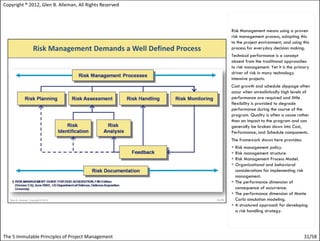
                                                         Risk Management means using a proven
                                                         risk management process, adapting this
                                                         to the project environment, and using this
                                                         process for everyday decision making.
                                                         Technical performance is a concept
                                                         absent from the traditional approaches
                                                         to risk management. Yet it is the primary
                                                         driver of risk in many technology
                                                         intensive projects.
                                                         Cost growth and schedule slippage often
                                                         occur when unrealistically high levels of
                                                         performance are required and little
                                                         flexibility is provided to degrade
                                                         performance during the course of the
                                                         program. Quality is often a cause rather
                                                         than an impact to the program and can
                                                         generally be broken down into Cost,
                                                         Performance, and Schedule components.
                                                         The framework shown here provides:
                                                          Risk management policy.
                                                          Risk management structure.
                                                          Risk Management Process Model.
                                                          Organizational and behavioral
                                                           considerations for implementing risk
                                                           management.
                                                          The performance dimension of
                                                           consequence of occurrence.
                                                          The performance dimension of Monte
                                                           Carlo simulation modeling.
                                                          A structured approach for developing
                                                           a risk handling strategy.


The 5 Immutable Principles of Project Management                                                31/58
Copyright ® 2012, Glen B. Alleman, All Rights Reserved


                                                         It does no good to manage risks if the
                                                         results are not communicated to all the
                                                         participants.
                                                         Risk communication is the basis of risk
                                                         mitigation.
                                                         This plan needs to address the following:
                                                          Executive summary – a simple summary
                                                           of the program and the risks
                                                           associated with the activities of the
                                                           program. Each risk needs an ordinal
                                                           rank, a planned mitigation if the risk is
                                                           active (a risk approved by the Risk
                                                           Board), and the mitigations shown in
                                                           the schedule with associated costs.
                                                          Program description – a detailed
                                                           description of the program and the risk
                                                           associated with each of the
                                                           deliverables. This description should be
                                                           “operational” in nature, with the
                                                           consequences description in
                                                           “operational” terms as well.
                                                          Risk reduction activities by phase –
                                                           using some formal risk management
                                                           process that connects risk, mitigation
                                                           and the Master Schedule. The efforts
                                                           for mitigation need to be in the
                                                           schedule.
                                                          Risk management methodology – using
                                                           the DoD Risk Management process is a
                                                           good start. This approach has proven
                                                           and approved by high risk, high
                                                           reward programs. The steps in the
                                                           processes are not optional and should
                                                           be executed for ALL risk processes.


The 5 Immutable Principles of Project Management                                                   32/58
Copyright ® 2012, Glen B. Alleman, All Rights Reserved


                                                         Risk Management is a full time effort.
                                                         Even if it is a part-time job.
                                                         Someone needs to “own” the risks and the
                                                         process around risk management.
                                                         Someone or a collection of “someone's”
                                                         needs to have risk management in their
                                                         mind(s) at all times.
                                                         Risk Management is not something you
                                                         can do once and them forget. The risks
                                                         don’t just go away.
                                                         They are forever there, even if they are
                                                         mitigated, retired or bought down.


The 5 Immutable Principles of Project Management                                                  33/58
Copyright ® 2012, Glen B. Alleman, All Rights Reserved


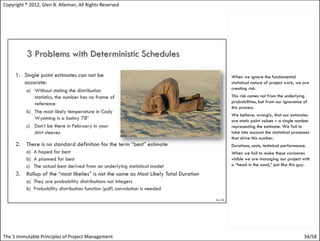
                                                         When we ignore the fundamental
                                                         statistical nature of project work, we are
                                                         creating risk.
                                                         This risk comes not from the underlying
                                                         probabilities, but from our ignorance of
                                                         this process.
                                                         We believe, wrongly, that our estimates
                                                         are static point values – a single number
                                                         representing the estimate. We fail to
                                                         take into account the statistical processes
                                                         that drive this number.
                                                         Durations, costs, technical performance.
                                                         When we fail to make these variances
                                                         visible we are managing our project with
                                                         a “head in the sand,” just like this guy.


The 5 Immutable Principles of Project Management                                                 34/58
Copyright ® 2012, Glen B. Alleman, All Rights Reserved


                                                         Many speak about risk management as
                                                         part of the project management process.
                                                         But do they do risk management as part
                                                         of the project management process?
                                                         Test yourself and anyone who claims to
                                                         be doing risk management


The 5 Immutable Principles of Project Management                                             35/58
Copyright ® 2012, Glen B. Alleman, All Rights Reserved


                                                         Measures of progress are one of the
                                                         difficult topics in project management.
                                                         Typically we measure progress by the
                                                         consumption of resources and the
                                                         passage of time.
                                                         We talk about “budget,” being “on
                                                         budget,” being “over budget.”
                                                         We talk about the passage of time.
                                                         “We’re on schedule,” “we’re late,” “our
                                                         schedule is slipping.”
                                                         These are all necessary things to talk
                                                         about. But they are not sufficient for our
                                                         project’s success.


The 5 Immutable Principles of Project Management                                                36/58
Copyright ® 2012, Glen B. Alleman, All Rights Reserved


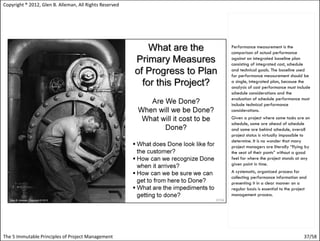
                                                         Performance measurement is the
                                                         comparison of actual performance
                                                         against an integrated baseline plan
                                                         consisting of integrated cost, schedule
                                                         and technical goals. The baseline used
                                                         for performance measurement should be
                                                         a single, integrated plan, because the
                                                         analysis of cost performance must include
                                                         schedule considerations and the
                                                         evaluation of schedule performance must
                                                         include technical performance
                                                         considerations.
                                                         Given a project where some tasks are on
                                                         schedule, some are ahead of schedule
                                                         and some are behind schedule, overall
                                                         project status is virtually impossible to
                                                         determine. It is no wonder that many
                                                         project managers are literally “flying by
                                                         the seat of their pants” without a good
                                                         feel for where the project stands at any
                                                         given point in time.
                                                         A systematic, organized process for
                                                         collecting performance information and
                                                         presenting it in a clear manner on a
                                                         regular basis is essential to the project
                                                         management process.


The 5 Immutable Principles of Project Management                                                37/58
Copyright ® 2012, Glen B. Alleman, All Rights Reserved

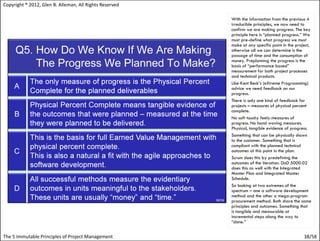
                                                         With the information from the previous 4
                                                         irreducible principles, we now need to
                                                         confirm we are making progress. The key
                                                         principle here is “planned progress.” We
                                                         must pre-define what progress we must
                                                         make at any specific point in the project,
                                                         otherwise all we can determine is the
                                                         passage of time and the consumption of
                                                         money. Preplanning the progress is the
                                                         basis of “performance based”
                                                         measurement for both project processes
                                                         and technical products.
                                                         Like Kent Beck’s (eXtreme Programming)
                                                         advice we need feedback on our
                                                         progress.
                                                         There is only one kind of feedback for
                                                         projects – measures of physical percent
                                                         complete.
                                                         No soft touchy feely measures of
                                                         progress. No hand waving measures.
                                                         Physical, tangible evidence of progress.
                                                         Something that can be physically shown
                                                         to the customer. Something that is
                                                         compliant with the planned technical
                                                         outcomes at this point in the plan.
                                                         Scrum does this by predefining the
                                                         outcomes of the iteration. DoD 5000.02
                                                         does this as well with the Integrated
                                                         Master Plan and Integrated Master
                                                         Schedule.
                                                         So looking at two extremes of the
                                                         spectrum – one a software development
                                                         method and the other a mega-program
                                                         procurement method. Both share the same
                                                         principles and outcomes. Something that
                                                         is tangible and measurable at
                                                         incremental steps along the way to
                                                         “done.”


The 5 Immutable Principles of Project Management                                               38/58
Copyright ® 2012, Glen B. Alleman, All Rights Reserved


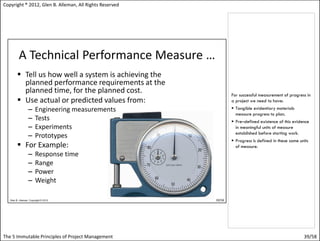
                                                         For successful measurement of progress in
                                                         a project we need to have:
                                                          Tangible evidentiary materials
                                                           measure progress to plan.
                                                          Pre–defined existence of this evidence
                                                           in meaningful units of measure
                                                           established before starting work.
                                                          Progress is defined in these same units
                                                           of measure.


The 5 Immutable Principles of Project Management                                               39/58
Copyright ® 2012, Glen B. Alleman, All Rights Reserved


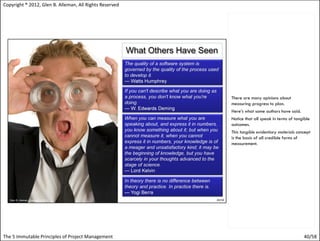
                                                         There are many opinions about
                                                         measuring progress to plan.
                                                         Here’s what some authors have said.
                                                         Notice that all speak in terms of tangible
                                                         outcomes.
                                                         This tangible evidentiary materials concept
                                                         is the basis of all credible forms of
                                                         measurement.


The 5 Immutable Principles of Project Management                                                40/58
Copyright ® 2012, Glen B. Alleman, All Rights Reserved


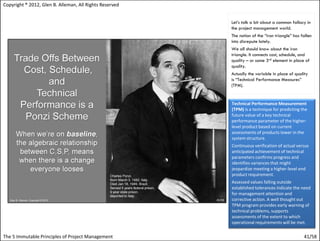
                                                         Let’s talk a bit about a common fallacy in
                                                         the project management world.
                                                         The notion of the “iron triangle” has fallen
                                                         into disrepute lately.
                                                         We all should know about the iron
                                                         triangle. It connects cost, schedule, and
                                                         quality – or some 3rd element in place of
                                                         quality.
                                                         Actually the variable in place of quality
                                                         is “Technical Performance Measures”
                                                         (TPM).


                                                         Technical Performance Measurement
                                                         (TPM) is a technique for predicting the
                                                         future value of a key technical
                                                         performance parameter of the higher-
                                                         level product based on current
                                                         assessments of products lower in the
                                                         system structure.
                                                         Continuous verification of actual versus
                                                         anticipated achievement of technical
                                                         parameters confirms progress and
                                                         identifies variances that might
                                                         jeopardize meeting a higher-level end
                                                         product requirement.
                                                         Assessed values falling outside
                                                         established tolerances indicate the need
                                                         for management attention and
                                                         corrective action. A well thought out
                                                         TPM program provides early warning of
                                                         technical problems, supports
                                                         assessments of the extent to which
                                                         operational requirements will be met.

The 5 Immutable Principles of Project Management                                                41/58
Copyright ® 2012, Glen B. Alleman, All Rights Reserved


                                                         When we say “project management” we
                                                         have to say “management” in terms of
                                                         measuring progress to plan.
                                                         The question is how to measure progress
                                                         to plan?
                                                         How do we define what the planned
                                                         progress “should” be, what actual
                                                         progress we made to date, and how
                                                         much work there is to go?
                                                         With the remaining progress to go, what
                                                         should or pace be to arrive at the end of
                                                         the project at the planned time?


The 5 Immutable Principles of Project Management                                              42/58
Copyright ® 2012, Glen B. Alleman, All Rights Reserved


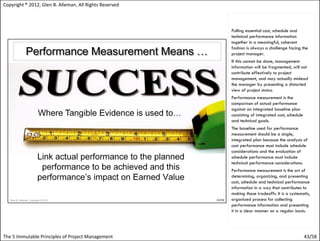
                                                         Pulling essential cost, schedule and
                                                         technical performance information
                                                         together in a meaningful, coherent
                                                         fashion is always a challenge facing the
                                                         project manager.
                                                         If this cannot be done, management
                                                         information will be fragmented, will not
                                                         contribute effectively to project
                                                         management, and may actually mislead
                                                         the manager by presenting a distorted
                                                         view of project status.
                                                         Performance measurement is the
                                                         comparison of actual performance
                                                         against an integrated baseline plan
                                                         consisting of integrated cost, schedule
                                                         and technical goals.
                                                         The baseline used for performance
                                                         measurement should be a single,
                                                         integrated plan because the analysis of
                                                         cost performance must include schedule
                                                         considerations and the evaluation of
                                                         schedule performance must include
                                                         technical performance considerations.
                                                         Performance measurement is the art of
                                                         determining, organizing, and presenting
                                                         cost, schedule and technical performance
                                                         information in a way that contributes to
                                                         making those tradeoffs. It is a systematic,
                                                         organized process for collecting
                                                         performance information and presenting
                                                         it in a clear manner on a regular basis.


The 5 Immutable Principles of Project Management                                                   43/58
Copyright ® 2012, Glen B. Alleman, All Rights Reserved


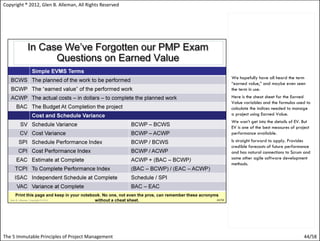
                                                         We hopefully have all heard the term
                                                         “earned value,” and maybe even seen
                                                         the term in use.
                                                         Here is the cheat sheet for the Earned
                                                         Value variables and the formulas used to
                                                         calculate the indices needed to manage
                                                         a project using Earned Value.
                                                         We won’t get into the details of EV. But
                                                         EV is one of the best measures of project
                                                         performance available.
                                                         Is straight forward to apply. Provides
                                                         credible forecasts of future performance
                                                         and has natural connections to Scrum and
                                                         some other agile software development
                                                         methods.


The 5 Immutable Principles of Project Management                                               44/58
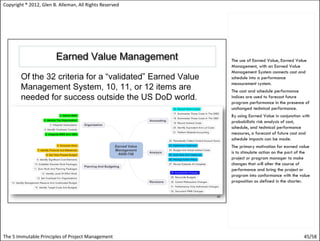
Copyright ® 2012, Glen B. Alleman, All Rights Reserved


                                                         The use of Earned Value, Earned Value
                                                         Management, with an Earned Value
                                                         Management System connects cost and
                                                         schedule into a performance
                                                         measurement system.
                                                         The cost and schedule performance
                                                         indices are used to forecast future
                                                         program performance in the presence of
                                                         unchanged technical performance.
                                                         By using Earned Value in conjunction with
                                                         probabilistic risk analysis of cost,
                                                         schedule, and technical performance
                                                         measures, a forecast of future cost and
                                                         schedule impacts can be made.
                                                         The primary motivation for earned value
                                                         is to stimulate action on the part of the
                                                         project or program manager to make
                                                         changes that will alter the course of
                                                         performance and bring the project or
                                                         program into conformance with the value
                                                         proposition as defined in the charter.


The 5 Immutable Principles of Project Management                                               45/58
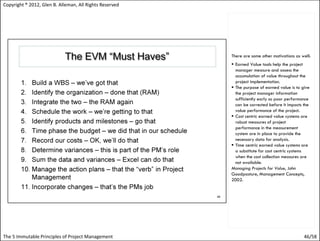
Copyright ® 2012, Glen B. Alleman, All Rights Reserved


                                                         There are some other motivations as well:
                                                          Earned Value tools help the project
                                                           manager measure and assess the
                                                           accumulation of value throughout the
                                                           project implementation.
                                                          The purpose of earned value is to give
                                                           the project manager information
                                                           sufficiently early so poor performance
                                                           can be corrected before it impacts the
                                                           value performance of the project.
                                                          Cost centric earned value systems are
                                                           robust measures of project
                                                           performance in the measurement
                                                           system are in place to provide the
                                                           necessary data for analysis.
                                                          Time centric earned value systems are
                                                           a substitute for cost centric systems
                                                           when the cost collection measures are
                                                           not available.
                                                         Managing Projects for Value, John
                                                         Goodpasture, Management Concepts,
                                                         2002.


The 5 Immutable Principles of Project Management                                              46/58
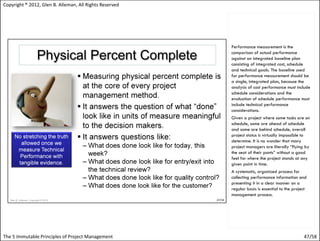
Copyright ® 2012, Glen B. Alleman, All Rights Reserved


                                                         Performance measurement is the
                                                         comparison of actual performance
                                                         against an integrated baseline plan
                                                         consisting of integrated cost, schedule
                                                         and technical goals. The baseline used
                                                         for performance measurement should be
                                                         a single, integrated plan, because the
                                                         analysis of cost performance must include
                                                         schedule considerations and the
                                                         evaluation of schedule performance must
                                                         include technical performance
                                                         considerations.
                                                         Given a project where some tasks are on
                                                         schedule, some are ahead of schedule
                                                         and some are behind schedule, overall
                                                         project status is virtually impossible to
                                                         determine. It is no wonder that many
                                                         project managers are literally “flying by
                                                         the seat of their pants” without a good
                                                         feel for where the project stands at any
                                                         given point in time.
                                                         A systematic, organized process for
                                                         collecting performance information and
                                                         presenting it in a clear manner on a
                                                         regular basis is essential to the project
                                                         management process.


The 5 Immutable Principles of Project Management                                                47/58
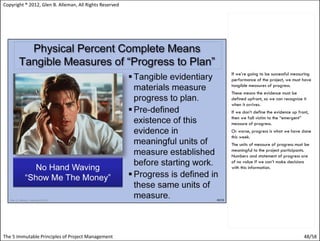
Copyright ® 2012, Glen B. Alleman, All Rights Reserved


                                                         If we’re going to be successful measuring
                                                         performance of the project, we must have
                                                         tangible measures of progress.
                                                         These means the evidence must be
                                                         defined upfront, so we can recognize it
                                                         when it arrives.
                                                         If we don’t define the evidence up front,
                                                         then we fall victim to the “emergent”
                                                         measure of progress.
                                                         Or worse, progress is what we have done
                                                         this week.
                                                         The units of measure of progress must be
                                                         meaningful to the project participants.
                                                         Numbers and statement of progress are
                                                         of no value if we can’t make decisions
                                                         with this information.


The 5 Immutable Principles of Project Management                                               48/58
Copyright ® 2012, Glen B. Alleman, All Rights Reserved


                                                         When we use traditional forecasting
                                                         based on cost and schedule adherence,
                                                         we ignore the “technical performance” of
                                                         the product we’re building.
                                                         We’re on schedule, we’re on budget, the
                                                         thing we’re building doesn’t work exactly
                                                         as we had planned.
                                                         So how can we be on-schedule and on-
                                                         budget?
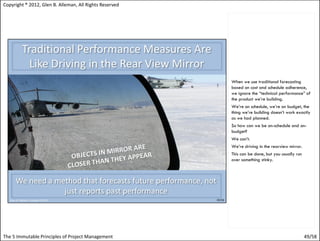
                                                         We can’t.
                                                         We’re driving in the rearview mirror.
                                                         This can be done, but you usually run
                                                         over something stinky.


The 5 Immutable Principles of Project Management                                                 49/58
Copyright ® 2012, Glen B. Alleman, All Rights Reserved


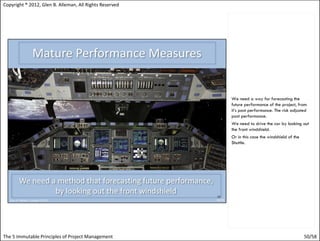
                                                         We need a way for forecasting the
                                                         future performance of the project, from
                                                         it’s past performance. The risk adjusted
                                                         past performance.
                                                         We need to drive the car by looking out
                                                         the front windshield.
                                                         Or in this case the windshield of the
                                                         Shuttle.


The 5 Immutable Principles of Project Management                                                 50/58
Copyright ® 2012, Glen B. Alleman, All Rights Reserved


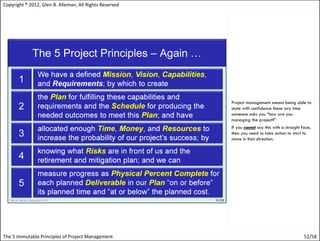
                                                         Project management means being able to
                                                         state with confidence these any time
                                                         someone asks you “how are you
                                                         managing the project?”
                                                         If you cannot say this with a straight face,
                                                         then you need to take action to start to
                                                         move in that direction.


The 5 Immutable Principles of Project Management                                                 51/58
Copyright ® 2012, Glen B. Alleman, All Rights Reserved


                                                         Since we visited the principles and done
                                                         some sample exercises with the principles
                                                         to get a feel of how they could be
                                                         applied.
                                                         Now we need to connect these principles
                                                         with the practices.
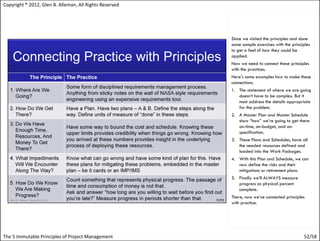
                                                         Here’s some examples how to make these
                                                         connections.
                                                         1. The statement of where we are going
                                                            doesn’t have to be complex. But it
                                                            must address the details appropriate
                                                            for the problem.
                                                         2. A Master Plan and Master Schedule
                                                            show “how” we’re going to get there
                                                            on-time, on-budget, and on-
                                                            specification.
                                                         3. These Plans and Schedules, have all
                                                            the needed resources defined and
                                                            loaded into the Work Packages.
                                                         4. With this Plan and Schedule, we can
                                                            now define the risks and their
                                                            mitigations or retirement plans.
                                                         5. Finally we’ll ALWAYS measure
                                                            progress as physical percent
                                                            complete.
                                                         There, now we’ve connected principles
                                                         with practice.


The 5 Immutable Principles of Project Management                                              52/58
Copyright ® 2012, Glen B. Alleman, All Rights Reserved

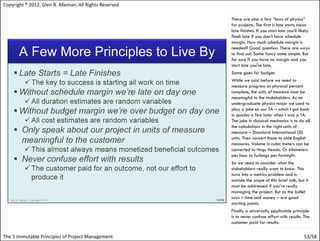
                                                         There are also a few “laws of physics”
                                                         for projects. The first is late starts mean
                                                         late finishes. If you start late you’ll likely
                                                         finish late if you don’t have schedule
                                                         margin. How much schedule margin is
                                                         needed? Good question. There are ways
                                                         to find out. Some fancy some simple. But
                                                         for sure if you have no margin and you
                                                         start late you're late.
                                                         Same goes for budget.
                                                         While we said before we need to
                                                         measure progress as physical percent
                                                         complete, the units of measure must be
                                                         meaningful to the stakeholders. As an
                                                         undergraduate physics major we used to
                                                         play a joke on our TA – which I got back
                                                         in spades a few later when I was a TA.
                                                         The joke in classical mechanics is to do all
                                                         the calculations in the right units of
                                                         measure – Standard International (SI)
                                                         units. Then convert those to olde English
                                                         measures. Volume in cubic meters can be
                                                         converted to Hogs Heads. Or kilometers
                                                         per hour to furlongs per fortnight.
                                                         So we need to consider what the
                                                         stakeholders really want to know. This
                                                         turns into a metrics problem and is
                                                         outside the scope of this brief talk, but it
                                                         must be addressed if you’re really
                                                         managing the project. But as the bullet
                                                         says – time and money – are good
                                                         starting points.
                                                         Finally a universally applicable principle
                                                         is to never confuse effort with results. The
                                                         customer paid for results.

The 5 Immutable Principles of Project Management                                                   53/58
Copyright ® 2012, Glen B. Alleman, All Rights Reserved


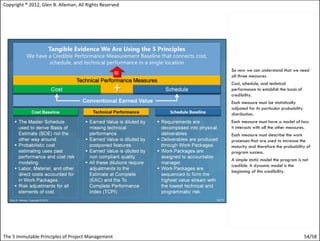
                                                         So now we can understand that we need
                                                         all three measures
                                                         Cost, schedule, and technical
                                                         performance to establish the basis of
                                                         credibility.
                                                         Each measure must be statistically
                                                         adjusted for its particular probability
                                                         distribution.
                                                         Each measure must have a model of how
                                                         it interacts with all the other measures.
                                                         Each measure must describe the work
                                                         processes that are used to increase the
                                                         maturity and therefore the probability of
                                                         program success.
                                                         A simple static model the program is not
                                                         credible. A dynamic model is the
                                                         beginning of this credibility.


The 5 Immutable Principles of Project Management                                                   54/58
Copyright ® 2012, Glen B. Alleman, All Rights Reserved


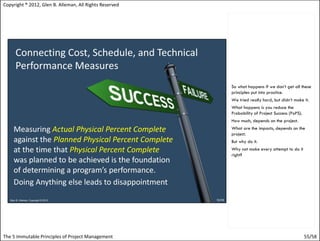
                                                         So what happens if we don’t get all these
                                                         principles put into practice.
                                                         We tried really hard, but didn’t make it.
                                                         What happens is you reduce the
                                                         Probability of Project Success (PoPS).
                                                         How much, depends on the project.
                                                         What are the impacts, depends on the
                                                         project.
                                                         But why do it.
                                                         Why not make every attempt to do it
                                                         right?


The 5 Immutable Principles of Project Management                                                  55/58
Copyright ® 2012, Glen B. Alleman, All Rights Reserved


                                                         Now for questions.


The 5 Immutable Principles of Project Management                              56/58
Copyright ® 2012, Glen B. Alleman, All Rights Reserved


                                                         So we’ve arrived at the end of our short
                                                         time here. What did we learn?
                                                         There are 5 immutable principles of
                                                         project management, no matter the
                                                         project domain and context.
                                                         We need to confirm are project is
                                                         applying these principles, and look for
                                                         the evidence in the form of practices for
                                                         each principle.
                                                         Hopefully I’ve conveyed the notion that
                                                         project management is not the same as
                                                         product development.
                                                         Both are needed, some times more than
                                                         the other depending on the context and
                                                         the domain.
                                                         If I’m building a web site I approach the
                                                         project management and development
                                                         method differently than if I’m building the
                                                         terminal guidance control software for an
                                                         autonomous Mars Lander


The 5 Immutable Principles of Project Management                                                57/58
Copyright ® 2012, Glen B. Alleman, All Rights Reserved


                                                         Here’s my contact information.
                                                         If you have questions that weren’t
                                                         answered here, would like a soft copy of
                                                         this briefing or any others from today or
                                                         last night’s PMI Chapter meeting, please
                                                         drop me a note.


The 5 Immutable Principles of Project Management                                              58/58

Immutable principles of project management (austin pmi)(v4)(no exercise)

  • 1.
  • 2.
    Copyright ® 2012,Glen B. Alleman, All Rights Reserved There are three outcomes for this talk. 1. I’m going the suggest there is common misunderstanding that software development and project management are the same thing. 2. There are 5 irreducible principles for managing any project, no matter the domain or the context. 3. And, as software developers, along with the project manager, if you are not answering the questions from these irreducible principles, you’re probably doing project management and your project is in jeopardy and you may not know it. The 5 Immutable Principles of Project Management 2/58
  • 3.
    Copyright ® 2012,Glen B. Alleman, All Rights Reserved We’ve all seen the numbers. We’ve all been told how bad things are. 77% of project failures are due to poor planning or poor project management. Here’s one more look. But we’re here to work on only one of the aspects of the “money flushing” part of your project activity We’re here today to talk about the project management aspects of projects. The planning, scheduling, costing, management verbs of projects. These are called the Programmatic Elements of the project. Versus the technological aspects. As a program manager I’m very interested in the technology. But my job is to make sure the programmatic aspects work, so the technology has a chance of actually showing up on time. The 5 Immutable Principles of Project Management 3/58
  • 4.
    Copyright ® 2012,Glen B. Alleman, All Rights Reserved So first let’s review what is a project. It’s a one off event. It’s not operations. It’s not repeatable processes – although the processes that manage projects are repeatable, the project itself is a one time occurrence. The reason this is important is that projects are a “one chance to get it right” type of endeavor. Operations has several chances to get it right. Maybe a lot of chances. Sometimes only a few. But never just one. Now there is another word here – probability. Projects have a probability of success. There is no guarantee. We’d like this probability to be as high as possible. For some projects the probability is high – close to 100%. For some projects the probability, while acceptable, is actually low. There is 1 chance in 149 of losing the mission for the Orion Manned Spaceflight program with specific types of launch vehicles. What’s the probability of having your Enterprise ERP project rollout fail in a way that causes an unrecoverable loss to your company? Good question. How can you improve the probability of success for your project? Another good question. The 5 Immutable Principles of Project Management 4/58
  • 5.
    Copyright ® 2012,Glen B. Alleman, All Rights Reserved Mr. Blaise’s quote is applicable to almost every major project we’ve encountered. It’s sad but true that we simply don’t know how to stop work once we’ve started. The work shop today is not about that decision though. It’s about applying the principles of project management, so we don’t have to treat projects in such a “black and white” manner. The 5 Immutable Principles of Project Management 5/58
  • 6.
    Copyright ® 2012,Glen B. Alleman, All Rights Reserved No matter what type of project you work, no matter what the domain, no matter what project management method you use, you must be capable of managing the work in the presence of change. It is not possible to manage change, you must manage in the presence of change. Change is everywhere, it is constant, and it is simply part of the environment of project work. The Five Immutable Principles we’ll speak to today will provide you with the tools to manage in the presence of change. 6/58
  • 7.
    Copyright ® 2012,Glen B. Alleman, All Rights Reserved Management is a verb. When applied to an object, like a project, this verb is the actions needed to control and guide the development of the outcomes of the project. No matter what your approach, self guided or all the way to formal project management methods, projects need a framework in which to make progress. The definitions here define the boundaries of the processes applied to the project. The 5 Immutable Principles of Project Management 7/58
  • 8.
    Copyright ® 2012,Glen B. Alleman, All Rights Reserved When we put these terms together we arrive at the basis of today's work shop. We need knowledge, skills, tools, and techniques in order to increase our Probability of Project Success (PoPS). The five (5) immutable project management principles are independent of all these things. At the same time they apply to any and all these things. And finally they are independent of any project domain and any context in that domain. With the concept of Project + Management in hand, let’s look at the domain and context in those domains for applying this verb and noun. The 5 Immutable Principles of Project Management 8/58
  • 9.
    When we hearabout principles we think about the foundation of a principles. There are the principles of playing baseball. Or the principles of planting a garden. These are the guidelines by which the practice can be successful. But principles must be put into practice and have some hope of being successful. The principles must be based on practices that have been shown to actually work in the domain you are trying to apply them to. I’m going to try and convince you today that these 5 Immutable Principles can be applied in all domains, where projects are the means of producing results. The 5 Immutable Principles of Project Management 9
  • 10.
    Copyright ® 2012,Glen B. Alleman, All Rights Reserved Here’s an idea that we don’t always consider upfront when we look for processes and principles. The amount of risk a project can tolerate is directly related to the business domain and the context of the project within that domain. Understanding the tolerance for these risk levels are critical to choosing and applying any software development method. However, the five immutable principles presented here are juts that, immutable. They must be present in some form no matter the product development method, the level of risk tolerance of the domain and the context within that domain. The risk tolerance for cost is defined as the ability for the customer to absorb changes in the planned cost through management reserve and the application of additional funds. The risk tolerance for schedule slippage is defined as the ability to still produce value for the customer in the presence of a late or slipping schedule. The risk tolerance for Technical Performance means the customer is willing to accept technical capabilities that are less than planned. With this background, let’s look at the five (5) immutable principles. The 5 Immutable Principles of Project Management 10/58
  • 11.
    Copyright ® 2012,Glen B. Alleman, All Rights Reserved The notion of simplicity has entered the discussion around project management methods, tools, processes, and other elements. On one end we have Leonardo’s quote about simplicity being the ultimate sophistication. On the other we have Mencken’s reminder that complex problems and their solutions are connected in ways we may not actually understand. Searching for simplicity in the absence of understanding the “system” usually leads to disappointment. When we’re walking through our immutable principles today, let’s keep in mind the connection between simplicity and complexity and the solutions we need to address this complexity. The 5 Immutable Principles of Project Management 11/58
  • 12.
    Copyright ® 2012,Glen B. Alleman, All Rights Reserved The five immutable principles of project management are: 1. Know where you are going by defining “done” at some point in the future. This point may be far in the future – months or years from now. Or closer in the future days or weeks from now. 2. Have some kind of plan to get to where you are going. This plan can be simple or it can be complex. The fidelity of the plan depends on the tolerance for risk by the users of the plan. 3. Understand the resources needed to execute the plan. How much time and money is needed to reach the destination. This can be fixed or it can be variable. 4. Identify the impediments to progress along the way to the destination. Have some means of removing, avoiding, or ignoring these impediments. 5. Have some way to measure your planned progress, not just your progress. Progress to Plan must be measured in units of physical percent complete. The 5 Immutable Principles of Project Management 12/58
  • 13.
    Copyright ® 2012,Glen B. Alleman, All Rights Reserved Our first step here is to separate a Plan from a Schedule. The PLAN is a procedure used to achieve an objective. It is a set of intended actions, through which one expects to achieve a goal. The SCHEDULE is the sequence of these intended actions, needed to implement the PLAN. But we don’t what to mix the PLAN with the SCHEDULE. The PLAN is the strategy for the successful completion of the project. In the strategic planning domain, a PLAN is a hypothesis that needs to be tested along the way to confirm we’re headed. The SCHEDULE is the order of the work to execute the PLAN. We need both. PLANS without SCHEDULES are not executable. SCHEDULES without PLANS have no stated mission, vision, or description of success other than the execution of the work. The 5 Immutable Principles of Project Management 13/58
  • 14.
    Copyright ® 2012,Glen B. Alleman, All Rights Reserved When we say “where are we going,” we should be talking about physical outcomes – the deliverables. When we say deliverables, what deliverables are we talking about? The deliverables should be those that fulfill the requirements. So what are the requirements? As our quote says here, the single hardest part of building a system is deciding what to build. No matter what method you use to make these decisions – from the agilest of methods to the most formal, we need to have the requirements stated in a form that is testable, verifiable, and traceable to the PLAN and SCHEDULE. The 5 Immutable Principles of Project Management 14/58
  • 15.
    Copyright ® 2012,Glen B. Alleman, All Rights Reserved Here’s some words that we’ll encounter during the development of requirements. These are not the only words of course, but these words are important ones. One critical set of words are “Stated” versus “Real.” Stated requirements are any requirement that is written down – that is stated. “Real” requirements are of course requirements that are really needed by the system to fulfill its business case. Other words are important as well. “Verified” and “Validated” are a pair. One of the requirements words that causes much extra work is “derived.” A derived requirement is one that is not primary, but is secondary. As such it may not be obvious that it is a requirement. There are requirements words that should be avoided. The first one – that may not be obvious – is “Customer.” Which customer? How do we know what the customer wants? One simple way out of this is to state the requirement, that we think is a customer requirement, in terms of a business requirement. Complete with a business reason, business case, business payback, other business reasons. Of course there are phrases that should be avoided as well. “User Friendly” has started to be purged from the vocabulary – at long last. But “flexible” and “reliable” are still hanging around. The 5 Immutable Principles of Project Management 15/58
  • 16.
    Copyright ® 2012,Glen B. Alleman, All Rights Reserved The key here is that requirements tell us something about where we are going. But requirements come in all shapes and sizes. Here’s a sample of two extremes. A small project and a not-small project. The small project is straight forward in terms of requirements. There is a list of them on the flip chart. They are likely well understood. They probably can be estimated in terms of cost and schedule. And most importantly the interactions between the requirements can be intuited with a little effort. The project on the right is a different class of effort. This is the top level components (if you can call them that) of the Future Combat System. It’s a $35B, that’s billion with a B program to restructure the entire US Army Battle Space Management processes. I help one of the teams – the Class I team – build their Performance Measurement Baseline and get that information into a cost and schedule management system, so they can use Earned Value Management to “manage” their program. FCS is a software intensive system, where software is in everything from small hand held devices to major facilities housing the “battle space management command.” If the software doesn’t work, the FCS doesn’t work. Soldiers can’t do their job. If soldiers can’t do their job – there’s a BIG PROBLEM. The 5 Immutable Principles of Project Management 16/58
  • 17.
    Copyright ® 2012,Glen B. Alleman, All Rights Reserved For the moment, let’s use a simpler analogy to connect with something more tangible. Let’s pretend we want to go on a hike. A nice hike to the saddle just to the right of the peak above this lake. That saddle is Pawnee Pass. It’s just west of Boulder Colorado, and a bit south of Rocky Mountain National Park. We’d like to go to Pawnee Pass in a single day – there and back. Not get too wet if it rains. Not be too hungry. And have a good time along the way with our hiking group. That’s our mission. The 5 Immutable Principles of Project Management 17/58
  • 18.
    Copyright ® 2012,Glen B. Alleman, All Rights Reserved These two words should be tattooed on your wrist. If we don’t have a Plan, our schedule is not credible. Plans are not Schedules. And Schedules are not Plans. A Plan is the Strategy for the successful delivery of the project. Plans state “what” is to be done (programmatically what, not technically what). Schedules state “how” it is to be done – programmatically how it is to be done. While this may seem subtle or maybe not even useful, it is critically important for several reasons:  The plan shows how the project produces increasing value and increasing maturity of the products.  It’s is the “road map” from the beginning to end, INDEPENDENT from the actual durations of the work.  The Plan speaks to What we are doing.  The schedule is the “driving instructions” for the vehicles on the roads, following the map.  The execution of the schedule is the actual “driving” of the vehicle by the driver along with the passengers. All three are needed, no one can be missing, all three interact with each other. The 5 Immutable Principles of Project Management 18/58
  • 19.
    Copyright ® 2012,Glen B. Alleman, All Rights Reserved Plans are strategies. They tell us the flow of the project in terms of deliverables and the increasing value and maturity of those deliverables. I’m going to introduce some new words here that we’ll use later. They are just words for now, so their exact meaning is not important. This is similar to the Value Stream Map found in Lean Six Sigma. The “map” is the flow of the Significant Accomplishments in the project or program. For these Accomplishments, there are a set of Criteria that define the “exit conditions” for the underlying work. Defining these criteria BEFORE defining the details of the work is the basis of the Planning process. This is a top down-first approach . It is NOT a Top Down only approach, just the 1st step in the process. But with the Accomplishments and the Criteria defined, there is a notional view of what “done” looks like. Measureable in some units meaningful to the project management team and the stakeholders in the project. This focus on the definition of “done” is important for several reasons: 1. “Done” is a measure of 100% done, not partially done, not almost done. But DONE. This is the concept of “starting with the end in mind,” popularized by Covey. 2. Along the way to DONE, there are measures of “getting to done” that are “mini-dones.” These “maturity assessment points” are the way to measure physical percent complete in terms of the product maturity rather than the consumption of resources or passage of time. The 5 Immutable Principles of Project Management 19/58
  • 20.
    Copyright ® 2012,Glen B. Alleman, All Rights Reserved Now that we know about the existence of a Plan, what is the Schedule? Why is it different from a Plan? The Schedule shows the work needed to produce the “deliverables” in the Plan. This sounds like a tautology – a statement of the obvious. But there’s more to it than that. This work is ONLY the work needed to cause the “exit criteria” to appear of each individual definition of the criteria for named Accomplishment. In a previous slide we mentioned the definition of the Accomplishments come first. With these definitions – and most importantly the order in which these Accomplishments must be accomplished I know this is not as clear as you’d expect at this point. But we’ll need to use an example before we get back to the details. For now think of the schedule as the description of how the individual Exit Criteria from the “lumps of work” are to be accomplished. The 5 Immutable Principles of Project Management 20/58
  • 21.
    Copyright ® 2012,Glen B. Alleman, All Rights Reserved Now that we know where we want to go, the next question is how to get there. How do we build the products or provide the services needed to reach the end of our project. There are numerous choices, depending on the domain and the context of the project in that domain. For the software domain there are many context’s. Using the example on the previous page, let’s look at two methods. These are the extreme ends of the spectrum of contexts and methods. They can serve to focus the discussion on project management rather than product development methods, by hopefully disconnecting project management from product development so we can look at them separately. In the first software development context – a list of features, SCRUM is a popular approach. But there are many more software based project, possibly more complex than the example from the previous page to the “wickedly” complex program also shown on the previous page. The SCRUM method is shown in its common diagram. But below it is the method used for product procurement in the US Department of Defense – DoD 5000.02. The products are not actually developed by the DoD (except in rare cases). But are instead, procured. So acquisition management is guided by this process. Both are iterative, both are incremental, both can deal with emerging requirements, both make use of “test driven planning,” and both have clear and concise measures of physical percent complete. The 5 Immutable Principles of Project Management 21/58
  • 22.
    Copyright ® 2012,Glen B. Alleman, All Rights Reserved Now that we know some things about what capabilities we need and how we might cause these capabilities to appear at the appointed time and place for the planned cost and schedule, do we know what we need to be successful? We need to constantly ask this question. If we don’t ask and answer the question, we’ll find out what is missing when they arrive on our doorstep. At that point it will be too late. It is not too late to acquire them, but too late to acquire them within our planned schedule and planned budget. The 5 Immutable Principles of Project Management 22/58
  • 23.
    Copyright ® 2012,Glen B. Alleman, All Rights Reserved Now that we know where we’re going and how to get there – do we have all we need to reach the end? Staff, time, money, the necessary skill and experience and the proper management support. These are all obvious on any project – at least any well managed project. But there are always underlying issues with answering these questions. The first is that management as well as the development organization are always optimistic about the outcome. This is the very nature of project management. Why be pessimistic? Well maybe not pessimistic, but how about realistic? What do we mean when we say realistic? One good word is credible. Credible could be optimistically credible or pessimistically credible. But either way we have a credible understanding of what it takes to reach the end. One part of credible is knowing what the risks and uncertainties are and how we are going to dealing with them. Managing in the Presence of these uncertainties is critical to reaching our goal. Risk and uncertainty never go away. They are always there. They are unavoidable. The 5 Immutable Principles of Project Management 23/58
  • 24.
    Copyright ® 2012,Glen B. Alleman, All Rights Reserved Once we recognize that time is not money and money is not time, the next eye opener for all project work is there is a natural statistical variability of both these elements. So no matter what software development method you are applying inside a project management set of processes, you must come to grips with the statistical nature of cost, schedule, and technical performance. This area is called Programmatic Risk and its cousin Technical Risk. The Programmatic Risk concept is not well understood outside the defense and space business. There it is mandated that Programmatic Risk be managed – DID 81650 describes this mandate. The Monte Carlo simulation method is the way to assess the behavior of the network of activities, but there subtleties beyond just the simulation of the network. The Monte Carlo tools don’t easily model the coupling and correlations between the work activities in a proactive manner. There are other tools for modeling the network, but they are also outside this presentation. The 5 Immutable Principles of Project Management 24/58
  • 25.
    Copyright ® 2012,Glen B. Alleman, All Rights Reserved Project Managers constantly seek ways to eliminate or control risk, variance, and uncertainty. This is a hopeless pursuit. Managing “in the presence” of risk, variance and uncertainty is the key to success. Some projects have few uncertainties –only the complexity of tasks and relationships is important – but most projects are characterized by several types of uncertainty. Although each uncertainty type is distinct, a single project may encounter some combination of four types: 1. Variation – comes from many small influences and yields a range of values on a particular activity. Attempting to control these variances outside their natural boundaries is a waste (Muda). 2. Foreseen Uncertainty – are uncertainties identifiable and understood influences that the team cannot be sure will occur. There needs to be a mitigation plan for these foreseen uncertainties. 3. Unforeseen Uncertainty – is uncertainty that can’t be identified during project planning. When these occur, a new plan is needed. 4. Chaos – appears in the presence of “unknown unknowns.” “Managing Project Uncertainty: From Variation to Chaos,” Arnoud De Meyer, Christoph H. Loch and Michael T. Pich, MIT Sloan Management Review, Winter 2000. The 5 Immutable Principles of Project Management 25/58
  • 26.
    Copyright ® 2012,Glen B. Alleman, All Rights Reserved Project duration and costs are random variables drawn from some underlying probability distribution. In probability theory, every random variable is attributed to a probability distribution. The probability distribution associated with a cost or duration describes the variance of these random variables. A common distribution of probabilistic estimates for cost and schedule random variables is the Triangle Distribution. Using the Triangle Distribution for the costs and durations, a Monte Carlo simulation of the network of activities and their costs can be performed. Monte Carlo methods are used to numerically transform and integrate the posterior quantitative risk assessment into a confidence interval. The result is a “confidence” model for the cost and completion times for the project based on the upper and lower bounds of each distribution assigned to each duration and cost. The 5 Immutable Principles of Project Management 26/58
  • 27.
    Copyright ® 2012,Glen B. Alleman, All Rights Reserved If risk management is how adults manage projects, here are some principles of project risk management. These five principles are simple, obvious, but difficult to implement. This reason they’re difficult is that most people shy away from risk. Managing in the presence of risk does not come naturally. It is a learned behavior. And once learned it has to be practiced. But before it can be learned and then practiced, “managing in the presence of risk,” must become part of the business culture. Some cultures doe this better than others. NASA is probably better than others. But even NASA has moved a risk adverse culture in the past decades. 1. Hoping that something positive will result is not a very good strategy. Preparing for success is the basis of success. 2. Single point estimates are no better than 50/50 guesses in the absence of knowledge of the standard deviation of the underlying distribution. 3. Without connecting cost, schedule, and technical performance of the effort to produce the product or service, the connection to value cannot be made. 4. Risk management is not an ad hoc process that you can make up as you go. A formal foundation for risk management is needed. 5. Identifying risks without communicating them is a waste of time. The 5 Immutable Principles of Project Management 27/58
  • 28.
    Copyright ® 2012,Glen B. Alleman, All Rights Reserved Project Managers constantly seek ways to eliminate or control risk, variance and uncertainly. This is a hopeless pursuit. Managing “in the presence” of risk, variance and uncertainty is the key to success. Some projects have few uncertainties –only the complexity of tasks and relationships is important – but most projects are characterized by several types of uncertainty. Although each uncertainty type is distinct, a single project may encounter some combination of four types: 1. Variation – comes from many small influences and yields a range of values on a particular activity. Attempting to control these variances outside their natural boundaries is a waste (Muda). 2. Foreseen Uncertainty – are uncertainties identifiable and understood influences that the team cannot be sure will occur. There needs to be a mitigation plan for these foreseen uncertainties. 3. Unforeseen Uncertainty – is uncertainty that can’t be identified during project planning. When these occur, a new plan is needed. 4. Chaos – appears in the presence of “unknown unknowns.” “Managing Project Uncertainty: From Variation to Chaos,” Arnoud De Meyer, Christoph H. Loch and Michael T. Pich, MIT Sloan Management Review, Winter 2000. The 5 Immutable Principles of Project Management 28/58
  • 29.
    Copyright ® 2012,Glen B. Alleman, All Rights Reserved The use of point estimates for durations and costs is many times the first impulse in an organization low on the project management maturity scale. Understanding cost and durations are actually “random variables,” drawn from an underlying distribution of possible value is the starting point for managing in the presence of uncertainty. The Triangle Distribution is used as a subjective description of a population for which there is only limited sample data, and especially where the relationship between variables is known but data is scarce. It is based on the knowledge of the minimum and maximum and a “best guess” of the modal value (the Most Likely). Using the Triangle Distribution for the costs and durations, a Monte Carlo simulation of the network of activities and their costs can be performed. Monte Carlo methods are used to numerically transform and integrate the posterior quantitative risk assessment into a confidence interval. The result is a “confidence” model for the cost and completion times for the project based on the upper and lower bounds of each distribution assigned to each duration and cost. This approach to estimating provides insight into the behavior of the plan as well as sensitivity between the individual elements of the plan. The 5 Immutable Principles of Project Management 29/58
  • 30.
    Copyright ® 2012,Glen B. Alleman, All Rights Reserved In many descriptions of project management – cost, schedule, and quality are considered as the “Iron Triangle.” Change one and the other two must change as well. It turns out this is too narrow a view of what's happening on a project. It’s the Technical Performance Measurement that replaces Quality. Quality is one of the Technical Performance measures. Technical Performance Measures describe the status of technical achievement of the project at any point in time. The Planned technical achievement is part of the Performance Measurement Baseline (PMB) in the same way the Planned Value (BCWS) is part of the PMB. The TPMs use the techniques of risk analysis and probability to give program managers the early warning needed to avoid unplanned costs and slippage in schedule. Systems engineering uses technical performance measurements to balance cost, schedule, and performance throughout the life cycle. TPMs compare actual versus planned technical development and design. They also report the degree to which system requirements are met in terms of performance, cost, schedule, and progress in implementing risk handling. The 5 Immutable Principles of Project Management 30/58
  • 31.
    Copyright ® 2012,Glen B. Alleman, All Rights Reserved Risk Management means using a proven risk management process, adapting this to the project environment, and using this process for everyday decision making. Technical performance is a concept absent from the traditional approaches to risk management. Yet it is the primary driver of risk in many technology intensive projects. Cost growth and schedule slippage often occur when unrealistically high levels of performance are required and little flexibility is provided to degrade performance during the course of the program. Quality is often a cause rather than an impact to the program and can generally be broken down into Cost, Performance, and Schedule components. The framework shown here provides:  Risk management policy.  Risk management structure.  Risk Management Process Model.  Organizational and behavioral considerations for implementing risk management.  The performance dimension of consequence of occurrence.  The performance dimension of Monte Carlo simulation modeling.  A structured approach for developing a risk handling strategy. The 5 Immutable Principles of Project Management 31/58
  • 32.
    Copyright ® 2012,Glen B. Alleman, All Rights Reserved It does no good to manage risks if the results are not communicated to all the participants. Risk communication is the basis of risk mitigation. This plan needs to address the following:  Executive summary – a simple summary of the program and the risks associated with the activities of the program. Each risk needs an ordinal rank, a planned mitigation if the risk is active (a risk approved by the Risk Board), and the mitigations shown in the schedule with associated costs.  Program description – a detailed description of the program and the risk associated with each of the deliverables. This description should be “operational” in nature, with the consequences description in “operational” terms as well.  Risk reduction activities by phase – using some formal risk management process that connects risk, mitigation and the Master Schedule. The efforts for mitigation need to be in the schedule.  Risk management methodology – using the DoD Risk Management process is a good start. This approach has proven and approved by high risk, high reward programs. The steps in the processes are not optional and should be executed for ALL risk processes. The 5 Immutable Principles of Project Management 32/58
  • 33.
    Copyright ® 2012,Glen B. Alleman, All Rights Reserved Risk Management is a full time effort. Even if it is a part-time job. Someone needs to “own” the risks and the process around risk management. Someone or a collection of “someone's” needs to have risk management in their mind(s) at all times. Risk Management is not something you can do once and them forget. The risks don’t just go away. They are forever there, even if they are mitigated, retired or bought down. The 5 Immutable Principles of Project Management 33/58
  • 34.
    Copyright ® 2012,Glen B. Alleman, All Rights Reserved When we ignore the fundamental statistical nature of project work, we are creating risk. This risk comes not from the underlying probabilities, but from our ignorance of this process. We believe, wrongly, that our estimates are static point values – a single number representing the estimate. We fail to take into account the statistical processes that drive this number. Durations, costs, technical performance. When we fail to make these variances visible we are managing our project with a “head in the sand,” just like this guy. The 5 Immutable Principles of Project Management 34/58
  • 35.
    Copyright ® 2012,Glen B. Alleman, All Rights Reserved Many speak about risk management as part of the project management process. But do they do risk management as part of the project management process? Test yourself and anyone who claims to be doing risk management The 5 Immutable Principles of Project Management 35/58
  • 36.
    Copyright ® 2012,Glen B. Alleman, All Rights Reserved Measures of progress are one of the difficult topics in project management. Typically we measure progress by the consumption of resources and the passage of time. We talk about “budget,” being “on budget,” being “over budget.” We talk about the passage of time. “We’re on schedule,” “we’re late,” “our schedule is slipping.” These are all necessary things to talk about. But they are not sufficient for our project’s success. The 5 Immutable Principles of Project Management 36/58
  • 37.
    Copyright ® 2012,Glen B. Alleman, All Rights Reserved Performance measurement is the comparison of actual performance against an integrated baseline plan consisting of integrated cost, schedule and technical goals. The baseline used for performance measurement should be a single, integrated plan, because the analysis of cost performance must include schedule considerations and the evaluation of schedule performance must include technical performance considerations. Given a project where some tasks are on schedule, some are ahead of schedule and some are behind schedule, overall project status is virtually impossible to determine. It is no wonder that many project managers are literally “flying by the seat of their pants” without a good feel for where the project stands at any given point in time. A systematic, organized process for collecting performance information and presenting it in a clear manner on a regular basis is essential to the project management process. The 5 Immutable Principles of Project Management 37/58
  • 38.
    Copyright ® 2012,Glen B. Alleman, All Rights Reserved With the information from the previous 4 irreducible principles, we now need to confirm we are making progress. The key principle here is “planned progress.” We must pre-define what progress we must make at any specific point in the project, otherwise all we can determine is the passage of time and the consumption of money. Preplanning the progress is the basis of “performance based” measurement for both project processes and technical products. Like Kent Beck’s (eXtreme Programming) advice we need feedback on our progress. There is only one kind of feedback for projects – measures of physical percent complete. No soft touchy feely measures of progress. No hand waving measures. Physical, tangible evidence of progress. Something that can be physically shown to the customer. Something that is compliant with the planned technical outcomes at this point in the plan. Scrum does this by predefining the outcomes of the iteration. DoD 5000.02 does this as well with the Integrated Master Plan and Integrated Master Schedule. So looking at two extremes of the spectrum – one a software development method and the other a mega-program procurement method. Both share the same principles and outcomes. Something that is tangible and measurable at incremental steps along the way to “done.” The 5 Immutable Principles of Project Management 38/58
  • 39.
    Copyright ® 2012,Glen B. Alleman, All Rights Reserved For successful measurement of progress in a project we need to have:  Tangible evidentiary materials measure progress to plan.  Pre–defined existence of this evidence in meaningful units of measure established before starting work.  Progress is defined in these same units of measure. The 5 Immutable Principles of Project Management 39/58
  • 40.
    Copyright ® 2012,Glen B. Alleman, All Rights Reserved There are many opinions about measuring progress to plan. Here’s what some authors have said. Notice that all speak in terms of tangible outcomes. This tangible evidentiary materials concept is the basis of all credible forms of measurement. The 5 Immutable Principles of Project Management 40/58
  • 41.
    Copyright ® 2012,Glen B. Alleman, All Rights Reserved Let’s talk a bit about a common fallacy in the project management world. The notion of the “iron triangle” has fallen into disrepute lately. We all should know about the iron triangle. It connects cost, schedule, and quality – or some 3rd element in place of quality. Actually the variable in place of quality is “Technical Performance Measures” (TPM). Technical Performance Measurement (TPM) is a technique for predicting the future value of a key technical performance parameter of the higher- level product based on current assessments of products lower in the system structure. Continuous verification of actual versus anticipated achievement of technical parameters confirms progress and identifies variances that might jeopardize meeting a higher-level end product requirement. Assessed values falling outside established tolerances indicate the need for management attention and corrective action. A well thought out TPM program provides early warning of technical problems, supports assessments of the extent to which operational requirements will be met. The 5 Immutable Principles of Project Management 41/58
  • 42.
    Copyright ® 2012,Glen B. Alleman, All Rights Reserved When we say “project management” we have to say “management” in terms of measuring progress to plan. The question is how to measure progress to plan? How do we define what the planned progress “should” be, what actual progress we made to date, and how much work there is to go? With the remaining progress to go, what should or pace be to arrive at the end of the project at the planned time? The 5 Immutable Principles of Project Management 42/58
  • 43.
    Copyright ® 2012,Glen B. Alleman, All Rights Reserved Pulling essential cost, schedule and technical performance information together in a meaningful, coherent fashion is always a challenge facing the project manager. If this cannot be done, management information will be fragmented, will not contribute effectively to project management, and may actually mislead the manager by presenting a distorted view of project status. Performance measurement is the comparison of actual performance against an integrated baseline plan consisting of integrated cost, schedule and technical goals. The baseline used for performance measurement should be a single, integrated plan because the analysis of cost performance must include schedule considerations and the evaluation of schedule performance must include technical performance considerations. Performance measurement is the art of determining, organizing, and presenting cost, schedule and technical performance information in a way that contributes to making those tradeoffs. It is a systematic, organized process for collecting performance information and presenting it in a clear manner on a regular basis. The 5 Immutable Principles of Project Management 43/58
  • 44.
    Copyright ® 2012,Glen B. Alleman, All Rights Reserved We hopefully have all heard the term “earned value,” and maybe even seen the term in use. Here is the cheat sheet for the Earned Value variables and the formulas used to calculate the indices needed to manage a project using Earned Value. We won’t get into the details of EV. But EV is one of the best measures of project performance available. Is straight forward to apply. Provides credible forecasts of future performance and has natural connections to Scrum and some other agile software development methods. The 5 Immutable Principles of Project Management 44/58
  • 45.
    Copyright ® 2012,Glen B. Alleman, All Rights Reserved The use of Earned Value, Earned Value Management, with an Earned Value Management System connects cost and schedule into a performance measurement system. The cost and schedule performance indices are used to forecast future program performance in the presence of unchanged technical performance. By using Earned Value in conjunction with probabilistic risk analysis of cost, schedule, and technical performance measures, a forecast of future cost and schedule impacts can be made. The primary motivation for earned value is to stimulate action on the part of the project or program manager to make changes that will alter the course of performance and bring the project or program into conformance with the value proposition as defined in the charter. The 5 Immutable Principles of Project Management 45/58
  • 46.
    Copyright ® 2012,Glen B. Alleman, All Rights Reserved There are some other motivations as well:  Earned Value tools help the project manager measure and assess the accumulation of value throughout the project implementation.  The purpose of earned value is to give the project manager information sufficiently early so poor performance can be corrected before it impacts the value performance of the project.  Cost centric earned value systems are robust measures of project performance in the measurement system are in place to provide the necessary data for analysis.  Time centric earned value systems are a substitute for cost centric systems when the cost collection measures are not available. Managing Projects for Value, John Goodpasture, Management Concepts, 2002. The 5 Immutable Principles of Project Management 46/58
  • 47.
    Copyright ® 2012,Glen B. Alleman, All Rights Reserved Performance measurement is the comparison of actual performance against an integrated baseline plan consisting of integrated cost, schedule and technical goals. The baseline used for performance measurement should be a single, integrated plan, because the analysis of cost performance must include schedule considerations and the evaluation of schedule performance must include technical performance considerations. Given a project where some tasks are on schedule, some are ahead of schedule and some are behind schedule, overall project status is virtually impossible to determine. It is no wonder that many project managers are literally “flying by the seat of their pants” without a good feel for where the project stands at any given point in time. A systematic, organized process for collecting performance information and presenting it in a clear manner on a regular basis is essential to the project management process. The 5 Immutable Principles of Project Management 47/58
  • 48.
    Copyright ® 2012,Glen B. Alleman, All Rights Reserved If we’re going to be successful measuring performance of the project, we must have tangible measures of progress. These means the evidence must be defined upfront, so we can recognize it when it arrives. If we don’t define the evidence up front, then we fall victim to the “emergent” measure of progress. Or worse, progress is what we have done this week. The units of measure of progress must be meaningful to the project participants. Numbers and statement of progress are of no value if we can’t make decisions with this information. The 5 Immutable Principles of Project Management 48/58
  • 49.
    Copyright ® 2012,Glen B. Alleman, All Rights Reserved When we use traditional forecasting based on cost and schedule adherence, we ignore the “technical performance” of the product we’re building. We’re on schedule, we’re on budget, the thing we’re building doesn’t work exactly as we had planned. So how can we be on-schedule and on- budget? We can’t. We’re driving in the rearview mirror. This can be done, but you usually run over something stinky. The 5 Immutable Principles of Project Management 49/58
  • 50.
    Copyright ® 2012,Glen B. Alleman, All Rights Reserved We need a way for forecasting the future performance of the project, from it’s past performance. The risk adjusted past performance. We need to drive the car by looking out the front windshield. Or in this case the windshield of the Shuttle. The 5 Immutable Principles of Project Management 50/58
  • 51.
    Copyright ® 2012,Glen B. Alleman, All Rights Reserved Project management means being able to state with confidence these any time someone asks you “how are you managing the project?” If you cannot say this with a straight face, then you need to take action to start to move in that direction. The 5 Immutable Principles of Project Management 51/58
  • 52.
    Copyright ® 2012,Glen B. Alleman, All Rights Reserved Since we visited the principles and done some sample exercises with the principles to get a feel of how they could be applied. Now we need to connect these principles with the practices. Here’s some examples how to make these connections. 1. The statement of where we are going doesn’t have to be complex. But it must address the details appropriate for the problem. 2. A Master Plan and Master Schedule show “how” we’re going to get there on-time, on-budget, and on- specification. 3. These Plans and Schedules, have all the needed resources defined and loaded into the Work Packages. 4. With this Plan and Schedule, we can now define the risks and their mitigations or retirement plans. 5. Finally we’ll ALWAYS measure progress as physical percent complete. There, now we’ve connected principles with practice. The 5 Immutable Principles of Project Management 52/58
  • 53.
    Copyright ® 2012,Glen B. Alleman, All Rights Reserved There are also a few “laws of physics” for projects. The first is late starts mean late finishes. If you start late you’ll likely finish late if you don’t have schedule margin. How much schedule margin is needed? Good question. There are ways to find out. Some fancy some simple. But for sure if you have no margin and you start late you're late. Same goes for budget. While we said before we need to measure progress as physical percent complete, the units of measure must be meaningful to the stakeholders. As an undergraduate physics major we used to play a joke on our TA – which I got back in spades a few later when I was a TA. The joke in classical mechanics is to do all the calculations in the right units of measure – Standard International (SI) units. Then convert those to olde English measures. Volume in cubic meters can be converted to Hogs Heads. Or kilometers per hour to furlongs per fortnight. So we need to consider what the stakeholders really want to know. This turns into a metrics problem and is outside the scope of this brief talk, but it must be addressed if you’re really managing the project. But as the bullet says – time and money – are good starting points. Finally a universally applicable principle is to never confuse effort with results. The customer paid for results. The 5 Immutable Principles of Project Management 53/58
  • 54.
    Copyright ® 2012,Glen B. Alleman, All Rights Reserved So now we can understand that we need all three measures Cost, schedule, and technical performance to establish the basis of credibility. Each measure must be statistically adjusted for its particular probability distribution. Each measure must have a model of how it interacts with all the other measures. Each measure must describe the work processes that are used to increase the maturity and therefore the probability of program success. A simple static model the program is not credible. A dynamic model is the beginning of this credibility. The 5 Immutable Principles of Project Management 54/58
  • 55.
    Copyright ® 2012,Glen B. Alleman, All Rights Reserved So what happens if we don’t get all these principles put into practice. We tried really hard, but didn’t make it. What happens is you reduce the Probability of Project Success (PoPS). How much, depends on the project. What are the impacts, depends on the project. But why do it. Why not make every attempt to do it right? The 5 Immutable Principles of Project Management 55/58
  • 56.
    Copyright ® 2012,Glen B. Alleman, All Rights Reserved Now for questions. The 5 Immutable Principles of Project Management 56/58
  • 57.
    Copyright ® 2012,Glen B. Alleman, All Rights Reserved So we’ve arrived at the end of our short time here. What did we learn? There are 5 immutable principles of project management, no matter the project domain and context. We need to confirm are project is applying these principles, and look for the evidence in the form of practices for each principle. Hopefully I’ve conveyed the notion that project management is not the same as product development. Both are needed, some times more than the other depending on the context and the domain. If I’m building a web site I approach the project management and development method differently than if I’m building the terminal guidance control software for an autonomous Mars Lander The 5 Immutable Principles of Project Management 57/58
  • 58.
    Copyright ® 2012,Glen B. Alleman, All Rights Reserved Here’s my contact information. If you have questions that weren’t answered here, would like a soft copy of this briefing or any others from today or last night’s PMI Chapter meeting, please drop me a note. The 5 Immutable Principles of Project Management 58/58