Adaptive Planning
Gartner Says Smart Organizations Will Embrace Fast and
Frequent Project Success / Failure in Their Quest for
Agility
Accepting higher project failure rates can help organizations
become more efficient more quickly, according to Gartner, Inc.
Gartner said project and portfolio management (PPM) leaders
who take a "fail-forward-fast" approach that accepts high
project failure rates as the norm will help their organizations
become more agile by embracing experimentation and enabling
the declaration of success or failure earlier in a project's life.
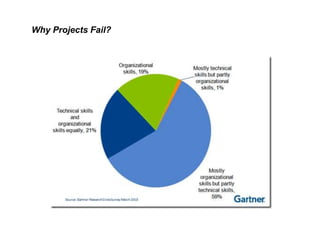
Why Projects Fail?
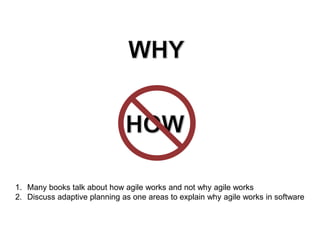
1. Many books talk about how agile works and not why agile works
2. Discuss adaptive planning as one areas to explain why agile works in software
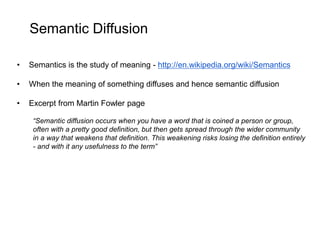
• Semantics is the study of meaning - http://en.wikipedia.org/wiki/Semantics
• When the meaning of some word diffuses and hence semantic diffusion
• Excerpt from Martin Fowler page
“Semantic diffusion occurs when you have a word that is coined a person or group,
often with a pretty good definition, but then gets spread through the wider community
in a way that weakens that definition. This weakening risks losing the definition entirely
- and with it any usefulness to the term”
Semantic Diffusion
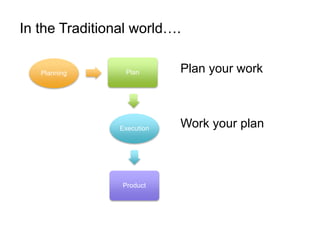
Planning Plan
Execution
Product
Plan your work
Work your plan
In the Traditional world….
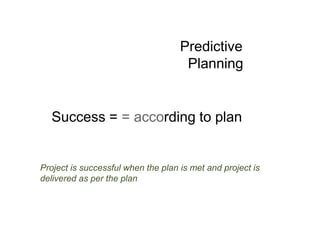
Predictive
Planning
Success = = according to plan
Project is successful when the plan is met and project is
delivered as per the plan
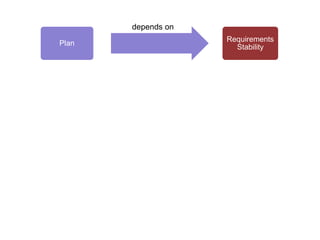
Plan
Requirements
Stability
depends on
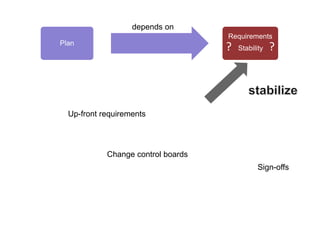
Plan
Requirements
? Stability ?
depends on
Up-front requirements
Change control boards
Sign-offs
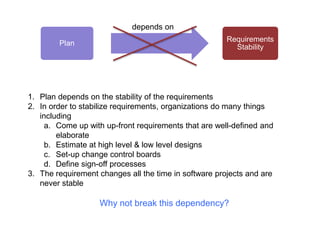
Plan
Requirements
Stability
depends on
1. Plan depends on the stability of the requirements
2. In order to stabilize requirements, organizations do many things
including
a. Come up with up-front requirements that are well-defined and
elaborate
b. Estimate at high level & low level designs
c. Set-up change control boards
d. Define sign-off processes
3. The requirement changes all the time in software projects and are
never stable
Why not break this dependency?
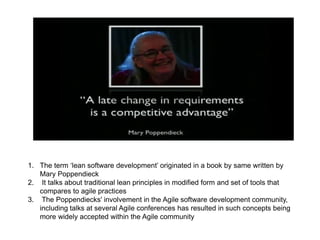
1. The term ‘lean software development’ originated in a book by same written by
Mary Poppendieck
2. It talks about traditional lean principles in modified form and set of tools that
compares to agile practices
3. The Poppendiecks' involvement in the Agile software development community,
including talks at several Agile conferences has resulted in such concepts being
more widely accepted within the Agile community
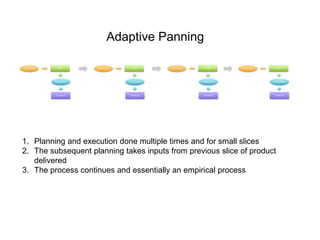
Adaptive Panning
1. Planning and execution done multiple times and for small slices
2. The subsequent planning take inputs from previous slice of product
delivered
3. The process continues and essentially an empirical process
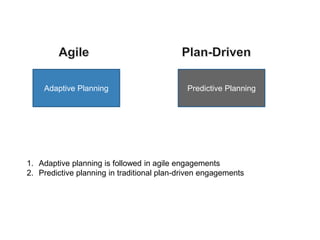
Adaptive Planning Predictive Planning
1. Adaptive planning is followed in agile engagements
2. Predictive planning in traditional plan-driven engagements
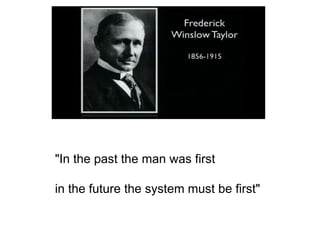
"In the past the man was first
in the future the system must be first"
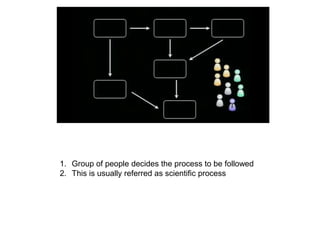
1. Group of people decides the process to be followed
2. This is usually referred as scientific process
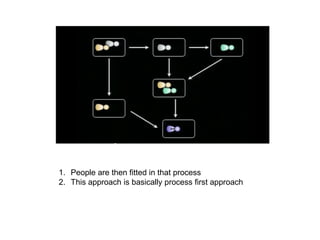
1. People are then fitted in that process
2. This approach is basically process first approach
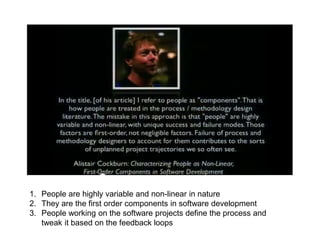
1. People are highly variable and non-linear in nature
2. They are the first order components in software development
3. People working on the software projects define the process and
tweak it based on the feedback loops
Adaptive Planning
People-first
Predictive Planning
Process-first
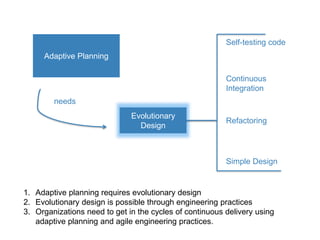
Adaptive Planning
Evolutionary
Design
needs
Self-testing code
Continuous
Integration
Refactoring
Simple Design
1. Adaptive planning requires evolutionary design
2. Evolutionary design is possible through above engineering practices
3. Organizations need to get in the cycles of continuous delivery using
adaptive planning and agile engineering practices.

Adaptive Planning in Agile

  • 1.
  • 2.
    Gartner Says SmartOrganizations Will Embrace Fast and Frequent Project Success / Failure in Their Quest for Agility Accepting higher project failure rates can help organizations become more efficient more quickly, according to Gartner, Inc. Gartner said project and portfolio management (PPM) leaders who take a "fail-forward-fast" approach that accepts high project failure rates as the norm will help their organizations become more agile by embracing experimentation and enabling the declaration of success or failure earlier in a project's life.
  • 3.
  • 5.
    1. Many bookstalk about how agile works and not why agile works 2. Discuss adaptive planning as one areas to explain why agile works in software
  • 6.
    • Semantics isthe study of meaning - http://en.wikipedia.org/wiki/Semantics • When the meaning of some word diffuses and hence semantic diffusion • Excerpt from Martin Fowler page “Semantic diffusion occurs when you have a word that is coined a person or group, often with a pretty good definition, but then gets spread through the wider community in a way that weakens that definition. This weakening risks losing the definition entirely - and with it any usefulness to the term” Semantic Diffusion
  • 7.
    Planning Plan Execution Product Plan yourwork Work your plan In the Traditional world….
  • 8.
    Predictive Planning Success = =according to plan Project is successful when the plan is met and project is delivered as per the plan
  • 9.
  • 10.
    Plan Requirements ? Stability ? dependson Up-front requirements Change control boards Sign-offs
  • 11.
    Plan Requirements Stability depends on 1. Plandepends on the stability of the requirements 2. In order to stabilize requirements, organizations do many things including a. Come up with up-front requirements that are well-defined and elaborate b. Estimate at high level & low level designs c. Set-up change control boards d. Define sign-off processes 3. The requirement changes all the time in software projects and are never stable Why not break this dependency?
  • 12.
    1. The term‘lean software development’ originated in a book by same written by Mary Poppendieck 2. It talks about traditional lean principles in modified form and set of tools that compares to agile practices 3. The Poppendiecks' involvement in the Agile software development community, including talks at several Agile conferences has resulted in such concepts being more widely accepted within the Agile community
  • 13.
    Adaptive Panning 1. Planningand execution done multiple times and for small slices 2. The subsequent planning take inputs from previous slice of product delivered 3. The process continues and essentially an empirical process
  • 14.
    Adaptive Planning PredictivePlanning 1. Adaptive planning is followed in agile engagements 2. Predictive planning in traditional plan-driven engagements
  • 15.
    "In the pastthe man was first in the future the system must be first"
  • 16.
    1. Group ofpeople decides the process to be followed 2. This is usually referred as scientific process
  • 17.
    1. People arethen fitted in that process 2. This approach is basically process first approach
  • 18.
    1. People arehighly variable and non-linear in nature 2. They are the first order components in software development 3. People working on the software projects define the process and tweak it based on the feedback loops
  • 19.
  • 20.
    Adaptive Planning Evolutionary Design needs Self-testing code Continuous Integration Refactoring SimpleDesign 1. Adaptive planning requires evolutionary design 2. Evolutionary design is possible through above engineering practices 3. Organizations need to get in the cycles of continuous delivery using adaptive planning and agile engineering practices.