HOW TO AVOID
PROJECT
TRAIN WRECKS 
Pete Luan, Pete Luan & Associates LLC 
April 2016  •   Oil and Gas Facilities 11
W
hy do we as an industry do so poorly in
executing large capital projects?
There are a whole series of reasons for
this poor performance, and oil and gas is
not the only industry affected. One sees the same issues in
public works projects, information technology projects, and
mining, etc. Any and all capital-intensive industries suffer
the same challenges.
As a consultant who has reviewed hundreds of projects,
I see many of the same issues repeating themselves. Many
of the projects that I review exceed USD 1 billion, which are
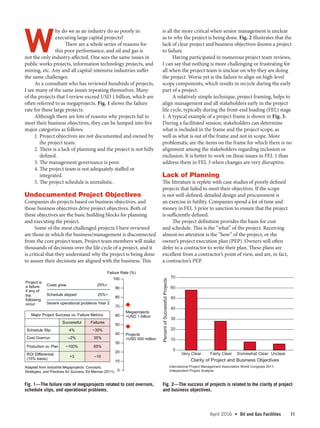
often referred to as megaprojects. Fig. 1 shows the failure
rate for these large projects.
Although there are lots of reasons why projects fail to
meet their business objectives, they can be lumped into five
major categories as follows:
1. Project objectives are not documented and owned by
the project team.
2. There is a lack of planning and the project is not fully
defined.
3. The management governance is poor.
4. The project team is not adequately staffed or
integrated.
5. The project schedule is unrealistic.
Undocumented Project Objectives
Companies do projects based on business objectives, and
those business objectives drive project objectives. Both of
these objectives are the basic building blocks for planning
and executing the project.
Some of the most challenged projects I have reviewed
are those in which the business/management is disconnected
from the core project team. Project team members will make
thousands of decisions over the life cycle of a project, and it
is critical that they understand why the project is being done
to assure their decisions are aligned with the business. This
is all the more critical when senior management is unclear
as to why the project is being done. Fig. 2 illustrates that the
lack of clear project and business objectives dooms a project
to failure.
Having participated in numerous project team reviews,
I can say that nothing is more challenging or frustrating for
all when the project team is unclear on why they are doing
the project. Worse yet is the failure to align on high-level
scope components, which results in recycle during the early
part of a project.
A relatively simple technique, project framing, helps to
align management and all stakeholders early in the project
life cycle, typically during the front-end loading (FEL) stage
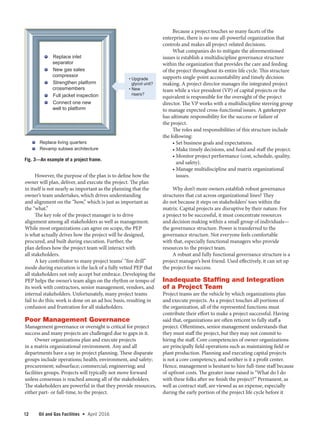
1. A typical example of a project frame is shown in Fig. 3.
During a facilitated session, stakeholders can determine
what is included in the frame and the project scope, as
well as what is out of the frame and not in scope. More
problematic are the items on the frame for which there is no
alignment among the stakeholders regarding inclusion or
exclusion. It is better to work on these issues in FEL 1 than
address them in FEL 3 when changes are very disruptive.
Lack of Planning
The literature is replete with case studies of poorly defined
projects that failed to meet their objectives. If the scope
is not well-defined, detailed design and procurement is
an exercise in futility. Companies spend a lot of time and
money in FEL 3 prior to sanction to ensure that the project
is sufficiently defined.
The project definition provides the basis for cost
and schedule. This is the “what” of the project. Receiving
almost no attention is the “how” of the project, or the
owner’s project execution plan (PEP). Owners will often
defer to a contractor to write their plan. These plans are
excellent from a contractor’s point of view, and are, in fact,
a contractor’s PEP.
Fig. 1—The failure rate of megaprojects related to cost overruns,
schedule slips, and operational problems.
Fig. 2—The success of projects is related to the clarity of project
and business objectives.
Project is
a failure
if any of
the
following
occur
Costs grew 25%+
Schedule slipped 25%+
Severe operational problems Year 2
100
90
80
70
60
50
40
30
20
10
0
Megaprojects
USD 1 billion
Projects
USD 500 million
Failure Rate (%)
Adapted from Industrial Megaprojects: Concepts,
Strategies, and Practices for Success, Ed Merrow (2011).
Major Project Success vs. Failure Metrics
Successful Failures
Schedule Slip 4% ~30%
Cost Overrun –2% 35%
Production vs. Plan ~100% 65%
ROI Differential
(15% basis)
+3 –10
0
10
20
30
40
50
60
70
Very Clear Fairly Clear Somewhat Clear Unclear
PercentofSuccessfulProjects
Clarity of Project and Business Objectives
International Project Management Association World Congress 2011;
Independent Project Analysis
12 Oil and Gas Facilities  •   April 2016
However, the purpose of the plan is to define how the
owner will plan, deliver, and execute the project. The plan
in itself is not nearly as important as the planning that the
owner’s team undertakes, which drives understanding
and alignment on the “how,” which is just as important as
the “what.”
The key role of the project manager is to drive
alignment among all stakeholders as well as management.
While most organizations can agree on scope, the PEP
is what actually drives how the project will be designed,
procured, and built during execution. Further, the
plan defines how the project team will interact with
all stakeholders.
A key contributor to many project teams’ “fire drill”
mode during execution is the lack of a fully vetted PEP that
all stakeholders not only accept but embrace. Developing the
PEP helps the owner’s team align on the rhythm or tempo of
its work with contractors, senior management, vendors, and
internal stakeholders. Unfortunately, many project teams
fail to do this; work is done on an ad hoc basis, resulting in
confusion and frustration for all stakeholders.
Poor Management Governance
Management governance or oversight is critical for project
success and many projects are challenged due to gaps in it.
Owner organizations plan and execute projects
in a matrix organizational environment. Any and all
departments have a say in project planning. These disparate
groups include operations; health, environment, and safety;
procurement; subsurface; commercial; engineering; and
facilities groups. Projects will typically not move forward
unless consensus is reached among all of the stakeholders.
The stakeholders are powerful in that they provide resources,
either part- or full-time, to the project.
Because a project touches so many facets of the
enterprise, there is no one all-powerful organization that
controls and makes all project-related decisions.
What companies do to mitigate the aforementioned
issues is establish a multidiscipline governance structure
within the organization that provides the care and feeding
of the project throughout its entire life cycle. This structure
supports single-point accountability and timely decision
making. A project director manages the integrated project
team while a vice president (VP) of capital projects or the
equivalent is responsible for the oversight of the project
director. The VP works with a multidiscipline steering group
to manage expected cross-functional issues. A gatekeeper
has ultimate responsibility for the success or failure of
the project.
The roles and responsibilities of this structure include
the following:
• Set business goals and expectations.
• Make timely decisions, and fund and staff the project.
• Monitor project performance (cost, schedule, quality,
and safety).
• Manage multidiscipline and matrix organizational
issues.
Why don’t more owners establish robust governance
structures that cut across organizational lines? They
do not because it steps on stakeholders’ toes within the
matrix. Capital projects are disruptive by their nature. For
a project to be successful, it must concentrate resources
and decision making within a small group of individuals—
the governance structure. Power is transferred to the
governance structure. Not everyone feels comfortable
with that, especially functional managers who provide
resources to the project team.
A robust and fully functional governance structure is a
project manager’s best friend. Used effectively, it can set up
the project for success.
Inadequate Staffing and Integration
of a Project Team
Project teams are the vehicle by which organizations plan
and execute projects. As a project touches all portions of
the organization, all of the represented functions must
contribute their effort to make a project successful. Having
said that, organizations are often reticent to fully staff a
project. Oftentimes, senior management understands that
they must staff the project, but they may not commit to
hiring the staff. Core competencies of owner organizations
are principally field operations such as maintaining field or
plant production. Planning and executing capital projects
is not a core competency, and neither is it a profit center.
Hence, management is hesitant to hire full-time staff because
of upfront costs. The greater issue raised is “What do I do
with these folks after we finish the project?” Permanent, as
well as contract staff, are viewed as an expense, especially
during the early portion of the project life cycle before it
Replace inlet
separator
New gas sales
compressor
Strengthen platform
crossmembers
Full jacket inspection
Connect one new
well to platform
Replace living quarters
Revamp subsea architecture
 • Upgrade
glycol unit?
 • New
risers?
Fig. 3—An example of a project frame.
April 2016  •   Oil and Gas Facilities 13
is approved and project staff can be capitalized as opposed
to expensed.
I am aware of several projects that are USD 500 million-
plus in which the owner attempts to manage the project
from the FEL 2 into the Execute stages with only one
or two individuals. Although this is possible, the owner
surrenders all control of the project outcome to the
contractor. Benchmarking data indicate a severe operability
penalty when the project is developed with minimal owner
input. Operability issues have the most impact on project
economics as they cripple cash flow.
In my review of capital projects, I have not seen an
owner’s project team that is overstaffed. In general, upstream
projects tend to be understaffed, and often key disciplines
are missing. Unfortunately, companies incur a severe cost
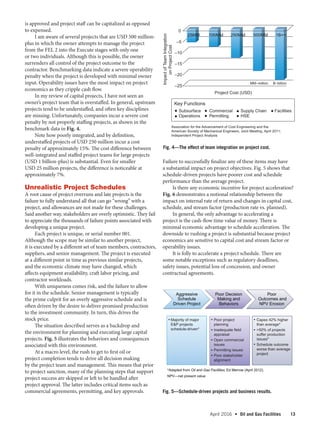
penalty by not properly staffing projects, as shown in the
benchmark data in Fig. 4.
Note how poorly integrated, and by definition,
understaffed projects of USD 250 million incur a cost
penalty of approximately 15%. The cost difference between
well-integrated and staffed project teams for large projects
(USD 1 billion-plus) is substantial. Even for smaller
USD 25 million projects, the difference is noticeable at
approximately 7%.
Unrealistic Project Schedules
A root cause of project overruns and late projects is the
failure to fully understand all that can go “wrong” with a
project, and allowances are not made for these challenges.
Said another way, stakeholders are overly optimistic. They fail
to appreciate the thousands of failure points associated with
developing a unique project.
Each project is unique, or serial number 001.
Although the scope may be similar to another project,
it is executed by a different set of team members, contractors,
suppliers, and senior management. The project is executed
at a different point in time as previous similar projects,
and the economic climate may have changed, which
affects equipment availability, craft labor pricing, and
contractor workloads.
With uniqueness comes risk, and the failure to allow
for it in the schedule. Senior management is typically
the prime culprit for an overly aggressive schedule and is
often driven by the desire to deliver promised production
to the investment community. In turn, this drives the
stock price.
The situation described serves as a backdrop and
the environment for planning and executing large capital
projects. Fig. 5 illustrates the behaviors and consequences
associated with this environment.
At a macro level, the rush to get to first oil or
project completion tends to drive all decision making
by the project team and management. This means that prior
to project sanction, many of the planning steps that support
project success are skipped or left to be handled after
project approval. The latter includes critical items such as
commercial agreements, permitting, and key approvals.
Failure to successfully finalize any of these items may have
a substantial impact on project objectives. Fig. 5 shows that
schedule-driven projects have poorer cost and schedule
performance than the average project.
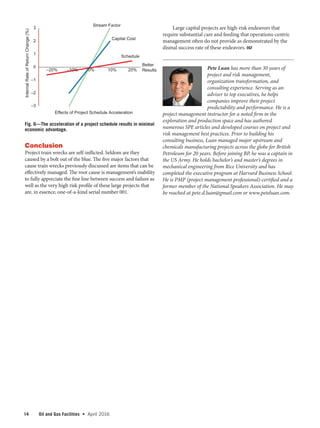
Is there any economic incentive for project acceleration?
Fig. 6 demonstrates a notional relationship between the
impact on internal rate of return and changes in capital cost,
schedule, and stream factor (production rate vs. planned).
In general, the only advantage to accelerating a
project is the cash-flow time value of money. There is
minimal economic advantage to schedule acceleration. The
downside to rushing a project is substantial because project
economics are sensitive to capital cost and stream factor or
operability issues.
It is folly to accelerate a project schedule. There are
some notable exceptions such as regulatory deadlines,
safety issues, potential loss of concession, and owner
contractual agreements.
Aggressive
Schedule
Driven Project
Poor Decision
Making and
Behaviors
Poor
Outcomes and
NPV Erosion
• 
• 
• 
• 
•
 
•
 
•
 
•
 
• 
*Adapted from Oil and Gas Facilities, Ed Merrow (April 2012).
NPV—net present value
Majority of major
EP projects
schedule-driven*
Poor project
planning
Inadequate field
appraisal
Open commercial
issues
Permitting issues
Poor stakeholder
alignment
Capex 42% higher
than average*
50% of projects
suffer production
issues*
Schedule outcome
worse than average
project
Fig. 4—The effect of team integration on project cost.
Fig. 5—Schedule-driven projects and business results.
–25
–20
–15
–10
–5
0
25MM 100MM 250MM 500MM 1B++
ImpactofTeamIntegration
onProjectCost
Project Cost (USD)
MM–million B–billion
Association for the Advancement of Cost Engineering and the
American Society of Mechanical Engineers, Joint Meeting, April 2011;
Independent Project Analysis
Key Functions
 Subsurface
 Operations
  Commercial
  Permitting
 Supply Chain
 HSE
 Facilities
14 Oil and Gas Facilities  •   April 2016
Conclusion
Project train wrecks are self-inflicted. Seldom are they
caused by a bolt out of the blue. The five major factors that
cause train wrecks previously discussed are items that can be
effectively managed. The root cause is management’s inability
to fully appreciate the fine line between success and failure as
well as the very high risk profile of these large projects that
are, in essence, one-of-a-kind serial number 001.
Large capital projects are high-risk endeavors that
require substantial care and feeding that operations-centric
management often do not provide as demonstrated by the
dismal success rate of these endeavors. OGF
Pete Luan has more than 30 years of
project and risk management,
organization transformation, and
consulting experience. Serving as an
adviser to top executives, he helps
companies improve their project
predictability and performance. He is a
project management instructor for a noted firm in the
exploration and production space and has authored
numerous SPE articles and developed courses on project and
risk management best practices. Prior to building his
consulting business, Luan managed major upstream and
chemicals manufacturing projects across the globe for British
Petroleum for 20 years. Before joining BP, he was a captain in
the US Army. He holds bachelor’s and master’s degrees in
mechanical engineering from Rice University and has
completed the executive program at Harvard Business School.
He is PMP (project management professional)-certified and a
former member of the National Speakers Association. He may
be reached at pete.d.luan@gmail.com or www.peteluan.com.
–3
–2
–1
0
1
2
3
–20% 10% 20%
InternalRateofReturnChange(%)
Effects of Project Schedule Acceleration
Better
Results
Schedule
Capital Cost
Stream Factor
–10% 0%
Fig. 6—The acceleration of a project schedule results in minimal
economic advantage.

How to Avoid Project Train Wrecks

  • 1.
    HOW TO AVOID PROJECT TRAINWRECKS  Pete Luan, Pete Luan & Associates LLC 
  • 2.
    April 2016  •   Oiland Gas Facilities 11 W hy do we as an industry do so poorly in executing large capital projects? There are a whole series of reasons for this poor performance, and oil and gas is not the only industry affected. One sees the same issues in public works projects, information technology projects, and mining, etc. Any and all capital-intensive industries suffer the same challenges. As a consultant who has reviewed hundreds of projects, I see many of the same issues repeating themselves. Many of the projects that I review exceed USD 1 billion, which are often referred to as megaprojects. Fig. 1 shows the failure rate for these large projects. Although there are lots of reasons why projects fail to meet their business objectives, they can be lumped into five major categories as follows: 1. Project objectives are not documented and owned by the project team. 2. There is a lack of planning and the project is not fully defined. 3. The management governance is poor. 4. The project team is not adequately staffed or integrated. 5. The project schedule is unrealistic. Undocumented Project Objectives Companies do projects based on business objectives, and those business objectives drive project objectives. Both of these objectives are the basic building blocks for planning and executing the project. Some of the most challenged projects I have reviewed are those in which the business/management is disconnected from the core project team. Project team members will make thousands of decisions over the life cycle of a project, and it is critical that they understand why the project is being done to assure their decisions are aligned with the business. This is all the more critical when senior management is unclear as to why the project is being done. Fig. 2 illustrates that the lack of clear project and business objectives dooms a project to failure. Having participated in numerous project team reviews, I can say that nothing is more challenging or frustrating for all when the project team is unclear on why they are doing the project. Worse yet is the failure to align on high-level scope components, which results in recycle during the early part of a project. A relatively simple technique, project framing, helps to align management and all stakeholders early in the project life cycle, typically during the front-end loading (FEL) stage 1. A typical example of a project frame is shown in Fig. 3. During a facilitated session, stakeholders can determine what is included in the frame and the project scope, as well as what is out of the frame and not in scope. More problematic are the items on the frame for which there is no alignment among the stakeholders regarding inclusion or exclusion. It is better to work on these issues in FEL 1 than address them in FEL 3 when changes are very disruptive. Lack of Planning The literature is replete with case studies of poorly defined projects that failed to meet their objectives. If the scope is not well-defined, detailed design and procurement is an exercise in futility. Companies spend a lot of time and money in FEL 3 prior to sanction to ensure that the project is sufficiently defined. The project definition provides the basis for cost and schedule. This is the “what” of the project. Receiving almost no attention is the “how” of the project, or the owner’s project execution plan (PEP). Owners will often defer to a contractor to write their plan. These plans are excellent from a contractor’s point of view, and are, in fact, a contractor’s PEP. Fig. 1—The failure rate of megaprojects related to cost overruns, schedule slips, and operational problems. Fig. 2—The success of projects is related to the clarity of project and business objectives. Project is a failure if any of the following occur Costs grew 25%+ Schedule slipped 25%+ Severe operational problems Year 2 100 90 80 70 60 50 40 30 20 10 0 Megaprojects USD 1 billion Projects USD 500 million Failure Rate (%) Adapted from Industrial Megaprojects: Concepts, Strategies, and Practices for Success, Ed Merrow (2011). Major Project Success vs. Failure Metrics Successful Failures Schedule Slip 4% ~30% Cost Overrun –2% 35% Production vs. Plan ~100% 65% ROI Differential (15% basis) +3 –10 0 10 20 30 40 50 60 70 Very Clear Fairly Clear Somewhat Clear Unclear PercentofSuccessfulProjects Clarity of Project and Business Objectives International Project Management Association World Congress 2011; Independent Project Analysis
  • 3.
    12 Oil andGas Facilities  •   April 2016 However, the purpose of the plan is to define how the owner will plan, deliver, and execute the project. The plan in itself is not nearly as important as the planning that the owner’s team undertakes, which drives understanding and alignment on the “how,” which is just as important as the “what.” The key role of the project manager is to drive alignment among all stakeholders as well as management. While most organizations can agree on scope, the PEP is what actually drives how the project will be designed, procured, and built during execution. Further, the plan defines how the project team will interact with all stakeholders. A key contributor to many project teams’ “fire drill” mode during execution is the lack of a fully vetted PEP that all stakeholders not only accept but embrace. Developing the PEP helps the owner’s team align on the rhythm or tempo of its work with contractors, senior management, vendors, and internal stakeholders. Unfortunately, many project teams fail to do this; work is done on an ad hoc basis, resulting in confusion and frustration for all stakeholders. Poor Management Governance Management governance or oversight is critical for project success and many projects are challenged due to gaps in it. Owner organizations plan and execute projects in a matrix organizational environment. Any and all departments have a say in project planning. These disparate groups include operations; health, environment, and safety; procurement; subsurface; commercial; engineering; and facilities groups. Projects will typically not move forward unless consensus is reached among all of the stakeholders. The stakeholders are powerful in that they provide resources, either part- or full-time, to the project. Because a project touches so many facets of the enterprise, there is no one all-powerful organization that controls and makes all project-related decisions. What companies do to mitigate the aforementioned issues is establish a multidiscipline governance structure within the organization that provides the care and feeding of the project throughout its entire life cycle. This structure supports single-point accountability and timely decision making. A project director manages the integrated project team while a vice president (VP) of capital projects or the equivalent is responsible for the oversight of the project director. The VP works with a multidiscipline steering group to manage expected cross-functional issues. A gatekeeper has ultimate responsibility for the success or failure of the project. The roles and responsibilities of this structure include the following: • Set business goals and expectations. • Make timely decisions, and fund and staff the project. • Monitor project performance (cost, schedule, quality, and safety). • Manage multidiscipline and matrix organizational issues. Why don’t more owners establish robust governance structures that cut across organizational lines? They do not because it steps on stakeholders’ toes within the matrix. Capital projects are disruptive by their nature. For a project to be successful, it must concentrate resources and decision making within a small group of individuals— the governance structure. Power is transferred to the governance structure. Not everyone feels comfortable with that, especially functional managers who provide resources to the project team. A robust and fully functional governance structure is a project manager’s best friend. Used effectively, it can set up the project for success. Inadequate Staffing and Integration of a Project Team Project teams are the vehicle by which organizations plan and execute projects. As a project touches all portions of the organization, all of the represented functions must contribute their effort to make a project successful. Having said that, organizations are often reticent to fully staff a project. Oftentimes, senior management understands that they must staff the project, but they may not commit to hiring the staff. Core competencies of owner organizations are principally field operations such as maintaining field or plant production. Planning and executing capital projects is not a core competency, and neither is it a profit center. Hence, management is hesitant to hire full-time staff because of upfront costs. The greater issue raised is “What do I do with these folks after we finish the project?” Permanent, as well as contract staff, are viewed as an expense, especially during the early portion of the project life cycle before it Replace inlet separator New gas sales compressor Strengthen platform crossmembers Full jacket inspection Connect one new well to platform Replace living quarters Revamp subsea architecture  • Upgrade glycol unit?  • New risers? Fig. 3—An example of a project frame.
  • 4.
    April 2016  •   Oiland Gas Facilities 13 is approved and project staff can be capitalized as opposed to expensed. I am aware of several projects that are USD 500 million- plus in which the owner attempts to manage the project from the FEL 2 into the Execute stages with only one or two individuals. Although this is possible, the owner surrenders all control of the project outcome to the contractor. Benchmarking data indicate a severe operability penalty when the project is developed with minimal owner input. Operability issues have the most impact on project economics as they cripple cash flow. In my review of capital projects, I have not seen an owner’s project team that is overstaffed. In general, upstream projects tend to be understaffed, and often key disciplines are missing. Unfortunately, companies incur a severe cost penalty by not properly staffing projects, as shown in the benchmark data in Fig. 4. Note how poorly integrated, and by definition, understaffed projects of USD 250 million incur a cost penalty of approximately 15%. The cost difference between well-integrated and staffed project teams for large projects (USD 1 billion-plus) is substantial. Even for smaller USD 25 million projects, the difference is noticeable at approximately 7%. Unrealistic Project Schedules A root cause of project overruns and late projects is the failure to fully understand all that can go “wrong” with a project, and allowances are not made for these challenges. Said another way, stakeholders are overly optimistic. They fail to appreciate the thousands of failure points associated with developing a unique project. Each project is unique, or serial number 001. Although the scope may be similar to another project, it is executed by a different set of team members, contractors, suppliers, and senior management. The project is executed at a different point in time as previous similar projects, and the economic climate may have changed, which affects equipment availability, craft labor pricing, and contractor workloads. With uniqueness comes risk, and the failure to allow for it in the schedule. Senior management is typically the prime culprit for an overly aggressive schedule and is often driven by the desire to deliver promised production to the investment community. In turn, this drives the stock price. The situation described serves as a backdrop and the environment for planning and executing large capital projects. Fig. 5 illustrates the behaviors and consequences associated with this environment. At a macro level, the rush to get to first oil or project completion tends to drive all decision making by the project team and management. This means that prior to project sanction, many of the planning steps that support project success are skipped or left to be handled after project approval. The latter includes critical items such as commercial agreements, permitting, and key approvals. Failure to successfully finalize any of these items may have a substantial impact on project objectives. Fig. 5 shows that schedule-driven projects have poorer cost and schedule performance than the average project. Is there any economic incentive for project acceleration? Fig. 6 demonstrates a notional relationship between the impact on internal rate of return and changes in capital cost, schedule, and stream factor (production rate vs. planned). In general, the only advantage to accelerating a project is the cash-flow time value of money. There is minimal economic advantage to schedule acceleration. The downside to rushing a project is substantial because project economics are sensitive to capital cost and stream factor or operability issues. It is folly to accelerate a project schedule. There are some notable exceptions such as regulatory deadlines, safety issues, potential loss of concession, and owner contractual agreements. Aggressive Schedule Driven Project Poor Decision Making and Behaviors Poor Outcomes and NPV Erosion •  •  •  •  •   •   •   •   •  *Adapted from Oil and Gas Facilities, Ed Merrow (April 2012). NPV—net present value Majority of major EP projects schedule-driven* Poor project planning Inadequate field appraisal Open commercial issues Permitting issues Poor stakeholder alignment Capex 42% higher than average* 50% of projects suffer production issues* Schedule outcome worse than average project Fig. 4—The effect of team integration on project cost. Fig. 5—Schedule-driven projects and business results. –25 –20 –15 –10 –5 0 25MM 100MM 250MM 500MM 1B++ ImpactofTeamIntegration onProjectCost Project Cost (USD) MM–million B–billion Association for the Advancement of Cost Engineering and the American Society of Mechanical Engineers, Joint Meeting, April 2011; Independent Project Analysis Key Functions  Subsurface  Operations   Commercial   Permitting  Supply Chain  HSE  Facilities
  • 5.
    14 Oil andGas Facilities  •   April 2016 Conclusion Project train wrecks are self-inflicted. Seldom are they caused by a bolt out of the blue. The five major factors that cause train wrecks previously discussed are items that can be effectively managed. The root cause is management’s inability to fully appreciate the fine line between success and failure as well as the very high risk profile of these large projects that are, in essence, one-of-a-kind serial number 001. Large capital projects are high-risk endeavors that require substantial care and feeding that operations-centric management often do not provide as demonstrated by the dismal success rate of these endeavors. OGF Pete Luan has more than 30 years of project and risk management, organization transformation, and consulting experience. Serving as an adviser to top executives, he helps companies improve their project predictability and performance. He is a project management instructor for a noted firm in the exploration and production space and has authored numerous SPE articles and developed courses on project and risk management best practices. Prior to building his consulting business, Luan managed major upstream and chemicals manufacturing projects across the globe for British Petroleum for 20 years. Before joining BP, he was a captain in the US Army. He holds bachelor’s and master’s degrees in mechanical engineering from Rice University and has completed the executive program at Harvard Business School. He is PMP (project management professional)-certified and a former member of the National Speakers Association. He may be reached at pete.d.luan@gmail.com or www.peteluan.com. –3 –2 –1 0 1 2 3 –20% 10% 20% InternalRateofReturnChange(%) Effects of Project Schedule Acceleration Better Results Schedule Capital Cost Stream Factor –10% 0% Fig. 6—The acceleration of a project schedule results in minimal economic advantage.