Immunomodulators
(immunosuppressant)
Dr. S. Parasuraman, M. Pharm., Ph.D.,
Associate Professor,
Faculty of Pharmacy, AIMST University,
Malaysia.
Learning Outcomes
At the end of this session, the student would be able
to:
• classify immunosuppressant agents. (CLO1)
• explain the mechanism of action and
pharmacokinetics for each immunosuppressant
agent. (CLO1 & CLO2)
• list the adverse effects of immunosuppressant
agents. (CLO1 & CLO2)
2
Immunosuppressants
• The importance of the immune system in protecting the
body against harmful foreign molecules is well recognized.
The immune system is one of the most complex organ
systems in the body, which can make it difficult to
manipulate.
• Immunosuppressants are drugs which inhibit
cellular/humoral or both types of immune responses and
have their major use in organ transplantation and
autoimmune diseases.
3
Major classes of immunosuppressive drugs
• Calcineurin inhibitors: Cyclosporine, Tacrolimus
• Mammalian target of rapamycin (m-TOR) inhibitors: sirolimus,
Everolimus, temsirolimus
• Antiproliferative/antimetabolic agents: Azathioprine,
Methotrexate, Cyclophosphamide, Chlorambucil, Mycophenolate
• Glucocorticoids: Prednisolone
• Biologicals (antibodies)
• TNF-alpha inhibitors: Etanercept, Infliximab, Adalimumab
• IL-1 receptor antagonist: Anakinra
• IL-2 receptor antagonists: Basiliximab, Daclizumab
• Anti-CD3 antibody: Muromonab-CD3
• Polyclonal antibodies: Antithymocyte antibody, Rho(D) immune globulin
4
Calcineurin Inhibitors
• The most effective immunosuppressive drugs in routine use are
the calcineurin inhibitors cyclosporine and tacrolimus, which
target intracellular signaling pathways induced as a consequence
of TCR activation
5
Calcineurin Inhibitors - Cyclosporine
• It is a highly selective immunosuppressant which markedly
increased the success of organ transplantations. Cyclosporine is a
highly effective drug for prevention of graft rejection reaction.
• MoA: Cyclosporine selectively inhibits T lymphocyte proliferation,
IL-2 and other cytokine production, without any effect on
suppressor T-cells.
• Dose: 10–15 mg/kg/day with milk or fruit juice till 1–2 weeks
after transplantation, gradually reduced to maintenance dose of
2–6 mg/kg/day. Therapy may be started with 3–5 mg/kg i.v.
infusion.
6
Calcineurin Inhibitors - Tacrolimus
MOA: Tacrolimus bonds to an
immunophilin, FK506 binding protein (FKBP).
This complex inhibits calcineurin
phosphatase. The drug inhibits calcium-
dependent events, such as IL-2 gene
transcription, nitric oxide synthase activation,
cell degranulation, and apoptosis. As a result,
T lymphocyte activation is inhibited.
Tacrolimus is 10 to 100 times more potent
than cyclosporine in its immunosuppressive
effects.
7
• Ref: Fung JJ. Tacrolimus and transplantation: a decade in review. Transplantation 2004;77:S41.
https://abdominalkey.com/calcineurin-inhibitors/
Calcineurin Inhibitors - Tacrolimus
• PK: Tacrolimus is administered orally as well as by i.v.
infusion. It is metabolized by CYP3A4 and excreted in bile
with a t½ of 12 hours.
• Therapeutic Uses: Prophylaxis of solid-organ allograft
rejection, used in fistulating Crohn’s disease, topically it is
useful in atopic dermatitis
• Toxicity. Nephrotoxicity; neurotoxicity (e.g., tremor,
headache, motor disturbances, seizures); GI complaints;
hypertension; hyperkalemia; hyperglycemia; and diabetes.
8
m-TOR inhibitors- Sirolimus
• Sirolimus (rapamycin) is a macrocyclic lactone. It is a newer
and potent immunosuppressant.
• MoA: Sirolimus inhibits T-lymphocyte activation and
proliferation downstream of the IL-2 and other T-cell growth
factor receptors.
• Therapeutic Uses. Sirolimus is indicated for prophylaxis of
organ transplant rejection, usually in combination with a
reduced dose of calcineurin inhibitor and glucocorticoids.
• Toxicity: Dose-dependent increase in serum cholesterol and
triglycerides. Sirolimus can worsen proteinuria and should be
used with caution in patients with GFR below 30% or
proteinuria. Other ADR includes anemia, leukopenia,
thrombocytopenia, mouth ulcer, hypokalemia, and GI effects
9
m-TOR inhibitors – Everolimus, Temsirolimus
• Everolimus is chemically closely related to sirolimus. It
is approved for treatment of astrocytoma, breast
cancer, kidney and liver transplant rejection
prophylaxis, pancreatic neuroendocrine tumor, renal
angiomyolipoma, and renal cell cancer
• Temsirolimus is an ester analogue of sirolimus is
converted in the body to sirolimus. Temsirolimus is
approved for use in advanced renal cell carcinoma and
in refractory mantle cell lymphoma. Dose: 25 mg i.v.
weekly.
10
Antiproliferative/antimetabolic agents
• Azathioprine: It is a purine antimetabolite which has
more marked immunosuppressant than antitumour
action. It is a prodrug that is converted first to 6-
mercaptopurine (6-MP) and then to the corresponding
nucleotide analog, thioinosinic acid. The analog is
incorporated into nucleic acid chains and blocks further
elongation of the DNA.
• Methotrexate: It is a folate antagonist and have potent
immunosuppressant and anti-inflammatory properties.
11
Antiproliferative/antimetabolic agents
• Cyclophosphamide: This cytotoxic drug has more
marked effect on B cells and humoral immunity
compared to that on T cells and CMI. It has been
particularly utilized in bone marrow transplantation.
• Mycophenolate: This immunosuppressant is a prodrug
of mycophenolic acid which selectively inhibits inosine
monophosphate dehydrogenase, an enzyme essential
for de novo synthesis of guanosine nucleotides in the T
and B cells
12
Glucocorticoids
• Glucocorticoids have potent immunosuppressant and
antiinflammatory action. They inhibit several
components of the immune response. They particularly
inhibit major histocompatibility complex (MHC)
expression.
• They are used in all cases of severe autoimmune
diseases, especially during exacerbation.
13
Biological agents
• These are biotechnologically produced recombinant
proteins or polyclonal/monoclonal antibodies directed
to cytokines or lymphocyte surface antigens which play
a key role in immune response.
• They are important recent additions, mostly as
supplementary or reserve drugs for severe and
refractory cases of autoimmune diseases and graft
versus host reaction.
14
Biological agents
15
Class Drug MoA Use
TNF-alpha
inhibitors
Etanercept Neutralizes both
TNFα and TNFβ
To treat rheumatoid
arthritis in
combination
with Mtx
Infliximab Against
TNFα which binds
and inactivates
TNFα
refractory
rheumatoid arthritis,
fistulating Crohn’s
disease, ulcerative
colitis, psoriasis and
ankylosing spondylitis
Adalimumab Autoimmune
diseases
Biological agents
16
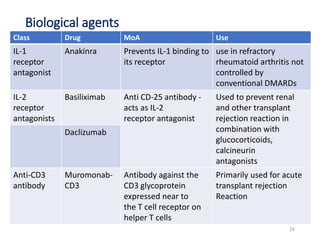
Class Drug MoA Use
IL-1
receptor
antagonist
Anakinra Prevents IL-1 binding to
its receptor
use in refractory
rheumatoid arthritis not
controlled by
conventional DMARDs
IL-2
receptor
antagonists
Basiliximab Anti CD-25 antibody -
acts as IL-2
receptor antagonist
Used to prevent renal
and other transplant
rejection reaction in
combination with
glucocorticoids,
calcineurin
antagonists
Daclizumab
Anti-CD3
antibody
Muromonab-
CD3
Antibody against the
CD3 glycoprotein
expressed near to
the T cell receptor on
helper T cells
Primarily used for acute
transplant rejection
Reaction
Biological agents
17
Class Drug MoA Use
Polyclonal
antibodies
Antithymocyte
antibody
Binds to T
lymphocytes
Primarily to suppress
acute allograft rejection
episodes, especially in
steroid resistant
cases.
Rho(D) immune
globulin
It binds the Rho
antigens and does
not allow them to
induce antibody
formation in Rh
negative individuals
Used for prevention
of postpartum/post-
abortion formation
of antibodies in Rho-D
negative, DU negative
women who have
delivered or aborted a
Rho-D positive, DU
positive baby/foetus
Thank you
18

Immunomodulators - 2.pptx

  • 1.
    Immunomodulators (immunosuppressant) Dr. S. Parasuraman,M. Pharm., Ph.D., Associate Professor, Faculty of Pharmacy, AIMST University, Malaysia.
  • 2.
    Learning Outcomes At theend of this session, the student would be able to: • classify immunosuppressant agents. (CLO1) • explain the mechanism of action and pharmacokinetics for each immunosuppressant agent. (CLO1 & CLO2) • list the adverse effects of immunosuppressant agents. (CLO1 & CLO2) 2
  • 3.
    Immunosuppressants • The importanceof the immune system in protecting the body against harmful foreign molecules is well recognized. The immune system is one of the most complex organ systems in the body, which can make it difficult to manipulate. • Immunosuppressants are drugs which inhibit cellular/humoral or both types of immune responses and have their major use in organ transplantation and autoimmune diseases. 3
  • 4.
    Major classes ofimmunosuppressive drugs • Calcineurin inhibitors: Cyclosporine, Tacrolimus • Mammalian target of rapamycin (m-TOR) inhibitors: sirolimus, Everolimus, temsirolimus • Antiproliferative/antimetabolic agents: Azathioprine, Methotrexate, Cyclophosphamide, Chlorambucil, Mycophenolate • Glucocorticoids: Prednisolone • Biologicals (antibodies) • TNF-alpha inhibitors: Etanercept, Infliximab, Adalimumab • IL-1 receptor antagonist: Anakinra • IL-2 receptor antagonists: Basiliximab, Daclizumab • Anti-CD3 antibody: Muromonab-CD3 • Polyclonal antibodies: Antithymocyte antibody, Rho(D) immune globulin 4
  • 5.
    Calcineurin Inhibitors • Themost effective immunosuppressive drugs in routine use are the calcineurin inhibitors cyclosporine and tacrolimus, which target intracellular signaling pathways induced as a consequence of TCR activation 5
  • 6.
    Calcineurin Inhibitors -Cyclosporine • It is a highly selective immunosuppressant which markedly increased the success of organ transplantations. Cyclosporine is a highly effective drug for prevention of graft rejection reaction. • MoA: Cyclosporine selectively inhibits T lymphocyte proliferation, IL-2 and other cytokine production, without any effect on suppressor T-cells. • Dose: 10–15 mg/kg/day with milk or fruit juice till 1–2 weeks after transplantation, gradually reduced to maintenance dose of 2–6 mg/kg/day. Therapy may be started with 3–5 mg/kg i.v. infusion. 6
  • 7.
    Calcineurin Inhibitors -Tacrolimus MOA: Tacrolimus bonds to an immunophilin, FK506 binding protein (FKBP). This complex inhibits calcineurin phosphatase. The drug inhibits calcium- dependent events, such as IL-2 gene transcription, nitric oxide synthase activation, cell degranulation, and apoptosis. As a result, T lymphocyte activation is inhibited. Tacrolimus is 10 to 100 times more potent than cyclosporine in its immunosuppressive effects. 7 • Ref: Fung JJ. Tacrolimus and transplantation: a decade in review. Transplantation 2004;77:S41. https://abdominalkey.com/calcineurin-inhibitors/
  • 8.
    Calcineurin Inhibitors -Tacrolimus • PK: Tacrolimus is administered orally as well as by i.v. infusion. It is metabolized by CYP3A4 and excreted in bile with a t½ of 12 hours. • Therapeutic Uses: Prophylaxis of solid-organ allograft rejection, used in fistulating Crohn’s disease, topically it is useful in atopic dermatitis • Toxicity. Nephrotoxicity; neurotoxicity (e.g., tremor, headache, motor disturbances, seizures); GI complaints; hypertension; hyperkalemia; hyperglycemia; and diabetes. 8
  • 9.
    m-TOR inhibitors- Sirolimus •Sirolimus (rapamycin) is a macrocyclic lactone. It is a newer and potent immunosuppressant. • MoA: Sirolimus inhibits T-lymphocyte activation and proliferation downstream of the IL-2 and other T-cell growth factor receptors. • Therapeutic Uses. Sirolimus is indicated for prophylaxis of organ transplant rejection, usually in combination with a reduced dose of calcineurin inhibitor and glucocorticoids. • Toxicity: Dose-dependent increase in serum cholesterol and triglycerides. Sirolimus can worsen proteinuria and should be used with caution in patients with GFR below 30% or proteinuria. Other ADR includes anemia, leukopenia, thrombocytopenia, mouth ulcer, hypokalemia, and GI effects 9
  • 10.
    m-TOR inhibitors –Everolimus, Temsirolimus • Everolimus is chemically closely related to sirolimus. It is approved for treatment of astrocytoma, breast cancer, kidney and liver transplant rejection prophylaxis, pancreatic neuroendocrine tumor, renal angiomyolipoma, and renal cell cancer • Temsirolimus is an ester analogue of sirolimus is converted in the body to sirolimus. Temsirolimus is approved for use in advanced renal cell carcinoma and in refractory mantle cell lymphoma. Dose: 25 mg i.v. weekly. 10
  • 11.
    Antiproliferative/antimetabolic agents • Azathioprine:It is a purine antimetabolite which has more marked immunosuppressant than antitumour action. It is a prodrug that is converted first to 6- mercaptopurine (6-MP) and then to the corresponding nucleotide analog, thioinosinic acid. The analog is incorporated into nucleic acid chains and blocks further elongation of the DNA. • Methotrexate: It is a folate antagonist and have potent immunosuppressant and anti-inflammatory properties. 11
  • 12.
    Antiproliferative/antimetabolic agents • Cyclophosphamide:This cytotoxic drug has more marked effect on B cells and humoral immunity compared to that on T cells and CMI. It has been particularly utilized in bone marrow transplantation. • Mycophenolate: This immunosuppressant is a prodrug of mycophenolic acid which selectively inhibits inosine monophosphate dehydrogenase, an enzyme essential for de novo synthesis of guanosine nucleotides in the T and B cells 12
  • 13.
    Glucocorticoids • Glucocorticoids havepotent immunosuppressant and antiinflammatory action. They inhibit several components of the immune response. They particularly inhibit major histocompatibility complex (MHC) expression. • They are used in all cases of severe autoimmune diseases, especially during exacerbation. 13
  • 14.
    Biological agents • Theseare biotechnologically produced recombinant proteins or polyclonal/monoclonal antibodies directed to cytokines or lymphocyte surface antigens which play a key role in immune response. • They are important recent additions, mostly as supplementary or reserve drugs for severe and refractory cases of autoimmune diseases and graft versus host reaction. 14
  • 15.
    Biological agents 15 Class DrugMoA Use TNF-alpha inhibitors Etanercept Neutralizes both TNFα and TNFβ To treat rheumatoid arthritis in combination with Mtx Infliximab Against TNFα which binds and inactivates TNFα refractory rheumatoid arthritis, fistulating Crohn’s disease, ulcerative colitis, psoriasis and ankylosing spondylitis Adalimumab Autoimmune diseases
  • 16.
    Biological agents 16 Class DrugMoA Use IL-1 receptor antagonist Anakinra Prevents IL-1 binding to its receptor use in refractory rheumatoid arthritis not controlled by conventional DMARDs IL-2 receptor antagonists Basiliximab Anti CD-25 antibody - acts as IL-2 receptor antagonist Used to prevent renal and other transplant rejection reaction in combination with glucocorticoids, calcineurin antagonists Daclizumab Anti-CD3 antibody Muromonab- CD3 Antibody against the CD3 glycoprotein expressed near to the T cell receptor on helper T cells Primarily used for acute transplant rejection Reaction
  • 17.
    Biological agents 17 Class DrugMoA Use Polyclonal antibodies Antithymocyte antibody Binds to T lymphocytes Primarily to suppress acute allograft rejection episodes, especially in steroid resistant cases. Rho(D) immune globulin It binds the Rho antigens and does not allow them to induce antibody formation in Rh negative individuals Used for prevention of postpartum/post- abortion formation of antibodies in Rho-D negative, DU negative women who have delivered or aborted a Rho-D positive, DU positive baby/foetus
  • 18.