Non-Specific Immunity
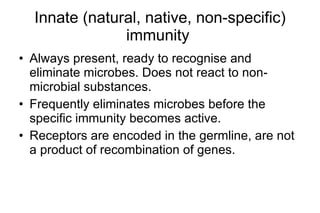
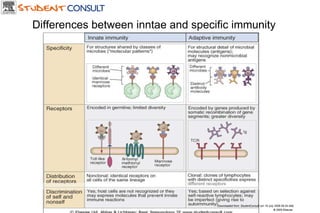
Innate (natural, native, non-specific) immunity  Always present, ready to recognise and eliminate microbes. Does not react to non-microbial substances .   Frequently eliminates microbes before the specific immunity becomes active. Receptors are encoded in the germline, are not a product of recombination of genes.
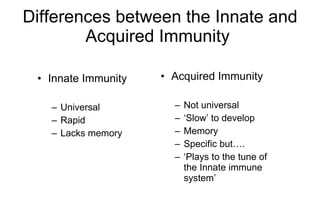
Differen ces  between the Innate and Acquired Immunity  Innate Immunity Universal Rapid Lacks memory Acquired Immunity Not universal ‘ Slow’ to develop M emory Specific but…. ‘ Plays to the tune of the Innate immune system’
Downloaded from: StudentConsult (on 19 July 2006 06:34 AM) © 2005 Elsevier  Differences between inntae and specific immunity
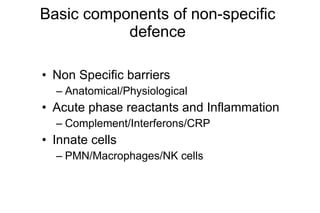
Basic components of non-specific defence Non Specific barriers Anatomical/Physiological Acute phase reactants and Inflammation Complement/Interferons/CRP Innate cells PMN/Macrophages/NK cells
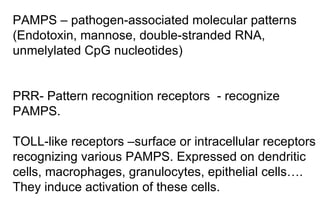
PAMPS – pathogen-associated molecular patterns ( Endotoxin , mannose, double-stranded  RNA , unmelylated CpG nucleotides )   PRR- Pattern recognition receptors  - recognize PAMPS.  TOLL-like receptors –surface or intracellular receptors recognizing  various PAMPS. Expressed on dendritic  cells, macrophages, granulocytes, epithelial cells…. They induce activation of th ese  cells.
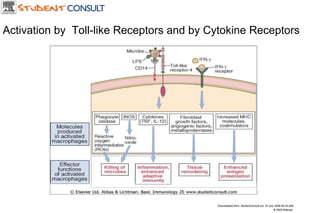
Downloaded from: StudentConsult (on 19 July 2006 06:34 AM) © 2005 Elsevier  Activation by  Toll-like Receptors and by Cytokine Receptors
The Complement System
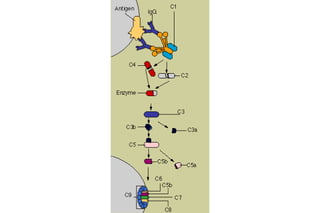
General features of the Complement System Activation Inactive, preformed protein is activated by the proteolytic cleavage.  It is cleft into the smaller part (called a) and a bigger part (called b). Usually the bigger part has also proteolytic activity, while the smaller part has various other  biological activities (chemotactic, anaphylatoxic). Co m ponent C6-C9 are activated without cleavage, they just „attach“ to the com p lex of the other com plement  components.
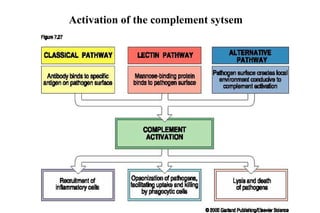
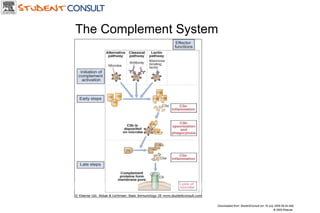
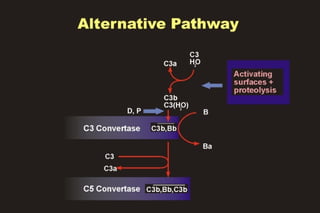
Activation of the complement sytsem
 
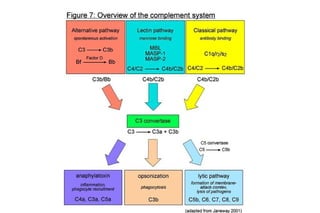
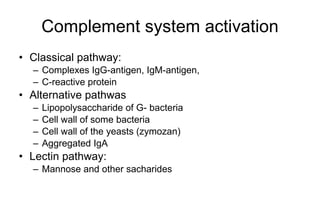
Complement  system  activation Classical pathway:  Complexes IgG-antigen, IgM-antigen,  C-reactive protein Altern a tive pathwas Lipopolysaccharide of G- bacteria Cell wall of some bacteria Cell wall of  the  yeasts (zymozan) Aggregated IgA Lectin pathway: Mannose and other sacharides
Downloaded from: StudentConsult (on 19 July 2006 06:34 AM) © 2005 Elsevier  The Complement System


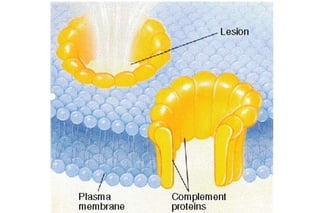
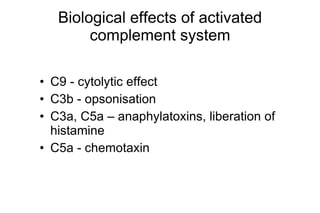
Biological effects of activated complement system C9 - cytolytic effect C3b - opsonisation C3a, C5a – anaphylatoxins, liberation of histamine C5a - chemotaxin
Phagocytosis
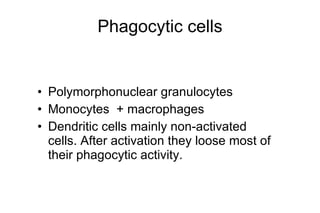
Phagocytic cells Polymorphonuclear granulocytes Monocytes  + macrophages Dendritic cells mainly non-activated  cells. After activation they loose  most  of their phagocyti c  activity.
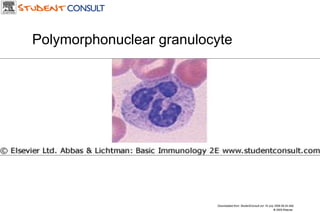
Downloaded from: StudentConsult (on 19 July 2006 06:34 AM) © 2005 Elsevier  Polymorphonuclear granulocyte
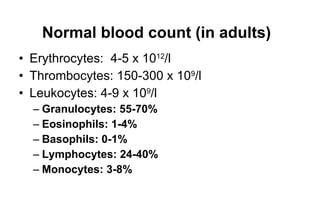
Normal blood count  (in adults) Erythrocytes:  4-5 x 10 12 /l Thrombocytes: 150-300 x 10 9 /l Leukocytes: 4-9 x 10 9 /l Granulocytes: 55-70% Eosinophils: 1-4% Basophils: 0-1% Lymphocytes: 24-40% Monocytes: 3-8%
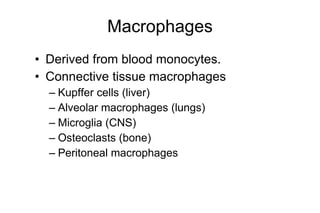
Macrophages Derived from blood monocytes. Connective tissue macrophages Kupffer cells (liver) Alveolar macrophages (lungs) Microglia (CNS) Osteoclasts (bone) Peritoneal macrophages
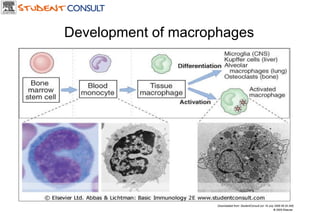
Downloaded from: StudentConsult (on 19 July 2006 06:34 AM) © 2005 Elsevier  Development of macrophages
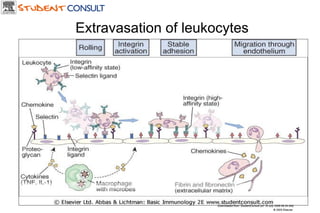
Downloaded from: StudentConsult (on 19 July 2006 06:34 AM) © 2005 Elsevier  Extravasation of leukocytes
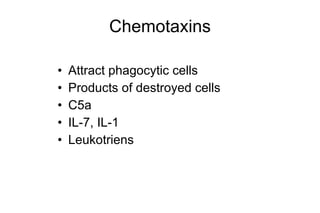
Chemotaxins Attract phagocytic cells Products of destroyed cells C5a IL-7, IL-1 Leukotriens
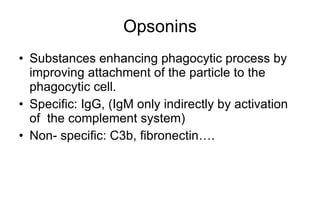
Opsonins Substances enhancing phagocytic process by improving attachment of the particle to the phagocytic cell. Spec ific : IgG, (IgM only indirectly by activation of  the complement system) Non- speci f ic: C3b, fibronectin….
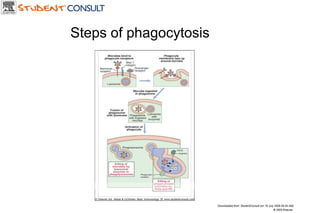
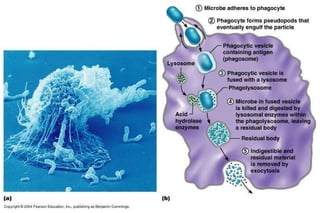
Downloaded from: StudentConsult (on 19 July 2006 06:34 AM) © 2005 Elsevier  Steps of phagocytosis
 
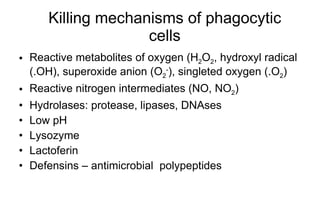
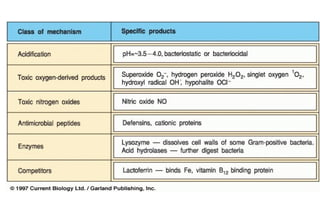
Killing mechanisms of phagocytic cells Reactive metabolites of oxygen (H 2 O 2 , hydroxyl radical (.OH), superoxide anion (O 2 - ), singleted oxygen (.O 2 ) Reactive nitroge n  intermediates (NO, NO 2 ) Hydrolases: protease,   lipases, DNAses Low pH Lysozyme Lactoferin Defensins – antimicrobial  polypeptides
 
Lysozyme Cleaves cell walls of G+ bacteria Present in granules of neutrophil granulocytes, in plasma, secretions .
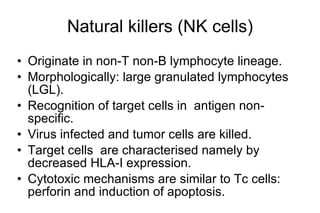
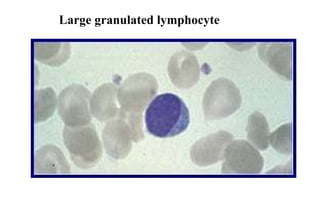
Natural killers (NK cells) Originate in non-T non-B lymphocyte lineage. Morphologically: large granulated lymphocytes (LGL). Recognition of target cells in  antigen non-speci f ic. Virus infected and tumor cells are killed. Target cells  are characterised namely by decreased HLA-I expression. Cytotoxic mechanisms are similar to Tc cells: perforin and induction of apoptosis.
Large granulated lymphocyte
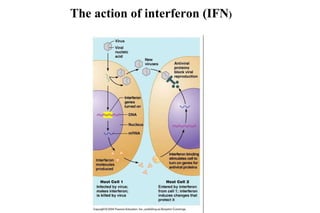
The action of interferon (IFN )
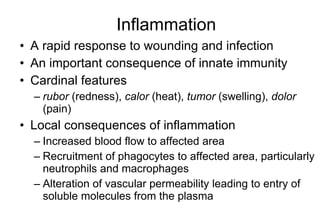
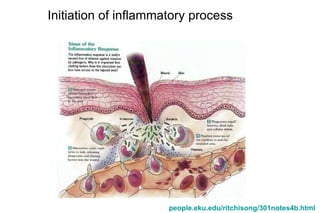
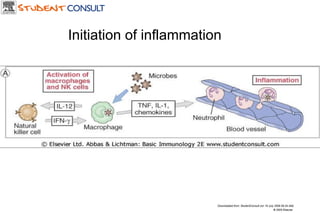
Inflammation A rapid response to wounding and infection An important consequence of innate immunity Cardinal features rubor  (redness),  calor  (heat),  tumor  (swelling),  dolor  (pain) Local consequences of inflammation   Increased blood flow to affected area Recruitment of phagocytes to affected area, particularly neutrophils and macrophages Alteration of vascular permeability leading to entry of soluble molecules from the plasma
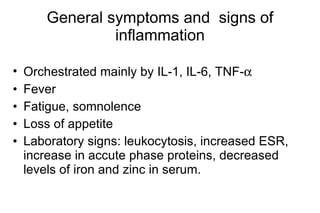
General symptoms and  signs of inflammation Orchestra t ed  mainly  by IL-1, IL-6, TNF-  Fever Fatigue, somnolence Loss of appetite Laboratory signs: leukocytosis, increased ESR, inc rease  in acc u te phase proteins, decreas e d levels of iron and zinc in serum .
Downloaded from: StudentConsult (on 19 July 2006 06:34 AM) © 2005 Elsevier  Initiation of inflammation
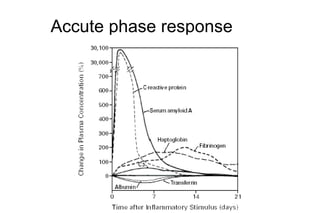
Accute-phase proteins Serum levels are increased during inflammation Produced by the liver after stimulation by IL-1, IL-6, TNF-  Best known: C-reactive protein Others: Complem e nt components, A1-AT, fibronectin..
Accute phase response
people.eku.edu/ritchisong/301notes4b.html   Initiation of inflammatory process
Drugs modulating inflammatory process Glucocorticoids Non-steroidal anti-rheumatic (anti-phlogistic) drugs (acidosalicylic acid , paracetamole, …) Antimalarics Gold Monoclonal antibodies against inf l ammatory cytokines and adhesion molecules

Immunology ii non-specific immunity

  • 1.
  • 2.
    Innate (natural, native,non-specific) immunity Always present, ready to recognise and eliminate microbes. Does not react to non-microbial substances . Frequently eliminates microbes before the specific immunity becomes active. Receptors are encoded in the germline, are not a product of recombination of genes.
  • 3.
    Differen ces between the Innate and Acquired Immunity Innate Immunity Universal Rapid Lacks memory Acquired Immunity Not universal ‘ Slow’ to develop M emory Specific but…. ‘ Plays to the tune of the Innate immune system’
  • 4.
    Downloaded from: StudentConsult(on 19 July 2006 06:34 AM) © 2005 Elsevier Differences between inntae and specific immunity
  • 5.
    Basic components ofnon-specific defence Non Specific barriers Anatomical/Physiological Acute phase reactants and Inflammation Complement/Interferons/CRP Innate cells PMN/Macrophages/NK cells
  • 6.
    PAMPS – pathogen-associatedmolecular patterns ( Endotoxin , mannose, double-stranded RNA , unmelylated CpG nucleotides ) PRR- Pattern recognition receptors - recognize PAMPS. TOLL-like receptors –surface or intracellular receptors recognizing various PAMPS. Expressed on dendritic cells, macrophages, granulocytes, epithelial cells…. They induce activation of th ese cells.
  • 7.
    Downloaded from: StudentConsult(on 19 July 2006 06:34 AM) © 2005 Elsevier Activation by Toll-like Receptors and by Cytokine Receptors
  • 8.
  • 9.
    General features ofthe Complement System Activation Inactive, preformed protein is activated by the proteolytic cleavage. It is cleft into the smaller part (called a) and a bigger part (called b). Usually the bigger part has also proteolytic activity, while the smaller part has various other biological activities (chemotactic, anaphylatoxic). Co m ponent C6-C9 are activated without cleavage, they just „attach“ to the com p lex of the other com plement components.
  • 10.
    Activation of thecomplement sytsem
  • 11.
  • 12.
    Complement system activation Classical pathway: Complexes IgG-antigen, IgM-antigen, C-reactive protein Altern a tive pathwas Lipopolysaccharide of G- bacteria Cell wall of some bacteria Cell wall of the yeasts (zymozan) Aggregated IgA Lectin pathway: Mannose and other sacharides
  • 13.
    Downloaded from: StudentConsult(on 19 July 2006 06:34 AM) © 2005 Elsevier The Complement System
  • 14.
  • 15.
  • 16.
  • 17.
    Biological effects ofactivated complement system C9 - cytolytic effect C3b - opsonisation C3a, C5a – anaphylatoxins, liberation of histamine C5a - chemotaxin
  • 18.
  • 19.
    Phagocytic cells Polymorphonucleargranulocytes Monocytes + macrophages Dendritic cells mainly non-activated cells. After activation they loose most of their phagocyti c activity.
  • 20.
    Downloaded from: StudentConsult(on 19 July 2006 06:34 AM) © 2005 Elsevier Polymorphonuclear granulocyte
  • 21.
    Normal blood count (in adults) Erythrocytes: 4-5 x 10 12 /l Thrombocytes: 150-300 x 10 9 /l Leukocytes: 4-9 x 10 9 /l Granulocytes: 55-70% Eosinophils: 1-4% Basophils: 0-1% Lymphocytes: 24-40% Monocytes: 3-8%
  • 22.
    Macrophages Derived fromblood monocytes. Connective tissue macrophages Kupffer cells (liver) Alveolar macrophages (lungs) Microglia (CNS) Osteoclasts (bone) Peritoneal macrophages
  • 23.
    Downloaded from: StudentConsult(on 19 July 2006 06:34 AM) © 2005 Elsevier Development of macrophages
  • 24.
    Downloaded from: StudentConsult(on 19 July 2006 06:34 AM) © 2005 Elsevier Extravasation of leukocytes
  • 25.
    Chemotaxins Attract phagocyticcells Products of destroyed cells C5a IL-7, IL-1 Leukotriens
  • 26.
    Opsonins Substances enhancingphagocytic process by improving attachment of the particle to the phagocytic cell. Spec ific : IgG, (IgM only indirectly by activation of the complement system) Non- speci f ic: C3b, fibronectin….
  • 27.
    Downloaded from: StudentConsult(on 19 July 2006 06:34 AM) © 2005 Elsevier Steps of phagocytosis
  • 28.
  • 29.
    Killing mechanisms ofphagocytic cells Reactive metabolites of oxygen (H 2 O 2 , hydroxyl radical (.OH), superoxide anion (O 2 - ), singleted oxygen (.O 2 ) Reactive nitroge n intermediates (NO, NO 2 ) Hydrolases: protease, lipases, DNAses Low pH Lysozyme Lactoferin Defensins – antimicrobial polypeptides
  • 30.
  • 31.
    Lysozyme Cleaves cellwalls of G+ bacteria Present in granules of neutrophil granulocytes, in plasma, secretions .
  • 32.
    Natural killers (NKcells) Originate in non-T non-B lymphocyte lineage. Morphologically: large granulated lymphocytes (LGL). Recognition of target cells in antigen non-speci f ic. Virus infected and tumor cells are killed. Target cells are characterised namely by decreased HLA-I expression. Cytotoxic mechanisms are similar to Tc cells: perforin and induction of apoptosis.
  • 33.
  • 34.
    The action ofinterferon (IFN )
  • 35.
    Inflammation A rapidresponse to wounding and infection An important consequence of innate immunity Cardinal features rubor (redness), calor (heat), tumor (swelling), dolor (pain) Local consequences of inflammation Increased blood flow to affected area Recruitment of phagocytes to affected area, particularly neutrophils and macrophages Alteration of vascular permeability leading to entry of soluble molecules from the plasma
  • 36.
    General symptoms and signs of inflammation Orchestra t ed mainly by IL-1, IL-6, TNF-  Fever Fatigue, somnolence Loss of appetite Laboratory signs: leukocytosis, increased ESR, inc rease in acc u te phase proteins, decreas e d levels of iron and zinc in serum .
  • 37.
    Downloaded from: StudentConsult(on 19 July 2006 06:34 AM) © 2005 Elsevier Initiation of inflammation
  • 38.
    Accute-phase proteins Serumlevels are increased during inflammation Produced by the liver after stimulation by IL-1, IL-6, TNF-  Best known: C-reactive protein Others: Complem e nt components, A1-AT, fibronectin..
  • 39.
  • 40.
    people.eku.edu/ritchisong/301notes4b.html Initiation of inflammatory process
  • 41.
    Drugs modulating inflammatoryprocess Glucocorticoids Non-steroidal anti-rheumatic (anti-phlogistic) drugs (acidosalicylic acid , paracetamole, …) Antimalarics Gold Monoclonal antibodies against inf l ammatory cytokines and adhesion molecules