
The 1920s
Red Scare
• fear of the spread of Communism
• The fear that communists were working to destroy the American way of life
during the decade of the 1920’s – this led to a fear of labor unions
What is Communism?
• Combination government and economic system where the government
makes all the economic decisions claiming it knows what is best for the
country as a whole
• A Communist Revolution takes place when the workers come together to
improve their working conditions by overthrowing the government that
allows the abuses by businesses to happen
Sacco and Vanzetti
• Sacco and Vanzetti were Italian
immigrants charged with murdering
a guard and robbing a shoe factory.
Why was their case so controversial
during the time period?
• Convicted on circumstantial
evidence, many believed they had
been framed for the crime because
of their anarchist and pro-union
activities.
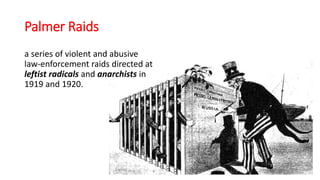
Palmer Raids
a series of violent and abusive
law-enforcement raids directed at
leftist radicals and anarchists in
1919 and 1920.
Leftist Radicals
• during the time period, a way of
referring to people who favored
Communism or labor unions
Anarchists
• during the time period, a way of
referring to people who
supported the overthrow of
government
• usually associated with
Communists
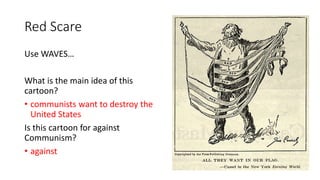
Red Scare
Use WAVES…
What is the main idea of this
cartoon?
• communists want to destroy the
United States
Is this cartoon for against
Communism?
• against
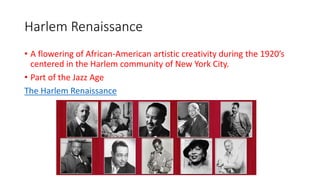
Harlem Renaissance
• A flowering of African-American artistic creativity during the 1920’s
centered in the Harlem community of New York City.
• Part of the Jazz Age
The Harlem Renaissance
Women in the 1920s
The 19th Amendment
• ratified in 1920, women gained the right to
vote nationwide
Impact
• women were empowered and began to assert
their independence
• women started wearing short skirts and
bobbed hair
• they began to abandon traditional female roles
and take jobs usually reserved for menFlappers
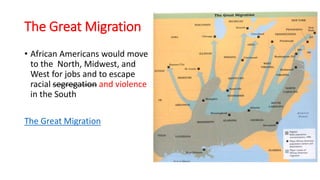
The Great Migration
• African Americans would move
to the North, Midwest, and
West for jobs and to escape
racial segregation and violence
in the South
The Great Migration
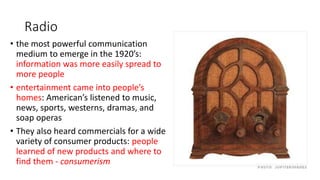
Radio
• the most powerful communication
medium to emerge in the 1920’s:
information was more easily spread to
more people
• entertainment came into people’s
homes: American’s listened to music,
news, sports, westerns, dramas, and
soap operas
• They also heard commercials for a wide
variety of consumer products: people
learned of new products and where to
find them - consumerism
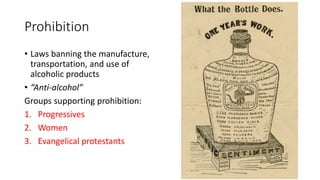
Prohibition
• Laws banning the manufacture,
transportation, and use of
alcoholic products
• “Anti-alcohol”
Groups supporting prohibition:
1. Progressives
2. Women
3. Evangelical protestants
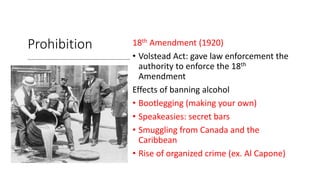
Prohibition 18th Amendment (1920)
• Volstead Act: gave law enforcement the
authority to enforce the 18th
Amendment
Effects of banning alcohol
• Bootlegging (making your own)
• Speakeasies: secret bars
• Smuggling from Canada and the
Caribbean
• Rise of organized crime (ex. Al Capone)

The 1920s

  • 1.
  • 2.
    Red Scare • fearof the spread of Communism • The fear that communists were working to destroy the American way of life during the decade of the 1920’s – this led to a fear of labor unions What is Communism? • Combination government and economic system where the government makes all the economic decisions claiming it knows what is best for the country as a whole • A Communist Revolution takes place when the workers come together to improve their working conditions by overthrowing the government that allows the abuses by businesses to happen
  • 3.
    Sacco and Vanzetti •Sacco and Vanzetti were Italian immigrants charged with murdering a guard and robbing a shoe factory. Why was their case so controversial during the time period? • Convicted on circumstantial evidence, many believed they had been framed for the crime because of their anarchist and pro-union activities.
  • 4.
    Palmer Raids a seriesof violent and abusive law-enforcement raids directed at leftist radicals and anarchists in 1919 and 1920.
  • 5.
    Leftist Radicals • duringthe time period, a way of referring to people who favored Communism or labor unions Anarchists • during the time period, a way of referring to people who supported the overthrow of government • usually associated with Communists
  • 6.
    Red Scare Use WAVES… Whatis the main idea of this cartoon? • communists want to destroy the United States Is this cartoon for against Communism? • against
  • 7.
    Harlem Renaissance • Aflowering of African-American artistic creativity during the 1920’s centered in the Harlem community of New York City. • Part of the Jazz Age The Harlem Renaissance
  • 8.
    Women in the1920s The 19th Amendment • ratified in 1920, women gained the right to vote nationwide Impact • women were empowered and began to assert their independence • women started wearing short skirts and bobbed hair • they began to abandon traditional female roles and take jobs usually reserved for menFlappers
  • 9.
    The Great Migration •African Americans would move to the North, Midwest, and West for jobs and to escape racial segregation and violence in the South The Great Migration
  • 10.
    Radio • the mostpowerful communication medium to emerge in the 1920’s: information was more easily spread to more people • entertainment came into people’s homes: American’s listened to music, news, sports, westerns, dramas, and soap operas • They also heard commercials for a wide variety of consumer products: people learned of new products and where to find them - consumerism
  • 11.
    Prohibition • Laws banningthe manufacture, transportation, and use of alcoholic products • “Anti-alcohol” Groups supporting prohibition: 1. Progressives 2. Women 3. Evangelical protestants
  • 12.
    Prohibition 18th Amendment(1920) • Volstead Act: gave law enforcement the authority to enforce the 18th Amendment Effects of banning alcohol • Bootlegging (making your own) • Speakeasies: secret bars • Smuggling from Canada and the Caribbean • Rise of organized crime (ex. Al Capone)

Editor's Notes

  • #8 WEB Dubois writer, sociologist, civil rights activist Marcus Garvey political leader, publisher, journalist Josephine Baker dancer, singer, fashion icon Duke Ellington musician Langston Hughes poet, novelist, playwright, columnist, social activist Louis Armstrong musician Alain Leroy Locke writer, philosopher, educator Zora Neale Huston author Claude McKay poet, novelist, journalist Aaron Douglas painter