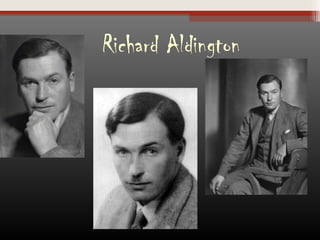
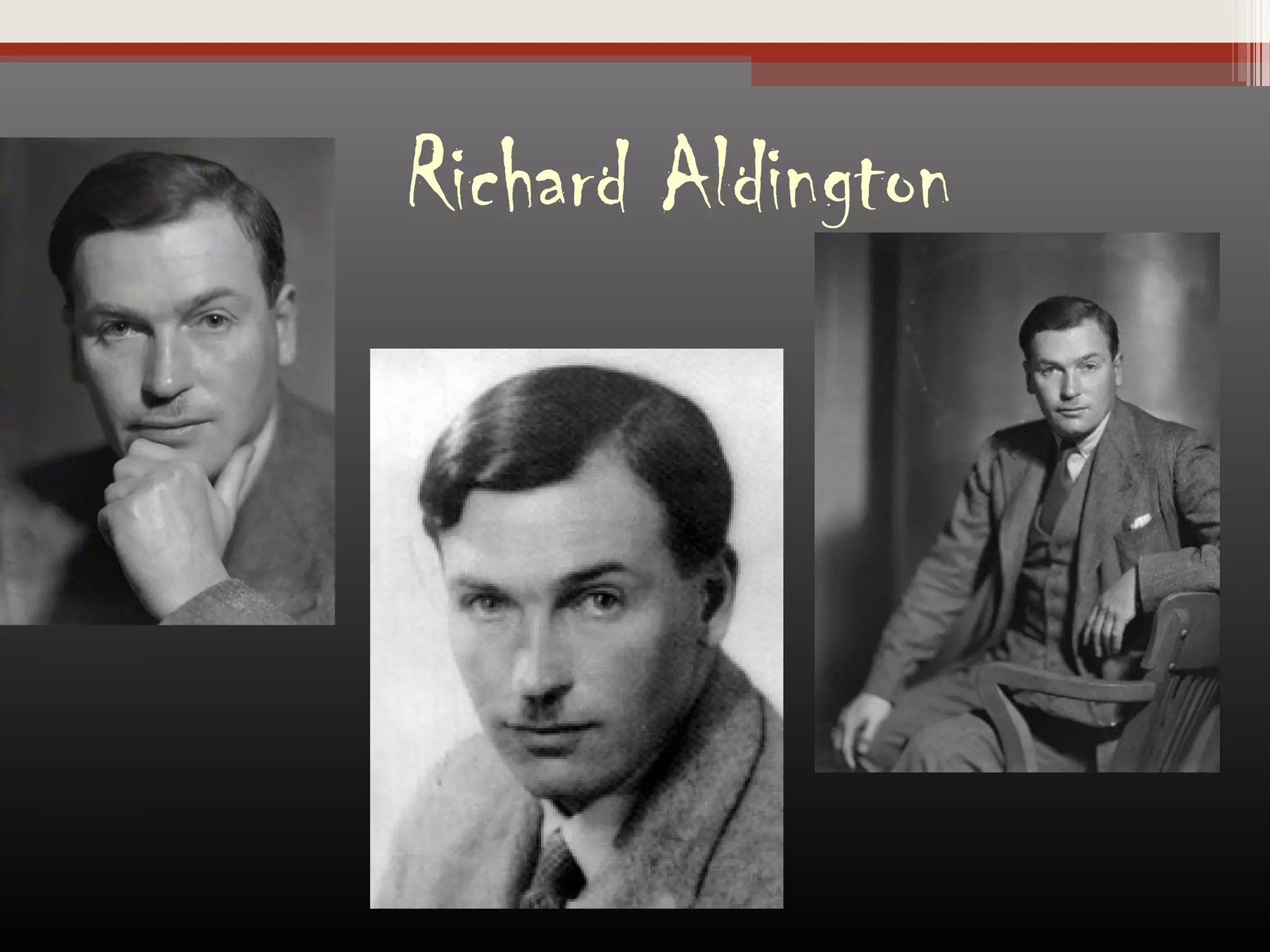
Richard Aldington
Richard Aldington was born on 8th
July, 1892 in Portsmouth, Hampshire.
He was educated for four years at
Dover College and then for one year
at the University of London. By the
age of nineteen Richard Aldington
could read Greek, Latin, French and
Italian with ease.
Richard had access to his father’s library with contained
many poetry books; this prepared him at the age of eighteen
to launch an attack on poetic tradition. His own first volume
of poems had appeared when he was seventeen.

In 1911 he met the American poet Hilda Doolittle, who
was already calling herself H.D. For six years she was
his senior and in 1913 they got married.
Richard Aldington and H.D. were taken up by the
American poet Ezra Pound, who sent their poetry to his
friend Harriet Monroe for the Chicago poetry magazine.
Aldingtons experiences in the trenches soon resulted in
the diagnosis of neurasthenia.Through the twenties he
was ill and bitter feeling. The broken Aldington
managed to salvage a life in France and Italy where he
became freelance writer and a translator. He had just
published his book of poetry on war, images of war in
1919. When in 1929 he then published his angry war
novel. This Aldingtons first novel made him famous and
Other novel written by Aldington was “The Colonel’s
Daughter” which was published in 1931. He also
published several volumes of poetry such as “The Fool l’
the Forest”.
Aldington left England to go to America at the beginning
of the second world war. His marriage to H.D. had been
dissolved in 1927 although they had been separated for
many years.
Aldington wrote several biographies. These included “A
Life of Wellington” which won him the “James Tait
Memorial Prize” in 1996.
Aldington’s autobiography, “Life for Life’s Sake”, was
published in 1941, he died in 1960.
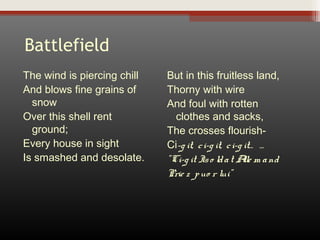
Battlefield
The wind is piercing chill
And blows fine grains of
snow
Over this shell rent
ground;
Every house in sight
Is smashed and desolate.

But in this fruitless land,
Thorny with wire
And foul with rotten
clothes and sacks,
The crosses flourishCi-g it, c i-g it, c i-g it… …
”Ci-g it Is o ld a t A m a nd
lle
Prie z p uo r lui”
The Poem

The wind is piercing chill
Is a metaphor, saying that the wind its self is hurting
them just as much as the war is, mentally and physically.
And blows fine grains of snow
Is saying that it is snowing and windy and
that the wind is really fine and is blowing everywhere.
Over this shell rent ground;
Means that the ground is covered in used bullets
and is empty and there are big crater holes from
where the shells have been blown up during battles.
Every house in sight is smashed and desolate.
All the homes are destroyed due to warfare in the towns and in the
cities, everybody has moved out to get away from the fighting and
moved on leaving the houses empty.
 
all barren and there is no vegetation it’s all mucky and messy.
 
But in this fruitless land,
This means that the ground is
Thorny with wire
Is saying that the wire is all bundled up in a big
bunch like a bramble bush.
 
And foul with rotting clothes and sacks,
The dead bodies are scattered all over the place and
their clothes are starting to rot and their sacks and
equipment are just left covering the ground.
 
 
The crosses flourishThe dead bodies are all buried and the crosses keep on going
up and filling mass amounts of land.
 
Ci-gît, ci-gît, ci-gît…’Ci-gît, 1 soldat Allemand, Priez pour
lui
Here lie here lies here lies a German soldier, pray for him
 
This last line is the most important line of the poem. It tells
us that even though he wasn’t on the Germans side but the
Germans are people too. It says that the war isn’t people
wanting to go out killing but its people having to kill. We
should think of the enemy as people but not as shooting
targets.
The end
Made by
Liliya Sidorova
10-V

Richard aldington

  • 1.
  • 2.
    Richard Aldington wasborn on 8th July, 1892 in Portsmouth, Hampshire. He was educated for four years at Dover College and then for one year at the University of London. By the age of nineteen Richard Aldington could read Greek, Latin, French and Italian with ease.
  • 3.
    Richard had accessto his father’s library with contained many poetry books; this prepared him at the age of eighteen to launch an attack on poetic tradition. His own first volume of poems had appeared when he was seventeen. In 1911 he met the American poet Hilda Doolittle, who was already calling herself H.D. For six years she was his senior and in 1913 they got married. Richard Aldington and H.D. were taken up by the American poet Ezra Pound, who sent their poetry to his friend Harriet Monroe for the Chicago poetry magazine. Aldingtons experiences in the trenches soon resulted in the diagnosis of neurasthenia.Through the twenties he was ill and bitter feeling. The broken Aldington managed to salvage a life in France and Italy where he became freelance writer and a translator. He had just published his book of poetry on war, images of war in 1919. When in 1929 he then published his angry war novel. This Aldingtons first novel made him famous and
  • 4.
    Other novel writtenby Aldington was “The Colonel’s Daughter” which was published in 1931. He also published several volumes of poetry such as “The Fool l’ the Forest”. Aldington left England to go to America at the beginning of the second world war. His marriage to H.D. had been dissolved in 1927 although they had been separated for many years. Aldington wrote several biographies. These included “A Life of Wellington” which won him the “James Tait Memorial Prize” in 1996. Aldington’s autobiography, “Life for Life’s Sake”, was published in 1941, he died in 1960.
  • 5.
    Battlefield The wind ispiercing chill And blows fine grains of snow Over this shell rent ground; Every house in sight Is smashed and desolate. But in this fruitless land, Thorny with wire And foul with rotten clothes and sacks, The crosses flourishCi-g it, c i-g it, c i-g it… … ”Ci-g it Is o ld a t A m a nd lle Prie z p uo r lui”
  • 6.
    The Poem The windis piercing chill Is a metaphor, saying that the wind its self is hurting them just as much as the war is, mentally and physically. And blows fine grains of snow Is saying that it is snowing and windy and that the wind is really fine and is blowing everywhere. Over this shell rent ground; Means that the ground is covered in used bullets and is empty and there are big crater holes from where the shells have been blown up during battles.
  • 7.
    Every house insight is smashed and desolate. All the homes are destroyed due to warfare in the towns and in the cities, everybody has moved out to get away from the fighting and moved on leaving the houses empty.   all barren and there is no vegetation it’s all mucky and messy.   But in this fruitless land, This means that the ground is
  • 8.
    Thorny with wire Issaying that the wire is all bundled up in a big bunch like a bramble bush.   And foul with rotting clothes and sacks, The dead bodies are scattered all over the place and their clothes are starting to rot and their sacks and equipment are just left covering the ground.    
  • 9.
    The crosses flourishThedead bodies are all buried and the crosses keep on going up and filling mass amounts of land.   Ci-gît, ci-gît, ci-gît…’Ci-gît, 1 soldat Allemand, Priez pour lui Here lie here lies here lies a German soldier, pray for him   This last line is the most important line of the poem. It tells us that even though he wasn’t on the Germans side but the Germans are people too. It says that the war isn’t people wanting to go out killing but its people having to kill. We should think of the enemy as people but not as shooting targets.
  • 10.

Editor's Notes