American Realism: 1850-1914 “ Division, Reconciliation, Expansion”
Navigation Literary Movements Author Bios Slavery Civil War Westward Expansion Urbanization
Literary Movements The writing of this period steered away from the Romantic, highly imaginative fiction from the early 1800’s. The four main movements are known as: Realism Naturalism “Literature of Discontent” Regionalism π
Realism Most of the famous literature from after the Civil War is called Realism. These writers turned away from Romanticism.  The immense cost of life from the Civil War disillusioned Americans from their early 1800’s idealism. Their plan was to portray life realistically (hence the name), and people as they were. Mov’t  |  π
Naturalism Naturalism is NOT “hippie-fiction.”  It is more pessimistic than Realism, primarily. The Naturalist writers believed that larger forces were at work: Nature, Fate, and Heredity. Their writing was inspired by hardships, whether it was war, the frontier, or urbanization. Mov’t  |  π
Along the lines of Naturalism, the social problems of this period were seen as a force to deal with. Many groups, from women to freed slaves, started expressing their discontent with the way things were. They started addressing these issues in their writing. “ Literature of Discontent” Mov’t  |  π
Regionalism Regionalism is all about “local flavor” or “local color.”  “ Local Color” means a reliance on minor details and dialects. They usually wrote about the South or the West. More often than not, these stories were full of humor and small-town characters. Mov’t  |  π
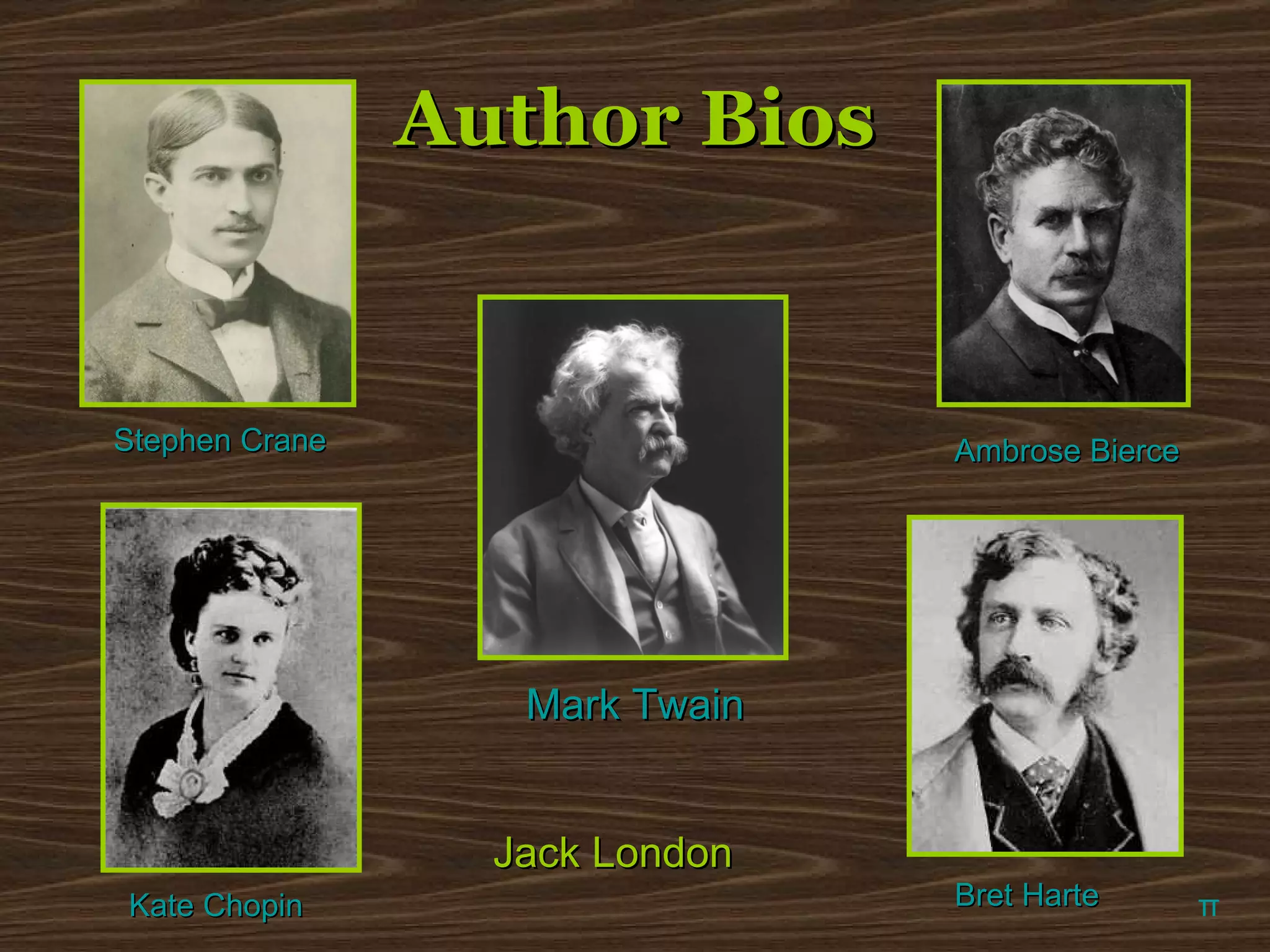
Author Bios π Mark Twain Ambrose Bierce Kate Chopin Bret Harte Stephen Crane Jack London
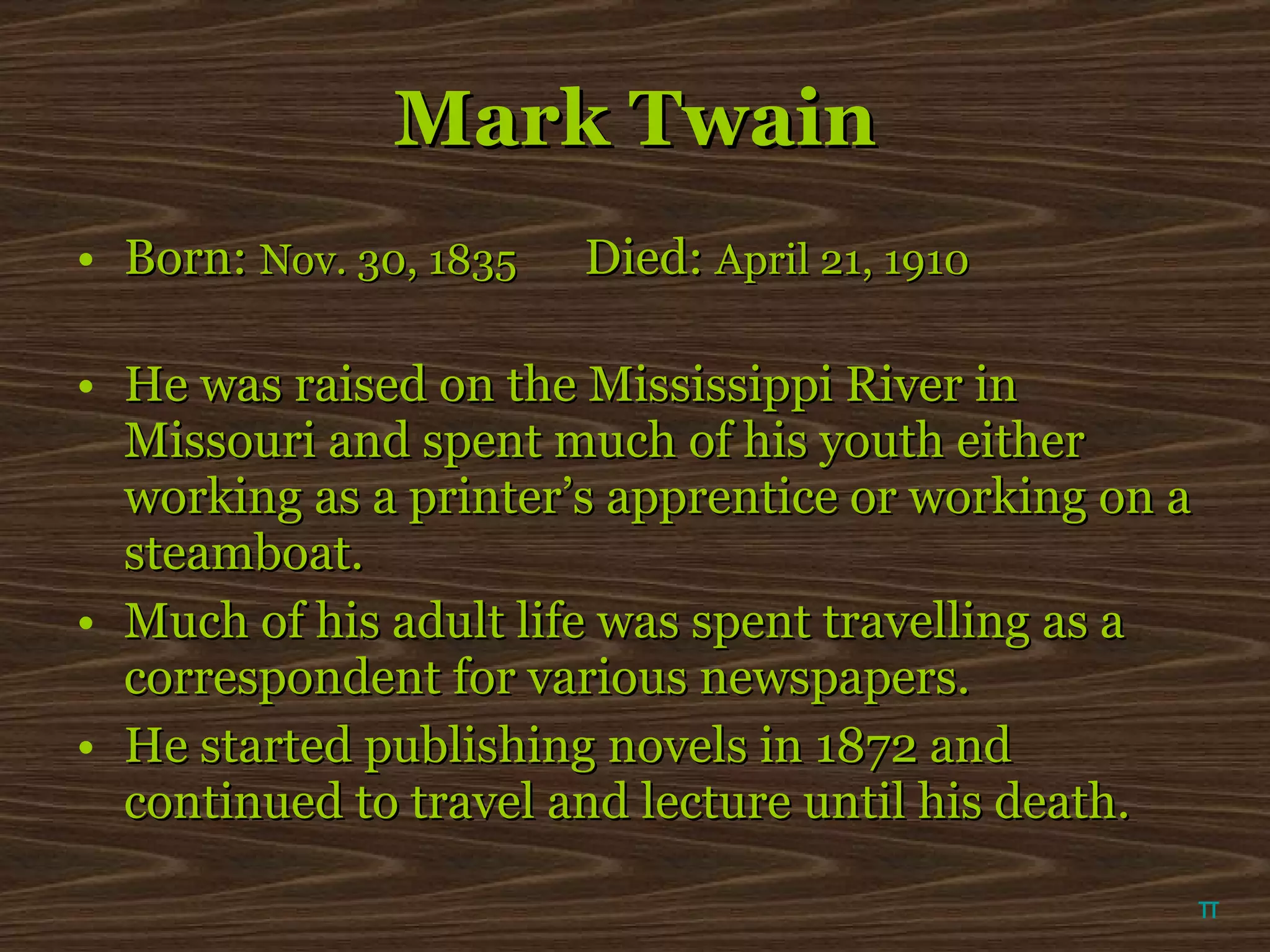
Mark Twain Born:  Nov. 30, 1835   Died:  April 21, 1910 He was raised on the Mississippi River in Missouri and spent much of his youth either working as a printer’s apprentice or working on a steamboat. Much of his adult life was spent travelling as a correspondent for various newspapers. He started publishing novels in 1872 and continued to travel and lecture until his death.  π
Mark Twain:  Important Works “ The Celebrated Jumping Frog of Calaveras County” – 1865 Tom Sawyer  – 1876 Huckleberry Finn  – 1884 “ A Connecticut Yankee in King Arthur’s Court” – 1889 “ The Man That Corrupted Hadleyburg” - 1900 Bios  |  π
Stephen Crane Born: Jan. 5, 1871 Died: June 5, 1900 He moved to New York City from his home in Newark around the early 1890’s.  This backdrop was an inspiration for his first novel, and opened his eyes to the urban experience. He worked as a journalist for many years, covering the war in Cuba, where he almost drowned when his ship sank in 1897. After extensive travel and reporting, he died of TB while living abroad in Germany. π
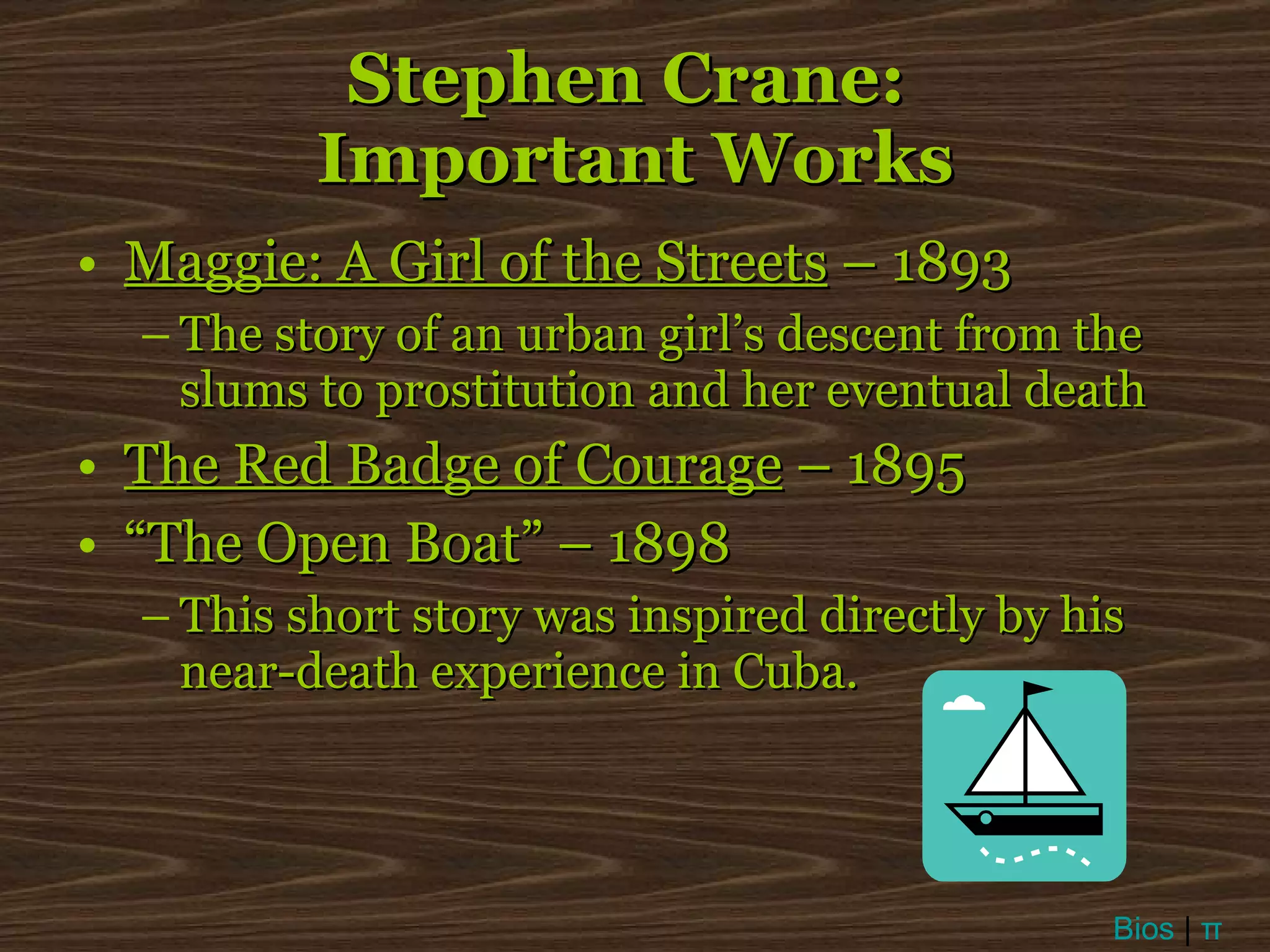
Stephen Crane:  Important Works Maggie: A Girl of the Streets  – 1893 The story of an urban girl’s descent from the slums to prostitution and her eventual death The Red Badge of Courage  – 1895 “ The Open Boat” – 1898 This short story was inspired directly by his near-death experience in Cuba. Bios  |  π
Bret Harte Born: Aug. 25, 1836 Died: May 5, 1902 Bret Harte moved to a mining community in California at the age of 13 (1854).  He wrote about these communities for newspapers around 1857.  Harte often collaborated with Twain as an editor for the  Californian  newspaper around 1864.  After a brief stint of success, his career started to flounder around the mid 1870’s, until he resumed in London from 1885 until his death. π
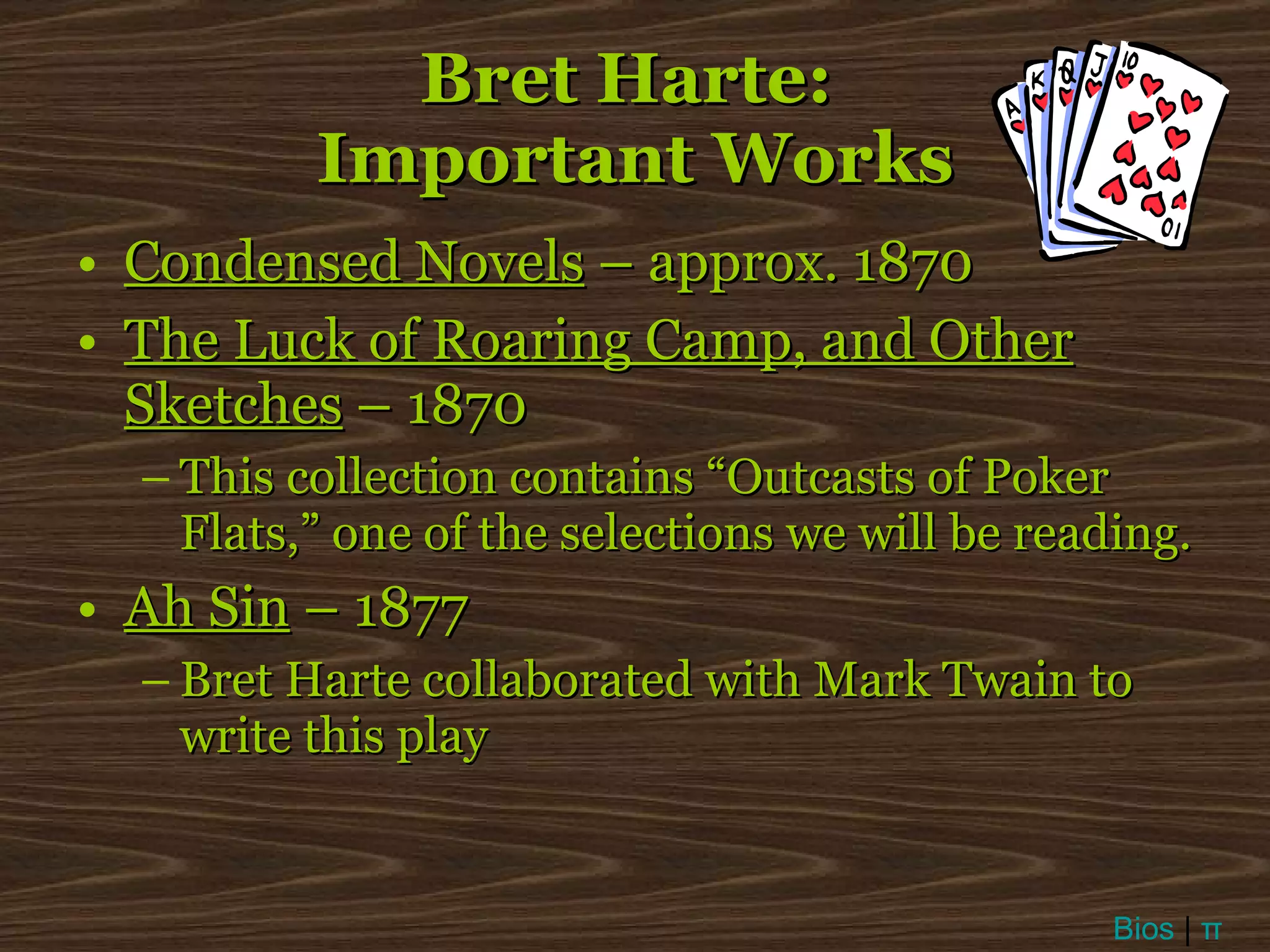
Bret Harte:  Important Works Condensed Novels  – approx. 1870 The Luck of Roaring Camp, and Other Sketches  – 1870 This collection contains “Outcasts of Poker Flats,” one of the selections we will be reading. Ah Sin  – 1877 Bret Harte collaborated with Mark Twain to write this play Bios  |  π
Kate Chopin Born: Feb. 8, 1851   Died: Aug. 22, 1904 She was born in St. Louis, MO, but she moved to Louisiana after her marriage in 1870. She wrote primarily on life in Louisiana and the people she met in the Bayou, Creole country. Kate wrote some early, relatively unknown novels, but made a name with short stories and her seminal work,  The Awakening. After she was widely shunned for writing  The Awakening , Kate Chopin retreated away from any major writing until her death in 1904. π
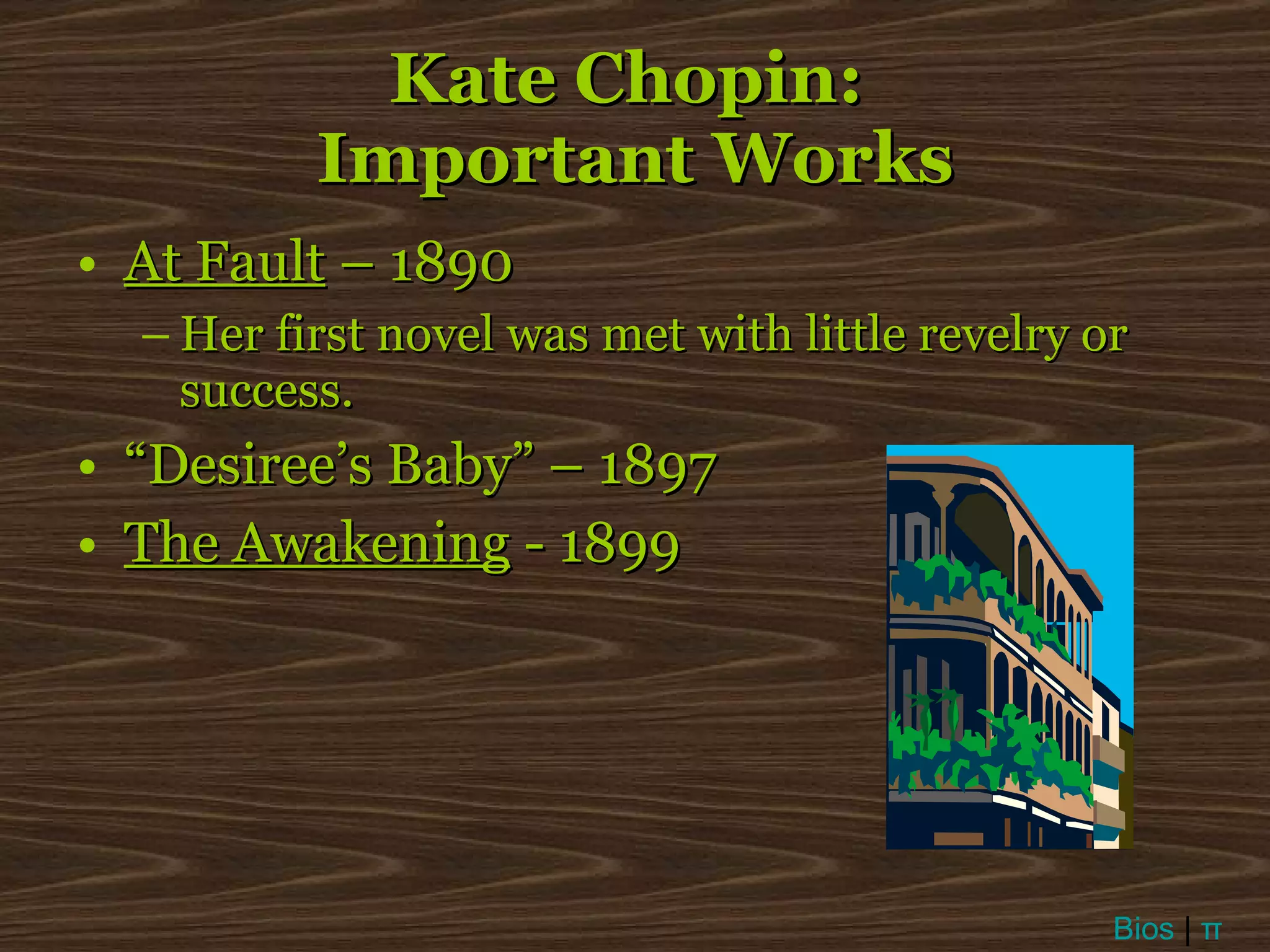
Kate Chopin:  Important Works At Fault  – 1890 Her first novel was met with little revelry or success. “ Desiree’s Baby” – 1897 The Awakening  - 1899 Bios  |  π
Ambrose Bierce Born: June 24, 1842 Died: 1914 (UNK) He enlisted in the army at 1861 and fought in many battles, taking serious wounds in 1864.  He, too, spent much of his professional life working for newspapers as a correspondent and witty writer. While working on columns and magazines, he wrote some of his best and most famous short stories. Old “Bitter Bierce” slipped off to Mexico in 1913 and likely died in the midst of Pancho Villa’s revolution in 1914, but his actual end is unknown.  π
Ambrose Bierce:  Important Works “ The Haunted Valley” – 1871 His first story to be published “ An Occurrence at Owl Creek Bridge” – 1891 The Devil’s Dictionary  – 1906 A collection of ironic and bitter definitions on common words, as well as one of Bierce’s most famous and enduring works. Bios  |  π
Born: Jan 12, 1876  Died: Nov. 22, 1916 His father, a roving astrologer, left young Jack with his mother, a spiritualist, and step-father. His youth was spent working as a sailor and seeing much of the country as a “hobo” on a train. In 1893, he joined a protest army of unemployed Americans, and in 1894 became a militant socialist. He started writing of his Alaskan adventures and time in the Yukon gold rush in 1900.  He committed suicide in 1916 as an unsuccessful writer and alcoholic.  Jack London
Jack London: Important Works The Son of the Wolf  – 1900 Jacks’ first novel earned him a wide, audience. “ Call of the Wild” – 1903  “ White Fang” – 1906  The Iron Heel  – 1907 This political future/fantasy novel anticipated the rise of fascism with frightening accuracy. “ To Build a Fire” – 1908
Slavery Slavery was a reality throughout America since it was founded, despite the hot debate as to whether or not we should have slaves. The issue hinged on two different Americas: The Urban, Industrial North and the Agrarian South. π
Slavery Southern plantations grew cotton,  sugar, rice, and tobacco, primarily.  They felt that slavery was the only way to survive in a plantation society. In 1850, the Fugitive Slave Act made it that all run away slaves, whether found in a slave state or a free state, had to be returned to their owner. Anti-slavery supporters were furious. π
Slavery Harriet Beecher Stowe’s  Uncle Tom’s Cabin  portrayed the cruelty of slavery to millions of Northerners (Pub. 1852).  The 1854 Kansas-Nebraska Act opened up western territories/states to slavery. Again, anti-slavery supporters and abolitionists were furious. In 1859, John Brown and his supporters broke into a federal armory in order to start a slave rebellion.  π
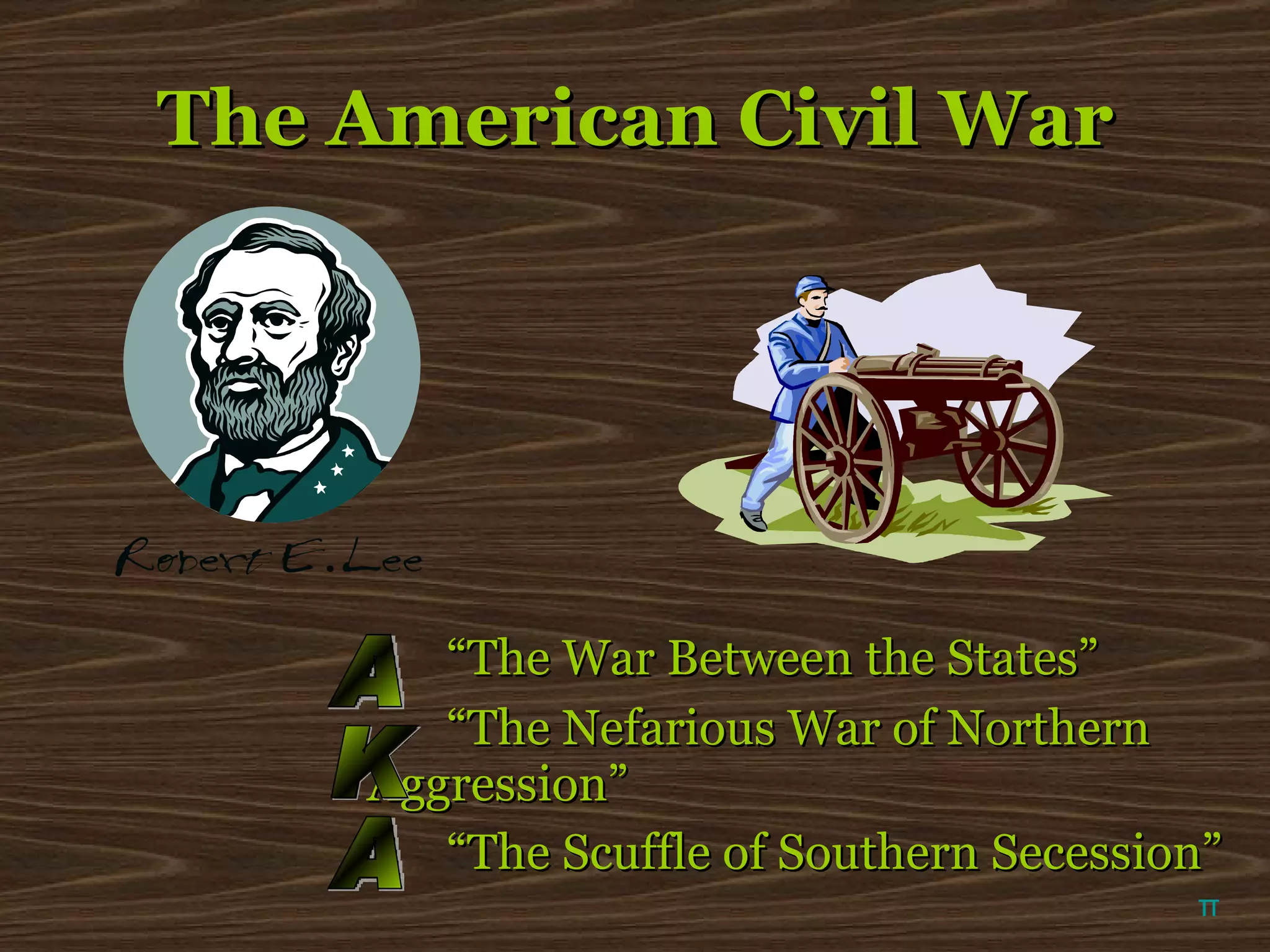
The American Civil War “ The War Between the States” “ The Nefarious War of Northern  Aggression” “ The Scuffle of Southern Secession” AKA π
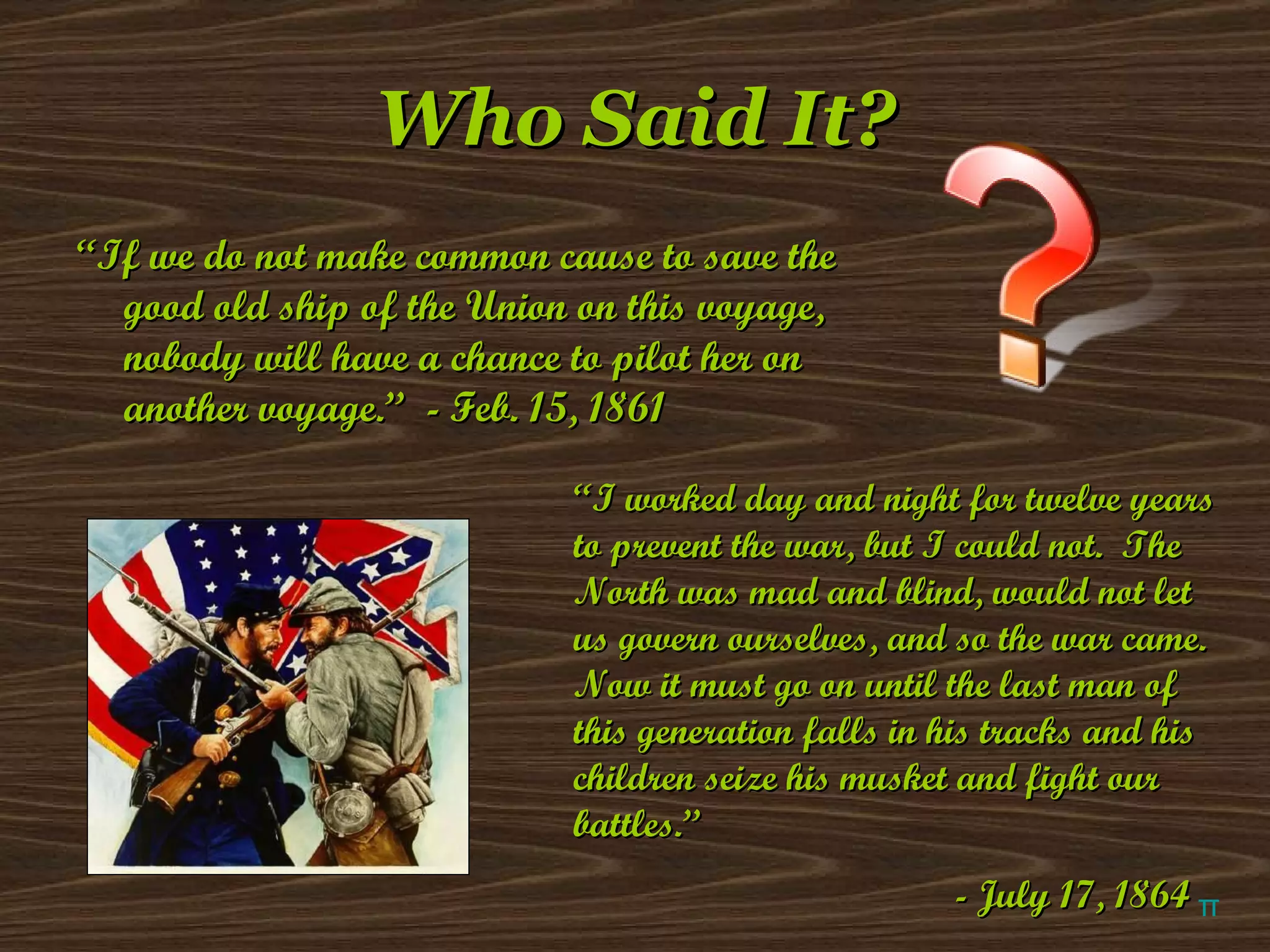
Who Said It? “ If we do not make common cause to save the good old ship of the Union on this voyage, nobody will have a chance to pilot her on another voyage.”  - Feb. 15, 1861 “ I worked day and night for twelve years to prevent the war, but I could not.  The North was mad and blind, would not let us govern ourselves, and so the war came.  Now it must go on until the last man of this generation falls in his tracks and his children seize his musket and fight our battles.” - July 17, 1864 π
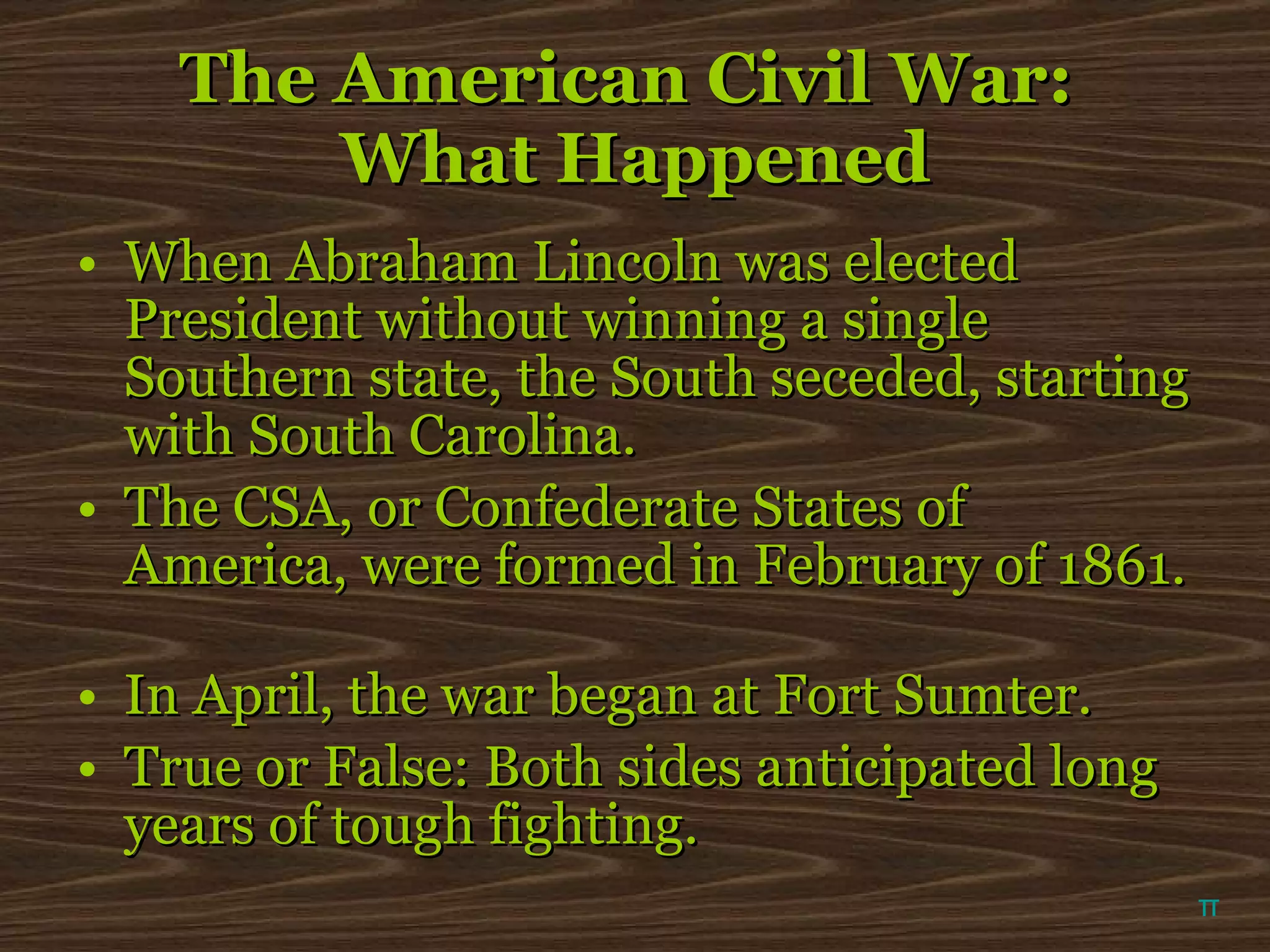
The American Civil War:  What Happened When Abraham Lincoln was elected President without winning a single Southern state, the South seceded, starting with South Carolina. The CSA, or Confederate States of America, were formed in February of 1861.  In April, the war began at Fort Sumter. True or False: Both sides anticipated long years of tough fighting. π
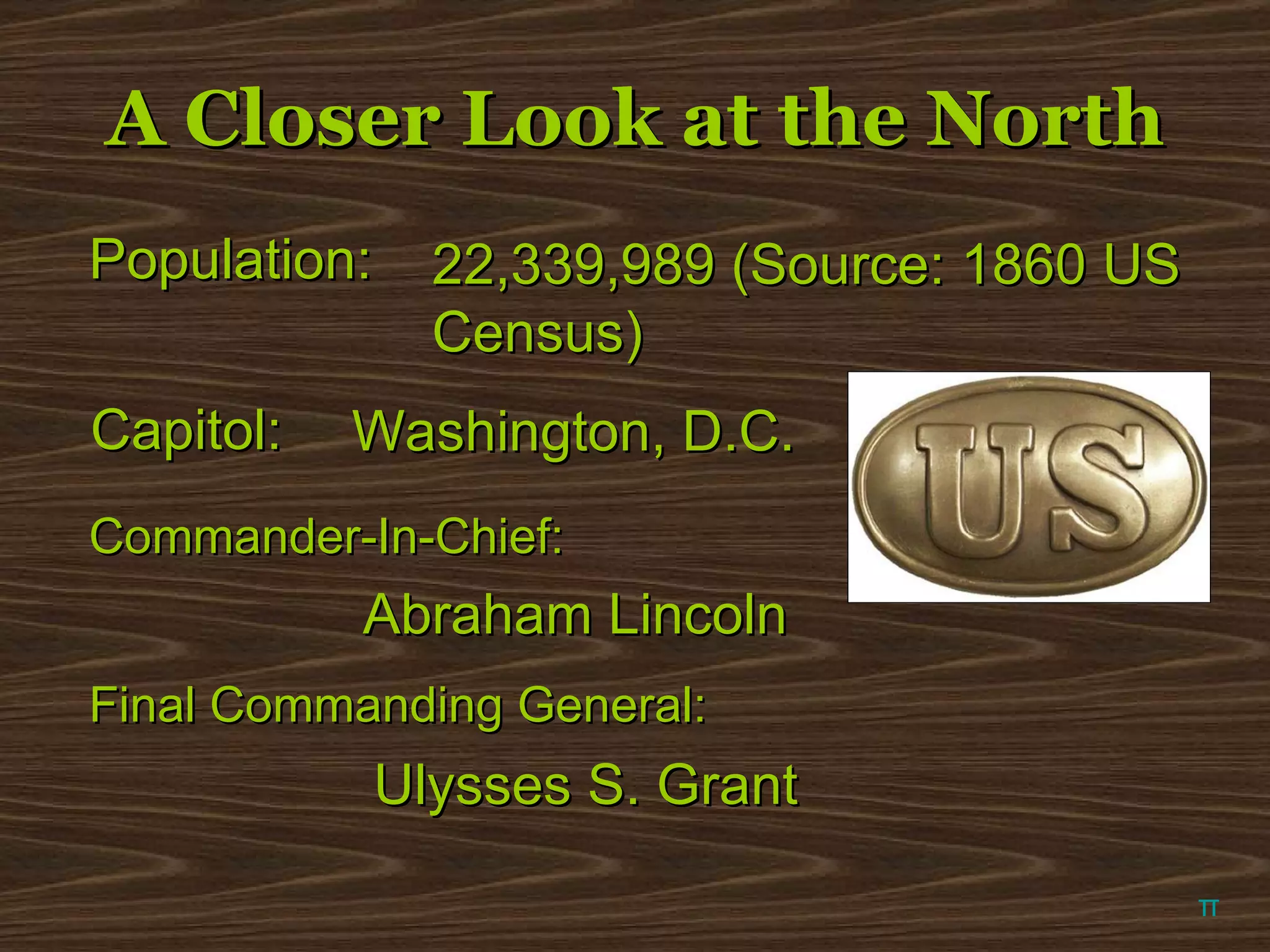
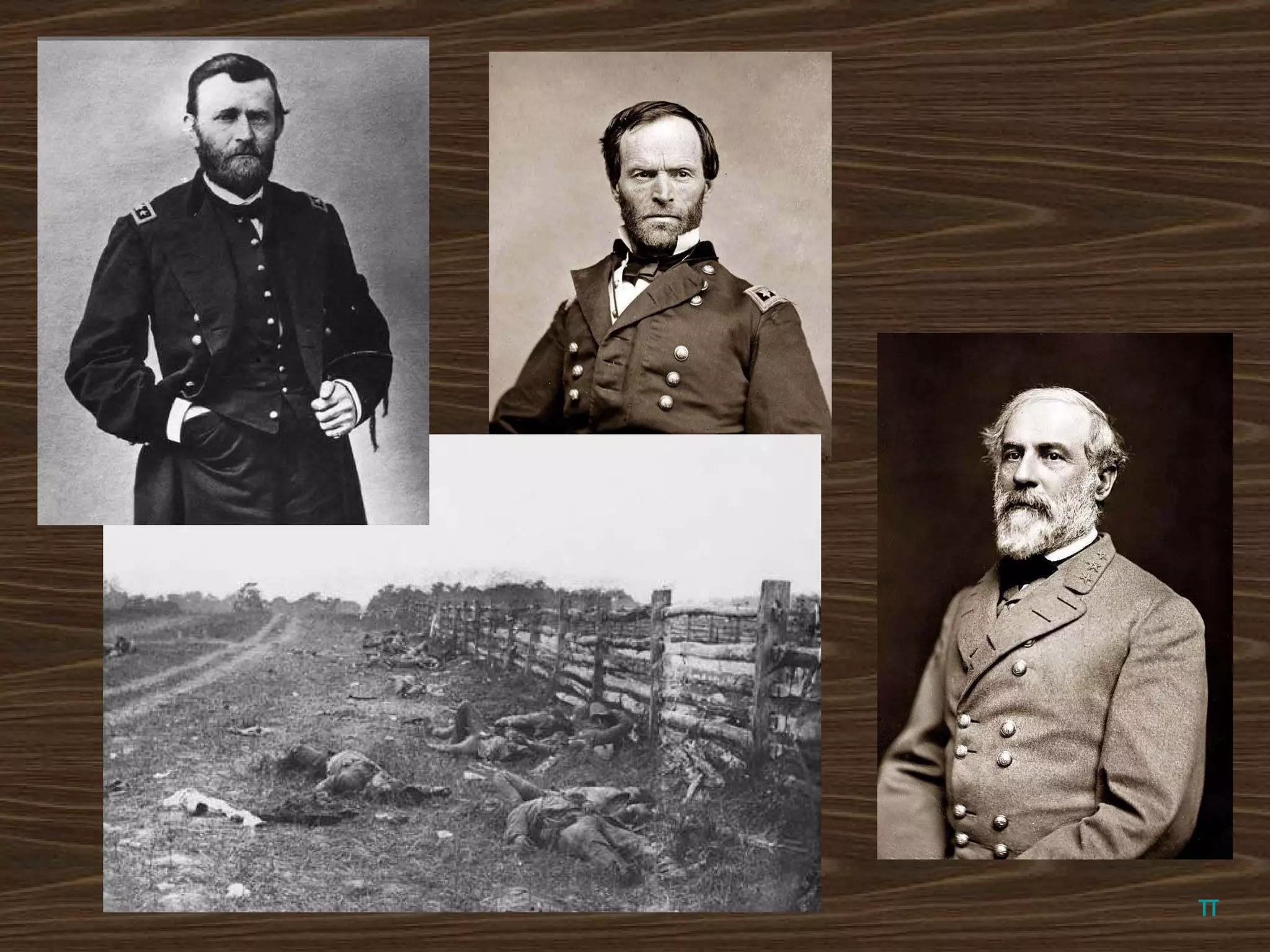
A Closer Look at the North π Population: 22,339,989 (Source: 1860 US Census) Capitol: Washington, D.C. Commander-In-Chief: Abraham Lincoln Final Commanding General: Ulysses S. Grant
A Closer Look at the South π Population: 9,103,332 (Source: 1860 US Census) Capitol: Montgomery, AL/  Richmond, VA Commander-In-Chief: Jefferson Davis Final Commanding General: Robert E. Lee
War By Numbers Total Number of Casualties: About 500,000 more were injured, and Civil War era medicine was not very good. 620,000 π
π
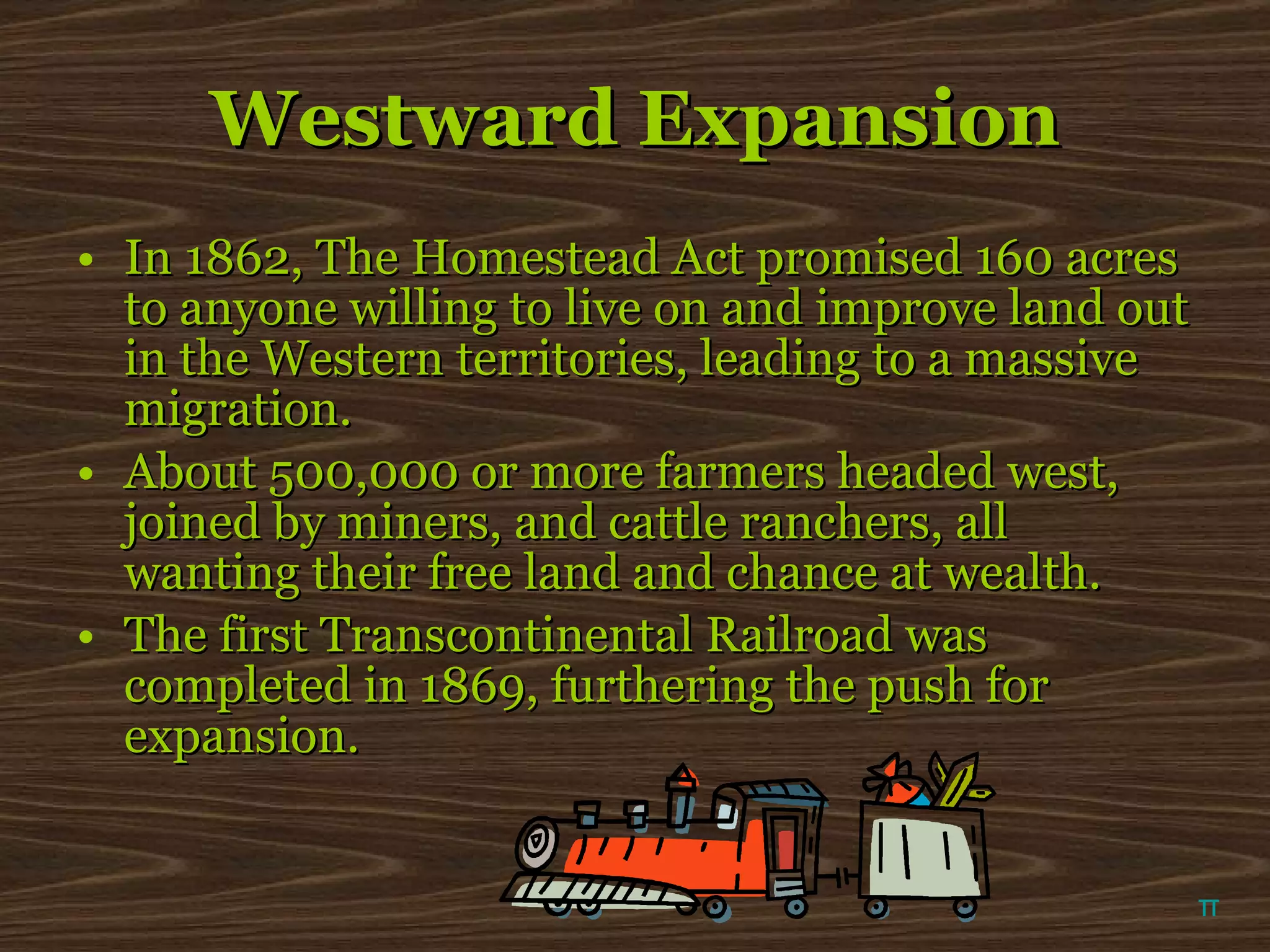
Westward Expansion In 1862, The Homestead Act promised 160 acres to anyone willing to live on and improve land out in the Western territories, leading to a massive migration. About 500,000 or more farmers headed west, joined by miners, and cattle ranchers, all wanting their free land and chance at wealth. The first Transcontinental Railroad was completed in 1869, furthering the push for expansion. π
The Frontier is Now Closed The 1890 census reported that America’s frontier no longer existed.  A steady stream of immigrants, farmers, African-Americans, just to name a few, had filled up the frontier with farms and cities.   π
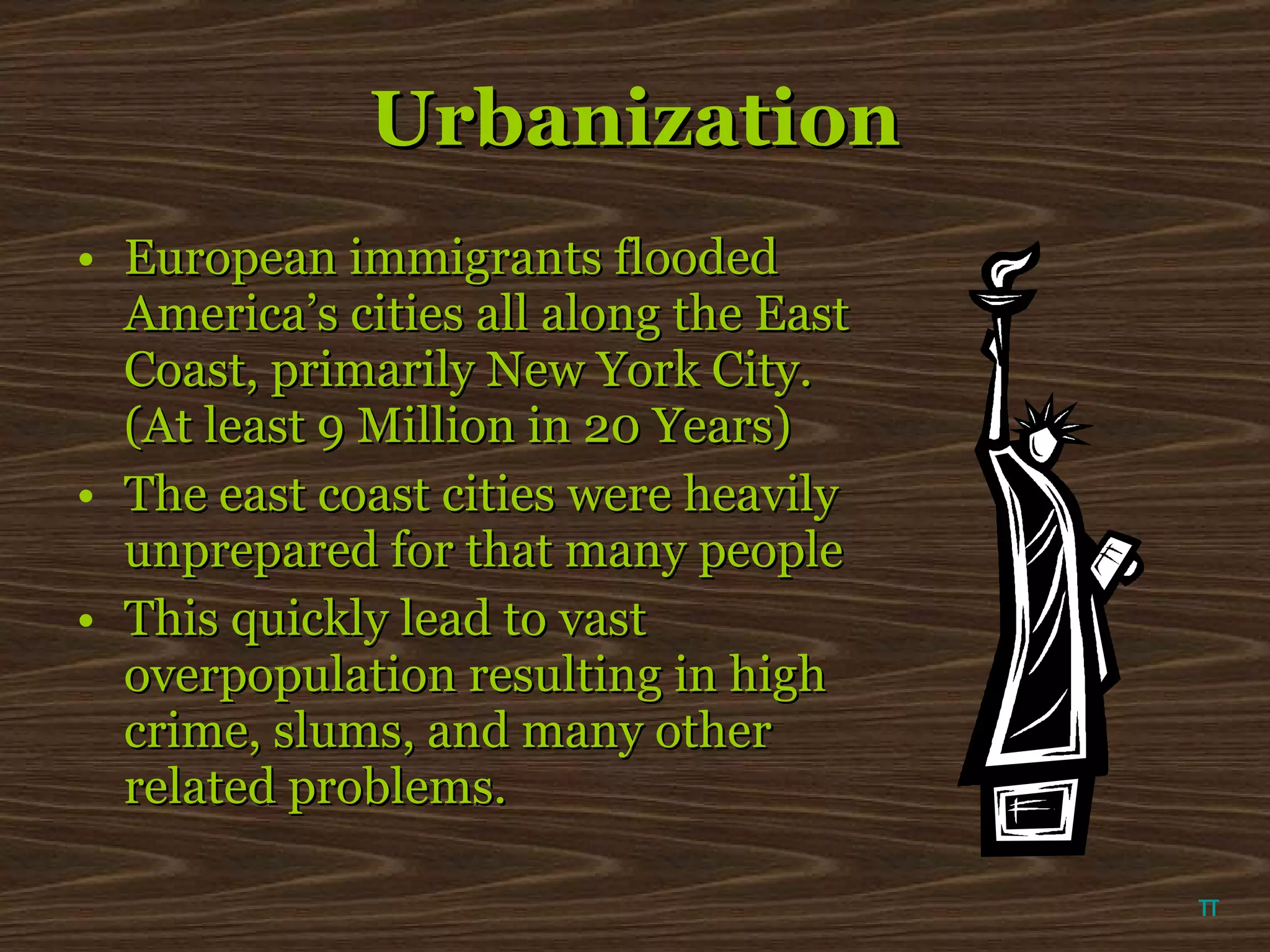
Urbanization European immigrants flooded America’s cities all along the East Coast, primarily New York City. (At least 9 Million in 20 Years) The east coast cities were heavily unprepared for that many people This quickly lead to vast overpopulation resulting in high crime, slums, and many other related problems. π
The Great City Skyscrapers, traffic, air and noise pollution, all became part of life in the big city. The industrial city needed workers, but often paid them poorly. Wages were so bad that one or two working adults could not support a family, so child labor became a common necessity. π

American realism lecture powerpoint

  • 1.
    American Realism: 1850-1914“ Division, Reconciliation, Expansion”
  • 2.
    Navigation Literary MovementsAuthor Bios Slavery Civil War Westward Expansion Urbanization
  • 3.
    Literary Movements Thewriting of this period steered away from the Romantic, highly imaginative fiction from the early 1800’s. The four main movements are known as: Realism Naturalism “Literature of Discontent” Regionalism π
  • 4.
    Realism Most ofthe famous literature from after the Civil War is called Realism. These writers turned away from Romanticism. The immense cost of life from the Civil War disillusioned Americans from their early 1800’s idealism. Their plan was to portray life realistically (hence the name), and people as they were. Mov’t | π
  • 5.
    Naturalism Naturalism isNOT “hippie-fiction.” It is more pessimistic than Realism, primarily. The Naturalist writers believed that larger forces were at work: Nature, Fate, and Heredity. Their writing was inspired by hardships, whether it was war, the frontier, or urbanization. Mov’t | π
  • 6.
    Along the linesof Naturalism, the social problems of this period were seen as a force to deal with. Many groups, from women to freed slaves, started expressing their discontent with the way things were. They started addressing these issues in their writing. “ Literature of Discontent” Mov’t | π
  • 7.
    Regionalism Regionalism isall about “local flavor” or “local color.” “ Local Color” means a reliance on minor details and dialects. They usually wrote about the South or the West. More often than not, these stories were full of humor and small-town characters. Mov’t | π
  • 8.
    Author Bios πMark Twain Ambrose Bierce Kate Chopin Bret Harte Stephen Crane Jack London
  • 9.
    Mark Twain Born: Nov. 30, 1835 Died: April 21, 1910 He was raised on the Mississippi River in Missouri and spent much of his youth either working as a printer’s apprentice or working on a steamboat. Much of his adult life was spent travelling as a correspondent for various newspapers. He started publishing novels in 1872 and continued to travel and lecture until his death. π
  • 10.
    Mark Twain: Important Works “ The Celebrated Jumping Frog of Calaveras County” – 1865 Tom Sawyer – 1876 Huckleberry Finn – 1884 “ A Connecticut Yankee in King Arthur’s Court” – 1889 “ The Man That Corrupted Hadleyburg” - 1900 Bios | π
  • 11.
    Stephen Crane Born:Jan. 5, 1871 Died: June 5, 1900 He moved to New York City from his home in Newark around the early 1890’s. This backdrop was an inspiration for his first novel, and opened his eyes to the urban experience. He worked as a journalist for many years, covering the war in Cuba, where he almost drowned when his ship sank in 1897. After extensive travel and reporting, he died of TB while living abroad in Germany. π
  • 12.
    Stephen Crane: Important Works Maggie: A Girl of the Streets – 1893 The story of an urban girl’s descent from the slums to prostitution and her eventual death The Red Badge of Courage – 1895 “ The Open Boat” – 1898 This short story was inspired directly by his near-death experience in Cuba. Bios | π
  • 13.
    Bret Harte Born:Aug. 25, 1836 Died: May 5, 1902 Bret Harte moved to a mining community in California at the age of 13 (1854). He wrote about these communities for newspapers around 1857. Harte often collaborated with Twain as an editor for the Californian newspaper around 1864. After a brief stint of success, his career started to flounder around the mid 1870’s, until he resumed in London from 1885 until his death. π
  • 14.
    Bret Harte: Important Works Condensed Novels – approx. 1870 The Luck of Roaring Camp, and Other Sketches – 1870 This collection contains “Outcasts of Poker Flats,” one of the selections we will be reading. Ah Sin – 1877 Bret Harte collaborated with Mark Twain to write this play Bios | π
  • 15.
    Kate Chopin Born:Feb. 8, 1851 Died: Aug. 22, 1904 She was born in St. Louis, MO, but she moved to Louisiana after her marriage in 1870. She wrote primarily on life in Louisiana and the people she met in the Bayou, Creole country. Kate wrote some early, relatively unknown novels, but made a name with short stories and her seminal work, The Awakening. After she was widely shunned for writing The Awakening , Kate Chopin retreated away from any major writing until her death in 1904. π
  • 16.
    Kate Chopin: Important Works At Fault – 1890 Her first novel was met with little revelry or success. “ Desiree’s Baby” – 1897 The Awakening - 1899 Bios | π
  • 17.
    Ambrose Bierce Born:June 24, 1842 Died: 1914 (UNK) He enlisted in the army at 1861 and fought in many battles, taking serious wounds in 1864. He, too, spent much of his professional life working for newspapers as a correspondent and witty writer. While working on columns and magazines, he wrote some of his best and most famous short stories. Old “Bitter Bierce” slipped off to Mexico in 1913 and likely died in the midst of Pancho Villa’s revolution in 1914, but his actual end is unknown. π
  • 18.
    Ambrose Bierce: Important Works “ The Haunted Valley” – 1871 His first story to be published “ An Occurrence at Owl Creek Bridge” – 1891 The Devil’s Dictionary – 1906 A collection of ironic and bitter definitions on common words, as well as one of Bierce’s most famous and enduring works. Bios | π
  • 19.
    Born: Jan 12,1876 Died: Nov. 22, 1916 His father, a roving astrologer, left young Jack with his mother, a spiritualist, and step-father. His youth was spent working as a sailor and seeing much of the country as a “hobo” on a train. In 1893, he joined a protest army of unemployed Americans, and in 1894 became a militant socialist. He started writing of his Alaskan adventures and time in the Yukon gold rush in 1900. He committed suicide in 1916 as an unsuccessful writer and alcoholic. Jack London
  • 20.
    Jack London: ImportantWorks The Son of the Wolf – 1900 Jacks’ first novel earned him a wide, audience. “ Call of the Wild” – 1903 “ White Fang” – 1906 The Iron Heel – 1907 This political future/fantasy novel anticipated the rise of fascism with frightening accuracy. “ To Build a Fire” – 1908
  • 21.
    Slavery Slavery wasa reality throughout America since it was founded, despite the hot debate as to whether or not we should have slaves. The issue hinged on two different Americas: The Urban, Industrial North and the Agrarian South. π
  • 22.
    Slavery Southern plantationsgrew cotton, sugar, rice, and tobacco, primarily. They felt that slavery was the only way to survive in a plantation society. In 1850, the Fugitive Slave Act made it that all run away slaves, whether found in a slave state or a free state, had to be returned to their owner. Anti-slavery supporters were furious. π
  • 23.
    Slavery Harriet BeecherStowe’s Uncle Tom’s Cabin portrayed the cruelty of slavery to millions of Northerners (Pub. 1852). The 1854 Kansas-Nebraska Act opened up western territories/states to slavery. Again, anti-slavery supporters and abolitionists were furious. In 1859, John Brown and his supporters broke into a federal armory in order to start a slave rebellion. π
  • 24.
    The American CivilWar “ The War Between the States” “ The Nefarious War of Northern Aggression” “ The Scuffle of Southern Secession” AKA π
  • 25.
    Who Said It?“ If we do not make common cause to save the good old ship of the Union on this voyage, nobody will have a chance to pilot her on another voyage.” - Feb. 15, 1861 “ I worked day and night for twelve years to prevent the war, but I could not. The North was mad and blind, would not let us govern ourselves, and so the war came. Now it must go on until the last man of this generation falls in his tracks and his children seize his musket and fight our battles.” - July 17, 1864 π
  • 26.
    The American CivilWar: What Happened When Abraham Lincoln was elected President without winning a single Southern state, the South seceded, starting with South Carolina. The CSA, or Confederate States of America, were formed in February of 1861. In April, the war began at Fort Sumter. True or False: Both sides anticipated long years of tough fighting. π
  • 27.
    A Closer Lookat the North π Population: 22,339,989 (Source: 1860 US Census) Capitol: Washington, D.C. Commander-In-Chief: Abraham Lincoln Final Commanding General: Ulysses S. Grant
  • 28.
    A Closer Lookat the South π Population: 9,103,332 (Source: 1860 US Census) Capitol: Montgomery, AL/ Richmond, VA Commander-In-Chief: Jefferson Davis Final Commanding General: Robert E. Lee
  • 29.
    War By NumbersTotal Number of Casualties: About 500,000 more were injured, and Civil War era medicine was not very good. 620,000 π
  • 30.
  • 31.
    Westward Expansion In1862, The Homestead Act promised 160 acres to anyone willing to live on and improve land out in the Western territories, leading to a massive migration. About 500,000 or more farmers headed west, joined by miners, and cattle ranchers, all wanting their free land and chance at wealth. The first Transcontinental Railroad was completed in 1869, furthering the push for expansion. π
  • 32.
    The Frontier isNow Closed The 1890 census reported that America’s frontier no longer existed. A steady stream of immigrants, farmers, African-Americans, just to name a few, had filled up the frontier with farms and cities. π
  • 33.
    Urbanization European immigrantsflooded America’s cities all along the East Coast, primarily New York City. (At least 9 Million in 20 Years) The east coast cities were heavily unprepared for that many people This quickly lead to vast overpopulation resulting in high crime, slums, and many other related problems. π
  • 34.
    The Great CitySkyscrapers, traffic, air and noise pollution, all became part of life in the big city. The industrial city needed workers, but often paid them poorly. Wages were so bad that one or two working adults could not support a family, so child labor became a common necessity. π