Download to read offline
![Synthesis and Characterization of Superhydrophobic Coatings
SYNTHESIS AND CHARACTERIZATION OF SUPERHYDROPHOBIC
COATINGS
*
Waleed Maqsood, E-mail address: waleed.maqsood93@gmail.com , Author
1*
Material Engineering Department, NED University of Engineering & Technology, Karachi,
Pakistan
ABSTRACT
Superhydrophobic coatings have drawn much attention in recent years because of their unique potential
industrial applications. The prepared coating is cheap and versatile and can be applied on various substrates
including glass, paper, acrylic, transparency and wood. Furthermore, the SHCs exhibit good long-term
stability, water-durability and UV-durability, adapting to out-door environment. Above all, the coatings are
environmental, low cost and can be quickly coated on various large-scale substrates, which will widen their
practical applications. Two distinct theoretical models have been used to guide the generation of
superhydrophobic surface by either roughening the surface or lowering the surface free energy, or both.The
increasing interest in studying and manufacturing hydrophobic surface results from their possible practical
applications. They find their primary use in corrosion, erosion or general degradation protection applications
on metallic, polymer and inorganic oxide (stone, glass, ceramic, etc.) solid surfaces. In recent years, this
field has evolved into a major industry trade which covers modern applications from anti-fogging as well as
water and snow repellent surfaces for construction materials, glass, automotive and aerospace technology, all
the way to reduce frictional drag on airplane wings and ship hulls.
Keywords: Superhydrophobic coating; Long-term stability
1. INTRODUCTION
Nature has a way of designing biological structures
to solve challenging science problem. Some
familiar instances are the various ways in which
plant life and animals cope with either the
abundance or scarcity of water. The Lotus foliage’s
hierarchical roughness and surface chemistry confer
to the leaf superhydrophobic properties; that is,
water drops adopt a contact angle greater than 150o
and curlicue like marbles under the gentlest forces
causation self-cleanup. [3]
Coating having superhydrophobic effect is a
nanoscopic surface layer that absorbs water.
Droplets to this kind of coating can fully rebound.
The vision of production of superhydrophobic
surfaces has huge potential applications in the area
of corrosion inhibition for metal components,
chemical and biological agent protection for
clothing, and many other industrial and commercial
applications. The wettability of the surface not only
affects the fundamental movement of the living
organisms in nature but also has a deep influence
on our daily life and in manufacturing, such as self-
cleaning materials, micro-fluid chips and micro-
reactors. The nature impels us that living organisms
and plants have the capability of self-cleaning
character owing to the superhydrophobic surface. It
is of significant interest to create surfaces that
simultaneously exhibit high water contact angle,
low contact angle hysteresis, and high transmission
of visible light, as well as mechanical wear
resistance for industrial applications. Recent
discoveries have linked the self-cleaning
mechanism of a lotus plant to a microscopic
morphology leading to superhydrophobic surfaces.
Coating can be applied in many ways like it can be
sprayed or substrate can be dipped in the coating.
[2]](https://image.slidesharecdn.com/ijsred-v2i5p21-190928094721/85/IJSRED-V2I5P21-1-320.jpg)
![Synthesis and Characterization of Superhydrophobic Coatings
SYNTHESIS AND CHARACTERIZATION OF SUPERHYDROPHOBIC
COATINGS
*
Waleed Maqsood, E-mail address: waleed.maqsood93@gmail.com , Author
1*
Material Engineering Department, NED University of Engineering & Technology, Karachi,
Pakistan
ABSTRACT
Superhydrophobic coatings have drawn much attention in recent years because of their unique potential
industrial applications. The prepared coating is cheap and versatile and can be applied on various substrates
including glass, paper, acrylic, transparency and wood. Furthermore, the SHCs exhibit good long-term
stability, water-durability and UV-durability, adapting to out-door environment. Above all, the coatings are
environmental, low cost and can be quickly coated on various large-scale substrates, which will widen their
practical applications. Two distinct theoretical models have been used to guide the generation of
superhydrophobic surface by either roughening the surface or lowering the surface free energy, or both.The
increasing interest in studying and manufacturing hydrophobic surface results from their possible practical
applications. They find their primary use in corrosion, erosion or general degradation protection applications
on metallic, polymer and inorganic oxide (stone, glass, ceramic, etc.) solid surfaces. In recent years, this
field has evolved into a major industry trade which covers modern applications from anti-fogging as well as
water and snow repellent surfaces for construction materials, glass, automotive and aerospace technology, all
the way to reduce frictional drag on airplane wings and ship hulls.
Keywords: Superhydrophobic coating; Long-term stability
1. INTRODUCTION
Nature has a way of designing biological structures
to solve challenging science problem. Some
familiar instances are the various ways in which
plant life and animals cope with either the
abundance or scarcity of water. The Lotus foliage’s
hierarchical roughness and surface chemistry confer
to the leaf superhydrophobic properties; that is,
water drops adopt a contact angle greater than 150o
and curlicue like marbles under the gentlest forces
causation self-cleanup. [3]
Coating having superhydrophobic effect is a
nanoscopic surface layer that absorbs water.
Droplets to this kind of coating can fully rebound.
The vision of production of superhydrophobic
surfaces has huge potential applications in the area
of corrosion inhibition for metal components,
chemical and biological agent protection for
clothing, and many other industrial and commercial
applications. The wettability of the surface not only
affects the fundamental movement of the living
organisms in nature but also has a deep influence
on our daily life and in manufacturing, such as self-
cleaning materials, micro-fluid chips and micro-
reactors. The nature impels us that living organisms
and plants have the capability of self-cleaning
character owing to the superhydrophobic surface. It
is of significant interest to create surfaces that
simultaneously exhibit high water contact angle,
low contact angle hysteresis, and high transmission
of visible light, as well as mechanical wear
resistance for industrial applications. Recent
discoveries have linked the self-cleaning
mechanism of a lotus plant to a microscopic
morphology leading to superhydrophobic surfaces.
Coating can be applied in many ways like it can be
sprayed or substrate can be dipped in the coating.
[2]](https://image.slidesharecdn.com/ijsred-v2i5p21-190928094721/75/IJSRED-V2I5P21-1-2048.jpg)
![Synthesis and Characterization of Superhydrophobic Coatings
Fig.1 Superhydrophobic Surface
The self-cleaning and water-resistant qualities of
superhydrophobic surfaces have the potential for
several sensible applications. It can be applied on
submarines and oil rigs that are exposed to harsh
silane environment and can coatings on marine
vessels, submarines and oil rigs which are
constantly exposed to a harsh saline environment
and also get covered by algae and other marine
organisms. [1]
Medical devices with such coatings will greatly
reduce risks of infections and contaminations. It
also provides protection to building material such
as marbles and sandstone from environmental
pollution and acid rain. Superhydrophobic paper
can be used to make currency notes which will not
get soiled easily from the grime and sweat of
people using them and this can enhance their
longevity. Anti-icing coatings for roads, aircrafts
and power lines in cold countries can have the
potential of providing enormous economic and
safety benefits.
2. EXPERIMENT
2.1 Chemicals & Equipments
Dichloromethane (CH2Cl2, 99.5%), acetone
(CH3COCH3), epoxy resin and polyamide resin
were from local market. PMMA and Zinc Stearate
were arranged fron Metallography Lab (MMD,
NEDUET) and they were dried in the oven at 80 °C
for 1 h before use. All the substrates (including
glass, polymer, paper, metal and wood.) were
obtained from local store. The dimensions of
substrates were (60 mm*40 mm*5 mm). Before
spraying, the substrates were cleaned by ultrasonic
cleaner with acetone and deionized water to remove
possible impurities before drying or further use.
Equipments needed were weighing machine (for
weighing the raw materials), magnetic stirrer,
ultrasonicating machine and spray gun, all arranged
from Material Department, NEDUET.
2.2 Synthesis
The simple and rapid spraying method was used to
fabricate the superhydrophobic surfaces. The binder
was prepared by dissolving 0.2g of epoxy resin and
0.1g of polyimide resin (hardener) into 20mL of
Dichloromethane. The mixture of PMMA/Zinc
Stearate was prepared by dissolving 0.4g of PMMA
and 1.6g of Zinc Stearate into 20mL of
Dichloromethane. Firstly, the substrates were spray
coated with epoxy resin solution and cured at 70o
C
for 30 min. Then, the epoxy coated substrates were
spray-coated again with the Dichloromethane
solution with mixture of PMMA/Zinc Stearate and
allowed to dry in open air overnight at room
temperature.
Fig.2 Flow chart of methodology
Procurement of Raw
Materials
Preparation of epoxy
solution
Spraying of epoxy
solution
Curing
Preparation of
PMMA/ZNO solution
Spraying of solution
Drying](https://image.slidesharecdn.com/ijsred-v2i5p21-190928094721/85/IJSRED-V2I5P21-2-320.jpg)
![Synthesis and Characterization of Superhydrophobic Coatings
6. REFERENCES
[1] Ningning Bai, Qing Li, Hongzhou Dong, Cui
Tan, Peng Cai, Lan Xu, “A versatile approach
for preparing self-recovering superhydrophobic
coatings”,Chemical Engineering Journal,
Elsevier B.V., Pages 75-81, 2016.
[2] Weitao Jianga
,Hong zhongLiua
,Lanlan
Wanga
,Shuya Zhua
,Lei Yina
,Yong sheng
Shia
,Bang dao Chena
,Yu cheng Dinga
,Ningli
Anb
, “An effective route for transparent and
superhydrophobic coating with high mechanical
stability”, Volume 562, 1 July 2014, Pages 383-
388.
[3] Zao Chen,Xiaojiang Liu,Yan
Wang,JunLi,Zisheng Guan,” Highly
transparent, stable, and superhydrophobic
coatings based on gradient structure design and
fast regeneration from physical damage”.
Volume 359, 30 December 2015, Pages 826-
833.
[4] M.Pantoja,F.Velasco,J.Abenojar,M.A.Martinez,
“Development of superhydrophobic coatings on
AISI 304 austenitic stainless steel with different
surface pretreatments”, Volume 671, 1 February
2019, Pages 22-30.
[5] MahendraS.Kavalea
D.B.Mahadika
V.G.Paralea
P.
B.Waghb
Satish
C.Guptab
A.VenkateswaraRaoa
Harish
C.Barshiliac
,” Optically transparent,
superhydrophobic methyltrimethoxysilane
based silica coatings without silylating reagent”,
Volume 258, Issue 1, 15 October 2011, Pages
158-162.
[6] LiangjuanGaoab
,JunhuiHea
, ”Surface
hydrophobic co-modification of hollow silica
nanoparticles toward large-area transparent
superhydrophobic coatings”, Volume 396, 15
April 2013, Pages 152-159.
[7] Wei-HengHuang,Chao-SungLin,“Robust
superhydrophobic transparent coatings
fabricated by a low-temperature sol–gel
process”, Volume 305, 30 June 2014, Pages
702-709.
[8] atish A. Mahadik, Vinayak G. Parale, Rajiv S.
Vhatkar, Dinesh B. Mahadik, Mahendra S.
Kavale, Pratap B. Wagh, Satish C. Gupta, Jyoti
L. Gurav,” Superhydrophobic silica coating by
dip coating method”, Volume 277, 15 July
2013, Pages 67-72.
[9] Harish C.Barshilia,SijuJohn,VishalMahajan,
Nanometric multi-scale rough, transparent and
anti-reflective ZnO superhydrophobic coatings
on high temperature solar absorber surfaces”,
Volume 107, December 2012, Pages 219-224.
[10] XiaojiangLiu,YangXu,KeyangBen,ZaoChen,Ya
nWang,ZishengGuan,”Transparent, durable and
thermally stable PDMS-derived
superhydrophobic surfaces”, Volume 339, 1
June 2015, Pages 94-101.
[11] Jian Liabc
,Hongqi Wana
,Yinping Yea
,Huidi
Zhoua
,Jianmin Chena
,’ One-step process to
fabrication of transparent superhydrophobic
SiO2 paper’, Volume 261, 15 November 2012,
Pages 470-472.
[12] Jinbin Lin,Hongling Chen,Ting Fei,Jinlong
Zhang,” Highly transparent superhydrophobic
organic–inorganic nanocoating from the
aggregation of silica nanoparticles”, Volume
421, 20 March 2013, Pages 51-62.
[13] Xiaojiang Liu,Yan Wang,Zao Chen,Keyang
Ben,Zisheng Guan,” A self-modification
approach toward transparent superhydrophobic
glass for rainproofing and superhydrophobic
fiberglass mesh for oil & water separation”,
Volume 360, Part B, 1 January 2016, Pages
789-797.
[14] Yanfen Wang,Benxia Li,Tongxuan
Liu,Chuyang Xu,Zhiwei Ge,” Controllable
fabrication of superhydrophobic TiO2 coating
with improved transparency and
thermostability”, Volume 441, 20 January 2014,
Pages 298-305.
[15] Jessica X.H.Wong,Hidehiko Asanuma,Hua-
Zhong Yu,” Simple and reproducible method of
preparing transparent superhydrophobic glass”,
Volume 522, 1 November 2012, Pages 159-163.](https://image.slidesharecdn.com/ijsred-v2i5p21-190928094721/85/IJSRED-V2I5P21-5-320.jpg)

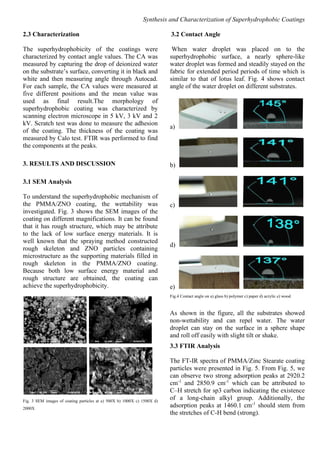
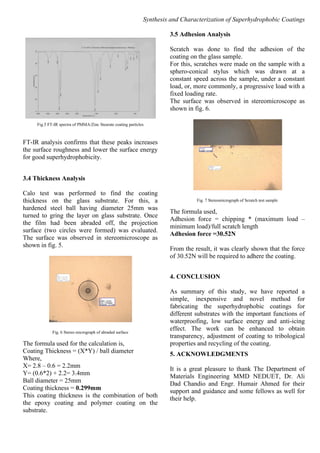
This document summarizes the synthesis and characterization of superhydrophobic coatings. It describes a simple spraying method used to apply coatings to various substrates like glass, polymer, paper, etc. The coatings were characterized through SEM analysis, contact angle measurements, thickness analysis, adhesion testing and FTIR. SEM images showed the coatings had a rough structure that contributed to their superhydrophobicity. Contact angle measurements found water droplets formed spherical shapes on all coated substrates, indicating they were superhydrophobic. Thickness analysis found the coating to be approximately 0.299mm thick. Adhesion testing required a force of 30.52N to remove the coating. The coatings showed potential for applications like anti-cor


