Download to read offline
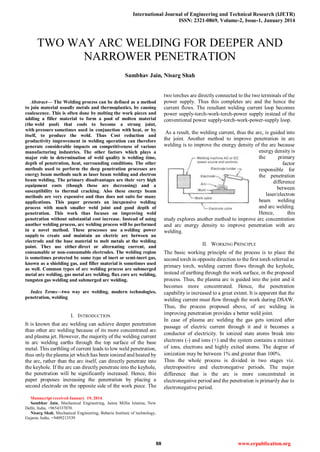
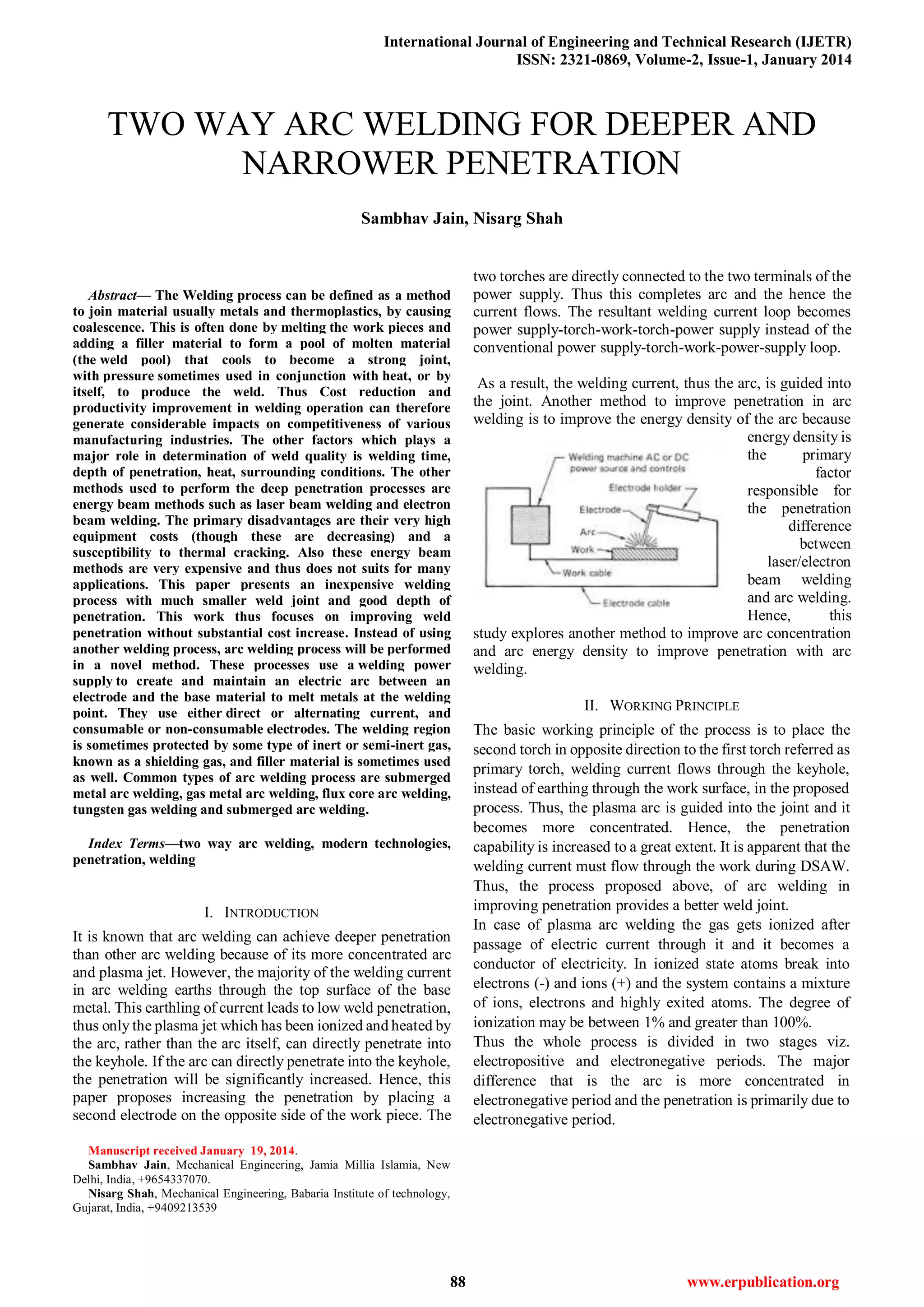
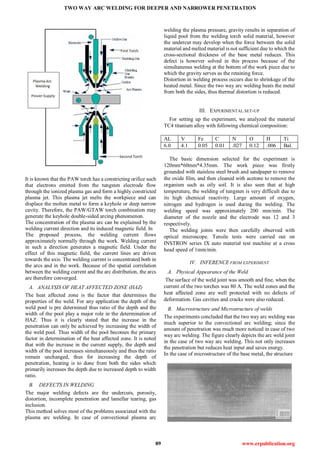
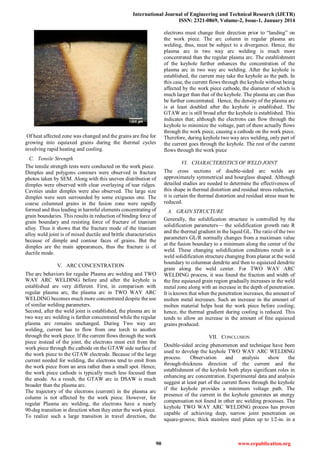
![TWO WAY ARC WELDING FOR DEEPER AND NARROWER PENETRATION
91 www.erpublication.org
single pass. Keyhole TWO WAY ARC WELDING reduces
heat input into the work piece by at least 70% in comparison
with regular keyhole PAW, which achieves the deepest and
narrowest penetration at the least heat input of all existing arc
welding processes. In other words, keyhole TWO WAY
ARC WELDING requires only 30% of the heat input needed
by keyhole PAW. Welds produced by keyhole TWO WAY
ARC WELDING are less than 1 mm wider than those
produced by the laser process. To penetrate the same
thickness of stainless steel plates up to 1⁄2in. thick, the heat
input into the work piece by the keyhole TWO WAY ARC
WELDING process is approximate five times as much as that
input by a high-power (approximately 10-kW)laser. Welds
produced by keyhole TWO WAY ARC WELDING are
approximately symmetrical and hour glass shaped. Keyhole
TWO WAY ARC WELDING tends to increase the amount
of the desirable equiaxed grains in the solidified welds.
Detailed studies are needed to fully disclose the metallurgical
implications and mechanical properties for keyhole TWO
WAY ARC WELDING of different materials, including the
impact of heat input reduction and symmetrical shape on
thermal distortion and residual stress, and to quantitatively
analyze the phenomena during double sided arcing and the
keyhole two way arc welding process.
Through the experimental set up it can be concluded that the
titanium alloy can be successfully welded by two way arc
welding at appropriate welding parameters. The welded joint
has good surface appearance without obvious deformation
and defects of cracks and gas acavities.
The two way arc welding process is superior over the regular
single side arc welding on the aspect of low heat ninput,
decreasing the width and deformation of welds and refining
grains. The joints can reach 96.14% tensile strength and
70.85% elongation of the base metal.
EFERENCES
[1] Laser Welding Handbook. 8th edition, Vol. 2: Welding Processes,
AWS, 1991.
[2] E. Craig, 1988. ―The plasma arc welding-a review,‖ Welding Journal,
67(2): 19-25.
[3] R. Hou, D. M. Evans, J. C. McClure, A. C. Nunes, and G. Garcia, 1996.
―Shielding gas and heat transfer efficiency in plasma arc welding,‖
Welding Journal, 75(10): 305s-1310s.
[4] C. J. Kaufman, Rocky Mountain Research Lab., Boulder, CO, private
communication, May 1995.
[5] J. R. Davis (Editor), 1994. ASM Specialty Handbook: Aluminum and
Aluminum Alloys, ASM International, 376-415.
[6] M. Young, the Technical Writers Handbook. Mill Valley, CA:
University Science, 1989.
[7] M. Tomsic and Barhorst, 1984. ―Keyhole plasma arc welding of
aluminum with variable polarity power,‖ Welding Journal, 63(2):
25-32.
[8] T. Paskell, C. Lundin, and H. Castner, 1997. ―GTAW flux increases
weld joint penetration,‖ Welding Journal, 76(4): 57-62.
[9] ZHANG, Bao-chang, Nonferrous Materials and Heat Processing [M].
Xian Northwestern Polytechnic University Press, 1993. 88-89. (in
chinese).
[10] LI Jiang-guo. Present situation and future of welding machinery in
dietary [J]. China Welding, 1994, 3(2) ; 44-47.
[11] McGaugly T. Two new technologies may increase pipe production and
reduce cost [J]. Welding Journal, 2000, 124(3) ; 695-701.
[12] Zhang Y M. Zhang S B. Double-sided arc welding increases weld joint
penetration [J]. Welding Journal, 1998, 77(6) ; 57-61.
[13] SI Chong-Yao Welding Manuals (Volume 2) [M]. Beijing; China
Machine Press, 1992. 537-540. (in Chinese)
[14] B. Irving, 1994. ―Welding the four most popular aluminum alloys,‖
Welding Journal, 73(2): 51-55.
[15] Zhang, Y. M., and Zhang, S. B. 1999. Method of arc welding using
dual serial opposed torches. U.S. Patent, No. 5,990,446.
[16] Welding Handbook. 8th edition, Vol. 2, Welding Processes. Miami,
Fla.: American Welding Society.
[17] Satoh, T., Katayama, J., Ioka, S., and Otani, M. 1990. Experimental
study on rotating behavior of arc during magnetically impelled arc butt
welding. Quarterly Journal of the Japanese Welding Society 8(1):
71–77.
[18] Dowden, J., and Kapadia, P. 1994. Plasma arc welding: a mathematical
model of the arc. Journal of Physics (D): Applied Physics 27: 902–910.
[19] Puchaicela, J. 1998. Control of distortion of welded steel structures.
Welding Journal 77(8): 49–52.
[20] Halmoy, E., Fostervoll, H., and Ramsland, A. 1994. New applications
of plasma keyhole welding. Welding in the World 34: 285–291.
[21] . Lancaster, J. F. 1986. The Physics of Welding. Oxford, Pergamon
Press
Sambhav Jain is pursuing bachelor of technology in
mechanical engineering fro m Jamia Millia Islamia, New
Delhi. He has keen interest in manufacturing engineering
processes.
Nisarg Shah is a student of mechanical engineering from babaria
institute of technology, Gujarat. He has interests in manufacturing
engineering.](https://image.slidesharecdn.com/ijetr021140-161122122056/85/Ijetr021140-4-320.jpg)

This document discusses a two-way arc welding process that aims to improve weld penetration without substantial cost increases compared to other deep penetration welding methods like laser beam welding. The process involves placing a second electrode on the opposite side of the workpiece so that welding current flows through the keyhole instead of just along the surface. Experimental results showed that two-way arc welding achieved much deeper penetration than conventional arc welding. It also reduced weld defects and heat input. Microstructural analysis found finer grain structures in the heat affected zone and tensile tests showed the welds had a ductile fracture mode.


![[IJET V2I5P19] Authors: D. Venkata Krishna, E. Mahesh, G. Kiran, G. Sai Suche...](https://cdn.slidesharecdn.com/ss_thumbnails/ijet-v2i5p19-161107144424-thumbnail.jpg?width=640&height=640&fit=bounds)


![[eeLine]company profile 140922(eng)](https://cdn.slidesharecdn.com/ss_thumbnails/eelinecompanyprofile140922eng-140922044658-phpapp02-thumbnail.jpg?width=640&height=640&fit=bounds)


