Sunil D. Kahar, K. Baba Pai / International Journal of Engineering Research and Applications
(IJERA) ISSN: 2248-9622 www.ijera.com
Vol. 3, Issue 4, Jul-Aug 2013, pp.2620-2627
2620 | P a g e
Corrosion Behavior of Electro-Slag Strip Cladded Weld Overlays
in Different Acid Solutions
Sunil D. Kahar*
, K. Baba Pai**
*
(Metallurgical and Materials Engg. Dept., The M. S. University of Baroda, Vadodara- 390001)
**
(Director, ITM Universe, Halol Road, Vadodara, Ex. Dean, Faculty of Tech. & Engg. Vadodara)
ABSTRACT
The electro-slag strip cladding (ESSC)
process is development of submerged arc strip
cladding process which has quickly established
itself as a reliable high deposition rate process.
ESSC process increasingly used for the
production of corrosion resistant weld overlays in
equipments for the offshore, chemical,
petrochemical & nuclear industries. In the present
work, 309L & 309LNb austenitic Stainless steel
strip were used to develop weld overlay on Cr-Mo
steel by variation in welding speed. Amount of
ferrite content has been evaluated by ferrite-scope
& micro structural study has been done on
neophot-2 microscope a at cladded region for both
weld overlays which show that amount of ferrite
in the matrix of austenite decreases with increase
welding speed from 160 mm/min to 200 mm/min.
Potentio dynamic studies were carried out on both
weld overlays in 0.1 N 1 H2SO4 & 0.1 N HNO3
solution using Potentiostat Gammry Reference
600 which reveal that (i) both weld overlays has
better corrosion resistance in 0.1 N H2SO4
solution as well as in 0.1 N HNO3 solution, (ii)
both weld overlays developed at 180mm /min.
welding speed has good corrosion resistance
compared to 160 & 200 mm/min. welding speed.
Cyclic polarization studies were carried out on
both weld overlays in 6 % FeCl3 Solution by using
Potentiostat Gammry Reference 600 which shows
that 309 L Nb cladded weld overlay has better
pitting resistance at 180mm/min welding speed
while 309L cladded weld overlays has lower at all
welding speed.
Keywords:, Austenitic Stainless steel, Electro-slag
strip cladding, Welding speed, Micro-structural
changes, Ferrite content, Potentio-dynamic study and
cyclic polarization study.
I. INTRODUCTION
Stainless steel strip cladding is a flexible &
economical way of depositing corrosion resistant,
protective layer on low alloy or low carbon steel due
to which it is widely used in the production of
components for chemical, petrochemical & nuclear
industries [1]. Large pressure vessels are used in
hydrogen containing environments, for example, in
the petroleum industry in hydro-cracking,
hydrodesulphurization and catalytic reforming
processes as well as in the chemical and coal
conversion industries [2]. All hydro processing
reactors require internal protection of the reactor
vessel walls to resist the high temperature corrosion
due to presence of sulphur in the process stream. This
protection is generally provided by stainless steel
strip electrodes which are made up of different grade
such as 347,309L, 309LNb, 316L, 317L. A stabilized
composition overlay also prevents sensitization
during the final post weld heat treatment (PWHT)
cycle of the reactor [3].The two most productive
systems for surfacing the large components which are
subjected to corrosion or wear are submerged arc and
electro-slag cladding, using a strip electrode. Both
processes are characterized by a high deposition rate,
low dilution and high deposit quality. Both these
processes are suitable for surfacing flat and curved
objects such as heat exchanger tube sheets and
pressure vessels. Submerged arc welding (SAW) is
most frequently used but, if higher productivity and
restricted dilution rates are required, electro-slag
welding (ESW) is recommended [4].
Electro-slag Strip Cladding
Electro-slag strip cladding relates to the resistance
welding processes and is based on the ohmic
resistance heating in a shallow layer of liquid electro
conductive slag. The heat generated by the molten
slag pool melts the surface of the base material and
the strip electrode end, which is dipping in the slag
and the flux. The penetration is less for electro-slag
welding than for submerge arc welding, since there is
no arc between the strip electrode and the parent
material [5]. To increase the cladding speed at
corresponding high welding currents, it is necessary
to use fluxes producing a slag of even higher
electrical conductivity and lower viscosity. The
temperature of the slag pool is about 2300°C and, if it
is not fully covered with flux, it emits infrared
radiation [6, 7].
Sunil D. Kahar, K. Baba Pai / International Journal of Engineering Research and Applications
(IJERA) ISSN: 2248-9622 www.ijera.com
Vol. 3, Issue 4, Jul-Aug 2013, pp.2620-2627
2621 | P a g e
Fig. 1: Schematic Diagram of ESSC Process
The interior temperature of the bath is in vicinity of
19250
C. The surface temperature is approximately
16500
C. Melted electrode and the base metal collect
in pool beneath the molten slag bath and slowly
solidifies to form the clad [8]. Out of all welding
parameters, welding speed is significantly influence
the ferrite content & dilution of weld overlays. If a
very low welding speed is selected during cladding, it
will the result in very low dilution but at the same
time acquiring an unacceptable high content of ferrite
as it can be impairs the corrosion resistance and the
ductility of the welded overlay. In this present work,
electro slag strip cladding process were used to
developed weld overlay of 309L & 309L Nb
austenitic stainless steel on Cr-Mo steel with
variation of welding speeds of 160 to 200 mm/min. at
fixed current (1,200 Amps) and Voltage(24 Volts).
Weld overlay are under gone various corrosion
problem such as general, pitting and inter granular
corrosion under service conditions. So the corrosion
behavior of both weld overlay will be studied in
different corrosive environments using various
corrosion tests such as potentiodynamic study &
cyclic polarization study [9].
II. EXPERIMENTAL PROCEDURE
2.1 Development of weld overlays:
The base material of 55 mm thick plate of SA387
Gr11 Cl2 steel received in the normalized were
cladded with single layer of 309 L & 309L Nb by
electro-slag strip cladding process using the
following welding conditions.
 Polarity: DECP
 Current1100A-1300A
 Voltage: 24-26 V
 Travel speed: 160,180,200 mm/min
 Electrode extension (Stick out): 35 mm max.
 Height of flux: 20-25 mm
 Preheat temperature: 1250
C min
 Inter pass temperature: 2000
C max.
Chemical composition of base metal & strip
electrodes were measured with the help of X-ray
florescent scope and tabulated in table-1.
Table-1: chemical Composition of base metal and
strip electrodes (weight%)
2.2 Sample Preparation:
Slices of cladded plates have been done across the
width area and it was taper grinded on milling
machine at angle of 10-15 degree for necessary
testing.
III. TESTING & EVALUATION
3.1 Visual Examination:
This is done for bead shape observation &
checking any welding defect like undercut during the
welding process.
3.2 Determination of Ferrite Content:
Ferrite content was measured with the help
of Fischer Ferrite- scope MP 30 for all types weld
overlays samples.
3.3 Microstructure Evaluation:
Neophot – 2 Microscope is used to observer
micro structural changes at grain boundary as well as
at interface using following etchant.
 Etchant for Base Metal: Nital (98% Methanol &
2% HNO3) solution.
 Etchant for cladded region: Aquzregia (75% HCl
& 25% HNO3) solution.
 All samples were viewed at 400X Magnification.
3.4 Corrosion Testing:
Potentiodynamic studies were carried out on
both weld overlays in 0.1 N H2SO4 solution & 0.1 N
HNO3 solution as per ASTM G-5 standard, while
cyclic polarization studies were carried out on both
weld overlays in 6 % FeCl3 Solution as per ASTM
G-61 standard using Potentiostat Gammry Reference
600. Corrosion cell was consist of Calomel electrode
as reference electrode, graphite rod as counter
electrode and test sample as working electrode.
Type Base Metal 309L
Clad
309L Nb
Clad
%C 0.15 0.005 0.005
% Cr 1.2 21.0 21.0
% Ni 0.16 11.0 11.0
% Mo 0.5 <0.03 <0.03
% Si 0.6 0.5 0.5
% Mn 1.2 1.8 1.8
% Nb 0.001 - 0.52
% N2 - 0.0036 0.0036
% P 0.003 0.012 0.012
% S <0.001 0.005 0.005
Sunil D. Kahar, K. Baba Pai / International Journal of Engineering Research and Applications
(IJERA) ISSN: 2248-9622 www.ijera.com
Vol. 3, Issue 4, Jul-Aug 2013, pp.2620-2627
2622 | P a g e
Table- 2: Operating Parameters of potentio-
dynamic test
Table- 3: Operating Parameters of cyclic
polarization test
IV. RESULTS & DISCUSSION
4.1 Determination of ferrite content:
Results of amount of ferrite content at cladded
surface are tabulated in table No 4 which shows that
for both weld overlays developed by 309 L & 309
LNb, the ferrite content decrease with increase in the
welding speed from 160 to 200 mm / min.
Table- 4 : Variation of ferrite content at different
welding speed
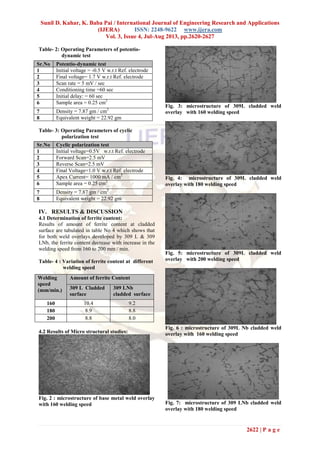
4.2 Results of Micro structural studies:
Fig. 2 : microstructure of base metal weld overlay
with 160 welding speed
Fig. 3: microstructure of 309L cladded weld
overlay with 160 welding speed
Fig. 4: microstructure of 309L cladded weld
overlay with 180 welding speed
Fig. 5: microstructure of 309L cladded weld
overlay with 200 welding speed
Fig. 6 : microstructure of 309L Nb cladded weld
overlay with 160 welding speed
Fig. 7: microstructure of 309 LNb cladded weld
overlay with 180 welding speed
Sr.No Potentio-dynamic test
1 Initial voltage = -0.5 V w.r.t Ref. electrode
2 Final voltage= 1.7 V w.r.t Ref. electrode
3 Scan rate = 5 mV / sec
4 Conditioning time =60 sec
5 Initial delay: = 60 sec
6 Sample area = 0.25 cm2
7 Density = 7.87 gm / cm2
8 Equivalent weight = 22.92 gm
Sr.No Cyclic polarization test
1 Initial voltage=0.5V w.r.t Ref. electrode
2 Forward Scan=2.5 mV
3 Reverse Scan=2.5 mV
4 Final Voltage=1.0 V w.r.t Ref. electrode
5 Apex Current= 1000 mA / cm2
6 Sample area = 0.25 cm2
7 Density = 7.87 gm / cm2
8 Equivalent weight = 22.92 gm
Welding
speed
(mm/min.)
Amount of ferrite Content
309 L Cladded
surface
309 LNb
cladded surface
160 10.4 9.2
180 8.9 8.8
200 8.8 8.0
Sunil D. Kahar, K. Baba Pai / International Journal of Engineering Research and Applications
(IJERA) ISSN: 2248-9622 www.ijera.com
Vol. 3, Issue 4, Jul-Aug 2013, pp.2620-2627
2623 | P a g e
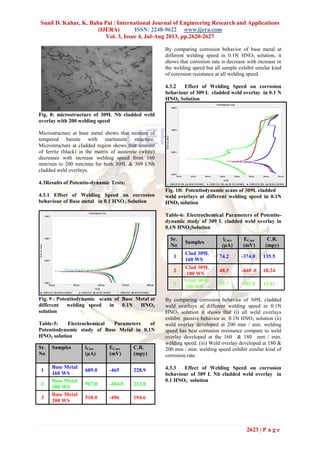
Fig. 8: microstructure of 309L Nb cladded weld
overlay with 200 welding speed
Microstructure at base metal shows that mixture of
tempered bainite with martensite structure.
Microstructure at cladded region shows that amount
of ferrite (black) in the matrix of austenite (white)
decreases with increase welding speed from 160
mm/min to 200 mm/min for both 309L & 309 LNb
cladded weld overlays.
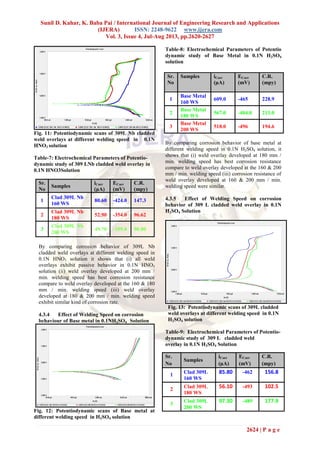
4.3Results of Potentio-dynamic Tests:
4.3.1 Effect of Welding Speed on corrosion
behaviour of Base metal in 0.1 HNO3 Solution
Fig. 9 : Potentiodynamic scans of Base Metal at
different welding speed in 0.1N HNO3
solution
Table-5: Electrochemical Parameters of
Potentiodynamic study of Base Metal in 0.1N
HNO3 solution
By comparing corrosion behavior of base metal at
different welding speed in 0.1N HNO3 solution, it
shows that corrosion rate is decrease with increase in
the welding speed but all sample exhibit similar kind
of corrosion resistance at all welding speed.
4.3.2 Effect of Welding Speed on corrosion
behaviour of 309 L cladded weld overlay in 0.1 N
HNO3 Solution
Fig. 10: Potentiodynamic scans of 309L cladded
weld overlays at different welding speed in 0.1N
HNO3 solution
Table-6: Electrochemical Parameters of Potentio-
dynamic study of 309 L cladded weld overlay in
0.1N HNO3Solution
By comparing corrosion behavior of 309L cladded
weld overlays at different welding speed in 0.1N
HNO3 solution it shows that (i) all weld overlays
exhibit passive behavior in 0.1N HNO3 solution (ii)
weld overlay developed at 200 mm / min. welding
speed has best corrosion resistance compare to weld
overlay developed at the 160 & 180 mm / min.
welding speed. (iii) Weld overlay developed at 180 &
200 mm / min. welding speed exhibit similar kind of
corrosion rate.
4.3.3 Effect of Welding Speed on corrosion
behaviour of 309 L Nb cladded weld overlay in
0.1 HNO3 solution
Sr.
No
Samples iCorr
(µA)
ECorr
(mV)
C.R.
(mpy)
1
Base Metal
160 WS
609.0 -465 228.9
2
Base Metal
180 WS
567.0 -404.0 213.0
3
Base Metal
200 WS
518.0 -496 194.6
Sr.
No
Samples
iCorr
(µA)
ECorr
(mV)
C.R.
(mpy)
1
Clad 309L
160 WS
74.2 -374.0 135.5
2
Clad 309L
180 WS
48.5 -440 .0 18.24
3
Clad 309L
200 WS
35.7 -402.0 13.41
Sunil D. Kahar, K. Baba Pai / International Journal of Engineering Research and Applications
(IJERA) ISSN: 2248-9622 www.ijera.com
Vol. 3, Issue 4, Jul-Aug 2013, pp.2620-2627
2624 | P a g e
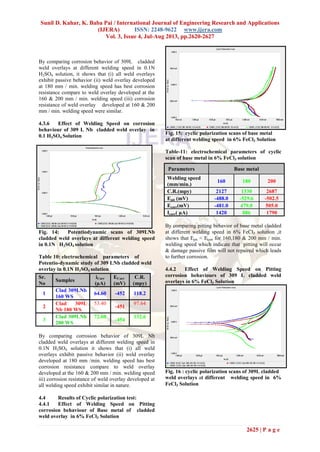
Fig. 11: Potentiodynamic scans of 309L Nb cladded
weld overlays at different welding speed in 0.1N
HNO3 solution
Table-7: Electrochemical Parameters of Potentio-
dynamic study of 309 LNb cladded weld overlay in
0.1N HNO3Solution
By comparing corrosion behavior of 309L Nb
cladded weld overlays at different welding speed in
0.1N HNO3 solution it shows that (i) all weld
overlays exhibit passive behavior in 0.1N HNO3
solution (ii) weld overlay developed at 200 mm /
min. welding speed has best corrosion resistance
compare to weld overlay developed at the 160 & 180
mm / min. welding speed (iii) weld overlay
developed at 180 & 200 mm / min. welding speed
exhibit similar kind of corrosion rate.
4.3.4 Effect of Welding Speed on corrosion
behaviour of Base metal in 0.1NH2SO4 Solution
Fig. 12: Potentiodynamic scans of Base metal at
different welding speed in H2SO4 solution
Table-8: Electrochemical Parameters of Potentio
dynamic study of Base Metal in 0.1N H2SO4
solution
By comparing corrosion behavior of base metal at
different welding speed in 0.1N H2SO4 solution, it
shows that (i) weld overlay developed at 180 mm /
min. welding speed has best corrosion resistance
compare to weld overlay developed at the 160 & 200
mm / min. welding speed (iii) corrosion resistance of
weld overlay developed at 160 & 200 mm / min.
welding speed were similar.
4.3.5 Effect of Welding Speed on corrosion
behavior of 309 L cladded weld overlay in 0.1N
H2SO4 Solution
Fig. 13: Potentiodynamic scans of 309L cladded
weld overlays at different welding speed in 0.1N
H2SO4 solution
Table-9: Electrochemical Parameters of Potentio-
dynamic study of 309 L cladded weld
overlay in 0.1N H2SO4 Solution
Sr.
No
Samples
iCorr
(µA)
ECorr
(mV)
C.R.
(mpy)
1
Clad 309L Nb
160 WS
80.60 -424.0 147.3
2
Clad 309L Nb
180 WS
52.90 -354.0 96.62
3
Clad 309L Nb
200 WS
49.70 -359.0 90.80
Sr.
No
Samples iCorr
(µA)
ECorr
(mV)
C.R.
(mpy)
1
Base Metal
160 WS
609.0 -465 228.9
2
Base Metal
180 WS
567.0 -404.0 213.0
3
Base Metal
200 WS
518.0 -496 194.6
Sr.
No
Samples
iCorr
(µA)
ECorr
(mV)
C.R.
(mpy)
1
Clad 309L
160 WS
85.80 -462 156.8
2 Clad 309L
180 WS
56.10 -493 102.5
3
Clad 309L
200 WS
97.30 -489 177.9
Sunil D. Kahar, K. Baba Pai / International Journal of Engineering Research and Applications
(IJERA) ISSN: 2248-9622 www.ijera.com
Vol. 3, Issue 4, Jul-Aug 2013, pp.2620-2627
2625 | P a g e
By comparing corrosion behavior of 309L cladded
weld overlays at different welding speed in 0.1N
H2SO4 solution, it shows that (i) all weld overlays
exhibit passive behavior (ii) weld overlay developed
at 180 mm / min. welding speed has best corrosion
resistance compare to weld overlay developed at the
160 & 200 mm / min. welding speed (iii) corrosion
resistance of weld overlay developed at 160 & 200
mm / min. welding speed were similar.
4.3.6 Effect of Welding Speed on corrosion
behaviour of 309 L Nb cladded weld overlay in
0.1 H2SO4 Solution
Fig. 14: Potentiodynamic scans of 309LNb
cladded weld overlays at different welding speed
in 0.1N H2SO4 solution
Table 10: electrochemical parameters of
Potentio-dynamic study of 309 LNb cladded weld
overlay in 0.1N H2SO4 solution
By comparing corrosion behavior of 309L Nb
cladded weld overlays at different welding speed in
0.1N H2SO4 solution it shows that (i) all weld
overlays exhibit passive behavior (ii) weld overlay
developed at 180 mm /min. welding speed has best
corrosion resistance compare to weld overlay
developed at the 160 & 200 mm / min. welding speed
iii) corrosion resistance of weld overlay developed at
all welding speed exhibit similar in nature.
4.4 Results of Cyclic polarization test:
4.4.1 Effect of Welding Speed on Pitting
corrosion behaviour of Base metal of cladded
weld overlay in 6% FeCl3 Solution
Fig. 15: cyclic polarization scans of base metal
at different welding speed in 6% FeCl3 Solution
Table-11: electrochemical parameters of cyclic
scan of base metal in 6% FeCl3 solution
By comparing pitting behavior of base metal cladded
at different welding speed in 6% FeCl3 solution ,it
shows that Epit < Ecorr for 160,180 & 200 mm / min.
welding speed which indicate that pitting will occur
& damage passive film will not repaired which leads
to further corrosion.
4.4.2 Effect of Welding Speed on Pitting
corrosion behaviours of 309 L cladded weld
overlays in 6% FeCl3 Solution
Fig. 16 : cyclic polarization scans of 309L cladded
weld overlays at different welding speed in 6%
FeCl3 Solution
Sr.
No
Samples
iCorr
(µA)
ECorr
(mV)
C.R.
(mpy)
1
Clad 309LNb
160 WS
64.60 -452 118.2
2
Clad 309L
Nb 180 WS
53.40
-451
97.64
3
Clad 309LNb
200 WS
72.60
-454
132.6
Parameters Base metal
Welding speed
(mm/min.)
160 180 200
C.R.(mpy) 2127 1330 2687
Epit (mV) -488.0 -529.6 -502.5
Ecorr(mV) -481.0 479.0 505.0
Icorr( µA) 1420 886 1790
Sunil D. Kahar, K. Baba Pai / International Journal of Engineering Research and Applications
(IJERA) ISSN: 2248-9622 www.ijera.com
Vol. 3, Issue 4, Jul-Aug 2013, pp.2620-2627
2626 | P a g e
Table 12: electrochemical parameters of cyclic
scan of 309L weld overlay in 6% FeCl3 Solution
By comparing pitting behavior of 309L cladded weld
overlays at different Welding speed in 6% FeCl3
solution, it shows that Epit < Ecorr for all welding
speed which indicate that pitting will occur &
damage passive film will not repaired which leads to
further corrosion.
4.4.3 Effect of Welding Speed on Pitting
corrosion behaviours of 309LNb cladded weld
overlays in 6% FeCl3 Solution
Fig. 17 : cyclic polarization scans of 309 L Nb
cladded weld overlays at different welding speed
in 6% FeCl3 Solution
Table 13: electrochemical parameters of cyclic
scan of 309L Nb weld overlay in 6% FeCl3
Solution
By comparing corrosion behavior of 309L Nb
cladded weld overlays at different Welding speed in
6% FeCl3 solution it shows that Epit > Ecorr for 180
mm / min. welding speed which indicate that the
pitting will occur but damage passive film will
repaired & protecting further corrosion while in case
of 160 & 200 mm / min. welding speed Epit < Ecorr
which indicate that pitting will occur & damage
passive film will not repaired which leads to further
corrosion.
V. CONCLUSIONS
1. Electroslag strip cladding process can be
advantageously and profitably used to deposit
austenitic stainless steel weld overlays on low-
alloy steel.
2. Amount of ferrite content is decrease with
increase the welding speed from 160 to 200 mm
/min for both weld overlays developed by 309 L
& 309 L Nb grade austenitic stainless steel.
3. Corrosion rate is decrease with increase the
welding speed from 160 to 200 mm /min for
both weld overlays developed by 309 L and 309
L Nb grade austenitic stainless steel in 0.1 N
H2SO4 and 0.1N HNO3 solutions.
4. Both weld overlays developed by 309 L and 309
LNb grade austenitic stainless steel exhibit best
corrosion resistance at 200 mm /min welding
speed in 0.1N HNO3 solution.
5. Both weld overlays developed by 309 L and 309
LNb grade austenitic stainless steel exhibit best
corrosion resistance at 180 mm /min. welding
speed in 0.1 N H2SO4 solution.
6. 309L cladded weld overlay developed at all
welding speed has lower pitting resistance in 6%
FeCl3 solution.
7. 309L Nb cladded weld overlay developed with
180 mm /min. welding speed has good pitting
resistance than weld overlay developed with 160
& 200 mm /min. in 6% FeCl3 solution.
REFERENCES
Journal Papers:
[1] Susan Pak, Solveig Rigdal, Leif Karlsson, Ann-
Charlotte Gustavsson, Electroslag and
submerged arc stainless steel cladding, Anti-
Corrosion Methods and Materials, Vol. 45 ( 1),
42 - 45 .
[2] R. paschold, l. karlsson, M. F. Gittos, Karlsson.
L, Pak. S. and Gustavsson, Disbonding of
Austenitic Weld Overlays in Hydro-processing
Applications, SVETSAREN, The ESAB welding
and cutting journal vol. 62 (1), 2007, 17-19.
[3] Soudokay Strip Cladding, Bohler Thyssen
Welding BELGIUM, online article,
www.soudkay.be
[4] Professor J.H. Devletian, Member, Y.P. Gao,
Q.H. Zhao, Visitors, and Professor W. E. Wood,
Strip Cladding of Main Propeller Shafting with
Ni Alloy 625 by Electroslag Surfacing,12.
[5] I. G. Rodionova, A. A. Sharapov, V. I. Puzachev,
V. A. Grishin, V. L. Mirochnik, and A. N.
Parameters 309 L Cladded weld overlay
Welding speed
(mm/min.)
160 180 200
C.R.(mpy) 463.0 203.2 395.5
Epit (mV) -195.3 -350.4 -136.2
Ecorr(mV) -13.00 -291.00 -70.80
Icorr( µA) 309.0 135.0 264.0
Parameters 309 LNb Cladded weld
overlay
Welding speed
(mm/min.)
160 180 200
C.R.(mpy) 275.9 70.62 155.0
Epit (mV) -478.6 -192.8 -167.3
Ecorr(mV) -388.0 -222.0 -153.0
Icorr( µA) 184.0 47.10 103.0
Sunil D. Kahar, K. Baba Pai / International Journal of Engineering Research and Applications
(IJERA) ISSN: 2248-9622 www.ijera.com
Vol. 3, Issue 4, Jul-Aug 2013, pp.2620-2627
2627 | P a g e
Rybkin, Technology use of electroslag
hardfacing to improve the quality of corrosion –
resistance bimetal, Chemical and Petroleum
Engineering. Vol. 34 (1-2), 1998, 22
[6] Dipl.-Ing. R. Paschold, ESAB GmbH, Solingen,
Germany, Electroslag strip cladding for
corrosion resistance, A welding review published
by ESAB AB, Sweden Vol.2-3, 2001, 62.
[7] Tapobrata Datta, Electroslag Strip Cladding-
Principle, Process Control and Application, 43
[8] K. Darowicki, S. Krakowiak, Electrochemical
investigations of stainless steels used in flue-
gasdesulphurization units, Anti-Corrosion
Methods and Materials, Vol. 44 (6), (1997),376.
[9] Dipl.-Ing. R. Paschold, ESAB GmbH, Solingen,
Germany “Electroslag strip cladding for
corrosion resistance”, A welding review
published by ESAB AB, Sweden No. 2-3, 2001,
66.

Oz3426202627

  • 1.
    Sunil D. Kahar,K. Baba Pai / International Journal of Engineering Research and Applications (IJERA) ISSN: 2248-9622 www.ijera.com Vol. 3, Issue 4, Jul-Aug 2013, pp.2620-2627 2620 | P a g e Corrosion Behavior of Electro-Slag Strip Cladded Weld Overlays in Different Acid Solutions Sunil D. Kahar* , K. Baba Pai** * (Metallurgical and Materials Engg. Dept., The M. S. University of Baroda, Vadodara- 390001) ** (Director, ITM Universe, Halol Road, Vadodara, Ex. Dean, Faculty of Tech. & Engg. Vadodara) ABSTRACT The electro-slag strip cladding (ESSC) process is development of submerged arc strip cladding process which has quickly established itself as a reliable high deposition rate process. ESSC process increasingly used for the production of corrosion resistant weld overlays in equipments for the offshore, chemical, petrochemical & nuclear industries. In the present work, 309L & 309LNb austenitic Stainless steel strip were used to develop weld overlay on Cr-Mo steel by variation in welding speed. Amount of ferrite content has been evaluated by ferrite-scope & micro structural study has been done on neophot-2 microscope a at cladded region for both weld overlays which show that amount of ferrite in the matrix of austenite decreases with increase welding speed from 160 mm/min to 200 mm/min. Potentio dynamic studies were carried out on both weld overlays in 0.1 N 1 H2SO4 & 0.1 N HNO3 solution using Potentiostat Gammry Reference 600 which reveal that (i) both weld overlays has better corrosion resistance in 0.1 N H2SO4 solution as well as in 0.1 N HNO3 solution, (ii) both weld overlays developed at 180mm /min. welding speed has good corrosion resistance compared to 160 & 200 mm/min. welding speed. Cyclic polarization studies were carried out on both weld overlays in 6 % FeCl3 Solution by using Potentiostat Gammry Reference 600 which shows that 309 L Nb cladded weld overlay has better pitting resistance at 180mm/min welding speed while 309L cladded weld overlays has lower at all welding speed. Keywords:, Austenitic Stainless steel, Electro-slag strip cladding, Welding speed, Micro-structural changes, Ferrite content, Potentio-dynamic study and cyclic polarization study. I. INTRODUCTION Stainless steel strip cladding is a flexible & economical way of depositing corrosion resistant, protective layer on low alloy or low carbon steel due to which it is widely used in the production of components for chemical, petrochemical & nuclear industries [1]. Large pressure vessels are used in hydrogen containing environments, for example, in the petroleum industry in hydro-cracking, hydrodesulphurization and catalytic reforming processes as well as in the chemical and coal conversion industries [2]. All hydro processing reactors require internal protection of the reactor vessel walls to resist the high temperature corrosion due to presence of sulphur in the process stream. This protection is generally provided by stainless steel strip electrodes which are made up of different grade such as 347,309L, 309LNb, 316L, 317L. A stabilized composition overlay also prevents sensitization during the final post weld heat treatment (PWHT) cycle of the reactor [3].The two most productive systems for surfacing the large components which are subjected to corrosion or wear are submerged arc and electro-slag cladding, using a strip electrode. Both processes are characterized by a high deposition rate, low dilution and high deposit quality. Both these processes are suitable for surfacing flat and curved objects such as heat exchanger tube sheets and pressure vessels. Submerged arc welding (SAW) is most frequently used but, if higher productivity and restricted dilution rates are required, electro-slag welding (ESW) is recommended [4]. Electro-slag Strip Cladding Electro-slag strip cladding relates to the resistance welding processes and is based on the ohmic resistance heating in a shallow layer of liquid electro conductive slag. The heat generated by the molten slag pool melts the surface of the base material and the strip electrode end, which is dipping in the slag and the flux. The penetration is less for electro-slag welding than for submerge arc welding, since there is no arc between the strip electrode and the parent material [5]. To increase the cladding speed at corresponding high welding currents, it is necessary to use fluxes producing a slag of even higher electrical conductivity and lower viscosity. The temperature of the slag pool is about 2300°C and, if it is not fully covered with flux, it emits infrared radiation [6, 7].
  • 2.
    Sunil D. Kahar,K. Baba Pai / International Journal of Engineering Research and Applications (IJERA) ISSN: 2248-9622 www.ijera.com Vol. 3, Issue 4, Jul-Aug 2013, pp.2620-2627 2621 | P a g e Fig. 1: Schematic Diagram of ESSC Process The interior temperature of the bath is in vicinity of 19250 C. The surface temperature is approximately 16500 C. Melted electrode and the base metal collect in pool beneath the molten slag bath and slowly solidifies to form the clad [8]. Out of all welding parameters, welding speed is significantly influence the ferrite content & dilution of weld overlays. If a very low welding speed is selected during cladding, it will the result in very low dilution but at the same time acquiring an unacceptable high content of ferrite as it can be impairs the corrosion resistance and the ductility of the welded overlay. In this present work, electro slag strip cladding process were used to developed weld overlay of 309L & 309L Nb austenitic stainless steel on Cr-Mo steel with variation of welding speeds of 160 to 200 mm/min. at fixed current (1,200 Amps) and Voltage(24 Volts). Weld overlay are under gone various corrosion problem such as general, pitting and inter granular corrosion under service conditions. So the corrosion behavior of both weld overlay will be studied in different corrosive environments using various corrosion tests such as potentiodynamic study & cyclic polarization study [9]. II. EXPERIMENTAL PROCEDURE 2.1 Development of weld overlays: The base material of 55 mm thick plate of SA387 Gr11 Cl2 steel received in the normalized were cladded with single layer of 309 L & 309L Nb by electro-slag strip cladding process using the following welding conditions.  Polarity: DECP  Current1100A-1300A  Voltage: 24-26 V  Travel speed: 160,180,200 mm/min  Electrode extension (Stick out): 35 mm max.  Height of flux: 20-25 mm  Preheat temperature: 1250 C min  Inter pass temperature: 2000 C max. Chemical composition of base metal & strip electrodes were measured with the help of X-ray florescent scope and tabulated in table-1. Table-1: chemical Composition of base metal and strip electrodes (weight%) 2.2 Sample Preparation: Slices of cladded plates have been done across the width area and it was taper grinded on milling machine at angle of 10-15 degree for necessary testing. III. TESTING & EVALUATION 3.1 Visual Examination: This is done for bead shape observation & checking any welding defect like undercut during the welding process. 3.2 Determination of Ferrite Content: Ferrite content was measured with the help of Fischer Ferrite- scope MP 30 for all types weld overlays samples. 3.3 Microstructure Evaluation: Neophot – 2 Microscope is used to observer micro structural changes at grain boundary as well as at interface using following etchant.  Etchant for Base Metal: Nital (98% Methanol & 2% HNO3) solution.  Etchant for cladded region: Aquzregia (75% HCl & 25% HNO3) solution.  All samples were viewed at 400X Magnification. 3.4 Corrosion Testing: Potentiodynamic studies were carried out on both weld overlays in 0.1 N H2SO4 solution & 0.1 N HNO3 solution as per ASTM G-5 standard, while cyclic polarization studies were carried out on both weld overlays in 6 % FeCl3 Solution as per ASTM G-61 standard using Potentiostat Gammry Reference 600. Corrosion cell was consist of Calomel electrode as reference electrode, graphite rod as counter electrode and test sample as working electrode. Type Base Metal 309L Clad 309L Nb Clad %C 0.15 0.005 0.005 % Cr 1.2 21.0 21.0 % Ni 0.16 11.0 11.0 % Mo 0.5 <0.03 <0.03 % Si 0.6 0.5 0.5 % Mn 1.2 1.8 1.8 % Nb 0.001 - 0.52 % N2 - 0.0036 0.0036 % P 0.003 0.012 0.012 % S <0.001 0.005 0.005
  • 3.
    Sunil D. Kahar,K. Baba Pai / International Journal of Engineering Research and Applications (IJERA) ISSN: 2248-9622 www.ijera.com Vol. 3, Issue 4, Jul-Aug 2013, pp.2620-2627 2622 | P a g e Table- 2: Operating Parameters of potentio- dynamic test Table- 3: Operating Parameters of cyclic polarization test IV. RESULTS & DISCUSSION 4.1 Determination of ferrite content: Results of amount of ferrite content at cladded surface are tabulated in table No 4 which shows that for both weld overlays developed by 309 L & 309 LNb, the ferrite content decrease with increase in the welding speed from 160 to 200 mm / min. Table- 4 : Variation of ferrite content at different welding speed 4.2 Results of Micro structural studies: Fig. 2 : microstructure of base metal weld overlay with 160 welding speed Fig. 3: microstructure of 309L cladded weld overlay with 160 welding speed Fig. 4: microstructure of 309L cladded weld overlay with 180 welding speed Fig. 5: microstructure of 309L cladded weld overlay with 200 welding speed Fig. 6 : microstructure of 309L Nb cladded weld overlay with 160 welding speed Fig. 7: microstructure of 309 LNb cladded weld overlay with 180 welding speed Sr.No Potentio-dynamic test 1 Initial voltage = -0.5 V w.r.t Ref. electrode 2 Final voltage= 1.7 V w.r.t Ref. electrode 3 Scan rate = 5 mV / sec 4 Conditioning time =60 sec 5 Initial delay: = 60 sec 6 Sample area = 0.25 cm2 7 Density = 7.87 gm / cm2 8 Equivalent weight = 22.92 gm Sr.No Cyclic polarization test 1 Initial voltage=0.5V w.r.t Ref. electrode 2 Forward Scan=2.5 mV 3 Reverse Scan=2.5 mV 4 Final Voltage=1.0 V w.r.t Ref. electrode 5 Apex Current= 1000 mA / cm2 6 Sample area = 0.25 cm2 7 Density = 7.87 gm / cm2 8 Equivalent weight = 22.92 gm Welding speed (mm/min.) Amount of ferrite Content 309 L Cladded surface 309 LNb cladded surface 160 10.4 9.2 180 8.9 8.8 200 8.8 8.0
  • 4.
    Sunil D. Kahar,K. Baba Pai / International Journal of Engineering Research and Applications (IJERA) ISSN: 2248-9622 www.ijera.com Vol. 3, Issue 4, Jul-Aug 2013, pp.2620-2627 2623 | P a g e Fig. 8: microstructure of 309L Nb cladded weld overlay with 200 welding speed Microstructure at base metal shows that mixture of tempered bainite with martensite structure. Microstructure at cladded region shows that amount of ferrite (black) in the matrix of austenite (white) decreases with increase welding speed from 160 mm/min to 200 mm/min for both 309L & 309 LNb cladded weld overlays. 4.3Results of Potentio-dynamic Tests: 4.3.1 Effect of Welding Speed on corrosion behaviour of Base metal in 0.1 HNO3 Solution Fig. 9 : Potentiodynamic scans of Base Metal at different welding speed in 0.1N HNO3 solution Table-5: Electrochemical Parameters of Potentiodynamic study of Base Metal in 0.1N HNO3 solution By comparing corrosion behavior of base metal at different welding speed in 0.1N HNO3 solution, it shows that corrosion rate is decrease with increase in the welding speed but all sample exhibit similar kind of corrosion resistance at all welding speed. 4.3.2 Effect of Welding Speed on corrosion behaviour of 309 L cladded weld overlay in 0.1 N HNO3 Solution Fig. 10: Potentiodynamic scans of 309L cladded weld overlays at different welding speed in 0.1N HNO3 solution Table-6: Electrochemical Parameters of Potentio- dynamic study of 309 L cladded weld overlay in 0.1N HNO3Solution By comparing corrosion behavior of 309L cladded weld overlays at different welding speed in 0.1N HNO3 solution it shows that (i) all weld overlays exhibit passive behavior in 0.1N HNO3 solution (ii) weld overlay developed at 200 mm / min. welding speed has best corrosion resistance compare to weld overlay developed at the 160 & 180 mm / min. welding speed. (iii) Weld overlay developed at 180 & 200 mm / min. welding speed exhibit similar kind of corrosion rate. 4.3.3 Effect of Welding Speed on corrosion behaviour of 309 L Nb cladded weld overlay in 0.1 HNO3 solution Sr. No Samples iCorr (µA) ECorr (mV) C.R. (mpy) 1 Base Metal 160 WS 609.0 -465 228.9 2 Base Metal 180 WS 567.0 -404.0 213.0 3 Base Metal 200 WS 518.0 -496 194.6 Sr. No Samples iCorr (µA) ECorr (mV) C.R. (mpy) 1 Clad 309L 160 WS 74.2 -374.0 135.5 2 Clad 309L 180 WS 48.5 -440 .0 18.24 3 Clad 309L 200 WS 35.7 -402.0 13.41
  • 5.
    Sunil D. Kahar,K. Baba Pai / International Journal of Engineering Research and Applications (IJERA) ISSN: 2248-9622 www.ijera.com Vol. 3, Issue 4, Jul-Aug 2013, pp.2620-2627 2624 | P a g e Fig. 11: Potentiodynamic scans of 309L Nb cladded weld overlays at different welding speed in 0.1N HNO3 solution Table-7: Electrochemical Parameters of Potentio- dynamic study of 309 LNb cladded weld overlay in 0.1N HNO3Solution By comparing corrosion behavior of 309L Nb cladded weld overlays at different welding speed in 0.1N HNO3 solution it shows that (i) all weld overlays exhibit passive behavior in 0.1N HNO3 solution (ii) weld overlay developed at 200 mm / min. welding speed has best corrosion resistance compare to weld overlay developed at the 160 & 180 mm / min. welding speed (iii) weld overlay developed at 180 & 200 mm / min. welding speed exhibit similar kind of corrosion rate. 4.3.4 Effect of Welding Speed on corrosion behaviour of Base metal in 0.1NH2SO4 Solution Fig. 12: Potentiodynamic scans of Base metal at different welding speed in H2SO4 solution Table-8: Electrochemical Parameters of Potentio dynamic study of Base Metal in 0.1N H2SO4 solution By comparing corrosion behavior of base metal at different welding speed in 0.1N H2SO4 solution, it shows that (i) weld overlay developed at 180 mm / min. welding speed has best corrosion resistance compare to weld overlay developed at the 160 & 200 mm / min. welding speed (iii) corrosion resistance of weld overlay developed at 160 & 200 mm / min. welding speed were similar. 4.3.5 Effect of Welding Speed on corrosion behavior of 309 L cladded weld overlay in 0.1N H2SO4 Solution Fig. 13: Potentiodynamic scans of 309L cladded weld overlays at different welding speed in 0.1N H2SO4 solution Table-9: Electrochemical Parameters of Potentio- dynamic study of 309 L cladded weld overlay in 0.1N H2SO4 Solution Sr. No Samples iCorr (µA) ECorr (mV) C.R. (mpy) 1 Clad 309L Nb 160 WS 80.60 -424.0 147.3 2 Clad 309L Nb 180 WS 52.90 -354.0 96.62 3 Clad 309L Nb 200 WS 49.70 -359.0 90.80 Sr. No Samples iCorr (µA) ECorr (mV) C.R. (mpy) 1 Base Metal 160 WS 609.0 -465 228.9 2 Base Metal 180 WS 567.0 -404.0 213.0 3 Base Metal 200 WS 518.0 -496 194.6 Sr. No Samples iCorr (µA) ECorr (mV) C.R. (mpy) 1 Clad 309L 160 WS 85.80 -462 156.8 2 Clad 309L 180 WS 56.10 -493 102.5 3 Clad 309L 200 WS 97.30 -489 177.9
  • 6.
    Sunil D. Kahar,K. Baba Pai / International Journal of Engineering Research and Applications (IJERA) ISSN: 2248-9622 www.ijera.com Vol. 3, Issue 4, Jul-Aug 2013, pp.2620-2627 2625 | P a g e By comparing corrosion behavior of 309L cladded weld overlays at different welding speed in 0.1N H2SO4 solution, it shows that (i) all weld overlays exhibit passive behavior (ii) weld overlay developed at 180 mm / min. welding speed has best corrosion resistance compare to weld overlay developed at the 160 & 200 mm / min. welding speed (iii) corrosion resistance of weld overlay developed at 160 & 200 mm / min. welding speed were similar. 4.3.6 Effect of Welding Speed on corrosion behaviour of 309 L Nb cladded weld overlay in 0.1 H2SO4 Solution Fig. 14: Potentiodynamic scans of 309LNb cladded weld overlays at different welding speed in 0.1N H2SO4 solution Table 10: electrochemical parameters of Potentio-dynamic study of 309 LNb cladded weld overlay in 0.1N H2SO4 solution By comparing corrosion behavior of 309L Nb cladded weld overlays at different welding speed in 0.1N H2SO4 solution it shows that (i) all weld overlays exhibit passive behavior (ii) weld overlay developed at 180 mm /min. welding speed has best corrosion resistance compare to weld overlay developed at the 160 & 200 mm / min. welding speed iii) corrosion resistance of weld overlay developed at all welding speed exhibit similar in nature. 4.4 Results of Cyclic polarization test: 4.4.1 Effect of Welding Speed on Pitting corrosion behaviour of Base metal of cladded weld overlay in 6% FeCl3 Solution Fig. 15: cyclic polarization scans of base metal at different welding speed in 6% FeCl3 Solution Table-11: electrochemical parameters of cyclic scan of base metal in 6% FeCl3 solution By comparing pitting behavior of base metal cladded at different welding speed in 6% FeCl3 solution ,it shows that Epit < Ecorr for 160,180 & 200 mm / min. welding speed which indicate that pitting will occur & damage passive film will not repaired which leads to further corrosion. 4.4.2 Effect of Welding Speed on Pitting corrosion behaviours of 309 L cladded weld overlays in 6% FeCl3 Solution Fig. 16 : cyclic polarization scans of 309L cladded weld overlays at different welding speed in 6% FeCl3 Solution Sr. No Samples iCorr (µA) ECorr (mV) C.R. (mpy) 1 Clad 309LNb 160 WS 64.60 -452 118.2 2 Clad 309L Nb 180 WS 53.40 -451 97.64 3 Clad 309LNb 200 WS 72.60 -454 132.6 Parameters Base metal Welding speed (mm/min.) 160 180 200 C.R.(mpy) 2127 1330 2687 Epit (mV) -488.0 -529.6 -502.5 Ecorr(mV) -481.0 479.0 505.0 Icorr( µA) 1420 886 1790
  • 7.
    Sunil D. Kahar,K. Baba Pai / International Journal of Engineering Research and Applications (IJERA) ISSN: 2248-9622 www.ijera.com Vol. 3, Issue 4, Jul-Aug 2013, pp.2620-2627 2626 | P a g e Table 12: electrochemical parameters of cyclic scan of 309L weld overlay in 6% FeCl3 Solution By comparing pitting behavior of 309L cladded weld overlays at different Welding speed in 6% FeCl3 solution, it shows that Epit < Ecorr for all welding speed which indicate that pitting will occur & damage passive film will not repaired which leads to further corrosion. 4.4.3 Effect of Welding Speed on Pitting corrosion behaviours of 309LNb cladded weld overlays in 6% FeCl3 Solution Fig. 17 : cyclic polarization scans of 309 L Nb cladded weld overlays at different welding speed in 6% FeCl3 Solution Table 13: electrochemical parameters of cyclic scan of 309L Nb weld overlay in 6% FeCl3 Solution By comparing corrosion behavior of 309L Nb cladded weld overlays at different Welding speed in 6% FeCl3 solution it shows that Epit > Ecorr for 180 mm / min. welding speed which indicate that the pitting will occur but damage passive film will repaired & protecting further corrosion while in case of 160 & 200 mm / min. welding speed Epit < Ecorr which indicate that pitting will occur & damage passive film will not repaired which leads to further corrosion. V. CONCLUSIONS 1. Electroslag strip cladding process can be advantageously and profitably used to deposit austenitic stainless steel weld overlays on low- alloy steel. 2. Amount of ferrite content is decrease with increase the welding speed from 160 to 200 mm /min for both weld overlays developed by 309 L & 309 L Nb grade austenitic stainless steel. 3. Corrosion rate is decrease with increase the welding speed from 160 to 200 mm /min for both weld overlays developed by 309 L and 309 L Nb grade austenitic stainless steel in 0.1 N H2SO4 and 0.1N HNO3 solutions. 4. Both weld overlays developed by 309 L and 309 LNb grade austenitic stainless steel exhibit best corrosion resistance at 200 mm /min welding speed in 0.1N HNO3 solution. 5. Both weld overlays developed by 309 L and 309 LNb grade austenitic stainless steel exhibit best corrosion resistance at 180 mm /min. welding speed in 0.1 N H2SO4 solution. 6. 309L cladded weld overlay developed at all welding speed has lower pitting resistance in 6% FeCl3 solution. 7. 309L Nb cladded weld overlay developed with 180 mm /min. welding speed has good pitting resistance than weld overlay developed with 160 & 200 mm /min. in 6% FeCl3 solution. REFERENCES Journal Papers: [1] Susan Pak, Solveig Rigdal, Leif Karlsson, Ann- Charlotte Gustavsson, Electroslag and submerged arc stainless steel cladding, Anti- Corrosion Methods and Materials, Vol. 45 ( 1), 42 - 45 . [2] R. paschold, l. karlsson, M. F. Gittos, Karlsson. L, Pak. S. and Gustavsson, Disbonding of Austenitic Weld Overlays in Hydro-processing Applications, SVETSAREN, The ESAB welding and cutting journal vol. 62 (1), 2007, 17-19. [3] Soudokay Strip Cladding, Bohler Thyssen Welding BELGIUM, online article, www.soudkay.be [4] Professor J.H. Devletian, Member, Y.P. Gao, Q.H. Zhao, Visitors, and Professor W. E. Wood, Strip Cladding of Main Propeller Shafting with Ni Alloy 625 by Electroslag Surfacing,12. [5] I. G. Rodionova, A. A. Sharapov, V. I. Puzachev, V. A. Grishin, V. L. Mirochnik, and A. N. Parameters 309 L Cladded weld overlay Welding speed (mm/min.) 160 180 200 C.R.(mpy) 463.0 203.2 395.5 Epit (mV) -195.3 -350.4 -136.2 Ecorr(mV) -13.00 -291.00 -70.80 Icorr( µA) 309.0 135.0 264.0 Parameters 309 LNb Cladded weld overlay Welding speed (mm/min.) 160 180 200 C.R.(mpy) 275.9 70.62 155.0 Epit (mV) -478.6 -192.8 -167.3 Ecorr(mV) -388.0 -222.0 -153.0 Icorr( µA) 184.0 47.10 103.0
  • 8.
    Sunil D. Kahar,K. Baba Pai / International Journal of Engineering Research and Applications (IJERA) ISSN: 2248-9622 www.ijera.com Vol. 3, Issue 4, Jul-Aug 2013, pp.2620-2627 2627 | P a g e Rybkin, Technology use of electroslag hardfacing to improve the quality of corrosion – resistance bimetal, Chemical and Petroleum Engineering. Vol. 34 (1-2), 1998, 22 [6] Dipl.-Ing. R. Paschold, ESAB GmbH, Solingen, Germany, Electroslag strip cladding for corrosion resistance, A welding review published by ESAB AB, Sweden Vol.2-3, 2001, 62. [7] Tapobrata Datta, Electroslag Strip Cladding- Principle, Process Control and Application, 43 [8] K. Darowicki, S. Krakowiak, Electrochemical investigations of stainless steels used in flue- gasdesulphurization units, Anti-Corrosion Methods and Materials, Vol. 44 (6), (1997),376. [9] Dipl.-Ing. R. Paschold, ESAB GmbH, Solingen, Germany “Electroslag strip cladding for corrosion resistance”, A welding review published by ESAB AB, Sweden No. 2-3, 2001, 66.