Culture - definition
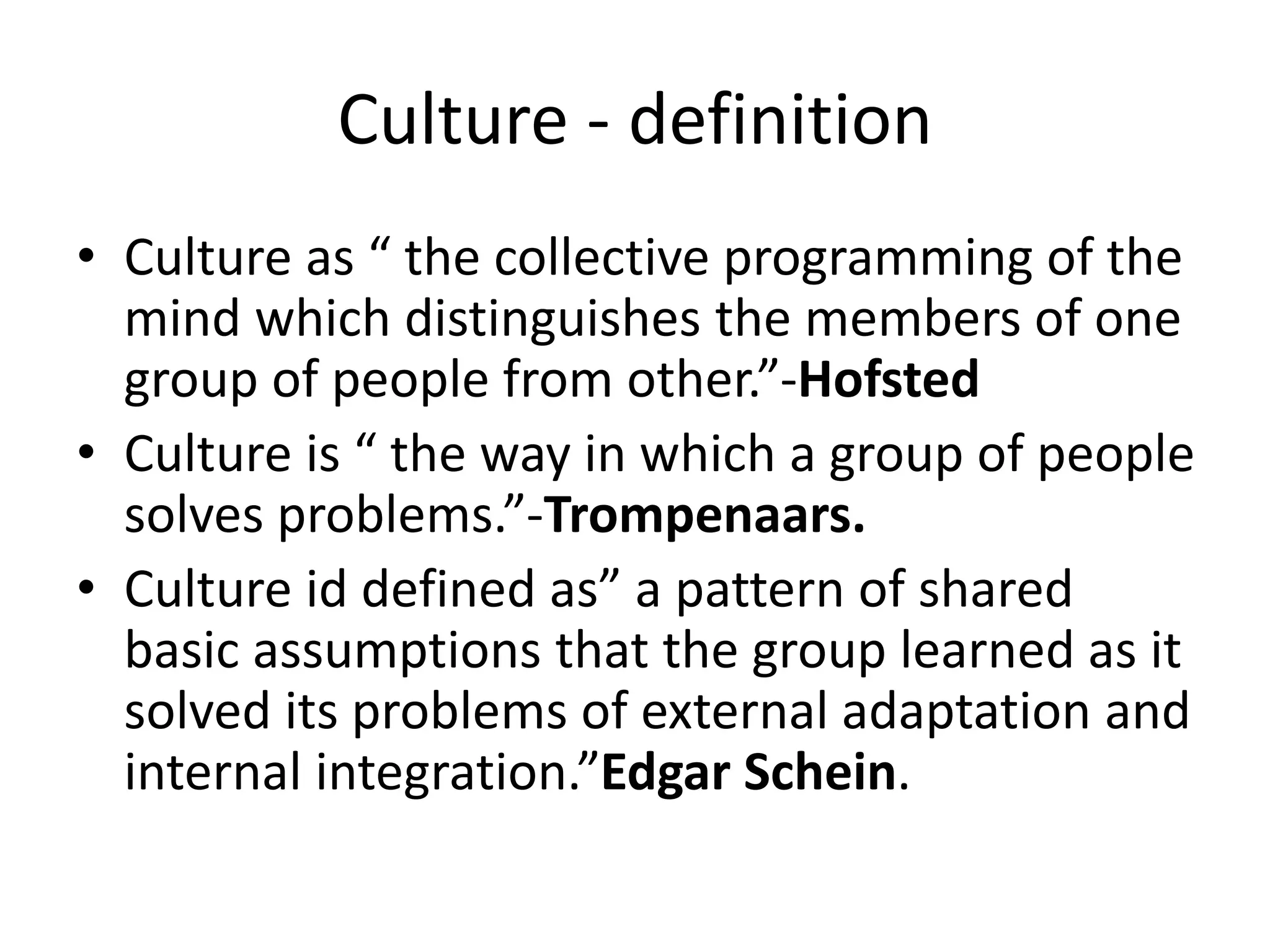
• Culture as “ the collective programming of the
mind which distinguishes the members of one
group of people from other.”-Hofsted
• Culture is “ the way in which a group of people
solves problems.”-Trompenaars.
• Culture id defined as” a pattern of shared
basic assumptions that the group learned as it
solved its problems of external adaptation and
internal integration.”Edgar Schein.
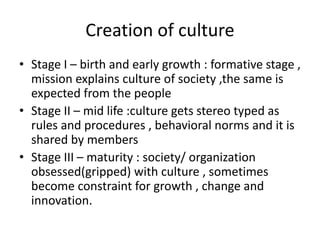
Creation of culture
• Stage I – birth and early growth : formative stage ,
mission explains culture of society ,the same is
expected from the people
• Stage II – mid life :culture gets stereo typed as
rules and procedures , behavioral norms and it is
shared by members
• Stage III – maturity : society/ organization
obsessed(gripped) with culture , sometimes
become constraint for growth , change and
innovation.
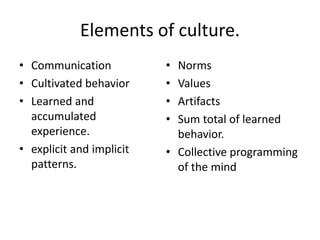
Elements of culture.
• Communication
• Cultivated behavior
• Learned and
accumulated
experience.
• explicit and implicit
patterns.
• Norms
• Values
• Artifacts
• Sum total of learned
behavior.
• Collective programming
of the mind
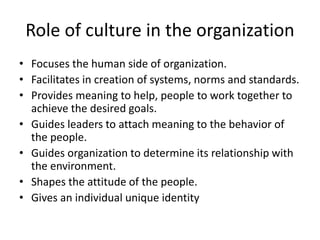
Role of culture in the organization
• Focuses the human side of organization.
• Facilitates in creation of systems, norms and standards.
• Provides meaning to help, people to work together to
achieve the desired goals.
• Guides leaders to attach meaning to the behavior of
the people.
• Guides organization to determine its relationship with
the environment.
• Shapes the attitude of the people.
• Gives an individual unique identity
Variables of culture
• National variables – applicable across the nation ,
(economic system , legal system , political system
, physical situation , technological know how)
• Socio cultural variables – religion , education ,
and language
• Cultural variables – values , norms , beliefs
• Attitudes – sense of time , materialism ,
individualism etc.
• Individual and group job behavior – motivation ,
productivity , commitment and ethics
Characteristics of culture.
• Learned behavior
• Shared behavior
• Based on tradition and
custom
• Seem as a means by
which humans physically
survive
• Adaptive
• Subject to change
• It allows a range of
permissible behavior
related to many things,
does not exist in isolation
• Socially constructed
realities
• Pattern of basic
assumptions
• Best understood in
relation to groups
Importance of inter cultural values
• Values lay the foundation for people attitudes
• Values influence the employee perception
• Based on cultural values we can motivate
people
• Values help to better understand the people
• People values interpret the behavior and
outcomes of the organization
Layers of culture
• National level – associated with the nation as a whole
• Regional level - ethnic , linguistic ,or religious
differences within nation
• Gender level – gender differences
• Generation level - differences between 3 or 4
generations
• Social class level – educational opportunities and
differences in occupation
• Corporate level – organization culture ,applicable to
those who employed
Theories of culture
Cultural determinism
• Culture determines the nature of people
• It is based on their ideas , meanings , beliefs ,
and values
• There is no limit of the abilities of people ,
hence proper cultural inputs can positively
program the behavior of people and make
them true performer
Cultural relativism
• This theory argues that culture is relative but not
same
• Different cultural groups think , feel , and act
differently
• Differences may naturally exist among groups and
societies
• This is important for cross cultural negotiation , it
helps in understanding the reasons for
differences
Cultural ethnocentrism
• It is a typical syndrome of distortion of one’s
own culture , and a bad way of thinking others
as inferior to one’s own culture
• Ethnocentrism ignores the cause and effect
relationship in cross cultural environment
• Ethnocentrism ignores the changes and
resulting in failure of organization to work in
alien culture
Guidelines for stable culture in MNCs
• Defining rules of conduct in clear and
unambiguous terms
• Teach these rules to all members of the
organization
• Ensure uniformity and understanding
• Focus on sense of responsibility
• Acknowledge the values of its members
• Be logical by intellectual reasoning in defining the
rules
• Have some commonality (unique culture is a
competitive strength)

Culture introduction

  • 1.
    Culture - definition •Culture as “ the collective programming of the mind which distinguishes the members of one group of people from other.”-Hofsted • Culture is “ the way in which a group of people solves problems.”-Trompenaars. • Culture id defined as” a pattern of shared basic assumptions that the group learned as it solved its problems of external adaptation and internal integration.”Edgar Schein.
  • 2.
    Creation of culture •Stage I – birth and early growth : formative stage , mission explains culture of society ,the same is expected from the people • Stage II – mid life :culture gets stereo typed as rules and procedures , behavioral norms and it is shared by members • Stage III – maturity : society/ organization obsessed(gripped) with culture , sometimes become constraint for growth , change and innovation.
  • 3.
    Elements of culture. •Communication • Cultivated behavior • Learned and accumulated experience. • explicit and implicit patterns. • Norms • Values • Artifacts • Sum total of learned behavior. • Collective programming of the mind
  • 4.
    Role of culturein the organization • Focuses the human side of organization. • Facilitates in creation of systems, norms and standards. • Provides meaning to help, people to work together to achieve the desired goals. • Guides leaders to attach meaning to the behavior of the people. • Guides organization to determine its relationship with the environment. • Shapes the attitude of the people. • Gives an individual unique identity
  • 5.
    Variables of culture •National variables – applicable across the nation , (economic system , legal system , political system , physical situation , technological know how) • Socio cultural variables – religion , education , and language • Cultural variables – values , norms , beliefs • Attitudes – sense of time , materialism , individualism etc. • Individual and group job behavior – motivation , productivity , commitment and ethics
  • 6.
    Characteristics of culture. •Learned behavior • Shared behavior • Based on tradition and custom • Seem as a means by which humans physically survive • Adaptive • Subject to change • It allows a range of permissible behavior related to many things, does not exist in isolation • Socially constructed realities • Pattern of basic assumptions • Best understood in relation to groups
  • 7.
    Importance of intercultural values • Values lay the foundation for people attitudes • Values influence the employee perception • Based on cultural values we can motivate people • Values help to better understand the people • People values interpret the behavior and outcomes of the organization
  • 8.
    Layers of culture •National level – associated with the nation as a whole • Regional level - ethnic , linguistic ,or religious differences within nation • Gender level – gender differences • Generation level - differences between 3 or 4 generations • Social class level – educational opportunities and differences in occupation • Corporate level – organization culture ,applicable to those who employed
  • 9.
    Theories of culture Culturaldeterminism • Culture determines the nature of people • It is based on their ideas , meanings , beliefs , and values • There is no limit of the abilities of people , hence proper cultural inputs can positively program the behavior of people and make them true performer
  • 10.
    Cultural relativism • Thistheory argues that culture is relative but not same • Different cultural groups think , feel , and act differently • Differences may naturally exist among groups and societies • This is important for cross cultural negotiation , it helps in understanding the reasons for differences
  • 11.
    Cultural ethnocentrism • Itis a typical syndrome of distortion of one’s own culture , and a bad way of thinking others as inferior to one’s own culture • Ethnocentrism ignores the cause and effect relationship in cross cultural environment • Ethnocentrism ignores the changes and resulting in failure of organization to work in alien culture
  • 12.
    Guidelines for stableculture in MNCs • Defining rules of conduct in clear and unambiguous terms • Teach these rules to all members of the organization • Ensure uniformity and understanding • Focus on sense of responsibility • Acknowledge the values of its members • Be logical by intellectual reasoning in defining the rules • Have some commonality (unique culture is a competitive strength)