A STUDY ON LINKAGES BETWEEN
PROFESSIONAL TEACHING AND
STUDENTS’ MENTAL HEALTH IN
SCHOOLS
MSCCFT MINI-RESEARCH
MCFTL-005
Counselling and Family Therapy:
Research Methods and Statistics
Name: Prabhat Kumar Sharma
Enrolment No:
Study Centre: Lady Hardinge Medical College, Delhi
Study Centre Code: 29053P
IGNOU Regional Centre: Delhi-2 (Rajghat)
Guide: Dr. Sumit Rana, Associate Professor, LHMC
Signature: Date:
SYNOPSIS
Schools are the nurseries where the future of our nation is built. In schools, children are
transformed into educated, rational human beings, capable of contributing positively to the
society. Professional teaching by qualified teachers plays an important role in this
transformation. In school, students are passing through a phase of life where they are highly
impressionable. They learn actively and passively, and discover viscerally, by taking cues from
their surroundings. In this situation, it is of utmost importance that pedagogy imparted in our
schools meet the standards of professionalism. There is a need to restructure the education
system for the holistic development of every student in this post-pandemic era. A healthy body
must include mental well-being. In this research report, we try to understand if the teaching
done by teachers in public and private schools meets the need of holistic development of
children. This report also explores as to what is professionalism in teaching and why it is
needed in teaching profession
Research Methods: This qualitative study adopted interviews as a research method for
collecting data wherein participants were interviewed from public and private schools each
respectively. Interviews were recorded and thematic analysis was conducted for analysing the
data.
Findings: Four broad themes have been identified for qualitative data analysis.
1.) Profile of teachers.
2.) Professionalism and knowledge about mental health.
3.) Teaching and competence.
4.) Challenges practicing professionalism.
Implication: In both public and private schools it varies because of profile of teachers and
difference in institutional setting. Professionalism in teaching profession leads to commitment
to work, competence and responsibility taker. It helps in building a student’s life while taking
the profession with responsibility, empathy and determination.
Keywords: Public school, Private school, Primary School Teacher, Professionalism
INTRODUCTION
Education is an ever-growing process and an ever-changing field. In modern times,
mental well-being and dealing with emotional issues of students has become an important
component of pedagogy. This means that teachers must be lifelong learners in order to teach
each new group of students and attend to their emotional and psychological issues. Teachers,
of all disciplines, must be well versed with basics of mental health and psychological disorders.
Ultimately it is the compassion and commitment of the teachers which help them to reach out
to children and accept every child’s unique abilities. It is the role of the teacher to channelize
students’ abilities to grow.
Primary education is the foundation stage in education. Therefore, much importance is to be
laid for the same. But, data gives evidence about the decline in the proportion of students in
private schools. Thus the study found that government schools still score over private ones in
several aspects, for instance, attendance rates and issues of gender sensitivity.
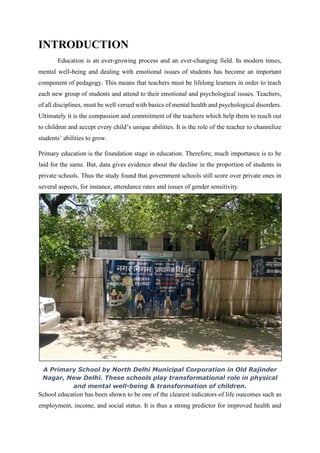
A Primary School by North Delhi Municipal Corporation in Old Rajinder
Nagar, New Delhi. These schools play transformational role in physical
and mental well-being & transformation of children.
School education has been shown to be one of the clearest indicators of life outcomes such as
employment, income, and social status. It is thus a strong predictor for improved health and
well-being. Lower levels of educational achievement have been linked to lower socioeconomic
status. But there is no simple strategy to improve the health and economic success of a nation
like India, having huge demographic dividend.
Given the above findings does more education always then improve mental health? Research
has demonstrated that this is not necessarily the case. In many people staying in education can
have deleterious effects upon mental health. Researchers studied the problem after educational
reforms in Britain in the early 1970s recommended raising the minimum age school for leaving
school from 15 to age 16.
‘Teacher professionalism’ is defined as the knowledge, skills, and practice that teachers must
have in order to be effective educators. This helps to understand the professional development
of teachers while engaging with students. It also looks upon the skills, competencies, wide
range of knowledge, string academic knowledge, innovation, challenges faced by teachers.
The purpose of this study is to understand the factors which contribute to the development of
training in teachers as holistic educators who can cater to mental health of students. The study
focuses upon school education. It is important to note that professional development not only
allows teachers to learn new teaching styles, techniques, and tips but also interact with
educators from other areas in order to improve their own teaching.
The present study is directed by the following specific objectives:
● to understand the profile of private and public schools teachers.
● to study professionalism among primary school teachers.
● to understand factors leading to professionalism among primary school teachers.
● to explore the challenges faced by school teachers while practicing professionalism.
MATERIALS AND METHODS
STUDY SETTING AND PARTICIPANTS
The study is a qualitative study which uses an exploratory research design to describe
professionalism among primary school teachers of public and private schools. Those included
in this study had completed B.Ed/Bl.Ed, with a minimum of 5 years of experience in teaching
in primary level public and private schools.
INTERVIEWS AND DATA COLLECTION
To explore and sub-analyse professionalism among teachers from private and public schools,
a semi-structured qualitative interview schedule was prepared by the researcher. It included
qualification, communication skills, management, and competency skills questions. Due to the
Covid pandemic, data was collected through telephonic interviews. Teachers not having more
than 5 years of teaching experience in public or public schools were not part of the study.
Some of the open-ended questions included were as follows:
• What does being professional in teaching mean to you?
• Does a basic knowledge about mental health helps you in teaching more effectively?
• As a teacher did you have to deal with mental health issues of students?
• What does your profession mean to you?
With each question, circular questions were asked, and adequate probes were introduced when
participants were not expressive to provide rich data. Each interview lasted for 10-15 mins.
DATA ANALYSIS
The transcripts were read several times to be familiarized with the interview content. Data was
managed and analysed manually. The qualitative interviews were transcribed and thematic
analysis was adopted for analysing the collected data. Thematic analysis was used to identify
themes and sub-themes for the result of the study.
RESULTS
The analysis resulted in a Sub-group analysis of knowledge on mental health in public and
private schools respectively in the identification of four major themes which include profile of
teachers, professionalism and teaching, teaching and competence, and challenges practicing
professionalism which were in line with the objectives of the study.
Profile of teachers:
Almost all participants agree that teaching as a profession is not an easy thing to do. It emerged
that the job profile of teachers has lately turned into a myth, referring to a flawed perception
that teaching profession is the easiest task adopted by everyone. It was agreed by the
participants that not everyone can become a good teacher, it should be a planned decision. You
need to have that confidence that you’re going to build somebody else’s life.
“You cannot just become a teacher, you need to plan to become a teacher because you’re going
to create or destruct somebody else’s life.” (Private school participant)
“Children learn from us, what we say what we speak what how we speak, they grasp it from
us. It is important to be aware of everything around us as for them we are their role models, a
teacher has a big responsibility of shaping children” (Public school participant)
There is a difference in the profile of the teachers of public and private schools, wherein public
school teachers avail job security. In popular perception, this marks as a getaway from
responsibilities, taking initiatives, and making efforts regularly. This is not always true.
Teachers of the private school raised their opinion about public school teachers who do not
take regular classes, wherein their attendance is low, resources offered are less.
Competitiveness among public school teachers is less as compared to private schools.
“In the public schools, once the teacher gets the job, they feel that the job security is there, I
am not saying that they not qualified enough,or they are not putting their effort, it is not like
that, they do have the job satisfaction and job security so after getting the job they become a
little irresponsible that is what is noticed” (Private school participant)
On the other hand, private school teachers are more responsible, use different techniques for
class. Participants shared that their workload is more that they are under pressure as they have
no job security and can be replaced if they will not perform. Therefore, so they are taking more
effort to keep their job, which thus also points that they have to be on a path to compete with
others.
“In public school, the workload is too much. And always the teachers, they will always be
watching, there are so many people around to watch them now. But in government schools, it
is not like that” (Public school participant)
Professionalism and teaching
In India, school teachers should have a B.Ed Degree for teaching either being a PGT or TGT
teacher. Teachers too are well-prepared prior to the class. Content knowledge and years of
experience have shown that communication, patience, acceptance, learning are key factors
while engaging with primary level students.
Teachers are to follow boundaries of personal and professional life as they have the
responsibility being a role model to students. It is the role of the teacher to acknowledge
students’ individual potential for growth.
“Talking professionalism in teaching means to me is to keep in mind your own work to mind
the child's benefit to mind your own personal growth, it's not personal growth in terms of
money, but in personal growth in terms of understanding the different variety of children and
their parent mindset, so that you can deal with them accordingly” (Private school participant)
Participants agreed that while dealing with primary school children the foremost principle is
patience and politeness as children are like customers, once you’re dealing with your customer
if you don’t communicate properly they won’t come back to you leading to dropout rates which
is thus not acceptable.
“Primary, we have to teach them they are the small kids now, they don't know about anything.
So these should be a model and we should teach them how to be regular how to do their work
on time and all cleanliness, punctuality, these all small things we have to teach the primary
children”(Public school participant)
Key factors shared by the participants being professional is being on time, being well prepared
for the class. And to give space for children as you have no right to be authoritative.
Teachers should be facilitators, and not authoritative towards children. Teachers should have a
clear distinction between their personal and professional life.
“Let's not take anything personal. You cannot take your personal life to school, you should not
in any work you cannot. What is happening at your personal life or family life should not affect
any kid because that kid is coming to you to get something from you to gain knowledge from
you to learn from you. So if you have a foul node, or if you're not in good terms with anybody,
take it out on any kids. Yes. And more than that See, the kids learn a lot from us to how we
behave in the classroom. We are going to go back to there are many kids who go back and
imitate” (Public school participant)
“Being professional means you should know the skill, not just imparting the knowledge, but the
knowledge of dealing with the students, you know, in whatever odd situation you Are you a
teacher should stand, you know, out like he or she should be able to deal with that student or
a definitely inclusive system is also very important”(Private school participant)
A teacher should not be biased towards students and should consider each student as equal. No
favouritism should be practiced while being in the teaching profession. In a class of 30-40
students, every child is unique and it is the role of the teacher to encourage each student towards
achieving their dreams. Children observe teachers more than teachers observe them, which
therefore, means that children are like sponge, they grasp every action and imitate the same. It
is important for a teacher to be aware of the words, actions, expressions which are used in the
classroom.
Teaching and competence
Participants agreed that the teachers should have wide knowledge about the subject and should
have pedagogical knowledge of how a class should be monitored. It is the role of the teachers
to encourage children and to participate in activities and grow with others.
Majority of the participants shared that a primary teacher should have the qualities of being
patient, motherly figure, responsibility taker. Teachers are offered certain programmes are
offered by government schools wherein they are given teacher training to adopt the verbal and
non-verbal skills in the class. They are also provided with disciplinary subject seminars on sex
education, self-discipline. There were also online portals through which seminars and lectures
were accessed.
To be polite, to be the good psychologist, and dedication. She or he should be patient enough.
Then we'll go responsibility taker. And we'll say and readiness all the time readiness (Private
school participant)
Patience is the key for a school teacher, that's something I have learned from my years, and
you got to be prepared for your class (Public school participant)
Communication and attitude does lead to professionalism, as communication is marked as the
key factor while dealing with children, attitude of the teacher is also important as it describes
the profile of the teacher. Teachers are to be flexible, wherein they are able to adjust to every
situation and act accordingly with students.
The competencies of teachers are seen when they have to use their management skills in
handling the class, especially inheriting their pedagogical knowledge in class. Participants of
both public and private school shared that extra time is taken for slow learners and ADHD
students wherein it is the competency of the teacher which is seen, the commitment,
compassion, responsibility of the teacher towards students.
“We used to give remedial classes to them every day after the school hours, one hr to be given
to them, subject wise everyday has been divided and then we use to provide them with excessive
worksheets other than what is given in the class then we keep on taking the feedback after every
10-15days what improvement is going on” (Private school participant)
“Calling them giving them special always asking them questions. Following up their work also
they doing it or not the class also are they doing their work are they able to read or understand
what I have taught them each and every class I do the follow up also” (Public school
participant)
Challenges practicing professionalism
Participants agreed that while practising teaching as a profession there were common
challenges which were faced by both public and private primary school teachers. Firstly, lack
of student interaction because of a a greater class strength. Teachers conveyed that having such
a greater class strength does not allow them to give individual attention to students which is
required at a primary grade. Class management is the main challenge faced by the teachers.
“Having a lower number would be beneficial for the children actually, see now times children
are totally dependent on the online sessions, so when it was offline session then too children
needed the personal attention at primary level and for managing, we teachers are also human
beings so managing 60 children for 40-45 min, we cannot create magic, we need to give time,
we need to give our efforts, personal attention and that is what we also expect that we can look
after each and every child. So if there would be lesser number of children, we would be able to
give the better timing, better attention to them as compared to the more in number” (Private
school participant)
“In first, second, third grade, I think 30 is Enough. not exceed more than 30. I think so because
otherwise we cannot give them personal attention” (Public school participant)
Teaching is a risk taking profession, participants agreed that teaching primary graders is hard
as students at that age doesn’t have much concentration level and are fickle minded. So it is the
techniques used by the teachers to help student’s attention level through coming up with various
activities, games, role plays.
“It is a risk taking job. It's not a 9-2 job” (Public school participant).
There was a shared opinion by the participants upon the assigned class to teach. Participants
shared that while they were qualified for teaching higher graders, but the school administration
appointed them for primary classes which led to a challenge for the teachers. They were not
able to teach at their level of age group, but initially through changing methods, now they are
experienced of teaching primary graders while having a qualified degree of teaching upper
primary classes.
It was also shared that the administration often only gave specific teachers the advantage for
attending seminars which were offered at various level for primary school teachers. These
seminars were taken upon sex education, stress management, time management, classroom
management, reading psychology of children, child development.
DISCUSSION
The interaction with the school teachers brought out some dichotomies, some lacunae and some
positive developments in our school education setup. It was realized that mental health of
students is still not an important issue in public schools. Suo motu action by teachers on topics
of mental health is not a commonplace occurrence in both public and private schools. Children
with emotional issues, and sometimes psychological disorders, are usually left out to fend for
themselves. It was also found that there is a significant difference in primary school teachers
of public and private schools. It was observed that lately, public school teachers are improving
their profile by having better classroom management, student psychology, and students-teacher
relationship as compared to private school teachers wherein they are more focused upon
academics and no student-teacher relationship is prominent cause only 10% of teaching goes
into the students as they are not able to focus upon one particular task at a time. There is a lack
of balance between academic and co-curricular in private schools which is the leading factors
to low professionalism in primary school teachers of private schools as compared to public
school teachers.
The study, I believe, has able to define what professionalism in teaching means and what are
the factors leading to professionalism, its challenges in practising. It is evident through teachers
body language, class management, communication with the children and parent that is it not as
polished as a trained qualified teacher, and also subject and psychological understanding is not
there as a trained one to have,so obviously there is a difference that is why we teachers are
required to take the training to keep ourselves updated so that we can update the children also.
The literature referred for the study only answers the disparity between primary school teachers
of public and private school and not professionalism in teaching profession in general, the
findings of this study can be used in future to study in depth about professionalism and
challenges while practicing in teaching profession.
ACKNOWLDGEMENTS
I would like to thank my mentor Prof. Dinesh Kataria, Director Professor, and Dr. Sumit Rana,
Associate Professor, Department of Psychiatry, Lady Hardinge Medical College (LHMC),
New Delhi for supporting me throughout the study and helping wherever and whenever I
needed help.
I would also like to that all the other faculties and staff members in the Psychiatry department,
LHMC who were helpful through this process.
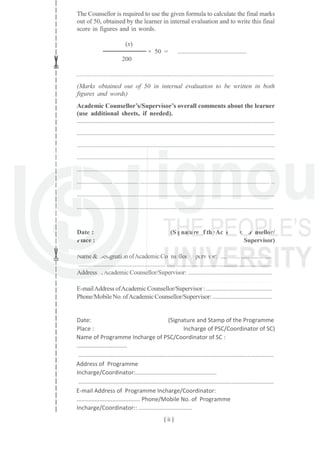
Date: (Signature and Stamp of the Programme
Place : Incharge of PSC/Coordinator of SC)
Name of Programme Incharge of PSC/Coordinator of SC :
...............................
........................................................................................................................
Address of Programme
Incharge/Coordinator:..................................................
........................................................................................................................
E-mail Address of Programme Incharge/Coordinator:
....................................... Phone/Mobile No. of Programme
Incharge/Coordinator:: .................................
( ii )
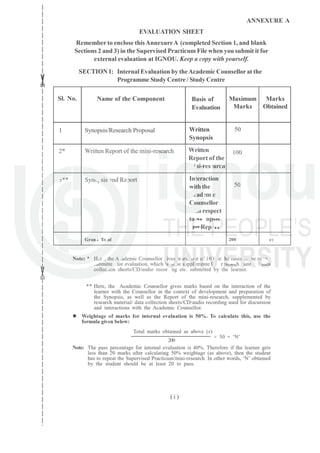
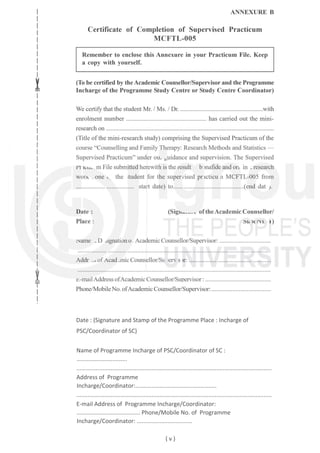
Date : (Signaure of the Academic Counsellor/
Place : Supervisor)
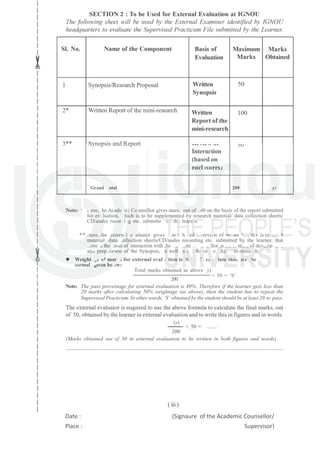
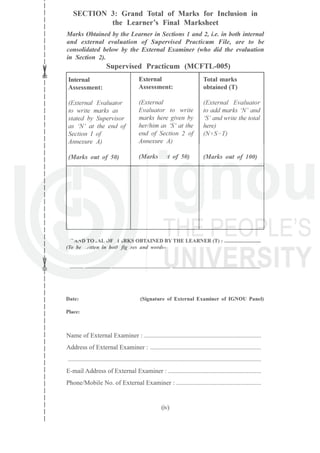
Date : (Signature and Stamp of the Programme Place : Incharge of
PSC/Coordinator of SC)
Name of Programme Incharge of PSC/Coordinator of SC :
...............................
........................................................................................................................
Address of Programme
Incharge/Coordinator:..................................................
........................................................................................................................
E-mail Address of Programme Incharge/Coordinator:
....................................... Phone/Mobile No. of Programme
Incharge/Coordinator: ..................................
( v )

IGNOU Sample Practical File for MCFTL005 Mini Research PKS

  • 1.
    A STUDY ONLINKAGES BETWEEN PROFESSIONAL TEACHING AND STUDENTS’ MENTAL HEALTH IN SCHOOLS MSCCFT MINI-RESEARCH MCFTL-005 Counselling and Family Therapy: Research Methods and Statistics Name: Prabhat Kumar Sharma Enrolment No: Study Centre: Lady Hardinge Medical College, Delhi Study Centre Code: 29053P IGNOU Regional Centre: Delhi-2 (Rajghat) Guide: Dr. Sumit Rana, Associate Professor, LHMC Signature: Date:
  • 2.
    SYNOPSIS Schools are thenurseries where the future of our nation is built. In schools, children are transformed into educated, rational human beings, capable of contributing positively to the society. Professional teaching by qualified teachers plays an important role in this transformation. In school, students are passing through a phase of life where they are highly impressionable. They learn actively and passively, and discover viscerally, by taking cues from their surroundings. In this situation, it is of utmost importance that pedagogy imparted in our schools meet the standards of professionalism. There is a need to restructure the education system for the holistic development of every student in this post-pandemic era. A healthy body must include mental well-being. In this research report, we try to understand if the teaching done by teachers in public and private schools meets the need of holistic development of children. This report also explores as to what is professionalism in teaching and why it is needed in teaching profession Research Methods: This qualitative study adopted interviews as a research method for collecting data wherein participants were interviewed from public and private schools each respectively. Interviews were recorded and thematic analysis was conducted for analysing the data. Findings: Four broad themes have been identified for qualitative data analysis. 1.) Profile of teachers. 2.) Professionalism and knowledge about mental health. 3.) Teaching and competence. 4.) Challenges practicing professionalism. Implication: In both public and private schools it varies because of profile of teachers and difference in institutional setting. Professionalism in teaching profession leads to commitment to work, competence and responsibility taker. It helps in building a student’s life while taking the profession with responsibility, empathy and determination. Keywords: Public school, Private school, Primary School Teacher, Professionalism
  • 3.
    INTRODUCTION Education is anever-growing process and an ever-changing field. In modern times, mental well-being and dealing with emotional issues of students has become an important component of pedagogy. This means that teachers must be lifelong learners in order to teach each new group of students and attend to their emotional and psychological issues. Teachers, of all disciplines, must be well versed with basics of mental health and psychological disorders. Ultimately it is the compassion and commitment of the teachers which help them to reach out to children and accept every child’s unique abilities. It is the role of the teacher to channelize students’ abilities to grow. Primary education is the foundation stage in education. Therefore, much importance is to be laid for the same. But, data gives evidence about the decline in the proportion of students in private schools. Thus the study found that government schools still score over private ones in several aspects, for instance, attendance rates and issues of gender sensitivity. A Primary School by North Delhi Municipal Corporation in Old Rajinder Nagar, New Delhi. These schools play transformational role in physical and mental well-being & transformation of children. School education has been shown to be one of the clearest indicators of life outcomes such as employment, income, and social status. It is thus a strong predictor for improved health and
  • 4.
    well-being. Lower levelsof educational achievement have been linked to lower socioeconomic status. But there is no simple strategy to improve the health and economic success of a nation like India, having huge demographic dividend. Given the above findings does more education always then improve mental health? Research has demonstrated that this is not necessarily the case. In many people staying in education can have deleterious effects upon mental health. Researchers studied the problem after educational reforms in Britain in the early 1970s recommended raising the minimum age school for leaving school from 15 to age 16. ‘Teacher professionalism’ is defined as the knowledge, skills, and practice that teachers must have in order to be effective educators. This helps to understand the professional development of teachers while engaging with students. It also looks upon the skills, competencies, wide range of knowledge, string academic knowledge, innovation, challenges faced by teachers. The purpose of this study is to understand the factors which contribute to the development of training in teachers as holistic educators who can cater to mental health of students. The study focuses upon school education. It is important to note that professional development not only allows teachers to learn new teaching styles, techniques, and tips but also interact with educators from other areas in order to improve their own teaching. The present study is directed by the following specific objectives: ● to understand the profile of private and public schools teachers. ● to study professionalism among primary school teachers. ● to understand factors leading to professionalism among primary school teachers. ● to explore the challenges faced by school teachers while practicing professionalism.
  • 5.
    MATERIALS AND METHODS STUDYSETTING AND PARTICIPANTS The study is a qualitative study which uses an exploratory research design to describe professionalism among primary school teachers of public and private schools. Those included in this study had completed B.Ed/Bl.Ed, with a minimum of 5 years of experience in teaching in primary level public and private schools. INTERVIEWS AND DATA COLLECTION To explore and sub-analyse professionalism among teachers from private and public schools, a semi-structured qualitative interview schedule was prepared by the researcher. It included qualification, communication skills, management, and competency skills questions. Due to the Covid pandemic, data was collected through telephonic interviews. Teachers not having more than 5 years of teaching experience in public or public schools were not part of the study. Some of the open-ended questions included were as follows: • What does being professional in teaching mean to you? • Does a basic knowledge about mental health helps you in teaching more effectively? • As a teacher did you have to deal with mental health issues of students? • What does your profession mean to you? With each question, circular questions were asked, and adequate probes were introduced when participants were not expressive to provide rich data. Each interview lasted for 10-15 mins. DATA ANALYSIS The transcripts were read several times to be familiarized with the interview content. Data was managed and analysed manually. The qualitative interviews were transcribed and thematic analysis was adopted for analysing the collected data. Thematic analysis was used to identify themes and sub-themes for the result of the study.
  • 6.
    RESULTS The analysis resultedin a Sub-group analysis of knowledge on mental health in public and private schools respectively in the identification of four major themes which include profile of teachers, professionalism and teaching, teaching and competence, and challenges practicing professionalism which were in line with the objectives of the study. Profile of teachers: Almost all participants agree that teaching as a profession is not an easy thing to do. It emerged that the job profile of teachers has lately turned into a myth, referring to a flawed perception that teaching profession is the easiest task adopted by everyone. It was agreed by the participants that not everyone can become a good teacher, it should be a planned decision. You need to have that confidence that you’re going to build somebody else’s life. “You cannot just become a teacher, you need to plan to become a teacher because you’re going to create or destruct somebody else’s life.” (Private school participant) “Children learn from us, what we say what we speak what how we speak, they grasp it from us. It is important to be aware of everything around us as for them we are their role models, a teacher has a big responsibility of shaping children” (Public school participant) There is a difference in the profile of the teachers of public and private schools, wherein public school teachers avail job security. In popular perception, this marks as a getaway from responsibilities, taking initiatives, and making efforts regularly. This is not always true. Teachers of the private school raised their opinion about public school teachers who do not take regular classes, wherein their attendance is low, resources offered are less. Competitiveness among public school teachers is less as compared to private schools. “In the public schools, once the teacher gets the job, they feel that the job security is there, I am not saying that they not qualified enough,or they are not putting their effort, it is not like that, they do have the job satisfaction and job security so after getting the job they become a little irresponsible that is what is noticed” (Private school participant) On the other hand, private school teachers are more responsible, use different techniques for class. Participants shared that their workload is more that they are under pressure as they have no job security and can be replaced if they will not perform. Therefore, so they are taking more
  • 7.
    effort to keeptheir job, which thus also points that they have to be on a path to compete with others. “In public school, the workload is too much. And always the teachers, they will always be watching, there are so many people around to watch them now. But in government schools, it is not like that” (Public school participant) Professionalism and teaching In India, school teachers should have a B.Ed Degree for teaching either being a PGT or TGT teacher. Teachers too are well-prepared prior to the class. Content knowledge and years of experience have shown that communication, patience, acceptance, learning are key factors while engaging with primary level students. Teachers are to follow boundaries of personal and professional life as they have the responsibility being a role model to students. It is the role of the teacher to acknowledge students’ individual potential for growth. “Talking professionalism in teaching means to me is to keep in mind your own work to mind the child's benefit to mind your own personal growth, it's not personal growth in terms of money, but in personal growth in terms of understanding the different variety of children and their parent mindset, so that you can deal with them accordingly” (Private school participant) Participants agreed that while dealing with primary school children the foremost principle is patience and politeness as children are like customers, once you’re dealing with your customer if you don’t communicate properly they won’t come back to you leading to dropout rates which is thus not acceptable. “Primary, we have to teach them they are the small kids now, they don't know about anything. So these should be a model and we should teach them how to be regular how to do their work on time and all cleanliness, punctuality, these all small things we have to teach the primary children”(Public school participant) Key factors shared by the participants being professional is being on time, being well prepared for the class. And to give space for children as you have no right to be authoritative. Teachers should be facilitators, and not authoritative towards children. Teachers should have a clear distinction between their personal and professional life.
  • 8.
    “Let's not takeanything personal. You cannot take your personal life to school, you should not in any work you cannot. What is happening at your personal life or family life should not affect any kid because that kid is coming to you to get something from you to gain knowledge from you to learn from you. So if you have a foul node, or if you're not in good terms with anybody, take it out on any kids. Yes. And more than that See, the kids learn a lot from us to how we behave in the classroom. We are going to go back to there are many kids who go back and imitate” (Public school participant) “Being professional means you should know the skill, not just imparting the knowledge, but the knowledge of dealing with the students, you know, in whatever odd situation you Are you a teacher should stand, you know, out like he or she should be able to deal with that student or a definitely inclusive system is also very important”(Private school participant) A teacher should not be biased towards students and should consider each student as equal. No favouritism should be practiced while being in the teaching profession. In a class of 30-40 students, every child is unique and it is the role of the teacher to encourage each student towards achieving their dreams. Children observe teachers more than teachers observe them, which therefore, means that children are like sponge, they grasp every action and imitate the same. It is important for a teacher to be aware of the words, actions, expressions which are used in the classroom. Teaching and competence Participants agreed that the teachers should have wide knowledge about the subject and should have pedagogical knowledge of how a class should be monitored. It is the role of the teachers to encourage children and to participate in activities and grow with others. Majority of the participants shared that a primary teacher should have the qualities of being patient, motherly figure, responsibility taker. Teachers are offered certain programmes are offered by government schools wherein they are given teacher training to adopt the verbal and non-verbal skills in the class. They are also provided with disciplinary subject seminars on sex education, self-discipline. There were also online portals through which seminars and lectures were accessed. To be polite, to be the good psychologist, and dedication. She or he should be patient enough. Then we'll go responsibility taker. And we'll say and readiness all the time readiness (Private school participant)
  • 9.
    Patience is thekey for a school teacher, that's something I have learned from my years, and you got to be prepared for your class (Public school participant) Communication and attitude does lead to professionalism, as communication is marked as the key factor while dealing with children, attitude of the teacher is also important as it describes the profile of the teacher. Teachers are to be flexible, wherein they are able to adjust to every situation and act accordingly with students. The competencies of teachers are seen when they have to use their management skills in handling the class, especially inheriting their pedagogical knowledge in class. Participants of both public and private school shared that extra time is taken for slow learners and ADHD students wherein it is the competency of the teacher which is seen, the commitment, compassion, responsibility of the teacher towards students. “We used to give remedial classes to them every day after the school hours, one hr to be given to them, subject wise everyday has been divided and then we use to provide them with excessive worksheets other than what is given in the class then we keep on taking the feedback after every 10-15days what improvement is going on” (Private school participant) “Calling them giving them special always asking them questions. Following up their work also they doing it or not the class also are they doing their work are they able to read or understand what I have taught them each and every class I do the follow up also” (Public school participant) Challenges practicing professionalism Participants agreed that while practising teaching as a profession there were common challenges which were faced by both public and private primary school teachers. Firstly, lack of student interaction because of a a greater class strength. Teachers conveyed that having such a greater class strength does not allow them to give individual attention to students which is required at a primary grade. Class management is the main challenge faced by the teachers. “Having a lower number would be beneficial for the children actually, see now times children are totally dependent on the online sessions, so when it was offline session then too children needed the personal attention at primary level and for managing, we teachers are also human beings so managing 60 children for 40-45 min, we cannot create magic, we need to give time, we need to give our efforts, personal attention and that is what we also expect that we can look after each and every child. So if there would be lesser number of children, we would be able to
  • 10.
    give the bettertiming, better attention to them as compared to the more in number” (Private school participant) “In first, second, third grade, I think 30 is Enough. not exceed more than 30. I think so because otherwise we cannot give them personal attention” (Public school participant) Teaching is a risk taking profession, participants agreed that teaching primary graders is hard as students at that age doesn’t have much concentration level and are fickle minded. So it is the techniques used by the teachers to help student’s attention level through coming up with various activities, games, role plays. “It is a risk taking job. It's not a 9-2 job” (Public school participant). There was a shared opinion by the participants upon the assigned class to teach. Participants shared that while they were qualified for teaching higher graders, but the school administration appointed them for primary classes which led to a challenge for the teachers. They were not able to teach at their level of age group, but initially through changing methods, now they are experienced of teaching primary graders while having a qualified degree of teaching upper primary classes. It was also shared that the administration often only gave specific teachers the advantage for attending seminars which were offered at various level for primary school teachers. These seminars were taken upon sex education, stress management, time management, classroom management, reading psychology of children, child development.
  • 11.
    DISCUSSION The interaction withthe school teachers brought out some dichotomies, some lacunae and some positive developments in our school education setup. It was realized that mental health of students is still not an important issue in public schools. Suo motu action by teachers on topics of mental health is not a commonplace occurrence in both public and private schools. Children with emotional issues, and sometimes psychological disorders, are usually left out to fend for themselves. It was also found that there is a significant difference in primary school teachers of public and private schools. It was observed that lately, public school teachers are improving their profile by having better classroom management, student psychology, and students-teacher relationship as compared to private school teachers wherein they are more focused upon academics and no student-teacher relationship is prominent cause only 10% of teaching goes into the students as they are not able to focus upon one particular task at a time. There is a lack of balance between academic and co-curricular in private schools which is the leading factors to low professionalism in primary school teachers of private schools as compared to public school teachers. The study, I believe, has able to define what professionalism in teaching means and what are the factors leading to professionalism, its challenges in practising. It is evident through teachers body language, class management, communication with the children and parent that is it not as polished as a trained qualified teacher, and also subject and psychological understanding is not there as a trained one to have,so obviously there is a difference that is why we teachers are required to take the training to keep ourselves updated so that we can update the children also. The literature referred for the study only answers the disparity between primary school teachers of public and private school and not professionalism in teaching profession in general, the findings of this study can be used in future to study in depth about professionalism and challenges while practicing in teaching profession.
  • 12.
    ACKNOWLDGEMENTS I would liketo thank my mentor Prof. Dinesh Kataria, Director Professor, and Dr. Sumit Rana, Associate Professor, Department of Psychiatry, Lady Hardinge Medical College (LHMC), New Delhi for supporting me throughout the study and helping wherever and whenever I needed help. I would also like to that all the other faculties and staff members in the Psychiatry department, LHMC who were helpful through this process.
  • 14.
    Date: (Signature andStamp of the Programme Place : Incharge of PSC/Coordinator of SC) Name of Programme Incharge of PSC/Coordinator of SC : ............................... ........................................................................................................................ Address of Programme Incharge/Coordinator:.................................................. ........................................................................................................................ E-mail Address of Programme Incharge/Coordinator: ....................................... Phone/Mobile No. of Programme Incharge/Coordinator:: ................................. ( ii )
  • 15.
    Date : (Signaureof the Academic Counsellor/ Place : Supervisor)
  • 17.
    Date : (Signatureand Stamp of the Programme Place : Incharge of PSC/Coordinator of SC) Name of Programme Incharge of PSC/Coordinator of SC : ............................... ........................................................................................................................ Address of Programme Incharge/Coordinator:.................................................. ........................................................................................................................ E-mail Address of Programme Incharge/Coordinator: ....................................... Phone/Mobile No. of Programme Incharge/Coordinator: .................................. ( v )