
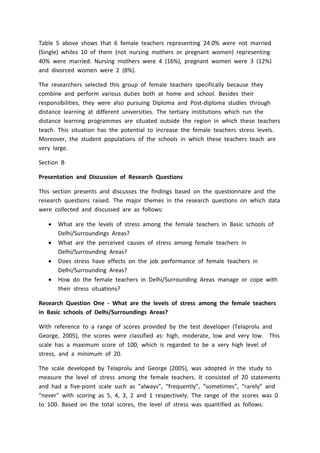
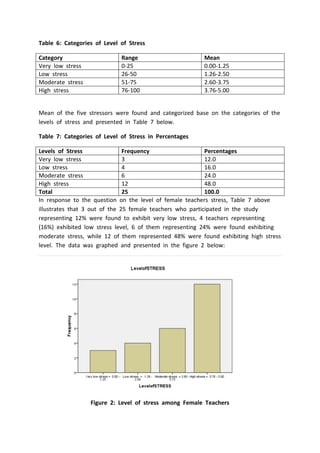
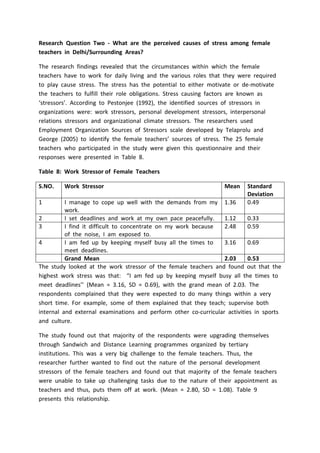
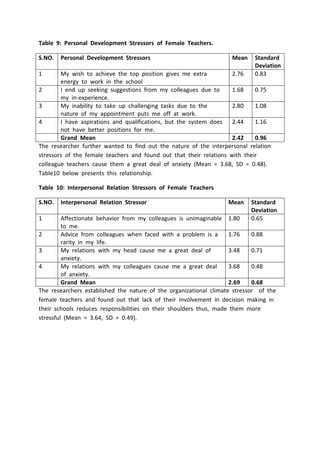



Supervised Practicum File
For The Course
MCFTL-005
NAME: RISHABH JAIN.
ENROLLMENT NO.: 197184740.
SUPERVISED PRACTICUM FILE
M.Sc.(CFT) – First Year
MCFTL-005
NAME: RISHABH JAIN
ENROLLMENT NO.: 197184740
ADDRESS: B-1/638 STREET NO. 22 HARSH VIHAR, DELHI-110093
PHONE.NO.: +91 7065479418
STUDY CENTRE/PROGRAMME STUDY CENTRE: (29053P) DEPARTMENT OF PSYCHIATRY & DRUG
DE-ADDICTION CENTRE, LADY HARDING MEDICAL COLLEGE & SSK HOSPITAL, NEW DELHI.
REGIONAL CENTRE: RAJGHAT
NAME & ADDRESS OF SUPERVISED PRACTICUM SUPERVISOR
PHONE NO./E-MAIL OF SUPERVISOR
R.K.Jain
SIGNATURE OF THE STUDENT
AN INVESTIGATION INTO FEMALE TEACHERS MANAGE STRESS AND TEACHERS
BURNOUT IN DELHI & SURROUNDING AREA
A Mini-Research Submitted
To
Indira Gandhi National Open University
in partial fulfilment
of the requirement
for the Degree of
Master’s of Science in Counselling and Family Therapy
Rishabh jain
Name of the Researcher/Candidate
197184740
Enrollment Number
(APRIL of 2021)
National Centre for Disability Studies
Indira Gandhi National Open University
Maidan Garhi, New Delhi-110063
TABLE OF CONTENTS
Acknowledgements………………………………………….……………………………………….……
List of Tables……………………………………….……………………………………….………………
List of Figures……………………………………….……………………………………….…………………………
Abstract……………………………………….……………………………………….……………………………………
Chapter I : Introduction……………………………….……………………………………….……………..
Chapter II : Review of Literature……………………………………….…………………………………
Chapter III : Methods/Methodology……………………………………….………………………………
Chapter IV : Results and Discussion……………………………………….………………………………
Chapter V : Summary, Conclusions and Recommendations…………………………………
Chapter VI : Bibliography/References……………………………………….………………………………
Appendices
(Approved Mini-Research Proposal)
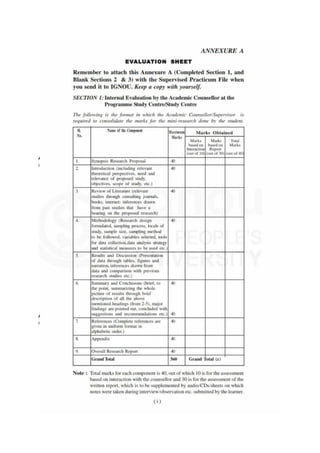
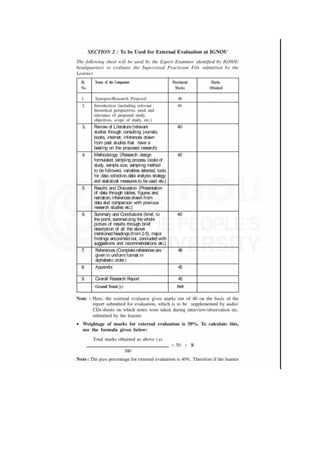
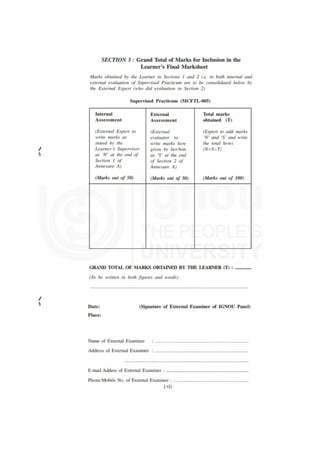
(ANNEXURE A : Evaluation Sheet)
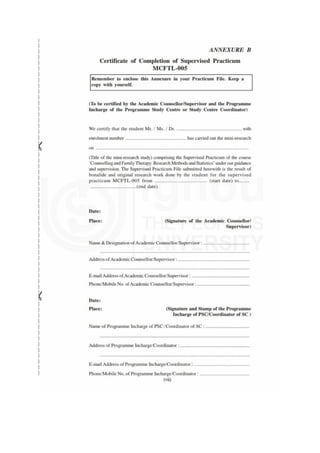
( ANNEXURE B : Certificate of Completion of Supervised Practicum MCFTL-005)
ACKNOWLEDGMENTS
I Would like to say “Thank You Mahavira” because of your Merciful, finally I
completed my Mini-Research for my higher level of studies. From deepest of my
heart, I would like to thank my family, who was always beside me, day and night
and nourished me with loves and prayers to ensure that I was able to move forward
and complete my studies. I would like to Thank You Syeda Shahnaz ma’am because
of scarify your time, energy, and help me with your valuable knowledge. For my
friends and classmates, you are my inspiration and motivate me on my every single
step.
To my guide Dr. Dinesh Kumar Kataria, you are a good listener. You were always
there when I need you. Thank you so much for your time, knowledge, and expertise
that you shared with me. Finally, thank you very much to Department of Psychiatry
& Drug De-Addiction Centre, Lady Harding Medical College.
LIST OF TABLES
1. Age Distribution of the Female Teachers……………………………………………………………………………
2. Distribution of the teaching classes of Female Teachers………………………………………………..
3. Distribution of present rank of the Respondents…………………………………………………………….
4. Distribution of working experience of the Female Teachers…………………………………………..
5. Marital and other status of the Female Teachers……………………………………………………………
6. Categories of Level of Stress………………………………………………..…………………………………………….
7. Categories of Level of Stress in Percentages…………………………………………………………………….
8. Work Stressors of Female Teachers…………………………………………………………………………………..
9. Personal Development Stressors of Female Teachers……………………………………………………….
10. Interpersonal Relation Stressors of Female Teachers………………………………………………………….
11. Organizational Climate Stressors Female Teachers…………………………………………………………….
12. Effects of Stress on Female Teachers………………………………………………………………………………...
13. Female Teachers in the Delhi/surrounding Area Stress Management Strategies…………..
LIST OF FIGURES
1. Effects of stress on the personality of the individuals……………………………….
2. Level of stress among Female Teachers………………………………………………………
ABSTRACT
The purpose of this study was to investigate into how female teachers in
Delhi/Surrounding Areas manage stress and teacher burnout, and explore the cause,
effects, and ways of improving work related for better standard of education. The
study was conducted with qualitative research approaches excuted through
questionnaires. Twenty five female were selected from eighteen Primary and High
Schools through purposive sampling technique for the study. The study employed
descriptive cross-sectional design particularly cross sectional survey design. The data
were subjected to statistical analyses, frequencies and percentages, together with
mean and standard deviation. The study revealed that the stress level of the female
teachers was high. Work over-load and interpersonal relationship were the main
causes of stress of the female teachers. Majority of the female teachers strongly
agreed that stress made them perform below standard. Based on the findings of the
study a number of recommendations were made. It was recommended that the
government of India should organize more training programmes on effective
management of stressors by making use of different stress management strategies
and providing effective guidance and counselling services. The government of India
should train more counsellors to serve at the Basic schools.
Chapter I
INTRODUCTION
The purpose of the study
The purpose of the study is to investigate into how female teachers in
Delhi/Surrounding Areas manage stress and teacher burnout, and explores the causes,
effects, and ways of improving work-related stress for better standard of education.
Objectives of the study
The objectives of the study are to:
 Identify the level of stress among female teachers in Basic schools in
Delhi/Surrounding Areas;
 Identify the causes of stress among female teachers in Basic schools in
Delhi/Surrounding Areas;
 Find out the effect of stress on the job performance of female teachers in
Delhi/Surrounding Areas;
 Explore how female teachers in Delhi/Surrounding Areas manage or cope with
their stress situations.
Research Questions
To achieve the purpose of the study, the following research questions were
formulated to guide the study:
 What is the level of stress among the female teachers in Basic schools in
Delhi/Surrounding Areas?
 What are the perceived causes of stress among female teachers in
Delhi/Surrounding Area?
 Does stress have effects on the job performance of female teachers in
Delhi/Surrounding Areas?
 How do the female teachers in Delhi/Surrounding Areas manage or cope with
their stress situations?
Delimitation of the study
The study should have covered the entire country but due to the time frame, it
was delimited to the female teachers in Delhi/Surrounding Areas.
Theoretical framework for the study
This study is based on Person- Environment (PE) Fit theory and the transactional
model of stress and burnout. These are the most widely accepted frameworks for
conducting research on job-stress and burnout (Brewer& McMahan, 2004; Edwards,
Caplan &Harrison, 1998; Edwards & Cooper, 1990; Kokkinos, 2007; Spielberger &
Vagg, `1999). Person- Environment (PE) Fit theory and transactional model of burnout
assert that the interaction between an individual and his or her environment
determines whether or not a situation is stressful for that person. It assumes that
human behaviour is a function of the person and the environment, and that a
person’s vocational satisfaction, stability and achievement depend on the congruence
or fit between the person’s personality and the environment in which the person
works (Herr, Cramer, & Niles, 2004; Kokkinos, 2007; Salami, 2006). In the context of
the workplace, the individual’s attributes are: interest, transferrable skills, career
motives and values, personality preferences, career orientations, self-concept and
sense of self-efficacy. The work environment include: individual’s expectations and
perceptions regarding workload, control over one’s work, tangible and intrinsic
rewards of work, the relationship and sense of community among co-workers,
perceptions of fairness in the workplace and the role of personal and organizational
values (Herr et al, 2004). If the fit between an individual and environment is
incompatible, stress sets in. Similarly, lack of fit between the demands placed on
individuals and their abilities to meet those demands can result in stress. Though
there are evidences that burnout occurs as a result of complex interaction between
individual characteristics and issues in the work environment, research has not
systematically considered the role of person variables in this direction especially
studying the manifestation of burnout among female teachers in education.
Lazarus and Folkman (1984) cited in Wood, Wood and Boyd (2005) contend that it is
not the stressor that causes stress but a person’s perception of it. According to
Lazarus, when people are confronted with a potentially stressful event, they engage
in a cognitive process that involves a primary and secondary appraisal.
A primary appraisal is an evaluation of the meaning and significance of the situation-
whether its effect on one’s well-being is positive, irrelevant or negative. An event
appraisal as stressful could involve:
 Harm or loss, which is damage that has already occurred.
 Threat or the potential for harm or loss or
 Challenge, which is the opportunity to grow or to gain.
An appraisal of threat, harm or loss can occur in relation to anything important to
you-a friendship, a part of your body, your property, your finances and your self
esteem. When people appraise a situation as involving threat, harm or loss, they
experience negative emotions such as anxiety, fear, anger, and resentment. An
appraisal that sees a challenge on the other hand is usually accompanied by positive
emotions such as excitement, hopefulness and eagerness. During secondary appraisal
if people judge the situation to be within their control, they make an evaluation of
available resources-physical (health, energy, stamina), social (support network)
psychological (skills, morale, self-esteem), material (money, tools, equipment), and
time. Then they consider the options and decide how to deal with the stressor. The
level of stress they feel is largely a function of whether their resources are adequate
to cope with the threat, and how severely these resources will be taxed in.
Conceptual Framework
Stress is a concept, although familiar with the individual, but is understood in different
ways. The use of this term in a vague and general form creates context of different
interpretations that sometimes are contradictory (Rutter, 1983). In this context, authors
attempt to categorize the different definitions of stress instead of creating a general
definition. Barron Lopez de Roda (1997) considers three kinds of stress definitions:
 Stress as stimulus: Here, stress is defined as any situation that provokes
alteration in the homeostatic processes. This particular definition has been
criticized, because it does not consider the individual differences in response
to the same situation. Individuals are not passive and there are many
situations that result in changes of the homeostatic processes but they are
not stressful, for instance, ‘to breath’.
 Stress as response: Stress, here, is defined in terms of the reactions provoked
in the organism. Some authors argue that this kind of definition of stress can
be misunderstood since there are both emotional and physical responses that
can fit in this definition of stress and they result from non-stressful situations,
for instance, ‘to practice sports’.
 Stress as interaction: Many authors suggest that stress should be understood
as a relationship between individuals and their environment. In this specific
relationship, the environment is perceived as threatening by the individuals’
who experience that environmental demands exceed their personal resources.
Lazarus and Folkman (1984) have developed a model of the psychological processes
involved in stress. According to these authors, stress is best understood in terms of
the individual’s cognitive interpretation of potentially stressful events. How events are
perceived is more important than the objective of the events themselves. Stress is
neither an environmental stimulus nor a psychological response, but rather a
relationship between environmental demands and the ability to deal with them. Thus,
stress is seen as a transaction between the individual and the environment. In this
circumstances transaction exist in two important processes: appraisal and coping.
Psychological appraisal: This refers to individuals’ constant assessment of a situation
and the resources available for dealing with it (Lazarus and Folkman, 1984; Lazarus,
1999). When individuals face a potentially stressful situation, they appraise the
amount of potential danger as well as their resources for dealing with that danger.
Individuals experience stress when the perceived threat exceeds perceived available
resources for coping with it. Coping is defined as individuals’ effort, cognitive and
behavioral, to deal with a stressful situation (Lazarus, 1999).
In other words, stress is a dynamic process involving both the individual and the
environment. The environment provides the initial stimulus, but the key determinants
of stress are the way the individual perceives the environment and the coping
resources selected to face it. In the case of this study the terms coping and stress
management strategies are used as synonymous.
Stress research has been of great interest to social scientists. In is an unavoidable
characteristic of life and work. In any job, there are wide variety of potential causes
of stress, some of which are common to both men and women, and others are
specific to each group. One particular area of stress research: management of stress;
has become a very important research area for teachers in Delhi/surrounding Area.
For example, research on management of stress in Education Service has included
female teachers in Basic Schools, Secondary Schools, Post-Secondary schools and
tertiary institutions. Seyle (1984) identifies the changes in the body’s physiology in
reaction to stress. He believes that our bodies respond biologically to stress. He calls
this response pattern: General Adaptation Syndrome (GAS). The GAS consists of three
stages, namely: Alarm, Resistance and Exhaustion (A-R-E).
 The Alarm reaction, also known as ‘fight or flight’ stage, is the stage during
which the perception of an immediate stressor triggers a physically complex
response.
 The Resistance or adaptation stage occurs when the stressor persists and the
body attempts to combat this stressor.
 The Exhaustion stage occurs when the stressor continues to persist for too
long and the bodily resources become depleted. The individual reaches this
stage only when the first two stages are unsuccessful and the stress continues
to trouble the person.
McGrath (1976) on his part developed a four-stage model. According to him the first
stage begins with a set of specific demands. In this case, an individual perceives that
this particular demand produces stress. McGrath stage two begins with an appraisal
process. At this point the individual may decide that he or she does not have the
physical or mental resources to meet the demand that he or she has perceived. The
stress created by this incongruity between demand and personal resources result in
stage three. This stage reveals a stress or copying response that takes the form of
psychological, physiological or behavioural reactions. The final or fourth stage he says
is the consequences, “the intensity and long range effects of stress”.
The theoretical model to be considered and selected for use in this study was the
four stage model developed by Gmelch, Wilke and Lourich (1984) and was based on
the McGrath (1976) model that examined interactions between the individual and the
environment. This model was developed specifically for teachers. Gmelch et al (1984)
describes how the four-stage stress areas was developed, analyzed and adapted for
teachers in the following stages: • Stage 1: This stage is the use of an interview
guide developed to measure sources of stress through relevant facets of job related
strains including supplementary items from teachers. • Stage 2: This stage emphasizes
the interpretation of stressors on their own perception of the situation. • Stage 3:
This stage relates to data collection from groups of teachers on copying strategies.
The individuals decide on their own copying strategies through the determination of
the situation in stage two. • Stage 4: This stage indicates the consequences of stress
on the health of the individuals.
This theory takes into account not only the stages of stress and their impact on
health generally but also emphasizes on data collection from individuals and group of
workers (teachers). This theory therefore, suggests that in dealing with stress
situations, data collections from individuals and groups is paramount. In doing so,
there is the need to follow a process noting causes and effects. The body of
theoretical research by Selye, McGrath and Gmelch was used to form the foundations
of this study. This study focused on the first, second, and third stages of the model
developed by Gmelch, Wilke and Lourich (1984). The first stage concerned the
development of clustered factors that represented the components of stressors in
teacher’s jobs. Gathering and analysing data about the perceptions of stress
exemplified the second stage. The third stage involved gathering, performing a
content analysis and separating the copying strategies into distinct categories and
composites. The theory is relevant to this study because it provides a framework and
roadmap with which to collect data on the causes and effects of stress. It appears
that, in the 14th century, the word “stress” was first used in a non-technical sense
to refer to hardship, adversity, or affliction (Lazarus, 1999). Robert Hooke, a
prominent Physicist-biologist of the late 17th
century formulated an engineering
analysis of stress by questioning how structures such as bridges should be designed
to prevent collapse (Lazarus, 1999). Three basic concepts emerged from his
investigation: including load, stress and strain (Lazarus, 1999). This analysis influenced
20th
century models of stress, which drew upon the idea of load as an external force
exerted on a social, physiological or psychological system (Lazarus, 1999). Load is
analogous to an external stimulus, and strain to the stress response or reaction
(Lazarus, 1999).
Critical examination of other definitions revealed that, Gazzaniga and Heatherton
(2003) explained stress as a component of emotional life. The definition emphasizes
the emotional aspect of stress. The researcher is in agreement with those whose
view is that; this definition is limited in the sense that stress is not only emotional
but also mental and physical. However, Gazzaniga and Heatherton’s definition guides
this research to examine into detail the emotional causes and effects of stress on
female teachers. Woods, Woods and Boyd (2004) explain stress from the response
perspective of physical and psychological view point while Powers, Dodd and Noland
(2006) see stress as the response from psychological and mental perspectives.
Perceived causes of stress
An interesting feature of stress is the wide range of physical and psychological
reactions that different people have to the same event; some may interpret an event
as stressful, whereas others simply take it in stride. Many people are of the view
that stress is caused by only unpleasant events. This is certainly not true, because
stress is caused by both pleasant and unpleasant events. Taylor (2003) enumerates
loss of job, having difficulties at home or school as stressful events. He adds that
positive change for the better, such as the birth of a new baby, wedding ceremony
and possessing a new house can equally cause unpleasant stress situations.
Lazarus (1999) determines that there are four categories of environmental variables
that influence stress and emotion. These are: demands, constraints, opportunities and
culture. These four variables influence a person’s reactions through the process of
cognitive appraisal. Lazarus added that, stress can be caused by anything that
stimulates people: it is a part of life. Some amount of stress can be stimulating, too
much can be destructive. Analysis of it in our everyday lives is prevalent in the
society.
Sizer-Webb, Whitney and De Bruyne (1999) identify the cause of stress in the home
environment emanating from activities of members of the family. Anspaugh, Hamrick
and Rosato (2003) see anger, hostility, frustration and depression as stimulated stress.
Further, Pruitt and Stein (1999) suggest that stress is a lifelong phenomenon
beginning from birth. Payne Hahn and Mauer (2005) place the causes of stress in
positive and negative experiences in life such as financial worries, relational conflicts,
marriage, new jobs and change of accommodation. Ferrell, Harold and Cherne (2008)
add pressures, problems from home or workplaces, sleeplessness, alcoholic drink and
worry about attribute are antecedents to stress. Weiten (2000) opines that difficulty
in decision-making triggers stress. Wood, Wood and Boyd (2005) propose that, stress
results from conflicts of three dimensional types, namely; approach-approach conflict,
avoidance-avoidance and approach-avoidance conflicts. The consequences, they say
generate discomfort and boring difficult situations.
Lefton (1997), states that lack of time is another common source of stress. Everyone
faces deadlines: Students must complete tasks before class ends, auto workers must
keep pace with the assembly lines; tax payers must file their returns within the
stipulated time and teachers must complete their lesson plans before the week
begins.
People have a very limited number of hours each day in which to accomplish tasks;
therefore, there is the need for carefully allocation of their time pressure. They may
establish routines, make lists, set schedules, and leave optional time pressure
successfully; they may begin to feel over loaded and stressful.
Finally, Weiten (2000), states that major disasters such as hijackings, hurricanes,
military combat and nuclear accidents produce devastating stress that affects the
individuals. Weiten adds that situations such as divorce, requiring meetings early and
set aside leisure time in which to rid themselves of stressful feelings. If people do
not handle the service of an attorney and taking new house hold chores trigger
stress. He however, notes that in appraising stress, people may perceive the same
stress as stressful for mere routine. Weiten’s observation re-echoes environmental
factors that Influence stress. Emphasis on environmental factors and their influences
would surely reflect in the study.
Perceived causes of occupational stress
Nearly everyone agrees that occupational stress results from the interaction of the
worker and the conditions of work. Views differ however; the primary cause of
occupational stress is the worker characteristics versus working conditions. These
differing viewpoints are important because they suggest ways to prevent stress at
work (Lazarus, 1999).
Writing on occupational stress, Blonna (2005) states that differences in individual
characteristics such as personality and coping styles are most important in predicting
whether certain occupational conditions will result in stress. In another development
Levi (1996) cited in Lefton (1997) discusses how job stress has been associated with
poor mental and physical health. Pelt (2008) enumerates stressors such as doing
many things within limited time, last-minutes signatures needed on school papers and
arguments with children over what clothing to wear to school.
Pruitt and Stein (1999) note that anxiety, depression, colds, asthma, chest pains and
difficulty in breathing are consequences of stress while Taylor (2003) attributes stress
to work overload. Taylor adds that work overload shows a stronger relationship to
physical health complaints and psychological distress. Duffy (1999) discusses role
conflict as a factor that causes occupational stress. Role conflict refers to a situation
in which one role conflicts with another role of the workplace. In the same vein,
Taylor (2003) states that role conflict and role ambiguity are also associated with
stress. Role ambiguity occurs when a person receives conflicting information about
work tasks or standards from different individuals. He cited an example that, if a
headmaster of a school is told by one colleague to publish more articles, is advised
by another colleague to publish fewer papers but of higher quality, and is told by a
third person to work on improving teaching ratings, the headmaster will experience
role ambiguity and conflict.
Conflicting demands by supervisors, work overload, poor physical working conditions,
and fiscal cutbacks are some stressors that recent research has indicated as leading
sources of teacher stress (Greenglass and Burke, 2003). After informally interacting
with some female workers, the researchers’ found, female teachers top stressors
could be work overload, where they may perform too many different tasks in too
little time such as staff and students’ supervision, teaching programme, planning and
budget maintenance. The researchers added that role insufficiency, role responsibility
and personal problems such as single parenting might also be stressors for female
teachers.
Research regarding occupational stress and the role of educational administrators who
have dual responsibilities of managing people and programme finances found that
handling relationships with staff and work overload were the primary sources of
stress (Cooper and Kelly). Several stressors contribute to workplace stress. Those
reported by the National Safety Council (2004) are: inability to voice concerns,
inadequate time to complete job responsibilities lack of job descriptions, lack of
creativity and autonomy, poor working conditions (lighting, noise, ventilation),too
much responsibility with little or no authority, too much to do with too little
resources, participating in work-related activities outside regular working hours,
receiving inadequate salary to meet financial needs, lack of control over decisions
and demands in worker’s personal life, career concerns including anxiety about
finding a job, receiving a promotion, and being under employed.
Effects of occupational stress
Scholars such as Duffy (2005) and Feldman (2005) make reference to effect of
occupational stress in multiple ways such as low productivity and illness. Pruitt and
Stein (1999) and Black (2003) explain that physiological effects of stress have been
documented as well, including increased heart rate, blood pressure, outbursts of
anger, unremitting and anxiety.
In addition, stress effect can take the form of behavioral characteristics, life
deterioration in work performance or in interpersonal relationships (Wiley, 2000).
Baron, Bryne and Branscombe (2006) similarly mentioned absenteeism, tardiness and
the loss of gifted workers among administrators. Other researchers, such as Insel and
Roth (2004) report that stress adversely affects an individual’s physical and
physiological wellbeing, resulting In low morale, poor job performance, low
productivity and job dissatisfaction. Mearns and Cain (2003) observe that though
stress is important in performing jobs, prolonged stress can be unacceptable and can
lead to burnout. They explained that burnout is the response to chronic stress
especially in jobs where the individuals work with people. The researcher is of the
view that if female teachers are stressful, they cannot perform their tasks effectively.
That is, they cannot supervise teaching and learning, besides; they cannot enforce
discipline among students and other staff. This would lead to poor academic
performance on the part of the students. Wood, Wood and Boyd (2005) opine that
job stress can have a variety of consequences. Perhaps the most frequently cited is
reduced effectiveness on the job. But job stress can also lead to accidents. Lefton
(1997) stated that stress increases the prevalence of heart attacks.
Levi (1990) and Lazarus (1999) cited in Wood, Wood and Boyd (2005) theorized that
this may happen because physiological components of stress responses place extra
burdens on the heart over many years.
Reporting from physiological view point, Coon (2002) is of the view that stressful
events reduce the body’s natural defences against disease. More surprising is the
assertion that major life changes-both good and bad can increase susceptibility to
illness. Coon further says that job stress reduces productivity. This is why Weiten
(2000) states that the effect of stress includes depression, schizophrenia, anxiety,
disorders, and women develop genital herpes and flare-ups of inflammatory bowel
diseases.
In contrast to the negative effect of stress reported by scholars such as Taylor and
Weiten, Anspaugh, Hamrick and Rosato (2003) provide eight positive effects including
enhanced thinking ability, greater goal orientation, sense of control, improved morale,
increased stamina, enhance creativity, enhanced motivation and free from stress-
related disease among female teachers.
Perceived effects of stress
Literature identifies the effects of stress under two broad headings: the individual
and the organization.
Effects on the individual:
Physiological effects: Malfunctions of the heart, kidney, liver and stomach-ace can
occur as a result of stress. “Research also shows that prolonged levels of stress
increase the chances of heart disease, brought about by a combination of behavioural
and physiological reactions to stress” (Medibank, 2008). Other physiological responses
are restlessness and insomnia. Some physiological responses such as excessive
sweating, high blood pressure and acne occur in some individuals. These effects are
mostly health related.
Behavioural effects: These include becoming violent, drug and alcohol addicts and
accident prone. This directly affects how well employees can perform their duties.
This is manifested In inability to make decisions, forgetfulness, hypersensitivity and
passiveness (Fisher, Schoenfeldt, & Shaw, 1990).
Psychological effects: Psychological effects of stress are very common in organizations
and other institutions and take the form of depression, anxiety and nervousness.
“When a person’s psychological balance is affected and he continues working, there
may be an observable decline in his performance given the state of his psychological
health” (Brun, 2006). Employees that experience stress are likely to get the feeling of
low job satisfaction.
Figure I: effect of stress on the personality of the individuals.
Effects on the organisation: The ripple effects of stress on the organization are
multiple and diverse. Usually when employees experience serious problems, the
organization also suffers (Fisher, Schoenfeldt, & Shaw, 1990). Those to be discussed
in this section however, are low productivity, absenteeism, conflicts, turnover and
lack of commitment. Unhealthy organizations do not get the best from their workers
and this may affect not only their performance in the increasingly competitive market
but eventually their survival (Leka, Griffiths, & Cox, 2003).
Low productivity: The level of productivity in organizations decreases when stress
sets in. Employees are not able to meet the requirements and expectations of
employers. The implications are that the organization may face with the challenge of
not being able to meet demands of its employees.
Conflicts: Conflicts can occur across and within departments as a result of stress.
Stress can cause job dissatisfaction which will eventually lead to conflicts. Stressed
individuals are not fully committed to the operations of the organization and this can
bring about conflicts when individuals have to work In teams or groups.
Turnover: Excessive stress eventually leads to turnover. Employees quit their jobs due
to frustration in search of better ones. Turnover has some ripple effects associated
with it. In Education sector these include the recruitment cost incurred when
engaging new employees. Also, such cost takes the form of advertisement, interview,
selection as well as the cost of training and development (Hoel, et al., 2001).
Sources of stress in teachers
As it is emphasized earlier, teaching is considered one of the most stressful jobs
worldwide. Nowadays there are various studies that analyse this phenomenon (Valero,
1997; Verdugo and Vere, 2003). Kyriacou (1998) notes five sources of stress in
teachers that have been reported consistently in a wide range of studies: poor pupil
behavior, time pressure and work overload, poor school ethos, poor working
conditions, and poor prospects. The School of Education at the University of
Manchester conducted an extensive research on stress in teachers (in Brown and
Ralph, 1998). The work-related factors that produce stress in teachers similar to what
is happening in school system are as follows:
 Teacher/pupil relationship: class size and ability mix, lack of discipline as
perceived by teachers, changes in pupil motivation and attitude, and anxiety
over test and examination results.
 Relationships with colleagues: uneven distribution of work-loads, personality
clashes/differences, poor systems of communication at every level, lack of
community spirit, and scarce or a little social interaction between different
staff groupings.
 Relationships with parents and the community: parental pressure to achieve
good results, the threat of performance management systems, poor status and
pay, biased media coverage, being obliged to accommodate unrealistic
expectations, and general societal cynicism about the role of teachers.
 Innovation and change: apparent lack of rationality behind constant demands
for change, feelings of powerlessness and of failure, and lack of resources and
information to facilitate change.
 School management and administration: scarcely involvement in decision
making process, poor overall school organization, poor models of
communication, lack of appropriate training to meet new job demands,
inadequate technical and administrative support, and inadequate staff facilities.
 Time factors: increasing variety and number of tasks, additional work demands
outside the normal school hours, and frequency and ineffective organization of
meetings.
 Performance at work: feeling like staying off work, inability to manage time
well, inability to meet deadlines, inability to concentrate, having a heavy
workload, inability to delegate, feelings of inadequacy related to performance
at work, job dissatisfaction, taking work home more frequently, and low level
of productivity.
 Relationships with colleagues: increased feelings of irritation or aggression,
becoming increasingly introverted, inability to relate to colleagues,
unwillingness to cooperate, frequent irrational conflicts at work, inappropriate
humor, de-motivation, withdrawing from supportive relationships, lying, role
ambiguity, and role conflict.
 Behavioural and emotional indicators: loss of appetite, reduced self-esteem,
increased use of drugs (alcohol, tranquillizers, coffee, cigarettes, and so
on),insomnia or nightmares, being unduly fussy, feelings of alienation, loss of
confidence, too busy to relax, frequent illness ( colds, influenza or other
infections) pains, or palpitations, accident prone, and persistent negative
thoughts.
Moreover, there are a number of stressors that impact upon teachers at work.
According to Cole and Walker (1990), Ross (1997) and Travers and Cooper (1996),
the sources and causes of teacher stress can be divided into six categories: (a)
Stressors intrinsic to the job, (b) teachers’ roles in the school, (c) relationships at
work, (d) career development, (e) organizational structure, and (f) the work-home
interface. In the following section, the focus is on the mentioned categories, as
these are all stressors that are experienced at work, or impact on stress at work.
Stressors intrinsic to the job
Travers and Cooper (1996) state that there is a set of unique factors for every job
that employee identify as being sources of pressure for them. The major recurring
themes in this regard, with specific reference to teachers are the concerns of
physical conditions, workload and long working hours.
Physical conditions: These situations that have received attention in the past include
class size, unsuitable buildings, noise level and inadequate resources (Cooper &
Payne, 1980; Kyriacou & Sutcliffe, 1987). In this regard, Travers and Cooper (1996)
pointed out that these factors do vary in significance depending on the particular
circumstances of the schools themselves. One example of poor physical conditions
may occur when schools cannot afford to provide up-to-date technologies at the
capacity that it may be required for the prescribed syllabus.
Furthermore, schools are often designed for different populations or sizes than the
actual amount of people accommodated. Factors such as an amalgamation of schools
can lead to poor physical conditions such as overheating and overcrowding in shared
rooms, limited storage space, lack of base classrooms, inadequate staff facilities and
problems with travel to and from work. In a study of stress and depressive
symptoms in newly appointed teachers, it was found that teachers who worked in
the most adverse school environments showed the most depressive symptoms
(Schonfeld, 1992).
Travers and Cooper (1996) investigated the relationship between teachers’ perceptions
of class size and pupil-teacher ratio as stressful. These researchers found that
teachers in schools with smaller pupil-teacher ratios were more likely to see class
size as creating little or no stress and also less likely to use ineffective or undesirable
teaching methods. Several studies have revealed that a general lack of resources is
the most significant source of teacher stress (Cole & Walker, 1990); Dewe, 1989;
Dewe, 1993; Goss, 1985; Travers & Cooper, 1996). Resources listed in these studies
include inadequate school buildings and equipment, lack of suitable teaching aids and
lack of suitable premises.
Workload: The issue of workload can be divided into two categories, namely role
overload and role under-load. Role overload occurs when the expectations and
demands of a job exceed the perceived ability of the individual fulfilling the role in
question (Newell, 1995). Newell (1995) and Rice (1998) have referred to two types of
role overload, namely qualitative and quantitative role or work overload. Qualitative
role overload occurs when individuals perceive that they do not have the abilities
and skills to perform the required job. Quantitative role overload, on the other hand,
occurs when the individual is expected to do more work in the time allotted for the
job than is possible. Billings and Moos (1981) stated that both men and women
experience role overload. This shared stressor may contribute to a sense of job
dissatisfaction (Dunahoo et al., 1996).
Role under-load occurs when the expectations and demands of the job underutilize
the abilities and skills of the individual in question (Newell, 1995). Qualitative role
under-load also occurs when the tasks in question are not mentally stimulating and
challenging. Quantitative role under-load results when the individual has too little to
do in a job and ends up being bored.
Long working hours: Travers and Cooper (1996) suggest that the requirement for
teachers to work long hours is another source of stress for teachers. Cole and
Walker (1990) stated that, although many people outside the teaching profession
believe that teachers have a short working day, the reality is that many teachers,
particularly those in managerial positions, work far longer hours than expected.
Furthermore, many teachers claim to put in excessive working hours at home for
marking, preparation, research work and assessing work of students (Mokoti, 2001).
Teachers’ role in the school
Structural factors such as role conflict (i.e., conflicting demands) and role ambiguity
(i.e., lack of clarity about the task) can be potential causes of teacher stress (Schultz
& Schultz, 2002). Rice (1998) has stated that role ambiguity is a commonly cited
cause of work stress. Role ambiguity occurs when there is a lack of clarity as to
what is actually expected of the person fulfilling a specific role (Newell, 1995; Schultz
& Schultz, 2002). Role ambiguity may also result from dissonance between the
individual’s perception of what the job should entail and what members of the
organization expect (Newell, 1995; Schultz & Schultz, 2002). Moch, Bartunek and
Brass (1979) stated that the effects of role ambiguity include low performance and
job dissatisfaction, high anxiety, tension, and motivation to leave the organization.
Travers and Cooper (1996) have found that role ambiguity can result in job
dissatisfaction, lack of self-confidence, feelings of futility, lack of self-esteem,
depression, low motivation, and the behavioural outcomes of increased intention to
leave the job. French, Caplan and VanHarrison (1982) found that women generally
perceive more role ambiguity than men and that woman have higher levels of life
stress compared to men. There are a number of factors that may lead to role
ambiguity for teachers, and these factors are contemporary issues in teaching. These
factors include job relocation, changes in the methods of working, the creation of
new organizational structure, and changes in the actual requirements of the job
(Mokoti, 2001).
Relationships at work
The pressure of relationships at work can be both a source of stress and a source of
social support (Travers & Cooper, 1996; Wallius, Sorbom & Brenner, 1985). In
attempting to understand the link between stress and relationships at work, it is also
important to consider the effect of hierarchies, and in the case of teachers,
relationships with pupils (Mokoti, 2001). The head-teacher/teacher relationship can be
a potential source of stress when the head teacher does not engage in participation
with other teachers, encourage feedback on his or her own decisions or performance,
and does not give his or her employees recognition for good work (Travers &
Cooper, 1996). Teachers' responses to this kind of relationship may be either
repressive (e.g., elevated blood pressure levels), or active (e.g. overt displays of anger
and aggression). This can create stressful situations for all teachers in the same
school (Sutherland & Cooper, 1991).
Relationships with colleague teachers: According to Dunham (1992), teachers have
reported that their working relationships with colleagues are one of their sources of
stress. This relates specifically to the quality of the interpersonal relationships.
Teachers may fear protesting about their problems when they are overburdened
because they do not want to let fellow teachers down. This may lead to poor
interpersonal relationships with colleagues and thus poor social support, and
eventually to more stress (Kyriacou, 1987).
Relationships with pupils: With regard to their relationships with pupils, the following
factors have been found to be potential sources of teacher stress: Pupils' poor
attitudes to schoolwork, pupils' lack of motivation and underachievement, pupils'
behaviour, and actual classroom violence (Goss, 1985; Kyriacou, 1987; Kyriacou &
Sutcliffe, 1987; Travers & Cooper, 1996).
Career development
According to Travers and Cooper (1996), the list of potential stressors that are
apparent In the area of career development of teachers have been identified as
consisting of two major clusters, namely lack of job security and status incongruence.
Lack of job security refers to fear of redundancy, obsolescence, forced early
retirement, fear of being banned from the practice, the threat of redeployment,
school closure and subsequent potential job change or loss. Status incongruence
relates to under-promotion or over-promotion, as well as frustration at having
ambitions thwarted and reaching a career ceiling. Furthermore, workers’ job
satisfaction and adjustment is determined by the emphasis that individuals and their
employers place on career development and what happens to the employees in
terms of work role fulfillment, task performance, job changes, promotion and status,
and by events such as unemployment and economic recessions (Isabella, 1988).
Lack of job security: In the past, teaching was perceived as a secure job (Mokoti,
2001). Increasingly, however, this is not the case. According to Cole and Walker
(1990), the insecurity of teachers’ jobs is well documented. The insecurity of
teachers’ jobs could be brought about by a number of factors, such as individuals
having to relocate, the rapid pace of change in the requirements and nature of
teaching and change in technologies and materials with which they have to deal
(Travers & Cooper, 1996). This could mean that teachers need to consider retraining,
and even possible career changes. This in itself makes teachers particularly vulnerable
to stress, as actual job change is a potential source of high stress (Lazarus &
Folkman, 1984; Thompson & Wendt, 1995; Travers & Cooper, 1996).
Occupational locking-in
Occupational locking-in refers to a situation where a particular individual has minimal
opportunity to move from his or her present job (Travers & Cooper, 1996). This may
be due to the lack of suitable employment alternatives in the job market, or lack of
opportunity to obtain a different job within the same organization (Travers & Cooper,
1996). For teachers, this may be the result of their training not equipping them for
moving to jobs outside the teaching profession (Thompson & Wendt, 1995). They
may feel limited to their roles as educators, and become anxious about moving out
into the world of work that is far removed from education (Cole & Walker, 1990;
Thompson & Wendt, 1995; Travers & Cooper, 1996).
Organisational structure and climate
Another important factor that contributes to teachers’ stress levels is the
organizational structure and the climate of the school in which they work (Mokoti,
2001). The structure of an organization may pose potential threats to the autonomy,
freedom and identity of individuals (Cooper & Marshall, 1976; Schultz & Schultz,
2002). According to Travers and Cooper (1996), structural stressors also include the
effects of highly interdependent departments, and a high degree of departmental
specialization and formalization, with little opportunity for individual advancement.
These problems may occur on a regular basis for teachers (Thompson & Wendt,
1995).
Participation in decision making
Participation in decision making refers to the involvement of subordinates with their
superiors in the managerial decision making process (Schultz & Schultz, 2002;
Tannenbaum & Massarik, 1989). During this process, decisions are made with regards
to organizing, directing and controlling responsible subordinates in the process of
coordinating the work (Tannenbaum & Massarik, 1989). According to Travers and
Cooper (1996), the job of a teacher has traditionally been one that involves a great
deal of autonomy. However, teachers have recently been expressing resentment at
the lack of involvement in many of the changes that are taking place within
education, and consequently, their schools(Mokoti, 2001). In the light of the recent
changes taking place within the education system, this could be considered another
source of pressure for teachers.
Performance appraisal
Performance appraisal refers to the periodic, formal evaluation of employee
performance (Schultz & Schultz, 2002). The purpose of performance appraisal Is to
provide an accurate and objective measure of how well a person is performing the
job. On the basis of this information, decisions will be made about the employee’s
future with the organization, specifically with regards to promotions and therefore
also pay increases (Schultz & Schultz, 2002). The process of being evaluated by
others can be a very stressful experience for some people, especially if the result of
the evaluation has an effect on job prospects and career progression. In addition to
this, teachers’ jobs necessitate that they are on show all day in front of the pupils.
To a large extent, their performance Is evaluated every time pupils take
examinations, or when parents, school governing bodies and school Inspectors visit
school. This is another source of stress for teachers (Mokoti, 2001). Finally, the next
section takes care of stressors outside the workplace.
Work-Home interface
Some potential stressors for employees exist outside of the work environment, but
still affect behaviour at work (Ross, 1997; Travers & Cooper, 1996). Potential
stressors in this regard include stressful life events, pressure resulting in conflict
between work and family demands, financial difficulties, and conflict between work
and family values. Events occurring at home may be both a source of stress and a
source of support. In the case of teachers, the main stressors from the home/work
interface are those resulting from the dual-career situation (Goss, 1985; Travers &
Cooper, 1996).
Female teachers and stress at work
There has been a significant movement of women into the labour force since the
Second World War (Rodin, 1991). As a result, more women find themselves faced
with the dual roles of being employees and mothers as well. According to Bullock
(1994), many women now exercise their freedom to work, while this has been
denied to previous generations. Bullock (1994) further pointed out that many women
work for financial reasons, as families are no longer able to cope financially on one
income. Lucas (1991) indicated that the increase in the percentage of working
women has raised questions about the relative contribution of work and family to
the psychological adjustment of women. Burke (1996) indicated that work and family
are the major life roles of most employed adults. Furthermore, the researcher
indicated that there is considerable evidence that work and family demands place
special burdens on employed women. Dunahoo et al. (1996) stated that women often
experience conflict about the combination of their work and family roles. Apparently,
work and family roles conflict is experienced when pressures from work and family
roles are incompatible, and participation in one of the roles makes it more difficult
to participate in the other (Burke, 1996). Scholars have written on the relationship
between gender and stress. Anspaugh, Hamrick and Rosato (2003) have found
interesting differences between men and women in their responses to stress. They
stress that while women are concerned about everyday life and therefore more
stressful men’s worries are limited to areas of life such as family problems and
sickness among other things.
Duffy (1999) observes that there are recognized individual differences in the
experience of stress and coping. Surely, since individual differences determine
reactions to situations, it is not to be expected that there may be true similarities in
stressful situations. Greenglass (1995) cited in Duffy (1999)reinforces the above
position when he notes that there exists occupational gender segregation and equal
power and control issues that tend to affect the perception of men and women and
how they cope with stress.
Duffy (1999), further stresses that more conflicts and stress results in woman more
than in men because of the multiplicity of stress that women experience and the
overlapping roles on their heads. It is worth noting that gender and occupational
issues are not only lifelong individual and collective experiences but also they are
natural. This is why Willis (2005) stress that women are more stressful during labour
because of the severe and sustained pain. He further opined that loss of staff
sympathy through making too much fuss or noise during labour is another stressful
event to women. These submissions mirror what is happening all over the world.
People of different races, gender and occupation suffer stress in one form or the
other. This information is relevant to this study because it widens the scope of the
research and provides areas of comments and assessments in the study.
Furthermore, their care-giving roles are a contributing stress factor and there is a
growing body of research connecting care-giving responsibilities with absenteeism and
stress at work (Chapman et al., 1994).Chapman et al. (1994) cited a number of
studies that found that employees with children missed more days of work, had
more conflict between work and family roles, took more time off during the day,
and experienced more physical ailments than employees with no children. Some
researchers have stated that, in addition to marriage and employment, the presence
of children may confound the impact of other sources of stress (Aneshensel, 1986).
Other researchers found that female employee’s with children experienced more
depression than those without children (Cleary &Mechanic, 1983). Furthermore,
women with dual roles are more likely to be depressed when they are experiencing
strain within these roles (Aneshensel, 1986). In addition to this, women often take on
other family-related roles and responsibilities such as becoming the primary care-giver
for an elderly or sickly family member, even when the family member is more
closely related to the woman’s partner or spouse (Chapman et al., 1994; Dunahoo et
al., 1996).According to Chapman et al. (1994), these women are more likely to
experience significant role conflict. Women who take on these additional care-giving
roles often find themselves sandwiched between the traditional and societal value
placed on family care and the new value placed on employment and careers for
women (Brody, 1991). Chapman et al. (1994) have argued that research on the
effects of occupying multiple care-giving roles is conflicting. The occupation of these
multiple care-giving roles may have both positive and negative effects. It is important
to note that studies have only recently begun to identify the risks to women’s health
that is associated with this multiplicity of roles (Olarte, 2000). Dayananda (1993)
mentioned that intra-role conflict could be another potential home stressor for
professional women. Dayananda (1993) referred to intra-role conflict as a situation
where there is disagreement between husband and wife as to the expectations of
wife and mother roles. This means that the husband may expect his wife to stay at
home and be a fulltime mother and wife, whereas the wife may want to balance
home and work roles so that she is able to be a wife, mother and worker.
Self esteem and stress
Self-esteem refers to how much you like yourself and feel good about yourself. Self-
esteem is a continuum, ranging from high self-esteem on one and to low self-esteem
on the other (Pruitt, Cumpler and Prothrow-Stith, 2001). Anspaugh, Hamrick and
Rosato (2003) draw our attention to how people feel about themselves and others
and their perceptions of the stressors in their lives are part of the psychology of
stress. Ability to cope with stress often hinges on impressions of how detrimental a
stressor is and how adequately resources can deal with the situation.
They added that how much stress people feel themselves, experiencing is closely
associated with their sense of self-esteem. Self-esteem includes beliefs and altitudes
about changes, personal talent, skills, and one’s ability to deal with changes and
challenges that inevitably occur in life. It is also the basis of self-efficacy and the
locus of control. Travers (2001) discusses that most influential factor in determining
responses to stress may be people’s perception of themselves.
Benefits of stress
Without stress, we will not be able to react to situations fast, think or act as at
when due. Stress keeps us from being bored. Thus, the researcher is of the view
that stress is not all the time bad. Despite the numerous effect of stress, there are
still positive outcomes of stress. Payne, Hahn and Mauer (2005), states that while
too much stress can have a negative impact and also cause some serious health
problems; a moderate level of stress is positive and beneficial. Stress can be very
motivating and energizing. They further opined that without some stress many people
may not get much accomplished in what they are doing because they are thinking
about the next activity rather than enjoying the present. This can of course cause
tension in their relationship as well. Furthermore, Taylor (2003) notes that stress is
important for several reasons. Firstly, they help to identify some of the most
common stressors of everyday life. Secondly, they provide additional evidence for the
stress-illness relationship. Taylor further states that not all occupational stress can be
avoided; knowledge of job factors that are stressful raises the possibility of
redesigning jobs and implementing stress management interventions.
Stress management techniques and practices
There are different ways of managing stress. But it is essential to note that we can
only manage what we know. This implies that it is always important to find out our
stress status. Basically, it's best to eliminate as many stressors as you can, and find
practical and emotional ways to better handle the stressors that are left. Naturally,
stress is not necessarily bad as it can motivate people to become creative and
productive as well. This implies that stress cannot be done away with completely,
rather, it could be managed (Rosch, 1997). Feldman (2005) gives the impressions
that though people live with minor stresses; they come to realize it’s built up effects
later in life. He further says that the efforts to control, reduce or learn to tolerate
the threats that lead to stress are known as coping. In the view of the researcher,
the following are among the simplest and most effective stress management
techniques that one could practice them regularly: maintaining the right attitude,
taking good care of yourself, creating the right atmosphere, keeping a healthy habits,
exercises, good nutrition. Hoeger and Hoeger (2005) suggest how stress can be
managed through physical activity. They further suggest remedies for stress through
the use of exercises. Payne, Halm and Mauer (2005) reinforce the position of Hoeger
and Hoeger but add that sports and games are equally effective in managing stress.
The views of these scholars draw attention to the importance of stress management
as a remedy. Insel and Roth (2004) show how important is it for other people to
share in fear, frustration and joy of others. In sharing, they note that it enriches life
and improves the well-being of body and mind. However, Baron, Byrne and
Branscombr (2006) in contrast, warn against over reliance on corporate support. They
stated that lack of reliable support can increase the risk of people suffering from
stress. They noted that life enrichment from stress situation is more common among
couples than single parents. Additional solutions are provided by other scholars.
Hayes (2001) emphasized the relevance of counselling services as stress remedy. This
is because counseling provides reconstruction of the client. This reconstruction
through the provision of counselling services is emphasized in the study because it is
indispensable. Specialists in counselling are suggested to deal with stressful situations
in the study. Bernstein, Penner, Clerke-Steward, Roy (2003) Gazzaniga and Heatherton
(2006) discuss the strategies for coping with stress can be cognitive, emotional,
behavioural, or physical. Cognitive coping strategies change how people to think more
calmly, rationally and constructively in the face of stress and may generate a more
hopeful emotional state. Cognitive copy strategies replace catastrophic thinking with
thoughts in which stressors are viewed as challenges rather than threats. This
substitution process is often called cognitive coping restructuring. Cognitive coping
does not eliminate stressors but it can help people perceive them as less threatening
and thus, make them less disruptive. Gazzaniga and Heatherten add that people take
direct steps or generate alternative solutions to the phenomenon of stress noting
that in doing so the costs and benefits must be weighed. Another set of scholars
such as Anspaugh, Hamrick and Rosato (2003) offer relaxation technique such as
visualization and biofeedback as good stress coping mechanisms. The views of those
scholars point to the fact that these management strategies cannot be an omnibus
approach to finding solutions to stressful situations. The relevance of this information
to the study is that in dealing with stressful situations each case must be considered
on its own merit. Individual approach to managing stress has been catered for in this
study. Changing perception, coping skills and managing emotions have been identified
by Pruitt and Stein (1999) as additional remedies. In this case, female teachers may
improve communication with staff or friends so that they can better understand the
nature of the stressor and how it occurred. If they are angry about something, they
may recognize that anger and express it rather than suppress it.
From the cognitive point of approach to finding solutions to stress, Powers, Dodd
and Noland (2006) prescribed adequate amount of rest and sleep. In contributing to
this statement, the researcher is of the view that female teachers could delegate
responsibility to others and have enough rest and sleep. To have enough rest, female
teachers may manage time or set priorities. This is why Afull-Broni (2008) is of the
view that through time, people are better able to place events in their true context
or period.
Furthermore, in the researcher’s view the female teachers may learn to say ‘no’ to
additional commitments when they are already pressed for time in managing stress.
Besides, female teachers may get along well with co-workers (or students) and they
should have regularly deep seven to eight hours sleep per night. They may have to
express their rights, thoughts and feelings in a direct and an honest way without
violating the rights of others. This is why Duffy (1999) mentions that assertiveness is
another way to manage stress.
In addition, food is very important for growth and for that matter as a stress
management strategy. Female teachers could eat a well-balanced diet. A balanced
diet according to Pruitt, Crumpler and Prothrow-Stith (2001) is a diet which contains
food from the six basic nutrients in their right proportion. These basic nutrients are
carbohydrates, fats, protein, vitamins, water and mineral elements. Although, often
overlooked nutritionally, water should be a key ingredient in any diet (Powers, Dodd
and Noland, 2006). Finally, Hales (2001) discusses meditation is a means of stress
management. They may sit quietly for 15 to 20 minutes twice a day concentrating
on a single word or image, and breathing slowly and regularly. The goal of
meditation is to reduce stress by achieving a complete state of physical and mental
relaxation.
The relevance of the scholarly views on the implications and impact of stress on
human life generally provide a framework for the study in assessing the impact of
stress on female teachers in Delhi/Surrounding Area. These views would no doubt
support discussions and analysis of the various impact of stress in this study.
Chapter II
REVIEW OF LITREATURE
Workers all over the world often face diverse situations in their workplace. After
conducting several surveys on the topic of stress and illness, the World Health
Organization (2002) came to the conclusion that stress is hitting a fever pitch in
every nation. So alarmed were they by the results that they cited stress as a ‘global
epidemic. Apart from the health problems of those under severe stress, Shieves
(1990) suggested that stress accounts for a considerable low productivity at work. He
said about twenty-five percent of all absenteeism at workplaces leading to low
productivity is caused by stress related problems. Furthermore, about eighty to ninety
percent of all industrial accidents are related to emotional stress. In view of this,
there is a growing concern in the nature, causes, effects and management of stress
in the teaching profession. Teaching which was once considered a rather routine job
has within the last decade become an increasingly complex profession. According to
Fimian (1988) issues such as litigation, liability, accountability, unions along with
increasingly diverse responsibilities and fair changing ideas have made teaching more
stressful. In fact, teaching has become one of the highly stressful occupations and
rank only behind air traffic controllers and physicians in stress intensity (Maslach &
Jackson, 1982).
The potential impact of stress on employees cannot be overemphasized. Even if the
impact appears to be psychological, it is often only a question of time before it
begins to be felt physically – unless the stressful circumstances are addressed (Oni-
Eseleh, 2010). Stress is also a reaction of the body and mind to events which are
threatening or challenging in life. It is experienced by persons when situations, events
or people make demands on the body and mind which cannot be coped with by
these persons. These demands could often be part of the daily routine. According to
Akinade (2007), stress is any stimulus that either raises the individual’s excitement or
anxiety level beyond what the individual regards as above his or her usual or
personal capabilities. According to Dr. Hans Within the general area of occupational
or work-related stress, teaching has been identified as one of the most stressful
occupations in many countries ( Cooper, Sloan, and Williams, 1988). Teaching related
stress, commonly termed ‘teacher stress’ , is defined as teachers’ experience of
“unpleasant, negative emotions such as anger, anxiety, tension, frustration, or
depression, resulting from some aspect of their work as teachers” (Kyriacou, 2001, p.
38). Like other forms of occupational stress, it can have serious implications for the
healthy functioning of the individual as well as for the organization in which the
individual serves. At a personal level, teaching related stress can affect a teacher’s
health, well-being, and performance (Larchick and Chance, 2004). From an
organizational perspective, it translates to unproductive employee behaviours such as
alienation, apathy, and absenteeism (Gugliemi and Tatrow, 1998). Hence, even after
nearly three decades of research efforts, the study of teacher stress, particularly its
causes, effects and coping strategies continues to attract a very widespread interest
and attention.
Work-related stress continues to be a problem in many institutions. It has therefore,
become a prominent topic in science researches. Stress at workplaces is considered
to be a factor that may affect productivity and organizational effectiveness thereby
lowering employee performance, absenteeism and turnover (Gmelch, 1993). Certain
categories of human services, such as medical, educational, and social-psychological
services, are particularly vulnerable to burnout. School teachers, particularly the
female counterparts are often faced with various stressful situations and also suffer
from high degrees of stress and teacher burnout. There is no single predictor of
burnout among teachers working in schools. Various factors may contribute to the
development of teacher burnout. Chang (2009) categorized the sources of teacher
burnout in three groups: individual factors, organizational factors, and transactional
factors. With regards to classroom situations, female teachers experience burnout
through exposure to high levels of organizational stressors, including work overload,
large class size, lack of resources, and problems of students. The female teacher is
also affected by individual stressors such as marital status, years of teaching
experiences, educational background, personality traits and transactional stressors
consisting of peer and administrative support, teacher efficacy and internal rewards.
The educational system in India is going through a whole culture of changes and
transformation and as a result subjected to very stressful working conditions. Many
teachers have found these changes too stressful and have left the teaching
profession, either through the voluntary severance package or through ill health and
burnout.
Moreover, factors such as long hours at work, engaging in co-curricular activities,
taking care of children and other domestic activities at home, making attempt to
further education through Distance Learning programmes, control and management of
both human and financial resources are some principal sources of stress which
increase the level of burnout among female teachers. Furthermore, with the
introduction and implementation of the school feeding programme, free school
uniforms and other interventions, enrolment of pupils goes up each year and this
automatically calls for extra vigilance, care, teaching, attention and supervision of the
pupils for a desirable standard of education.
A search through literature undoubtedly shows that the last two decades have
witnessed a proliferation of research studies on occupational stress among
educational personnel. Unfortunately, however, a little is known about the
management of work-related stress particularly among female teachers in
Delhi/Sourrounding Areas. Tailor (2003) and O’Donnell (2001) attribute stress to work
overload which leads to health complains and social isolation respectively. This
current research, therefore, intends to contribute to a better understanding of work-
related stress among female teachers in the Delhi/Sourrounding Area, by investigating
its causes, effects and management strategies. It is hoped that the results and
findings of the study will yield future intervention and strategies.
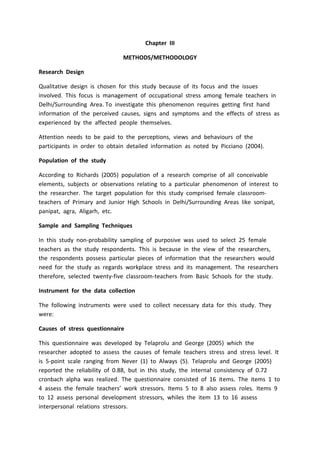
Chapter III
METHODS/METHODOLOGY
Research Design
Qualitative design is chosen for this study because of its focus and the issues
involved. This focus is management of occupational stress among female teachers in
Delhi/Surrounding Area. To investigate this phenomenon requires getting first hand
information of the perceived causes, signs and symptoms and the effects of stress as
experienced by the affected people themselves.
Attention needs to be paid to the perceptions, views and behaviours of the
participants in order to obtain detailed information as noted by Picciano (2004).
Population of the study
According to Richards (2005) population of a research comprise of all conceivable
elements, subjects or observations relating to a particular phenomenon of interest to
the researcher. The target population for this study comprised female classroom-
teachers of Primary and Junior High Schools in Delhi/Surrounding Areas like sonipat,
panipat, agra, Aligarh, etc.
Sample and Sampling Techniques
In this study non-probability sampling of purposive was used to select 25 female
teachers as the study respondents. This is because in the view of the researchers,
the respondents possess particular pieces of information that the researchers would
need for the study as regards workplace stress and its management. The researchers
therefore, selected twenty-five classroom-teachers from Basic Schools for the study.
Instrument for the data collection
The following instruments were used to collect necessary data for this study. They
were:
Causes of stress questionnaire
This questionnaire was developed by Telaprolu and George (2005) which the
researcher adopted to assess the causes of female teachers stress and stress level. It
is 5-point scale ranging from Never (1) to Always (5). Telaprolu and George (2005)
reported the reliability of 0.88, but in this study, the internal consistency of 0.72
cronbach alpha was realized. The questionnaire consisted of 16 items. The items 1 to
4 assess the female teachers’ work stressors. Items 5 to 8 also assess roles. Items 9
to 12 assess personal development stressors, whiles the item 13 to 16 assess
interpersonal relations stressors.
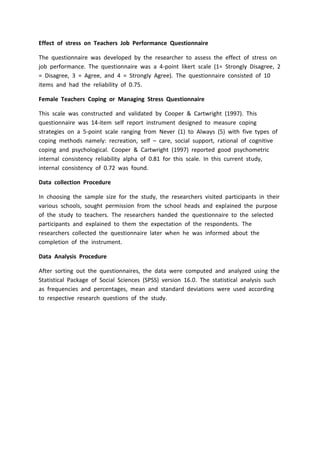
Effect of stress on Teachers Job Performance Questionnaire
The questionnaire was developed by the researcher to assess the effect of stress on
job performance. The questionnaire was a 4-point likert scale (1= Strongly Disagree, 2
= Disagree, 3 = Agree, and 4 = Strongly Agree). The questionnaire consisted of 10
items and had the reliability of 0.75.
Female Teachers Coping or Managing Stress Questionnaire
This scale was constructed and validated by Cooper & Cartwright (1997). This
questionnaire was 14-item self report instrument designed to measure coping
strategies on a 5-point scale ranging from Never (1) to Always (5) with five types of
coping methods namely: recreation, self – care, social support, rational of cognitive
coping and psychological. Cooper & Cartwright (1997) reported good psychometric
internal consistency reliability alpha of 0.81 for this scale. In this current study,
internal consistency of 0.72 was found.
Data collection Procedure
In choosing the sample size for the study, the researchers visited participants in their
various schools, sought permission from the school heads and explained the purpose
of the study to teachers. The researchers handed the questionnaire to the selected
participants and explained to them the expectation of the respondents. The
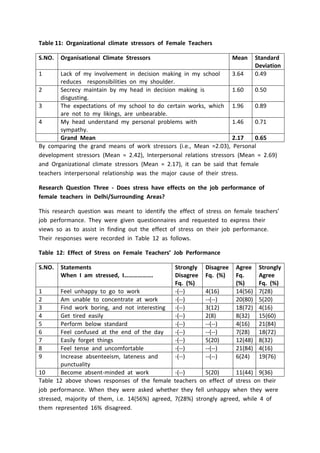
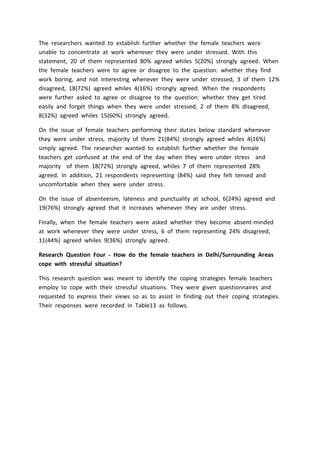
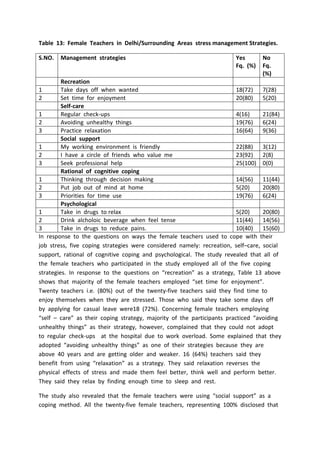
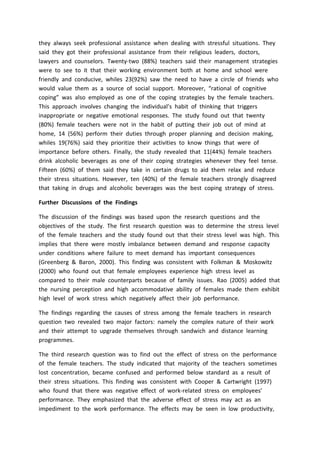
researchers collected the questionnaire later when he was informed about the
completion of the instrument.
Data Analysis Procedure
After sorting out the questionnaires, the data were computed and analyzed using the
Statistical Package of Social Sciences (SPSS) version 16.0. The statistical analysis such
as frequencies and percentages, mean and standard deviations were used according
to respective research questions of the study.
Chapter IV
RESULTS AND DISCUSSION
Section A
Demographic characteristics of respondents
Table 1: Age Distribution of the Female Teachers
Age (years) Frequency Percentages
Less than 30 5 20.0
30-40 10 40.0
41-50 7 28.0
51+ 3 12.0
Total 25 100.0
Table 1 above shows the age group of the female teachers. The dominant age group
of the respondents range between 30 – 40 years representing 10 (40%), followed by
the age range between 41 - 50 years representing 7 (28%) whereas those whose age
range above 50 years made up the smallest group, representing 3 (12%) of the
teachers.
Table 2: Distribution of teaching classes of Female Teachers
Teaching Class Frequency Percentages
Basic 1 2 8.0
Basic 2 1 4.0
Basic 3 4 16.0
Basic 5 6 24.0
Basic 6 3 12.0
Junior high 9 36.0
Total 25 100.0
Table 2 above shows the various teaching classes of the female teachers. The
statistics show that 14 teachers in Primary and 9 teachers in Junior High schools
were involved in the study. The data also implies that majority of the respondents
were from Primary schools. At the Primary section, teachers in Basic Five were the
highest i.e. 6 representing 24%, whiles teachers in Basic Two were the least i.e. 1
representing 4%. The 9 teachers from JHS on the other hand represent 36% of the
total number of the female teachers in the study.
Table 3: Distribution of present rank of the Respondents
Present rank Frequency Percentages
Senior superintendent II 10 40.0
Senior superintendent I 2 8.0
Principal superintendent 6 24.0
Assistant director II 5 20.0
Assistant director I 2 8.0
Total 25 100.0
Table 3 shows that female teachers with the lowest rank were 10 (Senior
Superintendent II), representing 40.0%, whiles those with the highest rank were 2,
representing 8.0%. This indicates that all the 25 respondents were professionally
trained teachers. The data also shows that those on the ranks of Principal
Superintendent, Assistant Director I and Assistant Director II had attained the
requisite status to occupy positions such as headteachers / headmasters of either
Primary or Junior High schools. They are likely to have gone through a lot of
stressful situations.
Table 4: Distribution of working experience of the Female Teachers
Years of working
experience
Frequency Percentages
3-5 4 16.0
6-10 6 24.0
11-15 6 24.0
Above 15 9 36.0
Total 25 100.0
Table 4 above shows working experiences of the respondents selected. The result
shows that none of the 25 respondents had less than three years working
experience. Those with the least years of working experience fell within 3 – 5 years
representing 16.0%, whiles 9 respondents had 15 years or more working experience
representing 36.0%. In all, the records show that these female teachers are likely to
have some amount of knowledge about their stressful circumstances at their work-
places and even at home.
Table 5: Marital and other status of the Female Teachers
Status Frequency Percentages
Single 6 24.0
Married 10 40.0
Divorced 2 8.0
Pregnant 3 12.0
Nursing 4 16.0
Total 25 100.0
Table 5 above shows that 6 female teachers representing 24.0% were not married
(Single) whiles 10 of them (not nursing mothers or pregnant women) representing
40% were married. Nursing mothers were 4 (16%), pregnant women were 3 (12%)
and divorced women were 2 (8%).
The researchers selected this group of female teachers specifically because they
combine and perform various duties both at home and school. Besides their
responsibilities, they were also pursuing Diploma and Post-diploma studies through
distance learning at different universities. The tertiary institutions which run the
distance learning programmes are situated outside the region in which these teachers
teach. This situation has the potential to increase the female teachers stress levels.
Moreover, the student populations of the schools in which these teachers teach are
very large.
Section B
Presentation and Discussion of Research Questions
This section presents and discusses the findings based on the questionnaire and the
research questions raised. The major themes in the research questions on which data
were collected and discussed are as follows:
 What are the levels of stress among the female teachers in Basic schools of
Delhi/Surroundings Areas?
 What are the perceived causes of stress among female teachers in
Delhi/Surrounding Areas?
 Does stress have effects on the job performance of female teachers in
Delhi/Surrounding Areas?
 How do the female teachers in Delhi/Surrounding Areas manage or cope with
their stress situations?
Research Question One - What are the levels of stress among the female teachers
in Basic schools of Delhi/Surroundings Areas?
With reference to a range of scores provided by the test developer (Telaprolu and
George, 2005), the scores were classified as: high, moderate, low and very low. This
scale has a maximum score of 100, which is regarded to be a very high level of
stress, and a minimum of 20.
The scale developed by Telaprolu and George (2005), was adopted in the study to
measure the level of stress among the female teachers. It consisted of 20 statements
and had a five-point scale such as “always”, “frequently”, “sometimes”, “rarely” and
“never” with scoring as 5, 4, 3, 2 and 1 respectively. The range of the scores was 0
to 100. Based on the total scores, the level of stress was quantified as follows:
Table 6: Categories of Level of Stress
Category Range Mean
Very low stress 0-25 0.00-1.25
Low stress 26-50 1.26-2.50
Moderate stress 51-75 2.60-3.75
High stress 76-100 3.76-5.00
Mean of the five stressors were found and categorized base on the categories of the
levels of stress and presented in Table 7 below.
Table 7: Categories of Level of Stress in Percentages
Levels of Stress Frequency Percentages
Very low stress 3 12.0
Low stress 4 16.0
Moderate stress 6 24.0
High stress 12 48.0
Total 25 100.0
In response to the question on the level of female teachers stress, Table 7 above
illustrates that 3 out of the 25 female teachers who participated in the study
representing 12% were found to exhibit very low stress, 4 teachers representing
(16%) exhibited low stress level, 6 of them representing 24% were found exhibiting
moderate stress, while 12 of them represented 48% were found exhibiting high stress
level. The data was graphed and presented in the figure 2 below:
Figure 2: Level of stress among Female Teachers
Research Question Two - What are the perceived causes of stress among female
teachers in Delhi/Surrounding Areas?
The research findings revealed that the circumstances within which the female
teachers have to work for daily living and the various roles that they were required
to play cause stress. The stress has the potential to either motivate or de-motivate
the teachers to fulfill their role obligations. Stress causing factors are known as
‘stressors’. According to Pestonjee (1992), the identified sources of stressors in
organizations were: work stressors, personal development stressors, interpersonal
relations stressors and organizational climate stressors. The researchers used
Employment Organization Sources of Stressors scale developed by Telaprolu and
George (2005) to identify the female teachers’ sources of stress. The 25 female
teachers who participated in the study were given this questionnaire and their
responses were presented in Table 8.
Table 8: Work Stressor of Female Teachers
S.NO. Work Stressor Mean Standard
Deviation
1 I manage to cope up well with the demands from my
work.
1.36 0.49
2 I set deadlines and work at my own pace peacefully. 1.12 0.33
3 I find it difficult to concentrate on my work because
of the noise, I am exposed to.
2.48 0.59
4 I am fed up by keeping myself busy all the times to
meet deadlines.
3.16 0.69
Grand Mean 2.03 0.53
The study looked at the work stressor of the female teachers and found out that the
highest work stress was that: “I am fed up by keeping myself busy all the times to
meet deadlines’’ (Mean = 3.16, SD = 0.69), with the grand mean of 2.03. The
respondents complained that they were expected to do many things within a very
short time. For example, some of them explained that they teach; supervise both
internal and external examinations and perform other co-curricular activities in sports
and culture.
The study found out that majority of the respondents were upgrading themselves
through Sandwich and Distance Learning programmes organized by tertiary
institutions. This was a very big challenge to the female teachers. Thus, the
researcher further wanted to find out the nature of the personal development
stressors of the female teachers and found out that majority of the female teachers
were unable to take up challenging tasks due to the nature of their appointment as
teachers and thus, puts them off at work. (Mean = 2.80, SD = 1.08). Table 9
presents this relationship.
Table 9: Personal Development Stressors of Female Teachers.
S.NO. Personal Development Stressors Mean Standard
Deviation
1 My wish to achieve the top position gives me extra
energy to work in the school
2.76 0.83
2 I end up seeking suggestions from my colleagues due to
my in-experience.
1.68 0.75
3 My inability to take up challenging tasks due to the
nature of my appointment puts me off at work.
2.80 1.08
4 I have aspirations and qualifications, but the system does
not have better positions for me.
2.44 1.16
Grand Mean 2.42 0.96
The researcher further wanted to find out the nature of the interpersonal relation
stressors of the female teachers and found out that their relations with their
colleague teachers cause them a great deal of anxiety (Mean = 3.68, SD = 0.48).
Table10 below presents this relationship.
Table 10: Interpersonal Relation Stressors of Female Teachers
S.NO. Interpersonal Relation Stressor Mean Standard
Deviation
1 Affectionate behavior from my colleagues is unimaginable
to me.
1.80 0.65
2 Advice from colleagues when faced with a problem is a
rarity in my life.
1.76 0.88
3 My relations with my head cause me a great deal of
anxiety.
3.48 0.71
4 My relations with my colleagues cause me a great deal
of anxiety.
3.68 0.48
Grand Mean 2.69 0.68
The researchers established the nature of the organizational climate stressor of the
female teachers and found out that lack of their involvement in decision making in
their schools reduces responsibilities on their shoulders thus, made them more
stressful (Mean = 3.64, SD = 0.49).
Table 11: Organizational climate stressors of Female Teachers
S.NO. Organisational Climate Stressors Mean Standard
Deviation
1 Lack of my involvement in decision making in my school
reduces responsibilities on my shoulder.
3.64 0.49
2 Secrecy maintain by my head in decision making is
disgusting.
1.60 0.50
3 The expectations of my school to do certain works, which
are not to my likings, are unbearable.
1.96 0.89
4 My head understand my personal problems with
sympathy.
1.46 0.71
Grand Mean 2.17 0.65
By comparing the grand means of work stressors (i.e., Mean =2.03), Personal
development stressors (Mean = 2.42), Interpersonal relations stressors (Mean = 2.69)
and Organizational climate stressors (Mean = 2.17), it can be said that female
teachers interpersonal relationship was the major cause of their stress.
Research Question Three - Does stress have effects on the job performance of
female teachers in Delhi/Surrounding Areas?
This research question was meant to identify the effect of stress on female teachers’
job performance. They were given questionnaires and requested to express their
views so as to assist in finding out the effect of stress on their job performance.
Their responses were recorded in Table 12 as follows.
Table 12: Effect of Stress on Female Teachers’ Job Performance
S.NO. Statements
When I am stressed, I……………….
Strongly
Disagree
Fq. (%)
Disagree
Fq. (%)
Agree
Fq.
(%)
Strongly
Agree
Fq. (%)
1 Feel unhappy to go to work -(--) 4(16) 14(56) 7(28)
2 Am unable to concentrate at work -(--) --(--) 20(80) 5(20)
3 Find work boring, and not interesting -(--) 3(12) 18(72) 4(16)
4 Get tired easily -(--) 2(8) 8(32) 15(60)
5 Perform below standard -(--) --(--) 4(16) 21(84)
6 Feel confused at the end of the day -(--) --(--) 7(28) 18(72)
7 Easily forget things -(--) 5(20) 12(48) 8(32)
8 Feel tense and uncomfortable -(--) --(--) 21(84) 4(16)
9 Increase absenteeism, lateness and
punctuality
-(--) --(--) 6(24) 19(76)
10 Become absent-minded at work -(--) 5(20) 11(44) 9(36)
Table 12 above shows responses of the female teachers on effect of stress on their
job performance. When they were asked whether they fell unhappy when they were
stressed, majority of them, i.e. 14(56%) agreed, 7(28%) strongly agreed, while 4 of
them represented 16% disagreed.
The researchers wanted to establish further whether the female teachers were
unable to concentrate at work whenever they were under stressed. With this
statement, 20 of them represented 80% agreed whiles 5(20%) strongly agreed. When
the female teachers were to agree or disagree to the question: whether they find
work boring, and not interesting whenever they were under stressed, 3 of them 12%
disagreed, 18(72%) agreed whiles 4(16%) strongly agreed. When the respondents
were further asked to agree or disagree to the question: whether they get tired
easily and forget things when they were under stressed, 2 of them 8% disagreed,
8(32%) agreed whiles 15(60%) strongly agreed.
On the issue of female teachers performing their duties below standard whenever
they were under stress, majority of them 21(84%) strongly agreed whiles 4(16%)
simply agreed. The researcher wanted to establish further whether the female
teachers get confused at the end of the day when they were under stress and
majority of them 18(72%) strongly agreed, whiles 7 of them represented 28%
agreed. In addition, 21 respondents representing (84%) said they felt tensed and
uncomfortable when they were under stress.
On the issue of absenteeism, lateness and punctuality at school, 6(24%) agreed and
19(76%) strongly agreed that it increases whenever they are under stress.
Finally, when the female teachers were asked whether they become absent-minded
at work whenever they were under stress, 6 of them representing 24% disagreed,
11(44%) agreed whiles 9(36%) strongly agreed.
Research Question Four - How do the female teachers in Delhi/Surrounding Areas
cope with stressful situation?
This research question was meant to identify the coping strategies female teachers
employ to cope with their stressful situations. They were given questionnaires and
requested to express their views so as to assist in finding out their coping strategies.
Their responses were recorded in Table13 as follows.
Table 13: Female Teachers in Delhi/Surrounding Areas stress management Strategies.
S.NO. Management strategies Yes
Fq. (%)
No
Fq.
(%)
Recreation
1 Take days off when wanted 18(72) 7(28)
2 Set time for enjoyment 20(80) 5(20)
Self-care
1 Regular check-ups 4(16) 21(84)
2 Avoiding unhealthy things 19(76) 6(24)
3 Practice relaxation 16(64) 9(36)
Social support
1 My working environment is friendly 22(88) 3(12)
2 I have a circle of friends who value me 23(92) 2(8)
3 Seek professional help 25(100) 0(0)
Rational of cognitive coping
1 Thinking through decision making 14(56) 11(44)
2 Put job out of mind at home 5(20) 20(80)
3 Priorities for time use 19(76) 6(24)
Psychological
1 Take in drugs to relax 5(20) 20(80)
2 Drink alcholoic beverage when feel tense 11(44) 14(56)
3 Take in drugs to reduce pains. 10(40) 15(60)
In response to the questions on ways the female teachers used to cope with their
job stress, five coping strategies were considered namely: recreation, self–care, social
support, rational of cognitive coping and psychological. The study revealed that all of
the female teachers who participated in the study employed all of the five coping
strategies. In response to the questions on “recreation” as a strategy, Table 13 above
shows that majority of the female teachers employed “set time for enjoyment”.
Twenty teachers i.e. (80%) out of the twenty-five teachers said they find time to
enjoy themselves when they are stressed. Those who said they take some days off
by applying for casual leave were18 (72%). Concerning female teachers employing
“self – care” as their coping strategy, majority of the participants practiced “avoiding
unhealthy things” as their strategy, however, complained that they could not adopt
to regular check-ups at the hospital due to work overload. Some explained that they
adopted “avoiding unhealthy things” as one of their strategies because they are
above 40 years and are getting older and weaker. 16 (64%) teachers said they
benefit from using “relaxation” as a strategy. They said relaxation reverses the
physical effects of stress and made them feel better, think well and perform better.
They said they relax by finding enough time to sleep and rest.
The study also revealed that the female teachers were using “social support” as a
coping method. All the twenty-five female teachers, representing 100% disclosed that
they always seek professional assistance when dealing with stressful situations. They
said they got their professional assistance from their religious leaders, doctors,
lawyers and counselors. Twenty-two (88%) teachers said their management strategies
were to see to it that their working environment both at home and school were
friendly and conducive, whiles 23(92%) saw the need to have a circle of friends who
would value them as a source of social support. Moreover, “rational of cognitive
coping” was also employed as one of the coping strategies by the female teachers.
This approach involves changing the individual’s habit of thinking that triggers
inappropriate or negative emotional responses. The study found out that twenty
(80%) female teachers were not in the habit of putting their job out of mind at
home, 14 (56%) perform their duties through proper planning and decision making,
whiles 19(76%) said they prioritize their activities to know things that were of
importance before others. Finally, the study revealed that 11(44%) female teachers
drink alcoholic beverages as one of their coping strategies whenever they feel tense.
Fifteen (60%) of them said they take in certain drugs to aid them relax and reduce
their stress situations. However, ten (40%) of the female teachers strongly disagreed
that taking in drugs and alcoholic beverages was the best coping strategy of stress.
Further Discussions of the Findings
The discussion of the findings was based upon the research questions and the
objectives of the study. The first research question was to determine the stress level
of the female teachers and the study found out that their stress level was high. This
implies that there were mostly imbalance between demand and response capacity
under conditions where failure to meet demand has important consequences
(Greenberg & Baron, 2000). This finding was consistent with Folkman & Moskowitz
(2000) who found out that female employees experience high stress level as
compared to their male counterparts because of family issues. Rao (2005) added that
the nursing perception and high accommodative ability of females made them exhibit
high level of work stress which negatively affect their job performance.
The findings regarding the causes of stress among the female teachers in research
question two revealed two major factors: namely the complex nature of their work
and their attempt to upgrade themselves through sandwich and distance learning
programmes.
The third research question was to find out the effect of stress on the performance
of the female teachers. The study indicated that majority of the teachers sometimes
lost concentration, became confused and performed below standard as a result of
their stress situations. This finding was consistent with Cooper & Cartwright (1997)
who found that there was negative effect of work-related stress on employees’
performance. They emphasized that the adverse effect of stress may act as an
impediment to the work performance. The effects may be seen in low productivity,
high absenteeism, high turnover, high rate of recruitment and high training costs.
Cooper & Cartwright (1997) further supported that work-related stress can affect
work performance negatively in terms of anxiety attacks, depression, and other
chronic illnesses such as migraines, and loss of enthusiasm. Rao (2005) mentioned
that fatigue and tiredness can be one of the main reasons behind lower level of
employee performance as a result of work-related stress. He also highlighted that
psychological aspects of employees are affected in terms of low concentration and
lack of motivation, and burnout as a result of work-related stress.
The fourth research question was to find out how the female teachers manage their
stress situations. The findings showed that majority of the female teachers use social
support to cope with their stress. This finding was consistent with Rao (2005) who
emphasized that women are fond of accompaniment and also easily make friends
and speak their mind so easily. On the other hand, Clarke & Cooper (2000) added
that women mostly seek advice and attend counselling services more than men.
Rice (1999) states that lower stress conditions increase employees’ performance and
suggested that administrators should support in making work environment friendly to
reduce stress in employees in order to increase productivity. The findings of the
research questions supported this claim. Finally, the study also revealed that a
working environment which is conducive reduces stress and as a result encourages
employees to perform better.
Chapter V
SUMMARY, CONCLUSIONS AND RECOMMENDATIONS
The following findings were arrived at in the present study:
 The level of stress among the female teachers was high.
 Female teachers interpersonal relationship was the main cause of their stress.
 Majority of the female teachers strongly agreed that stress made them
perform below standard.
 Most of the female teachers employed social support to cope with their
stress, specifically with friendly environment.
Conclusion
The teaching profession is a stressful occupation. Most teachers would agree that
daily interactions with students, parents, colleagues and the constant demands of
teaching often lead to overwhelming pressures and challenges, which ultimately
elevates to stress. The participants recognized several causes of stress: workoverload,
personal development, interpersonal relations and organizational climate. However,
the female teachers felt that their stress conditions negatively affect their job
performance but employing coping strategy such as social support can serve to
reduce the stress. Stress management techniques should be targeted at creating
conducive or friendly working environment.
Coping with stress is an individualized task and one method over another may not
be superior, so find what works for you and master it. A person that is stressed
takes so much away from his or her health and performance levels. To make the
most of your life, limit your stress and of course for that stress that you cannot
diminish, learn to manage it.
Recommendations
The findings of the study were important from the point of view of quality of
teachers and their effectiveness and efficiency in their teaching. Stress affects the job
performance of employees not excluding teachers. So, it is necessary to provide
proper environment and support systems to minimize the stress levels of the
individuals. The study has shown that there are variations in the experience of
stressors related to work, personal development, interpersonal relations and
organizational climate by the female teachers. Therefore, there is the need for
effective management of these stressors by making use of different management
strategies and providing effective guidance and counseling services.
Suggestions for Further Research
Present research is an endeavour to understand how female teachers manage or
cope with their stress and burnout. The results of the present study are opened for
verification by future researchers.
The following similar studies are suggested to be carried out with large sample size.
• A study on level of stress and management techniques among teaching
and non teaching staff.
• A study on job stress among both males and females in various
professions can be carried out in the future research and compare the
results.
• An investigation into the stressors and level of stress among female
teachers in comparison with other professions needs to be carried out.
Chapter VI
BIBLIOGRAPHY/REFERENCES
 Ackumey, M.A (2003). Organization and administration of a school guidance
programme. Accra: Media Graphics and Press Limited.
 Akinade, E. A (2007). Stress: Understanding & Managing it. Pumark Publishers
Lt. Nigeria. (pp: 1-25, 51-61, 78-83).
 Akinboye J. O., & Adeyemo, D. A. (2002). Stress at home and workplace.
Ibadan: Stirling Horden Publishers.
 Aldwin, C.M. (1994). Stress, coping and development. New York: The Guilford
Press.
 Anspaugh, D. J. : Hamrick, M. H:, and Rosato, F. D (2003).Wellness, Concepts
and Applications (5th Ed). United States: McGraw-Hill Companies.
 Baron, R. A; Bryne D and Branscombe, (2006). Social psychology (11th
Ed.).United States of America: Pearson Education Inc.
 Benefits Interface. (2010). Introduction to Attendance Management. Retrieved:
October 22, 2012, from: <www.benefits.org/interface/cost/absent.htm>
 Bernstein, D. A, Penner, L. A, Clarke-Steward, A, Roy, E. J. (2003). Psychology
(6th Ed.). United States of America: Houghton Mifflin Company.
 Blonna, R. (2005). Coping with stress in a changing world. U.S.A.: McGraw-Hill
CompaniesInc.
 Brewer, E.W. & McMahan, J. (2004). Job stress and burnout among Industrial
and Technical teacher educators. Journal of Vocational Education Research
28(2), 1-17.
 Chang, M. L. (2009). An appraisal perspective of teacher burnout: Examining
the emotional work of teachers. Educational Psychology Review, 21, 193-218.
 Cherniss, C. (1982). Preventing burnout: From theory to practice. In J. W.
Jones (Ed.). Theburnout syndrome: Current research, theory, interventions. Park
Ridge, IL: London House Press, 172-176.
 Clarke, S.G. & Cooper, C.L. (2000). The risk management of occupational stress.
Health, Risk and Society, 2(2), 173-187.
 Cohen, I. Marion, L., and Morrison, K. (2003). Research Methods (5th Ed.).New
York: Routledge Chapman and Hall Inc.
 Cohen, R.J. & Swerdlik, M.E. (2005). Psychological Testing and Assessment. An
Introduction to Tests and Measurement (6th Ed). Boston: McGraw Hill.
 Coon, D. (2002). A journey (1st Ed.).Canada: Thomson Learning Inc.
 Cooper, C.L. & Cartwright, S. (1997). An intervention strategy for workplace
stress. Journal of Psychosomatic Research, 41(1), 7-16.
 Cooper, C. L. & Kelly, M. (1993). Occupational stress in headteachers. British
journal of Educational Psychology. Retrieved from
http://www.asbj.com/2004/10/1003 research.html.
 Cooper, C. & Kelly, M. (1993). Occupational stress in headteachers: A national
UK study. British Journal of Educational Psychology, 63, 130-143.
 Cozby, P.C. (2003). Methods in Behavioral Research (8th Ed). Madrid: Mc Graw
Hill.
 Creswell, J. W. (2005). Educational research. New Jersey: Pearson Educational
Inc.
 Duffy, K. G. (2005). Psychology for living (8th Ed.). New Jersey: Education Inc.
 Duffy, K. G. (1999). Psychology for living (6th Ed.). United States of America:
Prentice-Hall International.
 Dunham, J. (1980). An exploratory comparative study of staff stress in England
and German comprehensive schools. Educational Review, 32 (4), 11-20.
 Farber, B. (2000). Treatment Strategies for Different Types of Teacher Burnout.
Journal of Clinical Psychology, 675-689.
 Feldman, R. S. (2005). Understanding Psychology (6th Ed.) U.S.A: McGraw-Hill
Companies.
 Ferrell, V. Harold, M.: and Cherne, M.D. (2008). Natural remedies.
Encyclopedia. United States of America: Harvestine Books.
 Fimian, M. J. (1988). Teacher stress inventory. Brandon, VT: Clinical Psychology
Publishing .
 Fisher, C. D., Schoenfeldt, L. F., & Shaw, J. B.(1990). Human Resource
Management. Boston, MA: Houghton Mifflin Company.
 Fraenkel, J. R. & Wallen, N.E. (2003). How to design evaluate research in
Education (5th Ed.). U.S.A: McGraw-Hill Companies.
 Frankel, J.R. & wallen, N.E. (2000). How to Design in Education. New York:
Longman Publishers.
 Frankfort-Nachmias, C.& Nachmias, D. (1996). Research Methods in Social
Sciences (5th Edition). New York: Replika Press Pvt. Ltd.
 Freudenberger, H. J. (1983). Burnout: Contemporary issues, trends, and
concerns. In B.A. Farber (Ed.). Stress and burnout in the human services
professions (pp. 76-145). New York: Pergamon Press.
 Folkman, S & Moskowitz, J.T. (2000). Positive effect and the other side of
coping. American Psychologists, 55(6), 647-654.
 Gerrig, R. J. and Zimbardo (2002). Psychology and life (16th Ed.). United States
of America: Pearson Education Company.
 Gmelch, W. H. (1993). Coping with faculty stress. New York: Sage Publications.
 Gmelch, W. H.; Wilke, P. K. and Lourich, N. P. (1984). Factorial dimensions of
faculty stress. Paper presented at the Annual Meeting of the American
Educational Research Association. New Orleans
 Greenberg, J. & Baron, R.A. (2000). Behavior in organizations. Upper Saddle
River, N.J: Prentice Hall.
 Gronlund, N.E. (1985). Measurement and Evaluation in Teaching.( 5th Ed.) New
York: MacMillan Publishing Company.
 Guglielmi, S.R. and Tatrow, K. (1998). Occupational stress, burnout, and health
in teachers: A methodological and theoretical analysis. Review of Educational
Research, 68, 61-91.
 Hales, D. & Zartman, C. (2001). An investigation to fitness and wellness.
Canada: Wadsworth/Thomson Learning.
 Hayes, N. (2001). Applied psychology. Great Britain: McGraw-Hill.
 Hoeger, W. K. and Hoeger, S. A. (2005). Lifetime physical fitness and wellness
(8th Ed.).United States of America. Wadsworth/Thomson Learning Inc.
 Insel, P.M. and Roth W.T. (2004). Core concepts in health (9th Ed.). United
States of America: McGraw-Hill Companies Inc.
 Kokkinos, C.M. (2007). Job stressors, personality and burnout in primary school
teachers. British Journal of Educational Psychology, 77 (1), 229 – 243.
 Kyriacou, C. (1987). Teacher stress and burnout: An international review.
Educational Research, 29 (2), 146 – 52.
 Kyriacou, C. (2001, p. 38). Teacher stress: Directions for suture research.
Educational Review, 53, 27-35.
 Lahey, B. B. (2004, p. 499). Psychology: An Introduction (8th Edition). New
York: McGraw-Hill.
 Larchick, R. and Chance, E. (2004). Teacher performance and personal life
stressors: Implications for urban life school administrators. National Forum of
Teacher Education Journal, 14E, 19-30.
 Lazarus, R. S. (1999). Stress and Emotion: A new synthesis. New York:
Springer.
 Lefton, L. A. (1997). Psychology. (6th Ed.). U.S.A: A Viacom Company.
 Leka, S., Griffiths, A., & Cox, T. (2003). Work Organization and Stress.
Protecting Workers' Health Series, p. 32.
 Maples, M. F. (1980). Stress: in defense of its positive dimensions: Action in
Teacher Education, 2(4), 23-28.
 Maslach, C., & Jackson, S.E. (1982). The measurement of experienced burnout.
Journal of Occupational Behavior, 2, 35-47.
 Maxon, R. (1999). Stress in the Workplace A Costly Epidemic. FDU Magazine.
Retrieved on October 2, 2013 from
http://www.fdu.edu/newspubs/magazine/99su/stress.html
 Mearns, J. and Cain, J.E (2003). Relationship between teachers’ occupational
stress and their burnout. Roles of coping and negative mood regulation
expectancies. Anxiety, stress and coping.
 Melhinsh, A. (1998). Executive health. London: Business Books. O'Connor, P.R.
& Clarke, V.A. (1990). Determinants of teacher stress. Australian Journal of
Education, 34 (1). 41-51.
 McGrath, J. E. (1976). Stress and Behavior in Organizations. Handbook of
Industrial and Organizational Psychology. Chicago: Rand McNally Co., Inc. pp.
1351–1395.
 McMillan, J. H.: and Schumacher, S. (1997). Research in Education (4th Ed.).
United States of America: Addison-Wesley Educational Publication Inc.
 Myers, D.G (2001). Psychology (6th Ed.).United States of America. Worth
Publishers.
 National Safety Council (2004). The safety agenda for the nation-In the
workplace. Retrieved April 10, 2012 from http://www.nsc.org/safety
agenda/workp/htm.
 O’Donnell, M. P. (2001). Health promotion in the workplace (3rd Ed.).
Portland. OR: Delmar.
 Oni-Eseleh, D.O (2010). Stress Kills .Choice Publications. Newburgh, NY 12550,
United State of America. (pp:125-139).
 Payne, W.A: Halm. D. B: and Mauer, E.B (2005). Understanding your health
(8th Ed.). United States of America: McGraw-Hill Companies Inc.
 Pelt, N.V. (2008). Secrete of sanity for stressed women. Thailand: Autumn
House Limited, Grantham, Lincolnshire.
 Picciano, A.G. (2004). Educational research primer. Great Britain: Cromwell
Press-Hill.
 Pines, A. & Aronson, E. (1988). Career burnout: Causes and cures. New York:
Free Press.
 Powers, S. K and Dodd, S. L: and Noland V. J. (2006). Total fitness and
wellness. United States of America. Pearson Education Company.
 Pruitt, B. E: Crumpler, K, T: and Prothrow-Smith, D. (2001). Health skills for
wellness (3rd Ed.). U.S.A.: Prentice-Hall Inc.
 Pruitt, B. E and Stein, J.J, (1999). Health style (2nd Ed.). United States of
America. A Viacom Company.
 Raedeke, T.D., & Smith, A.L. (2004). Coping resources and athlete burnout: An
examination of stress mediated moderation hypotheses. Journal of Sport and
Exercise Psychology, 26, 525-541. Rao V. S.P. (2005): Job analysis, Human
Resource Management, Second edition, Excel Publication (New Delhi); pp-(89,
90).
 Rao V. S.P.(2005): Performance and Potential appraisal, Human Resource
Management, Second edition, Excel Publication(New Delhi); pp-(338-340).
 Rice, F. P. (1998). Human Development. A life-span approach (3rd Ed.). United
States of America.: PrenticeHall Inc.
 Rice, P.L. (1999). Stress and health (2nd ed.). California: Brooks/Cole Publishing
Company.
 Riolli, L., & Savicki, V. (2003). Optimism and Coping as Moderators of the
Relation Between Work Resources and Burnout in Information Service Workers.
International Journal ofStress Management, 10, 235-252.
 Rosen, D. D. (2010, p.4). Stress! And how to deal with it effectively. Retrieved:
October 20, 2013, from http://www.marist.edu/counselling/pdfs/stress.pdf
 Rosch, P. (1997). Is job stress America’s leading adult health problem? A
commentary. Business insights.
 Ruiz, G. (2007). Role of Workplace Stress in Turnover Undervalued. Retrieved:
December 16, 2012: www.workforce.com/section/00/article/25/22/64.html.
 Salk, J. (1973). Survival of the Wisest. New York: Harper and Row
 Sarantakos, S. (1998). Social research (2nd Ed.). Hound Mills. MacMillan Press.
 Seaward, B. L. (2004). Managing stress principles and strategies for health and
well-being. Boston: Jones and Bartlett Publishing.
 Shives, R. (1990). Basic concepts of psychiatric mental health nursing (3rd
Ed.).
Philadelphia: Lippincot Co.
 Sizer, N. K. Eleanor, F. L. De-Bruyne W.W. (1999). Making life choices (2nd
Ed.).
United States of America: West Publishing Company.
 Taylor, A. I. & Buku D.K.(2006). Basics in guidance and counselling.(2nd
Ed), pp
39-55. Winneba:University of Education, Winneba.
 Taylor. S. E (2003). Health Psychology (5th Ed.). United States of America:
Pearson Education Company.
 Weiten, W. (2000). Psychology themes and variations: Wadsworth Brooks/Cole
Publishing Company.
 Wiley, C. (2000). A synthesis of research on the causes, effects and reduction
strategies of teacher stress. Journal of Instructional Psychology.
 Willis, J.B. (2005). Cracking the tress problem. Thailand: The stanborough Press
Limited, Alma Park, Grantham, Lincs.
 Wood, S. E.: Wood, E. G. and Boyd. D. (2005). The world of psychology (5th
Ed.). United States of America. Pearson Education Inc.
 World Health Organization (WHO) (2002) 525, 23 St. N.W, Washington,
D.C.20037, 861-890.
 Ziggah, S. R. (2009). Fundamental Skills in Guidance and Counselling.Cape
Coast: Edsam Computers and Publications, pp. 47-165.
IGNOU Sample Practical File for MCFTL005 Mini-Research RJ

IGNOU Sample Practical File for MCFTL005 Mini-Research RJ

  • 1.
    Supervised Practicum File ForThe Course MCFTL-005 NAME: RISHABH JAIN. ENROLLMENT NO.: 197184740.
  • 2.
    SUPERVISED PRACTICUM FILE M.Sc.(CFT)– First Year MCFTL-005 NAME: RISHABH JAIN ENROLLMENT NO.: 197184740 ADDRESS: B-1/638 STREET NO. 22 HARSH VIHAR, DELHI-110093 PHONE.NO.: +91 7065479418 STUDY CENTRE/PROGRAMME STUDY CENTRE: (29053P) DEPARTMENT OF PSYCHIATRY & DRUG DE-ADDICTION CENTRE, LADY HARDING MEDICAL COLLEGE & SSK HOSPITAL, NEW DELHI. REGIONAL CENTRE: RAJGHAT NAME & ADDRESS OF SUPERVISED PRACTICUM SUPERVISOR PHONE NO./E-MAIL OF SUPERVISOR R.K.Jain SIGNATURE OF THE STUDENT
  • 3.
    AN INVESTIGATION INTOFEMALE TEACHERS MANAGE STRESS AND TEACHERS BURNOUT IN DELHI & SURROUNDING AREA A Mini-Research Submitted To Indira Gandhi National Open University in partial fulfilment of the requirement for the Degree of Master’s of Science in Counselling and Family Therapy Rishabh jain Name of the Researcher/Candidate 197184740 Enrollment Number (APRIL of 2021) National Centre for Disability Studies Indira Gandhi National Open University Maidan Garhi, New Delhi-110063
  • 4.
    TABLE OF CONTENTS Acknowledgements………………………………………….……………………………………….…… Listof Tables……………………………………….……………………………………….……………… List of Figures……………………………………….……………………………………….………………………… Abstract……………………………………….……………………………………….…………………………………… Chapter I : Introduction……………………………….……………………………………….…………….. Chapter II : Review of Literature……………………………………….………………………………… Chapter III : Methods/Methodology……………………………………….……………………………… Chapter IV : Results and Discussion……………………………………….……………………………… Chapter V : Summary, Conclusions and Recommendations………………………………… Chapter VI : Bibliography/References……………………………………….……………………………… Appendices (Approved Mini-Research Proposal) (ANNEXURE A : Evaluation Sheet) ( ANNEXURE B : Certificate of Completion of Supervised Practicum MCFTL-005)
  • 5.
    ACKNOWLEDGMENTS I Would liketo say “Thank You Mahavira” because of your Merciful, finally I completed my Mini-Research for my higher level of studies. From deepest of my heart, I would like to thank my family, who was always beside me, day and night and nourished me with loves and prayers to ensure that I was able to move forward and complete my studies. I would like to Thank You Syeda Shahnaz ma’am because of scarify your time, energy, and help me with your valuable knowledge. For my friends and classmates, you are my inspiration and motivate me on my every single step. To my guide Dr. Dinesh Kumar Kataria, you are a good listener. You were always there when I need you. Thank you so much for your time, knowledge, and expertise that you shared with me. Finally, thank you very much to Department of Psychiatry & Drug De-Addiction Centre, Lady Harding Medical College.
  • 6.
    LIST OF TABLES 1.Age Distribution of the Female Teachers…………………………………………………………………………… 2. Distribution of the teaching classes of Female Teachers……………………………………………….. 3. Distribution of present rank of the Respondents……………………………………………………………. 4. Distribution of working experience of the Female Teachers………………………………………….. 5. Marital and other status of the Female Teachers…………………………………………………………… 6. Categories of Level of Stress………………………………………………..……………………………………………. 7. Categories of Level of Stress in Percentages……………………………………………………………………. 8. Work Stressors of Female Teachers………………………………………………………………………………….. 9. Personal Development Stressors of Female Teachers………………………………………………………. 10. Interpersonal Relation Stressors of Female Teachers…………………………………………………………. 11. Organizational Climate Stressors Female Teachers……………………………………………………………. 12. Effects of Stress on Female Teachers………………………………………………………………………………... 13. Female Teachers in the Delhi/surrounding Area Stress Management Strategies…………..
  • 7.
    LIST OF FIGURES 1.Effects of stress on the personality of the individuals………………………………. 2. Level of stress among Female Teachers………………………………………………………
  • 8.
    ABSTRACT The purpose ofthis study was to investigate into how female teachers in Delhi/Surrounding Areas manage stress and teacher burnout, and explore the cause, effects, and ways of improving work related for better standard of education. The study was conducted with qualitative research approaches excuted through questionnaires. Twenty five female were selected from eighteen Primary and High Schools through purposive sampling technique for the study. The study employed descriptive cross-sectional design particularly cross sectional survey design. The data were subjected to statistical analyses, frequencies and percentages, together with mean and standard deviation. The study revealed that the stress level of the female teachers was high. Work over-load and interpersonal relationship were the main causes of stress of the female teachers. Majority of the female teachers strongly agreed that stress made them perform below standard. Based on the findings of the study a number of recommendations were made. It was recommended that the government of India should organize more training programmes on effective management of stressors by making use of different stress management strategies and providing effective guidance and counselling services. The government of India should train more counsellors to serve at the Basic schools.
  • 9.
    Chapter I INTRODUCTION The purposeof the study The purpose of the study is to investigate into how female teachers in Delhi/Surrounding Areas manage stress and teacher burnout, and explores the causes, effects, and ways of improving work-related stress for better standard of education. Objectives of the study The objectives of the study are to:  Identify the level of stress among female teachers in Basic schools in Delhi/Surrounding Areas;  Identify the causes of stress among female teachers in Basic schools in Delhi/Surrounding Areas;  Find out the effect of stress on the job performance of female teachers in Delhi/Surrounding Areas;  Explore how female teachers in Delhi/Surrounding Areas manage or cope with their stress situations. Research Questions To achieve the purpose of the study, the following research questions were formulated to guide the study:  What is the level of stress among the female teachers in Basic schools in Delhi/Surrounding Areas?  What are the perceived causes of stress among female teachers in Delhi/Surrounding Area?  Does stress have effects on the job performance of female teachers in Delhi/Surrounding Areas?  How do the female teachers in Delhi/Surrounding Areas manage or cope with their stress situations? Delimitation of the study The study should have covered the entire country but due to the time frame, it was delimited to the female teachers in Delhi/Surrounding Areas.
  • 10.
    Theoretical framework forthe study This study is based on Person- Environment (PE) Fit theory and the transactional model of stress and burnout. These are the most widely accepted frameworks for conducting research on job-stress and burnout (Brewer& McMahan, 2004; Edwards, Caplan &Harrison, 1998; Edwards & Cooper, 1990; Kokkinos, 2007; Spielberger & Vagg, `1999). Person- Environment (PE) Fit theory and transactional model of burnout assert that the interaction between an individual and his or her environment determines whether or not a situation is stressful for that person. It assumes that human behaviour is a function of the person and the environment, and that a person’s vocational satisfaction, stability and achievement depend on the congruence or fit between the person’s personality and the environment in which the person works (Herr, Cramer, & Niles, 2004; Kokkinos, 2007; Salami, 2006). In the context of the workplace, the individual’s attributes are: interest, transferrable skills, career motives and values, personality preferences, career orientations, self-concept and sense of self-efficacy. The work environment include: individual’s expectations and perceptions regarding workload, control over one’s work, tangible and intrinsic rewards of work, the relationship and sense of community among co-workers, perceptions of fairness in the workplace and the role of personal and organizational values (Herr et al, 2004). If the fit between an individual and environment is incompatible, stress sets in. Similarly, lack of fit between the demands placed on individuals and their abilities to meet those demands can result in stress. Though there are evidences that burnout occurs as a result of complex interaction between individual characteristics and issues in the work environment, research has not systematically considered the role of person variables in this direction especially studying the manifestation of burnout among female teachers in education. Lazarus and Folkman (1984) cited in Wood, Wood and Boyd (2005) contend that it is not the stressor that causes stress but a person’s perception of it. According to Lazarus, when people are confronted with a potentially stressful event, they engage in a cognitive process that involves a primary and secondary appraisal. A primary appraisal is an evaluation of the meaning and significance of the situation- whether its effect on one’s well-being is positive, irrelevant or negative. An event appraisal as stressful could involve:  Harm or loss, which is damage that has already occurred.  Threat or the potential for harm or loss or  Challenge, which is the opportunity to grow or to gain. An appraisal of threat, harm or loss can occur in relation to anything important to you-a friendship, a part of your body, your property, your finances and your self esteem. When people appraise a situation as involving threat, harm or loss, they
  • 11.
    experience negative emotionssuch as anxiety, fear, anger, and resentment. An appraisal that sees a challenge on the other hand is usually accompanied by positive emotions such as excitement, hopefulness and eagerness. During secondary appraisal if people judge the situation to be within their control, they make an evaluation of available resources-physical (health, energy, stamina), social (support network) psychological (skills, morale, self-esteem), material (money, tools, equipment), and time. Then they consider the options and decide how to deal with the stressor. The level of stress they feel is largely a function of whether their resources are adequate to cope with the threat, and how severely these resources will be taxed in. Conceptual Framework Stress is a concept, although familiar with the individual, but is understood in different ways. The use of this term in a vague and general form creates context of different interpretations that sometimes are contradictory (Rutter, 1983). In this context, authors attempt to categorize the different definitions of stress instead of creating a general definition. Barron Lopez de Roda (1997) considers three kinds of stress definitions:  Stress as stimulus: Here, stress is defined as any situation that provokes alteration in the homeostatic processes. This particular definition has been criticized, because it does not consider the individual differences in response to the same situation. Individuals are not passive and there are many situations that result in changes of the homeostatic processes but they are not stressful, for instance, ‘to breath’.  Stress as response: Stress, here, is defined in terms of the reactions provoked in the organism. Some authors argue that this kind of definition of stress can be misunderstood since there are both emotional and physical responses that can fit in this definition of stress and they result from non-stressful situations, for instance, ‘to practice sports’.  Stress as interaction: Many authors suggest that stress should be understood as a relationship between individuals and their environment. In this specific relationship, the environment is perceived as threatening by the individuals’ who experience that environmental demands exceed their personal resources. Lazarus and Folkman (1984) have developed a model of the psychological processes involved in stress. According to these authors, stress is best understood in terms of the individual’s cognitive interpretation of potentially stressful events. How events are perceived is more important than the objective of the events themselves. Stress is neither an environmental stimulus nor a psychological response, but rather a relationship between environmental demands and the ability to deal with them. Thus, stress is seen as a transaction between the individual and the environment. In this circumstances transaction exist in two important processes: appraisal and coping.
  • 12.
    Psychological appraisal: Thisrefers to individuals’ constant assessment of a situation and the resources available for dealing with it (Lazarus and Folkman, 1984; Lazarus, 1999). When individuals face a potentially stressful situation, they appraise the amount of potential danger as well as their resources for dealing with that danger. Individuals experience stress when the perceived threat exceeds perceived available resources for coping with it. Coping is defined as individuals’ effort, cognitive and behavioral, to deal with a stressful situation (Lazarus, 1999). In other words, stress is a dynamic process involving both the individual and the environment. The environment provides the initial stimulus, but the key determinants of stress are the way the individual perceives the environment and the coping resources selected to face it. In the case of this study the terms coping and stress management strategies are used as synonymous. Stress research has been of great interest to social scientists. In is an unavoidable characteristic of life and work. In any job, there are wide variety of potential causes of stress, some of which are common to both men and women, and others are specific to each group. One particular area of stress research: management of stress; has become a very important research area for teachers in Delhi/surrounding Area. For example, research on management of stress in Education Service has included female teachers in Basic Schools, Secondary Schools, Post-Secondary schools and tertiary institutions. Seyle (1984) identifies the changes in the body’s physiology in reaction to stress. He believes that our bodies respond biologically to stress. He calls this response pattern: General Adaptation Syndrome (GAS). The GAS consists of three stages, namely: Alarm, Resistance and Exhaustion (A-R-E).  The Alarm reaction, also known as ‘fight or flight’ stage, is the stage during which the perception of an immediate stressor triggers a physically complex response.  The Resistance or adaptation stage occurs when the stressor persists and the body attempts to combat this stressor.  The Exhaustion stage occurs when the stressor continues to persist for too long and the bodily resources become depleted. The individual reaches this stage only when the first two stages are unsuccessful and the stress continues to trouble the person. McGrath (1976) on his part developed a four-stage model. According to him the first stage begins with a set of specific demands. In this case, an individual perceives that this particular demand produces stress. McGrath stage two begins with an appraisal process. At this point the individual may decide that he or she does not have the physical or mental resources to meet the demand that he or she has perceived. The stress created by this incongruity between demand and personal resources result in stage three. This stage reveals a stress or copying response that takes the form of
  • 13.
    psychological, physiological orbehavioural reactions. The final or fourth stage he says is the consequences, “the intensity and long range effects of stress”. The theoretical model to be considered and selected for use in this study was the four stage model developed by Gmelch, Wilke and Lourich (1984) and was based on the McGrath (1976) model that examined interactions between the individual and the environment. This model was developed specifically for teachers. Gmelch et al (1984) describes how the four-stage stress areas was developed, analyzed and adapted for teachers in the following stages: • Stage 1: This stage is the use of an interview guide developed to measure sources of stress through relevant facets of job related strains including supplementary items from teachers. • Stage 2: This stage emphasizes the interpretation of stressors on their own perception of the situation. • Stage 3: This stage relates to data collection from groups of teachers on copying strategies. The individuals decide on their own copying strategies through the determination of the situation in stage two. • Stage 4: This stage indicates the consequences of stress on the health of the individuals. This theory takes into account not only the stages of stress and their impact on health generally but also emphasizes on data collection from individuals and group of workers (teachers). This theory therefore, suggests that in dealing with stress situations, data collections from individuals and groups is paramount. In doing so, there is the need to follow a process noting causes and effects. The body of theoretical research by Selye, McGrath and Gmelch was used to form the foundations of this study. This study focused on the first, second, and third stages of the model developed by Gmelch, Wilke and Lourich (1984). The first stage concerned the development of clustered factors that represented the components of stressors in teacher’s jobs. Gathering and analysing data about the perceptions of stress exemplified the second stage. The third stage involved gathering, performing a content analysis and separating the copying strategies into distinct categories and composites. The theory is relevant to this study because it provides a framework and roadmap with which to collect data on the causes and effects of stress. It appears that, in the 14th century, the word “stress” was first used in a non-technical sense to refer to hardship, adversity, or affliction (Lazarus, 1999). Robert Hooke, a prominent Physicist-biologist of the late 17th century formulated an engineering analysis of stress by questioning how structures such as bridges should be designed to prevent collapse (Lazarus, 1999). Three basic concepts emerged from his investigation: including load, stress and strain (Lazarus, 1999). This analysis influenced 20th century models of stress, which drew upon the idea of load as an external force exerted on a social, physiological or psychological system (Lazarus, 1999). Load is analogous to an external stimulus, and strain to the stress response or reaction (Lazarus, 1999).
  • 14.
    Critical examination ofother definitions revealed that, Gazzaniga and Heatherton (2003) explained stress as a component of emotional life. The definition emphasizes the emotional aspect of stress. The researcher is in agreement with those whose view is that; this definition is limited in the sense that stress is not only emotional but also mental and physical. However, Gazzaniga and Heatherton’s definition guides this research to examine into detail the emotional causes and effects of stress on female teachers. Woods, Woods and Boyd (2004) explain stress from the response perspective of physical and psychological view point while Powers, Dodd and Noland (2006) see stress as the response from psychological and mental perspectives. Perceived causes of stress An interesting feature of stress is the wide range of physical and psychological reactions that different people have to the same event; some may interpret an event as stressful, whereas others simply take it in stride. Many people are of the view that stress is caused by only unpleasant events. This is certainly not true, because stress is caused by both pleasant and unpleasant events. Taylor (2003) enumerates loss of job, having difficulties at home or school as stressful events. He adds that positive change for the better, such as the birth of a new baby, wedding ceremony and possessing a new house can equally cause unpleasant stress situations. Lazarus (1999) determines that there are four categories of environmental variables that influence stress and emotion. These are: demands, constraints, opportunities and culture. These four variables influence a person’s reactions through the process of cognitive appraisal. Lazarus added that, stress can be caused by anything that stimulates people: it is a part of life. Some amount of stress can be stimulating, too much can be destructive. Analysis of it in our everyday lives is prevalent in the society. Sizer-Webb, Whitney and De Bruyne (1999) identify the cause of stress in the home environment emanating from activities of members of the family. Anspaugh, Hamrick and Rosato (2003) see anger, hostility, frustration and depression as stimulated stress. Further, Pruitt and Stein (1999) suggest that stress is a lifelong phenomenon beginning from birth. Payne Hahn and Mauer (2005) place the causes of stress in positive and negative experiences in life such as financial worries, relational conflicts, marriage, new jobs and change of accommodation. Ferrell, Harold and Cherne (2008) add pressures, problems from home or workplaces, sleeplessness, alcoholic drink and worry about attribute are antecedents to stress. Weiten (2000) opines that difficulty in decision-making triggers stress. Wood, Wood and Boyd (2005) propose that, stress results from conflicts of three dimensional types, namely; approach-approach conflict, avoidance-avoidance and approach-avoidance conflicts. The consequences, they say generate discomfort and boring difficult situations.
  • 15.
    Lefton (1997), statesthat lack of time is another common source of stress. Everyone faces deadlines: Students must complete tasks before class ends, auto workers must keep pace with the assembly lines; tax payers must file their returns within the stipulated time and teachers must complete their lesson plans before the week begins. People have a very limited number of hours each day in which to accomplish tasks; therefore, there is the need for carefully allocation of their time pressure. They may establish routines, make lists, set schedules, and leave optional time pressure successfully; they may begin to feel over loaded and stressful. Finally, Weiten (2000), states that major disasters such as hijackings, hurricanes, military combat and nuclear accidents produce devastating stress that affects the individuals. Weiten adds that situations such as divorce, requiring meetings early and set aside leisure time in which to rid themselves of stressful feelings. If people do not handle the service of an attorney and taking new house hold chores trigger stress. He however, notes that in appraising stress, people may perceive the same stress as stressful for mere routine. Weiten’s observation re-echoes environmental factors that Influence stress. Emphasis on environmental factors and their influences would surely reflect in the study. Perceived causes of occupational stress Nearly everyone agrees that occupational stress results from the interaction of the worker and the conditions of work. Views differ however; the primary cause of occupational stress is the worker characteristics versus working conditions. These differing viewpoints are important because they suggest ways to prevent stress at work (Lazarus, 1999). Writing on occupational stress, Blonna (2005) states that differences in individual characteristics such as personality and coping styles are most important in predicting whether certain occupational conditions will result in stress. In another development Levi (1996) cited in Lefton (1997) discusses how job stress has been associated with poor mental and physical health. Pelt (2008) enumerates stressors such as doing many things within limited time, last-minutes signatures needed on school papers and arguments with children over what clothing to wear to school. Pruitt and Stein (1999) note that anxiety, depression, colds, asthma, chest pains and difficulty in breathing are consequences of stress while Taylor (2003) attributes stress to work overload. Taylor adds that work overload shows a stronger relationship to physical health complaints and psychological distress. Duffy (1999) discusses role conflict as a factor that causes occupational stress. Role conflict refers to a situation in which one role conflicts with another role of the workplace. In the same vein,
  • 16.
    Taylor (2003) statesthat role conflict and role ambiguity are also associated with stress. Role ambiguity occurs when a person receives conflicting information about work tasks or standards from different individuals. He cited an example that, if a headmaster of a school is told by one colleague to publish more articles, is advised by another colleague to publish fewer papers but of higher quality, and is told by a third person to work on improving teaching ratings, the headmaster will experience role ambiguity and conflict. Conflicting demands by supervisors, work overload, poor physical working conditions, and fiscal cutbacks are some stressors that recent research has indicated as leading sources of teacher stress (Greenglass and Burke, 2003). After informally interacting with some female workers, the researchers’ found, female teachers top stressors could be work overload, where they may perform too many different tasks in too little time such as staff and students’ supervision, teaching programme, planning and budget maintenance. The researchers added that role insufficiency, role responsibility and personal problems such as single parenting might also be stressors for female teachers. Research regarding occupational stress and the role of educational administrators who have dual responsibilities of managing people and programme finances found that handling relationships with staff and work overload were the primary sources of stress (Cooper and Kelly). Several stressors contribute to workplace stress. Those reported by the National Safety Council (2004) are: inability to voice concerns, inadequate time to complete job responsibilities lack of job descriptions, lack of creativity and autonomy, poor working conditions (lighting, noise, ventilation),too much responsibility with little or no authority, too much to do with too little resources, participating in work-related activities outside regular working hours, receiving inadequate salary to meet financial needs, lack of control over decisions and demands in worker’s personal life, career concerns including anxiety about finding a job, receiving a promotion, and being under employed. Effects of occupational stress Scholars such as Duffy (2005) and Feldman (2005) make reference to effect of occupational stress in multiple ways such as low productivity and illness. Pruitt and Stein (1999) and Black (2003) explain that physiological effects of stress have been documented as well, including increased heart rate, blood pressure, outbursts of anger, unremitting and anxiety. In addition, stress effect can take the form of behavioral characteristics, life deterioration in work performance or in interpersonal relationships (Wiley, 2000). Baron, Bryne and Branscombe (2006) similarly mentioned absenteeism, tardiness and the loss of gifted workers among administrators. Other researchers, such as Insel and
  • 17.
    Roth (2004) reportthat stress adversely affects an individual’s physical and physiological wellbeing, resulting In low morale, poor job performance, low productivity and job dissatisfaction. Mearns and Cain (2003) observe that though stress is important in performing jobs, prolonged stress can be unacceptable and can lead to burnout. They explained that burnout is the response to chronic stress especially in jobs where the individuals work with people. The researcher is of the view that if female teachers are stressful, they cannot perform their tasks effectively. That is, they cannot supervise teaching and learning, besides; they cannot enforce discipline among students and other staff. This would lead to poor academic performance on the part of the students. Wood, Wood and Boyd (2005) opine that job stress can have a variety of consequences. Perhaps the most frequently cited is reduced effectiveness on the job. But job stress can also lead to accidents. Lefton (1997) stated that stress increases the prevalence of heart attacks. Levi (1990) and Lazarus (1999) cited in Wood, Wood and Boyd (2005) theorized that this may happen because physiological components of stress responses place extra burdens on the heart over many years. Reporting from physiological view point, Coon (2002) is of the view that stressful events reduce the body’s natural defences against disease. More surprising is the assertion that major life changes-both good and bad can increase susceptibility to illness. Coon further says that job stress reduces productivity. This is why Weiten (2000) states that the effect of stress includes depression, schizophrenia, anxiety, disorders, and women develop genital herpes and flare-ups of inflammatory bowel diseases. In contrast to the negative effect of stress reported by scholars such as Taylor and Weiten, Anspaugh, Hamrick and Rosato (2003) provide eight positive effects including enhanced thinking ability, greater goal orientation, sense of control, improved morale, increased stamina, enhance creativity, enhanced motivation and free from stress- related disease among female teachers. Perceived effects of stress Literature identifies the effects of stress under two broad headings: the individual and the organization. Effects on the individual: Physiological effects: Malfunctions of the heart, kidney, liver and stomach-ace can occur as a result of stress. “Research also shows that prolonged levels of stress increase the chances of heart disease, brought about by a combination of behavioural and physiological reactions to stress” (Medibank, 2008). Other physiological responses are restlessness and insomnia. Some physiological responses such as excessive
  • 18.
    sweating, high bloodpressure and acne occur in some individuals. These effects are mostly health related. Behavioural effects: These include becoming violent, drug and alcohol addicts and accident prone. This directly affects how well employees can perform their duties. This is manifested In inability to make decisions, forgetfulness, hypersensitivity and passiveness (Fisher, Schoenfeldt, & Shaw, 1990). Psychological effects: Psychological effects of stress are very common in organizations and other institutions and take the form of depression, anxiety and nervousness. “When a person’s psychological balance is affected and he continues working, there may be an observable decline in his performance given the state of his psychological health” (Brun, 2006). Employees that experience stress are likely to get the feeling of low job satisfaction. Figure I: effect of stress on the personality of the individuals. Effects on the organisation: The ripple effects of stress on the organization are multiple and diverse. Usually when employees experience serious problems, the organization also suffers (Fisher, Schoenfeldt, & Shaw, 1990). Those to be discussed in this section however, are low productivity, absenteeism, conflicts, turnover and lack of commitment. Unhealthy organizations do not get the best from their workers and this may affect not only their performance in the increasingly competitive market but eventually their survival (Leka, Griffiths, & Cox, 2003).
  • 19.
    Low productivity: Thelevel of productivity in organizations decreases when stress sets in. Employees are not able to meet the requirements and expectations of employers. The implications are that the organization may face with the challenge of not being able to meet demands of its employees. Conflicts: Conflicts can occur across and within departments as a result of stress. Stress can cause job dissatisfaction which will eventually lead to conflicts. Stressed individuals are not fully committed to the operations of the organization and this can bring about conflicts when individuals have to work In teams or groups. Turnover: Excessive stress eventually leads to turnover. Employees quit their jobs due to frustration in search of better ones. Turnover has some ripple effects associated with it. In Education sector these include the recruitment cost incurred when engaging new employees. Also, such cost takes the form of advertisement, interview, selection as well as the cost of training and development (Hoel, et al., 2001). Sources of stress in teachers As it is emphasized earlier, teaching is considered one of the most stressful jobs worldwide. Nowadays there are various studies that analyse this phenomenon (Valero, 1997; Verdugo and Vere, 2003). Kyriacou (1998) notes five sources of stress in teachers that have been reported consistently in a wide range of studies: poor pupil behavior, time pressure and work overload, poor school ethos, poor working conditions, and poor prospects. The School of Education at the University of Manchester conducted an extensive research on stress in teachers (in Brown and Ralph, 1998). The work-related factors that produce stress in teachers similar to what is happening in school system are as follows:  Teacher/pupil relationship: class size and ability mix, lack of discipline as perceived by teachers, changes in pupil motivation and attitude, and anxiety over test and examination results.  Relationships with colleagues: uneven distribution of work-loads, personality clashes/differences, poor systems of communication at every level, lack of community spirit, and scarce or a little social interaction between different staff groupings.  Relationships with parents and the community: parental pressure to achieve good results, the threat of performance management systems, poor status and pay, biased media coverage, being obliged to accommodate unrealistic expectations, and general societal cynicism about the role of teachers.  Innovation and change: apparent lack of rationality behind constant demands for change, feelings of powerlessness and of failure, and lack of resources and information to facilitate change.
  • 20.
     School managementand administration: scarcely involvement in decision making process, poor overall school organization, poor models of communication, lack of appropriate training to meet new job demands, inadequate technical and administrative support, and inadequate staff facilities.  Time factors: increasing variety and number of tasks, additional work demands outside the normal school hours, and frequency and ineffective organization of meetings.  Performance at work: feeling like staying off work, inability to manage time well, inability to meet deadlines, inability to concentrate, having a heavy workload, inability to delegate, feelings of inadequacy related to performance at work, job dissatisfaction, taking work home more frequently, and low level of productivity.  Relationships with colleagues: increased feelings of irritation or aggression, becoming increasingly introverted, inability to relate to colleagues, unwillingness to cooperate, frequent irrational conflicts at work, inappropriate humor, de-motivation, withdrawing from supportive relationships, lying, role ambiguity, and role conflict.  Behavioural and emotional indicators: loss of appetite, reduced self-esteem, increased use of drugs (alcohol, tranquillizers, coffee, cigarettes, and so on),insomnia or nightmares, being unduly fussy, feelings of alienation, loss of confidence, too busy to relax, frequent illness ( colds, influenza or other infections) pains, or palpitations, accident prone, and persistent negative thoughts. Moreover, there are a number of stressors that impact upon teachers at work. According to Cole and Walker (1990), Ross (1997) and Travers and Cooper (1996), the sources and causes of teacher stress can be divided into six categories: (a) Stressors intrinsic to the job, (b) teachers’ roles in the school, (c) relationships at work, (d) career development, (e) organizational structure, and (f) the work-home interface. In the following section, the focus is on the mentioned categories, as these are all stressors that are experienced at work, or impact on stress at work. Stressors intrinsic to the job Travers and Cooper (1996) state that there is a set of unique factors for every job that employee identify as being sources of pressure for them. The major recurring themes in this regard, with specific reference to teachers are the concerns of physical conditions, workload and long working hours. Physical conditions: These situations that have received attention in the past include class size, unsuitable buildings, noise level and inadequate resources (Cooper & Payne, 1980; Kyriacou & Sutcliffe, 1987). In this regard, Travers and Cooper (1996)
  • 21.
    pointed out thatthese factors do vary in significance depending on the particular circumstances of the schools themselves. One example of poor physical conditions may occur when schools cannot afford to provide up-to-date technologies at the capacity that it may be required for the prescribed syllabus. Furthermore, schools are often designed for different populations or sizes than the actual amount of people accommodated. Factors such as an amalgamation of schools can lead to poor physical conditions such as overheating and overcrowding in shared rooms, limited storage space, lack of base classrooms, inadequate staff facilities and problems with travel to and from work. In a study of stress and depressive symptoms in newly appointed teachers, it was found that teachers who worked in the most adverse school environments showed the most depressive symptoms (Schonfeld, 1992). Travers and Cooper (1996) investigated the relationship between teachers’ perceptions of class size and pupil-teacher ratio as stressful. These researchers found that teachers in schools with smaller pupil-teacher ratios were more likely to see class size as creating little or no stress and also less likely to use ineffective or undesirable teaching methods. Several studies have revealed that a general lack of resources is the most significant source of teacher stress (Cole & Walker, 1990); Dewe, 1989; Dewe, 1993; Goss, 1985; Travers & Cooper, 1996). Resources listed in these studies include inadequate school buildings and equipment, lack of suitable teaching aids and lack of suitable premises. Workload: The issue of workload can be divided into two categories, namely role overload and role under-load. Role overload occurs when the expectations and demands of a job exceed the perceived ability of the individual fulfilling the role in question (Newell, 1995). Newell (1995) and Rice (1998) have referred to two types of role overload, namely qualitative and quantitative role or work overload. Qualitative role overload occurs when individuals perceive that they do not have the abilities and skills to perform the required job. Quantitative role overload, on the other hand, occurs when the individual is expected to do more work in the time allotted for the job than is possible. Billings and Moos (1981) stated that both men and women experience role overload. This shared stressor may contribute to a sense of job dissatisfaction (Dunahoo et al., 1996). Role under-load occurs when the expectations and demands of the job underutilize the abilities and skills of the individual in question (Newell, 1995). Qualitative role under-load also occurs when the tasks in question are not mentally stimulating and challenging. Quantitative role under-load results when the individual has too little to do in a job and ends up being bored.
  • 22.
    Long working hours:Travers and Cooper (1996) suggest that the requirement for teachers to work long hours is another source of stress for teachers. Cole and Walker (1990) stated that, although many people outside the teaching profession believe that teachers have a short working day, the reality is that many teachers, particularly those in managerial positions, work far longer hours than expected. Furthermore, many teachers claim to put in excessive working hours at home for marking, preparation, research work and assessing work of students (Mokoti, 2001). Teachers’ role in the school Structural factors such as role conflict (i.e., conflicting demands) and role ambiguity (i.e., lack of clarity about the task) can be potential causes of teacher stress (Schultz & Schultz, 2002). Rice (1998) has stated that role ambiguity is a commonly cited cause of work stress. Role ambiguity occurs when there is a lack of clarity as to what is actually expected of the person fulfilling a specific role (Newell, 1995; Schultz & Schultz, 2002). Role ambiguity may also result from dissonance between the individual’s perception of what the job should entail and what members of the organization expect (Newell, 1995; Schultz & Schultz, 2002). Moch, Bartunek and Brass (1979) stated that the effects of role ambiguity include low performance and job dissatisfaction, high anxiety, tension, and motivation to leave the organization. Travers and Cooper (1996) have found that role ambiguity can result in job dissatisfaction, lack of self-confidence, feelings of futility, lack of self-esteem, depression, low motivation, and the behavioural outcomes of increased intention to leave the job. French, Caplan and VanHarrison (1982) found that women generally perceive more role ambiguity than men and that woman have higher levels of life stress compared to men. There are a number of factors that may lead to role ambiguity for teachers, and these factors are contemporary issues in teaching. These factors include job relocation, changes in the methods of working, the creation of new organizational structure, and changes in the actual requirements of the job (Mokoti, 2001). Relationships at work The pressure of relationships at work can be both a source of stress and a source of social support (Travers & Cooper, 1996; Wallius, Sorbom & Brenner, 1985). In attempting to understand the link between stress and relationships at work, it is also important to consider the effect of hierarchies, and in the case of teachers, relationships with pupils (Mokoti, 2001). The head-teacher/teacher relationship can be a potential source of stress when the head teacher does not engage in participation with other teachers, encourage feedback on his or her own decisions or performance, and does not give his or her employees recognition for good work (Travers & Cooper, 1996). Teachers' responses to this kind of relationship may be either repressive (e.g., elevated blood pressure levels), or active (e.g. overt displays of anger
  • 23.
    and aggression). Thiscan create stressful situations for all teachers in the same school (Sutherland & Cooper, 1991). Relationships with colleague teachers: According to Dunham (1992), teachers have reported that their working relationships with colleagues are one of their sources of stress. This relates specifically to the quality of the interpersonal relationships. Teachers may fear protesting about their problems when they are overburdened because they do not want to let fellow teachers down. This may lead to poor interpersonal relationships with colleagues and thus poor social support, and eventually to more stress (Kyriacou, 1987). Relationships with pupils: With regard to their relationships with pupils, the following factors have been found to be potential sources of teacher stress: Pupils' poor attitudes to schoolwork, pupils' lack of motivation and underachievement, pupils' behaviour, and actual classroom violence (Goss, 1985; Kyriacou, 1987; Kyriacou & Sutcliffe, 1987; Travers & Cooper, 1996). Career development According to Travers and Cooper (1996), the list of potential stressors that are apparent In the area of career development of teachers have been identified as consisting of two major clusters, namely lack of job security and status incongruence. Lack of job security refers to fear of redundancy, obsolescence, forced early retirement, fear of being banned from the practice, the threat of redeployment, school closure and subsequent potential job change or loss. Status incongruence relates to under-promotion or over-promotion, as well as frustration at having ambitions thwarted and reaching a career ceiling. Furthermore, workers’ job satisfaction and adjustment is determined by the emphasis that individuals and their employers place on career development and what happens to the employees in terms of work role fulfillment, task performance, job changes, promotion and status, and by events such as unemployment and economic recessions (Isabella, 1988). Lack of job security: In the past, teaching was perceived as a secure job (Mokoti, 2001). Increasingly, however, this is not the case. According to Cole and Walker (1990), the insecurity of teachers’ jobs is well documented. The insecurity of teachers’ jobs could be brought about by a number of factors, such as individuals having to relocate, the rapid pace of change in the requirements and nature of teaching and change in technologies and materials with which they have to deal (Travers & Cooper, 1996). This could mean that teachers need to consider retraining, and even possible career changes. This in itself makes teachers particularly vulnerable to stress, as actual job change is a potential source of high stress (Lazarus & Folkman, 1984; Thompson & Wendt, 1995; Travers & Cooper, 1996).
  • 24.
    Occupational locking-in Occupational locking-inrefers to a situation where a particular individual has minimal opportunity to move from his or her present job (Travers & Cooper, 1996). This may be due to the lack of suitable employment alternatives in the job market, or lack of opportunity to obtain a different job within the same organization (Travers & Cooper, 1996). For teachers, this may be the result of their training not equipping them for moving to jobs outside the teaching profession (Thompson & Wendt, 1995). They may feel limited to their roles as educators, and become anxious about moving out into the world of work that is far removed from education (Cole & Walker, 1990; Thompson & Wendt, 1995; Travers & Cooper, 1996). Organisational structure and climate Another important factor that contributes to teachers’ stress levels is the organizational structure and the climate of the school in which they work (Mokoti, 2001). The structure of an organization may pose potential threats to the autonomy, freedom and identity of individuals (Cooper & Marshall, 1976; Schultz & Schultz, 2002). According to Travers and Cooper (1996), structural stressors also include the effects of highly interdependent departments, and a high degree of departmental specialization and formalization, with little opportunity for individual advancement. These problems may occur on a regular basis for teachers (Thompson & Wendt, 1995). Participation in decision making Participation in decision making refers to the involvement of subordinates with their superiors in the managerial decision making process (Schultz & Schultz, 2002; Tannenbaum & Massarik, 1989). During this process, decisions are made with regards to organizing, directing and controlling responsible subordinates in the process of coordinating the work (Tannenbaum & Massarik, 1989). According to Travers and Cooper (1996), the job of a teacher has traditionally been one that involves a great deal of autonomy. However, teachers have recently been expressing resentment at the lack of involvement in many of the changes that are taking place within education, and consequently, their schools(Mokoti, 2001). In the light of the recent changes taking place within the education system, this could be considered another source of pressure for teachers. Performance appraisal Performance appraisal refers to the periodic, formal evaluation of employee performance (Schultz & Schultz, 2002). The purpose of performance appraisal Is to provide an accurate and objective measure of how well a person is performing the job. On the basis of this information, decisions will be made about the employee’s
  • 25.
    future with theorganization, specifically with regards to promotions and therefore also pay increases (Schultz & Schultz, 2002). The process of being evaluated by others can be a very stressful experience for some people, especially if the result of the evaluation has an effect on job prospects and career progression. In addition to this, teachers’ jobs necessitate that they are on show all day in front of the pupils. To a large extent, their performance Is evaluated every time pupils take examinations, or when parents, school governing bodies and school Inspectors visit school. This is another source of stress for teachers (Mokoti, 2001). Finally, the next section takes care of stressors outside the workplace. Work-Home interface Some potential stressors for employees exist outside of the work environment, but still affect behaviour at work (Ross, 1997; Travers & Cooper, 1996). Potential stressors in this regard include stressful life events, pressure resulting in conflict between work and family demands, financial difficulties, and conflict between work and family values. Events occurring at home may be both a source of stress and a source of support. In the case of teachers, the main stressors from the home/work interface are those resulting from the dual-career situation (Goss, 1985; Travers & Cooper, 1996). Female teachers and stress at work There has been a significant movement of women into the labour force since the Second World War (Rodin, 1991). As a result, more women find themselves faced with the dual roles of being employees and mothers as well. According to Bullock (1994), many women now exercise their freedom to work, while this has been denied to previous generations. Bullock (1994) further pointed out that many women work for financial reasons, as families are no longer able to cope financially on one income. Lucas (1991) indicated that the increase in the percentage of working women has raised questions about the relative contribution of work and family to the psychological adjustment of women. Burke (1996) indicated that work and family are the major life roles of most employed adults. Furthermore, the researcher indicated that there is considerable evidence that work and family demands place special burdens on employed women. Dunahoo et al. (1996) stated that women often experience conflict about the combination of their work and family roles. Apparently, work and family roles conflict is experienced when pressures from work and family roles are incompatible, and participation in one of the roles makes it more difficult to participate in the other (Burke, 1996). Scholars have written on the relationship between gender and stress. Anspaugh, Hamrick and Rosato (2003) have found interesting differences between men and women in their responses to stress. They stress that while women are concerned about everyday life and therefore more
  • 26.
    stressful men’s worriesare limited to areas of life such as family problems and sickness among other things. Duffy (1999) observes that there are recognized individual differences in the experience of stress and coping. Surely, since individual differences determine reactions to situations, it is not to be expected that there may be true similarities in stressful situations. Greenglass (1995) cited in Duffy (1999)reinforces the above position when he notes that there exists occupational gender segregation and equal power and control issues that tend to affect the perception of men and women and how they cope with stress. Duffy (1999), further stresses that more conflicts and stress results in woman more than in men because of the multiplicity of stress that women experience and the overlapping roles on their heads. It is worth noting that gender and occupational issues are not only lifelong individual and collective experiences but also they are natural. This is why Willis (2005) stress that women are more stressful during labour because of the severe and sustained pain. He further opined that loss of staff sympathy through making too much fuss or noise during labour is another stressful event to women. These submissions mirror what is happening all over the world. People of different races, gender and occupation suffer stress in one form or the other. This information is relevant to this study because it widens the scope of the research and provides areas of comments and assessments in the study. Furthermore, their care-giving roles are a contributing stress factor and there is a growing body of research connecting care-giving responsibilities with absenteeism and stress at work (Chapman et al., 1994).Chapman et al. (1994) cited a number of studies that found that employees with children missed more days of work, had more conflict between work and family roles, took more time off during the day, and experienced more physical ailments than employees with no children. Some researchers have stated that, in addition to marriage and employment, the presence of children may confound the impact of other sources of stress (Aneshensel, 1986). Other researchers found that female employee’s with children experienced more depression than those without children (Cleary &Mechanic, 1983). Furthermore, women with dual roles are more likely to be depressed when they are experiencing strain within these roles (Aneshensel, 1986). In addition to this, women often take on other family-related roles and responsibilities such as becoming the primary care-giver for an elderly or sickly family member, even when the family member is more closely related to the woman’s partner or spouse (Chapman et al., 1994; Dunahoo et al., 1996).According to Chapman et al. (1994), these women are more likely to experience significant role conflict. Women who take on these additional care-giving roles often find themselves sandwiched between the traditional and societal value placed on family care and the new value placed on employment and careers for women (Brody, 1991). Chapman et al. (1994) have argued that research on the
  • 27.
    effects of occupyingmultiple care-giving roles is conflicting. The occupation of these multiple care-giving roles may have both positive and negative effects. It is important to note that studies have only recently begun to identify the risks to women’s health that is associated with this multiplicity of roles (Olarte, 2000). Dayananda (1993) mentioned that intra-role conflict could be another potential home stressor for professional women. Dayananda (1993) referred to intra-role conflict as a situation where there is disagreement between husband and wife as to the expectations of wife and mother roles. This means that the husband may expect his wife to stay at home and be a fulltime mother and wife, whereas the wife may want to balance home and work roles so that she is able to be a wife, mother and worker. Self esteem and stress Self-esteem refers to how much you like yourself and feel good about yourself. Self- esteem is a continuum, ranging from high self-esteem on one and to low self-esteem on the other (Pruitt, Cumpler and Prothrow-Stith, 2001). Anspaugh, Hamrick and Rosato (2003) draw our attention to how people feel about themselves and others and their perceptions of the stressors in their lives are part of the psychology of stress. Ability to cope with stress often hinges on impressions of how detrimental a stressor is and how adequately resources can deal with the situation. They added that how much stress people feel themselves, experiencing is closely associated with their sense of self-esteem. Self-esteem includes beliefs and altitudes about changes, personal talent, skills, and one’s ability to deal with changes and challenges that inevitably occur in life. It is also the basis of self-efficacy and the locus of control. Travers (2001) discusses that most influential factor in determining responses to stress may be people’s perception of themselves. Benefits of stress Without stress, we will not be able to react to situations fast, think or act as at when due. Stress keeps us from being bored. Thus, the researcher is of the view that stress is not all the time bad. Despite the numerous effect of stress, there are still positive outcomes of stress. Payne, Hahn and Mauer (2005), states that while too much stress can have a negative impact and also cause some serious health problems; a moderate level of stress is positive and beneficial. Stress can be very motivating and energizing. They further opined that without some stress many people may not get much accomplished in what they are doing because they are thinking about the next activity rather than enjoying the present. This can of course cause tension in their relationship as well. Furthermore, Taylor (2003) notes that stress is important for several reasons. Firstly, they help to identify some of the most common stressors of everyday life. Secondly, they provide additional evidence for the stress-illness relationship. Taylor further states that not all occupational stress can be
  • 28.
    avoided; knowledge ofjob factors that are stressful raises the possibility of redesigning jobs and implementing stress management interventions. Stress management techniques and practices There are different ways of managing stress. But it is essential to note that we can only manage what we know. This implies that it is always important to find out our stress status. Basically, it's best to eliminate as many stressors as you can, and find practical and emotional ways to better handle the stressors that are left. Naturally, stress is not necessarily bad as it can motivate people to become creative and productive as well. This implies that stress cannot be done away with completely, rather, it could be managed (Rosch, 1997). Feldman (2005) gives the impressions that though people live with minor stresses; they come to realize it’s built up effects later in life. He further says that the efforts to control, reduce or learn to tolerate the threats that lead to stress are known as coping. In the view of the researcher, the following are among the simplest and most effective stress management techniques that one could practice them regularly: maintaining the right attitude, taking good care of yourself, creating the right atmosphere, keeping a healthy habits, exercises, good nutrition. Hoeger and Hoeger (2005) suggest how stress can be managed through physical activity. They further suggest remedies for stress through the use of exercises. Payne, Halm and Mauer (2005) reinforce the position of Hoeger and Hoeger but add that sports and games are equally effective in managing stress. The views of these scholars draw attention to the importance of stress management as a remedy. Insel and Roth (2004) show how important is it for other people to share in fear, frustration and joy of others. In sharing, they note that it enriches life and improves the well-being of body and mind. However, Baron, Byrne and Branscombr (2006) in contrast, warn against over reliance on corporate support. They stated that lack of reliable support can increase the risk of people suffering from stress. They noted that life enrichment from stress situation is more common among couples than single parents. Additional solutions are provided by other scholars. Hayes (2001) emphasized the relevance of counselling services as stress remedy. This is because counseling provides reconstruction of the client. This reconstruction through the provision of counselling services is emphasized in the study because it is indispensable. Specialists in counselling are suggested to deal with stressful situations in the study. Bernstein, Penner, Clerke-Steward, Roy (2003) Gazzaniga and Heatherton (2006) discuss the strategies for coping with stress can be cognitive, emotional, behavioural, or physical. Cognitive coping strategies change how people to think more calmly, rationally and constructively in the face of stress and may generate a more hopeful emotional state. Cognitive copy strategies replace catastrophic thinking with thoughts in which stressors are viewed as challenges rather than threats. This substitution process is often called cognitive coping restructuring. Cognitive coping does not eliminate stressors but it can help people perceive them as less threatening
  • 29.
    and thus, makethem less disruptive. Gazzaniga and Heatherten add that people take direct steps or generate alternative solutions to the phenomenon of stress noting that in doing so the costs and benefits must be weighed. Another set of scholars such as Anspaugh, Hamrick and Rosato (2003) offer relaxation technique such as visualization and biofeedback as good stress coping mechanisms. The views of those scholars point to the fact that these management strategies cannot be an omnibus approach to finding solutions to stressful situations. The relevance of this information to the study is that in dealing with stressful situations each case must be considered on its own merit. Individual approach to managing stress has been catered for in this study. Changing perception, coping skills and managing emotions have been identified by Pruitt and Stein (1999) as additional remedies. In this case, female teachers may improve communication with staff or friends so that they can better understand the nature of the stressor and how it occurred. If they are angry about something, they may recognize that anger and express it rather than suppress it. From the cognitive point of approach to finding solutions to stress, Powers, Dodd and Noland (2006) prescribed adequate amount of rest and sleep. In contributing to this statement, the researcher is of the view that female teachers could delegate responsibility to others and have enough rest and sleep. To have enough rest, female teachers may manage time or set priorities. This is why Afull-Broni (2008) is of the view that through time, people are better able to place events in their true context or period. Furthermore, in the researcher’s view the female teachers may learn to say ‘no’ to additional commitments when they are already pressed for time in managing stress. Besides, female teachers may get along well with co-workers (or students) and they should have regularly deep seven to eight hours sleep per night. They may have to express their rights, thoughts and feelings in a direct and an honest way without violating the rights of others. This is why Duffy (1999) mentions that assertiveness is another way to manage stress. In addition, food is very important for growth and for that matter as a stress management strategy. Female teachers could eat a well-balanced diet. A balanced diet according to Pruitt, Crumpler and Prothrow-Stith (2001) is a diet which contains food from the six basic nutrients in their right proportion. These basic nutrients are carbohydrates, fats, protein, vitamins, water and mineral elements. Although, often overlooked nutritionally, water should be a key ingredient in any diet (Powers, Dodd and Noland, 2006). Finally, Hales (2001) discusses meditation is a means of stress management. They may sit quietly for 15 to 20 minutes twice a day concentrating on a single word or image, and breathing slowly and regularly. The goal of meditation is to reduce stress by achieving a complete state of physical and mental relaxation.
  • 30.
    The relevance ofthe scholarly views on the implications and impact of stress on human life generally provide a framework for the study in assessing the impact of stress on female teachers in Delhi/Surrounding Area. These views would no doubt support discussions and analysis of the various impact of stress in this study.
  • 31.
    Chapter II REVIEW OFLITREATURE Workers all over the world often face diverse situations in their workplace. After conducting several surveys on the topic of stress and illness, the World Health Organization (2002) came to the conclusion that stress is hitting a fever pitch in every nation. So alarmed were they by the results that they cited stress as a ‘global epidemic. Apart from the health problems of those under severe stress, Shieves (1990) suggested that stress accounts for a considerable low productivity at work. He said about twenty-five percent of all absenteeism at workplaces leading to low productivity is caused by stress related problems. Furthermore, about eighty to ninety percent of all industrial accidents are related to emotional stress. In view of this, there is a growing concern in the nature, causes, effects and management of stress in the teaching profession. Teaching which was once considered a rather routine job has within the last decade become an increasingly complex profession. According to Fimian (1988) issues such as litigation, liability, accountability, unions along with increasingly diverse responsibilities and fair changing ideas have made teaching more stressful. In fact, teaching has become one of the highly stressful occupations and rank only behind air traffic controllers and physicians in stress intensity (Maslach & Jackson, 1982). The potential impact of stress on employees cannot be overemphasized. Even if the impact appears to be psychological, it is often only a question of time before it begins to be felt physically – unless the stressful circumstances are addressed (Oni- Eseleh, 2010). Stress is also a reaction of the body and mind to events which are threatening or challenging in life. It is experienced by persons when situations, events or people make demands on the body and mind which cannot be coped with by these persons. These demands could often be part of the daily routine. According to Akinade (2007), stress is any stimulus that either raises the individual’s excitement or anxiety level beyond what the individual regards as above his or her usual or personal capabilities. According to Dr. Hans Within the general area of occupational or work-related stress, teaching has been identified as one of the most stressful occupations in many countries ( Cooper, Sloan, and Williams, 1988). Teaching related stress, commonly termed ‘teacher stress’ , is defined as teachers’ experience of “unpleasant, negative emotions such as anger, anxiety, tension, frustration, or depression, resulting from some aspect of their work as teachers” (Kyriacou, 2001, p. 38). Like other forms of occupational stress, it can have serious implications for the healthy functioning of the individual as well as for the organization in which the individual serves. At a personal level, teaching related stress can affect a teacher’s health, well-being, and performance (Larchick and Chance, 2004). From an
  • 32.
    organizational perspective, ittranslates to unproductive employee behaviours such as alienation, apathy, and absenteeism (Gugliemi and Tatrow, 1998). Hence, even after nearly three decades of research efforts, the study of teacher stress, particularly its causes, effects and coping strategies continues to attract a very widespread interest and attention. Work-related stress continues to be a problem in many institutions. It has therefore, become a prominent topic in science researches. Stress at workplaces is considered to be a factor that may affect productivity and organizational effectiveness thereby lowering employee performance, absenteeism and turnover (Gmelch, 1993). Certain categories of human services, such as medical, educational, and social-psychological services, are particularly vulnerable to burnout. School teachers, particularly the female counterparts are often faced with various stressful situations and also suffer from high degrees of stress and teacher burnout. There is no single predictor of burnout among teachers working in schools. Various factors may contribute to the development of teacher burnout. Chang (2009) categorized the sources of teacher burnout in three groups: individual factors, organizational factors, and transactional factors. With regards to classroom situations, female teachers experience burnout through exposure to high levels of organizational stressors, including work overload, large class size, lack of resources, and problems of students. The female teacher is also affected by individual stressors such as marital status, years of teaching experiences, educational background, personality traits and transactional stressors consisting of peer and administrative support, teacher efficacy and internal rewards. The educational system in India is going through a whole culture of changes and transformation and as a result subjected to very stressful working conditions. Many teachers have found these changes too stressful and have left the teaching profession, either through the voluntary severance package or through ill health and burnout. Moreover, factors such as long hours at work, engaging in co-curricular activities, taking care of children and other domestic activities at home, making attempt to further education through Distance Learning programmes, control and management of both human and financial resources are some principal sources of stress which increase the level of burnout among female teachers. Furthermore, with the introduction and implementation of the school feeding programme, free school uniforms and other interventions, enrolment of pupils goes up each year and this automatically calls for extra vigilance, care, teaching, attention and supervision of the pupils for a desirable standard of education. A search through literature undoubtedly shows that the last two decades have witnessed a proliferation of research studies on occupational stress among educational personnel. Unfortunately, however, a little is known about the
  • 33.
    management of work-relatedstress particularly among female teachers in Delhi/Sourrounding Areas. Tailor (2003) and O’Donnell (2001) attribute stress to work overload which leads to health complains and social isolation respectively. This current research, therefore, intends to contribute to a better understanding of work- related stress among female teachers in the Delhi/Sourrounding Area, by investigating its causes, effects and management strategies. It is hoped that the results and findings of the study will yield future intervention and strategies.
  • 34.
    Chapter III METHODS/METHODOLOGY Research Design Qualitativedesign is chosen for this study because of its focus and the issues involved. This focus is management of occupational stress among female teachers in Delhi/Surrounding Area. To investigate this phenomenon requires getting first hand information of the perceived causes, signs and symptoms and the effects of stress as experienced by the affected people themselves. Attention needs to be paid to the perceptions, views and behaviours of the participants in order to obtain detailed information as noted by Picciano (2004). Population of the study According to Richards (2005) population of a research comprise of all conceivable elements, subjects or observations relating to a particular phenomenon of interest to the researcher. The target population for this study comprised female classroom- teachers of Primary and Junior High Schools in Delhi/Surrounding Areas like sonipat, panipat, agra, Aligarh, etc. Sample and Sampling Techniques In this study non-probability sampling of purposive was used to select 25 female teachers as the study respondents. This is because in the view of the researchers, the respondents possess particular pieces of information that the researchers would need for the study as regards workplace stress and its management. The researchers therefore, selected twenty-five classroom-teachers from Basic Schools for the study. Instrument for the data collection The following instruments were used to collect necessary data for this study. They were: Causes of stress questionnaire This questionnaire was developed by Telaprolu and George (2005) which the researcher adopted to assess the causes of female teachers stress and stress level. It is 5-point scale ranging from Never (1) to Always (5). Telaprolu and George (2005) reported the reliability of 0.88, but in this study, the internal consistency of 0.72 cronbach alpha was realized. The questionnaire consisted of 16 items. The items 1 to 4 assess the female teachers’ work stressors. Items 5 to 8 also assess roles. Items 9 to 12 assess personal development stressors, whiles the item 13 to 16 assess interpersonal relations stressors.
  • 35.
    Effect of stresson Teachers Job Performance Questionnaire The questionnaire was developed by the researcher to assess the effect of stress on job performance. The questionnaire was a 4-point likert scale (1= Strongly Disagree, 2 = Disagree, 3 = Agree, and 4 = Strongly Agree). The questionnaire consisted of 10 items and had the reliability of 0.75. Female Teachers Coping or Managing Stress Questionnaire This scale was constructed and validated by Cooper & Cartwright (1997). This questionnaire was 14-item self report instrument designed to measure coping strategies on a 5-point scale ranging from Never (1) to Always (5) with five types of coping methods namely: recreation, self – care, social support, rational of cognitive coping and psychological. Cooper & Cartwright (1997) reported good psychometric internal consistency reliability alpha of 0.81 for this scale. In this current study, internal consistency of 0.72 was found. Data collection Procedure In choosing the sample size for the study, the researchers visited participants in their various schools, sought permission from the school heads and explained the purpose of the study to teachers. The researchers handed the questionnaire to the selected participants and explained to them the expectation of the respondents. The researchers collected the questionnaire later when he was informed about the completion of the instrument. Data Analysis Procedure After sorting out the questionnaires, the data were computed and analyzed using the Statistical Package of Social Sciences (SPSS) version 16.0. The statistical analysis such as frequencies and percentages, mean and standard deviations were used according to respective research questions of the study.
  • 36.
    Chapter IV RESULTS ANDDISCUSSION Section A Demographic characteristics of respondents Table 1: Age Distribution of the Female Teachers Age (years) Frequency Percentages Less than 30 5 20.0 30-40 10 40.0 41-50 7 28.0 51+ 3 12.0 Total 25 100.0 Table 1 above shows the age group of the female teachers. The dominant age group of the respondents range between 30 – 40 years representing 10 (40%), followed by the age range between 41 - 50 years representing 7 (28%) whereas those whose age range above 50 years made up the smallest group, representing 3 (12%) of the teachers. Table 2: Distribution of teaching classes of Female Teachers Teaching Class Frequency Percentages Basic 1 2 8.0 Basic 2 1 4.0 Basic 3 4 16.0 Basic 5 6 24.0 Basic 6 3 12.0 Junior high 9 36.0 Total 25 100.0 Table 2 above shows the various teaching classes of the female teachers. The statistics show that 14 teachers in Primary and 9 teachers in Junior High schools were involved in the study. The data also implies that majority of the respondents were from Primary schools. At the Primary section, teachers in Basic Five were the highest i.e. 6 representing 24%, whiles teachers in Basic Two were the least i.e. 1 representing 4%. The 9 teachers from JHS on the other hand represent 36% of the total number of the female teachers in the study.
  • 37.
    Table 3: Distributionof present rank of the Respondents Present rank Frequency Percentages Senior superintendent II 10 40.0 Senior superintendent I 2 8.0 Principal superintendent 6 24.0 Assistant director II 5 20.0 Assistant director I 2 8.0 Total 25 100.0 Table 3 shows that female teachers with the lowest rank were 10 (Senior Superintendent II), representing 40.0%, whiles those with the highest rank were 2, representing 8.0%. This indicates that all the 25 respondents were professionally trained teachers. The data also shows that those on the ranks of Principal Superintendent, Assistant Director I and Assistant Director II had attained the requisite status to occupy positions such as headteachers / headmasters of either Primary or Junior High schools. They are likely to have gone through a lot of stressful situations. Table 4: Distribution of working experience of the Female Teachers Years of working experience Frequency Percentages 3-5 4 16.0 6-10 6 24.0 11-15 6 24.0 Above 15 9 36.0 Total 25 100.0 Table 4 above shows working experiences of the respondents selected. The result shows that none of the 25 respondents had less than three years working experience. Those with the least years of working experience fell within 3 – 5 years representing 16.0%, whiles 9 respondents had 15 years or more working experience representing 36.0%. In all, the records show that these female teachers are likely to have some amount of knowledge about their stressful circumstances at their work- places and even at home. Table 5: Marital and other status of the Female Teachers Status Frequency Percentages Single 6 24.0 Married 10 40.0 Divorced 2 8.0 Pregnant 3 12.0 Nursing 4 16.0 Total 25 100.0
  • 38.
    Table 5 aboveshows that 6 female teachers representing 24.0% were not married (Single) whiles 10 of them (not nursing mothers or pregnant women) representing 40% were married. Nursing mothers were 4 (16%), pregnant women were 3 (12%) and divorced women were 2 (8%). The researchers selected this group of female teachers specifically because they combine and perform various duties both at home and school. Besides their responsibilities, they were also pursuing Diploma and Post-diploma studies through distance learning at different universities. The tertiary institutions which run the distance learning programmes are situated outside the region in which these teachers teach. This situation has the potential to increase the female teachers stress levels. Moreover, the student populations of the schools in which these teachers teach are very large. Section B Presentation and Discussion of Research Questions This section presents and discusses the findings based on the questionnaire and the research questions raised. The major themes in the research questions on which data were collected and discussed are as follows:  What are the levels of stress among the female teachers in Basic schools of Delhi/Surroundings Areas?  What are the perceived causes of stress among female teachers in Delhi/Surrounding Areas?  Does stress have effects on the job performance of female teachers in Delhi/Surrounding Areas?  How do the female teachers in Delhi/Surrounding Areas manage or cope with their stress situations? Research Question One - What are the levels of stress among the female teachers in Basic schools of Delhi/Surroundings Areas? With reference to a range of scores provided by the test developer (Telaprolu and George, 2005), the scores were classified as: high, moderate, low and very low. This scale has a maximum score of 100, which is regarded to be a very high level of stress, and a minimum of 20. The scale developed by Telaprolu and George (2005), was adopted in the study to measure the level of stress among the female teachers. It consisted of 20 statements and had a five-point scale such as “always”, “frequently”, “sometimes”, “rarely” and “never” with scoring as 5, 4, 3, 2 and 1 respectively. The range of the scores was 0 to 100. Based on the total scores, the level of stress was quantified as follows:
  • 39.
    Table 6: Categoriesof Level of Stress Category Range Mean Very low stress 0-25 0.00-1.25 Low stress 26-50 1.26-2.50 Moderate stress 51-75 2.60-3.75 High stress 76-100 3.76-5.00 Mean of the five stressors were found and categorized base on the categories of the levels of stress and presented in Table 7 below. Table 7: Categories of Level of Stress in Percentages Levels of Stress Frequency Percentages Very low stress 3 12.0 Low stress 4 16.0 Moderate stress 6 24.0 High stress 12 48.0 Total 25 100.0 In response to the question on the level of female teachers stress, Table 7 above illustrates that 3 out of the 25 female teachers who participated in the study representing 12% were found to exhibit very low stress, 4 teachers representing (16%) exhibited low stress level, 6 of them representing 24% were found exhibiting moderate stress, while 12 of them represented 48% were found exhibiting high stress level. The data was graphed and presented in the figure 2 below: Figure 2: Level of stress among Female Teachers
  • 40.
    Research Question Two- What are the perceived causes of stress among female teachers in Delhi/Surrounding Areas? The research findings revealed that the circumstances within which the female teachers have to work for daily living and the various roles that they were required to play cause stress. The stress has the potential to either motivate or de-motivate the teachers to fulfill their role obligations. Stress causing factors are known as ‘stressors’. According to Pestonjee (1992), the identified sources of stressors in organizations were: work stressors, personal development stressors, interpersonal relations stressors and organizational climate stressors. The researchers used Employment Organization Sources of Stressors scale developed by Telaprolu and George (2005) to identify the female teachers’ sources of stress. The 25 female teachers who participated in the study were given this questionnaire and their responses were presented in Table 8. Table 8: Work Stressor of Female Teachers S.NO. Work Stressor Mean Standard Deviation 1 I manage to cope up well with the demands from my work. 1.36 0.49 2 I set deadlines and work at my own pace peacefully. 1.12 0.33 3 I find it difficult to concentrate on my work because of the noise, I am exposed to. 2.48 0.59 4 I am fed up by keeping myself busy all the times to meet deadlines. 3.16 0.69 Grand Mean 2.03 0.53 The study looked at the work stressor of the female teachers and found out that the highest work stress was that: “I am fed up by keeping myself busy all the times to meet deadlines’’ (Mean = 3.16, SD = 0.69), with the grand mean of 2.03. The respondents complained that they were expected to do many things within a very short time. For example, some of them explained that they teach; supervise both internal and external examinations and perform other co-curricular activities in sports and culture. The study found out that majority of the respondents were upgrading themselves through Sandwich and Distance Learning programmes organized by tertiary institutions. This was a very big challenge to the female teachers. Thus, the researcher further wanted to find out the nature of the personal development stressors of the female teachers and found out that majority of the female teachers were unable to take up challenging tasks due to the nature of their appointment as teachers and thus, puts them off at work. (Mean = 2.80, SD = 1.08). Table 9 presents this relationship.
  • 41.
    Table 9: PersonalDevelopment Stressors of Female Teachers. S.NO. Personal Development Stressors Mean Standard Deviation 1 My wish to achieve the top position gives me extra energy to work in the school 2.76 0.83 2 I end up seeking suggestions from my colleagues due to my in-experience. 1.68 0.75 3 My inability to take up challenging tasks due to the nature of my appointment puts me off at work. 2.80 1.08 4 I have aspirations and qualifications, but the system does not have better positions for me. 2.44 1.16 Grand Mean 2.42 0.96 The researcher further wanted to find out the nature of the interpersonal relation stressors of the female teachers and found out that their relations with their colleague teachers cause them a great deal of anxiety (Mean = 3.68, SD = 0.48). Table10 below presents this relationship. Table 10: Interpersonal Relation Stressors of Female Teachers S.NO. Interpersonal Relation Stressor Mean Standard Deviation 1 Affectionate behavior from my colleagues is unimaginable to me. 1.80 0.65 2 Advice from colleagues when faced with a problem is a rarity in my life. 1.76 0.88 3 My relations with my head cause me a great deal of anxiety. 3.48 0.71 4 My relations with my colleagues cause me a great deal of anxiety. 3.68 0.48 Grand Mean 2.69 0.68 The researchers established the nature of the organizational climate stressor of the female teachers and found out that lack of their involvement in decision making in their schools reduces responsibilities on their shoulders thus, made them more stressful (Mean = 3.64, SD = 0.49).
  • 42.
    Table 11: Organizationalclimate stressors of Female Teachers S.NO. Organisational Climate Stressors Mean Standard Deviation 1 Lack of my involvement in decision making in my school reduces responsibilities on my shoulder. 3.64 0.49 2 Secrecy maintain by my head in decision making is disgusting. 1.60 0.50 3 The expectations of my school to do certain works, which are not to my likings, are unbearable. 1.96 0.89 4 My head understand my personal problems with sympathy. 1.46 0.71 Grand Mean 2.17 0.65 By comparing the grand means of work stressors (i.e., Mean =2.03), Personal development stressors (Mean = 2.42), Interpersonal relations stressors (Mean = 2.69) and Organizational climate stressors (Mean = 2.17), it can be said that female teachers interpersonal relationship was the major cause of their stress. Research Question Three - Does stress have effects on the job performance of female teachers in Delhi/Surrounding Areas? This research question was meant to identify the effect of stress on female teachers’ job performance. They were given questionnaires and requested to express their views so as to assist in finding out the effect of stress on their job performance. Their responses were recorded in Table 12 as follows. Table 12: Effect of Stress on Female Teachers’ Job Performance S.NO. Statements When I am stressed, I………………. Strongly Disagree Fq. (%) Disagree Fq. (%) Agree Fq. (%) Strongly Agree Fq. (%) 1 Feel unhappy to go to work -(--) 4(16) 14(56) 7(28) 2 Am unable to concentrate at work -(--) --(--) 20(80) 5(20) 3 Find work boring, and not interesting -(--) 3(12) 18(72) 4(16) 4 Get tired easily -(--) 2(8) 8(32) 15(60) 5 Perform below standard -(--) --(--) 4(16) 21(84) 6 Feel confused at the end of the day -(--) --(--) 7(28) 18(72) 7 Easily forget things -(--) 5(20) 12(48) 8(32) 8 Feel tense and uncomfortable -(--) --(--) 21(84) 4(16) 9 Increase absenteeism, lateness and punctuality -(--) --(--) 6(24) 19(76) 10 Become absent-minded at work -(--) 5(20) 11(44) 9(36) Table 12 above shows responses of the female teachers on effect of stress on their job performance. When they were asked whether they fell unhappy when they were stressed, majority of them, i.e. 14(56%) agreed, 7(28%) strongly agreed, while 4 of them represented 16% disagreed.
  • 43.
    The researchers wantedto establish further whether the female teachers were unable to concentrate at work whenever they were under stressed. With this statement, 20 of them represented 80% agreed whiles 5(20%) strongly agreed. When the female teachers were to agree or disagree to the question: whether they find work boring, and not interesting whenever they were under stressed, 3 of them 12% disagreed, 18(72%) agreed whiles 4(16%) strongly agreed. When the respondents were further asked to agree or disagree to the question: whether they get tired easily and forget things when they were under stressed, 2 of them 8% disagreed, 8(32%) agreed whiles 15(60%) strongly agreed. On the issue of female teachers performing their duties below standard whenever they were under stress, majority of them 21(84%) strongly agreed whiles 4(16%) simply agreed. The researcher wanted to establish further whether the female teachers get confused at the end of the day when they were under stress and majority of them 18(72%) strongly agreed, whiles 7 of them represented 28% agreed. In addition, 21 respondents representing (84%) said they felt tensed and uncomfortable when they were under stress. On the issue of absenteeism, lateness and punctuality at school, 6(24%) agreed and 19(76%) strongly agreed that it increases whenever they are under stress. Finally, when the female teachers were asked whether they become absent-minded at work whenever they were under stress, 6 of them representing 24% disagreed, 11(44%) agreed whiles 9(36%) strongly agreed. Research Question Four - How do the female teachers in Delhi/Surrounding Areas cope with stressful situation? This research question was meant to identify the coping strategies female teachers employ to cope with their stressful situations. They were given questionnaires and requested to express their views so as to assist in finding out their coping strategies. Their responses were recorded in Table13 as follows.
  • 44.
    Table 13: FemaleTeachers in Delhi/Surrounding Areas stress management Strategies. S.NO. Management strategies Yes Fq. (%) No Fq. (%) Recreation 1 Take days off when wanted 18(72) 7(28) 2 Set time for enjoyment 20(80) 5(20) Self-care 1 Regular check-ups 4(16) 21(84) 2 Avoiding unhealthy things 19(76) 6(24) 3 Practice relaxation 16(64) 9(36) Social support 1 My working environment is friendly 22(88) 3(12) 2 I have a circle of friends who value me 23(92) 2(8) 3 Seek professional help 25(100) 0(0) Rational of cognitive coping 1 Thinking through decision making 14(56) 11(44) 2 Put job out of mind at home 5(20) 20(80) 3 Priorities for time use 19(76) 6(24) Psychological 1 Take in drugs to relax 5(20) 20(80) 2 Drink alcholoic beverage when feel tense 11(44) 14(56) 3 Take in drugs to reduce pains. 10(40) 15(60) In response to the questions on ways the female teachers used to cope with their job stress, five coping strategies were considered namely: recreation, self–care, social support, rational of cognitive coping and psychological. The study revealed that all of the female teachers who participated in the study employed all of the five coping strategies. In response to the questions on “recreation” as a strategy, Table 13 above shows that majority of the female teachers employed “set time for enjoyment”. Twenty teachers i.e. (80%) out of the twenty-five teachers said they find time to enjoy themselves when they are stressed. Those who said they take some days off by applying for casual leave were18 (72%). Concerning female teachers employing “self – care” as their coping strategy, majority of the participants practiced “avoiding unhealthy things” as their strategy, however, complained that they could not adopt to regular check-ups at the hospital due to work overload. Some explained that they adopted “avoiding unhealthy things” as one of their strategies because they are above 40 years and are getting older and weaker. 16 (64%) teachers said they benefit from using “relaxation” as a strategy. They said relaxation reverses the physical effects of stress and made them feel better, think well and perform better. They said they relax by finding enough time to sleep and rest. The study also revealed that the female teachers were using “social support” as a coping method. All the twenty-five female teachers, representing 100% disclosed that
  • 45.
    they always seekprofessional assistance when dealing with stressful situations. They said they got their professional assistance from their religious leaders, doctors, lawyers and counselors. Twenty-two (88%) teachers said their management strategies were to see to it that their working environment both at home and school were friendly and conducive, whiles 23(92%) saw the need to have a circle of friends who would value them as a source of social support. Moreover, “rational of cognitive coping” was also employed as one of the coping strategies by the female teachers. This approach involves changing the individual’s habit of thinking that triggers inappropriate or negative emotional responses. The study found out that twenty (80%) female teachers were not in the habit of putting their job out of mind at home, 14 (56%) perform their duties through proper planning and decision making, whiles 19(76%) said they prioritize their activities to know things that were of importance before others. Finally, the study revealed that 11(44%) female teachers drink alcoholic beverages as one of their coping strategies whenever they feel tense. Fifteen (60%) of them said they take in certain drugs to aid them relax and reduce their stress situations. However, ten (40%) of the female teachers strongly disagreed that taking in drugs and alcoholic beverages was the best coping strategy of stress. Further Discussions of the Findings The discussion of the findings was based upon the research questions and the objectives of the study. The first research question was to determine the stress level of the female teachers and the study found out that their stress level was high. This implies that there were mostly imbalance between demand and response capacity under conditions where failure to meet demand has important consequences (Greenberg & Baron, 2000). This finding was consistent with Folkman & Moskowitz (2000) who found out that female employees experience high stress level as compared to their male counterparts because of family issues. Rao (2005) added that the nursing perception and high accommodative ability of females made them exhibit high level of work stress which negatively affect their job performance. The findings regarding the causes of stress among the female teachers in research question two revealed two major factors: namely the complex nature of their work and their attempt to upgrade themselves through sandwich and distance learning programmes. The third research question was to find out the effect of stress on the performance of the female teachers. The study indicated that majority of the teachers sometimes lost concentration, became confused and performed below standard as a result of their stress situations. This finding was consistent with Cooper & Cartwright (1997) who found that there was negative effect of work-related stress on employees’ performance. They emphasized that the adverse effect of stress may act as an impediment to the work performance. The effects may be seen in low productivity,
  • 46.
    high absenteeism, highturnover, high rate of recruitment and high training costs. Cooper & Cartwright (1997) further supported that work-related stress can affect work performance negatively in terms of anxiety attacks, depression, and other chronic illnesses such as migraines, and loss of enthusiasm. Rao (2005) mentioned that fatigue and tiredness can be one of the main reasons behind lower level of employee performance as a result of work-related stress. He also highlighted that psychological aspects of employees are affected in terms of low concentration and lack of motivation, and burnout as a result of work-related stress. The fourth research question was to find out how the female teachers manage their stress situations. The findings showed that majority of the female teachers use social support to cope with their stress. This finding was consistent with Rao (2005) who emphasized that women are fond of accompaniment and also easily make friends and speak their mind so easily. On the other hand, Clarke & Cooper (2000) added that women mostly seek advice and attend counselling services more than men. Rice (1999) states that lower stress conditions increase employees’ performance and suggested that administrators should support in making work environment friendly to reduce stress in employees in order to increase productivity. The findings of the research questions supported this claim. Finally, the study also revealed that a working environment which is conducive reduces stress and as a result encourages employees to perform better.
  • 47.
    Chapter V SUMMARY, CONCLUSIONSAND RECOMMENDATIONS The following findings were arrived at in the present study:  The level of stress among the female teachers was high.  Female teachers interpersonal relationship was the main cause of their stress.  Majority of the female teachers strongly agreed that stress made them perform below standard.  Most of the female teachers employed social support to cope with their stress, specifically with friendly environment. Conclusion The teaching profession is a stressful occupation. Most teachers would agree that daily interactions with students, parents, colleagues and the constant demands of teaching often lead to overwhelming pressures and challenges, which ultimately elevates to stress. The participants recognized several causes of stress: workoverload, personal development, interpersonal relations and organizational climate. However, the female teachers felt that their stress conditions negatively affect their job performance but employing coping strategy such as social support can serve to reduce the stress. Stress management techniques should be targeted at creating conducive or friendly working environment. Coping with stress is an individualized task and one method over another may not be superior, so find what works for you and master it. A person that is stressed takes so much away from his or her health and performance levels. To make the most of your life, limit your stress and of course for that stress that you cannot diminish, learn to manage it. Recommendations The findings of the study were important from the point of view of quality of teachers and their effectiveness and efficiency in their teaching. Stress affects the job performance of employees not excluding teachers. So, it is necessary to provide proper environment and support systems to minimize the stress levels of the individuals. The study has shown that there are variations in the experience of stressors related to work, personal development, interpersonal relations and organizational climate by the female teachers. Therefore, there is the need for effective management of these stressors by making use of different management strategies and providing effective guidance and counseling services.
  • 48.
    Suggestions for FurtherResearch Present research is an endeavour to understand how female teachers manage or cope with their stress and burnout. The results of the present study are opened for verification by future researchers. The following similar studies are suggested to be carried out with large sample size. • A study on level of stress and management techniques among teaching and non teaching staff. • A study on job stress among both males and females in various professions can be carried out in the future research and compare the results. • An investigation into the stressors and level of stress among female teachers in comparison with other professions needs to be carried out.
  • 49.
    Chapter VI BIBLIOGRAPHY/REFERENCES  Ackumey,M.A (2003). Organization and administration of a school guidance programme. Accra: Media Graphics and Press Limited.  Akinade, E. A (2007). Stress: Understanding & Managing it. Pumark Publishers Lt. Nigeria. (pp: 1-25, 51-61, 78-83).  Akinboye J. O., & Adeyemo, D. A. (2002). Stress at home and workplace. Ibadan: Stirling Horden Publishers.  Aldwin, C.M. (1994). Stress, coping and development. New York: The Guilford Press.  Anspaugh, D. J. : Hamrick, M. H:, and Rosato, F. D (2003).Wellness, Concepts and Applications (5th Ed). United States: McGraw-Hill Companies.  Baron, R. A; Bryne D and Branscombe, (2006). Social psychology (11th Ed.).United States of America: Pearson Education Inc.  Benefits Interface. (2010). Introduction to Attendance Management. Retrieved: October 22, 2012, from: <www.benefits.org/interface/cost/absent.htm>  Bernstein, D. A, Penner, L. A, Clarke-Steward, A, Roy, E. J. (2003). Psychology (6th Ed.). United States of America: Houghton Mifflin Company.  Blonna, R. (2005). Coping with stress in a changing world. U.S.A.: McGraw-Hill CompaniesInc.  Brewer, E.W. & McMahan, J. (2004). Job stress and burnout among Industrial and Technical teacher educators. Journal of Vocational Education Research 28(2), 1-17.  Chang, M. L. (2009). An appraisal perspective of teacher burnout: Examining the emotional work of teachers. Educational Psychology Review, 21, 193-218.  Cherniss, C. (1982). Preventing burnout: From theory to practice. In J. W. Jones (Ed.). Theburnout syndrome: Current research, theory, interventions. Park Ridge, IL: London House Press, 172-176.  Clarke, S.G. & Cooper, C.L. (2000). The risk management of occupational stress. Health, Risk and Society, 2(2), 173-187.  Cohen, I. Marion, L., and Morrison, K. (2003). Research Methods (5th Ed.).New York: Routledge Chapman and Hall Inc.  Cohen, R.J. & Swerdlik, M.E. (2005). Psychological Testing and Assessment. An Introduction to Tests and Measurement (6th Ed). Boston: McGraw Hill.  Coon, D. (2002). A journey (1st Ed.).Canada: Thomson Learning Inc.  Cooper, C.L. & Cartwright, S. (1997). An intervention strategy for workplace stress. Journal of Psychosomatic Research, 41(1), 7-16.
  • 50.
     Cooper, C.L. & Kelly, M. (1993). Occupational stress in headteachers. British journal of Educational Psychology. Retrieved from http://www.asbj.com/2004/10/1003 research.html.  Cooper, C. & Kelly, M. (1993). Occupational stress in headteachers: A national UK study. British Journal of Educational Psychology, 63, 130-143.  Cozby, P.C. (2003). Methods in Behavioral Research (8th Ed). Madrid: Mc Graw Hill.  Creswell, J. W. (2005). Educational research. New Jersey: Pearson Educational Inc.  Duffy, K. G. (2005). Psychology for living (8th Ed.). New Jersey: Education Inc.  Duffy, K. G. (1999). Psychology for living (6th Ed.). United States of America: Prentice-Hall International.  Dunham, J. (1980). An exploratory comparative study of staff stress in England and German comprehensive schools. Educational Review, 32 (4), 11-20.  Farber, B. (2000). Treatment Strategies for Different Types of Teacher Burnout. Journal of Clinical Psychology, 675-689.  Feldman, R. S. (2005). Understanding Psychology (6th Ed.) U.S.A: McGraw-Hill Companies.  Ferrell, V. Harold, M.: and Cherne, M.D. (2008). Natural remedies. Encyclopedia. United States of America: Harvestine Books.  Fimian, M. J. (1988). Teacher stress inventory. Brandon, VT: Clinical Psychology Publishing .  Fisher, C. D., Schoenfeldt, L. F., & Shaw, J. B.(1990). Human Resource Management. Boston, MA: Houghton Mifflin Company.  Fraenkel, J. R. & Wallen, N.E. (2003). How to design evaluate research in Education (5th Ed.). U.S.A: McGraw-Hill Companies.  Frankel, J.R. & wallen, N.E. (2000). How to Design in Education. New York: Longman Publishers.  Frankfort-Nachmias, C.& Nachmias, D. (1996). Research Methods in Social Sciences (5th Edition). New York: Replika Press Pvt. Ltd.  Freudenberger, H. J. (1983). Burnout: Contemporary issues, trends, and concerns. In B.A. Farber (Ed.). Stress and burnout in the human services professions (pp. 76-145). New York: Pergamon Press.  Folkman, S & Moskowitz, J.T. (2000). Positive effect and the other side of coping. American Psychologists, 55(6), 647-654.  Gerrig, R. J. and Zimbardo (2002). Psychology and life (16th Ed.). United States of America: Pearson Education Company.  Gmelch, W. H. (1993). Coping with faculty stress. New York: Sage Publications.
  • 51.
     Gmelch, W.H.; Wilke, P. K. and Lourich, N. P. (1984). Factorial dimensions of faculty stress. Paper presented at the Annual Meeting of the American Educational Research Association. New Orleans  Greenberg, J. & Baron, R.A. (2000). Behavior in organizations. Upper Saddle River, N.J: Prentice Hall.  Gronlund, N.E. (1985). Measurement and Evaluation in Teaching.( 5th Ed.) New York: MacMillan Publishing Company.  Guglielmi, S.R. and Tatrow, K. (1998). Occupational stress, burnout, and health in teachers: A methodological and theoretical analysis. Review of Educational Research, 68, 61-91.  Hales, D. & Zartman, C. (2001). An investigation to fitness and wellness. Canada: Wadsworth/Thomson Learning.  Hayes, N. (2001). Applied psychology. Great Britain: McGraw-Hill.  Hoeger, W. K. and Hoeger, S. A. (2005). Lifetime physical fitness and wellness (8th Ed.).United States of America. Wadsworth/Thomson Learning Inc.  Insel, P.M. and Roth W.T. (2004). Core concepts in health (9th Ed.). United States of America: McGraw-Hill Companies Inc.  Kokkinos, C.M. (2007). Job stressors, personality and burnout in primary school teachers. British Journal of Educational Psychology, 77 (1), 229 – 243.  Kyriacou, C. (1987). Teacher stress and burnout: An international review. Educational Research, 29 (2), 146 – 52.  Kyriacou, C. (2001, p. 38). Teacher stress: Directions for suture research. Educational Review, 53, 27-35.  Lahey, B. B. (2004, p. 499). Psychology: An Introduction (8th Edition). New York: McGraw-Hill.  Larchick, R. and Chance, E. (2004). Teacher performance and personal life stressors: Implications for urban life school administrators. National Forum of Teacher Education Journal, 14E, 19-30.  Lazarus, R. S. (1999). Stress and Emotion: A new synthesis. New York: Springer.  Lefton, L. A. (1997). Psychology. (6th Ed.). U.S.A: A Viacom Company.  Leka, S., Griffiths, A., & Cox, T. (2003). Work Organization and Stress. Protecting Workers' Health Series, p. 32.  Maples, M. F. (1980). Stress: in defense of its positive dimensions: Action in Teacher Education, 2(4), 23-28.  Maslach, C., & Jackson, S.E. (1982). The measurement of experienced burnout. Journal of Occupational Behavior, 2, 35-47.  Maxon, R. (1999). Stress in the Workplace A Costly Epidemic. FDU Magazine. Retrieved on October 2, 2013 from http://www.fdu.edu/newspubs/magazine/99su/stress.html
  • 52.
     Mearns, J.and Cain, J.E (2003). Relationship between teachers’ occupational stress and their burnout. Roles of coping and negative mood regulation expectancies. Anxiety, stress and coping.  Melhinsh, A. (1998). Executive health. London: Business Books. O'Connor, P.R. & Clarke, V.A. (1990). Determinants of teacher stress. Australian Journal of Education, 34 (1). 41-51.  McGrath, J. E. (1976). Stress and Behavior in Organizations. Handbook of Industrial and Organizational Psychology. Chicago: Rand McNally Co., Inc. pp. 1351–1395.  McMillan, J. H.: and Schumacher, S. (1997). Research in Education (4th Ed.). United States of America: Addison-Wesley Educational Publication Inc.  Myers, D.G (2001). Psychology (6th Ed.).United States of America. Worth Publishers.  National Safety Council (2004). The safety agenda for the nation-In the workplace. Retrieved April 10, 2012 from http://www.nsc.org/safety agenda/workp/htm.  O’Donnell, M. P. (2001). Health promotion in the workplace (3rd Ed.). Portland. OR: Delmar.  Oni-Eseleh, D.O (2010). Stress Kills .Choice Publications. Newburgh, NY 12550, United State of America. (pp:125-139).  Payne, W.A: Halm. D. B: and Mauer, E.B (2005). Understanding your health (8th Ed.). United States of America: McGraw-Hill Companies Inc.  Pelt, N.V. (2008). Secrete of sanity for stressed women. Thailand: Autumn House Limited, Grantham, Lincolnshire.  Picciano, A.G. (2004). Educational research primer. Great Britain: Cromwell Press-Hill.  Pines, A. & Aronson, E. (1988). Career burnout: Causes and cures. New York: Free Press.  Powers, S. K and Dodd, S. L: and Noland V. J. (2006). Total fitness and wellness. United States of America. Pearson Education Company.  Pruitt, B. E: Crumpler, K, T: and Prothrow-Smith, D. (2001). Health skills for wellness (3rd Ed.). U.S.A.: Prentice-Hall Inc.  Pruitt, B. E and Stein, J.J, (1999). Health style (2nd Ed.). United States of America. A Viacom Company.  Raedeke, T.D., & Smith, A.L. (2004). Coping resources and athlete burnout: An examination of stress mediated moderation hypotheses. Journal of Sport and Exercise Psychology, 26, 525-541. Rao V. S.P. (2005): Job analysis, Human Resource Management, Second edition, Excel Publication (New Delhi); pp-(89, 90).
  • 53.
     Rao V.S.P.(2005): Performance and Potential appraisal, Human Resource Management, Second edition, Excel Publication(New Delhi); pp-(338-340).  Rice, F. P. (1998). Human Development. A life-span approach (3rd Ed.). United States of America.: PrenticeHall Inc.  Rice, P.L. (1999). Stress and health (2nd ed.). California: Brooks/Cole Publishing Company.  Riolli, L., & Savicki, V. (2003). Optimism and Coping as Moderators of the Relation Between Work Resources and Burnout in Information Service Workers. International Journal ofStress Management, 10, 235-252.  Rosen, D. D. (2010, p.4). Stress! And how to deal with it effectively. Retrieved: October 20, 2013, from http://www.marist.edu/counselling/pdfs/stress.pdf  Rosch, P. (1997). Is job stress America’s leading adult health problem? A commentary. Business insights.  Ruiz, G. (2007). Role of Workplace Stress in Turnover Undervalued. Retrieved: December 16, 2012: www.workforce.com/section/00/article/25/22/64.html.  Salk, J. (1973). Survival of the Wisest. New York: Harper and Row  Sarantakos, S. (1998). Social research (2nd Ed.). Hound Mills. MacMillan Press.  Seaward, B. L. (2004). Managing stress principles and strategies for health and well-being. Boston: Jones and Bartlett Publishing.  Shives, R. (1990). Basic concepts of psychiatric mental health nursing (3rd Ed.). Philadelphia: Lippincot Co.  Sizer, N. K. Eleanor, F. L. De-Bruyne W.W. (1999). Making life choices (2nd Ed.). United States of America: West Publishing Company.  Taylor, A. I. & Buku D.K.(2006). Basics in guidance and counselling.(2nd Ed), pp 39-55. Winneba:University of Education, Winneba.  Taylor. S. E (2003). Health Psychology (5th Ed.). United States of America: Pearson Education Company.  Weiten, W. (2000). Psychology themes and variations: Wadsworth Brooks/Cole Publishing Company.  Wiley, C. (2000). A synthesis of research on the causes, effects and reduction strategies of teacher stress. Journal of Instructional Psychology.  Willis, J.B. (2005). Cracking the tress problem. Thailand: The stanborough Press Limited, Alma Park, Grantham, Lincs.  Wood, S. E.: Wood, E. G. and Boyd. D. (2005). The world of psychology (5th Ed.). United States of America. Pearson Education Inc.  World Health Organization (WHO) (2002) 525, 23 St. N.W, Washington, D.C.20037, 861-890.  Ziggah, S. R. (2009). Fundamental Skills in Guidance and Counselling.Cape Coast: Edsam Computers and Publications, pp. 47-165.