BUILDING SERVICES I
TOPIC: INDOOR
ENVIRONMENTAL
QUALITY IN OFFCIE /
HEALTHCARE
PREPARED BY: TAN KIAH CHUN (0324414)
DARREN LOONG CHI YOONG (0318029)
TAN ZHAO MING(0318724)
KONG ZHEN CHUNG(0319528)
YONG SING YEW(0318766)
THAN LEK MEI (0315538)
INDOOR ENVIRONMENTAL
HEALTH QUALITY IN OFFICE
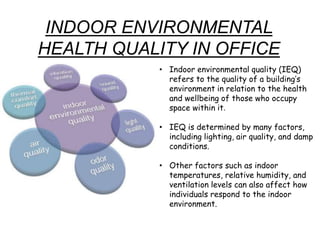
• Indoor environmental quality (IEQ)
refers to the quality of a building’s
environment in relation to the health
and wellbeing of those who occupy
space within it.
• IEQ is determined by many factors,
including lighting, air quality, and damp
conditions.
• Other factors such as indoor
temperatures, relative humidity, and
ventilation levels can also affect how
individuals respond to the indoor
environment.
INDOOR ENVIRONMENTAL
QUALITY (IEQ) IN OFFICES
APPLICATIONS AND SYSTEMS
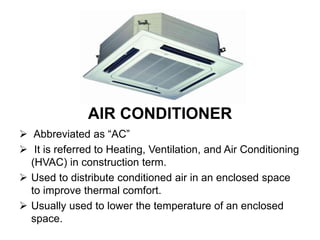
AIR CONDITIONER
 Abbreviated as “AC”
 It is referred to Heating, Ventilation, and Air Conditioning
(HVAC) in construction term.
 Used to distribute conditioned air in an enclosed space
to improve thermal comfort.
 Usually used to lower the temperature of an enclosed
space.
AIR CONDITIONER IN OFFICES
Why is it essential?
 Because most offices today are of high rise buildings,
therefore natural ventilation is impractical.
 Air conditioner can also control the humidity of an
enclosed space.
 Since humans perspire to provide natural cooling by the
evaporation of perspiration of the skin, drier air improves
the comfort provided.
AIR CONDITIONER IN OFFICES
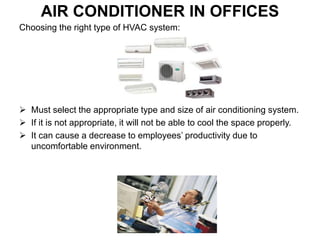
Choosing the right type of HVAC system:
 Must select the appropriate type and size of air conditioning system.
 If it is not appropriate, it will not be able to cool the space properly.
 It can cause a decrease to employees’ productivity due to
uncomfortable environment.
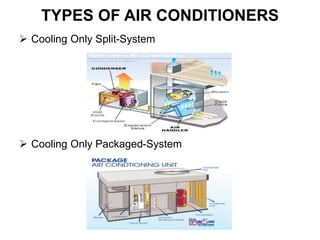
TYPES OF AIR CONDITIONERS
 Cooling Only Split-System
 Cooling Only Packaged-System
TYPES OF AIR CONDITIONERS
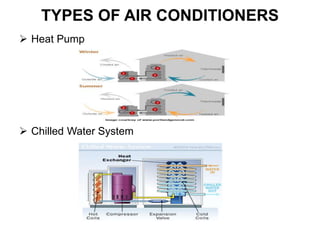
 Heat Pump
 Chilled Water System
TYPES OF AIR CONDITIONERS
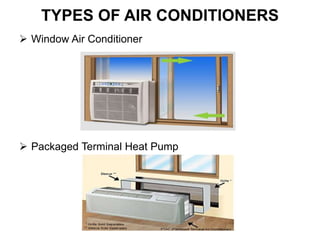
 Window Air Conditioner
 Packaged Terminal Heat Pump
SYSTEM OF AN AIR CONDITIONER
 Three (3) main parts of a standard air conditioner:
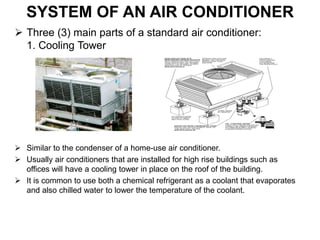
1. Cooling Tower
 Similar to the condenser of a home-use air conditioner.
 Usually air conditioners that are installed for high rise buildings such as
offices will have a cooling tower in place on the roof of the building.
 It is common to use both a chemical refrigerant as a coolant that evaporates
and also chilled water to lower the temperature of the coolant.
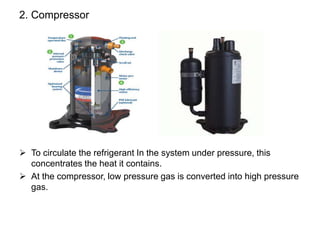
2. Compressor
 To circulate the refrigerant In the system under pressure, this
concentrates the heat it contains.
 At the compressor, low pressure gas is converted into high pressure
gas.
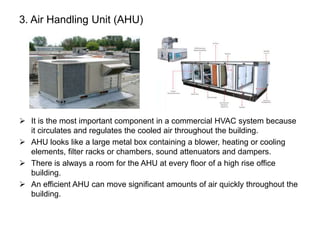
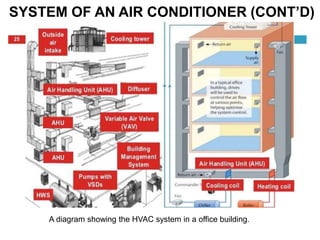
3. Air Handling Unit (AHU)
 It is the most important component in a commercial HVAC system because
it circulates and regulates the cooled air throughout the building.
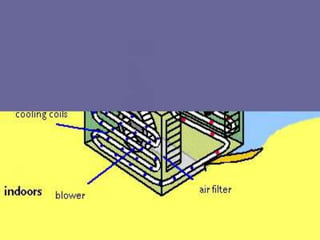
 AHU looks like a large metal box containing a blower, heating or cooling
elements, filter racks or chambers, sound attenuators and dampers.
 There is always a room for the AHU at every floor of a high rise office
building.
 An efficient AHU can move significant amounts of air quickly throughout the
building.
SYSTEM OF AN AIR CONDITIONER (CONT’D)
A diagram showing the HVAC system in a office building.
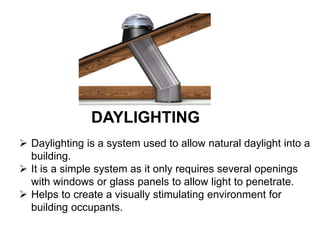
DAYLIGHTING
 Daylighting is a system used to allow natural daylight into a
building.
 It is a simple system as it only requires several openings
with windows or glass panels to allow light to penetrate.
 Helps to create a visually stimulating environment for
building occupants.
INTRODUCTION TO DAYLIGHTING (CONT’D)
 Daylighting can be used to substitute electrical lighting
during the day, therefore it can help to cut down one third
of total building energy costs.
 In order to create an effective daylighting system, the
location of windows or skylight has to be designed in
such a way to avoid direct admittance of direct sunlight
into occupants’ eyes.
 Blinds and shades can be used to minimize direct
sunlight that can affect the comfort of occupants in the
building.
 There are various types of daylighting systems but most
of the office buildings uses either tubular daylighting
device or horizontal daylighting system.
TUBULAR DAYLIGHTING DEVICE
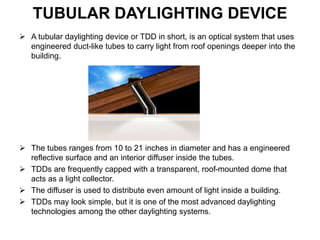
 A tubular daylighting device or TDD in short, is an optical system that uses
engineered duct-like tubes to carry light from roof openings deeper into the
building.
 The tubes ranges from 10 to 21 inches in diameter and has a engineered
reflective surface and an interior diffuser inside the tubes.
 TDDs are frequently capped with a transparent, roof-mounted dome that
acts as a light collector.
 The diffuser is used to distribute even amount of light inside a building.
 TDDs may look simple, but it is one of the most advanced daylighting
technologies among the other daylighting systems.
TUBULAR DAYLIGHTING DEVICE
(CONT’D)
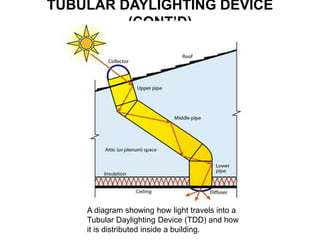
A diagram showing how light travels into a
Tubular Daylighting Device (TDD) and how
it is distributed inside a building.
HORIZONTAL DAYLIGHTING
SYSTEM This is a even more simple and traditional daylighting system.
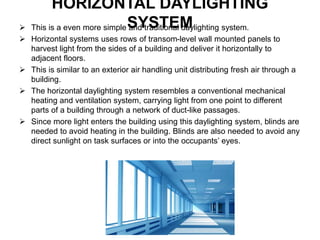
 Horizontal systems uses rows of transom-level wall mounted panels to
harvest light from the sides of a building and deliver it horizontally to
adjacent floors.
 This is similar to an exterior air handling unit distributing fresh air through a
building.
 The horizontal daylighting system resembles a conventional mechanical
heating and ventilation system, carrying light from one point to different
parts of a building through a network of duct-like passages.
 Since more light enters the building using this daylighting system, blinds are
needed to avoid heating in the building. Blinds are also needed to avoid any
direct sunlight on task surfaces or into the occupants’ eyes.
HORIZONTAL DAYLIGHTING SYSTEM (CONT’D
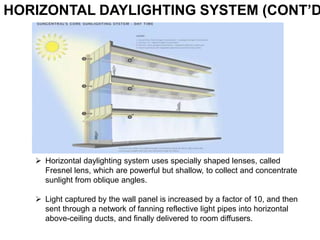
 Horizontal daylighting system uses specially shaped lenses, called
Fresnel lens, which are powerful but shallow, to collect and concentrate
sunlight from oblique angles.
 Light captured by the wall panel is increased by a factor of 10, and then
sent through a network of fanning reflective light pipes into horizontal
above-ceiling ducts, and finally delivered to room diffusers.
Installation
process
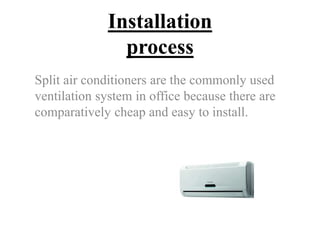
Split air conditioners are the commonly used
ventilation system in office because there are
comparatively cheap and easy to install.
Method 1 of 3: Install the
Indoor Unit
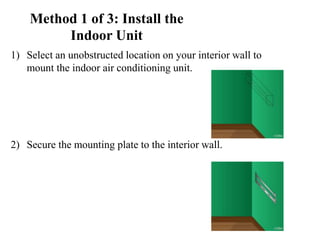
1) Select an unobstructed location on your interior wall to
mount the indoor air conditioning unit.
2) Secure the mounting plate to the interior wall.
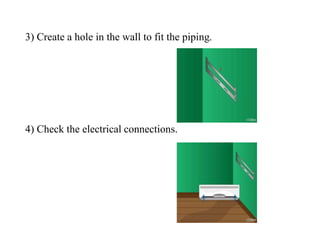
3) Create a hole in the wall to fit the piping.
4) Check the electrical connections.
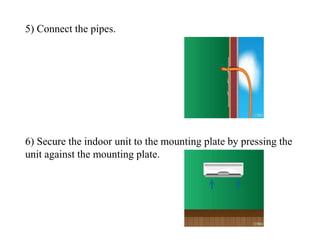
5) Connect the pipes.
6) Secure the indoor unit to the mounting plate by pressing the
unit against the mounting plate.
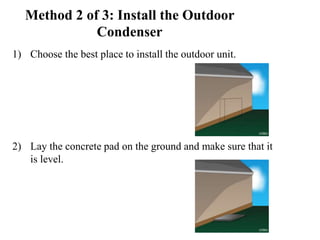
Method 2 of 3: Install the Outdoor
Condenser
1) Choose the best place to install the outdoor unit.
2) Lay the concrete pad on the ground and make sure that it
is level.
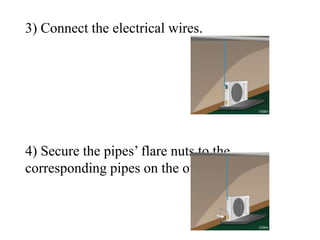
3) Connect the electrical wires.
4) Secure the pipes’ flare nuts to the
corresponding pipes on the outdoor unit.
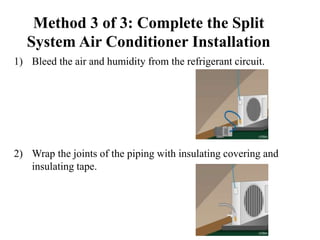
Method 3 of 3: Complete the Split
System Air Conditioner Installation
1) Bleed the air and humidity from the refrigerant circuit.
2) Wrap the joints of the piping with insulating covering and
insulating tape.
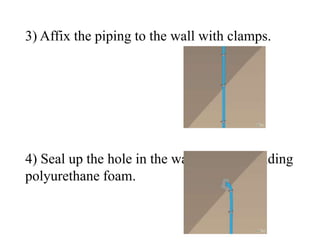
3) Affix the piping to the wall with clamps.
4) Seal up the hole in the wall using expanding
polyurethane foam.
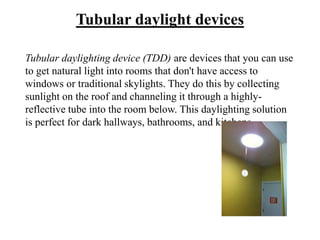
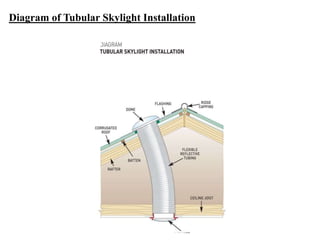
Tubular daylight devices
Tubular daylighting device (TDD) are devices that you can use
to get natural light into rooms that don't have access to
windows or traditional skylights. They do this by collecting
sunlight on the roof and channeling it through a highly-
reflective tube into the room below. This daylighting solution
is perfect for dark hallways, bathrooms, and kitchens.
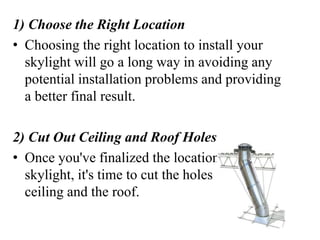
1) Choose the Right Location
• Choosing the right location to install your
skylight will go a long way in avoiding any
potential installation problems and providing
a better final result.
2) Cut Out Ceiling and Roof Holes
• Once you've finalized the location for your
skylight, it's time to cut the holes in the
ceiling and the roof.
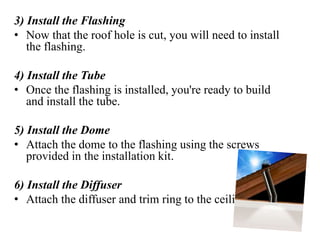
3) Install the Flashing
• Now that the roof hole is cut, you will need to install
the flashing.
4) Install the Tube
• Once the flashing is installed, you're ready to build
and install the tube.
5) Install the Dome
• Attach the dome to the flashing using the screws
provided in the installation kit.
6) Install the Diffuser
• Attach the diffuser and trim ring to the ceiling ring.
Diagram of Tubular Skylight Installation
PROBLEMS
Indoor environmental quality not
necessarily from air
• Noise
• Lightning
• Ergonomic stressors
• Job-related psychosocial stressors can
• Individually and combination
Problem
• Office operation intended to reduce short-
term costs will contribute the problem
• Lack use of walk mats at entrance- increase
amount of soil tracked
• Low-bid custodial service that fail to remove
soils and containment- increase the load of
volatile organic chemicals
• Renovation and remodeling can effect the
indoor environment
Negative effect on air quality
• Reducing the flow of outdoor ventilation air
• Shutting down HVAC system unoccupied
periods
• Select least expensive and least efficient panel
filters
Effective design and construction of
office
• Properly designed and constructed building
shell-isolates and insulates the indoors from
the outdoors
• Keeps outdoor containments such as dust and
liquid water enter the office
• Insulation in the office helps to protect the
interior temperature extremes
Well designed heating, ventilation and
air-conditioning (HVAC) system
• Provide clean outdoor air
• Modify and control indoor temperature
• Dilute general pollution from people,
activities, furnishings
• HVAC system-maintain correct air pressure
relationship between indoor and outdoor
Effective, prompt and preventive
maintenance
• Reduce the occurrence of problems with the
indoor environment
• Careful management of custodial, pest
control, building engineering and
maintenance service-prevent problem
Change the floor plan
• Moving walls or change in number and
distribution of people-may deviate from
intended design and operation of HVAC
system
• Short term problem maybe reduced
• Such as painting during unoccupied periods
and airing out carpets before installation
Pollutant source control
• Most cost-effective solution to IEQ problems
• Prohibit tobacco smoking in office
• Changing air pressure relationship will help to
isolate sources
• Good filtration help prevent outside pollution
pollen from entering the building
• Minimize the use of perfumes or colognes
• Do not do the activities such as cooking food
in microwave ovens
• May trigger a co-worker’s discomfort
• Chemical formulations should be used
sparingly-only when dedicated ventilation is
provided.
• Air supply diffusers should not be blocked or
taped closed
Case
Study
INDOOR ENVIRONMENTAL
QUALITY IN OFFICES
Indoor Environmental
Conditions
 In 2004, Professor Dr. Alan Hedge from Cornell University conducted a study at
Insurance Office of America’s headquarters in Orlando.
 Aim of study – To investigate the link between changes in physical environmental
conditions and changes in work performances
Methods
 The office were equipped with air samplers that recorded
the temperature every 15 minutes
 Tracked the productivity of 9 workers working in the
office
 Productivity was tracked by software that measure their
typing speed and error for 20 consecutive days
Result
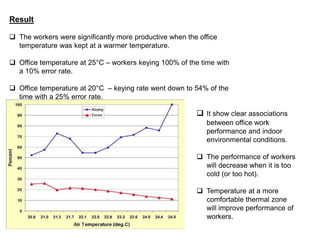
 The workers were significantly more productive when the office
temperature was kept at a warmer temperature.
 Office temperature at 25°C – workers keying 100% of the time with
a 10% error rate.
 Office temperature at 20°C – keying rate went down to 54% of the
time with a 25% error rate.
 It show clear associations
between office work
performance and indoor
environmental conditions.
 The performance of workers
will decrease when it is too
cold (or too hot).
 Temperature at a more
comfortable thermal zone
will improve performance of
workers.
Impact of Daylight
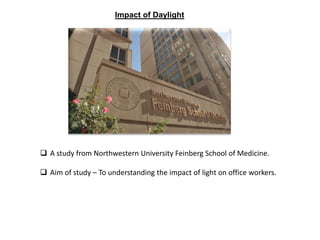
 A study from Northwestern University Feinberg School of Medicine.
 Aim of study – To understanding the impact of light on office workers.
Methods
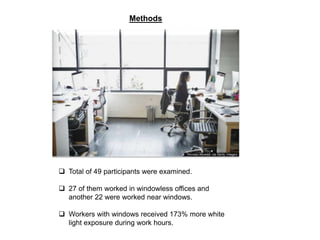
 Total of 49 participants were examined.
 27 of them worked in windowless offices and
another 22 were worked near windows.

 Workers with windows received 173% more white
light exposure during work hours.
Result
 Workers with windows in the workplace slept an average of 46 minutes
more per night than others who did not have the natural light exposure in
workplace.
 More physical activity than those without windows.
 Workers without windows had more sleep disturbances.
 May suffer memory loss, depression, slower psychomotor reflexes and
shorter attention spans.
 Daylight can improve office workers
productivity and health
Advantages and
Disadvantages
Advantages Disadvantages
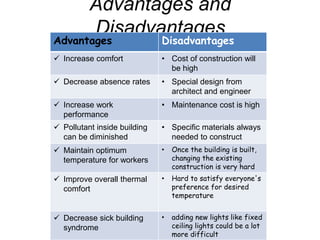
 Increase comfort • Cost of construction will
be high
 Decrease absence rates • Special design from
architect and engineer
 Increase work
performance
• Maintenance cost is high
 Pollutant inside building
can be diminished
• Specific materials always
needed to construct
 Maintain optimum
temperature for workers
• Once the building is built,
changing the existing
construction is very hard
 Improve overall thermal
comfort
• Hard to satisfy everyone's
preference for desired
temperature
 Decrease sick building
syndrome
• adding new lights like fixed
ceiling lights could be a lot
more difficult
THANK YOU

Ieq presentation

  • 1.
    BUILDING SERVICES I TOPIC:INDOOR ENVIRONMENTAL QUALITY IN OFFCIE / HEALTHCARE PREPARED BY: TAN KIAH CHUN (0324414) DARREN LOONG CHI YOONG (0318029) TAN ZHAO MING(0318724) KONG ZHEN CHUNG(0319528) YONG SING YEW(0318766) THAN LEK MEI (0315538)
  • 2.
    INDOOR ENVIRONMENTAL HEALTH QUALITYIN OFFICE • Indoor environmental quality (IEQ) refers to the quality of a building’s environment in relation to the health and wellbeing of those who occupy space within it. • IEQ is determined by many factors, including lighting, air quality, and damp conditions. • Other factors such as indoor temperatures, relative humidity, and ventilation levels can also affect how individuals respond to the indoor environment.
  • 3.
    INDOOR ENVIRONMENTAL QUALITY (IEQ)IN OFFICES APPLICATIONS AND SYSTEMS
  • 4.
    AIR CONDITIONER  Abbreviatedas “AC”  It is referred to Heating, Ventilation, and Air Conditioning (HVAC) in construction term.  Used to distribute conditioned air in an enclosed space to improve thermal comfort.  Usually used to lower the temperature of an enclosed space.
  • 5.
    AIR CONDITIONER INOFFICES Why is it essential?  Because most offices today are of high rise buildings, therefore natural ventilation is impractical.  Air conditioner can also control the humidity of an enclosed space.  Since humans perspire to provide natural cooling by the evaporation of perspiration of the skin, drier air improves the comfort provided.
  • 6.
    AIR CONDITIONER INOFFICES Choosing the right type of HVAC system:  Must select the appropriate type and size of air conditioning system.  If it is not appropriate, it will not be able to cool the space properly.  It can cause a decrease to employees’ productivity due to uncomfortable environment.
  • 7.
    TYPES OF AIRCONDITIONERS  Cooling Only Split-System  Cooling Only Packaged-System
  • 8.
    TYPES OF AIRCONDITIONERS  Heat Pump  Chilled Water System
  • 9.
    TYPES OF AIRCONDITIONERS  Window Air Conditioner  Packaged Terminal Heat Pump
  • 10.
    SYSTEM OF ANAIR CONDITIONER  Three (3) main parts of a standard air conditioner: 1. Cooling Tower  Similar to the condenser of a home-use air conditioner.  Usually air conditioners that are installed for high rise buildings such as offices will have a cooling tower in place on the roof of the building.  It is common to use both a chemical refrigerant as a coolant that evaporates and also chilled water to lower the temperature of the coolant.
  • 11.
    2. Compressor  Tocirculate the refrigerant In the system under pressure, this concentrates the heat it contains.  At the compressor, low pressure gas is converted into high pressure gas.
  • 12.
    3. Air HandlingUnit (AHU)  It is the most important component in a commercial HVAC system because it circulates and regulates the cooled air throughout the building.  AHU looks like a large metal box containing a blower, heating or cooling elements, filter racks or chambers, sound attenuators and dampers.  There is always a room for the AHU at every floor of a high rise office building.  An efficient AHU can move significant amounts of air quickly throughout the building.
  • 13.
    SYSTEM OF ANAIR CONDITIONER (CONT’D) A diagram showing the HVAC system in a office building.
  • 15.
    DAYLIGHTING  Daylighting isa system used to allow natural daylight into a building.  It is a simple system as it only requires several openings with windows or glass panels to allow light to penetrate.  Helps to create a visually stimulating environment for building occupants.
  • 16.
    INTRODUCTION TO DAYLIGHTING(CONT’D)  Daylighting can be used to substitute electrical lighting during the day, therefore it can help to cut down one third of total building energy costs.  In order to create an effective daylighting system, the location of windows or skylight has to be designed in such a way to avoid direct admittance of direct sunlight into occupants’ eyes.  Blinds and shades can be used to minimize direct sunlight that can affect the comfort of occupants in the building.  There are various types of daylighting systems but most of the office buildings uses either tubular daylighting device or horizontal daylighting system.
  • 17.
    TUBULAR DAYLIGHTING DEVICE A tubular daylighting device or TDD in short, is an optical system that uses engineered duct-like tubes to carry light from roof openings deeper into the building.  The tubes ranges from 10 to 21 inches in diameter and has a engineered reflective surface and an interior diffuser inside the tubes.  TDDs are frequently capped with a transparent, roof-mounted dome that acts as a light collector.  The diffuser is used to distribute even amount of light inside a building.  TDDs may look simple, but it is one of the most advanced daylighting technologies among the other daylighting systems.
  • 18.
    TUBULAR DAYLIGHTING DEVICE (CONT’D) Adiagram showing how light travels into a Tubular Daylighting Device (TDD) and how it is distributed inside a building.
  • 19.
    HORIZONTAL DAYLIGHTING SYSTEM Thisis a even more simple and traditional daylighting system.  Horizontal systems uses rows of transom-level wall mounted panels to harvest light from the sides of a building and deliver it horizontally to adjacent floors.  This is similar to an exterior air handling unit distributing fresh air through a building.  The horizontal daylighting system resembles a conventional mechanical heating and ventilation system, carrying light from one point to different parts of a building through a network of duct-like passages.  Since more light enters the building using this daylighting system, blinds are needed to avoid heating in the building. Blinds are also needed to avoid any direct sunlight on task surfaces or into the occupants’ eyes.
  • 20.
    HORIZONTAL DAYLIGHTING SYSTEM(CONT’D  Horizontal daylighting system uses specially shaped lenses, called Fresnel lens, which are powerful but shallow, to collect and concentrate sunlight from oblique angles.  Light captured by the wall panel is increased by a factor of 10, and then sent through a network of fanning reflective light pipes into horizontal above-ceiling ducts, and finally delivered to room diffusers.
  • 21.
    Installation process Split air conditionersare the commonly used ventilation system in office because there are comparatively cheap and easy to install.
  • 22.
    Method 1 of3: Install the Indoor Unit 1) Select an unobstructed location on your interior wall to mount the indoor air conditioning unit. 2) Secure the mounting plate to the interior wall.
  • 23.
    3) Create ahole in the wall to fit the piping. 4) Check the electrical connections.
  • 24.
    5) Connect thepipes. 6) Secure the indoor unit to the mounting plate by pressing the unit against the mounting plate.
  • 25.
    Method 2 of3: Install the Outdoor Condenser 1) Choose the best place to install the outdoor unit. 2) Lay the concrete pad on the ground and make sure that it is level.
  • 26.
    3) Connect theelectrical wires. 4) Secure the pipes’ flare nuts to the corresponding pipes on the outdoor unit.
  • 27.
    Method 3 of3: Complete the Split System Air Conditioner Installation 1) Bleed the air and humidity from the refrigerant circuit. 2) Wrap the joints of the piping with insulating covering and insulating tape.
  • 28.
    3) Affix thepiping to the wall with clamps. 4) Seal up the hole in the wall using expanding polyurethane foam.
  • 29.
    Tubular daylight devices Tubulardaylighting device (TDD) are devices that you can use to get natural light into rooms that don't have access to windows or traditional skylights. They do this by collecting sunlight on the roof and channeling it through a highly- reflective tube into the room below. This daylighting solution is perfect for dark hallways, bathrooms, and kitchens.
  • 30.
    1) Choose theRight Location • Choosing the right location to install your skylight will go a long way in avoiding any potential installation problems and providing a better final result. 2) Cut Out Ceiling and Roof Holes • Once you've finalized the location for your skylight, it's time to cut the holes in the ceiling and the roof.
  • 31.
    3) Install theFlashing • Now that the roof hole is cut, you will need to install the flashing. 4) Install the Tube • Once the flashing is installed, you're ready to build and install the tube. 5) Install the Dome • Attach the dome to the flashing using the screws provided in the installation kit. 6) Install the Diffuser • Attach the diffuser and trim ring to the ceiling ring.
  • 32.
    Diagram of TubularSkylight Installation
  • 34.
  • 35.
    Indoor environmental qualitynot necessarily from air • Noise • Lightning • Ergonomic stressors • Job-related psychosocial stressors can • Individually and combination
  • 36.
    Problem • Office operationintended to reduce short- term costs will contribute the problem • Lack use of walk mats at entrance- increase amount of soil tracked • Low-bid custodial service that fail to remove soils and containment- increase the load of volatile organic chemicals • Renovation and remodeling can effect the indoor environment
  • 37.
    Negative effect onair quality • Reducing the flow of outdoor ventilation air • Shutting down HVAC system unoccupied periods • Select least expensive and least efficient panel filters
  • 39.
    Effective design andconstruction of office • Properly designed and constructed building shell-isolates and insulates the indoors from the outdoors • Keeps outdoor containments such as dust and liquid water enter the office • Insulation in the office helps to protect the interior temperature extremes
  • 40.
    Well designed heating,ventilation and air-conditioning (HVAC) system • Provide clean outdoor air • Modify and control indoor temperature • Dilute general pollution from people, activities, furnishings • HVAC system-maintain correct air pressure relationship between indoor and outdoor
  • 41.
    Effective, prompt andpreventive maintenance • Reduce the occurrence of problems with the indoor environment • Careful management of custodial, pest control, building engineering and maintenance service-prevent problem
  • 42.
    Change the floorplan • Moving walls or change in number and distribution of people-may deviate from intended design and operation of HVAC system • Short term problem maybe reduced • Such as painting during unoccupied periods and airing out carpets before installation
  • 43.
    Pollutant source control •Most cost-effective solution to IEQ problems • Prohibit tobacco smoking in office • Changing air pressure relationship will help to isolate sources • Good filtration help prevent outside pollution pollen from entering the building
  • 44.
    • Minimize theuse of perfumes or colognes • Do not do the activities such as cooking food in microwave ovens • May trigger a co-worker’s discomfort • Chemical formulations should be used sparingly-only when dedicated ventilation is provided. • Air supply diffusers should not be blocked or taped closed
  • 45.
  • 46.
    Indoor Environmental Conditions  In2004, Professor Dr. Alan Hedge from Cornell University conducted a study at Insurance Office of America’s headquarters in Orlando.  Aim of study – To investigate the link between changes in physical environmental conditions and changes in work performances
  • 47.
    Methods  The officewere equipped with air samplers that recorded the temperature every 15 minutes  Tracked the productivity of 9 workers working in the office  Productivity was tracked by software that measure their typing speed and error for 20 consecutive days
  • 48.
    Result  The workerswere significantly more productive when the office temperature was kept at a warmer temperature.  Office temperature at 25°C – workers keying 100% of the time with a 10% error rate.  Office temperature at 20°C – keying rate went down to 54% of the time with a 25% error rate.  It show clear associations between office work performance and indoor environmental conditions.  The performance of workers will decrease when it is too cold (or too hot).  Temperature at a more comfortable thermal zone will improve performance of workers.
  • 49.
    Impact of Daylight A study from Northwestern University Feinberg School of Medicine.  Aim of study – To understanding the impact of light on office workers.
  • 50.
    Methods  Total of49 participants were examined.  27 of them worked in windowless offices and another 22 were worked near windows.  Workers with windows received 173% more white light exposure during work hours.
  • 51.
    Result  Workers withwindows in the workplace slept an average of 46 minutes more per night than others who did not have the natural light exposure in workplace.  More physical activity than those without windows.  Workers without windows had more sleep disturbances.  May suffer memory loss, depression, slower psychomotor reflexes and shorter attention spans.  Daylight can improve office workers productivity and health
  • 52.
    Advantages and Disadvantages Advantages Disadvantages Increase comfort • Cost of construction will be high  Decrease absence rates • Special design from architect and engineer  Increase work performance • Maintenance cost is high  Pollutant inside building can be diminished • Specific materials always needed to construct  Maintain optimum temperature for workers • Once the building is built, changing the existing construction is very hard  Improve overall thermal comfort • Hard to satisfy everyone's preference for desired temperature  Decrease sick building syndrome • adding new lights like fixed ceiling lights could be a lot more difficult
  • 53.