UNDERSTANDING
COMPREHENSION
WHAT IS COMPREHENSION
01
02
03
04
Comprehension, or extracting meaning from what you read, is the
ultimate goal of reading. Experienced readers take this for granted
and may not appreciate the reading comprehension skills
required. The process of comprehension is both interactive and
strategic. Rather than passively reading text, readers must analyze
it, internalize it and make it their own.
In order to read with comprehension, developing readers must be
able to read with some proficiency and then receive explicit
instruction in reading comprehension strategies (Tierney, 1982)
Comprehension:
The Goal of Reading
General
Strategies
for Reading
Comprehension
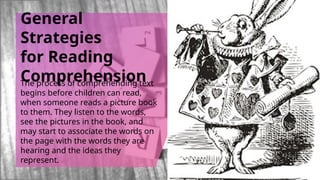
The process of comprehending text
begins before children can read,
when someone reads a picture book
to them. They listen to the words,
see the pictures in the book, and
may start to associate the words on
the page with the words they are
hearing and the ideas they
represent.
Using Prior Knowledge/Previewing
When students preview text, they tap into what they already know
that will help them to understand the text they are about to read.
This provides a framework for any new information they read.
Predicting
When students make predictions about the text they are about to
read, it sets up expectations based on their prior knowledge about
similar topics. As they read, they may mentally revise their
prediction as they gain more information.
Identifying the Main Idea and Summarization
Identifying the main idea and summarizing requires that students
determine what is important and then put it in their own words.
Implicit in this process is trying to understand the author’s
purpose in writing the text.
Questioning
Asking and answering questions about text is another strategy
that helps students focus on the meaning of text. Teachers can
help by modeling both the process of asking good questions and
strategies for finding the answers in the text.
Making Inferences
In order to make inferences about something that is not explicitly
stated in the text, students must learn to draw on prior knowledge
and recognize clues in the text itself.
Visualizing
Studies have shown that students who visualize while reading
have better recall than those who do not (Pressley, 1977). Readers
can take advantage of illustrations that are embedded in the text
or create their own mental images or drawings when reading text
without illustrations.
Strategies for Reading Comprehension: Expository Text
Expository text explains facts and concepts in order to inform, persuade, or
explain.
The Structure of Expository Text
Expository text is typically structured with visual cues such as headings and
subheadings that provide clear cues as to the structure of the information. The
first sentence in a paragraph is also typically a topic sentence that clearly
states what the paragraph is about.
Expository text also often uses one of five common text structures as an
organizing principle:
• Cause and effect
• Problem and solution
• Compare and contrast
• Description
• Time order (sequence of events, actions, or steps)
Strategies for Reading
Comprehension: Narrative Text
Narrative text tells a story, either a true story or a fictional story. There are
a number of strategies that will help students understand narrative text.
Story Maps
Teachers can have students diagram the story grammar of the text to raise
their awareness of the elements the author uses to construct the story.
Story grammar includes:
•Setting: When and where the story takes place (which can change over
the course of the story).
•Characters: The people or animals in the story, including the protagonist
(main character), whose motivations and actions drive the story.
•Plot: The story line, which typically includes one or more problems or
conflicts that the protagonist must address and ultimately resolve.
•Theme: The overriding lesson or main idea that the author wants readers
to glean from the story. It could be explicitly stated as in Aesop’s Fables or
inferred by the reader
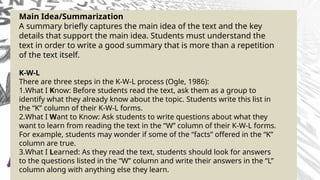
Main Idea/Summarization
A summary briefly captures the main idea of the text and the key
details that support the main idea. Students must understand the
text in order to write a good summary that is more than a repetition
of the text itself.
K-W-L
There are three steps in the K-W-L process (Ogle, 1986):
1.What I Know: Before students read the text, ask them as a group to
identify what they already know about the topic. Students write this list in
the “K” column of their K-W-L forms.
2.What I Want to Know: Ask students to write questions about what they
want to learn from reading the text in the “W” column of their K-W-L forms.
For example, students may wonder if some of the “facts” offered in the “K”
column are true.
3.What I Learned: As they read the text, students should look for answers
to the questions listed in the “W” column and write their answers in the “L”
column along with anything else they learn.
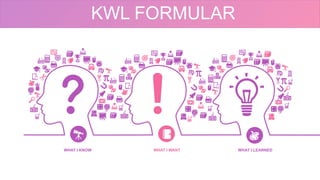
KWL FORMULAR
WHAT I KNOW WHAT I WANT WHAT I LEARNED
PPT Professional
LET’S
PRACTICE
DO THIS…
Any Question…
Contents Here
Contents Here
Contents Here
Contents Here
Contents Here

reading and Understanding comprehension.pptx

  • 1.
  • 2.
  • 3.
    Comprehension, or extractingmeaning from what you read, is the ultimate goal of reading. Experienced readers take this for granted and may not appreciate the reading comprehension skills required. The process of comprehension is both interactive and strategic. Rather than passively reading text, readers must analyze it, internalize it and make it their own. In order to read with comprehension, developing readers must be able to read with some proficiency and then receive explicit instruction in reading comprehension strategies (Tierney, 1982) Comprehension: The Goal of Reading
  • 4.
    General Strategies for Reading Comprehension The processof comprehending text begins before children can read, when someone reads a picture book to them. They listen to the words, see the pictures in the book, and may start to associate the words on the page with the words they are hearing and the ideas they represent.
  • 5.
    Using Prior Knowledge/Previewing Whenstudents preview text, they tap into what they already know that will help them to understand the text they are about to read. This provides a framework for any new information they read. Predicting When students make predictions about the text they are about to read, it sets up expectations based on their prior knowledge about similar topics. As they read, they may mentally revise their prediction as they gain more information. Identifying the Main Idea and Summarization Identifying the main idea and summarizing requires that students determine what is important and then put it in their own words. Implicit in this process is trying to understand the author’s purpose in writing the text.
  • 6.
    Questioning Asking and answeringquestions about text is another strategy that helps students focus on the meaning of text. Teachers can help by modeling both the process of asking good questions and strategies for finding the answers in the text. Making Inferences In order to make inferences about something that is not explicitly stated in the text, students must learn to draw on prior knowledge and recognize clues in the text itself. Visualizing Studies have shown that students who visualize while reading have better recall than those who do not (Pressley, 1977). Readers can take advantage of illustrations that are embedded in the text or create their own mental images or drawings when reading text without illustrations.
  • 7.
    Strategies for ReadingComprehension: Expository Text Expository text explains facts and concepts in order to inform, persuade, or explain. The Structure of Expository Text Expository text is typically structured with visual cues such as headings and subheadings that provide clear cues as to the structure of the information. The first sentence in a paragraph is also typically a topic sentence that clearly states what the paragraph is about. Expository text also often uses one of five common text structures as an organizing principle: • Cause and effect • Problem and solution • Compare and contrast • Description • Time order (sequence of events, actions, or steps)
  • 8.
    Strategies for Reading Comprehension:Narrative Text Narrative text tells a story, either a true story or a fictional story. There are a number of strategies that will help students understand narrative text. Story Maps Teachers can have students diagram the story grammar of the text to raise their awareness of the elements the author uses to construct the story. Story grammar includes: •Setting: When and where the story takes place (which can change over the course of the story). •Characters: The people or animals in the story, including the protagonist (main character), whose motivations and actions drive the story. •Plot: The story line, which typically includes one or more problems or conflicts that the protagonist must address and ultimately resolve. •Theme: The overriding lesson or main idea that the author wants readers to glean from the story. It could be explicitly stated as in Aesop’s Fables or inferred by the reader
  • 9.
    Main Idea/Summarization A summarybriefly captures the main idea of the text and the key details that support the main idea. Students must understand the text in order to write a good summary that is more than a repetition of the text itself. K-W-L There are three steps in the K-W-L process (Ogle, 1986): 1.What I Know: Before students read the text, ask them as a group to identify what they already know about the topic. Students write this list in the “K” column of their K-W-L forms. 2.What I Want to Know: Ask students to write questions about what they want to learn from reading the text in the “W” column of their K-W-L forms. For example, students may wonder if some of the “facts” offered in the “K” column are true. 3.What I Learned: As they read the text, students should look for answers to the questions listed in the “W” column and write their answers in the “L” column along with anything else they learn.
  • 10.
    KWL FORMULAR WHAT IKNOW WHAT I WANT WHAT I LEARNED
  • 11.
  • 12.
  • 13.
    Any Question… Contents Here ContentsHere Contents Here Contents Here Contents Here