280 281
LithosLithos
CaroltwomblyTaraCook
Photoby:Carter,Sebastian.TwentiethCenturyTypeDesigners:SebastianCarter.Aldershot:Lund
Humphries,2002.Print.
“Text families have so many characters and
require such attention to detail. They can
be both tedious and exhausting to create.
I like display designs better. They’re more
spontaneous and fun to work on.”
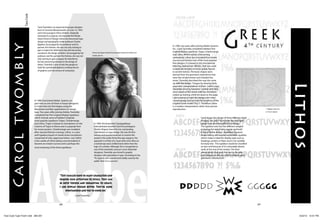
Carol Twombly is an award-winning type designer
born in Concord, Massachusetts, on June 13, 1959
and is the youngest of five children. Originally
interested in sculpture, she attended the Rhode
Island School of Design where she discovered type
design and typography under professor Charles
Bigelow. Encouraged by her professor and his
partner, Kris Holmes, she was not only starting to
gain a respect for letterforms but also becoming
involved in the design of letters. Encouraged by her
professor and his partner, Kris Holmes, she was not
only starting to gain a respect for letterforms
but also becoming involved in the design of
letters. Twombly is one of only five people to
hold this specialized diploma combing the art
of graphics and the science of computers.
In 1988 Carol joined Adobe Systems, Inc.
part-time as one of three in-house designers.
It is here that she first began using the
Macintosh and Mac applications to design
type. Two years after joining Adobe, Twombly
completed her first original display typefaces
which include some of Adobe’s Originals
most popular typefaces: Trajan, Charlemange
and Lithos. Trajan is based on inscriptions on the
Column of Trajan in Rome and is a popular font
for movie posters. Charlemange was modeled
after classical Roman carvings. Lithos is a sans
serif typeface based on Greek stone inscriptions
comprised of only uppercase letters. Just within
a few weeks of Lithos being commercialized, it
became an instant success and is perhaps the
most enduring of the three typefaces.
In 1994, the Association Typographique
Internationale awarded Carol the prestigious
Charles Peignot Award for her outstanding
contribution to type design. She was the first
woman and second American to receive this
award in the under thirty-five age category. Her
approach is of that of a visual artist who relies on
a trained eye and a skilled hand rather than the
logic of a scholar. Although she is recognized as
one of the twentieth century’s most influential
designers, Twombly sees herself a graphic
designer who specializes in type. According to her,
“If a type is well-received and widely used by the
public then it is a success.”
In 1990, two years after joining Adobe Systems
Inc., Carol Twombly completed Adobe’s first
original display typefaces: Trajan, Charlemange
and Lithos. Within weeks of becoming
commercial, Lithos was considered an instant
success and remains one of her most popular
font designs. It is based on the inscriptional
lettering, dating from 400 B.C, that was used
to dedicate temples or honor public figures
in ancient Greece. The basic shapes were
derived from the geometric letterforms that
were free of adornment and chiseled into
stone. Twombly described the way she came
up with the design,“I began by drawing fairly
geometric interpretations of them. I didn’t copy
the letters directly, however I started with fairly
close copies of the Greek stuff, but the letters
ended up looking a little bit dead on the page.
I also wanted to make the design a bit more
contemporary but not lose the simplicity of the
original Greek model.”(Fig 1) Therefore Lithos
is a modern interpretation rather than precise
reproduction.
Carol began the design of three different initial
weights, she said“I found that the extralight
weight was the most difficult to design.”
The typeface now has five different weights
including the initial light, regular and bold.
It has a flexible design, simplified character
shapes along with playful asymmetric qualities
which makes it ideal for display type such as
headings, posters or flyers and is not suitable
for body text. This typeface would be classified
as sans serif because of it’s noticeably absent
serifs at the end of the strokes. The final
characteristic that puts this font in the sans
serif category is the fact that it is based upon
geometric construction.
1. Digital copy of a
Lithos sketch
- Carol Twombly
Tara Cook Type Final1.indd 280-281Tara Cook Type Final1.indd 280-281 5/22/12 12:51 PM5/22/12 12:51 PM
MBLYTWOMY
WOMBLYTWY
AROL CARoLL CL
TWOMBlYTwY
CAROLCAROL
ROLCAROLL CAL
OMBLYTWOY
LCAROLCAROL
OLCAROLCARL
CAROLTWOMBLY
ADOBE TYPE DESIGNERa b c d e f g h i j k l m n o p q r s t u v w x y z
CCCCCAAAAAROLLLLTTTTTWOMBLY
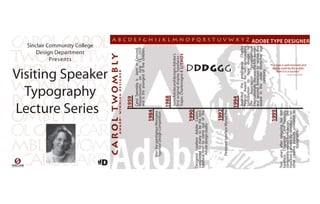
CarolTwomblyisborninConcord,
Massachusetts,onJune13,1959
andistheyoungestoffivechildren.
1959
1988
1990
JoinsAdobeanddesignsAdobe’s
firstoriginaldisplaytypefaces-
Trajan,Charlemagne&LITHOS
AwardedtheprestigiousCharles
PeignotAwardforheroutstanding
contributiontotypedesignby
TheAssociationTypographique
Internationale.Shewasthefirstwoman
andsecondAmericantoreceivethis
awardintheunderthirty-fiveage
category.
1992
DesignedtypefaceAdobeCaslon,
consideredbymanytobethebest
typefaceevertocomeoutofthe
Adobedesignstudio
1994
DesignedtypefaceMyriadPro
“If a type is well-received and
widely used by the public
then it is a success.”
- Carol Twombly
DDD
1999
Twoyearsafterreleasingherlast
typeface,Chaparral,CarolTwombly
completelyretiredfromdesign.She
nowlivesaprivatelifedevotedtoher
othercreativepursuitsunrelatedto
typography.
1984
WontheprestigiousMorisawa
TypefaceDesignCompetition
award-winningdesigner
GGG
Sinclair Community College
Design Department
Presents
Visiting Speaker
Typography
Lecture Seriess
MBLYTWOMY
WOMBLYTWY
AROL CARoLL CL
TWOMBlYTwY
CAROLCAROL
ROLCAROLL CAL
OMBLYTWOY
LCAROLCAROL
OLCAROLCARL
ADMISSION
IS
FREE!!!!
OPEN
TOPUBLIC!!!!
Questions?
(937) 512 - 4505
When: Friday, June 15, 2012 7:00 pm
Where: Blair Hall Theatre
Building 2
Sinclair Community College
444 West Third Street
Dayton, OH 45402
Table of Contents
Chapter 1 . . . . . . . . . . . . . . . . . . . . . . B1
Chapter 2 . . . . . . . . . . . . . . . . . . . . . . C1,D1
Chapter 3 . . . . . . . . . . . . . . . . . . . . . . E1
Chapter 4 . . . . . . . . . . . . . . . . . . . . . . F1
Glossary . . . . . . . . . . . . . . . . . . . . . . . G1,H1
Index . . . . . . . . . . . . . . . . . . . . . . . . . . I1
Colophon . . . . . . . . . . . . . . . . . . . . . . . J1
Introduction . . . . . . . . . . . . . . . . . . . . A1
The Legibility Of Typelinda reynoldsDedicated to Jackie Brewer
All rights reserved. No part of the contents of this book may be reproduced or transmitted in any form or by any means, electronic,
photocopying, recording, or otherwise, without the written permission of the publisher. Library of Congress Cataloging-in-Publication
Data: Reynolds, Linda. The Legibility of Type.
A1
Copyright 2010 by Linda Reynolds
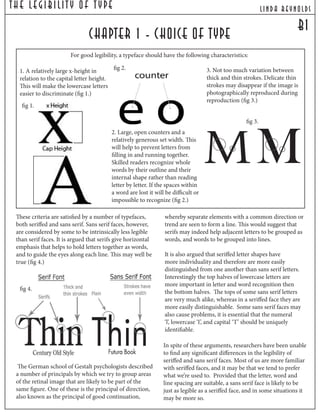
What makes type legible? This is often dismissed as merely a mater of common sense, but if common sense is all
that is needed, why is it that some of the basic rules for good legibility are so frequently flouted? True, legibility
may not always be the first consideration, but for words that are intended to be read it cannot be ignored.
It has never been difficult to find examples of illegibillity of various kinds, but examples are abound now that desktop
publishing systems have brought electronic typesetting within reach of those with little or no knowledge of basic
design principals. Legibility as an issue is perhaps more important than ever before, some of the most important factors
effecting it are outlined below.
The Legibilit y Of T ype lind a reynolds
b1
1. A relatively large x-height in
relation to the capital letter height.
This will make the lowercase letters
easier to discriminate (fig 1.)
2. Large, open counters and a
relatively generous set width. This
will help to prevent letters from
filling in and running together.
Skilled readers recognize whole
words by their outline and their
internal shape rather than reading
letter by letter. If the spaces within
a word are lost it will be difficult or
impossible to recognize (fig 2.)
For good legibility, a typeface should have the following characteristics:
3. Not too much variation between
thick and thin strokes. Delicate thin
strokes may disappear if the image is
photographically reproduced during
reproduction (fig 3.)
fig 1.
fig 2.
fig 3.
These criteria are satisfied by a number of typefaces,
both seriffed and sans serif. Sans serif faces, however,
are considered by some to be intrinsically less legible
than serif faces. It is argued that serifs give horizontal
emphasis that helps to hold letters together as words,
and to guide the eyes along each line. This may well be
true (fig 4.)
fig 4.
The German school of Gestalt psychologists described
a number of principals by which we try to group areas
of the retinal image that are likely to be part of the
same figure. One of these is the principal of direction,
also known as the principal of good continuation,
whereby separate elements with a common direction or
trend are seen to form a line. This would suggest that
serifs may indeed help adjacent letters to be grouped as
words, and words to be grouped into lines.
It is also argued that seriffed letter shapes have
more individuality and therefore are more easily
distinguished from one another than sans serif letters.
Interestingly the top halves of lowercase letters are
more important in letter and word recognition then
the bottom halves. The tops of some sans serif letters
are very much alike, whereas in a seriffed face they are
more easily distinguishable. Some sans serif faces may
also cause problems, it is essential that the numeral
‘l’, lowercase ‘I’, and capital ‘T’ should be uniquely
identifiable.
In spite of these arguments, researchers have been unable
to find any significant differences in the legibility of
seriffed and sans serif faces. Most of us are more familiar
with seriffed faces, and it may be that we tend to prefer
what we’re used to. Provided that the letter, word and
line spacing are suitable, a sans serif face is likely to be
just as legible as a seriffed face, and in some situations it
may be more so.
chapter 1 - choice of type
c1
chapter 2 - variations in letterform
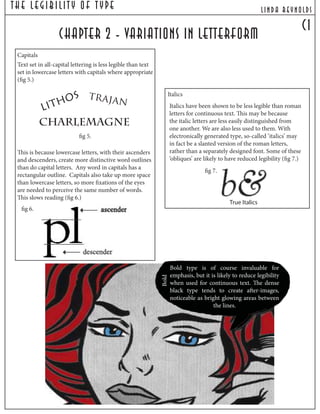
Capitals
Text set in all-capital lettering is less legible than text
set in lowercase letters with capitals where appropriate
(fig 5.)
This is because lowercase letters, with their ascenders
and descenders, create more distinctive word outlines
than do capital letters. Any word in capitals has a
rectangular outline. Capitals also take up more space
than lowercase letters, so more fixations of the eyes
are needed to perceive the same number of words.
This slows reading (fig 6.)
LITHOS
Charlemagne
trajan
fig 5.
fig 6.
Italics
Italics have been shown to be less legible than roman
letters for continuous text. This may be because
the italic letters are less easily distinguished from
one another. We are also less used to them. With
electronically generated type, so-called ‘italics’ may
in fact be a slanted version of the roman letters,
rather than a separately designed font. Some of these
‘obliques’ are likely to have reduced legibility (fig 7.)
fig 7.
Bold
Bold type is of course invaluable for
emphasis, but it is likely to reduce legibility
when used for continuous text. The dense
black type tends to create after-images,
noticeable as bright glowing areas between
the lines.
lind a reynoldsThe Legibilit y Of T ype
True Italics
The Legibilit y Of T ype lind a reynolds
d1
chapter 2 - variations in letterform [cont.]
Condensed & Extended Type
The danger with condensed
styles is that the letters will either
apparently or actually fill in
and run together. The standard
of reproduction needs to be
high to ensure good legibility.
Extended styles reduce the
number of words that can be read
at each fixation. Normal letter
proportions can be distorted very
easily in electronic typesetting
systems, with predictably illegible
results in many cases.
Type Size
If the type is too small, letters and word will be difficult
to discriminate. If it is too large, less words will be
perceived at each fixation. For a normal reading distance
of 12-15 in, the optimum type size for continuous text
is usually somewhere between 9pt and 11pt, depending
on the x-height of the typeface and the circumstances in
which the material will be used.
one point = 1/72 inch
one pica = 12 points
one inch = 6 picas or 72 points
Ex.
extended
condensed
Ex.
The Legibilit y Of T ype lind a reynolds
e1
chapter 3 - the arrangement of type on the page
Word Spacing
The space between words must of course be
perceptively greater than the space between letters
within a word. The Gestalt principle of grouping
by ‘proximity’ is at work here. However, the
spacing must not be so great that the horizontal
emphasis, or ‘good continuation’ of the line is
destroyed. Optimum word spacing will therefore
depend on both letter spacing and line spacing.
Line Spacing
For ease of reading, words must be grouped into
lines that the eyes can follow easily. The white
space between lines must therefore be greater than
the word spacing. For continuous text it is almost
always an advantage to use a linefeed one or two
points greater than the point size of the type. This
is especially true for line lengths approaching the
upper limit for good legibility, for typefaces with a
strong vertical emphasis (this would include most
sans serifs and modern seriffed faces) and for faces
with a relatively large x-height. If too much space
is added however, the lines will appear to drift
apart and the text will appear lighter in color.
Line Length
Line length is a very important factor in legibility.
If the lines are too short, we are unable to make
efficient use of our peripheral vision and the normal
pattern of eye movements is disrupted. If the lines
are too long, it is difficult for the eyes to make a
smooth and accurate ‘backsweep’ to the beginning
of each new line. We may miss lines or begin reading
the same line again (‘doubling’). The optimum line
length for continuous reading is between about 60
and 65 characters and spaces. Lines of more than 70
characters and spaces will reduce legibility and may
be consciously perceived as being an effort to read.
The minimum line length for comfort is probably
about 40 characters and spaces.
Justified & Unjustified Setting
Line length is a very important factor in legibility.
If the lines are too short, we are unable to make
efficient use of our peripheral vision and the normal
pattern of eye movements is disrupted. If the lines
are too long, it is difficult for the eyes to make a
smooth and accurate ‘backsweep’ to the beginning
of each new line. We may miss lines or begin reading
the same line again (‘doubling’). The optimum line
length for continuous reading is between about 60
and 65 characters and spaces. Lines of more than 70
characters and spaces will reduce legibility and may
be consciously perceived as being an effort to read.
The minimum line length for comfort is probably
about 40 characters and spaces.
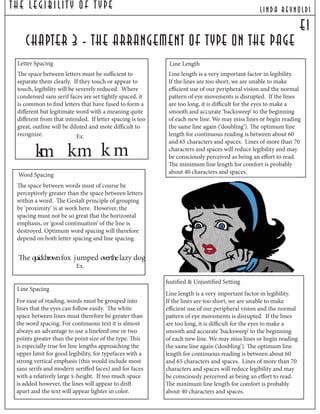
Letter Spacing
The space between letters must be sufficient to
separate them clearly. If they touch or appear to
touch, legibility will be severely reduced. Where
condensed sans serif faces are set tightly spaced, it
is common to find letters that have fused to form a
different but legitimate word with a meaning quite
different from that intended. If letter spacing is too
great, outline will be diluted and mote difficult to
recognize.
km km k m
The quickbrownfox jumped overthelazy dog
Ex.
Ex.
The Legibilit y Of T ype lind a reynolds
F1
chapter 4 - type and its background
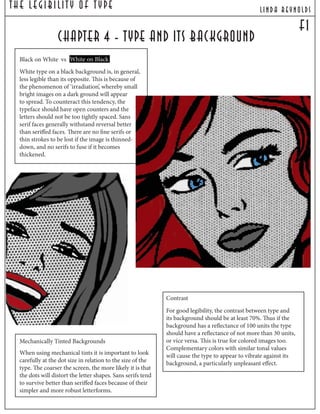
Black on White vs White on Black
White type on a black background is, in general,
less legible than its opposite. This is because of
the phenomenon of ‘irradiation’, whereby small
bright images on a dark ground will appear
to spread. To counteract this tendency, the
typeface should have open counters and the
letters should not be too tightly spaced. Sans
serif faces generally withstand reversal better
than seriffed faces. There are no fine serifs or
thin strokes to be lost if the image is thinned-
down, and no serifs to fuse if it becomes
thickened.
Mechanically Tinted Backgrounds
When using mechanical tints it is important to look
carefully at the dot size in relation to the size of the
type. The coarser the screen, the more likely it is that
the dots will distort the letter shapes. Sans serifs tend
to survive better than seriffed faces because of their
simpler and more robust letterforms.
Contrast
For good legibility, the contrast between type and
its background should be at least 70%. Thus if the
background has a reflectance of 100 units the type
should have a reflectance of not more than 30 units,
or vice versa. This is true for colored images too.
Complementary colors with similar tonal values
will cause the type to appear to vibrate against its
background, a particularly unpleasant effect.
The Legibilit y Of T ype lind a reynolds
g1
Glossary
alignment - The positioning of text within the page margins. Alignment can be flush left, flush right, justified, or
centered. Flush left and flush right are sometimes referred to as left justified and right justified.
ascender - The part of lowercase letters (such as k, b, and d) that ascends above the x-height of the other lowercase
letters in a face.
baseline - The imaginary line on which the majority of the characters in a typeface rest.
contrast - A subjective feeling that graphic elements (such as fonts) are different but work together well. This gives
a feeling of variety without losing harmony. Within a particular font, contrast also refers to the variety of stroke
thicknesses that make up the characters. Helvetica has low contrast and Bodoni has high contrast.
counter - The enclosed (or partially enclosed) space within letters such as ‘c,’ ‘e,’ S,’ ‘H,’ and ‘g.’ Often confused with
“bowl.”
descender - The part of lowercase letters (such as y, p, and q) that descends below the baseline of the other lowercase
letters in a font face. In some typefaces, the uppercase J and Q also descend below the baseline.
font - One weight, width, and style of a typeface. Before scalable type, there was little distinction between the terms
font, face, and family. Font and face still tend to be used interchangeably, although the term face is usually more
correct.
grid - A grid is the skeleton or framework that allows for arranging content within the space of the page. It is the
building block of all digital images and marks and is not a rigid formula, but instead a flexible, resilient structure.
headline - The short lines of emphasized text that introduce detail information in the body text that follows. Also
the category of faces that are designed to work best in headline text.
kerning - The adjustment of horizontal space between individual characters in a line of text. Adjustments in
kerning are especially important in large display and headline text lines. Without it, many letter combinations
can look awkward. The objective of kerning is to create visually equal spaces between all letters so that the eye
can move smoothly along the text.
The Legibilit y Of T ype lind a reynolds
leading - The amount of space added between lines of text to make the document legible. The term originally
referred to the thin lead spacers that printers used to physically increase space between lines of metal type. Most
applications automatically apply standard leading based on the point size of the font. Closer leading fits more
text on the page, but decreases legibility. Looser leading spreads text out to fill a page and makes the document
easier to read.
legibility - The ease with which the reader can discern the type on the page, based on the tone of the type in
relation to the background and the letterforms’ shape with respect to each other.
pica - A unit of measure that is approximately 1/6th of an inch. A pica is equal to 12 points. The traditional
British and American pica is 0.166 inches. In PostScript printers, a pica is exactly 1/6th of an inch.
points - A unit of measure in typography. There are approximately 72 points to the inch. A pica is 12 points.
san serif - A type face that does not have serifs. Generally a low-contrast design. Sans serif faces lend a clean,
simple appearance to documents.
serif - Small decorative strokes that are added to the end of a letter’s main strokes. Serifs improve readability by
leading the eye along the line of type.
subhead - May be either a display line enlarging on the main headline, usually in smaller size or a short heading
inside the copy used to break up long patches of gray.
tracking - The average space between characters in a block of text. Sometimes also referred to as letter-spacing.
typeface - The letters, numbers, and symbols that make up a design of type. A typeface is often part of a type
family of coordinated designs. The individual typefaces are named after the family and are also specified with a
designation, such as italic, bold or condensed.
x-height - Traditionally, x-height is the height of the lowercase letter x. It is also the height of the body of
lowercase letters in a font, excluding the ascenders and descenders. Some lower-case letters that do not have
ascenders or descenders still extend a little bit above or below the x-height as part of their design. The x-height
can vary greatly from typeface to typeface at the same point size.
Glossary
h1
The Legibilit y Of T ype lind a reynolds
i1
index
counters p. B1, F1
stroke p. B1, F1
sans serif p. B1, F1
serif p. B1, F1
ascender p. C1
descender p. C1
Gestalt Principle p. E1
legibility p. B1, C1, D1, E1, F1
capitals p. C1
bold p. C1
italics p. C1
condensed type p. D1, E1
extended type p. D1
letter spacing p. E1
line length p. E1
justified setting p. E1
x-height p. B1,E1
typeface p. B1, D1, E1, F1
type size p. D1
word spacing p. E1
unjustified setting p. E1
line spacing p. B1,E1
contrast p. F1
pica p. D1
points p. D1,E1
The Legibilit y Of T ype lind a reynolds
J1
colophon
Book Design: Tara E
Cook
Hardware: Th
is book was created
using a M
acintosh
Gx
Software: Designed
and
produced
using
Adobe Photoshop and
InDesign
Type Faces used: ITC
anna, M
inion
Pro
Linda Reynolds
Th
e Legibility of Type
Copyright
2010 by Linda Reynolds
“Your Solution to Pest Intrusion!”“Your Solution to Pest Intrusion!”
 Technologically
advanced methods of
protection!
 Family and
environmentally
friendly!
 Well-trained and
professional
employees!
 Lifetime
protection!
www.terminix.com
Call 24/7 for a solution now!
Kansas
Missouri
Johnson Co.
Independence
913-696-0351
816-241-1405
913-631-7130
816-478-8212
Commonly
Treated Pests:
 Termites
 Ants
 Rodents
 Spiders
 Flies
 Hornets
 Fleas
 Cockroaches
Strongest
Guarantee in
the Business!
ID,P,PS+portfolio.compressed

ID,P,PS+portfolio.compressed

  • 1.
    280 281 LithosLithos CaroltwomblyTaraCook Photoby:Carter,Sebastian.TwentiethCenturyTypeDesigners:SebastianCarter.Aldershot:Lund Humphries,2002.Print. “Text familieshave so many characters and require such attention to detail. They can be both tedious and exhausting to create. I like display designs better. They’re more spontaneous and fun to work on.” Carol Twombly is an award-winning type designer born in Concord, Massachusetts, on June 13, 1959 and is the youngest of five children. Originally interested in sculpture, she attended the Rhode Island School of Design where she discovered type design and typography under professor Charles Bigelow. Encouraged by her professor and his partner, Kris Holmes, she was not only starting to gain a respect for letterforms but also becoming involved in the design of letters. Encouraged by her professor and his partner, Kris Holmes, she was not only starting to gain a respect for letterforms but also becoming involved in the design of letters. Twombly is one of only five people to hold this specialized diploma combing the art of graphics and the science of computers. In 1988 Carol joined Adobe Systems, Inc. part-time as one of three in-house designers. It is here that she first began using the Macintosh and Mac applications to design type. Two years after joining Adobe, Twombly completed her first original display typefaces which include some of Adobe’s Originals most popular typefaces: Trajan, Charlemange and Lithos. Trajan is based on inscriptions on the Column of Trajan in Rome and is a popular font for movie posters. Charlemange was modeled after classical Roman carvings. Lithos is a sans serif typeface based on Greek stone inscriptions comprised of only uppercase letters. Just within a few weeks of Lithos being commercialized, it became an instant success and is perhaps the most enduring of the three typefaces. In 1994, the Association Typographique Internationale awarded Carol the prestigious Charles Peignot Award for her outstanding contribution to type design. She was the first woman and second American to receive this award in the under thirty-five age category. Her approach is of that of a visual artist who relies on a trained eye and a skilled hand rather than the logic of a scholar. Although she is recognized as one of the twentieth century’s most influential designers, Twombly sees herself a graphic designer who specializes in type. According to her, “If a type is well-received and widely used by the public then it is a success.” In 1990, two years after joining Adobe Systems Inc., Carol Twombly completed Adobe’s first original display typefaces: Trajan, Charlemange and Lithos. Within weeks of becoming commercial, Lithos was considered an instant success and remains one of her most popular font designs. It is based on the inscriptional lettering, dating from 400 B.C, that was used to dedicate temples or honor public figures in ancient Greece. The basic shapes were derived from the geometric letterforms that were free of adornment and chiseled into stone. Twombly described the way she came up with the design,“I began by drawing fairly geometric interpretations of them. I didn’t copy the letters directly, however I started with fairly close copies of the Greek stuff, but the letters ended up looking a little bit dead on the page. I also wanted to make the design a bit more contemporary but not lose the simplicity of the original Greek model.”(Fig 1) Therefore Lithos is a modern interpretation rather than precise reproduction. Carol began the design of three different initial weights, she said“I found that the extralight weight was the most difficult to design.” The typeface now has five different weights including the initial light, regular and bold. It has a flexible design, simplified character shapes along with playful asymmetric qualities which makes it ideal for display type such as headings, posters or flyers and is not suitable for body text. This typeface would be classified as sans serif because of it’s noticeably absent serifs at the end of the strokes. The final characteristic that puts this font in the sans serif category is the fact that it is based upon geometric construction. 1. Digital copy of a Lithos sketch - Carol Twombly Tara Cook Type Final1.indd 280-281Tara Cook Type Final1.indd 280-281 5/22/12 12:51 PM5/22/12 12:51 PM
  • 2.
    MBLYTWOMY WOMBLYTWY AROL CARoLL CL TWOMBlYTwY CAROLCAROL ROLCAROLLCAL OMBLYTWOY LCAROLCAROL OLCAROLCARL CAROLTWOMBLY ADOBE TYPE DESIGNERa b c d e f g h i j k l m n o p q r s t u v w x y z CCCCCAAAAAROLLLLTTTTTWOMBLY CarolTwomblyisborninConcord, Massachusetts,onJune13,1959 andistheyoungestoffivechildren. 1959 1988 1990 JoinsAdobeanddesignsAdobe’s firstoriginaldisplaytypefaces- Trajan,Charlemagne&LITHOS AwardedtheprestigiousCharles PeignotAwardforheroutstanding contributiontotypedesignby TheAssociationTypographique Internationale.Shewasthefirstwoman andsecondAmericantoreceivethis awardintheunderthirty-fiveage category. 1992 DesignedtypefaceAdobeCaslon, consideredbymanytobethebest typefaceevertocomeoutofthe Adobedesignstudio 1994 DesignedtypefaceMyriadPro “If a type is well-received and widely used by the public then it is a success.” - Carol Twombly DDD 1999 Twoyearsafterreleasingherlast typeface,Chaparral,CarolTwombly completelyretiredfromdesign.She nowlivesaprivatelifedevotedtoher othercreativepursuitsunrelatedto typography. 1984 WontheprestigiousMorisawa TypefaceDesignCompetition award-winningdesigner GGG Sinclair Community College Design Department Presents Visiting Speaker Typography Lecture Seriess
  • 3.
    MBLYTWOMY WOMBLYTWY AROL CARoLL CL TWOMBlYTwY CAROLCAROL ROLCAROLLCAL OMBLYTWOY LCAROLCAROL OLCAROLCARL ADMISSION IS FREE!!!! OPEN TOPUBLIC!!!! Questions? (937) 512 - 4505 When: Friday, June 15, 2012 7:00 pm Where: Blair Hall Theatre Building 2 Sinclair Community College 444 West Third Street Dayton, OH 45402
  • 4.
    Table of Contents Chapter1 . . . . . . . . . . . . . . . . . . . . . . B1 Chapter 2 . . . . . . . . . . . . . . . . . . . . . . C1,D1 Chapter 3 . . . . . . . . . . . . . . . . . . . . . . E1 Chapter 4 . . . . . . . . . . . . . . . . . . . . . . F1 Glossary . . . . . . . . . . . . . . . . . . . . . . . G1,H1 Index . . . . . . . . . . . . . . . . . . . . . . . . . . I1 Colophon . . . . . . . . . . . . . . . . . . . . . . . J1 Introduction . . . . . . . . . . . . . . . . . . . . A1 The Legibility Of Typelinda reynoldsDedicated to Jackie Brewer All rights reserved. No part of the contents of this book may be reproduced or transmitted in any form or by any means, electronic, photocopying, recording, or otherwise, without the written permission of the publisher. Library of Congress Cataloging-in-Publication Data: Reynolds, Linda. The Legibility of Type. A1 Copyright 2010 by Linda Reynolds What makes type legible? This is often dismissed as merely a mater of common sense, but if common sense is all that is needed, why is it that some of the basic rules for good legibility are so frequently flouted? True, legibility may not always be the first consideration, but for words that are intended to be read it cannot be ignored. It has never been difficult to find examples of illegibillity of various kinds, but examples are abound now that desktop publishing systems have brought electronic typesetting within reach of those with little or no knowledge of basic design principals. Legibility as an issue is perhaps more important than ever before, some of the most important factors effecting it are outlined below.
  • 5.
    The Legibilit yOf T ype lind a reynolds b1 1. A relatively large x-height in relation to the capital letter height. This will make the lowercase letters easier to discriminate (fig 1.) 2. Large, open counters and a relatively generous set width. This will help to prevent letters from filling in and running together. Skilled readers recognize whole words by their outline and their internal shape rather than reading letter by letter. If the spaces within a word are lost it will be difficult or impossible to recognize (fig 2.) For good legibility, a typeface should have the following characteristics: 3. Not too much variation between thick and thin strokes. Delicate thin strokes may disappear if the image is photographically reproduced during reproduction (fig 3.) fig 1. fig 2. fig 3. These criteria are satisfied by a number of typefaces, both seriffed and sans serif. Sans serif faces, however, are considered by some to be intrinsically less legible than serif faces. It is argued that serifs give horizontal emphasis that helps to hold letters together as words, and to guide the eyes along each line. This may well be true (fig 4.) fig 4. The German school of Gestalt psychologists described a number of principals by which we try to group areas of the retinal image that are likely to be part of the same figure. One of these is the principal of direction, also known as the principal of good continuation, whereby separate elements with a common direction or trend are seen to form a line. This would suggest that serifs may indeed help adjacent letters to be grouped as words, and words to be grouped into lines. It is also argued that seriffed letter shapes have more individuality and therefore are more easily distinguished from one another than sans serif letters. Interestingly the top halves of lowercase letters are more important in letter and word recognition then the bottom halves. The tops of some sans serif letters are very much alike, whereas in a seriffed face they are more easily distinguishable. Some sans serif faces may also cause problems, it is essential that the numeral ‘l’, lowercase ‘I’, and capital ‘T’ should be uniquely identifiable. In spite of these arguments, researchers have been unable to find any significant differences in the legibility of seriffed and sans serif faces. Most of us are more familiar with seriffed faces, and it may be that we tend to prefer what we’re used to. Provided that the letter, word and line spacing are suitable, a sans serif face is likely to be just as legible as a seriffed face, and in some situations it may be more so. chapter 1 - choice of type
  • 6.
    c1 chapter 2 -variations in letterform Capitals Text set in all-capital lettering is less legible than text set in lowercase letters with capitals where appropriate (fig 5.) This is because lowercase letters, with their ascenders and descenders, create more distinctive word outlines than do capital letters. Any word in capitals has a rectangular outline. Capitals also take up more space than lowercase letters, so more fixations of the eyes are needed to perceive the same number of words. This slows reading (fig 6.) LITHOS Charlemagne trajan fig 5. fig 6. Italics Italics have been shown to be less legible than roman letters for continuous text. This may be because the italic letters are less easily distinguished from one another. We are also less used to them. With electronically generated type, so-called ‘italics’ may in fact be a slanted version of the roman letters, rather than a separately designed font. Some of these ‘obliques’ are likely to have reduced legibility (fig 7.) fig 7. Bold Bold type is of course invaluable for emphasis, but it is likely to reduce legibility when used for continuous text. The dense black type tends to create after-images, noticeable as bright glowing areas between the lines. lind a reynoldsThe Legibilit y Of T ype True Italics
  • 7.
    The Legibilit yOf T ype lind a reynolds d1 chapter 2 - variations in letterform [cont.] Condensed & Extended Type The danger with condensed styles is that the letters will either apparently or actually fill in and run together. The standard of reproduction needs to be high to ensure good legibility. Extended styles reduce the number of words that can be read at each fixation. Normal letter proportions can be distorted very easily in electronic typesetting systems, with predictably illegible results in many cases. Type Size If the type is too small, letters and word will be difficult to discriminate. If it is too large, less words will be perceived at each fixation. For a normal reading distance of 12-15 in, the optimum type size for continuous text is usually somewhere between 9pt and 11pt, depending on the x-height of the typeface and the circumstances in which the material will be used. one point = 1/72 inch one pica = 12 points one inch = 6 picas or 72 points Ex. extended condensed Ex.
  • 8.
    The Legibilit yOf T ype lind a reynolds e1 chapter 3 - the arrangement of type on the page Word Spacing The space between words must of course be perceptively greater than the space between letters within a word. The Gestalt principle of grouping by ‘proximity’ is at work here. However, the spacing must not be so great that the horizontal emphasis, or ‘good continuation’ of the line is destroyed. Optimum word spacing will therefore depend on both letter spacing and line spacing. Line Spacing For ease of reading, words must be grouped into lines that the eyes can follow easily. The white space between lines must therefore be greater than the word spacing. For continuous text it is almost always an advantage to use a linefeed one or two points greater than the point size of the type. This is especially true for line lengths approaching the upper limit for good legibility, for typefaces with a strong vertical emphasis (this would include most sans serifs and modern seriffed faces) and for faces with a relatively large x-height. If too much space is added however, the lines will appear to drift apart and the text will appear lighter in color. Line Length Line length is a very important factor in legibility. If the lines are too short, we are unable to make efficient use of our peripheral vision and the normal pattern of eye movements is disrupted. If the lines are too long, it is difficult for the eyes to make a smooth and accurate ‘backsweep’ to the beginning of each new line. We may miss lines or begin reading the same line again (‘doubling’). The optimum line length for continuous reading is between about 60 and 65 characters and spaces. Lines of more than 70 characters and spaces will reduce legibility and may be consciously perceived as being an effort to read. The minimum line length for comfort is probably about 40 characters and spaces. Justified & Unjustified Setting Line length is a very important factor in legibility. If the lines are too short, we are unable to make efficient use of our peripheral vision and the normal pattern of eye movements is disrupted. If the lines are too long, it is difficult for the eyes to make a smooth and accurate ‘backsweep’ to the beginning of each new line. We may miss lines or begin reading the same line again (‘doubling’). The optimum line length for continuous reading is between about 60 and 65 characters and spaces. Lines of more than 70 characters and spaces will reduce legibility and may be consciously perceived as being an effort to read. The minimum line length for comfort is probably about 40 characters and spaces. Letter Spacing The space between letters must be sufficient to separate them clearly. If they touch or appear to touch, legibility will be severely reduced. Where condensed sans serif faces are set tightly spaced, it is common to find letters that have fused to form a different but legitimate word with a meaning quite different from that intended. If letter spacing is too great, outline will be diluted and mote difficult to recognize. km km k m The quickbrownfox jumped overthelazy dog Ex. Ex.
  • 9.
    The Legibilit yOf T ype lind a reynolds F1 chapter 4 - type and its background Black on White vs White on Black White type on a black background is, in general, less legible than its opposite. This is because of the phenomenon of ‘irradiation’, whereby small bright images on a dark ground will appear to spread. To counteract this tendency, the typeface should have open counters and the letters should not be too tightly spaced. Sans serif faces generally withstand reversal better than seriffed faces. There are no fine serifs or thin strokes to be lost if the image is thinned- down, and no serifs to fuse if it becomes thickened. Mechanically Tinted Backgrounds When using mechanical tints it is important to look carefully at the dot size in relation to the size of the type. The coarser the screen, the more likely it is that the dots will distort the letter shapes. Sans serifs tend to survive better than seriffed faces because of their simpler and more robust letterforms. Contrast For good legibility, the contrast between type and its background should be at least 70%. Thus if the background has a reflectance of 100 units the type should have a reflectance of not more than 30 units, or vice versa. This is true for colored images too. Complementary colors with similar tonal values will cause the type to appear to vibrate against its background, a particularly unpleasant effect.
  • 10.
    The Legibilit yOf T ype lind a reynolds g1 Glossary alignment - The positioning of text within the page margins. Alignment can be flush left, flush right, justified, or centered. Flush left and flush right are sometimes referred to as left justified and right justified. ascender - The part of lowercase letters (such as k, b, and d) that ascends above the x-height of the other lowercase letters in a face. baseline - The imaginary line on which the majority of the characters in a typeface rest. contrast - A subjective feeling that graphic elements (such as fonts) are different but work together well. This gives a feeling of variety without losing harmony. Within a particular font, contrast also refers to the variety of stroke thicknesses that make up the characters. Helvetica has low contrast and Bodoni has high contrast. counter - The enclosed (or partially enclosed) space within letters such as ‘c,’ ‘e,’ S,’ ‘H,’ and ‘g.’ Often confused with “bowl.” descender - The part of lowercase letters (such as y, p, and q) that descends below the baseline of the other lowercase letters in a font face. In some typefaces, the uppercase J and Q also descend below the baseline. font - One weight, width, and style of a typeface. Before scalable type, there was little distinction between the terms font, face, and family. Font and face still tend to be used interchangeably, although the term face is usually more correct. grid - A grid is the skeleton or framework that allows for arranging content within the space of the page. It is the building block of all digital images and marks and is not a rigid formula, but instead a flexible, resilient structure. headline - The short lines of emphasized text that introduce detail information in the body text that follows. Also the category of faces that are designed to work best in headline text. kerning - The adjustment of horizontal space between individual characters in a line of text. Adjustments in kerning are especially important in large display and headline text lines. Without it, many letter combinations can look awkward. The objective of kerning is to create visually equal spaces between all letters so that the eye can move smoothly along the text.
  • 11.
    The Legibilit yOf T ype lind a reynolds leading - The amount of space added between lines of text to make the document legible. The term originally referred to the thin lead spacers that printers used to physically increase space between lines of metal type. Most applications automatically apply standard leading based on the point size of the font. Closer leading fits more text on the page, but decreases legibility. Looser leading spreads text out to fill a page and makes the document easier to read. legibility - The ease with which the reader can discern the type on the page, based on the tone of the type in relation to the background and the letterforms’ shape with respect to each other. pica - A unit of measure that is approximately 1/6th of an inch. A pica is equal to 12 points. The traditional British and American pica is 0.166 inches. In PostScript printers, a pica is exactly 1/6th of an inch. points - A unit of measure in typography. There are approximately 72 points to the inch. A pica is 12 points. san serif - A type face that does not have serifs. Generally a low-contrast design. Sans serif faces lend a clean, simple appearance to documents. serif - Small decorative strokes that are added to the end of a letter’s main strokes. Serifs improve readability by leading the eye along the line of type. subhead - May be either a display line enlarging on the main headline, usually in smaller size or a short heading inside the copy used to break up long patches of gray. tracking - The average space between characters in a block of text. Sometimes also referred to as letter-spacing. typeface - The letters, numbers, and symbols that make up a design of type. A typeface is often part of a type family of coordinated designs. The individual typefaces are named after the family and are also specified with a designation, such as italic, bold or condensed. x-height - Traditionally, x-height is the height of the lowercase letter x. It is also the height of the body of lowercase letters in a font, excluding the ascenders and descenders. Some lower-case letters that do not have ascenders or descenders still extend a little bit above or below the x-height as part of their design. The x-height can vary greatly from typeface to typeface at the same point size. Glossary h1
  • 12.
    The Legibilit yOf T ype lind a reynolds i1 index counters p. B1, F1 stroke p. B1, F1 sans serif p. B1, F1 serif p. B1, F1 ascender p. C1 descender p. C1 Gestalt Principle p. E1 legibility p. B1, C1, D1, E1, F1 capitals p. C1 bold p. C1 italics p. C1 condensed type p. D1, E1 extended type p. D1 letter spacing p. E1 line length p. E1 justified setting p. E1 x-height p. B1,E1 typeface p. B1, D1, E1, F1 type size p. D1 word spacing p. E1 unjustified setting p. E1 line spacing p. B1,E1 contrast p. F1 pica p. D1 points p. D1,E1
  • 13.
    The Legibilit yOf T ype lind a reynolds J1 colophon Book Design: Tara E Cook Hardware: Th is book was created using a M acintosh Gx Software: Designed and produced using Adobe Photoshop and InDesign Type Faces used: ITC anna, M inion Pro Linda Reynolds Th e Legibility of Type Copyright 2010 by Linda Reynolds
  • 14.
    “Your Solution toPest Intrusion!”“Your Solution to Pest Intrusion!”  Technologically advanced methods of protection!  Family and environmentally friendly!  Well-trained and professional employees!  Lifetime protection! www.terminix.com Call 24/7 for a solution now! Kansas Missouri Johnson Co. Independence 913-696-0351 816-241-1405 913-631-7130 816-478-8212 Commonly Treated Pests:  Termites  Ants  Rodents  Spiders  Flies  Hornets  Fleas  Cockroaches Strongest Guarantee in the Business!