TYPOGRAPHY
DEFINITION OF TYPOGRAPHY
• it is the style or appearance of text.
• it is the art of rearranging text to make it
more readable, and more pleasing to the
audience eyes.
• this involves the typefaces, point size,
leading, and kerning.
HEIRARCHYused to guide the reader's eye to whatever is most
important
LEADING
The
Space
Between
Lines
Of
Text
TRACKINGThe overall space between c h a r a c t e r s
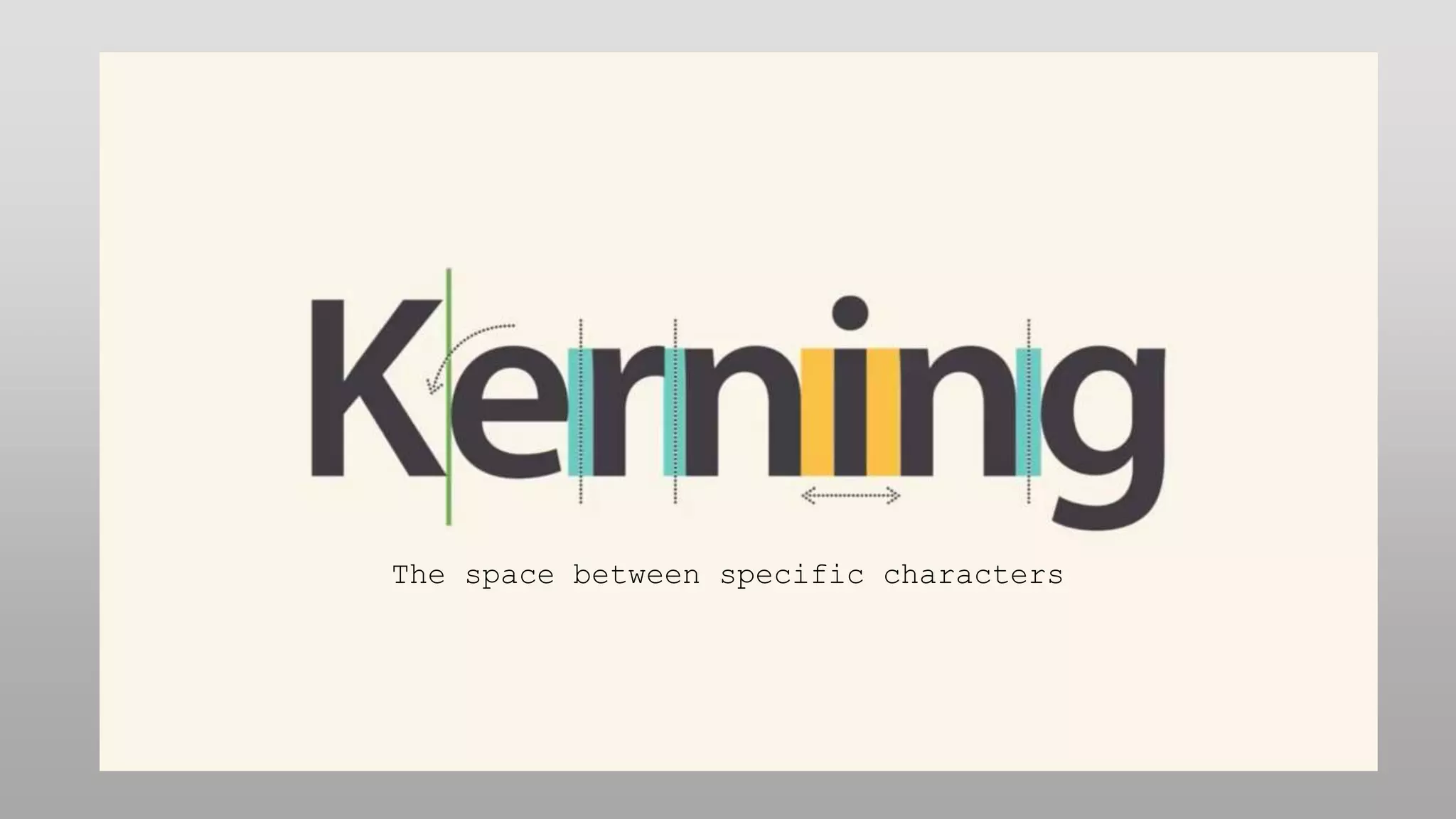
The space between specific characters
ANATOMY OF A
LETTERFORM
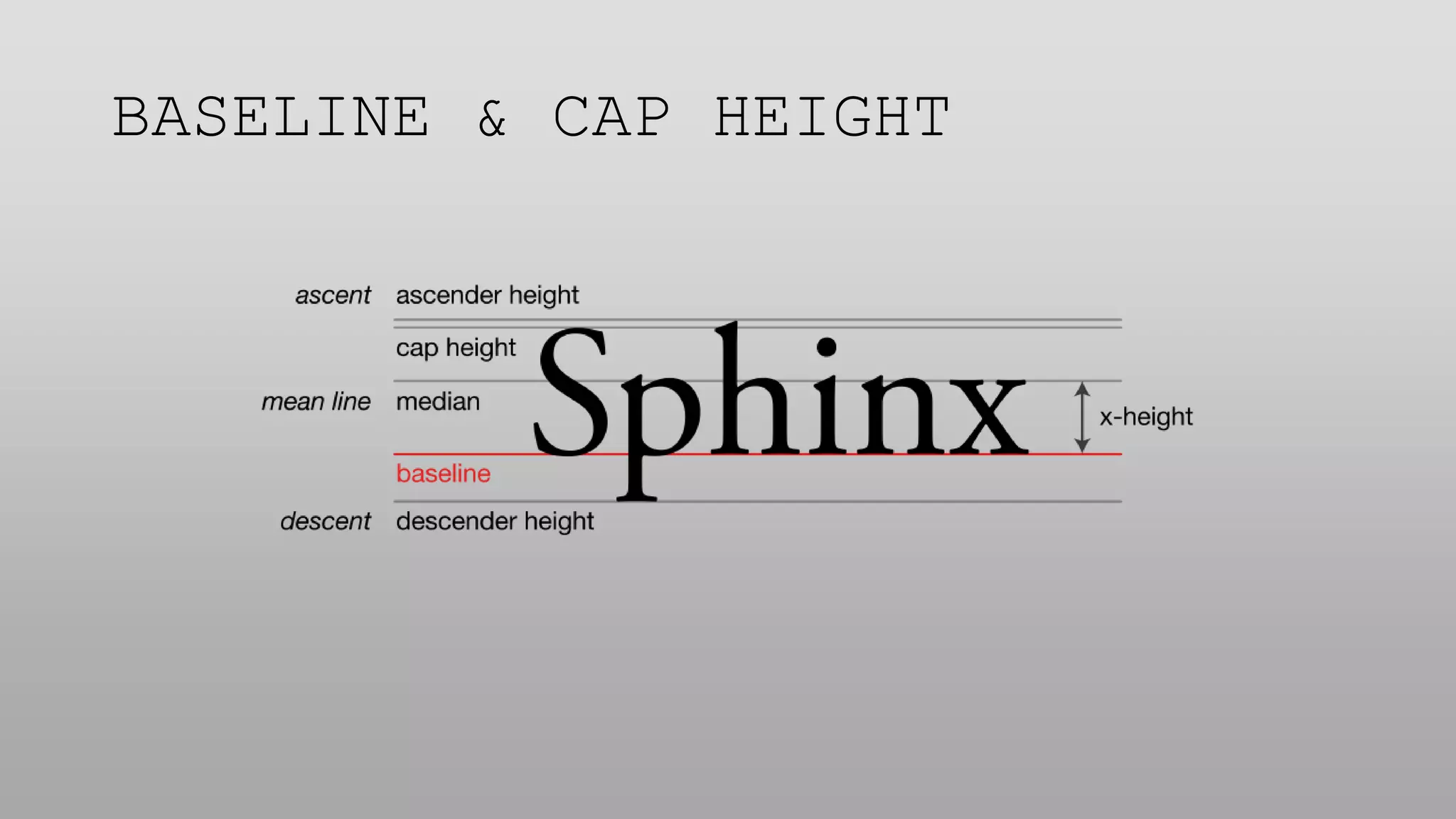
BASELINE & CAP HEIGHT
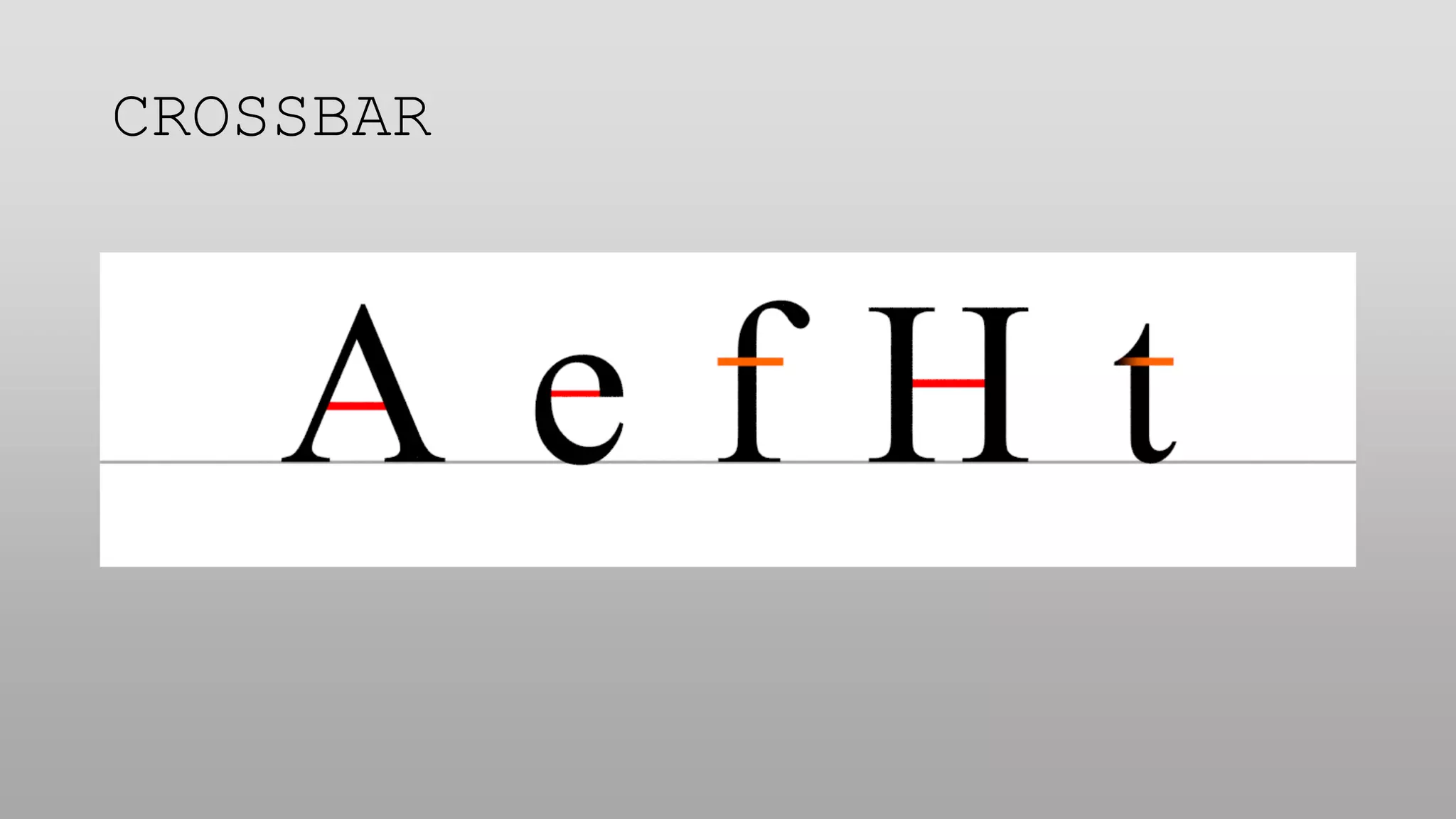
CROSSBAR
SERIF
MEANLINE
BOWL
DESCENDER
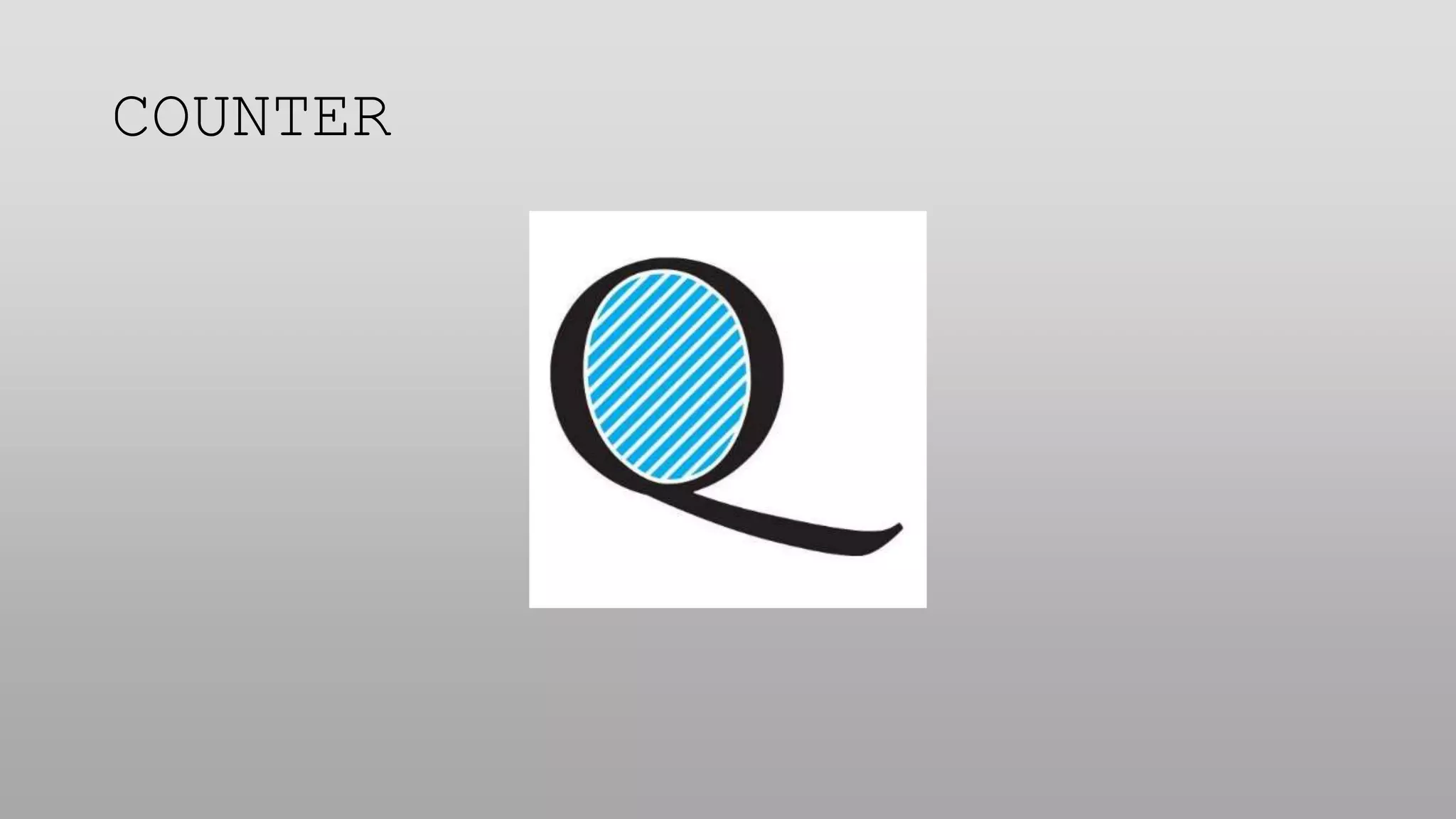
COUNTER
STEM
TITTLE
TERMINAL
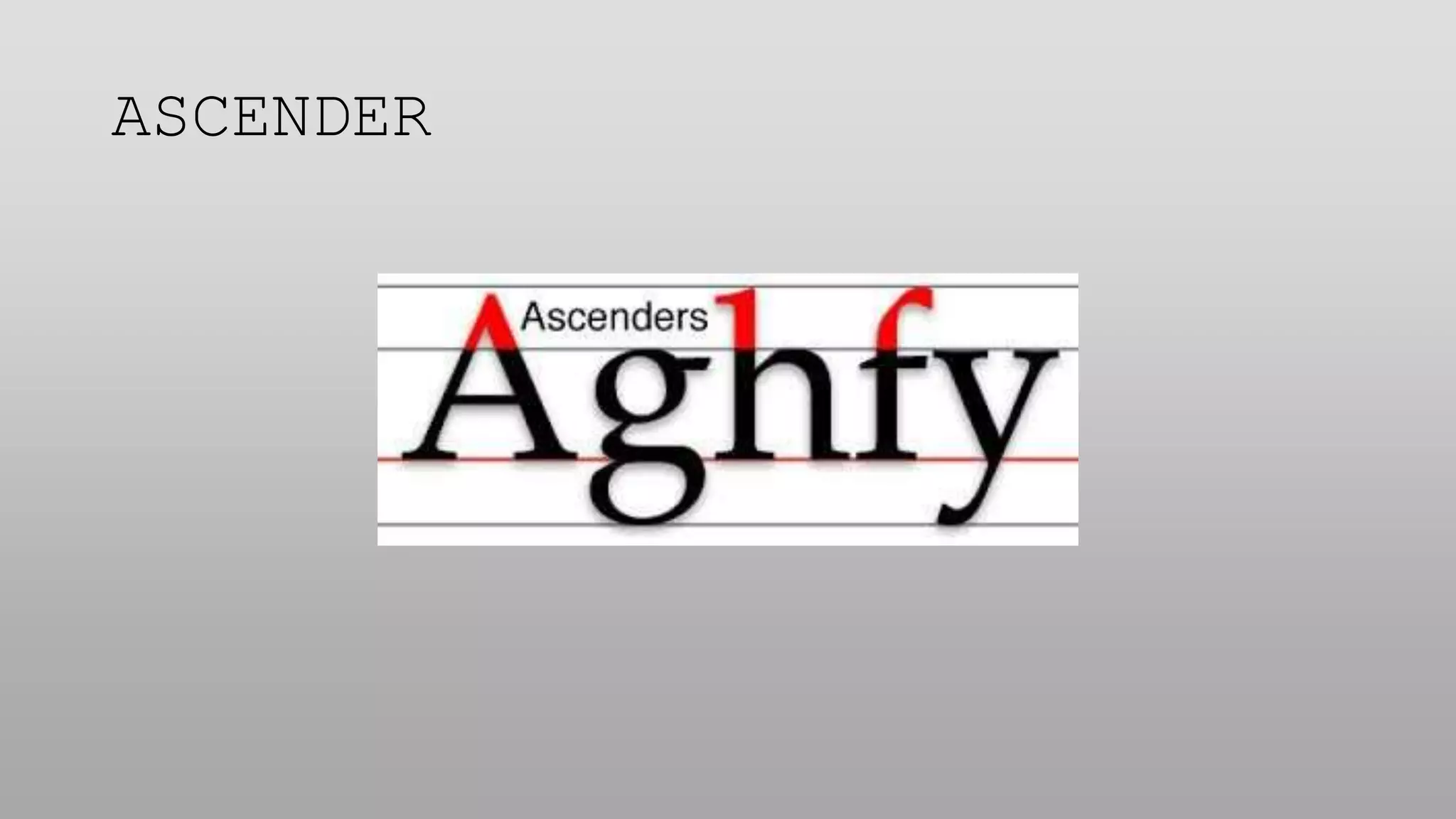
ASCENDER
LEGS
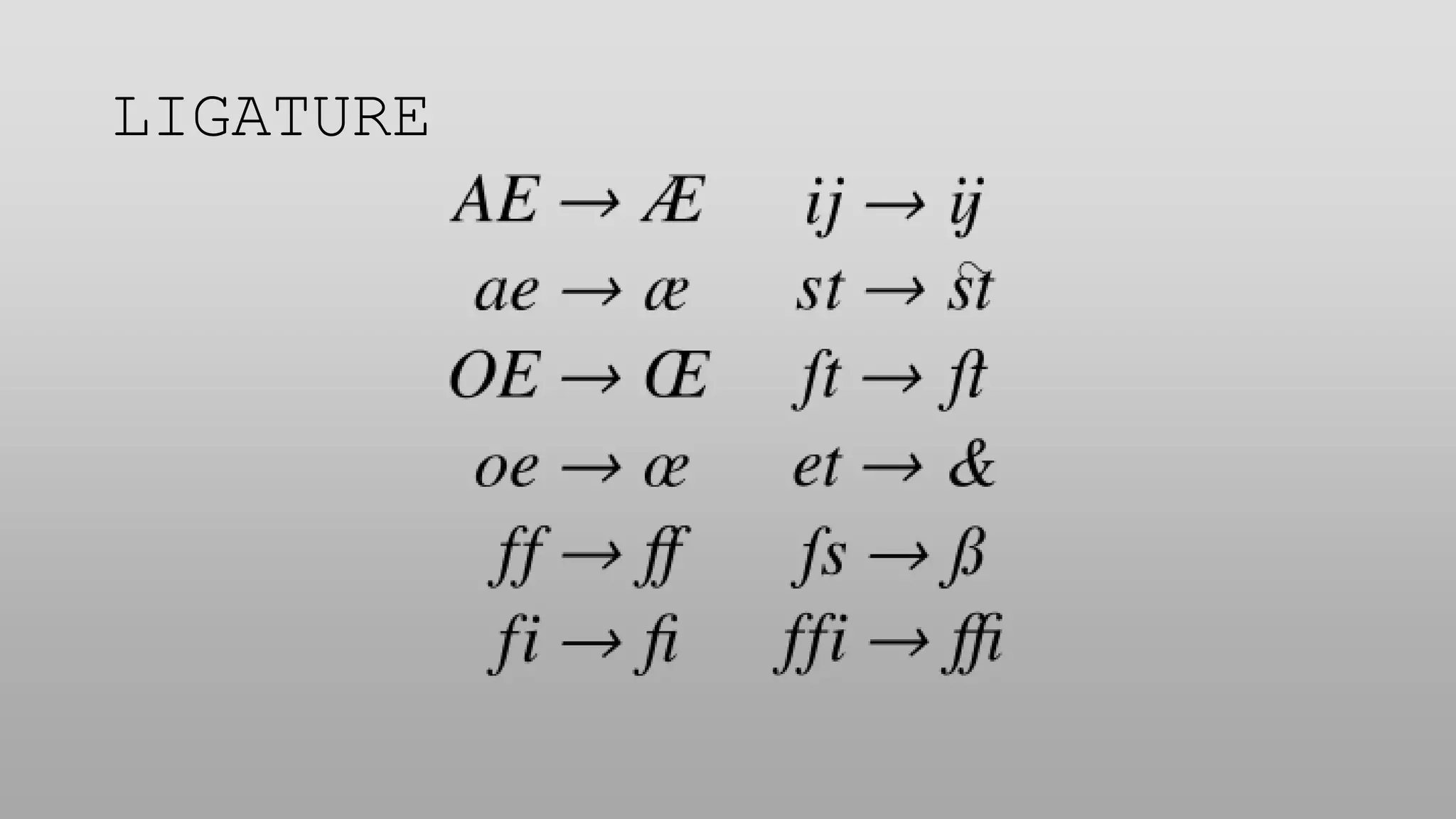
LIGATURE
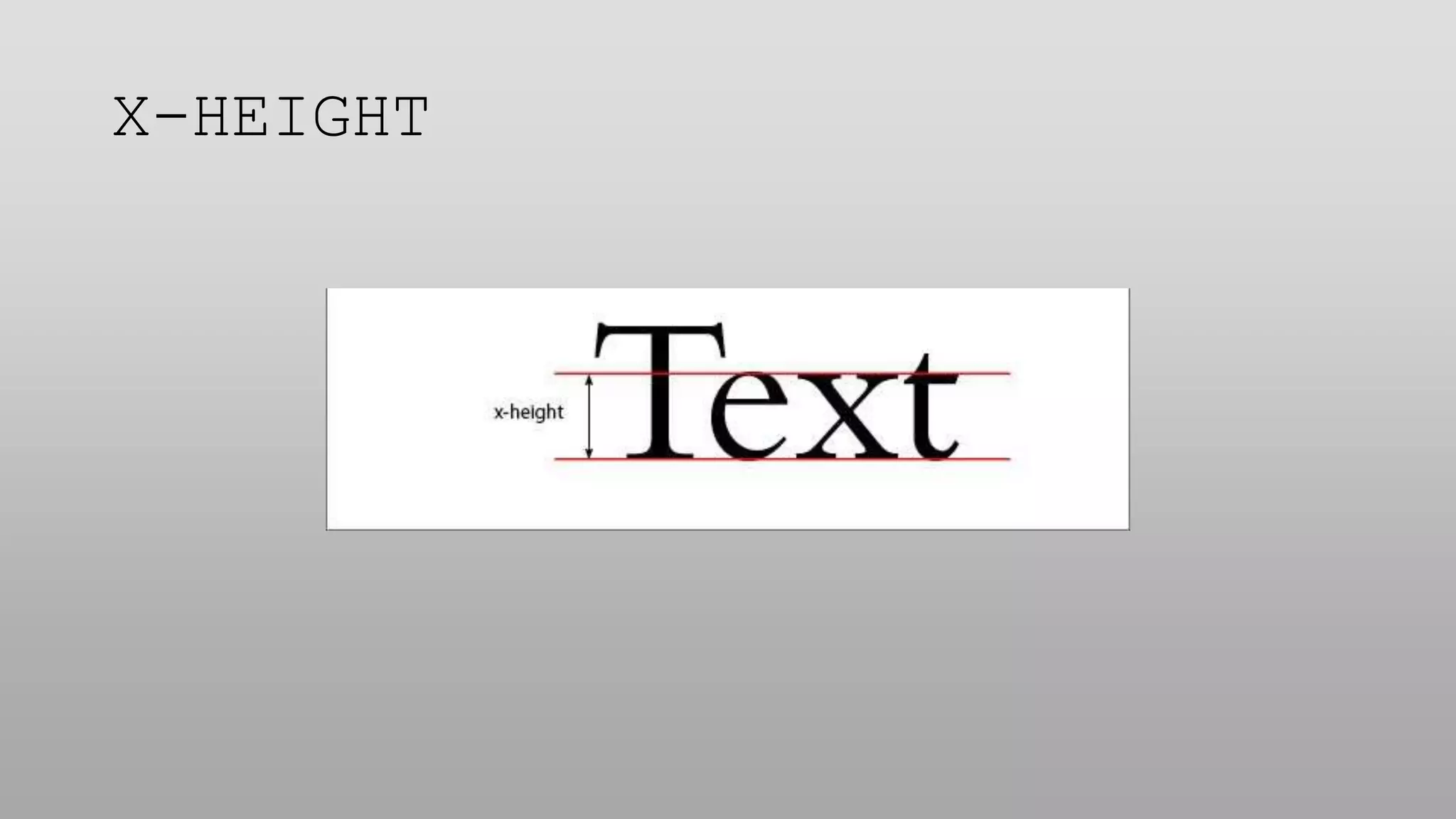
X-HEIGHT
TYPE
CLASSIFICATI
ON
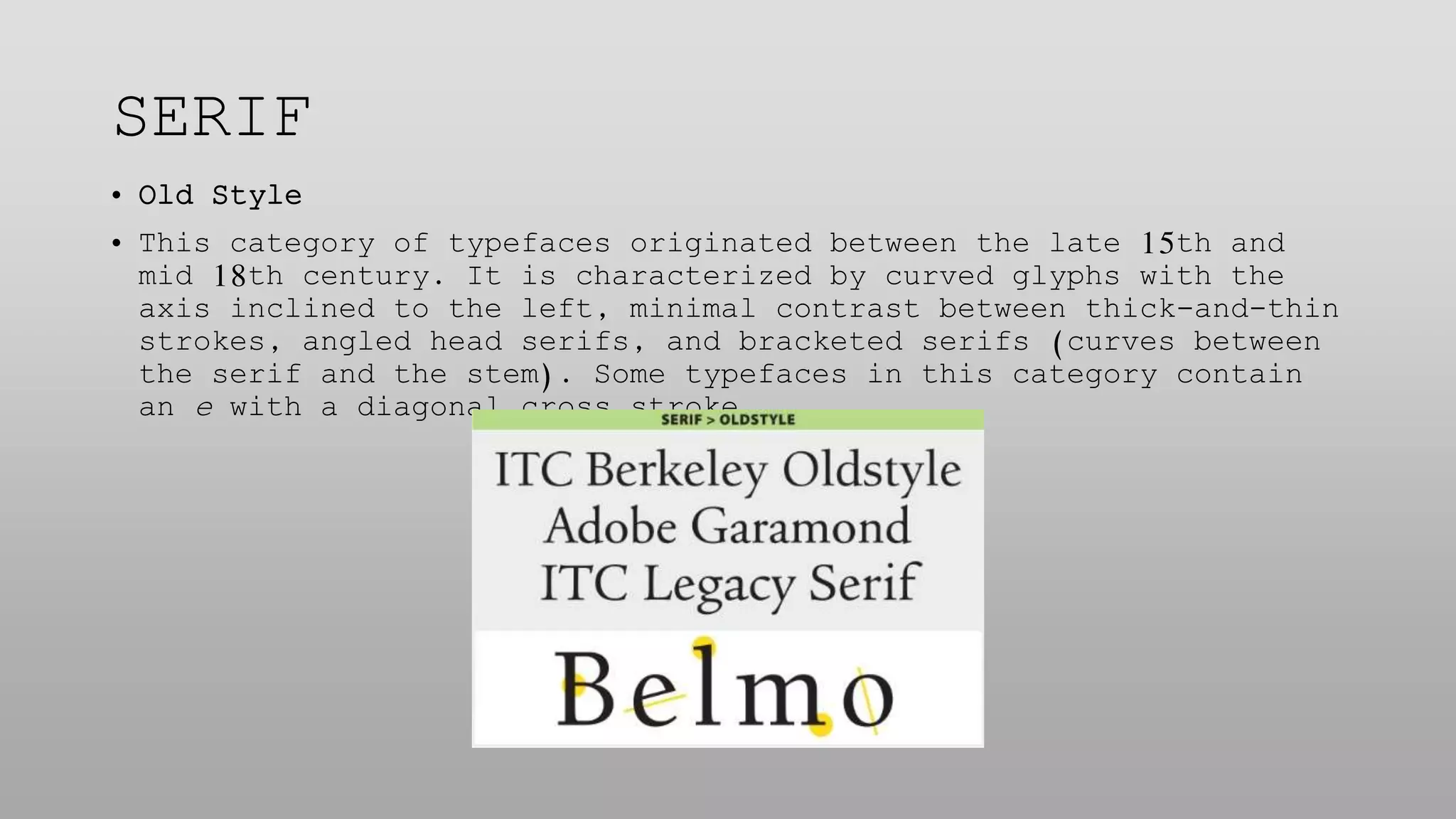
SERIF
• Old Style
• This category of typefaces originated between the late 15th and
mid 18th century. It is characterized by curved glyphs with the
axis inclined to the left, minimal contrast between thick-and-thin
strokes, angled head serifs, and bracketed serifs (curves between
the serif and the stem). Some typefaces in this category contain
an e with a diagonal cross stroke.
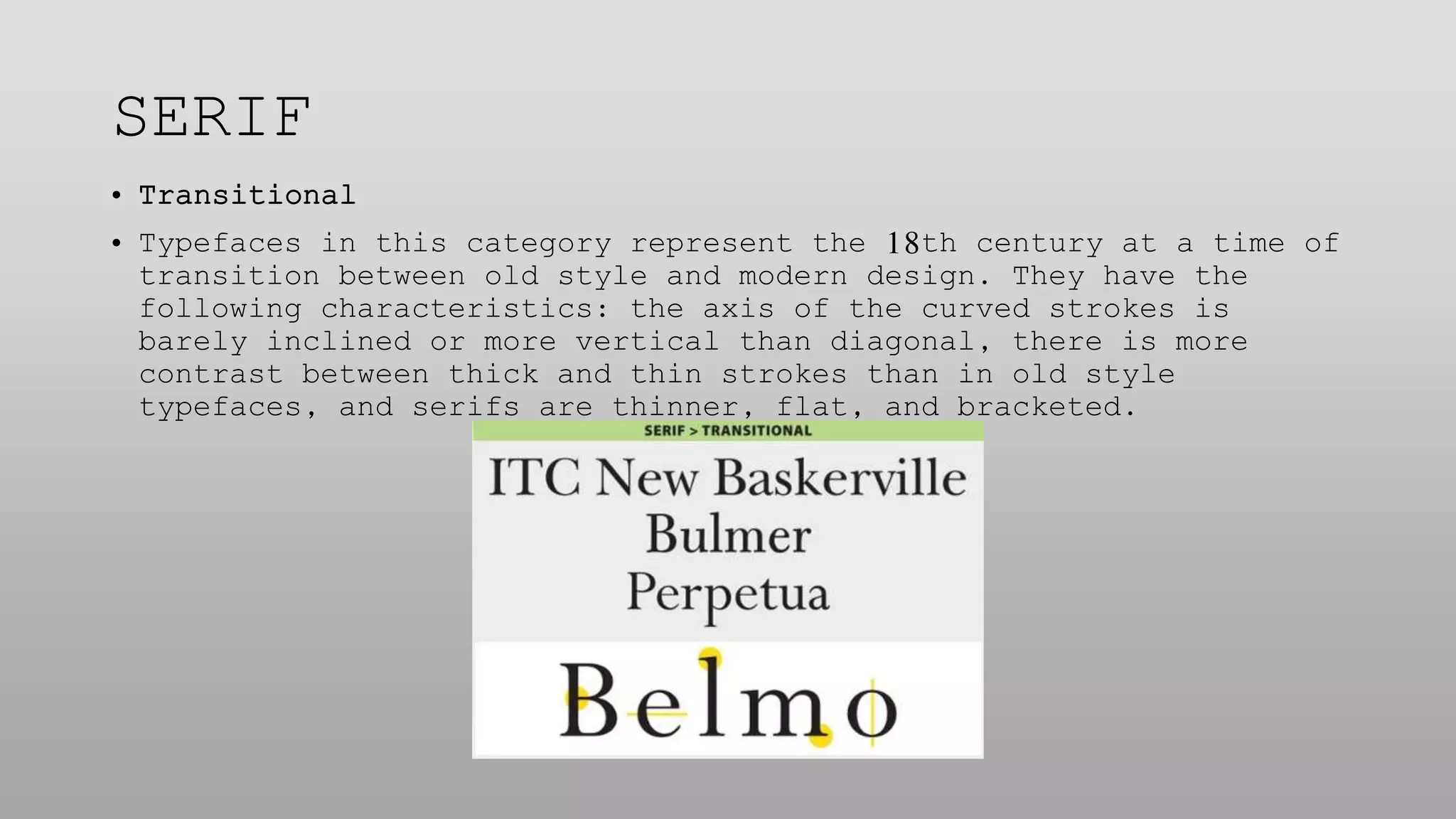
SERIF
• Transitional
• Typefaces in this category represent the 18th century at a time of
transition between old style and modern design. They have the
following characteristics: the axis of the curved strokes is
barely inclined or more vertical than diagonal, there is more
contrast between thick and thin strokes than in old style
typefaces, and serifs are thinner, flat, and bracketed.
SERIF
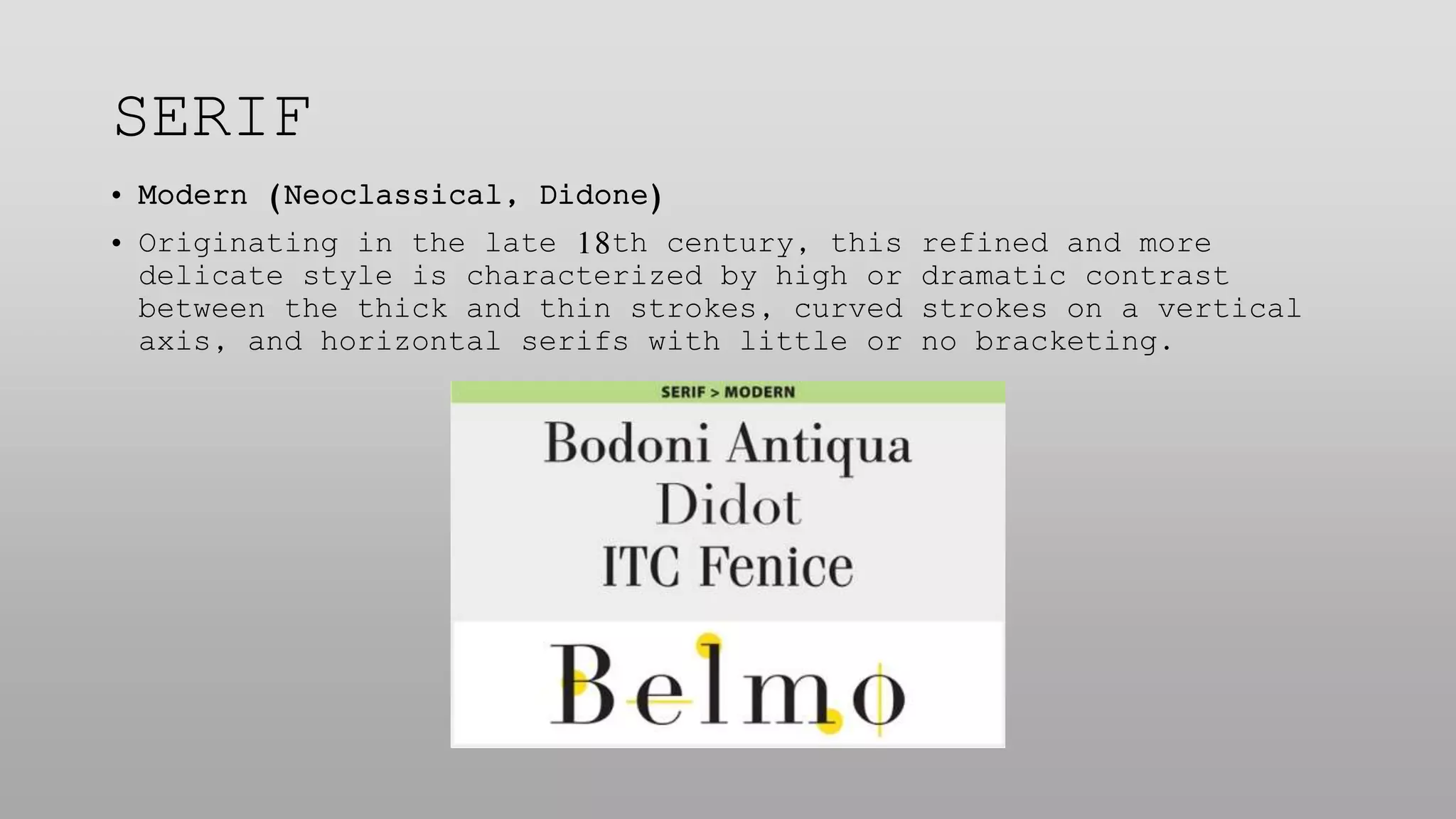
• Modern (Neoclassical, Didone)
• Originating in the late 18th century, this refined and more
delicate style is characterized by high or dramatic contrast
between the thick and thin strokes, curved strokes on a vertical
axis, and horizontal serifs with little or no bracketing.
SERIF
• Square Serif
• Typefaces belonging to this early 19th century style have very
heavy square serifs, little or no bracketing, and hardly any
stroke contrast. They are often geometric or square in style.
SERIF
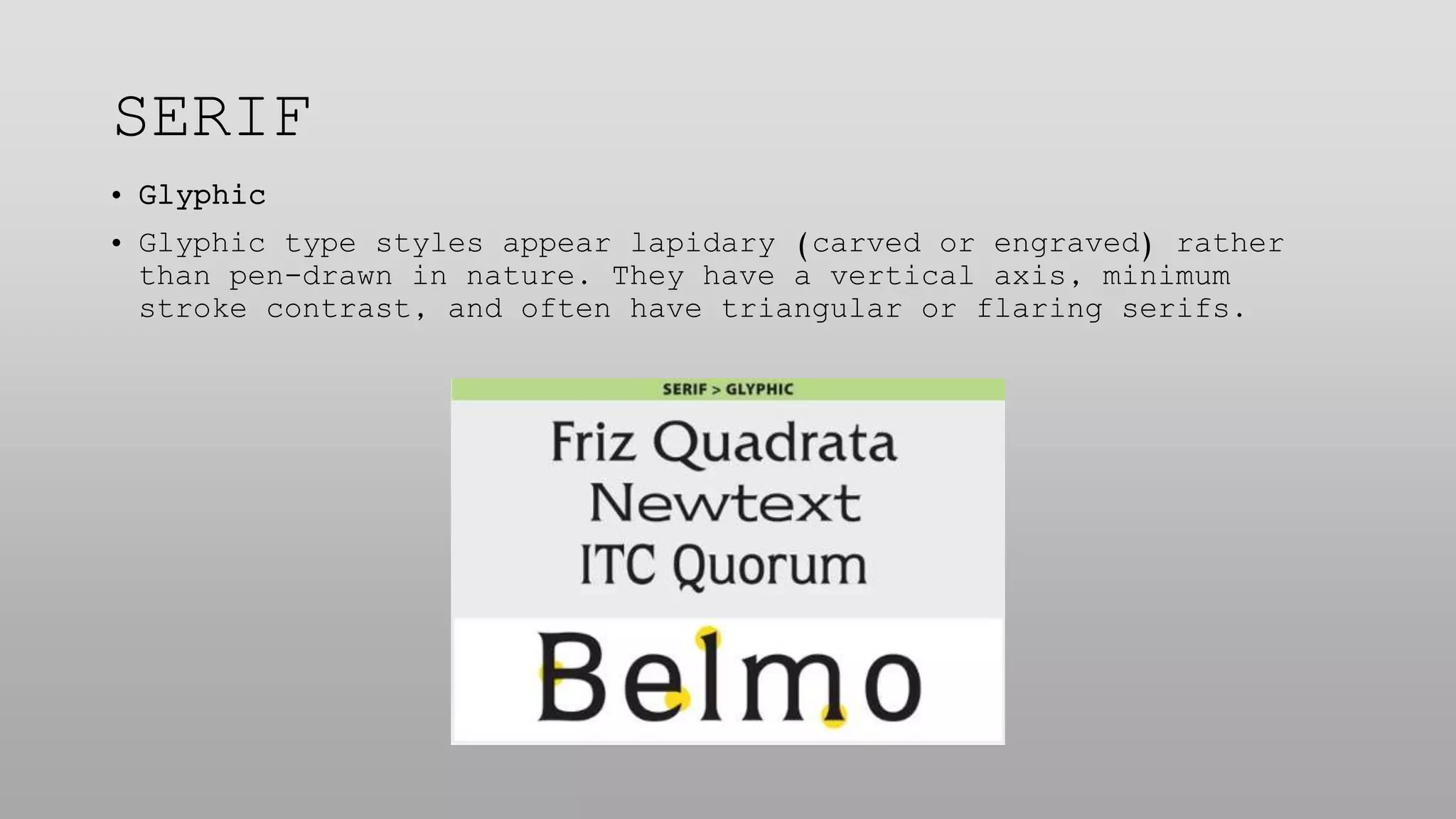
• Glyphic
• Glyphic type styles appear lapidary (carved or engraved) rather
than pen-drawn in nature. They have a vertical axis, minimum
stroke contrast, and often have triangular or flaring serifs.
SANS SERIF
• Grotesque
• This style was the first popular sans serif. Its distinguishing
features are slight contrast in stroke weight, a squared look to
some curves, a “spurred” capital G, and a double-bowl lowercase g.
Later versions lost their squared curve, and have a single-bowl
lowercase g.
SANS SERIF
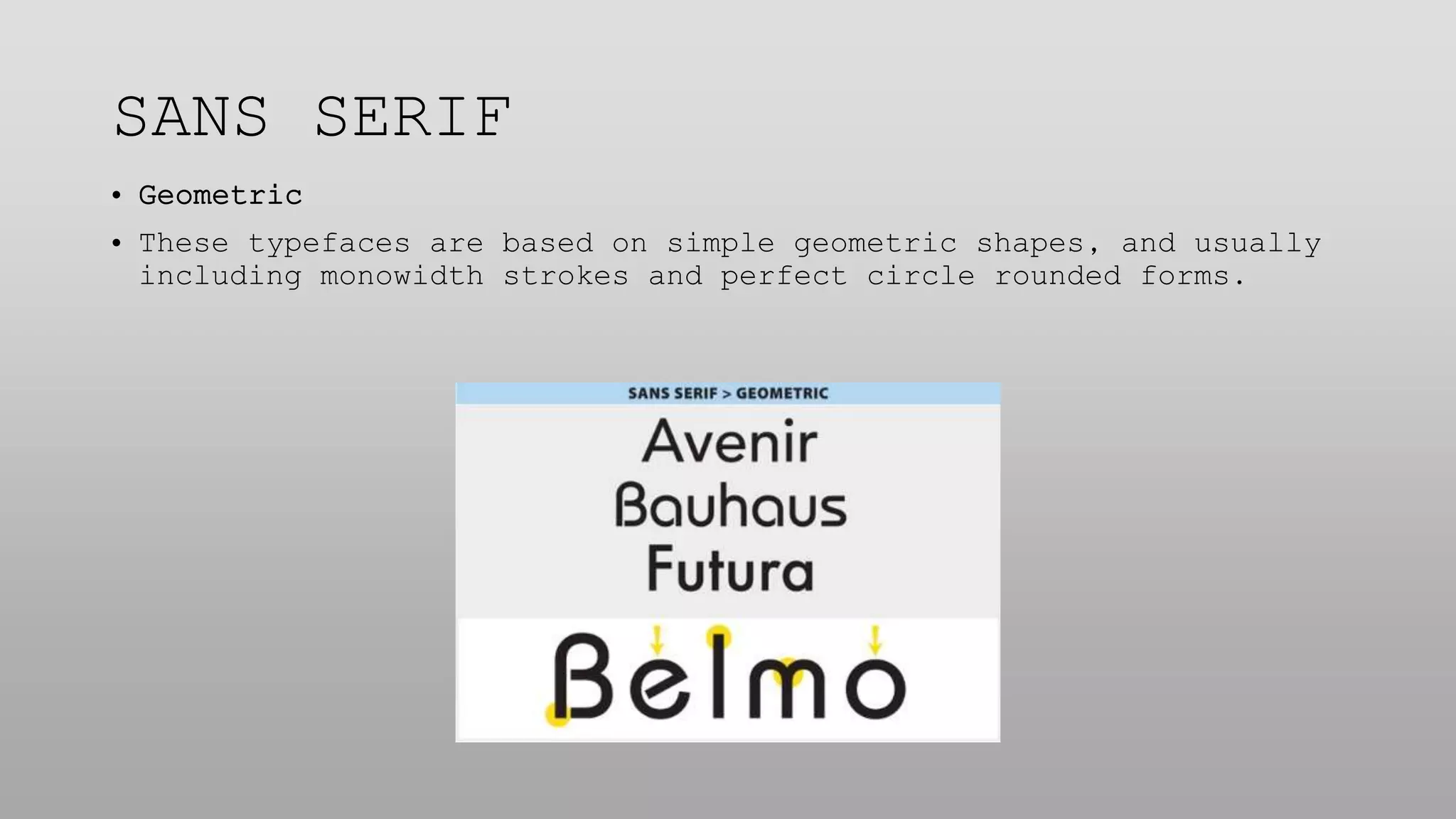
• Geometric
• These typefaces are based on simple geometric shapes, and usually
including monowidth strokes and perfect circle rounded forms.
SANS SERIF
• Humanistic
• Humanistic type styles were an attempt to improve the legibility
of sans serif designs by blending their structure with the
classical Roman form. More simply, they are based on the
proportions of Roman capitals and old style lowercase, with an
apparent stroke contrast, as well as a calligraphic influence.
SCRIPTS
• Formal
• These very elegant typestyles derived from the penmanship of the
17th century are characterized by flowing loops and flourishes
with graceful, rhythmic strokes. They are most often connecting
scripts.
SCRIPTS
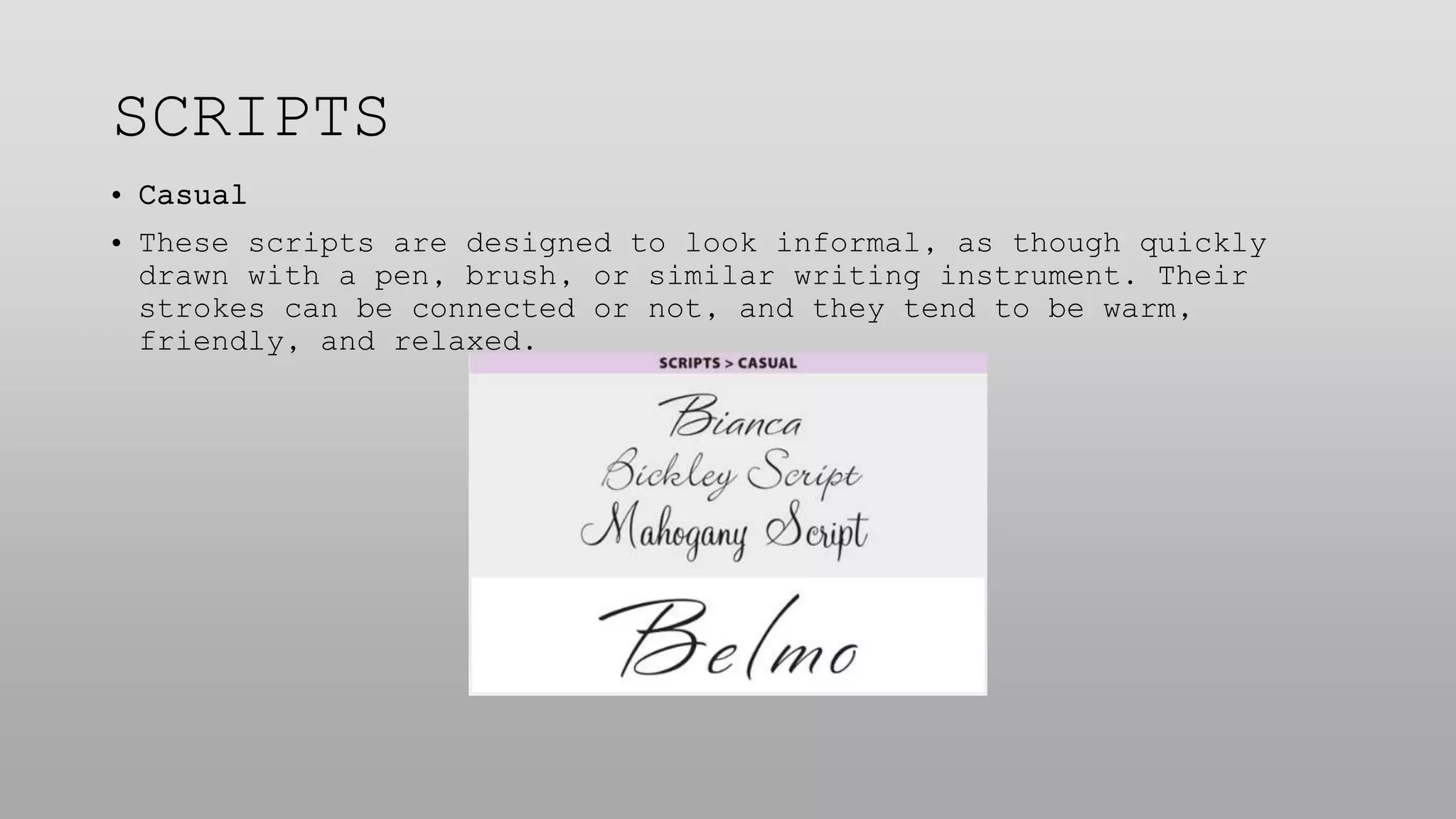
• Casual
• These scripts are designed to look informal, as though quickly
drawn with a pen, brush, or similar writing instrument. Their
strokes can be connected or not, and they tend to be warm,
friendly, and relaxed.
SCRIPTS
• Calligraphic
• This broad category of typestyles strives to imitate the writing
or lettering of the calligrapher, whose work is hand drawn for
each job. Calligraphic typestyles often look as if they were drawn
with flat-tipped pens or brushes, and they occasionally include
the drips, spots, blotches, and irregularities inherent in the
process. Their strokes can be connected or non-connected.
SCRIPTS
• Blackletter
• Blackletter type styles evolved from the early handwritten forms
of liturgical writings and illuminated manuscripts. This style
went from writing to typesetting when it was used to set the
Gutenberg Bible, the first book printed with movable type.
Blackletter typefaces are characterized by a dense, black texture,
and highly decorated caps. The lowercase consists of narrow,
angular forms with dramatic thick-to-thin strokes and serifs.
SCRIPTS
• Handwriting
• Handwriting typefaces are typographic interpretations of actual
handwriting or hand printing. The stylistic range is extremely
diverse and can be anything from a connected script or scrawl to a
quirky, bouncy, irregular hand printing.
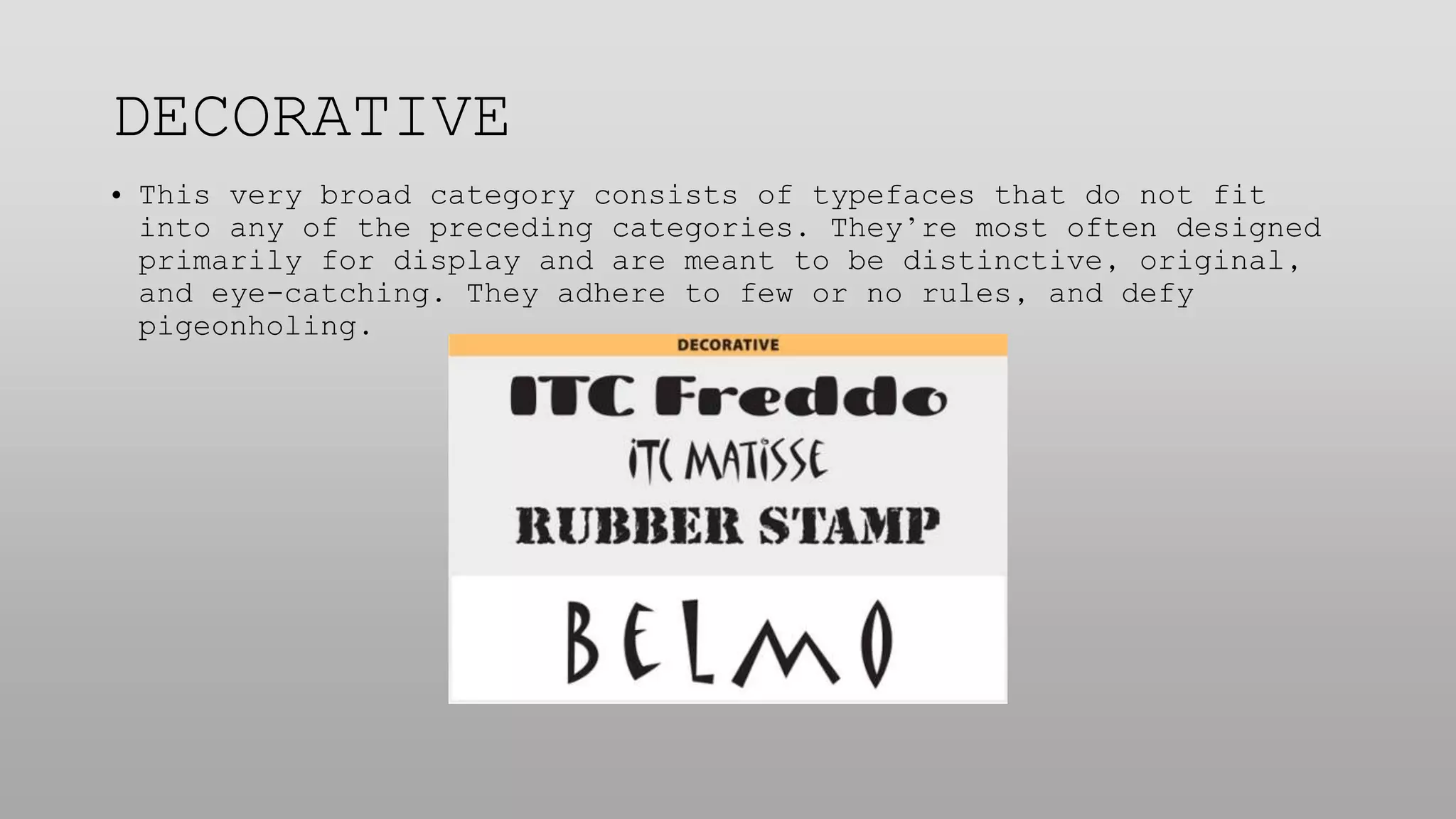
DECORATIVE
• This very broad category consists of typefaces that do not fit
into any of the preceding categories. They’re most often designed
primarily for display and are meant to be distinctive, original,
and eye-catching. They adhere to few or no rules, and defy
pigeonholing.
HISTORY OF
TYPOGRAPHY
Ancient Era – Saying it with
Pictures
• Ancient cave paintings that date back to 20,000
B.C. are perhaps the very first recorded
written communication. However, formal writing
is said to have been developed by the Sumerians
at around 3,500 B.C.
The Middle Ages – Handwritten
and Well-Illustrated
Manuscripts
• The Middle Ages were all about hand-written and
well-illustrated manuscripts. It led to the
evolution of a wide range of writing styles.
Unicals and half unicals were prominent
features, with rounded, elaborate lettering.
The art of Calligraphy along with page layout
and lettering forged new ground.
Gutenberg and Modern
Typography
• As we all learned in history class, the
development of moveable type and the printing
press in the 15th century by Johannes Gutenberg
was a turning point for the modern world—and,
of course, modern typography. During this time,
both practical and decorative typefaces
appeared en masse, along with a lighter, more
ordered page layout with subtle illustrations.
Shifting to the Present
• Graphic designers these days have the luxury of
endless tools and technology to create a wide
range of typographic styles and even entire
families of font families and typefaces. Armed
with the knowledge of typographic history,
graphic designers can expand their horizons and
enhance their skills to produce a much more
refined body of work.
THANK YOU
DE VERA, LANZ
DEL POSO, CEDRIC
DIZON, LAURENCE
MARINO, HAZEL
RUFF, SYLVIA
RUIZ, JOHN

Typography

  • 1.
  • 2.
    DEFINITION OF TYPOGRAPHY •it is the style or appearance of text. • it is the art of rearranging text to make it more readable, and more pleasing to the audience eyes. • this involves the typefaces, point size, leading, and kerning.
  • 3.
    HEIRARCHYused to guidethe reader's eye to whatever is most important
  • 4.
  • 5.
    TRACKINGThe overall spacebetween c h a r a c t e r s
  • 6.
    The space betweenspecific characters
  • 7.
  • 8.
  • 9.
  • 10.
  • 11.
  • 12.
  • 13.
  • 14.
  • 15.
  • 16.
  • 17.
  • 18.
  • 19.
  • 20.
  • 21.
  • 22.
  • 23.
    SERIF • Old Style •This category of typefaces originated between the late 15th and mid 18th century. It is characterized by curved glyphs with the axis inclined to the left, minimal contrast between thick-and-thin strokes, angled head serifs, and bracketed serifs (curves between the serif and the stem). Some typefaces in this category contain an e with a diagonal cross stroke.
  • 24.
    SERIF • Transitional • Typefacesin this category represent the 18th century at a time of transition between old style and modern design. They have the following characteristics: the axis of the curved strokes is barely inclined or more vertical than diagonal, there is more contrast between thick and thin strokes than in old style typefaces, and serifs are thinner, flat, and bracketed.
  • 25.
    SERIF • Modern (Neoclassical,Didone) • Originating in the late 18th century, this refined and more delicate style is characterized by high or dramatic contrast between the thick and thin strokes, curved strokes on a vertical axis, and horizontal serifs with little or no bracketing.
  • 26.
    SERIF • Square Serif •Typefaces belonging to this early 19th century style have very heavy square serifs, little or no bracketing, and hardly any stroke contrast. They are often geometric or square in style.
  • 27.
    SERIF • Glyphic • Glyphictype styles appear lapidary (carved or engraved) rather than pen-drawn in nature. They have a vertical axis, minimum stroke contrast, and often have triangular or flaring serifs.
  • 28.
    SANS SERIF • Grotesque •This style was the first popular sans serif. Its distinguishing features are slight contrast in stroke weight, a squared look to some curves, a “spurred” capital G, and a double-bowl lowercase g. Later versions lost their squared curve, and have a single-bowl lowercase g.
  • 29.
    SANS SERIF • Geometric •These typefaces are based on simple geometric shapes, and usually including monowidth strokes and perfect circle rounded forms.
  • 30.
    SANS SERIF • Humanistic •Humanistic type styles were an attempt to improve the legibility of sans serif designs by blending their structure with the classical Roman form. More simply, they are based on the proportions of Roman capitals and old style lowercase, with an apparent stroke contrast, as well as a calligraphic influence.
  • 31.
    SCRIPTS • Formal • Thesevery elegant typestyles derived from the penmanship of the 17th century are characterized by flowing loops and flourishes with graceful, rhythmic strokes. They are most often connecting scripts.
  • 32.
    SCRIPTS • Casual • Thesescripts are designed to look informal, as though quickly drawn with a pen, brush, or similar writing instrument. Their strokes can be connected or not, and they tend to be warm, friendly, and relaxed.
  • 33.
    SCRIPTS • Calligraphic • Thisbroad category of typestyles strives to imitate the writing or lettering of the calligrapher, whose work is hand drawn for each job. Calligraphic typestyles often look as if they were drawn with flat-tipped pens or brushes, and they occasionally include the drips, spots, blotches, and irregularities inherent in the process. Their strokes can be connected or non-connected.
  • 34.
    SCRIPTS • Blackletter • Blacklettertype styles evolved from the early handwritten forms of liturgical writings and illuminated manuscripts. This style went from writing to typesetting when it was used to set the Gutenberg Bible, the first book printed with movable type. Blackletter typefaces are characterized by a dense, black texture, and highly decorated caps. The lowercase consists of narrow, angular forms with dramatic thick-to-thin strokes and serifs.
  • 35.
    SCRIPTS • Handwriting • Handwritingtypefaces are typographic interpretations of actual handwriting or hand printing. The stylistic range is extremely diverse and can be anything from a connected script or scrawl to a quirky, bouncy, irregular hand printing.
  • 36.
    DECORATIVE • This verybroad category consists of typefaces that do not fit into any of the preceding categories. They’re most often designed primarily for display and are meant to be distinctive, original, and eye-catching. They adhere to few or no rules, and defy pigeonholing.
  • 37.
  • 38.
    Ancient Era –Saying it with Pictures • Ancient cave paintings that date back to 20,000 B.C. are perhaps the very first recorded written communication. However, formal writing is said to have been developed by the Sumerians at around 3,500 B.C.
  • 39.
    The Middle Ages– Handwritten and Well-Illustrated Manuscripts • The Middle Ages were all about hand-written and well-illustrated manuscripts. It led to the evolution of a wide range of writing styles. Unicals and half unicals were prominent features, with rounded, elaborate lettering. The art of Calligraphy along with page layout and lettering forged new ground.
  • 40.
    Gutenberg and Modern Typography •As we all learned in history class, the development of moveable type and the printing press in the 15th century by Johannes Gutenberg was a turning point for the modern world—and, of course, modern typography. During this time, both practical and decorative typefaces appeared en masse, along with a lighter, more ordered page layout with subtle illustrations.
  • 41.
    Shifting to thePresent • Graphic designers these days have the luxury of endless tools and technology to create a wide range of typographic styles and even entire families of font families and typefaces. Armed with the knowledge of typographic history, graphic designers can expand their horizons and enhance their skills to produce a much more refined body of work.
  • 42.
    THANK YOU DE VERA,LANZ DEL POSO, CEDRIC DIZON, LAURENCE MARINO, HAZEL RUFF, SYLVIA RUIZ, JOHN